OSCILLATOR
By.
Md. Faizan Ahmad
INTRODUCTION
 convert dc energy to ac energy at a very high frequency.
 If the feedback signal is large enough and has correct phase,
there will be an output signal even though there is no external
input signal.
 The criterion is that the signal fed back to the input of the
amplifier must be in phase. In-phase feedback is also called
positive feedback, or regenerative feedback.
 It is an unstable amplifier.
 Electronic oscillators are divided into:
 Sinusoidal (or harmonic) oscillators-which produce
an output having sine waveform
 Non-sinusoidal (or relaxation) oscillator-the output is
square, rectangular or saw-tooth or pulse shape.
 Oscillators are widely applied in many digital devices,
Signal generator, Touch-tone telephone, musical
instrument and radio/television transmitter and etc.
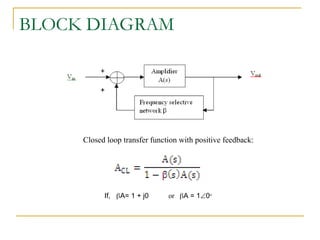
BLOCK DIAGRAM
Closed loop transfer function with positive feedback:
If, A= 1 + j0 or A = 10o
 Barkhausen criterion :
 The feedback factor or loop gain . The gain is
infinite, this represent the condition for oscillation.

The net phase shift around the loop 0˚ (or an
integral multiple of 360˚ ). In other word, feedback
should be positive.
 The amplifier gain must be greater than the loss in
the feedback path.
OSCILLATOR CONDITION
 A less than 1
AVin is less than Vin the output signal will die out
(Damped Oscillation).
 A greater than 1
AVin is greater than Vin the output signal will build
up.
 A equal to 1
AVin is equal to Vin the output signal will steady,
Undamped Oscillations (Stable oscillator).
TYPE OF OSCILLATOR
 LC
 Hartley
 Colpitt’s
 Crystal
 Amstrong
 RC
 Phase Shift (RC)
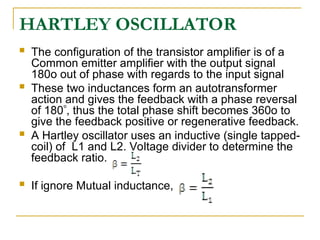
 The configuration of the transistor amplifier is of a
Common emitter amplifier with the output signal
180o out of phase with regards to the input signal
 These two inductances form an autotransformer
action and gives the feedback with a phase reversal
of 180, thus the total phase shift becomes 360o to
give the feedback positive or regenerative feedback.
 A Hartley oscillator uses an inductive (single tapped-
coil) of L1 and L2. Voltage divider to determine the
feedback ratio.
 If ignore Mutual inductance,
HARTLEY OSCILLATOR
 When the LC tank is resonant, the circulating current flows through L1 in series
with L2. The equivalent L to use in equation is:
 L T = L1 + L2 +2M or L T  L1 + L2
 L1 ,is a primary
 L2 ,is the secondary
 M, Mutual inductance between the coils.
 The tuning capacitor CT allows the Hartley oscillator to be tuned over a wide
range of frequency
 The lowest frequency is determined by the maximum capacitance of CT or
otherwise.
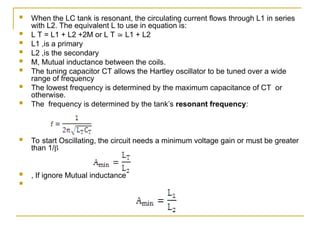
 The frequency is determined by the tank’s resonant frequency:
 To start Oscillating, the circuit needs a minimum voltage gain or must be greater
than 1/
 , If ignore Mutual inductance

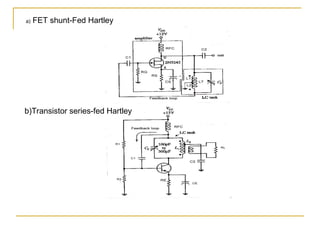
a) FET shunt-Fed Hartley
b)Transistor series-fed Hartley
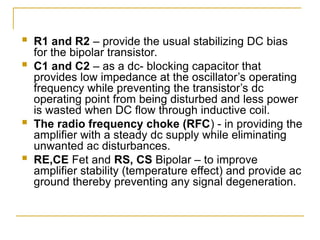
 R1 and R2 – provide the usual stabilizing DC bias
for the bipolar transistor.
 C1 and C2 – as a dc- blocking capacitor that
provides low impedance at the oscillator’s operating
frequency while preventing the transistor’s dc
operating point from being disturbed and less power
is wasted when DC flow through inductive coil.
 The radio frequency choke (RFC) - in providing the
amplifier with a steady dc supply while eliminating
unwanted ac disturbances.
 RE,CE Fet and RS, CS Bipolar – to improve
amplifier stability (temperature effect) and provide ac
ground thereby preventing any signal degeneration.
COLPITTS OSCILLATOR
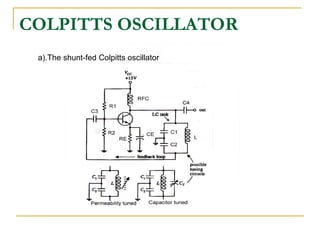
a).The shunt-fed Colpitts oscillator
 The Colpitts oscillator is adaptable to a wide range of
frequencies and has better stability than the Hartley.
 The configuration of the transistor amplifier is of a Common
emitter amplifier with the output signal 180o out of phase with
regards to the input signal.
 The additional 180o phase shift required for oscillation is
achieved by the fact the two capacitors are connected together in
series but parallel with the inductive coil resulting in overall
phase shift of the circuit being zero or 360o.
 R1 and R2 stabilizing DC bias for the transistor. While C1 and
C2 acts as DC-blocking capacitor
 To start-up and oscillate at the proper frequency, the voltage
gain of the circuit must meet or exceed the Barkhausen criterion,
to start.
A ≥ 1
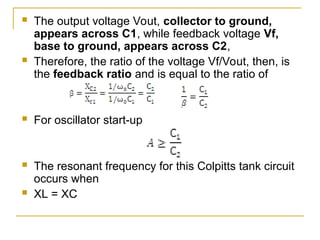
 The output voltage Vout, collector to ground,
appears across C1, while feedback voltage Vf,
base to ground, appears across C2,
 Therefore, the ratio of the voltage Vf/Vout, then, is
the feedback ratio and is equal to the ratio of
 For oscillator start-up
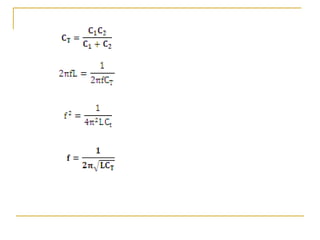
 The resonant frequency for this Colpitts tank circuit
occurs when
 XL = XC
PHASE SHIFT OSCILLATOR
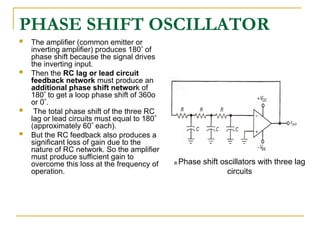
 The amplifier (common emitter or
inverting amplifier) produces 180 of
phase shift because the signal drives
the inverting input.
 Then the RC lag or lead circuit
feedback network must produce an
additional phase shift network of
180 to get a loop phase shift of 360o
or 0.
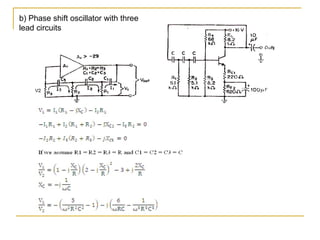
 The total phase shift of the three RC
lag or lead circuits must equal to 180
(approximately 60 each).
 But the RC feedback also produces a
significant loss of gain due to the
nature of RC network. So the amplifier
must produce sufficient gain to
overcome this loss at the frequency of
operation.
a.Phase shift oscillators with three lag
circuits
b) Phase shift oscillator with three
lead circuits
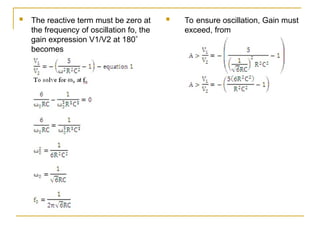
 The reactive term must be zero at
the frequency of oscillation fo, the
gain expression V1/V2 at 180
becomes
 To ensure oscillation, Gain must
exceed, from
AMSTRONG OSCILLATOR
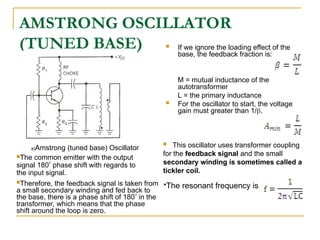
(TUNED BASE)  If we ignore the loading effect of the
base, the feedback fraction is:
M = mutual inductance of the
autotransformer
L = the primary inductance
 For the oscillator to start, the voltage
gain must greater than 1/.
a)Amstrong (tuned base) Oscillator
The common emitter with the output
signal 180 phase shift with regards to
the input signal.
 This oscillator uses transformer coupling
for the feedback signal and the small
secondary winding is sometimes called a
tickler coil.
The resonant frequency is
Therefore, the feedback signal is taken from
a small secondary winding and fed back to
the base, there is a phase shift of 180 in the
transformer, which means that the phase
shift around the loop is zero.
CRYSTAL
 The main substances that produce the piezoelectric
effect are quartz (RF oscillator and filters), Rochelle
salts and tourmaline.
 If a high degree of oscillator stability is needed such
as communication and computer systems, the
crystal oscillator are used to generate the timing
signal because the Crystal-controlled oscillators will
typically have a minimum frequency drift of
0.0001%.
 A crystal is used as a frequency determining device
and can act in both series and parallel tuned circuit.
 Crystal used in oscillator circuits are thin sheet, or
wafer, cut from natural or synthetic quartz and
ground to a specific thickness to obtain the desired
resonant frequency.
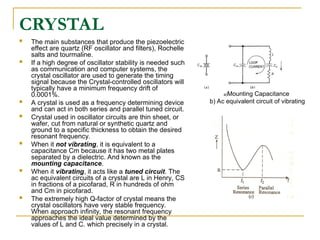
 When it not vibrating, it is equivalent to a
capacitance Cm because it has two metal plates
separated by a dielectric. And known as the
mounting capacitance.
 When it vibrating, it acts like a tuned circuit. The
ac equivalent circuits of a crystal are L in Henry, CS
in fractions of a picofarad, R in hundreds of ohm
and Cm in picofarad.
 The extremely high Q-factor of crystal means the
crystal oscillators have very stable frequency.
When approach infinity, the resonant frequency
approaches the ideal value determined by the
values of L and C. which precisely in a crystal.
a)Mounting Capacitance
b) Ac equivalent circuit of vibrating
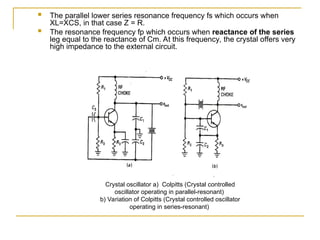
 The parallel lower series resonance frequency fs which occurs when
XL=XCS, in that case Z = R.
 The resonance frequency fp which occurs when reactance of the series
leg equal to the reactance of Cm. At this frequency, the crystal offers very
high impedance to the external circuit.
Crystal oscillator a) Colpitts (Crystal controlled
oscillator operating in parallel-resonant)
b) Variation of Colpitts (Crystal controlled oscillator
operating in series-resonant)
SERIES AND PARALLEL
RESONANCE
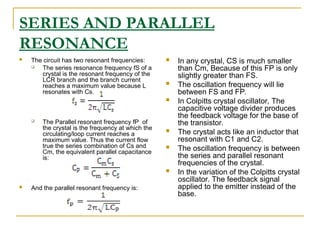
 The circuit has two resonant frequencies:
 The series resonance frequency fS of a
crystal is the resonant frequency of the
LCR branch and the branch current
reaches a maximum value because L
resonates with Cs.
 The Parallel resonant frequency fP of
the crystal is the frequency at which the
circulating/loop current reaches a
maximum value. Thus the current flow
true the series combination of Cs and
Cm, the equivalent parallel capacitance
is:
 And the parallel resonant frequency is:
 In any crystal, CS is much smaller
than Cm, Because of this FP is only
slightly greater than FS.
 The oscillation frequency will lie
between FS and FP.
 In Colpitts crystal oscillator, The
capacitive voltage divider produces
the feedback voltage for the base of
the transistor.
 The crystal acts like an inductor that
resonant with C1 and C2.
 The oscillation frequency is between
the series and parallel resonant
frequencies of the crystal.
 In the variation of the Colpitts crystal
oscillator. The feedback signal
applied to the emitter instead of the
base.
THANK YOU

Basic Oscillator Functioning and types.ppt

  • 1.
  • 2.
    INTRODUCTION  convert dcenergy to ac energy at a very high frequency.  If the feedback signal is large enough and has correct phase, there will be an output signal even though there is no external input signal.  The criterion is that the signal fed back to the input of the amplifier must be in phase. In-phase feedback is also called positive feedback, or regenerative feedback.  It is an unstable amplifier.
  • 3.
     Electronic oscillatorsare divided into:  Sinusoidal (or harmonic) oscillators-which produce an output having sine waveform  Non-sinusoidal (or relaxation) oscillator-the output is square, rectangular or saw-tooth or pulse shape.  Oscillators are widely applied in many digital devices, Signal generator, Touch-tone telephone, musical instrument and radio/television transmitter and etc.
  • 4.
    BLOCK DIAGRAM Closed looptransfer function with positive feedback: If, A= 1 + j0 or A = 10o
  • 5.
     Barkhausen criterion:  The feedback factor or loop gain . The gain is infinite, this represent the condition for oscillation.  The net phase shift around the loop 0˚ (or an integral multiple of 360˚ ). In other word, feedback should be positive.  The amplifier gain must be greater than the loss in the feedback path.
  • 6.
    OSCILLATOR CONDITION  Aless than 1 AVin is less than Vin the output signal will die out (Damped Oscillation).  A greater than 1 AVin is greater than Vin the output signal will build up.  A equal to 1 AVin is equal to Vin the output signal will steady, Undamped Oscillations (Stable oscillator).
  • 7.
    TYPE OF OSCILLATOR LC  Hartley  Colpitt’s  Crystal  Amstrong  RC  Phase Shift (RC)
  • 8.
     The configurationof the transistor amplifier is of a Common emitter amplifier with the output signal 180o out of phase with regards to the input signal  These two inductances form an autotransformer action and gives the feedback with a phase reversal of 180, thus the total phase shift becomes 360o to give the feedback positive or regenerative feedback.  A Hartley oscillator uses an inductive (single tapped- coil) of L1 and L2. Voltage divider to determine the feedback ratio.  If ignore Mutual inductance, HARTLEY OSCILLATOR
  • 9.
     When theLC tank is resonant, the circulating current flows through L1 in series with L2. The equivalent L to use in equation is:  L T = L1 + L2 +2M or L T  L1 + L2  L1 ,is a primary  L2 ,is the secondary  M, Mutual inductance between the coils.  The tuning capacitor CT allows the Hartley oscillator to be tuned over a wide range of frequency  The lowest frequency is determined by the maximum capacitance of CT or otherwise.  The frequency is determined by the tank’s resonant frequency:  To start Oscillating, the circuit needs a minimum voltage gain or must be greater than 1/  , If ignore Mutual inductance 
  • 10.
    a) FET shunt-FedHartley b)Transistor series-fed Hartley
  • 11.
     R1 andR2 – provide the usual stabilizing DC bias for the bipolar transistor.  C1 and C2 – as a dc- blocking capacitor that provides low impedance at the oscillator’s operating frequency while preventing the transistor’s dc operating point from being disturbed and less power is wasted when DC flow through inductive coil.  The radio frequency choke (RFC) - in providing the amplifier with a steady dc supply while eliminating unwanted ac disturbances.  RE,CE Fet and RS, CS Bipolar – to improve amplifier stability (temperature effect) and provide ac ground thereby preventing any signal degeneration.
  • 12.
  • 13.
     The Colpittsoscillator is adaptable to a wide range of frequencies and has better stability than the Hartley.  The configuration of the transistor amplifier is of a Common emitter amplifier with the output signal 180o out of phase with regards to the input signal.  The additional 180o phase shift required for oscillation is achieved by the fact the two capacitors are connected together in series but parallel with the inductive coil resulting in overall phase shift of the circuit being zero or 360o.  R1 and R2 stabilizing DC bias for the transistor. While C1 and C2 acts as DC-blocking capacitor  To start-up and oscillate at the proper frequency, the voltage gain of the circuit must meet or exceed the Barkhausen criterion, to start. A ≥ 1
  • 14.
     The outputvoltage Vout, collector to ground, appears across C1, while feedback voltage Vf, base to ground, appears across C2,  Therefore, the ratio of the voltage Vf/Vout, then, is the feedback ratio and is equal to the ratio of  For oscillator start-up  The resonant frequency for this Colpitts tank circuit occurs when  XL = XC
  • 16.
    PHASE SHIFT OSCILLATOR The amplifier (common emitter or inverting amplifier) produces 180 of phase shift because the signal drives the inverting input.  Then the RC lag or lead circuit feedback network must produce an additional phase shift network of 180 to get a loop phase shift of 360o or 0.  The total phase shift of the three RC lag or lead circuits must equal to 180 (approximately 60 each).  But the RC feedback also produces a significant loss of gain due to the nature of RC network. So the amplifier must produce sufficient gain to overcome this loss at the frequency of operation. a.Phase shift oscillators with three lag circuits
  • 17.
    b) Phase shiftoscillator with three lead circuits
  • 18.
     The reactiveterm must be zero at the frequency of oscillation fo, the gain expression V1/V2 at 180 becomes  To ensure oscillation, Gain must exceed, from
  • 19.
    AMSTRONG OSCILLATOR (TUNED BASE) If we ignore the loading effect of the base, the feedback fraction is: M = mutual inductance of the autotransformer L = the primary inductance  For the oscillator to start, the voltage gain must greater than 1/. a)Amstrong (tuned base) Oscillator The common emitter with the output signal 180 phase shift with regards to the input signal.  This oscillator uses transformer coupling for the feedback signal and the small secondary winding is sometimes called a tickler coil. The resonant frequency is Therefore, the feedback signal is taken from a small secondary winding and fed back to the base, there is a phase shift of 180 in the transformer, which means that the phase shift around the loop is zero.
  • 20.
    CRYSTAL  The mainsubstances that produce the piezoelectric effect are quartz (RF oscillator and filters), Rochelle salts and tourmaline.  If a high degree of oscillator stability is needed such as communication and computer systems, the crystal oscillator are used to generate the timing signal because the Crystal-controlled oscillators will typically have a minimum frequency drift of 0.0001%.  A crystal is used as a frequency determining device and can act in both series and parallel tuned circuit.  Crystal used in oscillator circuits are thin sheet, or wafer, cut from natural or synthetic quartz and ground to a specific thickness to obtain the desired resonant frequency.  When it not vibrating, it is equivalent to a capacitance Cm because it has two metal plates separated by a dielectric. And known as the mounting capacitance.  When it vibrating, it acts like a tuned circuit. The ac equivalent circuits of a crystal are L in Henry, CS in fractions of a picofarad, R in hundreds of ohm and Cm in picofarad.  The extremely high Q-factor of crystal means the crystal oscillators have very stable frequency. When approach infinity, the resonant frequency approaches the ideal value determined by the values of L and C. which precisely in a crystal. a)Mounting Capacitance b) Ac equivalent circuit of vibrating
  • 21.
     The parallellower series resonance frequency fs which occurs when XL=XCS, in that case Z = R.  The resonance frequency fp which occurs when reactance of the series leg equal to the reactance of Cm. At this frequency, the crystal offers very high impedance to the external circuit. Crystal oscillator a) Colpitts (Crystal controlled oscillator operating in parallel-resonant) b) Variation of Colpitts (Crystal controlled oscillator operating in series-resonant)
  • 22.
    SERIES AND PARALLEL RESONANCE The circuit has two resonant frequencies:  The series resonance frequency fS of a crystal is the resonant frequency of the LCR branch and the branch current reaches a maximum value because L resonates with Cs.  The Parallel resonant frequency fP of the crystal is the frequency at which the circulating/loop current reaches a maximum value. Thus the current flow true the series combination of Cs and Cm, the equivalent parallel capacitance is:  And the parallel resonant frequency is:  In any crystal, CS is much smaller than Cm, Because of this FP is only slightly greater than FS.  The oscillation frequency will lie between FS and FP.  In Colpitts crystal oscillator, The capacitive voltage divider produces the feedback voltage for the base of the transistor.  The crystal acts like an inductor that resonant with C1 and C2.  The oscillation frequency is between the series and parallel resonant frequencies of the crystal.  In the variation of the Colpitts crystal oscillator. The feedback signal applied to the emitter instead of the base.
  • 23.