2. 1.History
2.What Is Synchrotron?
3.How a Synchrotron Works?
4.Why Synchrotron?
5.Applications.
3. Edwin McMillan constructed the first electron
synchrotron in 1945
The first proton synchrotron was designed by Sir
Marcus Oliphant and built in 1952.
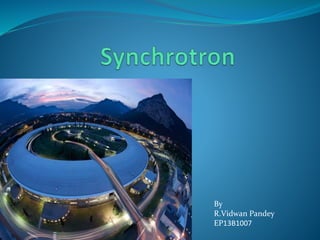
4. Synchrotron is a particular type of cyclic
particle accelerator that produces very bright
light.
Synchrotron light (also known as synchrotron
radiation) is electromagnetic radiation that is
emitted when charged particles moving at close to
the speed of light are forced to change direction
by a magnetic field
5. It produces not only visible light, but also infrared
light, ultraviolet light and X-rays.
The Light produced by synchrotrons are about
100 million times brighter than the X-rays
produced by an X-ray machine in a hospital.
There are more than 50 synchrotron light
sources around the world.
6. The Canadian Light Source has
4 Components :-
1.E-Gun & Linear Accelerator.
2.Booster Ring.
3.Storage Ring.
4.Beamlines & End Stations
7.
8. E-gun uses 220,000 v DC power to heat up a
tungsten oxide “button” which emits a small
stream of electrons into a vacuum tube.
These electrons are sped up in the linear
accelerator to nearly the speed of light.
9. The beam of electrons that enters the
booster ring is roughly the same thickness
as a human hair.
This Booster Ring is surrounded with
magnets that will accelerate the power of
electron stream.
10.
11. The result of these manipulations is extremely
brilliant light called Synchrotron Light.
The Electron Circulate around the Storage Ring
are passed through wigglers and undulators to
release Intense electromagnetic waves.
13. Beams of synchrotron light are filtered to
select the appropriate wavelength to answer
specific questions.
Scientists can observe the interaction
between the light and the molecules in
samples.
Incredible amounts of data can be recorded
from these experiments.
14. Synchrotrons produce extremely brilliant light:-
providing molecular level images
extensive chemical information
allows advanced technology microscopes
15. It Has Huge applications:-
•Materials engineering(ceramic coating)