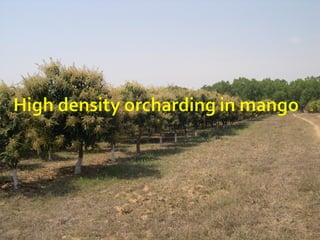
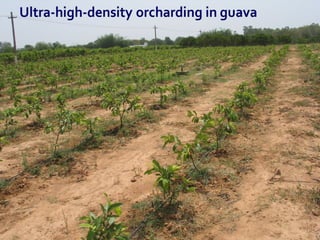
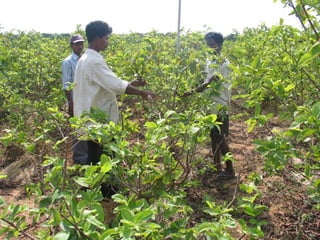
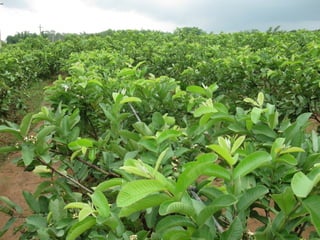
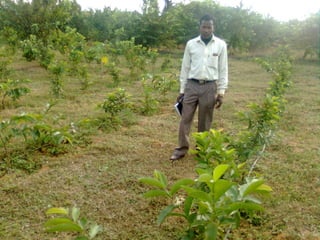
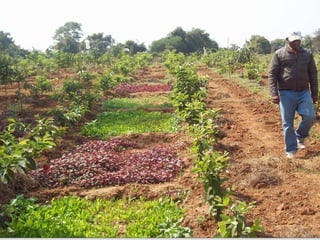
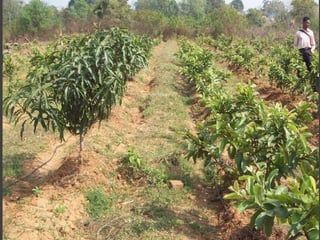
High density orcharding in fruit
crops
 High density orcharding is the practice of
accommodating higher number of plants of
the same species per unit area by planting at
a closer spacing than that is planted under
traditional system.
 Increased sunlight capture per unit area
 Land use efficiency
 Appropriate vegetative reproductive balance
of the plants.
 Low vegetative growth
 Low productivity per plant
 Planting system
 Canopy management
 Use of dwarfing rootstock/Interstock
 Training
 Shoot pruning
 Root pruning
 Use of growth regulators
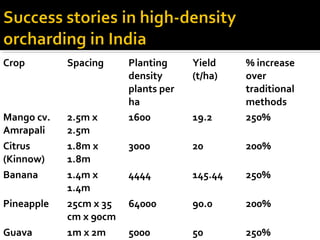
Crop Spacing Planting
density
plants per
ha
Yield
(t/ha)
% increase
over
traditional
methods
Mango cv.
Amrapali
2.5m x
2.5m
1600 19.2 250%
Citrus
(Kinnow)
1.8m x
1.8m
3000 20 200%
Banana 1.4m x
1.4m
4444 145.44 250%
Pineapple 25cm x 35
cm x 90cm
64000 90.0 200%
Guava 1m x 2m 5000 50 250%
Experiences at B P S A C on high density
orcharding in fruit crops
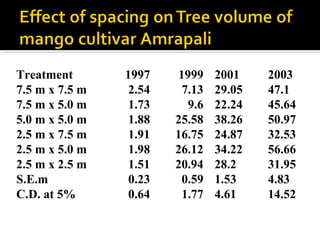
Treatment 1997 1999 2001 2003
7.5 m x 7.5 m 2.54 7.13 29.05 47.1
7.5 m x 5.0 m 1.73 9.6 22.24 45.64
5.0 m x 5.0 m 1.88 25.58 38.26 50.97
2.5 m x 7.5 m 1.91 16.75 24.87 32.53
2.5 m x 5.0 m 1.98 26.12 34.22 56.66
2.5 m x 2.5 m 1.51 20.94 28.2 31.95
S.E.m 0.23 0.59 1.53 4.83
C.D. at 5% 0.64 1.77 4.61 14.52
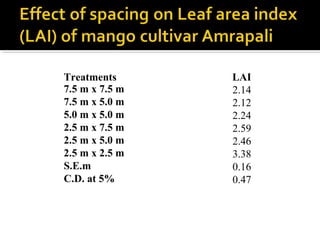
Treatments LAI
7.5 m x 7.5 m 2.14
7.5 m x 5.0 m 2.12
5.0 m x 5.0 m 2.24
2.5 m x 7.5 m 2.59
2.5 m x 5.0 m 2.46
2.5 m x 2.5 m 3.38
S.E.m 0.16
C.D. at 5% 0.47
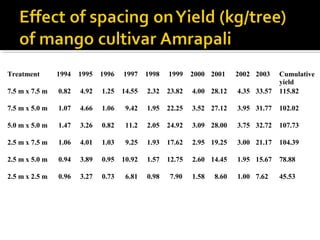
Treatment 1994 1995 1996 1997 1998 1999 2000 2001 2002 2003 Cumulative
yield
7.5 m x 7.5 m 0.82 4.92 1.25 14.55 2.32 23.82 4.00 28.12 4.35 33.57 115.82
7.5 m x 5.0 m 1.07 4.66 1.06 9.42 1.95 22.25 3.52 27.12 3.95 31.77 102.02
5.0 m x 5.0 m 1.47 3.26 0.82 11.2 2.05 24.92 3.09 28.00 3.75 32.72 107.73
2.5 m x 7.5 m 1.06 4.01 1.03 9.25 1.93 17.62 2.95 19.25 3.00 21.17 104.39
2.5 m x 5.0 m 0.94 3.89 0.95 10.92 1.57 12.75 2.60 14.45 1.95 15.67 78.88
2.5 m x 2.5 m 0.96 3.27 0.73 6.81 0.98 7.90 1.58 8.60 1.00 7.62 45.53
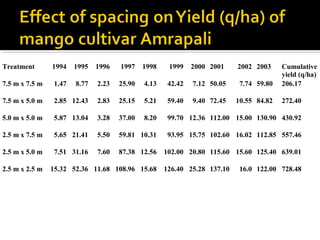
Treatment 1994 1995 1996 1997 1998 1999 2000 2001 2002 2003 Cumulative
yield (q/ha)
7.5 m x 7.5 m 1.47 8.77 2.23 25.90 4.13 42.42 7.12 50.05 7.74 59.80 206.17
7.5 m x 5.0 m 2.85 12.43 2.83 25.15 5.21 59.40 9.40 72.45 10.55 84.82 272.40
5.0 m x 5.0 m 5.87 13.04 3.28 37.00 8.20 99.70 12.36 112.00 15.00 130.90 430.92
2.5 m x 7.5 m 5.65 21.41 5.50 59.81 10.31 93.95 15.75 102.60 16.02 112.85 557.46
2.5 m x 5.0 m 7.51 31.16 7.60 87.38 12.56 102.00 20.80 115.60 15.60 125.40 639.01
2.5 m x 2.5 m 15.32 52.36 11.68 108.96 15.68 126.40 25.28 137.10 16.0 122.00 728.48
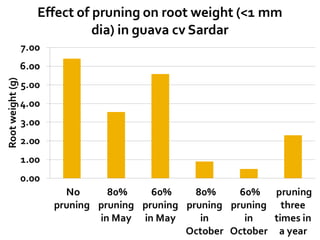
 Severe pruning in alternate rows every three
years
 Possible strategy
 Planting at a spacing of 5 m x 5 m
 Shoot pruning in alternate years when fruiting is
not expected
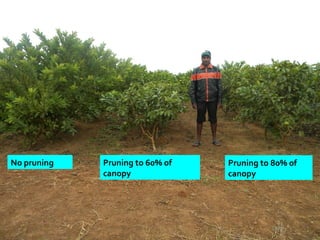
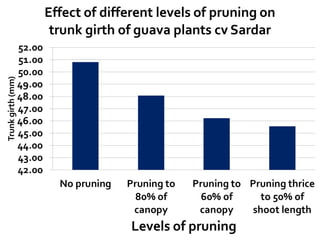
No pruning Pruning to 60% of
canopy
Pruning to 80% of
canopy
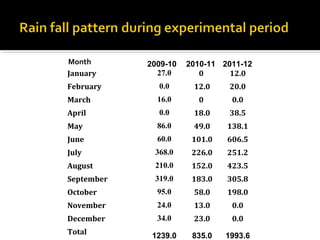
Month 2009-10 2010-11 2011-12
January 27.0 0  12.0
February 0.0 12.0 20.0
March 16.0 0  0.0
April 0.0 18.0 38.5
May 86.0 49.0 138.1
June 60.0 101.0 606.5
July 368.0 226.0 251.2
August 210.0 152.0 423.5
September 319.0 183.0 305.8
October 95.0 58.0 198.0
November 24.0 13.0 0.0
December 34.0 23.0 0.0
Total 1239.0 835.0 1993.6
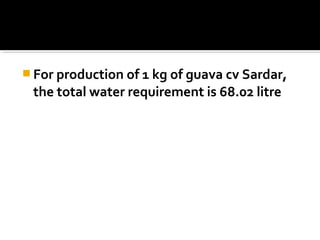
 For production of 1 kg of guava cv Sardar,
the total water requirement is 68.02 litre
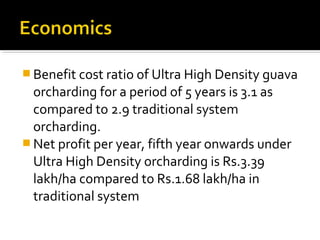
 Benefit cost ratio of Ultra High Density guava
orcharding for a period of 5 years is 3.1 as
compared to 2.9 traditional system
orcharding.
 Net profit per year, fifth year onwards under
Ultra High Density orcharding is Rs.3.39
lakh/ha compared to Rs.1.68 lakh/ha in
traditional system
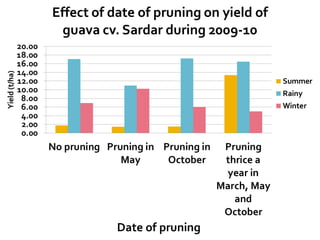
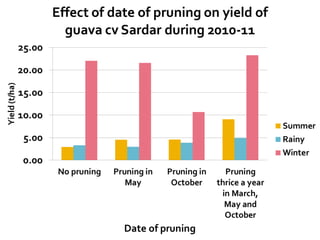
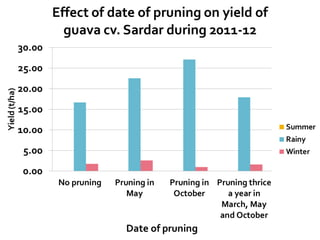
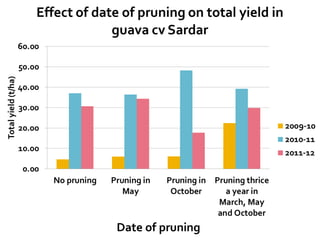
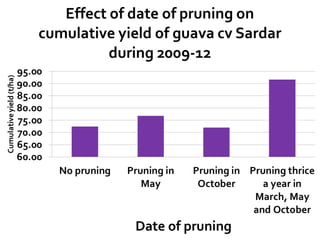
 Keeping in view yield and gross income,
pruning of guava plants thrice a year viz.
March, May and October to 50% of shoot
length can be recommended for
maximization of income from Ultra-high
density guava orchard growing under Bihar
conditions.
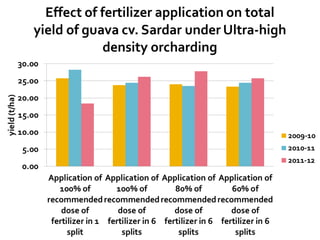
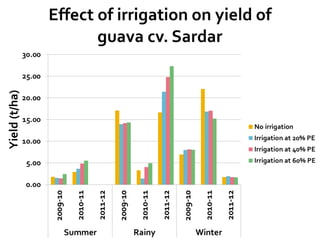
 Application of 60% of recommended dose
of fertilizer and irrigation at 60% PE was
found to be most suitable
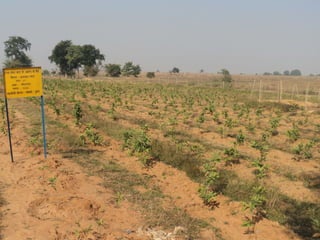
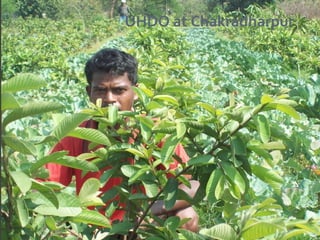
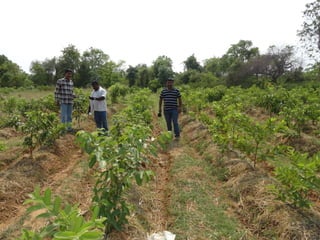
UHDO at Chakradharpur
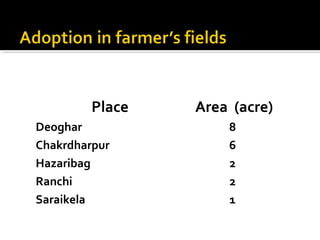
Place Area (acre)
Deoghar 8
Chakrdharpur 6
Hazaribag 2
Ranchi 2
Saraikela 1
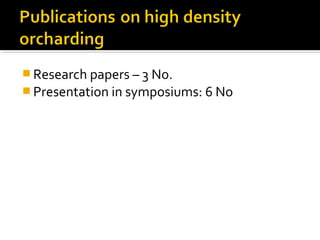
 Research papers – 3 No.
 Presentation in symposiums: 6 No
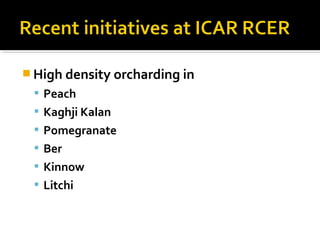
 High density orcharding in
 Peach
 Kaghji Kalan
 Pomegranate
 Ber
 Kinnow
 Litchi
 Fine-tuning canopy management
strategies
 Standardization of nutrient and water
management strategies
High density orcharding in fruit crops.

High density orcharding in fruit crops.

  • 1.
  • 2.
     High densityorcharding is the practice of accommodating higher number of plants of the same species per unit area by planting at a closer spacing than that is planted under traditional system.
  • 3.
     Increased sunlightcapture per unit area  Land use efficiency  Appropriate vegetative reproductive balance of the plants.
  • 4.
     Low vegetativegrowth  Low productivity per plant
  • 5.
     Planting system Canopy management  Use of dwarfing rootstock/Interstock  Training  Shoot pruning  Root pruning  Use of growth regulators
  • 6.
    Crop Spacing Planting density plantsper ha Yield (t/ha) % increase over traditional methods Mango cv. Amrapali 2.5m x 2.5m 1600 19.2 250% Citrus (Kinnow) 1.8m x 1.8m 3000 20 200% Banana 1.4m x 1.4m 4444 145.44 250% Pineapple 25cm x 35 cm x 90cm 64000 90.0 200% Guava 1m x 2m 5000 50 250%
  • 7.
    Experiences at BP S A C on high density orcharding in fruit crops
  • 9.
    Treatment 1997 19992001 2003 7.5 m x 7.5 m 2.54 7.13 29.05 47.1 7.5 m x 5.0 m 1.73 9.6 22.24 45.64 5.0 m x 5.0 m 1.88 25.58 38.26 50.97 2.5 m x 7.5 m 1.91 16.75 24.87 32.53 2.5 m x 5.0 m 1.98 26.12 34.22 56.66 2.5 m x 2.5 m 1.51 20.94 28.2 31.95 S.E.m 0.23 0.59 1.53 4.83 C.D. at 5% 0.64 1.77 4.61 14.52
  • 10.
    Treatments LAI 7.5 mx 7.5 m 2.14 7.5 m x 5.0 m 2.12 5.0 m x 5.0 m 2.24 2.5 m x 7.5 m 2.59 2.5 m x 5.0 m 2.46 2.5 m x 2.5 m 3.38 S.E.m 0.16 C.D. at 5% 0.47
  • 11.
    Treatment 1994 19951996 1997 1998 1999 2000 2001 2002 2003 Cumulative yield 7.5 m x 7.5 m 0.82 4.92 1.25 14.55 2.32 23.82 4.00 28.12 4.35 33.57 115.82 7.5 m x 5.0 m 1.07 4.66 1.06 9.42 1.95 22.25 3.52 27.12 3.95 31.77 102.02 5.0 m x 5.0 m 1.47 3.26 0.82 11.2 2.05 24.92 3.09 28.00 3.75 32.72 107.73 2.5 m x 7.5 m 1.06 4.01 1.03 9.25 1.93 17.62 2.95 19.25 3.00 21.17 104.39 2.5 m x 5.0 m 0.94 3.89 0.95 10.92 1.57 12.75 2.60 14.45 1.95 15.67 78.88 2.5 m x 2.5 m 0.96 3.27 0.73 6.81 0.98 7.90 1.58 8.60 1.00 7.62 45.53
  • 12.
    Treatment 1994 19951996 1997 1998 1999 2000 2001 2002 2003 Cumulative yield (q/ha) 7.5 m x 7.5 m 1.47 8.77 2.23 25.90 4.13 42.42 7.12 50.05 7.74 59.80 206.17 7.5 m x 5.0 m 2.85 12.43 2.83 25.15 5.21 59.40 9.40 72.45 10.55 84.82 272.40 5.0 m x 5.0 m 5.87 13.04 3.28 37.00 8.20 99.70 12.36 112.00 15.00 130.90 430.92 2.5 m x 7.5 m 5.65 21.41 5.50 59.81 10.31 93.95 15.75 102.60 16.02 112.85 557.46 2.5 m x 5.0 m 7.51 31.16 7.60 87.38 12.56 102.00 20.80 115.60 15.60 125.40 639.01 2.5 m x 2.5 m 15.32 52.36 11.68 108.96 15.68 126.40 25.28 137.10 16.0 122.00 728.48
  • 15.
     Severe pruningin alternate rows every three years
  • 16.
     Possible strategy Planting at a spacing of 5 m x 5 m  Shoot pruning in alternate years when fruiting is not expected
  • 20.
    No pruning Pruningto 60% of canopy Pruning to 80% of canopy
  • 21.
    Month 2009-10 2010-112011-12 January 27.0 0  12.0 February 0.0 12.0 20.0 March 16.0 0  0.0 April 0.0 18.0 38.5 May 86.0 49.0 138.1 June 60.0 101.0 606.5 July 368.0 226.0 251.2 August 210.0 152.0 423.5 September 319.0 183.0 305.8 October 95.0 58.0 198.0 November 24.0 13.0 0.0 December 34.0 23.0 0.0 Total 1239.0 835.0 1993.6
  • 30.
     For productionof 1 kg of guava cv Sardar, the total water requirement is 68.02 litre
  • 37.
     Benefit costratio of Ultra High Density guava orcharding for a period of 5 years is 3.1 as compared to 2.9 traditional system orcharding.  Net profit per year, fifth year onwards under Ultra High Density orcharding is Rs.3.39 lakh/ha compared to Rs.1.68 lakh/ha in traditional system
  • 38.
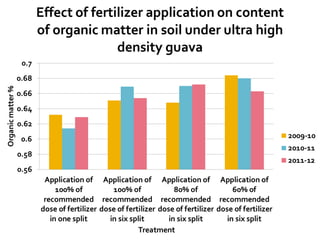
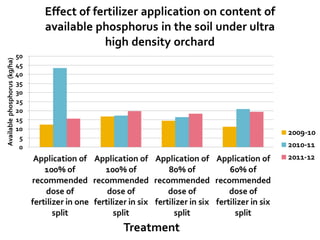
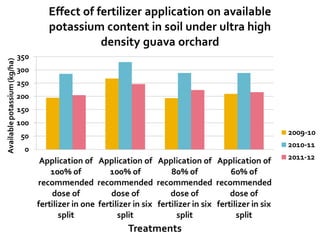
     Keeping inview yield and gross income, pruning of guava plants thrice a year viz. March, May and October to 50% of shoot length can be recommended for maximization of income from Ultra-high density guava orchard growing under Bihar conditions.  Application of 60% of recommended dose of fertilizer and irrigation at 60% PE was found to be most suitable
  • 44.
  • 48.
    Place Area (acre) Deoghar8 Chakrdharpur 6 Hazaribag 2 Ranchi 2 Saraikela 1
  • 49.
     Research papers– 3 No.  Presentation in symposiums: 6 No
  • 50.
     High densityorcharding in  Peach  Kaghji Kalan  Pomegranate  Ber  Kinnow  Litchi
  • 51.
     Fine-tuning canopymanagement strategies  Standardization of nutrient and water management strategies