Photosynthesis
It’s not simple being green
Objectives
• Understand the difference between autotroph and
heterotroph
• Describe the location and structure of a chloroplast.
Explain how chloroplast structure is related to its function
• Recognize and explain the summary equation for
photosynthesis
• Understand the role of REDOX reactions in
photosynthesis
• Understand the properties of light discussed in class
• Describe the relationship between action and absorption
spectrum
• Explain what happens when chlorophyll or accessory
pigments absorb photons
Objectives continued
• List the function and components of a
photosystem
• Compare cyclic and noncyclic electron flow and
explain the relationship between these components
of the light reactions
• Summarize the light reactions of photosynthesis
• Summarize the carbon fixing reactions of the
Calvin cycle
• Describe the role of NADPH and ATP in the
Calvin cycle
• Understand why variations of photosynthesis
evolved
Overview of Photosynthesis
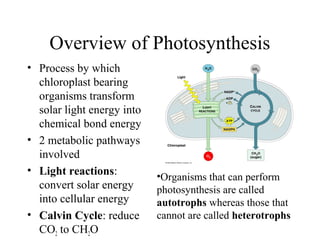
• Process by which
chloroplast bearing
organisms transform
solar light energy into
chemical bond energy
• 2 metabolic pathways
involved
• Light reactions:
convert solar energy
into cellular energy
• Calvin Cycle: reduce
CO2 to CH2O
•Organisms that can perform
photosynthesis are called
autotrophs whereas those that
cannot are called heterotrophs
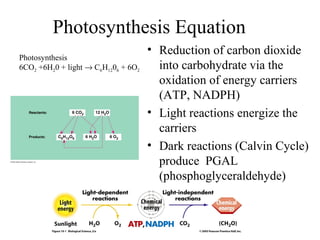
Photosynthesis Equation
• Reduction of carbon dioxide
into carbohydrate via the
oxidation of energy carriers
(ATP, NADPH)
• Light reactions energize the
carriers
• Dark reactions (Calvin Cycle)
produce PGAL
(phosphoglyceraldehyde)
Photosynthesis
6CO2 +6H20 + light → C6H1206 + 6O2
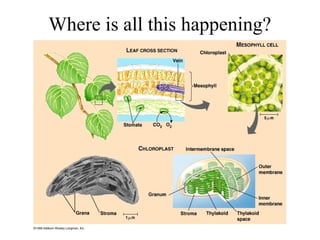
Where is all this happening?
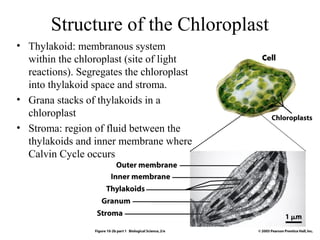
Structure of the Chloroplast
• Thylakoid: membranous system
within the chloroplast (site of light
reactions). Segregates the chloroplast
into thylakoid space and stroma.
• Grana stacks of thylakoids in a
chloroplast
• Stroma: region of fluid between the
thylakoids and inner membrane where
Calvin Cycle occurs
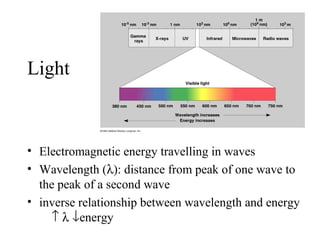
Light
• Electromagnetic energy travelling in waves
• Wavelength (λ): distance from peak of one wave to
the peak of a second wave
• inverse relationship between wavelength and energy
↑ λ ↓energy
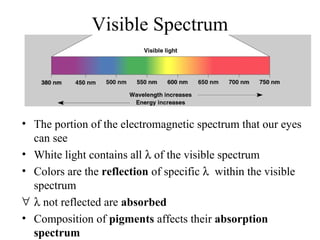
Visible Spectrum
• The portion of the electromagnetic spectrum that our eyes
can see
• White light contains all λ of the visible spectrum
• Colors are the reflection of specific λ within the visible
spectrum
∀ λ not reflected are absorbed
• Composition of pigments affects their absorption
spectrum
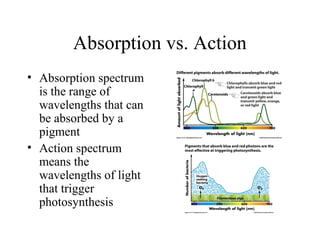
Absorption vs. Action
• Absorption spectrum
is the range of
wavelengths that can
be absorbed by a
pigment
• Action spectrum
means the
wavelengths of light
that trigger
photosynthesis
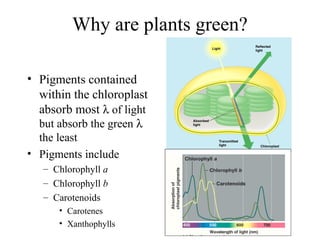
Why are plants green?
• Pigments contained
within the chloroplast
absorb most λ of light
but absorb the green λ
the least
• Pigments include
– Chlorophyll a
– Chlorophyll b
– Carotenoids
• Carotenes
• Xanthophylls
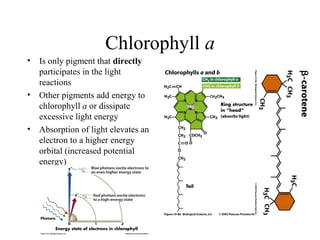
Chlorophyll a
• Is only pigment that directly
participates in the light
reactions
• Other pigments add energy to
chlorophyll a or dissipate
excessive light energy
• Absorption of light elevates an
electron to a higher energy
orbital (increased potential
energy)
Photosystems
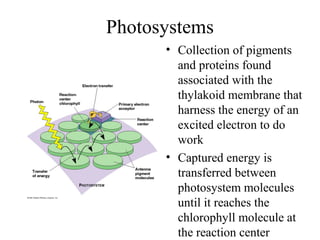
• Collection of pigments
and proteins found
associated with the
thylakoid membrane that
harness the energy of an
excited electron to do
work
• Captured energy is
transferred between
photosystem molecules
until it reaches the
chlorophyll molecule at
the reaction center
What Next?
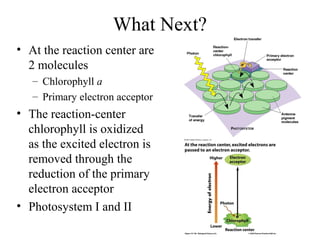
• At the reaction center are
2 molecules
– Chlorophyll a
– Primary electron acceptor
• The reaction-center
chlorophyll is oxidized
as the excited electron is
removed through the
reduction of the primary
electron acceptor
• Photosystem I and II
Electron Flow
• Two routes for the path of electrons stored in the primary
electron acceptors
• Both pathways
– begin with the capturing of photon energy
– utilize an electron transport chain with cytochromes for chemiosmosis
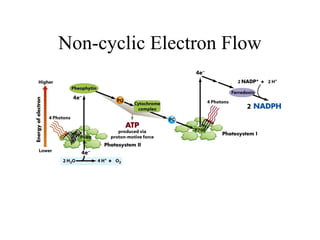
• Noncyclic electron flow
– uses both photosystem II and I
– electrons from photosystem II are removed and replaced by electrons
donated from water
– synthesizes ATP and NADPH
– electron donation converts water into ½ O2 and 2H+
• Cyclic electron flow
– Uses photosystem I only
– electrons from photosystem I are recycled
– synthesizes ATP only
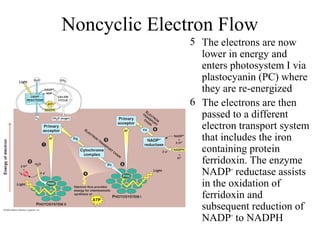
Noncyclic Electron Flow
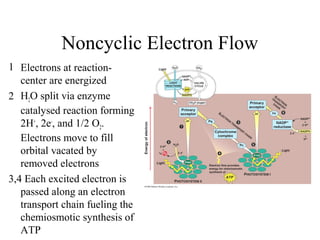
1 Electrons at reaction-
center are energized
2 H2O split via enzyme
catalysed reaction forming
2H+
, 2e-
, and 1/2 O2.
Electrons move to fill
orbital vacated by
removed electrons
3,4 Each excited electron is
passed along an electron
transport chain fueling the
chemiosmotic synthesis of
ATP
5 The electrons are now
lower in energy and
enters photosystem I via
plastocyanin (PC) where
they are re-energized
6 The electrons are then
passed to a different
electron transport system
that includes the iron
containing protein
ferridoxin. The enzyme
NADP+
reductase assists
in the oxidation of
ferridoxin and
subsequent reduction of
NADP+
to NADPH
Noncyclic Electron Flow
Non-cyclic Electron Flow
Cyclic Electron Flow
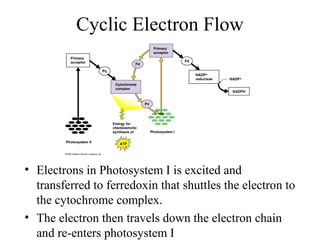
• Electrons in Photosystem I is excited and
transferred to ferredoxin that shuttles the electron to
the cytochrome complex.
• The electron then travels down the electron chain
and re-enters photosystem I
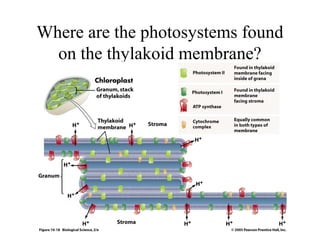
Where are the photosystems found
on the thylakoid membrane?
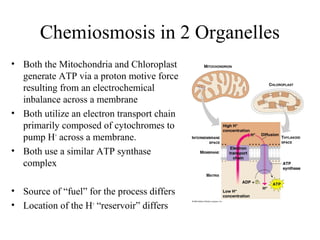
Chemiosmosis in 2 Organelles
• Both the Mitochondria and Chloroplast
generate ATP via a proton motive force
resulting from an electrochemical
inbalance across a membrane
• Both utilize an electron transport chain
primarily composed of cytochromes to
pump H+
across a membrane.
• Both use a similar ATP synthase
complex
• Source of “fuel” for the process differs
• Location of the H+
“reservoir” differs
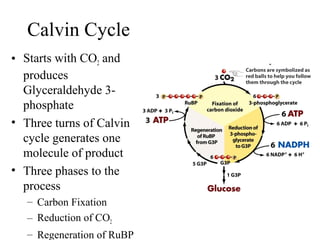
Calvin Cycle
• Starts with CO2 and
produces
Glyceraldehyde 3-
phosphate
• Three turns of Calvin
cycle generates one
molecule of product
• Three phases to the
process
– Carbon Fixation
– Reduction of CO2
– Regeneration of RuBP
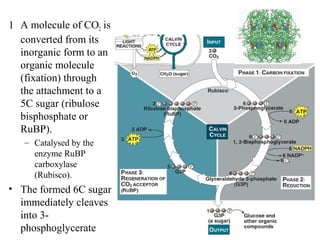
1 A molecule of CO2 is
converted from its
inorganic form to an
organic molecule
(fixation) through
the attachment to a
5C sugar (ribulose
bisphosphate or
RuBP).
– Catalysed by the
enzyme RuBP
carboxylase
(Rubisco).
• The formed 6C sugar
immediately cleaves
into 3-
phosphoglycerate
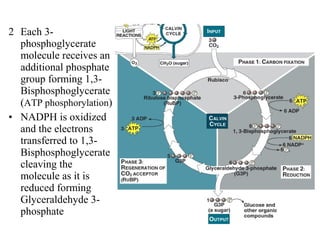
2 Each 3-
phosphoglycerate
molecule receives an
additional phosphate
group forming 1,3-
Bisphosphoglycerate
(ATP phosphorylation)
• NADPH is oxidized
and the electrons
transferred to 1,3-
Bisphosphoglycerate
cleaving the
molecule as it is
reduced forming
Glyceraldehyde 3-
phosphate
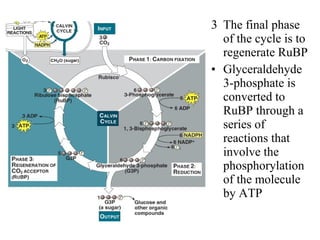
3 The final phase
of the cycle is to
regenerate RuBP
• Glyceraldehyde
3-phosphate is
converted to
RuBP through a
series of
reactions that
involve the
phosphorylation
of the molecule
by ATP
Variations Anyone?
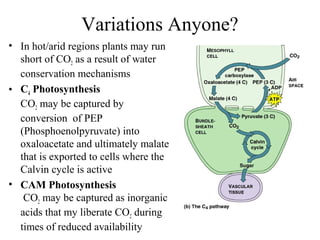
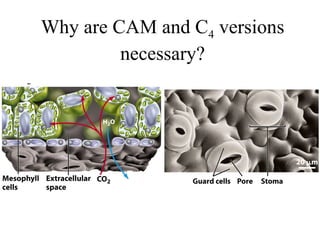
• In hot/arid regions plants may run
short of CO2 as a result of water
conservation mechanisms
• C4 Photosynthesis
CO2 may be captured by
conversion of PEP
(Phosphoenolpyruvate) into
oxaloacetate and ultimately malate
that is exported to cells where the
Calvin cycle is active
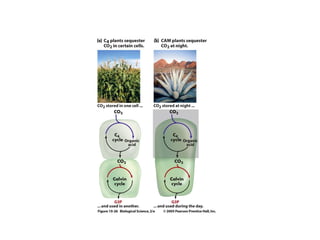
• CAM Photosynthesis
CO2 may be captured as inorganic
acids that my liberate CO2 during
times of reduced availability
Why are CAM and C4 versions
necessary?

Photosynthesis final

  • 1.
  • 2.
    Objectives • Understand thedifference between autotroph and heterotroph • Describe the location and structure of a chloroplast. Explain how chloroplast structure is related to its function • Recognize and explain the summary equation for photosynthesis • Understand the role of REDOX reactions in photosynthesis • Understand the properties of light discussed in class • Describe the relationship between action and absorption spectrum • Explain what happens when chlorophyll or accessory pigments absorb photons
  • 3.
    Objectives continued • Listthe function and components of a photosystem • Compare cyclic and noncyclic electron flow and explain the relationship between these components of the light reactions • Summarize the light reactions of photosynthesis • Summarize the carbon fixing reactions of the Calvin cycle • Describe the role of NADPH and ATP in the Calvin cycle • Understand why variations of photosynthesis evolved
  • 4.
    Overview of Photosynthesis •Process by which chloroplast bearing organisms transform solar light energy into chemical bond energy • 2 metabolic pathways involved • Light reactions: convert solar energy into cellular energy • Calvin Cycle: reduce CO2 to CH2O •Organisms that can perform photosynthesis are called autotrophs whereas those that cannot are called heterotrophs
  • 5.
    Photosynthesis Equation • Reductionof carbon dioxide into carbohydrate via the oxidation of energy carriers (ATP, NADPH) • Light reactions energize the carriers • Dark reactions (Calvin Cycle) produce PGAL (phosphoglyceraldehyde) Photosynthesis 6CO2 +6H20 + light → C6H1206 + 6O2
  • 6.
    Where is allthis happening?
  • 7.
    Structure of theChloroplast • Thylakoid: membranous system within the chloroplast (site of light reactions). Segregates the chloroplast into thylakoid space and stroma. • Grana stacks of thylakoids in a chloroplast • Stroma: region of fluid between the thylakoids and inner membrane where Calvin Cycle occurs
  • 8.
    Light • Electromagnetic energytravelling in waves • Wavelength (λ): distance from peak of one wave to the peak of a second wave • inverse relationship between wavelength and energy ↑ λ ↓energy
  • 9.
    Visible Spectrum • Theportion of the electromagnetic spectrum that our eyes can see • White light contains all λ of the visible spectrum • Colors are the reflection of specific λ within the visible spectrum ∀ λ not reflected are absorbed • Composition of pigments affects their absorption spectrum
  • 10.
    Absorption vs. Action •Absorption spectrum is the range of wavelengths that can be absorbed by a pigment • Action spectrum means the wavelengths of light that trigger photosynthesis
  • 11.
    Why are plantsgreen? • Pigments contained within the chloroplast absorb most λ of light but absorb the green λ the least • Pigments include – Chlorophyll a – Chlorophyll b – Carotenoids • Carotenes • Xanthophylls
  • 12.
    Chlorophyll a • Isonly pigment that directly participates in the light reactions • Other pigments add energy to chlorophyll a or dissipate excessive light energy • Absorption of light elevates an electron to a higher energy orbital (increased potential energy)
  • 13.
    Photosystems • Collection ofpigments and proteins found associated with the thylakoid membrane that harness the energy of an excited electron to do work • Captured energy is transferred between photosystem molecules until it reaches the chlorophyll molecule at the reaction center
  • 14.
    What Next? • Atthe reaction center are 2 molecules – Chlorophyll a – Primary electron acceptor • The reaction-center chlorophyll is oxidized as the excited electron is removed through the reduction of the primary electron acceptor • Photosystem I and II
  • 15.
    Electron Flow • Tworoutes for the path of electrons stored in the primary electron acceptors • Both pathways – begin with the capturing of photon energy – utilize an electron transport chain with cytochromes for chemiosmosis • Noncyclic electron flow – uses both photosystem II and I – electrons from photosystem II are removed and replaced by electrons donated from water – synthesizes ATP and NADPH – electron donation converts water into ½ O2 and 2H+ • Cyclic electron flow – Uses photosystem I only – electrons from photosystem I are recycled – synthesizes ATP only
  • 16.
    Noncyclic Electron Flow 1Electrons at reaction- center are energized 2 H2O split via enzyme catalysed reaction forming 2H+ , 2e- , and 1/2 O2. Electrons move to fill orbital vacated by removed electrons 3,4 Each excited electron is passed along an electron transport chain fueling the chemiosmotic synthesis of ATP
  • 17.
    5 The electronsare now lower in energy and enters photosystem I via plastocyanin (PC) where they are re-energized 6 The electrons are then passed to a different electron transport system that includes the iron containing protein ferridoxin. The enzyme NADP+ reductase assists in the oxidation of ferridoxin and subsequent reduction of NADP+ to NADPH Noncyclic Electron Flow
  • 18.
  • 19.
    Cyclic Electron Flow •Electrons in Photosystem I is excited and transferred to ferredoxin that shuttles the electron to the cytochrome complex. • The electron then travels down the electron chain and re-enters photosystem I
  • 20.
    Where are thephotosystems found on the thylakoid membrane?
  • 21.
    Chemiosmosis in 2Organelles • Both the Mitochondria and Chloroplast generate ATP via a proton motive force resulting from an electrochemical inbalance across a membrane • Both utilize an electron transport chain primarily composed of cytochromes to pump H+ across a membrane. • Both use a similar ATP synthase complex • Source of “fuel” for the process differs • Location of the H+ “reservoir” differs
  • 22.
    Calvin Cycle • Startswith CO2 and produces Glyceraldehyde 3- phosphate • Three turns of Calvin cycle generates one molecule of product • Three phases to the process – Carbon Fixation – Reduction of CO2 – Regeneration of RuBP
  • 23.
    1 A moleculeof CO2 is converted from its inorganic form to an organic molecule (fixation) through the attachment to a 5C sugar (ribulose bisphosphate or RuBP). – Catalysed by the enzyme RuBP carboxylase (Rubisco). • The formed 6C sugar immediately cleaves into 3- phosphoglycerate
  • 24.
    2 Each 3- phosphoglycerate moleculereceives an additional phosphate group forming 1,3- Bisphosphoglycerate (ATP phosphorylation) • NADPH is oxidized and the electrons transferred to 1,3- Bisphosphoglycerate cleaving the molecule as it is reduced forming Glyceraldehyde 3- phosphate
  • 25.
    3 The finalphase of the cycle is to regenerate RuBP • Glyceraldehyde 3-phosphate is converted to RuBP through a series of reactions that involve the phosphorylation of the molecule by ATP
  • 26.
    Variations Anyone? • Inhot/arid regions plants may run short of CO2 as a result of water conservation mechanisms • C4 Photosynthesis CO2 may be captured by conversion of PEP (Phosphoenolpyruvate) into oxaloacetate and ultimately malate that is exported to cells where the Calvin cycle is active • CAM Photosynthesis CO2 may be captured as inorganic acids that my liberate CO2 during times of reduced availability
  • 28.
    Why are CAMand C4 versions necessary?