MIXING
By: The University of Faisalabad
Definition
 In industrial process engineering, mixing is
a unit operation that involves manipulating a
heterogeneous physical system, with the
intent to make it more homogeneous.
OR
 Mixing is a phenomena in which two or
more separate components are intermingled
to form more or less uniform product.
Types of Mixing
 Mixing of cohesive solids
 Mixing of noncohesive solids
 Mixing of liquids
Cont…
 Single phase liquid mixing
 Mixing of immiscible liquids
 Gas liquid mixing
 Liquid solid mixing
 Solid liquid gas mixing
 Solid solid mixing
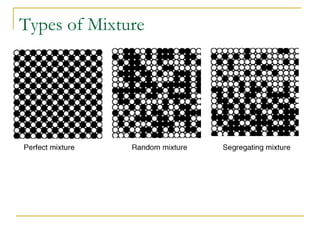
Types of Mixture
Mechanism of Mixing
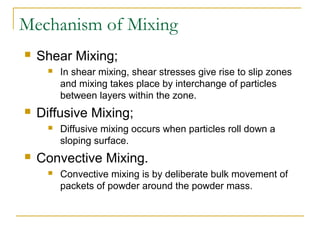
 Shear Mixing;
 In shear mixing, shear stresses give rise to slip zones
and mixing takes place by interchange of particles
between layers within the zone.
 Diffusive Mixing;
 Diffusive mixing occurs when particles roll down a
sloping surface.
 Convective Mixing.
 Convective mixing is by deliberate bulk movement of
packets of powder around the powder mass.
Types of Mixer
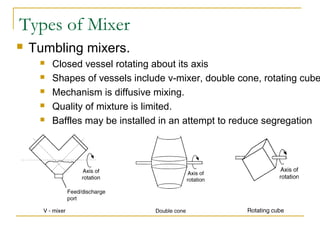
 Tumbling mixers.
 Closed vessel rotating about its axis
 Shapes of vessels include v-mixer, double cone, rotating cube
 Mechanism is diffusive mixing.
 Quality of mixture is limited.
 Baffles may be installed in an attempt to reduce segregation
Types of Mixer
 Convective mixers
 Circulation patterns are set up within a static shell by
rotating blades or paddles
 Mechanism is convective mixing
 Accompanied by some diffusive and shear mixing
 Ribbon blender in which helical blades or ribbons rotate
on a horizontal axis in a static cylinder
 Rotational speeds are typically < 60 rpm
Ribbon Blender
Conical Screw Mixer
Muller mixer
Pug mill
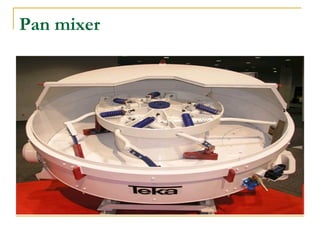
Pan mixer
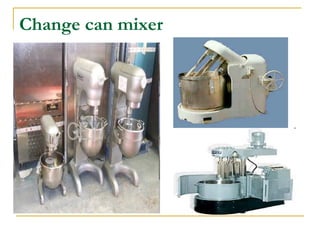
Change can mixer
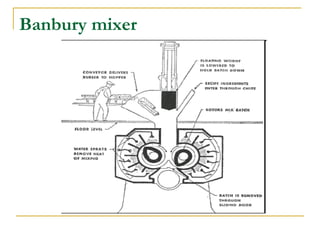
Banbury mixer
Mixer Selection
 Choice of impeller can also affect mixing time
 Propellers typically require longer mixing times
compared to turbines
 Propellers have lower power consumption
 Gas bubbles, liquid drops, or solid particles also
increase blending time
 No direct relation between power consumed and
amount or degree of mixing.
Degree of the Mixing
 Difficult to quantify the degree of mixing
 If dealing with the solid particles, the statistical
variation in composition among withdrawn at
any time from a mix is commonly used a
measure of the degree of mixing
 Standard deviation S or the variance s2
is
generally used.
 No amount of mixing will lead to the formation of
a uniform mosaic but only to a condition, where
there is an overall uniformity but not point
uniformity.
Agitation vs. Mixing
 Agitation – induced motion of a material in a
specified way
 Usually a circulatory pattern inside a container
 Mixing – random distribution, into and
through one another, of two or more initially
separate phases
 Various degrees of homogeneity
Purposes of Agitation
 Suspending solid particles
 Blending miscible liquids
 Dispersing a gas through a liquid in the form
of small bubbles
 Dispersing a second liquid, immiscible with
the first, to form an emulsion or suspension of
fine drops
 Promoting heat transfer between the liquid
and a coil or jacket
Agitation Equipment
 Tank or vessel
 Cylindrical in form with a vertical axis
 Rounded tank bottom
 Depth ≅ diameter
 Impellers
 Axial-flow – generate currents parallel with the
axis of the impeller shaft
 Radial-flow – generate currents in a tangential or
radial direction
 Propellers, Turbines & High-efficiency Impellers
Measurements of Design for Turbine
“Standard” Turbine Design
 Type and location of impeller, proportions of
vessel, number and proportions of baffles
 No. of baffles – 4
 No. of impeller blades – 4-16 (usually 6-8)
3
1
3
1
=
=
t
t
a
D
E
D
D
5
1
1
=
=
a
t
D
W
D
H
4
1
12
1
=
=
a
t
D
L
D
J
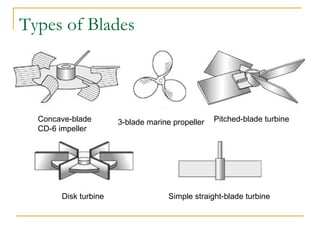
3-blade marine propeller
Simple straight-blade turbineDisk turbine
Concave-blade
CD-6 impeller
Pitched-blade turbine
Types of Blades
cont.
Flow Patterns
 Depends on type of impeller, characteristics
of fluid, size and proportions of tank, baffles,
and agitator
 Swirling – stratification at various levels with
no longitudinal flow between levels
Power Consumption
THANKS

Mixing

  • 1.
  • 2.
    Definition  In industrialprocess engineering, mixing is a unit operation that involves manipulating a heterogeneous physical system, with the intent to make it more homogeneous. OR  Mixing is a phenomena in which two or more separate components are intermingled to form more or less uniform product.
  • 3.
    Types of Mixing Mixing of cohesive solids  Mixing of noncohesive solids  Mixing of liquids
  • 4.
    Cont…  Single phaseliquid mixing  Mixing of immiscible liquids  Gas liquid mixing  Liquid solid mixing  Solid liquid gas mixing  Solid solid mixing
  • 5.
  • 6.
    Mechanism of Mixing Shear Mixing;  In shear mixing, shear stresses give rise to slip zones and mixing takes place by interchange of particles between layers within the zone.  Diffusive Mixing;  Diffusive mixing occurs when particles roll down a sloping surface.  Convective Mixing.  Convective mixing is by deliberate bulk movement of packets of powder around the powder mass.
  • 7.
    Types of Mixer Tumbling mixers.  Closed vessel rotating about its axis  Shapes of vessels include v-mixer, double cone, rotating cube  Mechanism is diffusive mixing.  Quality of mixture is limited.  Baffles may be installed in an attempt to reduce segregation
  • 8.
    Types of Mixer Convective mixers  Circulation patterns are set up within a static shell by rotating blades or paddles  Mechanism is convective mixing  Accompanied by some diffusive and shear mixing  Ribbon blender in which helical blades or ribbons rotate on a horizontal axis in a static cylinder  Rotational speeds are typically < 60 rpm
  • 9.
  • 10.
  • 11.
  • 12.
  • 13.
  • 14.
  • 15.
  • 16.
    Mixer Selection  Choiceof impeller can also affect mixing time  Propellers typically require longer mixing times compared to turbines  Propellers have lower power consumption  Gas bubbles, liquid drops, or solid particles also increase blending time  No direct relation between power consumed and amount or degree of mixing.
  • 17.
    Degree of theMixing  Difficult to quantify the degree of mixing  If dealing with the solid particles, the statistical variation in composition among withdrawn at any time from a mix is commonly used a measure of the degree of mixing  Standard deviation S or the variance s2 is generally used.  No amount of mixing will lead to the formation of a uniform mosaic but only to a condition, where there is an overall uniformity but not point uniformity.
  • 18.
    Agitation vs. Mixing Agitation – induced motion of a material in a specified way  Usually a circulatory pattern inside a container  Mixing – random distribution, into and through one another, of two or more initially separate phases  Various degrees of homogeneity
  • 19.
    Purposes of Agitation Suspending solid particles  Blending miscible liquids  Dispersing a gas through a liquid in the form of small bubbles  Dispersing a second liquid, immiscible with the first, to form an emulsion or suspension of fine drops  Promoting heat transfer between the liquid and a coil or jacket
  • 20.
    Agitation Equipment  Tankor vessel  Cylindrical in form with a vertical axis  Rounded tank bottom  Depth ≅ diameter  Impellers  Axial-flow – generate currents parallel with the axis of the impeller shaft  Radial-flow – generate currents in a tangential or radial direction  Propellers, Turbines & High-efficiency Impellers
  • 21.
  • 22.
    “Standard” Turbine Design Type and location of impeller, proportions of vessel, number and proportions of baffles  No. of baffles – 4  No. of impeller blades – 4-16 (usually 6-8) 3 1 3 1 = = t t a D E D D 5 1 1 = = a t D W D H 4 1 12 1 = = a t D L D J
  • 23.
    3-blade marine propeller Simplestraight-blade turbineDisk turbine Concave-blade CD-6 impeller Pitched-blade turbine Types of Blades
  • 24.
  • 25.
    Flow Patterns  Dependson type of impeller, characteristics of fluid, size and proportions of tank, baffles, and agitator  Swirling – stratification at various levels with no longitudinal flow between levels
  • 27.
  • 28.