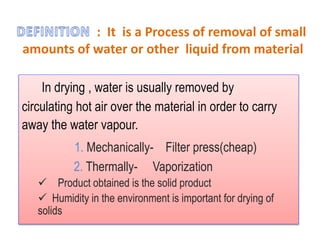
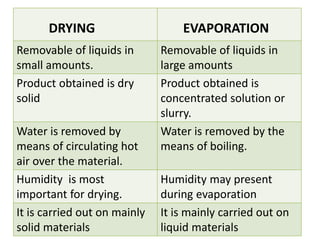
Drying involves the removal of water or other liquids from materials through evaporation. There are two main types: drying and evaporation. Drying removes small amounts of liquid using hot air circulation, while evaporation removes larger amounts through boiling. The key difference is that drying produces a dry solid, while evaporation produces a concentrated solution, suspension or slurry. Common drying methods include tray drying, drum drying, spray drying, and freeze drying. Each method has advantages and disadvantages depending on the material and desired end product. Proper control of factors like temperature, air flow, and humidity is important for achieving efficient drying.





![BOUND WATER
[hygroscopic materials]
Water in fine capillaries, cell
and fiber walls, physical
interaction
Vapour pressure of wet
solids is < vapour pressure
of pure water
UNBOUND WATER
[non hygroscopic materials]
Water in void
spaces
Vapour pressure of
wet solids is =
vapour pressure of
pure water](https://image.slidesharecdn.com/dryingfinalpresentation-180923140819/85/Drying-PHYSICAL-PHARMACY-PHARMACEUTICS-8-320.jpg)
![Explanation
• Bound water is the minimum water [moisture] held by
the material that exerts an equilibrium vapour pressure
less than the pure water at same temperature.
Substance containing bound water are called
hygroscopic substances.
• Un bound water is the amount of water [moisture] held
by the material that exerts an equilibrium vapour
pressure equal to that of pure water at the same
temperature.
Substance containing unbound water are called
Non hygroscopic substances.](https://image.slidesharecdn.com/dryingfinalpresentation-180923140819/85/Drying-PHYSICAL-PHARMACY-PHARMACEUTICS-9-320.jpg)