Prepared by,
Md. Alauddin
May, 2016
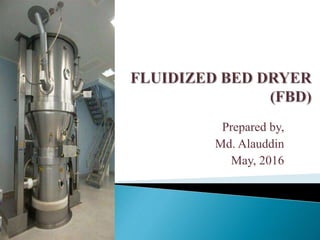
 Fluid bed drying is most widely used technique for drying
pharmaceutical powders and granulation.
 The direct contact between particles and air/gas is possible in fluid
bed system.
 Here any type of inert gas or air is used.
 They can be designed in either batch or continuous type fluid bed
dryer.
 In fluidized bed dryer, hot air is passed at high pressure through a
perforated bottom of the container containing granules to be dried.
 The granules are lifted from the bottom and suspended in the stream
of air.
The hot gas surrounding every granule to completely dry them.
Thus, material or granules are uniformly dried.
The hot air/gas used for drying can be generated by either steam
coils or a combustion furnace.
The angle of repose of gas-solid mixture is zero and it assumes
the shape of the vessel that contains it.
 In fluid bed drying uniform conditions of temperature,
composition and particle size distribution is achieved throughout
the bed because of complete mixing between the solids and gas is
obtained.
 Fluidized bed dryer requires less time to complete drying. i.e., 20 to
40 min.
 Hot spots are not observed in the dryer, because of its excellent
mixing and drying capacities.
 The thermal efficiency is 2 to 6 times greater than tray dryer.
 It facilitates the drying of thermolabile substances , since the
contact time for drying is short.
 It can be used either as batch type or continuous type.
 The free movement of individual particles eliminates the risk of
soluble material migrating as may occur in static bed.
 Many organic powders develop electrostatic charges during
drying which can be avoided by efficient electrical earthing of
the dryer.
 The turbulence of the fluidized state of granules may cause
attrition of some materials resulting in production of fines
which can be be avoided by using suitable binding agent.
Apparatus Parameters
 Air distribution plate Position of the air distribution plate influences
the airflow pattern inside the body.
 Shape of instrument body Annular base gives better product and
fluidization
 Nozzle height in case of coater and granulator. It plays vital role as
in coating, the atomized coating solution should not get dried before
reaching the tablet surface.
 Positive and negative pressure operation.
Process Parameters
1) Temperature
As the inlet air temperature increases the rate of drying increases
and vice versa.
This approach to increase the rate of drying can not be used
always because some materials are harmed by high temperature, e.g.
Ibuprofen liquefies above 60°C temperature of inlet air should be
optimized without any impact on product quality.
If temperature is high, it leads to blistering. If temperature is low,
soft spot can be formed.
2) Humidity
Humidity in the inlet air should be as low as possible and ideally
dehumidified air should be used for faster drying rate because as the
humidity of inlet air decreases the rate of drying increases.
3) Air flow rate:
 Air flow rate should be controlled properly in order to get
efficient use of drying air. Air flow rate should not be too
fast or too slow but optimized to have efficient drying.
Product Parameters
1)Initial moisture content of material.
 It should not be high otherwise it increases drying time.
2)Batch size.
 It should be small and optimized based on feasibility.
A)Batch Type Vertical Fluid Bed Dryer With Granulating option
1. Reverse Turning Bed Type
In this equipment, by turning the gas dispersion plate (the reverse
turning bed) in 90° direction with the control motor, all the dried
material can be discharged at once.
2. Rotating Discharge Type
Dried material is discharged by opening the discharge gate equipped
at the side of the Dryer. As the perforated plate is used as the gas
dispersion plate, the gas inside the equipment whirls and pushes the
dried material out from the discharge gate.
 The residence period of the dried material can be controlled
which results in uniform drying.
 It is most suitable in case where an accurate control of the
residence period is required at the decreasing rate drying zone.
 Small destruction of particle occurs therefore suitable for
granular or crystallized material.
 Easy operation can be achieved by an automatic control of
material feeding, drying discharging etc. When multiple stage
system us adopted, the exhaust gas heat can be used
efficiently.
B)Continuous Type Horizontal Vibrating Conveyor FBD
 Residence time in any drying zone is dependent on
(1) Length of the zone
(2) The frequency and the amplitude of the vibration
(3) Use of dams
 Heat transfer units such as tube or plate, are built inside
the equipment.
 These unit supplies 60-80 % heat necessary for drying.
 The materials with relative high moisture content can also be dried.
 At and after a second drying chamber, piston flow ability can be
achieved by arranging numbers of the partition plates as per the
required residence period.
 The perforated plate at the fixed direction ensures easy discharging.
 Small destruction of particles, so suitable for granules or crystalline
materials.
 In multiple zones fluid bed dryers, heating and cooling occurs in
same unit.
 Each zone has independent control for temperature, dewpoint and
velocity of air/gas.
 By adjusting the weir height for each zone, residence time can vary
up to four fold in the unit.
The construction of a vertical fluidized bed dryer
 The dryer is made of stainless steel or plastic.
 A detachable bowl is placed at the bottom of the dryer, which is
used for charging and discharging.
 The bowl has a perforated bottom with a wire mesh support for
placing materials to be dried.
 A fan is mounted in the upper part for circulating hot air.
 Fresh air inlet, pre-filter and heat exchanger are connected serially
to heat the air to the required temperatures.
 The temperature of hot air and exit are monitored.
 Bag filters are placed above the drying bowl for recovery of fines.
 When the velocity of the air is greater than the settling velocity of
granules, the granules remain partially suspended in the gas stream.
 After some time, a point of pressure is reached at which frictional
drag in the particles is equal to the force of gravity.
 The granules rise in the container because of high velocity gas and
fell back in a random boiling motion.
 This condition is said to be fluidized state.
 Drying is achieved at constant rate and falling rate period is very
short.
Fluidized bed dryers

Fluidized bed dryers

  • 1.
  • 2.
     Fluid beddrying is most widely used technique for drying pharmaceutical powders and granulation.  The direct contact between particles and air/gas is possible in fluid bed system.  Here any type of inert gas or air is used.  They can be designed in either batch or continuous type fluid bed dryer.  In fluidized bed dryer, hot air is passed at high pressure through a perforated bottom of the container containing granules to be dried.  The granules are lifted from the bottom and suspended in the stream of air.
  • 3.
    The hot gassurrounding every granule to completely dry them. Thus, material or granules are uniformly dried. The hot air/gas used for drying can be generated by either steam coils or a combustion furnace. The angle of repose of gas-solid mixture is zero and it assumes the shape of the vessel that contains it.  In fluid bed drying uniform conditions of temperature, composition and particle size distribution is achieved throughout the bed because of complete mixing between the solids and gas is obtained.
  • 5.
     Fluidized beddryer requires less time to complete drying. i.e., 20 to 40 min.  Hot spots are not observed in the dryer, because of its excellent mixing and drying capacities.  The thermal efficiency is 2 to 6 times greater than tray dryer.  It facilitates the drying of thermolabile substances , since the contact time for drying is short.  It can be used either as batch type or continuous type.  The free movement of individual particles eliminates the risk of soluble material migrating as may occur in static bed.
  • 6.
     Many organicpowders develop electrostatic charges during drying which can be avoided by efficient electrical earthing of the dryer.  The turbulence of the fluidized state of granules may cause attrition of some materials resulting in production of fines which can be be avoided by using suitable binding agent.
  • 7.
    Apparatus Parameters  Airdistribution plate Position of the air distribution plate influences the airflow pattern inside the body.  Shape of instrument body Annular base gives better product and fluidization  Nozzle height in case of coater and granulator. It plays vital role as in coating, the atomized coating solution should not get dried before reaching the tablet surface.  Positive and negative pressure operation.
  • 8.
    Process Parameters 1) Temperature Asthe inlet air temperature increases the rate of drying increases and vice versa. This approach to increase the rate of drying can not be used always because some materials are harmed by high temperature, e.g. Ibuprofen liquefies above 60°C temperature of inlet air should be optimized without any impact on product quality. If temperature is high, it leads to blistering. If temperature is low, soft spot can be formed. 2) Humidity Humidity in the inlet air should be as low as possible and ideally dehumidified air should be used for faster drying rate because as the humidity of inlet air decreases the rate of drying increases.
  • 9.
    3) Air flowrate:  Air flow rate should be controlled properly in order to get efficient use of drying air. Air flow rate should not be too fast or too slow but optimized to have efficient drying. Product Parameters 1)Initial moisture content of material.  It should not be high otherwise it increases drying time. 2)Batch size.  It should be small and optimized based on feasibility.
  • 10.
    A)Batch Type VerticalFluid Bed Dryer With Granulating option 1. Reverse Turning Bed Type In this equipment, by turning the gas dispersion plate (the reverse turning bed) in 90° direction with the control motor, all the dried material can be discharged at once. 2. Rotating Discharge Type Dried material is discharged by opening the discharge gate equipped at the side of the Dryer. As the perforated plate is used as the gas dispersion plate, the gas inside the equipment whirls and pushes the dried material out from the discharge gate.
  • 12.
     The residenceperiod of the dried material can be controlled which results in uniform drying.  It is most suitable in case where an accurate control of the residence period is required at the decreasing rate drying zone.  Small destruction of particle occurs therefore suitable for granular or crystallized material.  Easy operation can be achieved by an automatic control of material feeding, drying discharging etc. When multiple stage system us adopted, the exhaust gas heat can be used efficiently.
  • 13.
    B)Continuous Type HorizontalVibrating Conveyor FBD  Residence time in any drying zone is dependent on (1) Length of the zone (2) The frequency and the amplitude of the vibration (3) Use of dams  Heat transfer units such as tube or plate, are built inside the equipment.  These unit supplies 60-80 % heat necessary for drying.
  • 15.
     The materialswith relative high moisture content can also be dried.  At and after a second drying chamber, piston flow ability can be achieved by arranging numbers of the partition plates as per the required residence period.  The perforated plate at the fixed direction ensures easy discharging.  Small destruction of particles, so suitable for granules or crystalline materials.  In multiple zones fluid bed dryers, heating and cooling occurs in same unit.  Each zone has independent control for temperature, dewpoint and velocity of air/gas.  By adjusting the weir height for each zone, residence time can vary up to four fold in the unit.
  • 16.
    The construction ofa vertical fluidized bed dryer  The dryer is made of stainless steel or plastic.  A detachable bowl is placed at the bottom of the dryer, which is used for charging and discharging.  The bowl has a perforated bottom with a wire mesh support for placing materials to be dried.  A fan is mounted in the upper part for circulating hot air.  Fresh air inlet, pre-filter and heat exchanger are connected serially to heat the air to the required temperatures.  The temperature of hot air and exit are monitored.  Bag filters are placed above the drying bowl for recovery of fines.
  • 18.
     When thevelocity of the air is greater than the settling velocity of granules, the granules remain partially suspended in the gas stream.  After some time, a point of pressure is reached at which frictional drag in the particles is equal to the force of gravity.  The granules rise in the container because of high velocity gas and fell back in a random boiling motion.  This condition is said to be fluidized state.  Drying is achieved at constant rate and falling rate period is very short.