MIXING
BY: AMJAD ANWAR
C.NO: 18
SEMESTER: 7TH (2014-19)
DEPARTMENT OF PHARMACY
UNIVERSITY OF MALAKAND
1
MIXING
 An operation in which two or more components (in a
separate or roughly mixed condition) are treated so
that each particle lies as nearly as possible in contact
with a particle of each of the other ingredients.
OR
 The process that tends to result in a randomization of
dissimilar particles within a system
2
Ideal Or Perfect Mixing
 When each particle lay adjacent to a particle of the
other component (i.e. each particle lies as closely as
possible in contact with a particle of the other
component)
OR
 When quantity of materials in all part of a system is
same (E.g. ABABAB) it is perfect mixing.
3
Random mixing
 A mix where the probability of selecting a particular
type of particle is the same at all positions in the mix,
and is equal to the proportion of such particles in the
total mix
OR
 Proportion is different in all parts a system. E.g. AB AA
BA AB
4
SEGREGATION (DE-MIXING)
 Segregation is the opposite effect to mixing, i.e.
components tend to separate out
 Segregation arises because powder mixes
encountered practically are not composed of mono-
sized spherical particles, but contain particles that
differ in size, shape and density. These variations
mean that particles will tend to behave differently
when forced to move and hence, tend to separate.
5
Percolation segregation:
 Smaller particles tend to fall through the voids
between larger ones and so move to the bottom of
the mass
 It may occur in static powder beds, but occurs to a
greater extent as the bed 'dilates' on being
disturbed
6
Trajectory segregation:
 Larger particles will tend to have greater kinetic
energy imparted to them (owing to their larger mass)
and therefore move greater distances than smaller
particles before they come to rest. This may result in
the separation of particles of different size
7
Elutriation segregation/dusting out:
 When a material is discharged from a container,
very small particles ('dust') in a mix may tend to be
'blown' upwards by turbulent air currents as the
mass tumbles, and remain suspended in the air.
When the mixer is stopped or material discharge is
complete, these particles will sediment and
subsequently form a layer on top of the coarser
particles
8
OBJECTIVES OF MIXING:
 To achieve a physical mixture.
 To bring a physical change.
 To achieve a dispersion.
 To promote a chemical reaction.
1) Simple physical mixture:
 Producing a blend of two or more miscible liquids
or two or more uniformly divided solids
9
2) Physical change:
 Producing a change that is physical as distinct from
chemical
 E.g. mixing a solid with a solvent to produce a solution
3) Dispersion:
 Dispersion of two immiscible liquids (Emulsion)
 Dispersion of a solid in liquid (Suspension or Paste)
4) Promotion of reaction:
 Activate, promote and control a chemical reaction so
ensuring a uniform product.
 E.g. where accurate adjustment to PH is requires and
the degree of mixing depend on the process
10
NEED OF MIXING
 It is a unit operation for tablet, capsule b/c
many ingredients are used, so mixing is
required.
 Single material (potent e.g. 0.2ϻg) which is
difficult to handle so we add ingredients which
Is mixed
11
TYPES OF MIXTURES
1) POSITIVE MIXTURE:
 Spontaneous and irreversible mixing (i.e. requiring
no energy input for mixing)
 Mixing……..Without energy
 Separation…..Requires energy
 E.g. when two or more gases or miscible liquids are
mixed together by means of diffusion process (water
and milk)
12
2) NEGATIVE MIXTURE
 Mixtures that require a higher degree of mixing along
with the expenditure of energy for mixing
 Mixing…….Requires energy
 Separation….. Without energy
 E.g. suspensions of solids in liquids and Emulsions of
two immiscible liquids
13
3) NEUTRAL MIXTURE
 Static in behavior (No tendency to mix
spontaneously, nor segregate when mixed)
 Both mixing and segregation occurs with expenditure
of energy.
 E.g. physical mixing (Pastes, Ointments and mixed
powders)
14
TYPES OF MIXING
 Liquid mixing or fluid mixing
 Powder mixing or solid mixing
 Semi-solid mixing
15
A) FLUID/LIQUID MIXING
 Mixing process may be easy for some fluid and
difficult for others. Following three parameters
gives necessary knowledge about basic
requirement of fluid for mixing.
 Flow characteristics.
 Mixing mechanisms.
 Mixing equipment.
16
FLOW CHARACTERISTICS:
 The fluid may flow freely or flow with resistance. They
show different flow characteristics, they may be
classified as,
 Newtonian fluid
 Non –Newtonian fluid
NEWTONIAN FLUIDS
 Such fluid flow like water and for them the shear
stress (force applied) is directly proportional to the
shear rate. Newtonian fluids are those whose
viscosity does not change by shear stress.
17
NON-NEWTONIAN FLUIDS
 Fluids whose viscosity changes with the increase
or decrease of shear stress. Non-Newtonian
fluids are of three types.
1) PLASTIC/BINGHAM FLOW
 A certain shearing stress must be exerted before the
flow begins. This stress is termed is Yield value (Flow
will not occur by applying stress below this value)
 The system behaves like a solid when small stresses
(lower than yield value) are applied i.e. the system
exhibits elastic deformations that are reversible when
these small stresses are removed
18
2) PSEUDO-PLASTIC FLOW
 A type of flow where no yield value exist and the
flow begins immediately on the application of a
shearing stress
 Viscosity decreases as the shear rate is increased
until a constant value is reached
3) DILATANT FLOW
 It is opposite to that of pseudo-plastic flow in that
the viscosity increases with increase in shear rate.
As such material increase in volume during
shearing, they are referred to as dilatants and
exhibit shear thickening
19
MECHANISM OF MIXING
 Four types of mechanism are involved in
mixing of fluids.
 Bulk transport mixing.
 Turbulent mixing.
 Laminar mixing.
 Molecular diffusion.
20
Bulk Transport
 Movement of relatively large portion of a material
being mixed from one location to another in a
system
 Does not result in efficient mixing
 It is made effective by means of paddle, blade or
shuffling of system in three dimensions
21
Turbulent Mixing
 Turbulent mixing is the result of turbulent fluid flow
(Characterized by random fluctuation of the fluid
velocity at any given point in the system)
 The churning flow characteristics of turbulence
results in constantly changing velocities, so the fluid
has different instantaneous velocities at different
locations at the same instant in time
 Such temporal and spatial velocity differences
produces randomization of fluid particles that’s why
turbulent mixing is highly effective mixing mechanism
 Turbulent flow can be conveniently visualized as a
composite of eddies
22
Laminar Mixing
 Flow dominated by viscosity forces is called laminar
flow and is characterized by smooth and parallel line
motion of the fluid
 Applicable for viscous liquid or laminar liquids
 When two dissimilar liquids are mixed through laminar
flow, the shear that is generated stretches the
interface between them
 In this mechanism, layers fold back upon themselves.
Thus the number of layers increases. So, the mixing
involves reduction of fluid layer thickness by
producing folding effect. The applied shear stresses
between the interfaces of the 2 dissimilar liquids to be
mixed.
23
Molecular Diffusion
 The mixing result from the diffusion of molecules
caused by thermal motion is referred to as
molecular diffusion. This mechanism occurs at
molecular level.
 This type of mixing occurs whenever there is a
concentration gradient (According to Fick’s law).
24
MIXING EQUIPMENTS
Batch mixing
 Mixing a specific and limited quantity of material
 Impellers
 Air jet
 Fluid jet
Continuous mixing
 Equipment used for both are different. The two
components are common in the equipment used for
batch and continuous mixing processes which are;
 Tank of suitable size to hold material.
 Means of supply of energy to the system so as to enhance
the speed of mixing.
25
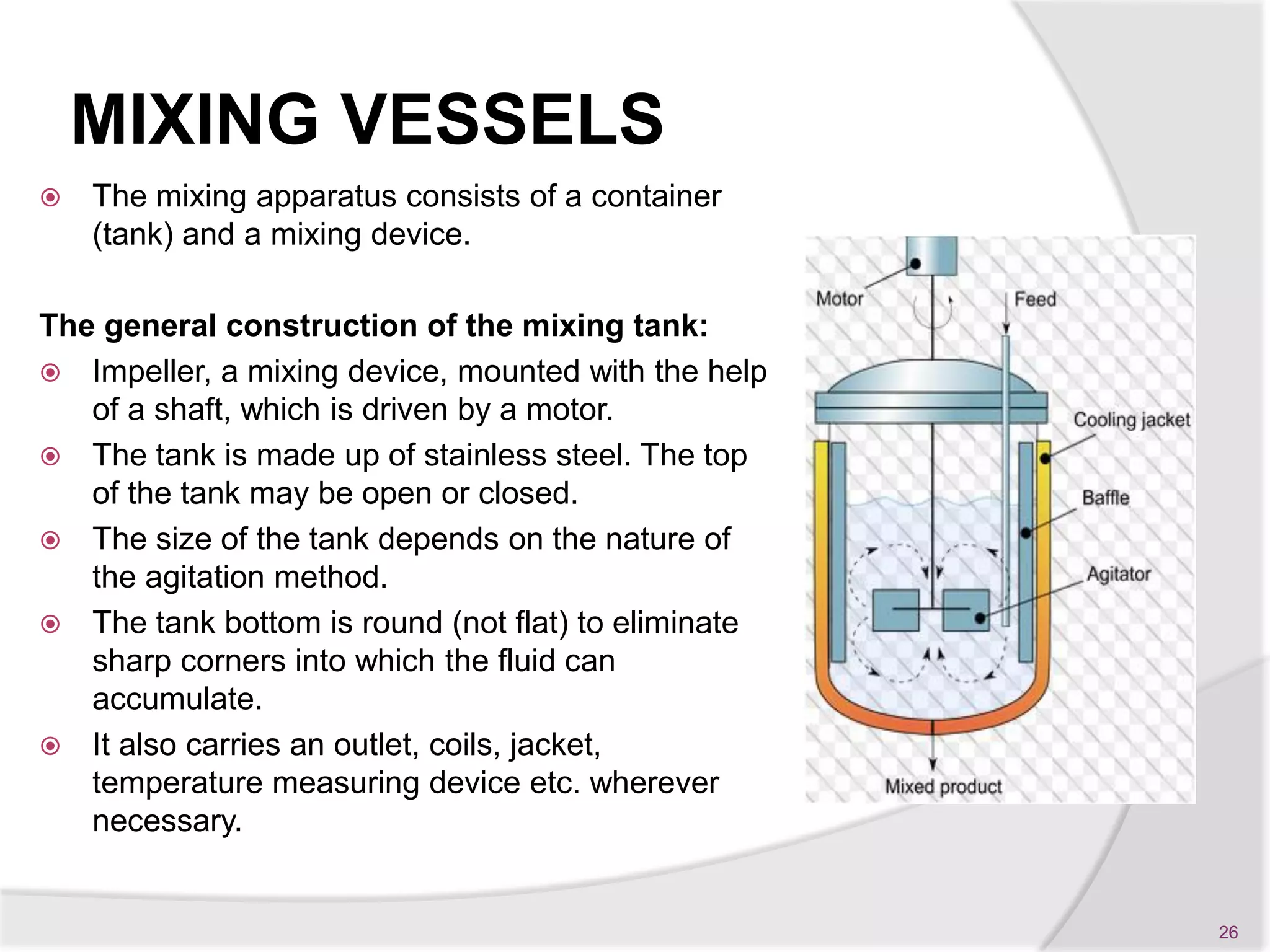
MIXING VESSELS
 The mixing apparatus consists of a container
(tank) and a mixing device.
The general construction of the mixing tank:
 Impeller, a mixing device, mounted with the help
of a shaft, which is driven by a motor.
 The tank is made up of stainless steel. The top
of the tank may be open or closed.
 The size of the tank depends on the nature of
the agitation method.
 The tank bottom is round (not flat) to eliminate
sharp corners into which the fluid can
accumulate.
 It also carries an outlet, coils, jacket,
temperature measuring device etc. wherever
necessary.
26
 The energy to the fluid can be given
by mean of;
 Impeller
 Air jets
 Liquid jets
27
FLOW PATTERN DURING MIXING
 Mixing occurs due to the resultant effect of 3
components acting on liquid:
 Tangential / Circular component
 Radial component
 Axial / Longitudinal component
PITCH: distance covered by liquid during axial flow
28
Tangential component
 Direction: Acts in the direction
tangent to the circle of rotation
around the impeller shaft.
 Effect: If shaft is placed
vertically & centrally, tangential
flow follows a circular path
around the shaft & creates a
vortex in the liquid.
29
Radial component
 Direction: Acts in the direction
perpendicular to the impeller
shaft.
 Effect: Excessive radial flow
takes the material to the
container wall, and then the
material falls to the bottom and
rotates as a mass beneath the
impeller.
30
Axial component
 Direction: Acts in the direction
parallel to the impeller shaft.
 Effect: Inadequate longitudinal
component causes the liquid
and solid to rotate in layers
without mixing. Adequate
longitudinal pattern is best used
to generate strong vertical
currents particularly while
suspending solids are present.
31
a) IMPELLER
 Impellers are mixing devices that provide a
definite flow pattern in liquid during mixing,
moving at various speeds.
 Liquids are mixed usually by impellers, which
produce shear forces for inducing the
necessary flow pattern in the mixing container.
CLASSIFICATION
 Impeller exists in different forms.
1. Propeller 2. Turbine 3. Paddles
32
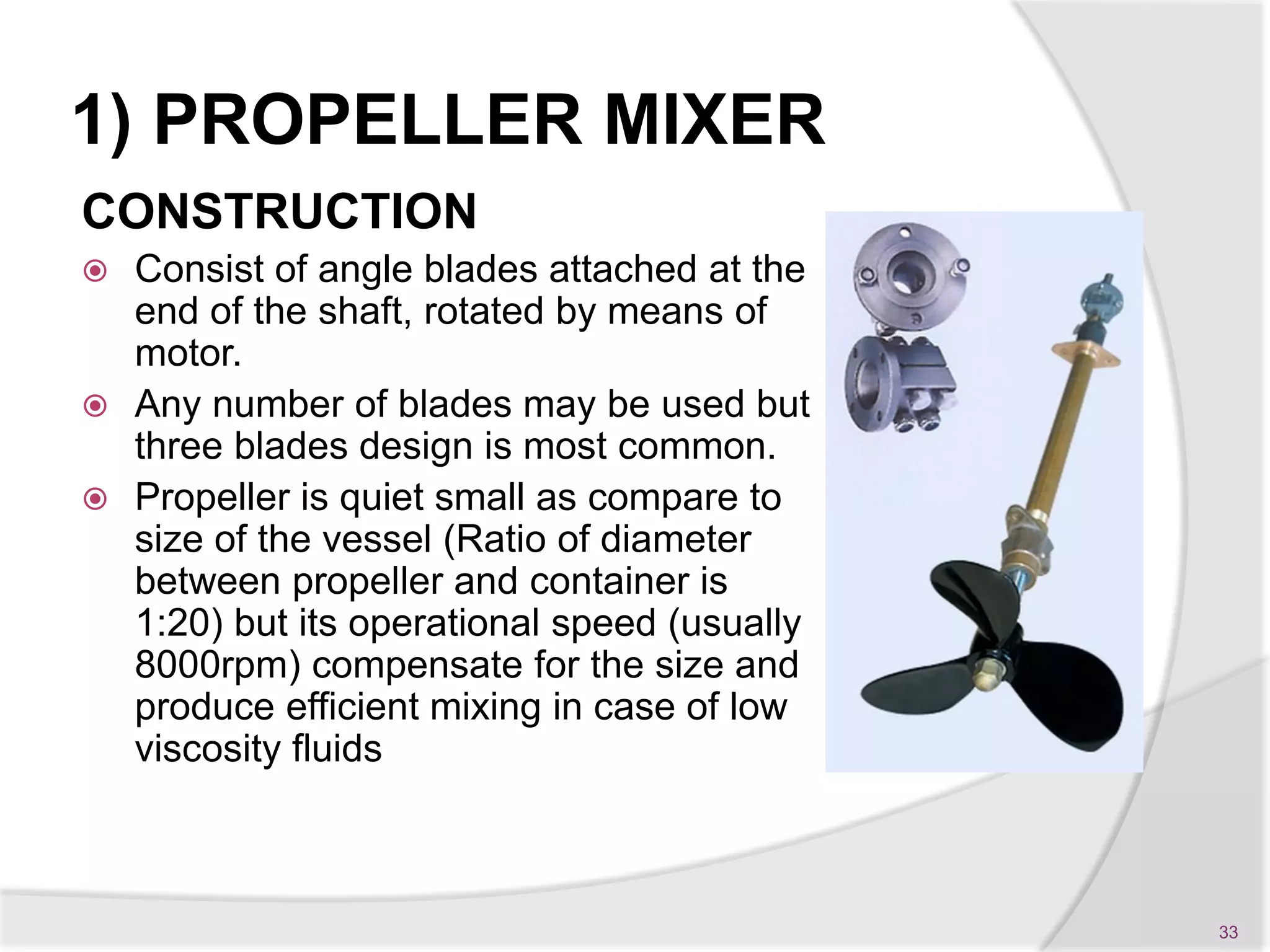
1) PROPELLER MIXER
CONSTRUCTION
 Consist of angle blades attached at the
end of the shaft, rotated by means of
motor.
 Any number of blades may be used but
three blades design is most common.
 Propeller is quiet small as compare to
size of the vessel (Ratio of diameter
between propeller and container is
1:20) but its operational speed (usually
8000rpm) compensate for the size and
produce efficient mixing in case of low
viscosity fluids
33
WORKING
 The material to be mixed is taken in a vessel and
the propeller bearing shaft is inserted.
 The angle blades of the propeller cause circulation
of the liquid in both axial and radial direction
ensuring good bulk transport but low shearing
force.
 The propeller may be installed in a number of ways.
 The centrally mounted vertical propeller is however
not considered good as it produces vertex.
34
ADVANTAGES
 Used when high mixing capacity is required.
 Effective for liquids which have maximum viscosity
of 2.0 pascals.sec or slurries up to 10% solids of
fine mesh size.
 Effective gas-liquid dispersion is possible at
laboratory scale.
Example
 Multivitamin elixirs, Disinfectant solutions
are prepared using propellers
35
DISADVANTAGES OF PROPELLERS
 Propellers are not normally effective with
liquids of viscosity greater than 5 pascal-
second, such as glycerin castor oil, etc
 The centrally mounted vertical propeller
produces vertex.
36
VORTEX
 Vertex is a powerful circular moving mass of water
or wind that can draw object into its hollow which
may result in air entrapped and bubbles formation.
 If a low viscosity liquid is stirred in an un-baffled
tank by an axially mounted agitator, tangential flow
follows a circular path around the shaft & a
swirling flow pattern is developed. This is vortex
37
HOW IS IT FORMED?
 In an un-baffled tank, a vortex is produced due to
the centrifugal force on the rotating liquid. This
creates a swirling motion in the liquid & the surface
tends to go upward near the vessel rim & downward
near the shaft. So a V-shaped surface is formed
which is the vortex.
38
REASONS
 If the shaft is placed symmetrically in the
tank.
 If the blades of the turbines are arranged
perpendicular to the central shaft.
 At high impeller speeds
 Unbaffled tank
39
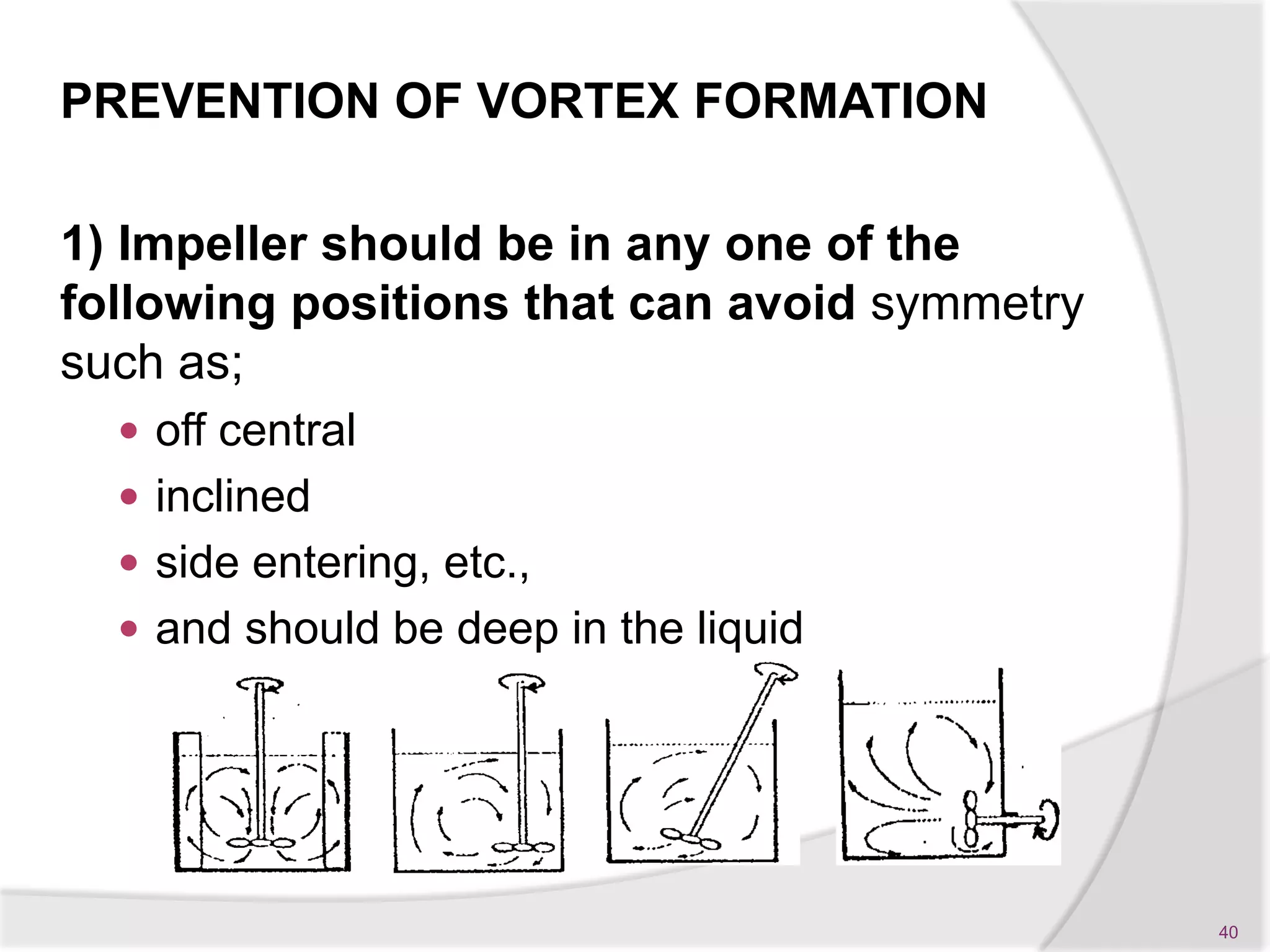
PREVENTION OF VORTEX FORMATION
1) Impeller should be in any one of the
following positions that can avoid symmetry
such as;
 off central
 inclined
 side entering, etc.,
 and should be deep in the liquid
40
2) Baffled containers should be used. In
such case impeller can be mounted
vertically at the center
41
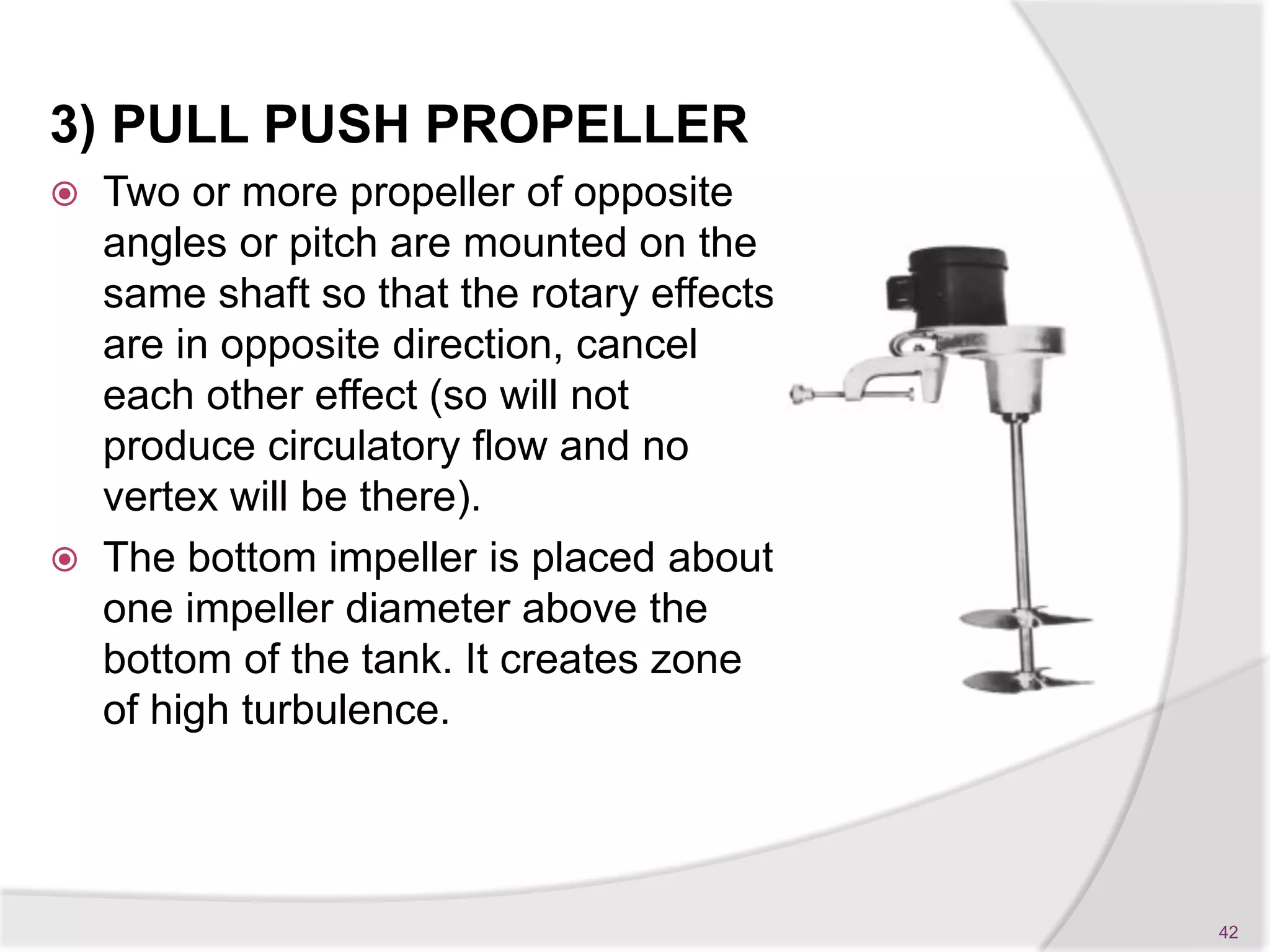
3) PULL PUSH PROPELLER
 Two or more propeller of opposite
angles or pitch are mounted on the
same shaft so that the rotary effects
are in opposite direction, cancel
each other effect (so will not
produce circulatory flow and no
vertex will be there).
 The bottom impeller is placed about
one impeller diameter above the
bottom of the tank. It creates zone
of high turbulence.
42
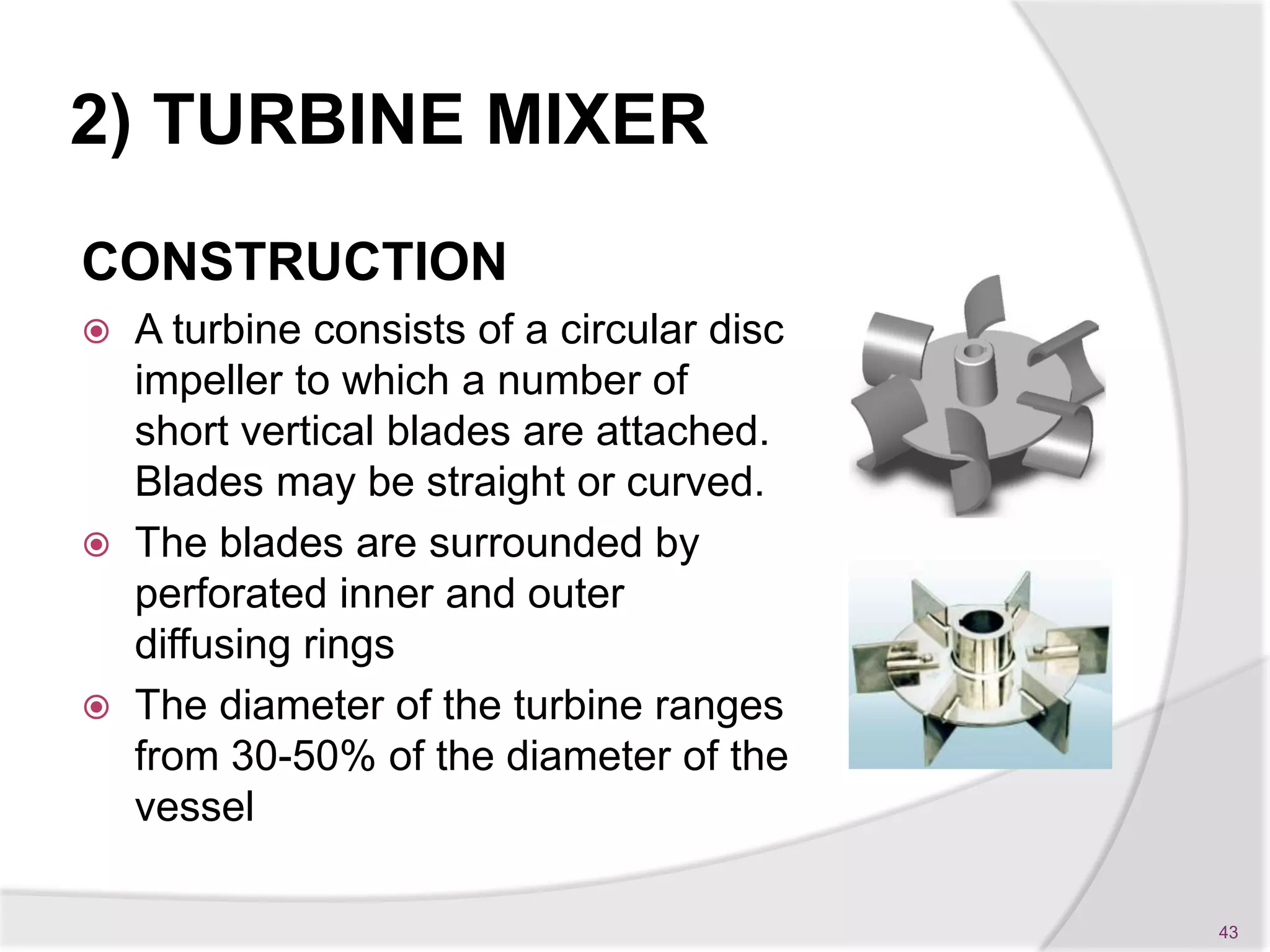
2) TURBINE MIXER
CONSTRUCTION
 A turbine consists of a circular disc
impeller to which a number of
short vertical blades are attached.
Blades may be straight or curved.
 The blades are surrounded by
perforated inner and outer
diffusing rings
 The diameter of the turbine ranges
from 30-50% of the diameter of the
vessel
43
WORKING
 Used in similar manner as that of impeller, however it
is rotated at somewhat small speed than impeller (50-
200 rpm).
 Flat blade turbines produce radial and tangential
flow but as the speed increases radial flow
dominates. Pitched blade turbine produces axial flow
 Near the impeller zone of rapid currents, high
turbulence and intense shear is observed
 Shear produced by turbines can be further enhanced
using a diffuser ring (stationary perforated ring which
surrounds the turbine).
 Diffuser ring increase the shear forces and liquid
passes through the perforations reducing rotational
swirling and vortexing.
44
ADVANTAGES
 Turbines give greater shearing forces than propellers
though the pumping rate is less. Therefore suitable
for emulsification.
 Effective for high viscous solutions with a wide range
of viscosities up to 7.0 Pascal-Second.
 In low viscous materials of large volumes turbine
create a strong currents which spread throughout the
tank destroying stagnant pockets.
 They can handle slurries with 60% solids.
 Turbines are suitable for liquids of large volume and
high viscosity, if the tank is baffled.
45
3) PADDLE MIXERS
 Paddles are agitator consisting of usually flat blades
attached to a vertical shaft and normally operated at low
speed (100-rpm).
 The blades have a larger surface area In relation to the
tank in which they rotate, so they can be used
effectively.
 Primarily paddle mixer produce tangential flow and
somewhat radial flow but no axial action unless blades
are pitched.
 Paddles for more viscous fluids have a number of
blades which are shaped in such a way to fit closely to
the surface of vessel (Avoiding dead spots and
deposited solids)
 At very low speeds it gives mild agitation in un-baffled
tank but as for high speeds baffles are necessary to
avoid swirling and vortexing
46
TYPES OF PADDLE MIXERS
 Simple paddle mixer
 Planetary motion mixer: (Small paddle rotating
on its own axis but travel also in a circular Path
round the mixing vessel. It is used for more viscos
fluids)
 Gate mixer: (It is a simple paddle, but is very
large in diameter)
 Stationary paddle mixer: (It is used for mixing of
solid with viscos liquid. Sigma plate mixer is its
improved form)
47
USES OF PADDLES
 Paddles are used in the manufacture of;
 Antacid suspensions
 Agar and pectin related purgatives
 Antidiarrheal mixtures such as bismuth-kaolin.
48
Advantages of paddles
 Vortex formation is not possible with paddle
impellers because of low speed mixing.
Disadvantages of paddles
 Mixing of the suspension is poor therefore baffled
tanks are required.
49
b) AIR JETS
 Air jets or other inert gas jets are effectively
used for mixing purpose with fluid of the
following characteristics;
○ Having low viscosity
○ Non foaming
○ Non-reactive with gas employed
○ Non-volatile in nature
50
PRINCIPLE
 When compressed air jet or suitable
gas is allows to pass at high pressure
from the inlet provided at the bottom of
the tank, air bubbles are formed in the
liquid phase.
 This causes buoyancy of the bubbles
which lifts the liquid (confined to the
central portion due to the presence of
draft tubes) from bottom to the top of
the vessel.
 The liquids flow down from the
periphery of the vessel and enter from
the bottom due to suction effect.
 The intense turbulence generated by
the jet produces intimate mixing
51
c) FLUID JETS
 In this device, the pumping operation is used to
transfer the liquid into the mixing tank.
MECHANISM
 In this case the fluids are pumped through nozzle
which permits good circulation of material through
the tank.
 The fluid jets in this operation behaves like propeller
in that they produce turbulent flow in the direction of
their axis, while differ from propeller b/c they don't
produce tangential flow themselves.
 They may also operate simply by pumping the liquid
from the tank and back into the tank through the jet.
52
CONTINUOUS MIXING
 Continuous mixing may be
accomplished in two ways.
 By using tubes or pipes
 By using mixing chamber
53
TUBE TYPE/PIPE TYPE MIXER
 In this method, the material flows through tube or
pipe and there is very little back flow.
 Baffles, rods or combination of these may be
placed in tubes or pipes to enhance mixing
efficiency.
 Mixing in such systems mainly occurs through
mass transport in direction normal to that of
primary flow
54
CHAMBER MIXING
 Mixing chamber is used as continuous
mixing equipment, when there is difficulty in
controlling the input rate and fluctuation.
 Fluctuation in the composition final mixture
is greatly reduced by dilation effects of the
material contained in the chamber.
 It may consist of a baffled pipe or an empty
chamber.
 Liquids to be mixed are passed through the
pipe/ chamber.
 Mixing takes place through bulk transport in
the direction of flow.
 The power supplied to pump the liquid itself
accomplishes mixing.
 For effective mixing controlling the feed rate
is essential.
55
B) POWDER MIXING
 Powder mixing may be regarded as an operation
in which two or more than two solid substances in
particulate form intermingled in mixer by
continuous movement of particles.
 It is an example of neutral mixture and is one the
most common operation employed during
preparation of different formulation like powder,
tablets, capsules etc
56
MECHANISM OF POWDER MIXING
 Mixing of powder is generally carried out by one of
the following mechanism or their combination.
 Convective mixing
 Shear mixing
 Diffusive mixing
CONVECTIVE MIXING:
 It is also called bulk transport. It takes place by
transferring the part of material from one location
to another location of the system by means of
blades or paddles of the equipment.
57
SHEAR MIXING:
 This type of mixing occurs when a layer of
material flows over another layer resulting in
the layers moving at different speeds and
therefore mixing at the layer interface.
 Occurs when;
 The removal of mass by convective mixing
creates an unstable shear/slip plane which
causes the powder bed to collapse
 The action of the mixer induces velocity
gradients within the powder bed
58
DIFFUSIVE MIXING
 Diffusive mechanism occurs by random movement of
particle within a powder bed and causes them to
change their relative position in relation to one another
 When a powder bed is forced to move, it will dilate
(The volume occupied by the bed will increase). This
occurs because the powder particles become less
tightly packed and there is an increase in the air
spaces or voids between them. So there is the
potential for the powder particles to pass through the
void spaces created under gravitational forces (in
tumbling mixer) or by forced movement (in fluidized
bed). Mixing of individual particles is referred to as
diffusive mixing
59
EQUIPMENTS FOR SOLID MIXING
 Tumbling mixer
 High shear mixture or granulator
 Agitator mixer
 Ribbon mixer
 Planetary mixer
 Nauta mixer
60
1) TUMBLING MIXER/SHEAR MIXER
 In this type of mixer movement of whole mixer is
responsible for mixing action of solid.
CONSTRUCTION:
 Tumbling mixer usually consist of metallic vessels
which are rotated on their horizental axis at optimum
speed by means of motor
 The mixing vessel is usually made up of stainless
steel and have door have loading/unloading of
material.
 The door is usually lined with rubber which provides
a perfect seal after closure.
61
 Tumbling mixture are available in variety of shapes and
sizes these include;
 Y-cone blender
 Cubical blender
 Double cone mixer
 Twin shell / V-shaped mixer
62
WORKING:
 The material to be mixed is loaded into mixing
vessel which is rotated at low speed by electric
motor.
 Due to slow speed of rotation the powder is raised
along the sides of the vessel until the angle of
repose is exceeded.
 The powder then tumbles down and mixing of
compound occurs.
 The rotation of vessel is very important in this case
 If the speed of rotation is too slow, it will cause
sliding only so proper mixing will not occurs.
 If it is rotated at high speed so the material will
adhere to the walls due to centrifugal force
63
 So optimum speed is required (30-100 rpm)
 Mixing mostly occurs by convective mechanism
 Shear mixing will occur as a velocity gradient is
produced, (the top layer moving with high velocity
and the velocity decreasing as the distance from
the surface increases)
 When the bed tumbles it dilates, allowing the
particles to move downward under gravitational
force, and so diffusive mixing occurs
 Addition of ‘prongs’, baffles or rotating bars will
also cause convective mixing
64
ADVANTAGES:
 Good for free flowing powders/granules
 Mix from approximately 50 g (Laboratory scale) to
over 100 kg (Large scale)
 Can be used to produce ordered mixes
 Used in the blending of lubricants, glidants or
external disintegrants with granules prior to tableting
DISADVANTAGES:
 Less effective for cohesive/poorly flowing powders
 Segregation is likely to occur if there are significant
differences in particle size
65
2) HIGH SHEAR MIXER-GRANULATOR
 It is so called because mixing mainly occurs
by shear mixing mechanism and at same time
granulation is carried out
CONSTRUCTION:
 It consist of a vessel having propeller
with long blades
 The clearance (distance b/w propeller
blades and walls of vessel) is low.
 There is a closing lid that closes the
vessel after material to be mixed is
added.
 For introduction of material/granulating
agent funnel is used.
 For the purposes of granulation a
chopper is present on side wall
66
WORKING:
 The material is to mixed id introduced to the mixer.
 The centrally mounted propeller blade at the bottom
of the mixer rotates at high speed, throwing material
towards the mixture bowl wall by centrifugal force.
 The material is then forced upward before dropping
back down towards the centre of the mixer.
 The particulate movement within the bowl tends to
mix the components quickly owing to high shear
forces (arising from the high velocity) and expansion
in the bed volume that allows diffusive mixing
67
 After mixing the granulating agent (water or
alcohol) is then added through funnel.
 It will produce wet mass that will go to the side
wall of mixer because of propeller.
 On sides, chopper with vertical, short and sharp
blades, is present that is rotating at speed higher
than that of the propeller and will broke the wet
mass so as to produce granules.
68
ADVANTAGES:
 Can be used for both wet and dry mixing
 For granulation purposes
DISADVANTAGE:
 Materials being mixed can fracture easily due to
high speed movement
 Cannot be used for blending lubricants
69
3) AGITATOR MIXER:
 These are the mixers in which the container to
hold the material is fixed. Mixing is done by means
of mixing screws, paddles or blades.
 Well known mixers of this type include the
following:
 The ribbon blender/Mixer
 Planetary mixer:
 Nauta mixer
70
RIBBON MIXER
Construction
 Consists of horizontal cylindrical
trough with semicircular bottom
usually open at the top. It is fitted
with two helical blades, which are
mounted on the same shaft through
the long axis of the trough.
 Blades have both right and left hand
twists.
 Blades are connected to fixed speed
drive.
 It can be loaded by top and emptying
is done through bottom port.
71
Principle:
 Mechanism of mixing is shear. Shear is transferred
by moving blades. High shear rates are effective in
breaking lumps and aggregates.
 Convective mixing also occurs as the powder bed is
lifted and allowed to cascade to the bottom of the
container. An equilibrium state of mixing can be
achieved.
Uses:
 Used for mixing of finely divided solids, wet solid
mass and plastic solids.
 Uniform size and density materials can be easily
mixed.
 Used for solid – solid and liquid – solid mixing.
72
Advantages:
 High shear can be applied by using perforated
baffles, which bring about a rubbing and breakdown
of aggregates.
 Headroom requires less space.
Disadvantages:
 It is a poor mixer, because movement of
particles is two dimensional.
 Shearing action is less than in planetary mixer.
 Dead spots are observed in the mixer, though
they are minimum
 It has fixed speed drive.
 Not suitable for fragile crystals and sensitive
materials.
73
PLANETARY MIXER
 The name “planetary mixer” comes from the system
used in the equipment that mixes the dough in the
planets rotation direction.
Construction:
 Consists of vertical cylinder shell for ingredients
placement which can be removed.
 Mixing element (whisk, hook, flat beater, scrapper or
other system)
 It consists of a rod that rotates in its own axis and also
moves forward (around the bowl axis). As the movement
is just like planet so it is called planetary mixer
 The blade is mounted from the top of the bowl.
 Mixing shaft is driven by planetary gear and it is normally
built with variable speed drive
74
Principle
 Mechanism of mixing is shear. Shear is applied
between moving blade and stationary wall.
 Mixing arm moves around its own axis and around
the central axis so that it reaches every spot of the
vessel.
 The plates in the blades are sloped so that powder
makes an upward movement to achieve tumbling
action also.
Uses
 Break down agglomerates rapidly.
 Low speeds are used for dry blending and fast for
wet granulation.
75
Advantages:
 Speed of rotation can be varied at will.
 Avoid dead zones and vortex formation
 More useful for wet granulation process.
Disadvantages:
 Mechanical heat is buildup within the powder mix.
 It requires high power.
 It has limited size and is useful for batch work only
76
NAUTA MIXER
 It is a vertical screw mixer Originally designed as a powder and
semi-solid mixer but now-a-days also used as a mixer-
granulator
Construction
 It consists of conical vessel fitted at the base with a
rotating screw, which is fastened to the end of
rotating arm.
 Accessory equipments include;
 Lump breaker, attached at the bottom of the conical
chamber
 Temperature monitor
 A nuclear non-contact density gauge
 Infrared moisture analyzer
 Sampling system
77
Working
 Material is added (powder to be mixed, liquid
granulating agent)
 The screw is moving in a planetary motion and
also lifting the material to be blended from bottom
to the near the top, where it cascades backs into
the mass, thus imparts 3 dimensional mixing.
 The mixer thus combine
 Convective mixing.
 Shear.
 Diffusive mixing
78
C) SEMI-SOLID MIXING
MECHANISM:
 It has been found that, in mixing an
insoluble powder with, a liquid, a
number of stages can be observed as
the liquid content is increased
79
a) Pellet & powder state
 Addition of small amount of liquid to a bulk of
powder causes the solids to ball up and form small
pellets.
 The pellets are embedded in a matrix of dry
powder which has a cushioning effect to make the
pellet difficult to break up.
80
b) Pellet state
 Further addition of liquid results in the conversion
of more dry powder to pellets until all the material
is in this state.
 The mass has coarse granular appearance but
pellets do not cohesive and agitation will cause
aggregates to break down into small granules.
 The rate of homogenization is even lower than in
pellet and powder state and is the stage aimed it
in moistening powder for tablet
81
c) Plastic state
 As the liquid content is increased further the
character of the mixture changes markedly.
 Aggregates of material adhere, Granular appearance
is lost and mixture become more or less homogenous
and of clay like consistency
 Plastic properties are shown the mixture being
difficult to shear, flowing at low stresses but break
under high stress.
 Homogenization is achieved much rapidly
82
d) Sticky state
 Continual incorporation of liquid causes the
mixture to attain the sticky state; the appearance
become paste like, the surface is shiny and the
mass adheres to solid surface.
 The mass flows easily, even under low stresses
but homogeneity is attained only slowly
83
e) Liquid state (semisolid state)
 Eventually the addition of liquids result in a
decrease of consistency until a fluid state is
reached
 In this state, the liquid flows under its own weight
and will drain off vertical surface.
 The Homogenization is rapid
84
SIGMA-BLADE/ARM MIXER
 Used for semi-solid of plastic consistency
Principle:
 Shear (Inter meshing of sigma blades creates high
shear and kneading action
85
Construction and working
 It consists of double tough shaped stationary bowl.
 Two sigma shaped blades are fitted horizontally in
each trough of the bowl.
 These blades have very low clearance and are
connected to a fixed speed drive.
 Mixer is loaded from top and unloaded by tilting the
entire bowl.
 The blades rotate tangentially at different speeds,
one about twice than the other (2:1), which allows
movement of powder from sides to centers.
86
 The material also moves top to downwards and
gets sheared between the blades and the wall of
the tough resulting cascading action.
 Perforated blades can be used to break lumps and
aggregates which create high shear forces.
 The final stage of mix represents an equilibrium
state
87
Uses:
 Used in the wet granulation process in the manufacture
of tablets, pill masses and ointments,
 It is primarily used for liquid-solid mixing, although it can
be used for solid-solid mixing.
 This mixer is well suited to high viscosity materials like
grease, putty, toffee and bubble gum.
 With its strong construction and high power, the sigma
blade mixer can handle the heaviest plastic materials
and products like tablet granules, and ointments that
are mixed readily
 Sigma blade mixer is used in chemical and
pharmaceutical industries, to make food products,
adhesives, rubber
88
Advantages:
 Sigma blade mixer creates a minimum dead space
during mixing.
 It has close tolerances between the blades and
the sidewalls as well as bottom of the mixer shell.
Disadvantages:
 Sigma blade mixer works at a fixed speed.
 Problems of entrainment of the air and therefore
lead to decomposition of oxidisable materials
89
90

MIXING

  • 1.
    MIXING BY: AMJAD ANWAR C.NO:18 SEMESTER: 7TH (2014-19) DEPARTMENT OF PHARMACY UNIVERSITY OF MALAKAND 1
  • 2.
    MIXING  An operationin which two or more components (in a separate or roughly mixed condition) are treated so that each particle lies as nearly as possible in contact with a particle of each of the other ingredients. OR  The process that tends to result in a randomization of dissimilar particles within a system 2
  • 3.
    Ideal Or PerfectMixing  When each particle lay adjacent to a particle of the other component (i.e. each particle lies as closely as possible in contact with a particle of the other component) OR  When quantity of materials in all part of a system is same (E.g. ABABAB) it is perfect mixing. 3
  • 4.
    Random mixing  Amix where the probability of selecting a particular type of particle is the same at all positions in the mix, and is equal to the proportion of such particles in the total mix OR  Proportion is different in all parts a system. E.g. AB AA BA AB 4
  • 5.
    SEGREGATION (DE-MIXING)  Segregationis the opposite effect to mixing, i.e. components tend to separate out  Segregation arises because powder mixes encountered practically are not composed of mono- sized spherical particles, but contain particles that differ in size, shape and density. These variations mean that particles will tend to behave differently when forced to move and hence, tend to separate. 5
  • 6.
    Percolation segregation:  Smallerparticles tend to fall through the voids between larger ones and so move to the bottom of the mass  It may occur in static powder beds, but occurs to a greater extent as the bed 'dilates' on being disturbed 6
  • 7.
    Trajectory segregation:  Largerparticles will tend to have greater kinetic energy imparted to them (owing to their larger mass) and therefore move greater distances than smaller particles before they come to rest. This may result in the separation of particles of different size 7
  • 8.
    Elutriation segregation/dusting out: When a material is discharged from a container, very small particles ('dust') in a mix may tend to be 'blown' upwards by turbulent air currents as the mass tumbles, and remain suspended in the air. When the mixer is stopped or material discharge is complete, these particles will sediment and subsequently form a layer on top of the coarser particles 8
  • 9.
    OBJECTIVES OF MIXING: To achieve a physical mixture.  To bring a physical change.  To achieve a dispersion.  To promote a chemical reaction. 1) Simple physical mixture:  Producing a blend of two or more miscible liquids or two or more uniformly divided solids 9
  • 10.
    2) Physical change: Producing a change that is physical as distinct from chemical  E.g. mixing a solid with a solvent to produce a solution 3) Dispersion:  Dispersion of two immiscible liquids (Emulsion)  Dispersion of a solid in liquid (Suspension or Paste) 4) Promotion of reaction:  Activate, promote and control a chemical reaction so ensuring a uniform product.  E.g. where accurate adjustment to PH is requires and the degree of mixing depend on the process 10
  • 11.
    NEED OF MIXING It is a unit operation for tablet, capsule b/c many ingredients are used, so mixing is required.  Single material (potent e.g. 0.2ϻg) which is difficult to handle so we add ingredients which Is mixed 11
  • 12.
    TYPES OF MIXTURES 1)POSITIVE MIXTURE:  Spontaneous and irreversible mixing (i.e. requiring no energy input for mixing)  Mixing……..Without energy  Separation…..Requires energy  E.g. when two or more gases or miscible liquids are mixed together by means of diffusion process (water and milk) 12
  • 13.
    2) NEGATIVE MIXTURE Mixtures that require a higher degree of mixing along with the expenditure of energy for mixing  Mixing…….Requires energy  Separation….. Without energy  E.g. suspensions of solids in liquids and Emulsions of two immiscible liquids 13
  • 14.
    3) NEUTRAL MIXTURE Static in behavior (No tendency to mix spontaneously, nor segregate when mixed)  Both mixing and segregation occurs with expenditure of energy.  E.g. physical mixing (Pastes, Ointments and mixed powders) 14
  • 15.
    TYPES OF MIXING Liquid mixing or fluid mixing  Powder mixing or solid mixing  Semi-solid mixing 15
  • 16.
    A) FLUID/LIQUID MIXING Mixing process may be easy for some fluid and difficult for others. Following three parameters gives necessary knowledge about basic requirement of fluid for mixing.  Flow characteristics.  Mixing mechanisms.  Mixing equipment. 16
  • 17.
    FLOW CHARACTERISTICS:  Thefluid may flow freely or flow with resistance. They show different flow characteristics, they may be classified as,  Newtonian fluid  Non –Newtonian fluid NEWTONIAN FLUIDS  Such fluid flow like water and for them the shear stress (force applied) is directly proportional to the shear rate. Newtonian fluids are those whose viscosity does not change by shear stress. 17
  • 18.
    NON-NEWTONIAN FLUIDS  Fluidswhose viscosity changes with the increase or decrease of shear stress. Non-Newtonian fluids are of three types. 1) PLASTIC/BINGHAM FLOW  A certain shearing stress must be exerted before the flow begins. This stress is termed is Yield value (Flow will not occur by applying stress below this value)  The system behaves like a solid when small stresses (lower than yield value) are applied i.e. the system exhibits elastic deformations that are reversible when these small stresses are removed 18
  • 19.
    2) PSEUDO-PLASTIC FLOW A type of flow where no yield value exist and the flow begins immediately on the application of a shearing stress  Viscosity decreases as the shear rate is increased until a constant value is reached 3) DILATANT FLOW  It is opposite to that of pseudo-plastic flow in that the viscosity increases with increase in shear rate. As such material increase in volume during shearing, they are referred to as dilatants and exhibit shear thickening 19
  • 20.
    MECHANISM OF MIXING Four types of mechanism are involved in mixing of fluids.  Bulk transport mixing.  Turbulent mixing.  Laminar mixing.  Molecular diffusion. 20
  • 21.
    Bulk Transport  Movementof relatively large portion of a material being mixed from one location to another in a system  Does not result in efficient mixing  It is made effective by means of paddle, blade or shuffling of system in three dimensions 21
  • 22.
    Turbulent Mixing  Turbulentmixing is the result of turbulent fluid flow (Characterized by random fluctuation of the fluid velocity at any given point in the system)  The churning flow characteristics of turbulence results in constantly changing velocities, so the fluid has different instantaneous velocities at different locations at the same instant in time  Such temporal and spatial velocity differences produces randomization of fluid particles that’s why turbulent mixing is highly effective mixing mechanism  Turbulent flow can be conveniently visualized as a composite of eddies 22
  • 23.
    Laminar Mixing  Flowdominated by viscosity forces is called laminar flow and is characterized by smooth and parallel line motion of the fluid  Applicable for viscous liquid or laminar liquids  When two dissimilar liquids are mixed through laminar flow, the shear that is generated stretches the interface between them  In this mechanism, layers fold back upon themselves. Thus the number of layers increases. So, the mixing involves reduction of fluid layer thickness by producing folding effect. The applied shear stresses between the interfaces of the 2 dissimilar liquids to be mixed. 23
  • 24.
    Molecular Diffusion  Themixing result from the diffusion of molecules caused by thermal motion is referred to as molecular diffusion. This mechanism occurs at molecular level.  This type of mixing occurs whenever there is a concentration gradient (According to Fick’s law). 24
  • 25.
    MIXING EQUIPMENTS Batch mixing Mixing a specific and limited quantity of material  Impellers  Air jet  Fluid jet Continuous mixing  Equipment used for both are different. The two components are common in the equipment used for batch and continuous mixing processes which are;  Tank of suitable size to hold material.  Means of supply of energy to the system so as to enhance the speed of mixing. 25
  • 26.
    MIXING VESSELS  Themixing apparatus consists of a container (tank) and a mixing device. The general construction of the mixing tank:  Impeller, a mixing device, mounted with the help of a shaft, which is driven by a motor.  The tank is made up of stainless steel. The top of the tank may be open or closed.  The size of the tank depends on the nature of the agitation method.  The tank bottom is round (not flat) to eliminate sharp corners into which the fluid can accumulate.  It also carries an outlet, coils, jacket, temperature measuring device etc. wherever necessary. 26
  • 27.
     The energyto the fluid can be given by mean of;  Impeller  Air jets  Liquid jets 27
  • 28.
    FLOW PATTERN DURINGMIXING  Mixing occurs due to the resultant effect of 3 components acting on liquid:  Tangential / Circular component  Radial component  Axial / Longitudinal component PITCH: distance covered by liquid during axial flow 28
  • 29.
    Tangential component  Direction:Acts in the direction tangent to the circle of rotation around the impeller shaft.  Effect: If shaft is placed vertically & centrally, tangential flow follows a circular path around the shaft & creates a vortex in the liquid. 29
  • 30.
    Radial component  Direction:Acts in the direction perpendicular to the impeller shaft.  Effect: Excessive radial flow takes the material to the container wall, and then the material falls to the bottom and rotates as a mass beneath the impeller. 30
  • 31.
    Axial component  Direction:Acts in the direction parallel to the impeller shaft.  Effect: Inadequate longitudinal component causes the liquid and solid to rotate in layers without mixing. Adequate longitudinal pattern is best used to generate strong vertical currents particularly while suspending solids are present. 31
  • 32.
    a) IMPELLER  Impellersare mixing devices that provide a definite flow pattern in liquid during mixing, moving at various speeds.  Liquids are mixed usually by impellers, which produce shear forces for inducing the necessary flow pattern in the mixing container. CLASSIFICATION  Impeller exists in different forms. 1. Propeller 2. Turbine 3. Paddles 32
  • 33.
    1) PROPELLER MIXER CONSTRUCTION Consist of angle blades attached at the end of the shaft, rotated by means of motor.  Any number of blades may be used but three blades design is most common.  Propeller is quiet small as compare to size of the vessel (Ratio of diameter between propeller and container is 1:20) but its operational speed (usually 8000rpm) compensate for the size and produce efficient mixing in case of low viscosity fluids 33
  • 34.
    WORKING  The materialto be mixed is taken in a vessel and the propeller bearing shaft is inserted.  The angle blades of the propeller cause circulation of the liquid in both axial and radial direction ensuring good bulk transport but low shearing force.  The propeller may be installed in a number of ways.  The centrally mounted vertical propeller is however not considered good as it produces vertex. 34
  • 35.
    ADVANTAGES  Used whenhigh mixing capacity is required.  Effective for liquids which have maximum viscosity of 2.0 pascals.sec or slurries up to 10% solids of fine mesh size.  Effective gas-liquid dispersion is possible at laboratory scale. Example  Multivitamin elixirs, Disinfectant solutions are prepared using propellers 35
  • 36.
    DISADVANTAGES OF PROPELLERS Propellers are not normally effective with liquids of viscosity greater than 5 pascal- second, such as glycerin castor oil, etc  The centrally mounted vertical propeller produces vertex. 36
  • 37.
    VORTEX  Vertex isa powerful circular moving mass of water or wind that can draw object into its hollow which may result in air entrapped and bubbles formation.  If a low viscosity liquid is stirred in an un-baffled tank by an axially mounted agitator, tangential flow follows a circular path around the shaft & a swirling flow pattern is developed. This is vortex 37
  • 38.
    HOW IS ITFORMED?  In an un-baffled tank, a vortex is produced due to the centrifugal force on the rotating liquid. This creates a swirling motion in the liquid & the surface tends to go upward near the vessel rim & downward near the shaft. So a V-shaped surface is formed which is the vortex. 38
  • 39.
    REASONS  If theshaft is placed symmetrically in the tank.  If the blades of the turbines are arranged perpendicular to the central shaft.  At high impeller speeds  Unbaffled tank 39
  • 40.
    PREVENTION OF VORTEXFORMATION 1) Impeller should be in any one of the following positions that can avoid symmetry such as;  off central  inclined  side entering, etc.,  and should be deep in the liquid 40
  • 41.
    2) Baffled containersshould be used. In such case impeller can be mounted vertically at the center 41
  • 42.
    3) PULL PUSHPROPELLER  Two or more propeller of opposite angles or pitch are mounted on the same shaft so that the rotary effects are in opposite direction, cancel each other effect (so will not produce circulatory flow and no vertex will be there).  The bottom impeller is placed about one impeller diameter above the bottom of the tank. It creates zone of high turbulence. 42
  • 43.
    2) TURBINE MIXER CONSTRUCTION A turbine consists of a circular disc impeller to which a number of short vertical blades are attached. Blades may be straight or curved.  The blades are surrounded by perforated inner and outer diffusing rings  The diameter of the turbine ranges from 30-50% of the diameter of the vessel 43
  • 44.
    WORKING  Used insimilar manner as that of impeller, however it is rotated at somewhat small speed than impeller (50- 200 rpm).  Flat blade turbines produce radial and tangential flow but as the speed increases radial flow dominates. Pitched blade turbine produces axial flow  Near the impeller zone of rapid currents, high turbulence and intense shear is observed  Shear produced by turbines can be further enhanced using a diffuser ring (stationary perforated ring which surrounds the turbine).  Diffuser ring increase the shear forces and liquid passes through the perforations reducing rotational swirling and vortexing. 44
  • 45.
    ADVANTAGES  Turbines givegreater shearing forces than propellers though the pumping rate is less. Therefore suitable for emulsification.  Effective for high viscous solutions with a wide range of viscosities up to 7.0 Pascal-Second.  In low viscous materials of large volumes turbine create a strong currents which spread throughout the tank destroying stagnant pockets.  They can handle slurries with 60% solids.  Turbines are suitable for liquids of large volume and high viscosity, if the tank is baffled. 45
  • 46.
    3) PADDLE MIXERS Paddles are agitator consisting of usually flat blades attached to a vertical shaft and normally operated at low speed (100-rpm).  The blades have a larger surface area In relation to the tank in which they rotate, so they can be used effectively.  Primarily paddle mixer produce tangential flow and somewhat radial flow but no axial action unless blades are pitched.  Paddles for more viscous fluids have a number of blades which are shaped in such a way to fit closely to the surface of vessel (Avoiding dead spots and deposited solids)  At very low speeds it gives mild agitation in un-baffled tank but as for high speeds baffles are necessary to avoid swirling and vortexing 46
  • 47.
    TYPES OF PADDLEMIXERS  Simple paddle mixer  Planetary motion mixer: (Small paddle rotating on its own axis but travel also in a circular Path round the mixing vessel. It is used for more viscos fluids)  Gate mixer: (It is a simple paddle, but is very large in diameter)  Stationary paddle mixer: (It is used for mixing of solid with viscos liquid. Sigma plate mixer is its improved form) 47
  • 48.
    USES OF PADDLES Paddles are used in the manufacture of;  Antacid suspensions  Agar and pectin related purgatives  Antidiarrheal mixtures such as bismuth-kaolin. 48
  • 49.
    Advantages of paddles Vortex formation is not possible with paddle impellers because of low speed mixing. Disadvantages of paddles  Mixing of the suspension is poor therefore baffled tanks are required. 49
  • 50.
    b) AIR JETS Air jets or other inert gas jets are effectively used for mixing purpose with fluid of the following characteristics; ○ Having low viscosity ○ Non foaming ○ Non-reactive with gas employed ○ Non-volatile in nature 50
  • 51.
    PRINCIPLE  When compressedair jet or suitable gas is allows to pass at high pressure from the inlet provided at the bottom of the tank, air bubbles are formed in the liquid phase.  This causes buoyancy of the bubbles which lifts the liquid (confined to the central portion due to the presence of draft tubes) from bottom to the top of the vessel.  The liquids flow down from the periphery of the vessel and enter from the bottom due to suction effect.  The intense turbulence generated by the jet produces intimate mixing 51
  • 52.
    c) FLUID JETS In this device, the pumping operation is used to transfer the liquid into the mixing tank. MECHANISM  In this case the fluids are pumped through nozzle which permits good circulation of material through the tank.  The fluid jets in this operation behaves like propeller in that they produce turbulent flow in the direction of their axis, while differ from propeller b/c they don't produce tangential flow themselves.  They may also operate simply by pumping the liquid from the tank and back into the tank through the jet. 52
  • 53.
    CONTINUOUS MIXING  Continuousmixing may be accomplished in two ways.  By using tubes or pipes  By using mixing chamber 53
  • 54.
    TUBE TYPE/PIPE TYPEMIXER  In this method, the material flows through tube or pipe and there is very little back flow.  Baffles, rods or combination of these may be placed in tubes or pipes to enhance mixing efficiency.  Mixing in such systems mainly occurs through mass transport in direction normal to that of primary flow 54
  • 55.
    CHAMBER MIXING  Mixingchamber is used as continuous mixing equipment, when there is difficulty in controlling the input rate and fluctuation.  Fluctuation in the composition final mixture is greatly reduced by dilation effects of the material contained in the chamber.  It may consist of a baffled pipe or an empty chamber.  Liquids to be mixed are passed through the pipe/ chamber.  Mixing takes place through bulk transport in the direction of flow.  The power supplied to pump the liquid itself accomplishes mixing.  For effective mixing controlling the feed rate is essential. 55
  • 56.
    B) POWDER MIXING Powder mixing may be regarded as an operation in which two or more than two solid substances in particulate form intermingled in mixer by continuous movement of particles.  It is an example of neutral mixture and is one the most common operation employed during preparation of different formulation like powder, tablets, capsules etc 56
  • 57.
    MECHANISM OF POWDERMIXING  Mixing of powder is generally carried out by one of the following mechanism or their combination.  Convective mixing  Shear mixing  Diffusive mixing CONVECTIVE MIXING:  It is also called bulk transport. It takes place by transferring the part of material from one location to another location of the system by means of blades or paddles of the equipment. 57
  • 58.
    SHEAR MIXING:  Thistype of mixing occurs when a layer of material flows over another layer resulting in the layers moving at different speeds and therefore mixing at the layer interface.  Occurs when;  The removal of mass by convective mixing creates an unstable shear/slip plane which causes the powder bed to collapse  The action of the mixer induces velocity gradients within the powder bed 58
  • 59.
    DIFFUSIVE MIXING  Diffusivemechanism occurs by random movement of particle within a powder bed and causes them to change their relative position in relation to one another  When a powder bed is forced to move, it will dilate (The volume occupied by the bed will increase). This occurs because the powder particles become less tightly packed and there is an increase in the air spaces or voids between them. So there is the potential for the powder particles to pass through the void spaces created under gravitational forces (in tumbling mixer) or by forced movement (in fluidized bed). Mixing of individual particles is referred to as diffusive mixing 59
  • 60.
    EQUIPMENTS FOR SOLIDMIXING  Tumbling mixer  High shear mixture or granulator  Agitator mixer  Ribbon mixer  Planetary mixer  Nauta mixer 60
  • 61.
    1) TUMBLING MIXER/SHEARMIXER  In this type of mixer movement of whole mixer is responsible for mixing action of solid. CONSTRUCTION:  Tumbling mixer usually consist of metallic vessels which are rotated on their horizental axis at optimum speed by means of motor  The mixing vessel is usually made up of stainless steel and have door have loading/unloading of material.  The door is usually lined with rubber which provides a perfect seal after closure. 61
  • 62.
     Tumbling mixtureare available in variety of shapes and sizes these include;  Y-cone blender  Cubical blender  Double cone mixer  Twin shell / V-shaped mixer 62
  • 63.
    WORKING:  The materialto be mixed is loaded into mixing vessel which is rotated at low speed by electric motor.  Due to slow speed of rotation the powder is raised along the sides of the vessel until the angle of repose is exceeded.  The powder then tumbles down and mixing of compound occurs.  The rotation of vessel is very important in this case  If the speed of rotation is too slow, it will cause sliding only so proper mixing will not occurs.  If it is rotated at high speed so the material will adhere to the walls due to centrifugal force 63
  • 64.
     So optimumspeed is required (30-100 rpm)  Mixing mostly occurs by convective mechanism  Shear mixing will occur as a velocity gradient is produced, (the top layer moving with high velocity and the velocity decreasing as the distance from the surface increases)  When the bed tumbles it dilates, allowing the particles to move downward under gravitational force, and so diffusive mixing occurs  Addition of ‘prongs’, baffles or rotating bars will also cause convective mixing 64
  • 65.
    ADVANTAGES:  Good forfree flowing powders/granules  Mix from approximately 50 g (Laboratory scale) to over 100 kg (Large scale)  Can be used to produce ordered mixes  Used in the blending of lubricants, glidants or external disintegrants with granules prior to tableting DISADVANTAGES:  Less effective for cohesive/poorly flowing powders  Segregation is likely to occur if there are significant differences in particle size 65
  • 66.
    2) HIGH SHEARMIXER-GRANULATOR  It is so called because mixing mainly occurs by shear mixing mechanism and at same time granulation is carried out CONSTRUCTION:  It consist of a vessel having propeller with long blades  The clearance (distance b/w propeller blades and walls of vessel) is low.  There is a closing lid that closes the vessel after material to be mixed is added.  For introduction of material/granulating agent funnel is used.  For the purposes of granulation a chopper is present on side wall 66
  • 67.
    WORKING:  The materialis to mixed id introduced to the mixer.  The centrally mounted propeller blade at the bottom of the mixer rotates at high speed, throwing material towards the mixture bowl wall by centrifugal force.  The material is then forced upward before dropping back down towards the centre of the mixer.  The particulate movement within the bowl tends to mix the components quickly owing to high shear forces (arising from the high velocity) and expansion in the bed volume that allows diffusive mixing 67
  • 68.
     After mixingthe granulating agent (water or alcohol) is then added through funnel.  It will produce wet mass that will go to the side wall of mixer because of propeller.  On sides, chopper with vertical, short and sharp blades, is present that is rotating at speed higher than that of the propeller and will broke the wet mass so as to produce granules. 68
  • 69.
    ADVANTAGES:  Can beused for both wet and dry mixing  For granulation purposes DISADVANTAGE:  Materials being mixed can fracture easily due to high speed movement  Cannot be used for blending lubricants 69
  • 70.
    3) AGITATOR MIXER: These are the mixers in which the container to hold the material is fixed. Mixing is done by means of mixing screws, paddles or blades.  Well known mixers of this type include the following:  The ribbon blender/Mixer  Planetary mixer:  Nauta mixer 70
  • 71.
    RIBBON MIXER Construction  Consistsof horizontal cylindrical trough with semicircular bottom usually open at the top. It is fitted with two helical blades, which are mounted on the same shaft through the long axis of the trough.  Blades have both right and left hand twists.  Blades are connected to fixed speed drive.  It can be loaded by top and emptying is done through bottom port. 71
  • 72.
    Principle:  Mechanism ofmixing is shear. Shear is transferred by moving blades. High shear rates are effective in breaking lumps and aggregates.  Convective mixing also occurs as the powder bed is lifted and allowed to cascade to the bottom of the container. An equilibrium state of mixing can be achieved. Uses:  Used for mixing of finely divided solids, wet solid mass and plastic solids.  Uniform size and density materials can be easily mixed.  Used for solid – solid and liquid – solid mixing. 72
  • 73.
    Advantages:  High shearcan be applied by using perforated baffles, which bring about a rubbing and breakdown of aggregates.  Headroom requires less space. Disadvantages:  It is a poor mixer, because movement of particles is two dimensional.  Shearing action is less than in planetary mixer.  Dead spots are observed in the mixer, though they are minimum  It has fixed speed drive.  Not suitable for fragile crystals and sensitive materials. 73
  • 74.
    PLANETARY MIXER  Thename “planetary mixer” comes from the system used in the equipment that mixes the dough in the planets rotation direction. Construction:  Consists of vertical cylinder shell for ingredients placement which can be removed.  Mixing element (whisk, hook, flat beater, scrapper or other system)  It consists of a rod that rotates in its own axis and also moves forward (around the bowl axis). As the movement is just like planet so it is called planetary mixer  The blade is mounted from the top of the bowl.  Mixing shaft is driven by planetary gear and it is normally built with variable speed drive 74
  • 75.
    Principle  Mechanism ofmixing is shear. Shear is applied between moving blade and stationary wall.  Mixing arm moves around its own axis and around the central axis so that it reaches every spot of the vessel.  The plates in the blades are sloped so that powder makes an upward movement to achieve tumbling action also. Uses  Break down agglomerates rapidly.  Low speeds are used for dry blending and fast for wet granulation. 75
  • 76.
    Advantages:  Speed ofrotation can be varied at will.  Avoid dead zones and vortex formation  More useful for wet granulation process. Disadvantages:  Mechanical heat is buildup within the powder mix.  It requires high power.  It has limited size and is useful for batch work only 76
  • 77.
    NAUTA MIXER  Itis a vertical screw mixer Originally designed as a powder and semi-solid mixer but now-a-days also used as a mixer- granulator Construction  It consists of conical vessel fitted at the base with a rotating screw, which is fastened to the end of rotating arm.  Accessory equipments include;  Lump breaker, attached at the bottom of the conical chamber  Temperature monitor  A nuclear non-contact density gauge  Infrared moisture analyzer  Sampling system 77
  • 78.
    Working  Material isadded (powder to be mixed, liquid granulating agent)  The screw is moving in a planetary motion and also lifting the material to be blended from bottom to the near the top, where it cascades backs into the mass, thus imparts 3 dimensional mixing.  The mixer thus combine  Convective mixing.  Shear.  Diffusive mixing 78
  • 79.
    C) SEMI-SOLID MIXING MECHANISM: It has been found that, in mixing an insoluble powder with, a liquid, a number of stages can be observed as the liquid content is increased 79
  • 80.
    a) Pellet &powder state  Addition of small amount of liquid to a bulk of powder causes the solids to ball up and form small pellets.  The pellets are embedded in a matrix of dry powder which has a cushioning effect to make the pellet difficult to break up. 80
  • 81.
    b) Pellet state Further addition of liquid results in the conversion of more dry powder to pellets until all the material is in this state.  The mass has coarse granular appearance but pellets do not cohesive and agitation will cause aggregates to break down into small granules.  The rate of homogenization is even lower than in pellet and powder state and is the stage aimed it in moistening powder for tablet 81
  • 82.
    c) Plastic state As the liquid content is increased further the character of the mixture changes markedly.  Aggregates of material adhere, Granular appearance is lost and mixture become more or less homogenous and of clay like consistency  Plastic properties are shown the mixture being difficult to shear, flowing at low stresses but break under high stress.  Homogenization is achieved much rapidly 82
  • 83.
    d) Sticky state Continual incorporation of liquid causes the mixture to attain the sticky state; the appearance become paste like, the surface is shiny and the mass adheres to solid surface.  The mass flows easily, even under low stresses but homogeneity is attained only slowly 83
  • 84.
    e) Liquid state(semisolid state)  Eventually the addition of liquids result in a decrease of consistency until a fluid state is reached  In this state, the liquid flows under its own weight and will drain off vertical surface.  The Homogenization is rapid 84
  • 85.
    SIGMA-BLADE/ARM MIXER  Usedfor semi-solid of plastic consistency Principle:  Shear (Inter meshing of sigma blades creates high shear and kneading action 85
  • 86.
    Construction and working It consists of double tough shaped stationary bowl.  Two sigma shaped blades are fitted horizontally in each trough of the bowl.  These blades have very low clearance and are connected to a fixed speed drive.  Mixer is loaded from top and unloaded by tilting the entire bowl.  The blades rotate tangentially at different speeds, one about twice than the other (2:1), which allows movement of powder from sides to centers. 86
  • 87.
     The materialalso moves top to downwards and gets sheared between the blades and the wall of the tough resulting cascading action.  Perforated blades can be used to break lumps and aggregates which create high shear forces.  The final stage of mix represents an equilibrium state 87
  • 88.
    Uses:  Used inthe wet granulation process in the manufacture of tablets, pill masses and ointments,  It is primarily used for liquid-solid mixing, although it can be used for solid-solid mixing.  This mixer is well suited to high viscosity materials like grease, putty, toffee and bubble gum.  With its strong construction and high power, the sigma blade mixer can handle the heaviest plastic materials and products like tablet granules, and ointments that are mixed readily  Sigma blade mixer is used in chemical and pharmaceutical industries, to make food products, adhesives, rubber 88
  • 89.
    Advantages:  Sigma blademixer creates a minimum dead space during mixing.  It has close tolerances between the blades and the sidewalls as well as bottom of the mixer shell. Disadvantages:  Sigma blade mixer works at a fixed speed.  Problems of entrainment of the air and therefore lead to decomposition of oxidisable materials 89
  • 90.