Handling data 1
BTEOTSSSBAT:
Identify quantitative and qualitative data
Display data using bar charts, pie charts and stem
and leaf diagrams
Key words
Discrete
Continuous
Stem and leaf diagram
data
pictogram
pie chart
bar chart
tally
frequency
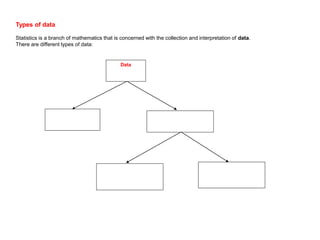
Types of data
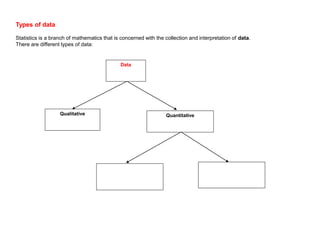
Statistics is a branch of mathematics that is concerned with the collection and interpretation of data.
There are different types of data:
Data
Types of data
Statistics is a branch of mathematics that is concerned with the collection and interpretation of data.
There are different types of data:
Data
QuantitativeQualitative
Types of data
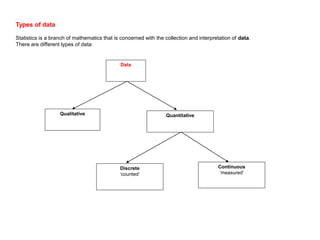
Statistics is a branch of mathematics that is concerned with the collection and interpretation of data.
There are different types of data:
Data
QuantitativeQualitative
Continuous
‘measured’
Discrete
‘counted’
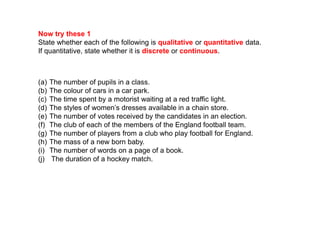
Now try these 1
State whether each of the following is qualitative or quantitative data.
If quantitative, state whether it is discrete or continuous.
(a) The number of pupils in a class.
(b) The colour of cars in a car park.
(c) The time spent by a motorist waiting at a red traffic light.
(d) The styles of women’s dresses available in a chain store.
(e) The number of votes received by the candidates in an election.
(f) The club of each of the members of the England football team.
(g) The number of players from a club who play football for England.
(h) The mass of a new born baby.
(i) The number of words on a page of a book.
(j) The duration of a hockey match.
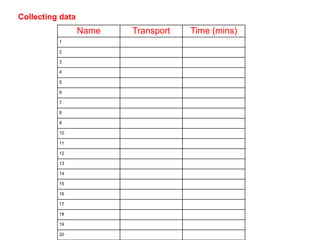
Collecting data
Name Transport Time (mins)
1
2
3
4
5
6
7
8
9
10
11
12
13
14
15
16
17
18
19
20
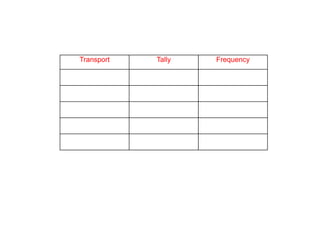
Transport Tally Frequency
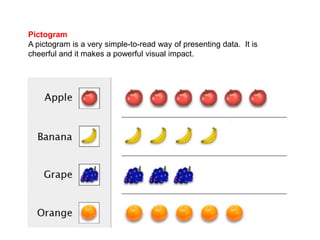
Pictogram
A pictogram is a very simple-to-read way of presenting data. It is
cheerful and it makes a powerful visual impact.
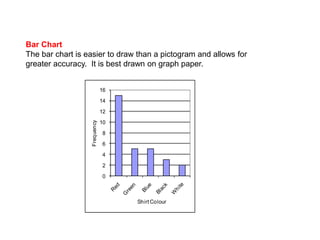
Bar Chart
The bar chart is easier to draw than a pictogram and allows for
greater accuracy. It is best drawn on graph paper.
0
2
4
6
8
10
12
14
16
Frequency
Shirt Colour
How to draw pie charts
Step 1
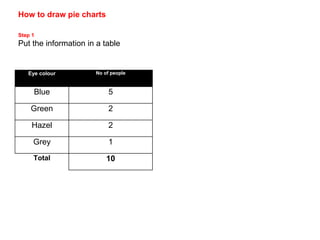
Put the information in a table
Eye colour No of people
Blue 5
Green 2
Hazel 2
Grey 1
Total 10
How to draw pie charts
Step 1
Put the information in a table
Eye colour No of people
Blue 5
Green 2
Hazel 2
Grey 1
Total 10
How to draw pie charts
Step 1
Put the information in a table
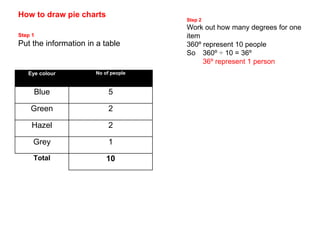
Step 2
Work out how many degrees for one
item
360º represent 10 people
So 360º ÷ 10 = 36º
36º represent 1 person
Eye colour No of people
Blue 5
Green 2
Hazel 2
Grey 1
Total 10
How to draw pie charts
Step 1
Put the information in a table
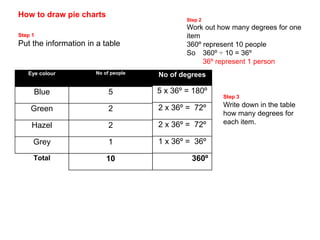
Step 2
Work out how many degrees for one
item
360º represent 10 people
So 360º ÷ 10 = 36º
36º represent 1 person
No of degrees
5 x 36º = 180º
2 x 36º = 72º
2 x 36º = 72º
1 x 36º = 36º
360º
Step 3
Write down in the table
how many degrees for
each item.
How to draw pie charts
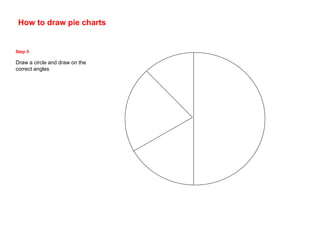
Step 5
Draw a circle and draw on the
correct angles
How to draw pie charts
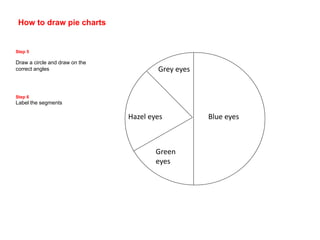
Step 5
Draw a circle and draw on the
correct angles
Step 6
Label the segments
Grey eyes
Blue eyes
Green
eyes
Hazel eyes
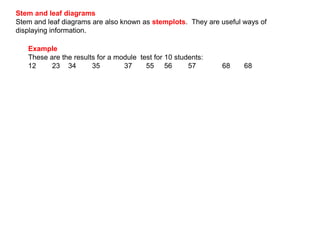
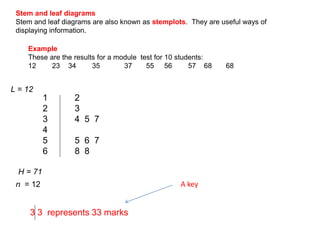
Stem and leaf diagrams
Stem and leaf diagrams are also known as stemplots. They are useful ways of
displaying information.
Example
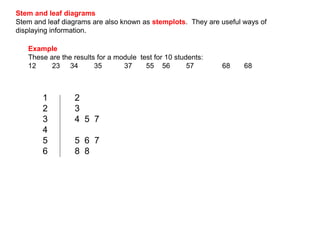
These are the results for a module test for 10 students:
12 23 34 35 37 55 56 57 68 68
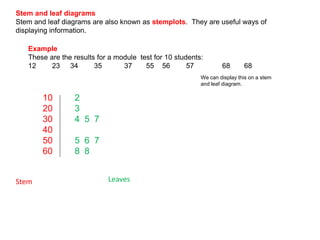
10 2
20 3
30 4 5 7
40
50 5 6 7
60 8 8
We can display this on a stem
and leaf diagram.
LeavesStem
Stem and leaf diagrams
Stem and leaf diagrams are also known as stemplots. They are useful ways of
displaying information.
Example
These are the results for a module test for 10 students:
12 23 34 35 37 55 56 57 68 68
1 2
2 3
3 4 5 7
4
5 5 6 7
6 8 8
Stem and leaf diagrams
Stem and leaf diagrams are also known as stemplots. They are useful ways of
displaying information.
Example
These are the results for a module test for 10 students:
12 23 34 35 37 55 56 57 68 68
1 2
2 3
3 4 5 7
4
5 5 6 7
6 8 8
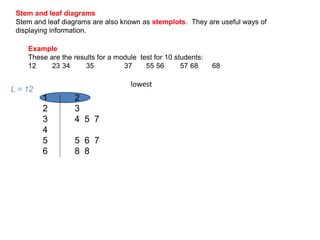
L = 12
lowest
Stem and leaf diagrams
Stem and leaf diagrams are also known as stemplots. They are useful ways of
displaying information.
Example
These are the results for a module test for 10 students:
12 23 34 35 37 55 56 57 68 68
1 2
2 3
3 4 5 7
4
5 5 6 7
6 8 8
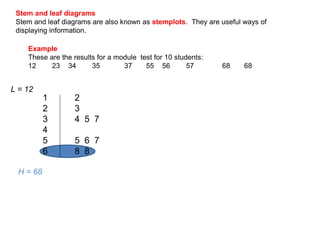
L = 12
H = 68
Stem and leaf diagrams
Stem and leaf diagrams are also known as stemplots. They are useful ways of
displaying information.
Example
These are the results for a module test for 10 students:
12 23 34 35 37 55 56 57 68 68
1 2
2 3
3 4 5 7
4
5 5 6 7
6 8 8
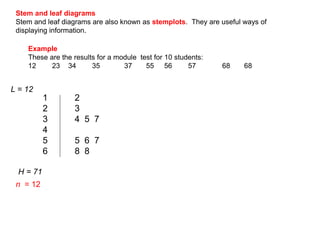
n = 12
L = 12
H = 71
Stem and leaf diagrams
Stem and leaf diagrams are also known as stemplots. They are useful ways of
displaying information.
Example
These are the results for a module test for 10 students:
12 23 34 35 37 55 56 57 68 68
1 2
2 3
3 4 5 7
4
5 5 6 7
6 8 8
3 3 represents 33 marks
n = 12
L = 12
H = 71
A key
Stem and leaf diagrams
Stem and leaf diagrams are also known as stemplots. They are useful ways of
displaying information.
Example
These are the results for a module test for 10 students:
12 23 34 35 37 55 56 57 68 68
Handling data 1
Handling data 1

Handling data 1

  • 1.
    Handling data 1 BTEOTSSSBAT: Identifyquantitative and qualitative data Display data using bar charts, pie charts and stem and leaf diagrams
  • 2.
    Key words Discrete Continuous Stem andleaf diagram data pictogram pie chart bar chart tally frequency
  • 3.
    Types of data Statisticsis a branch of mathematics that is concerned with the collection and interpretation of data. There are different types of data: Data
  • 4.
    Types of data Statisticsis a branch of mathematics that is concerned with the collection and interpretation of data. There are different types of data: Data QuantitativeQualitative
  • 5.
    Types of data Statisticsis a branch of mathematics that is concerned with the collection and interpretation of data. There are different types of data: Data QuantitativeQualitative Continuous ‘measured’ Discrete ‘counted’
  • 6.
    Now try these1 State whether each of the following is qualitative or quantitative data. If quantitative, state whether it is discrete or continuous. (a) The number of pupils in a class. (b) The colour of cars in a car park. (c) The time spent by a motorist waiting at a red traffic light. (d) The styles of women’s dresses available in a chain store. (e) The number of votes received by the candidates in an election. (f) The club of each of the members of the England football team. (g) The number of players from a club who play football for England. (h) The mass of a new born baby. (i) The number of words on a page of a book. (j) The duration of a hockey match.
  • 7.
    Collecting data Name TransportTime (mins) 1 2 3 4 5 6 7 8 9 10 11 12 13 14 15 16 17 18 19 20
  • 8.
  • 9.
    Pictogram A pictogram isa very simple-to-read way of presenting data. It is cheerful and it makes a powerful visual impact.
  • 10.
    Bar Chart The barchart is easier to draw than a pictogram and allows for greater accuracy. It is best drawn on graph paper. 0 2 4 6 8 10 12 14 16 Frequency Shirt Colour
  • 12.
    How to drawpie charts Step 1 Put the information in a table
  • 13.
    Eye colour Noof people Blue 5 Green 2 Hazel 2 Grey 1 Total 10 How to draw pie charts Step 1 Put the information in a table
  • 14.
    Eye colour Noof people Blue 5 Green 2 Hazel 2 Grey 1 Total 10 How to draw pie charts Step 1 Put the information in a table Step 2 Work out how many degrees for one item 360º represent 10 people So 360º ÷ 10 = 36º 36º represent 1 person
  • 15.
    Eye colour Noof people Blue 5 Green 2 Hazel 2 Grey 1 Total 10 How to draw pie charts Step 1 Put the information in a table Step 2 Work out how many degrees for one item 360º represent 10 people So 360º ÷ 10 = 36º 36º represent 1 person No of degrees 5 x 36º = 180º 2 x 36º = 72º 2 x 36º = 72º 1 x 36º = 36º 360º Step 3 Write down in the table how many degrees for each item.
  • 16.
    How to drawpie charts Step 5 Draw a circle and draw on the correct angles
  • 17.
    How to drawpie charts Step 5 Draw a circle and draw on the correct angles Step 6 Label the segments Grey eyes Blue eyes Green eyes Hazel eyes
  • 18.
    Stem and leafdiagrams Stem and leaf diagrams are also known as stemplots. They are useful ways of displaying information. Example These are the results for a module test for 10 students: 12 23 34 35 37 55 56 57 68 68
  • 19.
    10 2 20 3 304 5 7 40 50 5 6 7 60 8 8 We can display this on a stem and leaf diagram. LeavesStem Stem and leaf diagrams Stem and leaf diagrams are also known as stemplots. They are useful ways of displaying information. Example These are the results for a module test for 10 students: 12 23 34 35 37 55 56 57 68 68
  • 20.
    1 2 2 3 34 5 7 4 5 5 6 7 6 8 8 Stem and leaf diagrams Stem and leaf diagrams are also known as stemplots. They are useful ways of displaying information. Example These are the results for a module test for 10 students: 12 23 34 35 37 55 56 57 68 68
  • 21.
    1 2 2 3 34 5 7 4 5 5 6 7 6 8 8 L = 12 lowest Stem and leaf diagrams Stem and leaf diagrams are also known as stemplots. They are useful ways of displaying information. Example These are the results for a module test for 10 students: 12 23 34 35 37 55 56 57 68 68
  • 22.
    1 2 2 3 34 5 7 4 5 5 6 7 6 8 8 L = 12 H = 68 Stem and leaf diagrams Stem and leaf diagrams are also known as stemplots. They are useful ways of displaying information. Example These are the results for a module test for 10 students: 12 23 34 35 37 55 56 57 68 68
  • 23.
    1 2 2 3 34 5 7 4 5 5 6 7 6 8 8 n = 12 L = 12 H = 71 Stem and leaf diagrams Stem and leaf diagrams are also known as stemplots. They are useful ways of displaying information. Example These are the results for a module test for 10 students: 12 23 34 35 37 55 56 57 68 68
  • 24.
    1 2 2 3 34 5 7 4 5 5 6 7 6 8 8 3 3 represents 33 marks n = 12 L = 12 H = 71 A key Stem and leaf diagrams Stem and leaf diagrams are also known as stemplots. They are useful ways of displaying information. Example These are the results for a module test for 10 students: 12 23 34 35 37 55 56 57 68 68