Fractures And Dislocations of Hand
Dr Aftab Alam
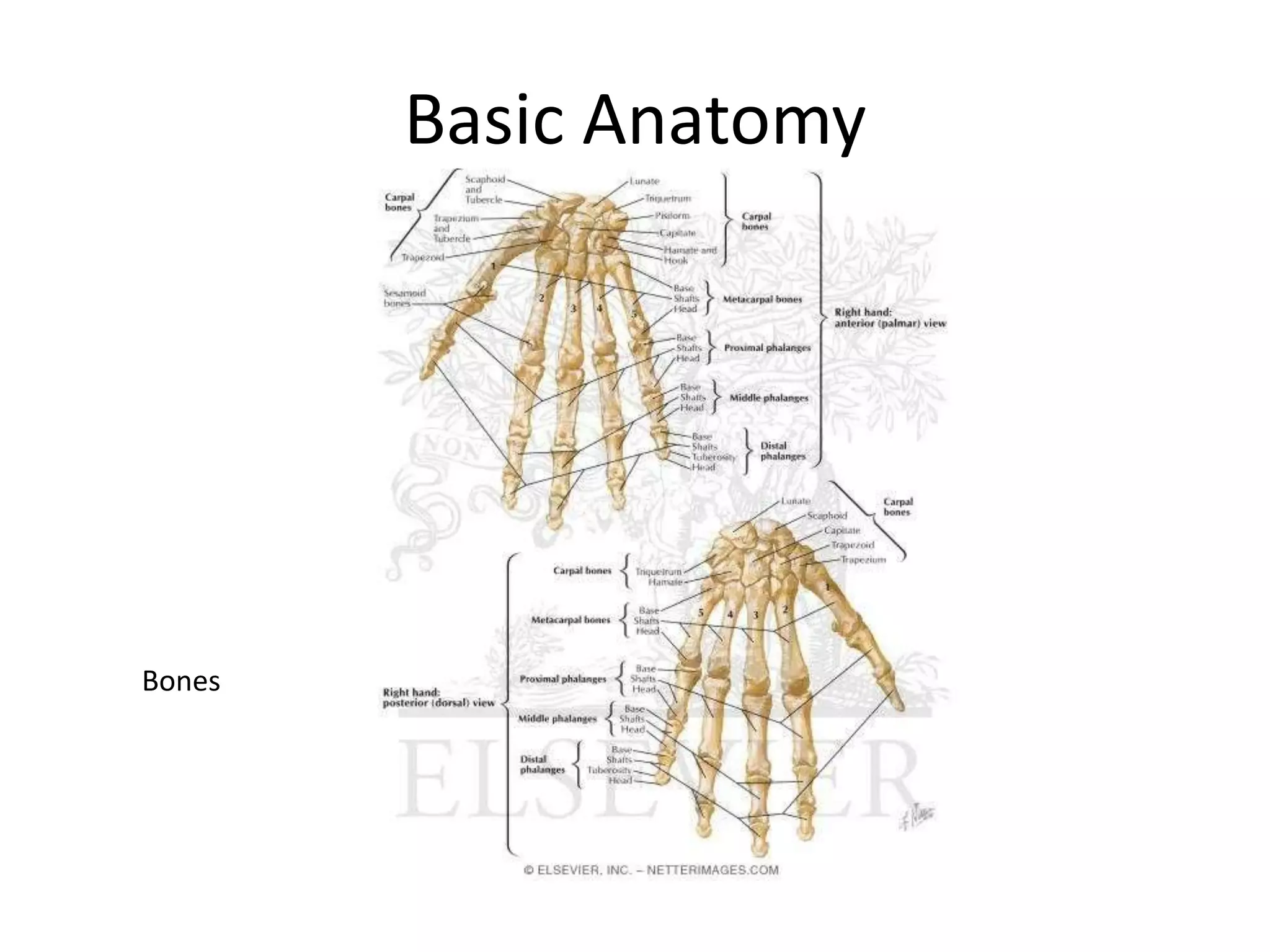
Basic Anatomy

Bones
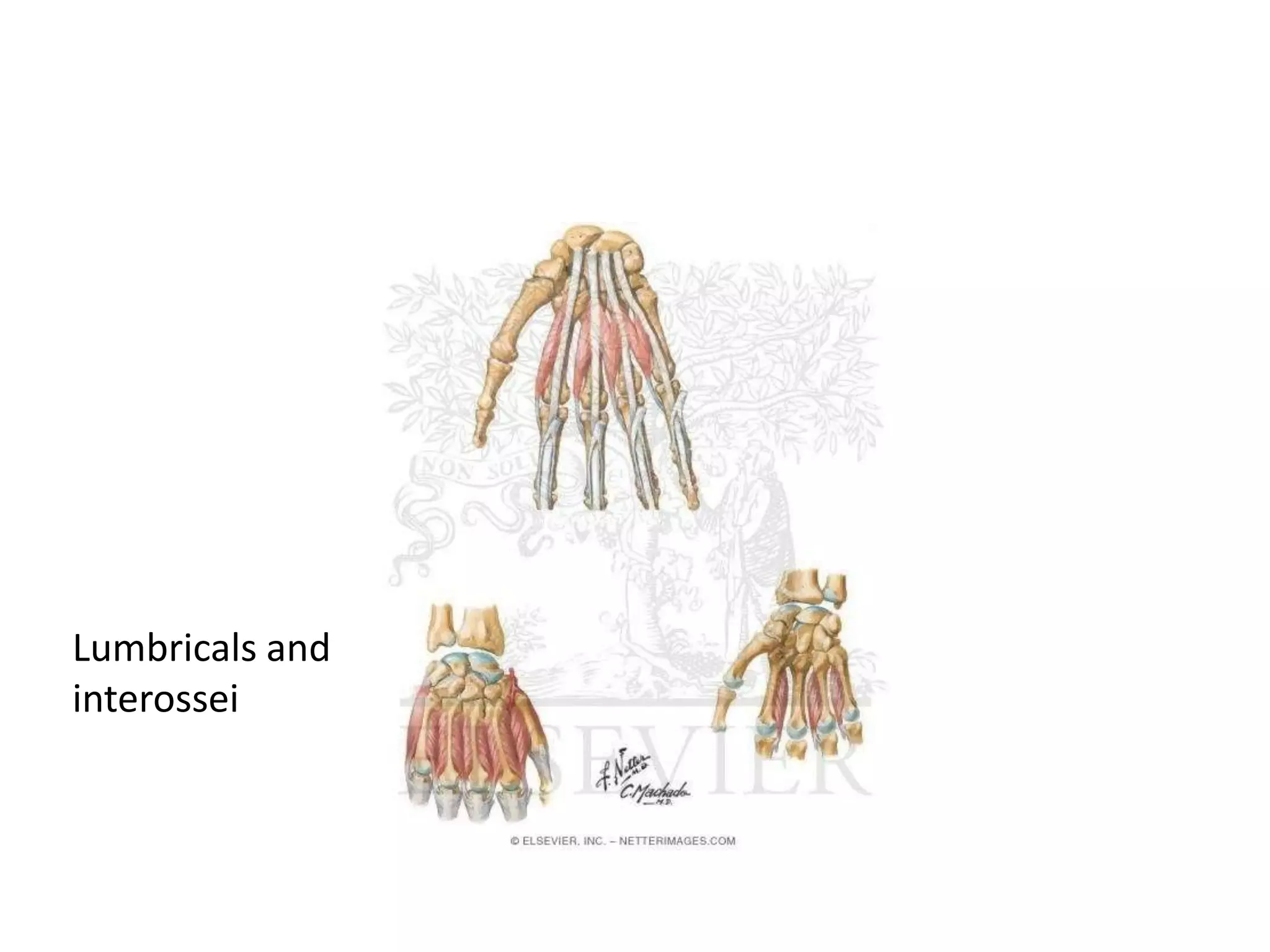
Lumbricals and
interossei
Blood supply
MR Angiogram of
hand
Principles of Management
-Mechanism of injury should be assessed regarding magitude ,
direction, point of application.
-Fracture reduction, reduction maneuvres should not cause
additional trauma and should be gentle.
-Complete neurovascular examination should be done.
-Injuries to tendons should be addressed.
-Splints should immobilize minimum no. of joints and allow
unrestricted motion at other joints.
-Total duration of immobilization should rarely exceed 4 weeks.
-Plain radiographs , atleast 2 projections centered at level of
interest, oblique views may show displacements not evident
on other views.
Injuries of the Thumb
• First CMC joint - Most important
• Injuries (# SL DL) cause limitation of motion pain & weakness

Bennett Fracture
• Bennett , Irish , 1882
• Intraarticular # through base of first MC
• Shaft dislocated laterally due to pull of Abductor Pollicis
Longus
• Medial fragment remains in place due to Volar Oblique Lig.
• Reduction easy but difficult to maintain.
• Closed Pinning
• Open fixation with K wires / 2- 2.7 mm screw
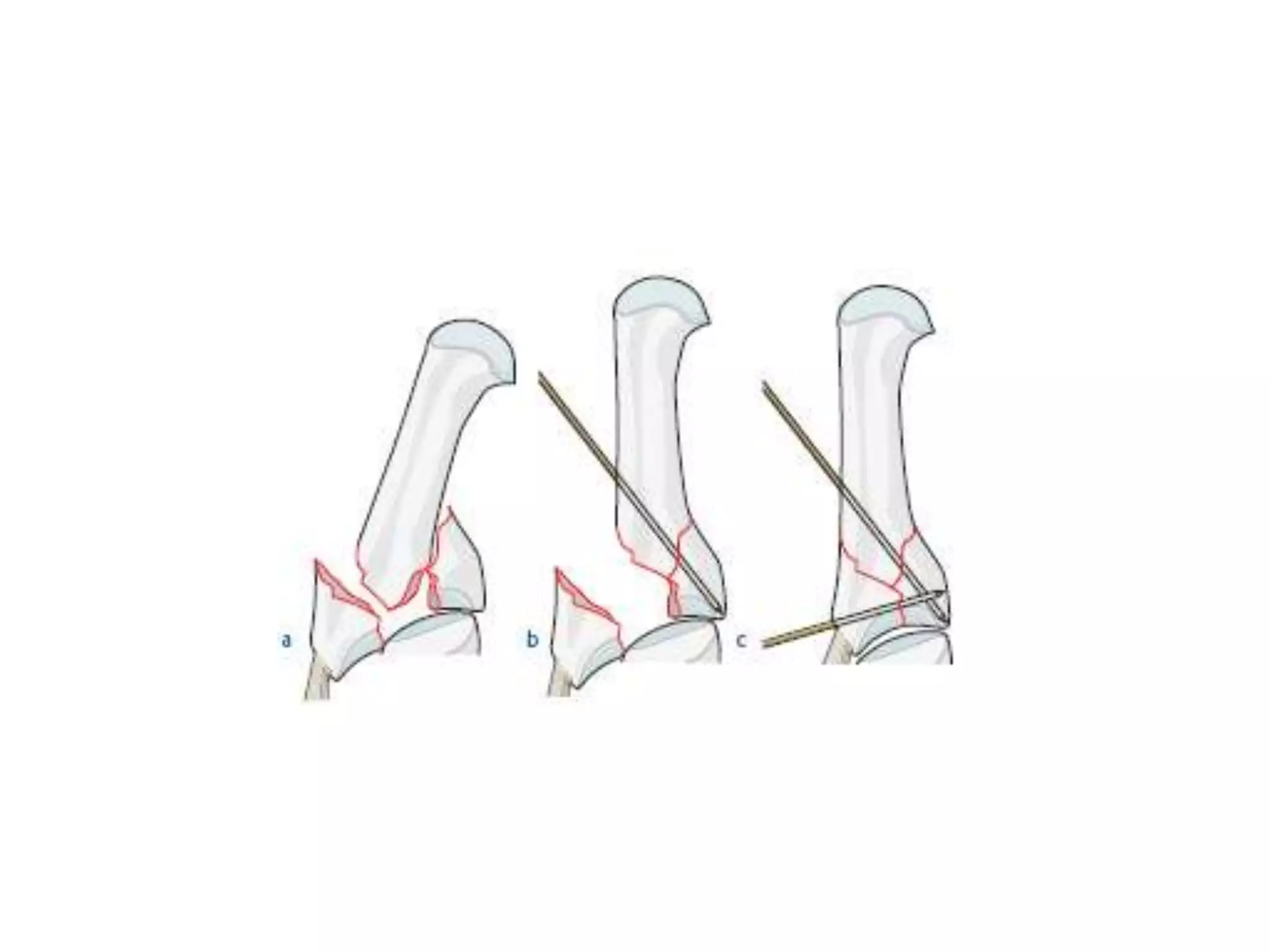
Wagner Tech for closed pinning
• Postoperative Care –
Cast for 4 wks
If screw fixation is used active ROM with intermittent
splinting at 2 wks.

• Complications –
Malunion with CMC arthritis (1-3mm tolerated)
Reduction not to be attempted after 6 wks
Corrective Osteotomy by Giachino
Arthritis –Arthrodesis /Arthroplasty
Rolando Fracture
•
•
•
•
•

Comminuted First Metacarpal Base #
Presents as ‘Y’ or ‘T’ Pattern
Differs from Bennette that usually no diaphyseal displacement
Likely for Posttraumatic arthritis – accurate reduction
Fixed with small wires placed under the subchondral bone
supplemented with a larger transarticular / transmetacarpal
pinning.
• TBW with Ex Fix
• T plate
• If reduction and fixation achieved well results are excellent.
Thumb Carpometacarpal Joint
Dislocation
•
•
•
•
•

Rare Injury
Reported cases mostly Dorsal dislocations
Dorsoradial & Volar Ob Lig most imp in preventing dislocation
Should be reduced and immobilized early for 4-6 wk.
If unstable OR and pinning with DR lig repair, immobilize for 46wk.
• Recurrent dislocation warrants ligament repair and
immobilization.
Thumb immobilizer
Thumb Metacarpophalangeal
Fractures
• Usually involve ulnar margin of proximal phalynx due to UCL
avulsion
• Small frag/ <2-3 mm disp – no surgery
• Large frag / Angulated /Displaced – require surgery
Thumb Metacarpophalangeal
Dislocations
•
•
•
•
•

Most common -Dorsal dislocation
Mech- hyperextension injury
Most common among all MCP dislocations
Simple- reducible closed
Complex- Irreducible by closed methods due to interposition
of sesamoids , volar plate , flexor tendon – open reduction
• Immobilized in 20 deg flexion for 4 wks
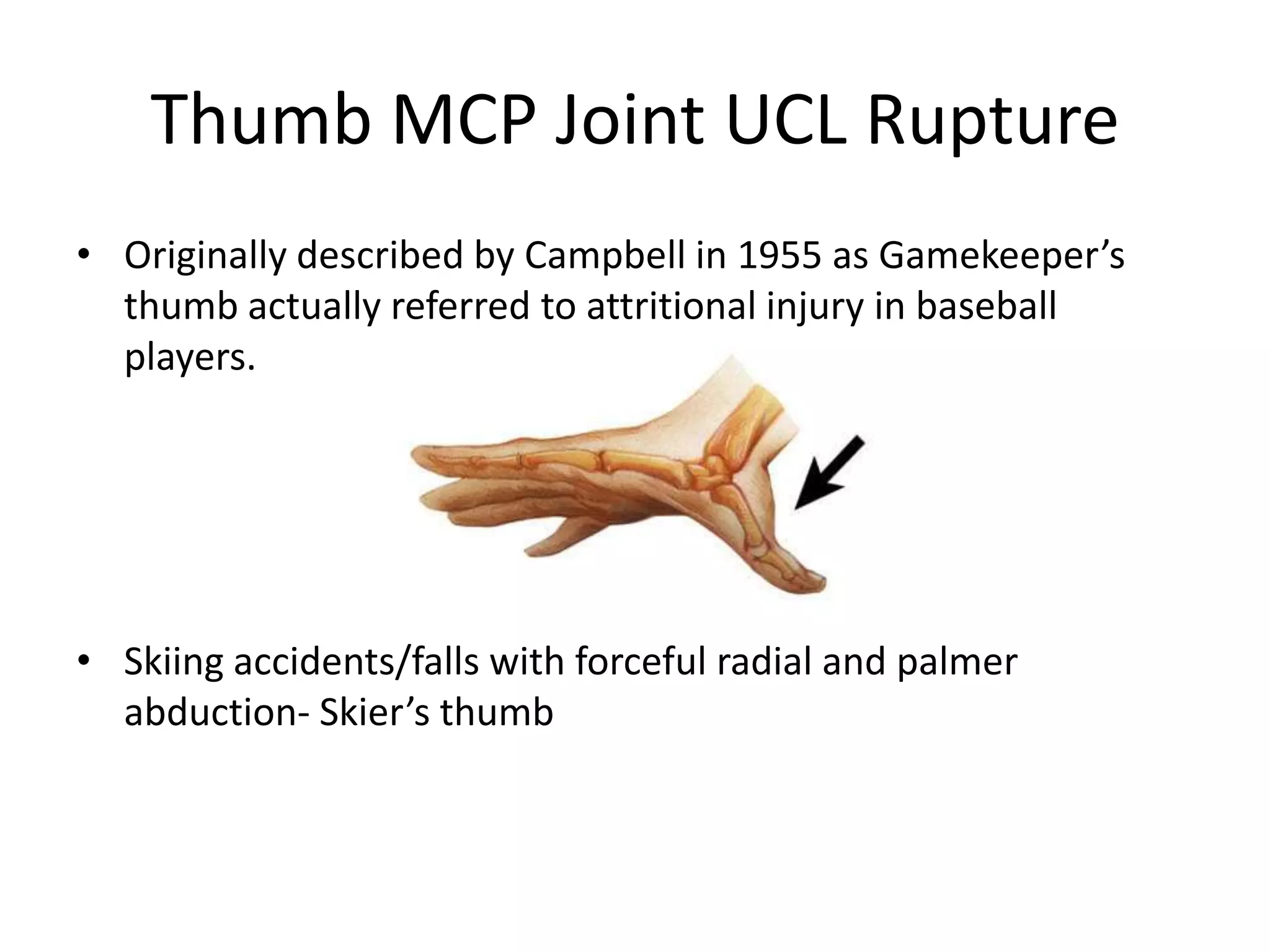
Thumb MCP Joint UCL Rupture
• Originally described by Campbell in 1955 as Gamekeeper’s
thumb actually referred to attritional injury in baseball
players.

• Skiing accidents/falls with forceful radial and palmer
abduction- Skier’s thumb
Stener Lesion - adductor aponeurosis interposed between
the ruptured ulnar collateral ligament and its site of insertion
on the base of the proximal phalanx.
Prevents healing -> chronic instability -> arthroses

Associated injuries - avulsion # , dorsal capsular rupture ,
volar plate tears.
• Plane Xray – if <2mm disp signifies absence of Steiner lesion
and heals with casting only.
• Avoid stress at joint to prevent Steiner lesion
• Salter Harris I/II injuries stress films contraindicated
• USG, Arthrography,MRI 
Incomplete rupture – thumb spica 4-6 wk
Complete rupture – surgical repair
Thumb MCP Radial Collateral Ligament
Injury
• Less frequent than UCL injury
• No lesion like steiner exist.
• Incomplete tears/tears without volar , rotational subluxationtreated with cast for 4-6 wks
• Complete tear with subluxation – direct repair.
• Supplemental PL tendon graft , advancement of APB for
chronic instability.
Improper treatment leads to painful instability during ‘push off’
Carpometacarpal Fracture-Dislocations
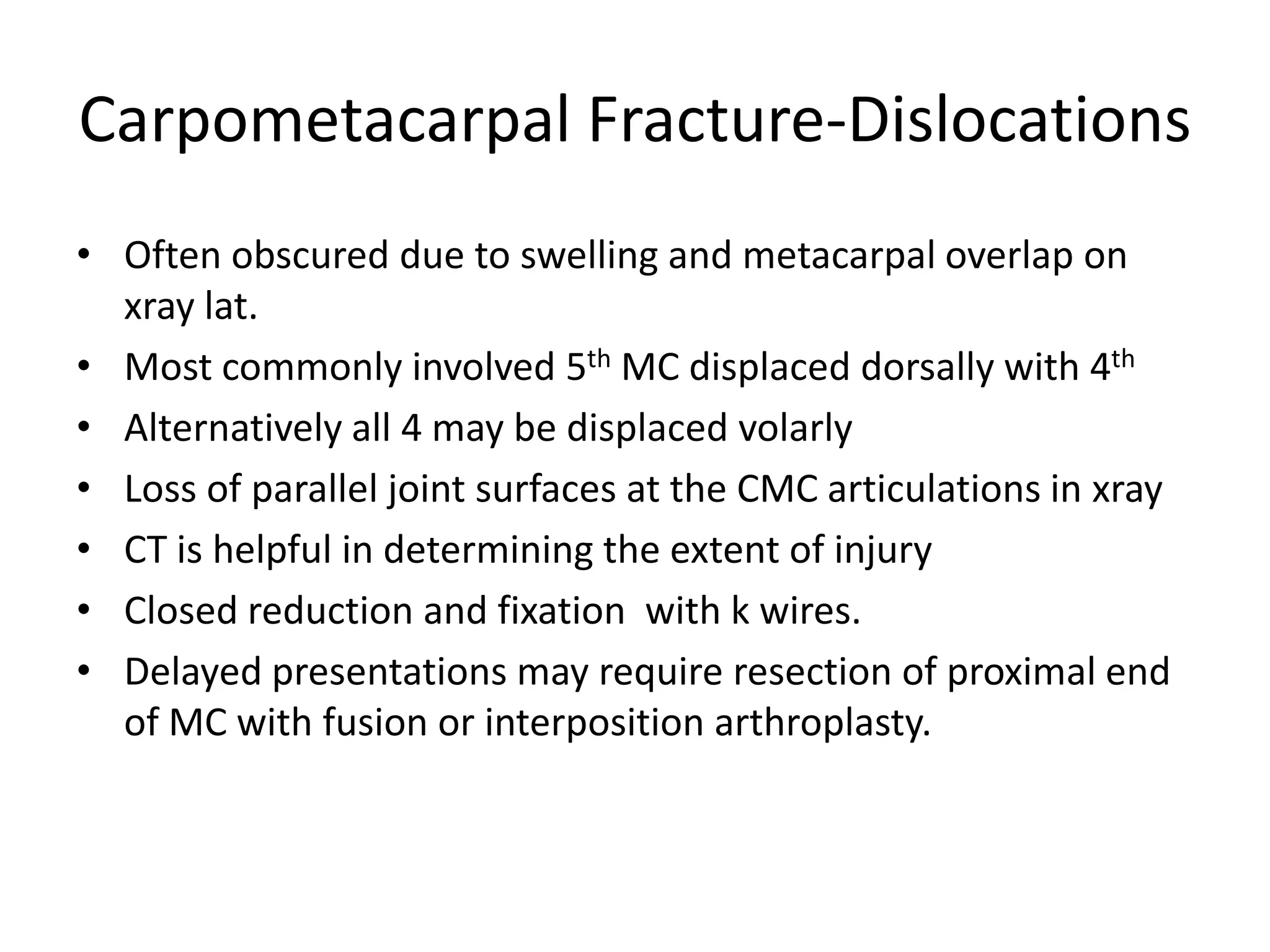
• Often obscured due to swelling and metacarpal overlap on
xray lat.
• Most commonly involved 5th MC displaced dorsally with 4th
• Alternatively all 4 may be displaced volarly
• Loss of parallel joint surfaces at the CMC articulations in xray
• CT is helpful in determining the extent of injury
• Closed reduction and fixation with k wires.
• Delayed presentations may require resection of proximal end
of MC with fusion or interposition arthroplasty.
#dislocation of 5th mc , reduced and fixed with k wires
CMC dislocation 4th 5th MC
HamatoMC #dislocaton
Intraarticular Fracture of the Fifth
Metacarpal Base
• Disabling injury
• If unattended, malunion results in weakness of grip and
painful joint.
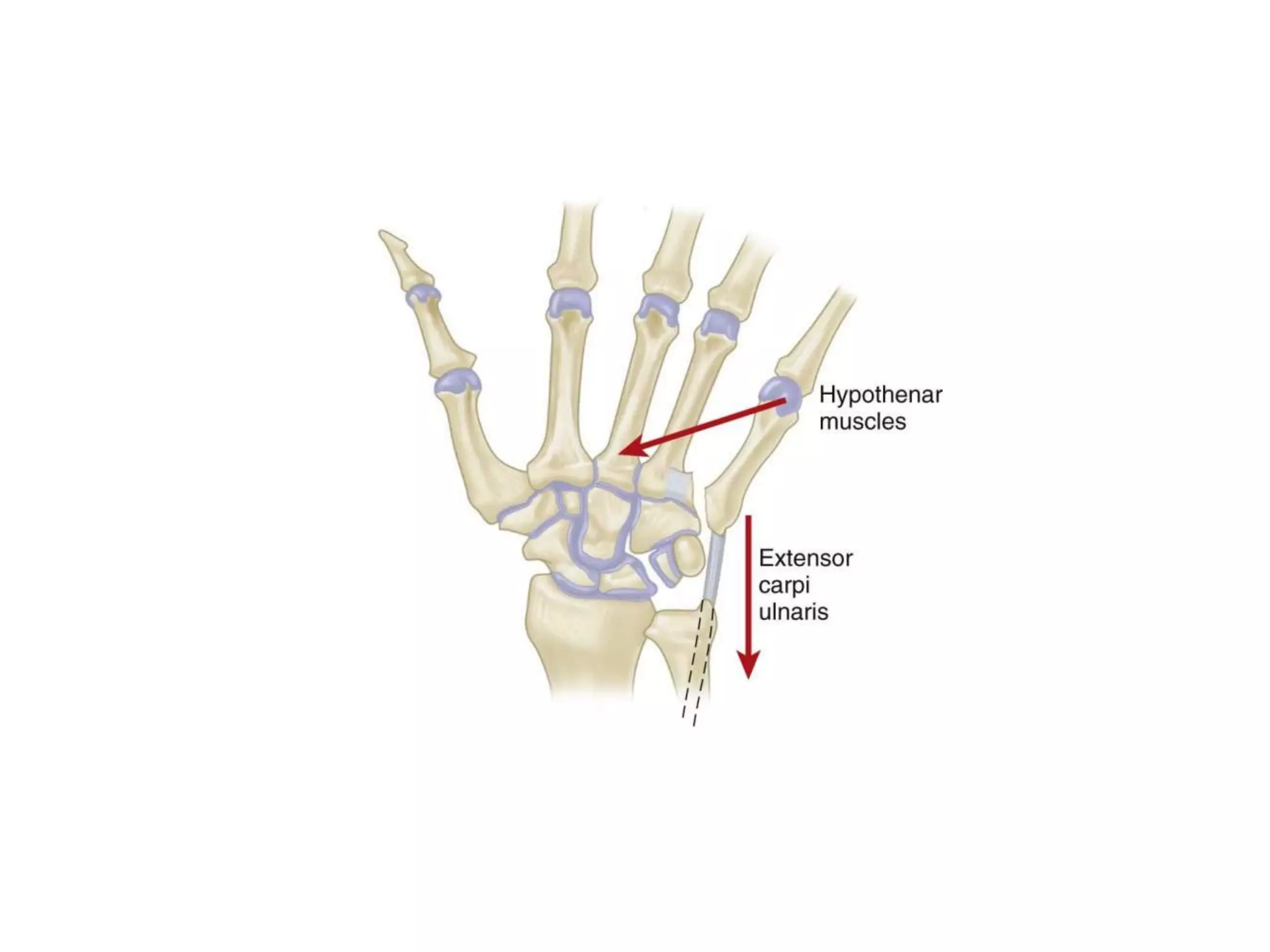
• Lesion somewhat similar to Bennett # due to ECU attachment
• Reduction and pinning
• Malunion may require corrective osteotomy and resection
arthroplasty.
Malunion , resection arthroplasty , ECU tendon should be
reattached
Finger Metacarpophalangeal
Dislocations
•
•
•
•

Less common than IP dislocations
Commonly seen in Index finger
Dislocation results in Kaplans lesion
Fibrocartilaginous plate avulses from volar aspect of the
second metacarpal neck(weakest attachment).
• The flexor tendons and the pretendinous band are displaced
ulnarly and the lumbrical radially to the metacarpal head .
Reduction of MCP dislocation
• Incomplete dislocation- easy reduction
• Complete dislocation - 50 % success by closed reduction
-50% require open reduction by volar or dorsal approach and
requires complete division of volar plate.
• Subsequently protect joint from hyperextension for 3 wks
Metacarpal Shaft or Neck Fractures
•
•
•
•
•

Generally treated by closed methods
OR & fixation req if multiple/assoc with soft tissue injury
Most imp factor in reduction- Rotational alignment
Transverse shaft #s fixed with IM K wires
Oblique #s can be fixed with interfragmentary screws
Boxer’s Fracture
• Metacarpal neck # involving little finger
• Metacarpal head is freed from any proximal stabilizing
influence so metacarpal head tilts volarly causing joint to lie
in hyperextension & collateral ligaments become slack.
• If joint is allowed to remain in hyperextension, collateral
ligaments will shorten, leading to limited MCP flexion.
• An infrequent variant of Boxer’s # may involve MC head
Angulation (measured-15)
• Non Operative Treatment
• Clawing results from the palmar displacement of the
metacarpal head & resulting imbalance of extrinsic tendons
Pt may have cosmetic deformity, but good function
• Reduction method
Collateral ligs must be placed in a tightened position to
control distal fragment and achieve reduction.
MC joint flexed to 90 to tighten collateral, flexed metacarpal is
directed dorsally, which effects reduction of metacarpal head
by correction of volar angulation.
• Criteria for acceptable reduction
Lateral view -angulation > 30-40 deg- functional deficit (pc) may
result - consider percutaneous pin fixation.
30 deg of angulation results in loss of 22% of finger ROM
AP view -little or no angulation should be accepted -indicates
mal-rotation of the digit
• Casting
Buddy taping should always be done irrespective of method
of casting.
This prevents malrotation.
Bouquet Pinning of Metacarpal Neck Fracture
Care should be taken to protect wrist extensors tendons by
giving an incision and partially elevating them
Sharp tip is cut off , bent about 3mm from leading end.
Enter the canal at most acute angle possible
Put several k wires through the # site
Goal is to tension the wires off the intact proximal cortex and
enter the distal fragment in various locations, creating a
“bouquet” effect.
• Operative treatment
can be done with K wires
Indications for plating of MC shaft #s
• Multiple fractures with gross displacement or additional soft
tissue injury
• Displaced diaphyseal transverse, short oblique, or short spiral
fractures
• Comminuted intraarticular and periarticular fractures
• Comminuted fractures with shortening or malrotation or both
• Fractures with substance loss or segmental defects.
Metacarpal Head Fractures
• Intraarticular , often of 4th and 5th MC heads
• Occurs during fist fight,hitting opponents teeth
IM K wire fixation of 4th MC shaft
Tech for percutaneous pinning
Tech for ORIF of MC shaft #
Plating for MC shaft
Multiple #s treated with plating
Ex Fix for 5th
MC shaft
MC shaft # fixed with Interfragmantary screws
Fracture of the Middle or Proximal Phalanx
Direct blow over dorsum
Palmer angulation with clawing
Pratt’s method ORIF
Proximal Interphalangeal Joint FractureDislocation
Always an unstable dorsal displacement of the middle phalanx
caused by disruption of the attachment of the volar
fibrocartilaginous plate.
If – single VOLAR fragment with >50% jt space – ORIF
-- <50% of articular space – active motion of PIP jt while
maintaining finger in extension block splint.
Other modalities include
Hemi-hamate autograft
• Closed Reduction and Extension Block
Splinting
Excessive comminution of middle phalynx shaft is better treated
by traction than by open methods.
Various available devices allow early motion at PIP and DIP jt
Dynamic External Splint Reduction
This technique relies on coupling distraction and volarly directed
forces across the joint in # dislocation of PIP jt
Interphalangeal Dislocations
Mostly dorsal
Easily reduced
Collaterals usually intact
If ligaments are ruptured, repair is required ,especially radial
collateral lig.
With persistent dorsal subluxation, the joint may be pinned in 20
degrees of flexion for 2 to 3 weeks.
Undiagnosed Interphalangeal Dislocations
Rarely a dislocation may be obscured by swelling.
Joint cartilage may be eroded by pressure from articular edge in
a weeks time,open reduction is necessary
Distal Phalangeal Fractures
Usually crushed comminuted #s
Require only splinting
In cases of near amputations 22-gauge hypodermic needle can
be used for supporting the bone while the soft tissues heal.
Sometimes may be fixed with compression screws to prevent
nonunion
Mallet finger
Distal interphalangeal joint extension lag due to disruption of the
terminal extensor tendon.
Mechanism of injury
Full passive joint extension is present.
Proximal migration of extensor apparatus may result in swan
neck deformity
Type 1: Closed or blunt trauma with loss of tendon continuity
with or without a small avulsion fracture
Type 2: Laceration at or proximal to the distal interphalangeal
joint with loss of tendon continuity
Type 3: Deep abrasion with loss of skin, subcutaneous cover, and
tendon substance
Type 4: 4A—transphyseal fracture in children
4B—hyperflexion injury with fracture of articular surface
of 20% to 50%
4C—hyperextension injury with fracture of the articular
surface usually greater than 50% with early or late volar
subluxation of the distal phalanx.
Treatment for type 1(most common)
Contineous extension of DIP jt with splint
Type 2 can be treated by tendon suture repair and Kirschner wire
fixation of the distal interphalangeal joint in full extension.
Type 3 mallet fingers require soft tissue coverage and pinning of
the distal interphalangeal joint and possible primary
arthrodesis.
Type 4 Open reduction and K wire fixation of the epiphyseal
fragment is indicated if closed reduction cannot be obtained
Type 4 mallet finger treated with pinning and pullout wire
Complications
Increased association of complications seen with
- rigid internal fixation (attributed to necessity)
- intra/periarticular injuries
Complications can be
- malunion/nonunion
- hardware associated
- extensor lag
- infection
- contractures
- instability
Infections
Seen despite excellent vascularity.
Often seen in injuries associated with crushing component
Preoperative wound culture proves to be of no help
Most commonly associated organism S.Aureus
Open wound , non contaminated with intact vascularity role of
antibiotics in reducing infection rate has not been supported
Stiffness
Most common and most feared complication
Resultant Stiffness is contributed by
magnitude of original trauma
age and genetic composition of the patient
duration of immobilisation
position of immobilisation
invasiveness of intervention
Position of immobilisation should follow the principles of
splinting ligaments at full length and balancing tendon forces
that act across a joint.
First webspace contractures are common , can be prevented by
splinting the first metacarpal in max abduction
Once a fixed contracture has developed , tenocapsulolysis can be
done if patient desires to improve motion
Hypersensitivity
• Small size of hand with complex distribution of fine nerves
provide very few areas to have clear incision or percutaneous
pins maintaining a distance of 1 cm
• Crush injuries- invariably assoc. with hypersensitivity
• Neuroma formation should be guarded especially while
operating on
-ulnar side of thumb MP(high conc. Of dorsal digital N
branches.
-radial side of wrist (near superficial radial N)
Treatment – gabapentin , amytriptyline , pregabalin , contact
desensitisation therapy
Malunion and Deformity
Frequently encountered due to lack of understanding hand biomechanics
belief that all hand # do well with non op treatment
due to a non compliant patient
Malunions should be managed with corrective osteotomy
at deformity site/ compensatory
Rotational corrections best done at MC base(cancellous)(25-30)
Rotational deformity is result of improper choice of non op Rx
Corrective osteotomies are more successfulful at MC level than
phalyngeal level
• Tenolysis alone improves extensor lag
• Intraarticular osteotomy can be done for selected cases of
intraarticular malunion at MC head.
• IA malunion may cause OA ,decreased grip and pain
• Exact pattern of osteotomy should be assessed for chosing
the type of osteotomy (opening wedge closing wedge , pivot
osteotomy oblique osteotomy)
• Shortening should be considered if closed osteotomy planned
• Extensor lag of 7 degrees predictable for every 2 mm
shortening
Nonunion
Rare in hand fractures with exception of distal phalynx.
Seen where - CRIF has caused distraction or
- ORIF with excessive stripping of periosteum
Hypertrophic nonunion addressed by DCP alone
Variable pitch compression screws for distal phalynx #
Osteonecrosis of MC head in IA # as it lacks independent blood
supply
Residual Instability
More common proximally (cmc) following dislocation.
Pure dislocations tend to be more unstable as all ligaments are
torn and require Lig-Lig or Lig-Bone healing
Fracture dislocations,one or more of key stabilizing ligaments
remain intact.
CMC #dislocations can be assesed by injecting local anaesthetic,
if it relieves pain, Arthrodesis (5th in 20-30deg)
Posttraumatic arthritis
IA # and residual joint instability may cause accelarated hyaline
cartilage wear.
There is poor corelation between radiographic appearance and
clinical loss of function and pain.
Fusion can be done for CMC of index and middle finger.
Fusion of MP and PIP jt results in loss of function
Tendon ruptures
Missed tendon ruptures associated with dislocations may lead to
deformity posture
mallet finger it DIP
boutonniere deformity at PIP
Treatment involves arthrodesis in flexion at DIP whereas effort
should be made at PIP jt to restore extension as arthrodesis is
not well tolerated here.
Fractures and dislocations of hand

Fractures and dislocations of hand

  • 1.
    Fractures And Dislocationsof Hand Dr Aftab Alam
  • 2.
  • 3.
  • 4.
  • 5.
  • 9.
    Principles of Management -Mechanismof injury should be assessed regarding magitude , direction, point of application. -Fracture reduction, reduction maneuvres should not cause additional trauma and should be gentle. -Complete neurovascular examination should be done. -Injuries to tendons should be addressed. -Splints should immobilize minimum no. of joints and allow unrestricted motion at other joints. -Total duration of immobilization should rarely exceed 4 weeks. -Plain radiographs , atleast 2 projections centered at level of interest, oblique views may show displacements not evident on other views.
  • 10.
  • 11.
    • First CMCjoint - Most important • Injuries (# SL DL) cause limitation of motion pain & weakness Bennett Fracture • Bennett , Irish , 1882 • Intraarticular # through base of first MC • Shaft dislocated laterally due to pull of Abductor Pollicis Longus • Medial fragment remains in place due to Volar Oblique Lig. • Reduction easy but difficult to maintain. • Closed Pinning • Open fixation with K wires / 2- 2.7 mm screw
  • 14.
    Wagner Tech forclosed pinning
  • 16.
    • Postoperative Care– Cast for 4 wks If screw fixation is used active ROM with intermittent splinting at 2 wks. • Complications – Malunion with CMC arthritis (1-3mm tolerated) Reduction not to be attempted after 6 wks Corrective Osteotomy by Giachino Arthritis –Arthrodesis /Arthroplasty
  • 17.
    Rolando Fracture • • • • • Comminuted FirstMetacarpal Base # Presents as ‘Y’ or ‘T’ Pattern Differs from Bennette that usually no diaphyseal displacement Likely for Posttraumatic arthritis – accurate reduction Fixed with small wires placed under the subchondral bone supplemented with a larger transarticular / transmetacarpal pinning. • TBW with Ex Fix • T plate
  • 22.
    • If reductionand fixation achieved well results are excellent.
  • 23.
    Thumb Carpometacarpal Joint Dislocation • • • • • RareInjury Reported cases mostly Dorsal dislocations Dorsoradial & Volar Ob Lig most imp in preventing dislocation Should be reduced and immobilized early for 4-6 wk. If unstable OR and pinning with DR lig repair, immobilize for 46wk. • Recurrent dislocation warrants ligament repair and immobilization.
  • 26.
  • 27.
    Thumb Metacarpophalangeal Fractures • Usuallyinvolve ulnar margin of proximal phalynx due to UCL avulsion • Small frag/ <2-3 mm disp – no surgery • Large frag / Angulated /Displaced – require surgery
  • 29.
    Thumb Metacarpophalangeal Dislocations • • • • • Most common-Dorsal dislocation Mech- hyperextension injury Most common among all MCP dislocations Simple- reducible closed Complex- Irreducible by closed methods due to interposition of sesamoids , volar plate , flexor tendon – open reduction • Immobilized in 20 deg flexion for 4 wks
  • 31.
    Thumb MCP JointUCL Rupture • Originally described by Campbell in 1955 as Gamekeeper’s thumb actually referred to attritional injury in baseball players. • Skiing accidents/falls with forceful radial and palmer abduction- Skier’s thumb
  • 35.
    Stener Lesion -adductor aponeurosis interposed between the ruptured ulnar collateral ligament and its site of insertion on the base of the proximal phalanx. Prevents healing -> chronic instability -> arthroses Associated injuries - avulsion # , dorsal capsular rupture , volar plate tears.
  • 36.
    • Plane Xray– if <2mm disp signifies absence of Steiner lesion and heals with casting only. • Avoid stress at joint to prevent Steiner lesion • Salter Harris I/II injuries stress films contraindicated • USG, Arthrography,MRI  Incomplete rupture – thumb spica 4-6 wk Complete rupture – surgical repair
  • 37.
    Thumb MCP RadialCollateral Ligament Injury • Less frequent than UCL injury • No lesion like steiner exist. • Incomplete tears/tears without volar , rotational subluxationtreated with cast for 4-6 wks • Complete tear with subluxation – direct repair. • Supplemental PL tendon graft , advancement of APB for chronic instability.
  • 38.
    Improper treatment leadsto painful instability during ‘push off’
  • 39.
    Carpometacarpal Fracture-Dislocations • Oftenobscured due to swelling and metacarpal overlap on xray lat. • Most commonly involved 5th MC displaced dorsally with 4th • Alternatively all 4 may be displaced volarly • Loss of parallel joint surfaces at the CMC articulations in xray • CT is helpful in determining the extent of injury • Closed reduction and fixation with k wires. • Delayed presentations may require resection of proximal end of MC with fusion or interposition arthroplasty.
  • 40.
    #dislocation of 5thmc , reduced and fixed with k wires
  • 41.
  • 42.
  • 43.
    Intraarticular Fracture ofthe Fifth Metacarpal Base • Disabling injury • If unattended, malunion results in weakness of grip and painful joint. • Lesion somewhat similar to Bennett # due to ECU attachment • Reduction and pinning • Malunion may require corrective osteotomy and resection arthroplasty.
  • 45.
    Malunion , resectionarthroplasty , ECU tendon should be reattached
  • 46.
    Finger Metacarpophalangeal Dislocations • • • • Less commonthan IP dislocations Commonly seen in Index finger Dislocation results in Kaplans lesion Fibrocartilaginous plate avulses from volar aspect of the second metacarpal neck(weakest attachment). • The flexor tendons and the pretendinous band are displaced ulnarly and the lumbrical radially to the metacarpal head .
  • 49.
    Reduction of MCPdislocation
  • 50.
    • Incomplete dislocation-easy reduction • Complete dislocation - 50 % success by closed reduction -50% require open reduction by volar or dorsal approach and requires complete division of volar plate. • Subsequently protect joint from hyperextension for 3 wks
  • 51.
    Metacarpal Shaft orNeck Fractures • • • • • Generally treated by closed methods OR & fixation req if multiple/assoc with soft tissue injury Most imp factor in reduction- Rotational alignment Transverse shaft #s fixed with IM K wires Oblique #s can be fixed with interfragmentary screws
  • 52.
    Boxer’s Fracture • Metacarpalneck # involving little finger • Metacarpal head is freed from any proximal stabilizing influence so metacarpal head tilts volarly causing joint to lie in hyperextension & collateral ligaments become slack. • If joint is allowed to remain in hyperextension, collateral ligaments will shorten, leading to limited MCP flexion. • An infrequent variant of Boxer’s # may involve MC head
  • 54.
  • 56.
    • Non OperativeTreatment • Clawing results from the palmar displacement of the metacarpal head & resulting imbalance of extrinsic tendons Pt may have cosmetic deformity, but good function • Reduction method Collateral ligs must be placed in a tightened position to control distal fragment and achieve reduction. MC joint flexed to 90 to tighten collateral, flexed metacarpal is directed dorsally, which effects reduction of metacarpal head by correction of volar angulation.
  • 57.
    • Criteria foracceptable reduction Lateral view -angulation > 30-40 deg- functional deficit (pc) may result - consider percutaneous pin fixation. 30 deg of angulation results in loss of 22% of finger ROM AP view -little or no angulation should be accepted -indicates mal-rotation of the digit
  • 58.
    • Casting Buddy tapingshould always be done irrespective of method of casting. This prevents malrotation.
  • 60.
    Bouquet Pinning ofMetacarpal Neck Fracture Care should be taken to protect wrist extensors tendons by giving an incision and partially elevating them Sharp tip is cut off , bent about 3mm from leading end. Enter the canal at most acute angle possible Put several k wires through the # site Goal is to tension the wires off the intact proximal cortex and enter the distal fragment in various locations, creating a “bouquet” effect.
  • 63.
    • Operative treatment canbe done with K wires
  • 64.
    Indications for platingof MC shaft #s • Multiple fractures with gross displacement or additional soft tissue injury • Displaced diaphyseal transverse, short oblique, or short spiral fractures • Comminuted intraarticular and periarticular fractures • Comminuted fractures with shortening or malrotation or both • Fractures with substance loss or segmental defects.
  • 65.
    Metacarpal Head Fractures •Intraarticular , often of 4th and 5th MC heads • Occurs during fist fight,hitting opponents teeth
  • 66.
    IM K wirefixation of 4th MC shaft
  • 67.
  • 68.
    Tech for ORIFof MC shaft #
  • 69.
  • 70.
    Multiple #s treatedwith plating
  • 71.
    Ex Fix for5th MC shaft
  • 72.
    MC shaft #fixed with Interfragmantary screws
  • 73.
    Fracture of theMiddle or Proximal Phalanx Direct blow over dorsum Palmer angulation with clawing
  • 75.
  • 77.
    Proximal Interphalangeal JointFractureDislocation Always an unstable dorsal displacement of the middle phalanx caused by disruption of the attachment of the volar fibrocartilaginous plate. If – single VOLAR fragment with >50% jt space – ORIF -- <50% of articular space – active motion of PIP jt while maintaining finger in extension block splint. Other modalities include Hemi-hamate autograft
  • 78.
    • Closed Reductionand Extension Block Splinting
  • 80.
    Excessive comminution ofmiddle phalynx shaft is better treated by traction than by open methods. Various available devices allow early motion at PIP and DIP jt
  • 81.
    Dynamic External SplintReduction This technique relies on coupling distraction and volarly directed forces across the joint in # dislocation of PIP jt
  • 83.
    Interphalangeal Dislocations Mostly dorsal Easilyreduced Collaterals usually intact If ligaments are ruptured, repair is required ,especially radial collateral lig. With persistent dorsal subluxation, the joint may be pinned in 20 degrees of flexion for 2 to 3 weeks.
  • 84.
    Undiagnosed Interphalangeal Dislocations Rarelya dislocation may be obscured by swelling. Joint cartilage may be eroded by pressure from articular edge in a weeks time,open reduction is necessary
  • 85.
    Distal Phalangeal Fractures Usuallycrushed comminuted #s Require only splinting In cases of near amputations 22-gauge hypodermic needle can be used for supporting the bone while the soft tissues heal. Sometimes may be fixed with compression screws to prevent nonunion
  • 87.
  • 88.
    Distal interphalangeal jointextension lag due to disruption of the terminal extensor tendon. Mechanism of injury
  • 89.
    Full passive jointextension is present. Proximal migration of extensor apparatus may result in swan neck deformity
  • 90.
    Type 1: Closedor blunt trauma with loss of tendon continuity with or without a small avulsion fracture Type 2: Laceration at or proximal to the distal interphalangeal joint with loss of tendon continuity Type 3: Deep abrasion with loss of skin, subcutaneous cover, and tendon substance Type 4: 4A—transphyseal fracture in children 4B—hyperflexion injury with fracture of articular surface of 20% to 50% 4C—hyperextension injury with fracture of the articular surface usually greater than 50% with early or late volar subluxation of the distal phalanx.
  • 91.
    Treatment for type1(most common) Contineous extension of DIP jt with splint
  • 92.
    Type 2 canbe treated by tendon suture repair and Kirschner wire fixation of the distal interphalangeal joint in full extension. Type 3 mallet fingers require soft tissue coverage and pinning of the distal interphalangeal joint and possible primary arthrodesis. Type 4 Open reduction and K wire fixation of the epiphyseal fragment is indicated if closed reduction cannot be obtained
  • 94.
    Type 4 malletfinger treated with pinning and pullout wire
  • 97.
    Complications Increased association ofcomplications seen with - rigid internal fixation (attributed to necessity) - intra/periarticular injuries Complications can be - malunion/nonunion - hardware associated - extensor lag - infection - contractures - instability
  • 98.
    Infections Seen despite excellentvascularity. Often seen in injuries associated with crushing component Preoperative wound culture proves to be of no help Most commonly associated organism S.Aureus Open wound , non contaminated with intact vascularity role of antibiotics in reducing infection rate has not been supported
  • 99.
    Stiffness Most common andmost feared complication Resultant Stiffness is contributed by magnitude of original trauma age and genetic composition of the patient duration of immobilisation position of immobilisation invasiveness of intervention Position of immobilisation should follow the principles of splinting ligaments at full length and balancing tendon forces that act across a joint.
  • 100.
    First webspace contracturesare common , can be prevented by splinting the first metacarpal in max abduction Once a fixed contracture has developed , tenocapsulolysis can be done if patient desires to improve motion
  • 101.
    Hypersensitivity • Small sizeof hand with complex distribution of fine nerves provide very few areas to have clear incision or percutaneous pins maintaining a distance of 1 cm • Crush injuries- invariably assoc. with hypersensitivity • Neuroma formation should be guarded especially while operating on -ulnar side of thumb MP(high conc. Of dorsal digital N branches. -radial side of wrist (near superficial radial N) Treatment – gabapentin , amytriptyline , pregabalin , contact desensitisation therapy
  • 102.
    Malunion and Deformity Frequentlyencountered due to lack of understanding hand biomechanics belief that all hand # do well with non op treatment due to a non compliant patient Malunions should be managed with corrective osteotomy at deformity site/ compensatory Rotational corrections best done at MC base(cancellous)(25-30) Rotational deformity is result of improper choice of non op Rx Corrective osteotomies are more successfulful at MC level than phalyngeal level
  • 103.
    • Tenolysis aloneimproves extensor lag • Intraarticular osteotomy can be done for selected cases of intraarticular malunion at MC head. • IA malunion may cause OA ,decreased grip and pain • Exact pattern of osteotomy should be assessed for chosing the type of osteotomy (opening wedge closing wedge , pivot osteotomy oblique osteotomy) • Shortening should be considered if closed osteotomy planned • Extensor lag of 7 degrees predictable for every 2 mm shortening
  • 104.
    Nonunion Rare in handfractures with exception of distal phalynx. Seen where - CRIF has caused distraction or - ORIF with excessive stripping of periosteum Hypertrophic nonunion addressed by DCP alone Variable pitch compression screws for distal phalynx # Osteonecrosis of MC head in IA # as it lacks independent blood supply
  • 105.
    Residual Instability More commonproximally (cmc) following dislocation. Pure dislocations tend to be more unstable as all ligaments are torn and require Lig-Lig or Lig-Bone healing Fracture dislocations,one or more of key stabilizing ligaments remain intact. CMC #dislocations can be assesed by injecting local anaesthetic, if it relieves pain, Arthrodesis (5th in 20-30deg)
  • 106.
    Posttraumatic arthritis IA #and residual joint instability may cause accelarated hyaline cartilage wear. There is poor corelation between radiographic appearance and clinical loss of function and pain. Fusion can be done for CMC of index and middle finger. Fusion of MP and PIP jt results in loss of function
  • 107.
    Tendon ruptures Missed tendonruptures associated with dislocations may lead to deformity posture mallet finger it DIP boutonniere deformity at PIP Treatment involves arthrodesis in flexion at DIP whereas effort should be made at PIP jt to restore extension as arthrodesis is not well tolerated here.