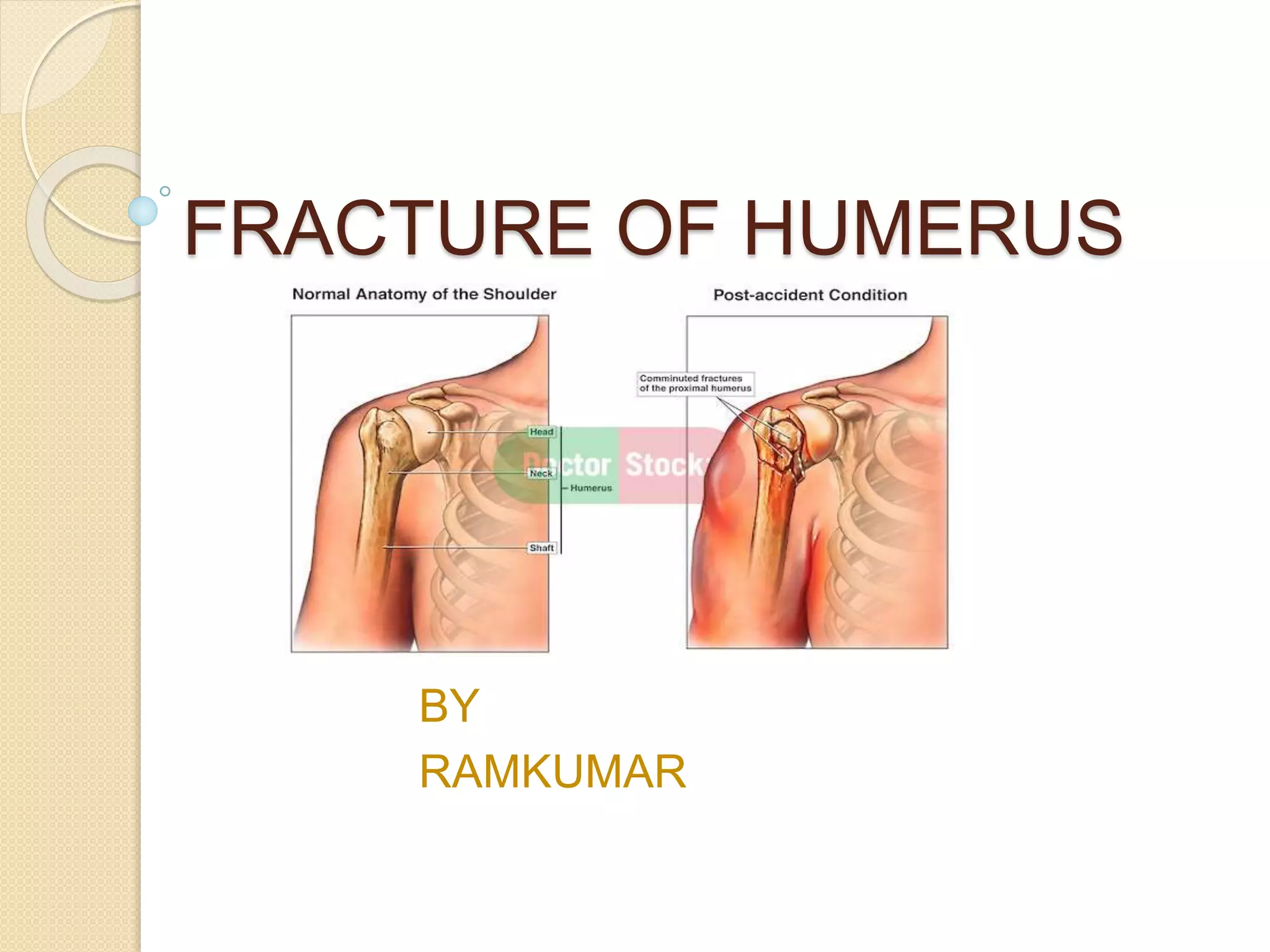
FRACTURE OF HUMERUS
BY
RAMKUMAR
INTRODUCTION
 The humerus is your upper arm bone between
your shoulder and elbow. When your humerus is
fractured near or at the ball of your shoulder
joint, it is commonly known as
a broken shoulder.
 3% to 5% of all fractures
 Most will heal with appropriate conservative care,
although a limited number will require surgery for
optimal outcome.
 Given the extensive range of motion of the
shoulder and elbow, and the minimal effect from
minor shortening, a wide range of radiographic
malunion can be accepted with little functional
deficit
ANATOMY
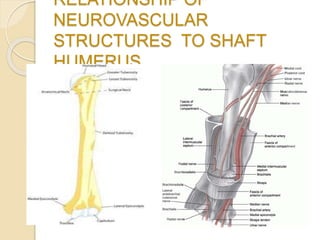
 Proximally, the humerus is roughly cylindrical in
cross section, tapering to a triangular shape
distally.
 The medullary canal of the humerus tapers to an
end above the supracondylar expansion.
 Nutrient artery- enters the bone very constantly at
the junction of M/3- L/3 and foramina of entry are
concentrated in a small area of the distal half of
M/3 on medial side
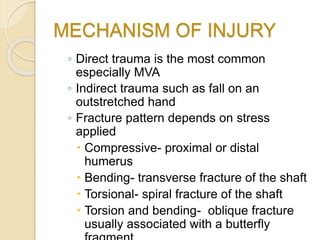
 Radial nerve- it does not travel along the spiral
groove and it lies close to the inferior lip of spiral
groove but not in it
 It is only for a short distance near the lateral
supracondylar ridge that the nerve is direct contact
with the humerus and pierces lateral intermuscular
septum
RELATIONSHIP OF
NEUROVASCULAR
STRUCTURES TO SHAFT
HUMERUS
MECHANISM OF INJURY
◦ Direct trauma is the most common
especially MVA
◦ Indirect trauma such as fall on an
outstretched hand
◦ Fracture pattern depends on stress
applied
 Compressive- proximal or distal
humerus
 Bending- transverse fracture of the shaft
 Torsional- spiral fracture of the shaft
 Torsion and bending- oblique fracture
usually associated with a butterfly
CLINICAL FEATURES
 Pain.
 Deformity.
 Bruising.
 Crepitus.
 Abnormal mobility
 Swelling.
 Any neurovascular injury
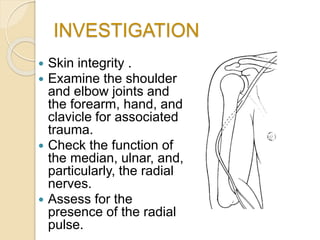
INVESTIGATION
 Skin integrity .
 Examine the shoulder
and elbow joints and
the forearm, hand, and
clavicle for associated
trauma.
 Check the function of
the median, ulnar, and,
particularly, the radial
nerves.
 Assess for the
presence of the radial
pulse.
INVESTIGATION
 Radiographs
 CT scan
 MRI scan
 Nerve conduction studies
AP and lateral views of the humerus,
including the joints below and above the
injury.
 Computed Tomographic (CT) scans of
associated intra-articular injuries
proximally or distally.
 MRI for pathological #
CLASSIFICATION
 CLOSED
 OPEN
 LOCATION- proximal, middle, distal
 FRACTURE PATTERN-tranverse,
spiral, oblique,comminuted segmental
 SOFT TISSUE STATUS – Tscherene
& Gotzen
Gustilo &
Anderson
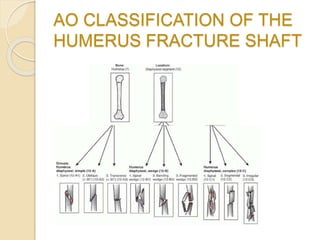
AO CLASSIFICATION OF THE
HUMERUS FRACTURE SHAFT
TREATMENT
Non operative operative
NON OPERATIVE
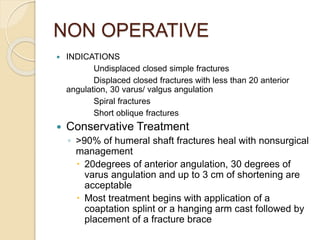
 INDICATIONS
Undisplaced closed simple fractures
Displaced closed fractures with less than 20 anterior
angulation, 30 varus/ valgus angulation
Spiral fractures
Short oblique fractures
 Conservative Treatment
◦ >90% of humeral shaft fractures heal with nonsurgical
management
 20degrees of anterior angulation, 30 degrees of
varus angulation and up to 3 cm of shortening are
acceptable
 Most treatment begins with application of a
coaptation splint or a hanging arm cast followed by
placement of a fracture brace
NON OPERATIVE
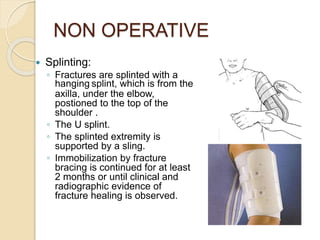
 Splinting:
◦ Fractures are splinted with a
hanging splint, which is from the
axilla, under the elbow,
postioned to the top of the
shoulder .
◦ The U splint.
◦ The splinted extremity is
supported by a sling.
◦ Immobilization by fracture
bracing is continued for at least
2 months or until clinical and
radiographic evidence of
fracture healing is observed.
OPERATIVE
INDICATIONS
◦ Fractures in which reduction is unable to be
achieved or maintained.
◦ Fractures with nerve injuries after reduction
maneuvers.
◦ Open fractures.
◦ Intra articular extension injury.
◦ Neurovascular injury.
◦ Impending pathologic fractures.
◦ Segmental fractures.
◦ Multiple extremity fractures.
OPERATIVE
METHODS OF SURGICAL MANAGEMENT
Plating
Nailing
External fixation
ANTERIOR APPROACH
 Incision
 Proximal land mark – coracoid process
 Distal land mark- anterior to lateral
supracondylar ridge
OPERATIVE
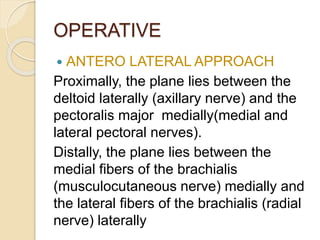
 ANTERO LATERAL APPROACH
Proximally, the plane lies between the
deltoid laterally (axillary nerve) and the
pectoralis major medially(medial and
lateral pectoral nerves).
Distally, the plane lies between the
medial fibers of the brachialis
(musculocutaneous nerve) medially and
the lateral fibers of the brachialis (radial
nerve) laterally
OPERATIVE
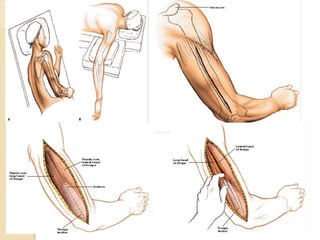
 POSTERIOR APPROACH
Position of the patient for the approach to
the upper arm in either the (A) lateral or
(B) prone position
 Incision
 Tip of olecranon distally to postero lateral
corner of acromion proximally
Incise the deep fascia of the arm in line
with the skin incision.
Identify the gap between the lateral and
long heads of the triceps muscle
COMPLICATIONS OF OPERATIVE
MANAGEMENT
 Injury to the radial nerve.
 Nonunion rates are higher when
fractures are treated with intramedullary
nailing.
 Malunion.
 Shoulder pain -when fractures are
treated with nails and with plates .
 Elbow or shoulder stiffness.
REFERENCE
 http://emedicine.medscape.com/article/8
25488-overview
 http://patient.info/doctor/fractured-
humerus
 https://en.wikipedia.org/wiki/Humerus_fra
cture
 http://physioworks.com.au/injuries-
conditions-1/fractured_humerus-
broken_shoulder
 http://orthoinfo.aaos.org/topic.cfm?topic=
A00513

Fracture of humerus

  • 1.
  • 2.
    INTRODUCTION  The humerusis your upper arm bone between your shoulder and elbow. When your humerus is fractured near or at the ball of your shoulder joint, it is commonly known as a broken shoulder.  3% to 5% of all fractures  Most will heal with appropriate conservative care, although a limited number will require surgery for optimal outcome.  Given the extensive range of motion of the shoulder and elbow, and the minimal effect from minor shortening, a wide range of radiographic malunion can be accepted with little functional deficit
  • 3.
    ANATOMY  Proximally, thehumerus is roughly cylindrical in cross section, tapering to a triangular shape distally.  The medullary canal of the humerus tapers to an end above the supracondylar expansion.  Nutrient artery- enters the bone very constantly at the junction of M/3- L/3 and foramina of entry are concentrated in a small area of the distal half of M/3 on medial side  Radial nerve- it does not travel along the spiral groove and it lies close to the inferior lip of spiral groove but not in it  It is only for a short distance near the lateral supracondylar ridge that the nerve is direct contact with the humerus and pierces lateral intermuscular septum
  • 4.
  • 5.
    MECHANISM OF INJURY ◦Direct trauma is the most common especially MVA ◦ Indirect trauma such as fall on an outstretched hand ◦ Fracture pattern depends on stress applied  Compressive- proximal or distal humerus  Bending- transverse fracture of the shaft  Torsional- spiral fracture of the shaft  Torsion and bending- oblique fracture usually associated with a butterfly
  • 6.
    CLINICAL FEATURES  Pain. Deformity.  Bruising.  Crepitus.  Abnormal mobility  Swelling.  Any neurovascular injury
  • 7.
    INVESTIGATION  Skin integrity.  Examine the shoulder and elbow joints and the forearm, hand, and clavicle for associated trauma.  Check the function of the median, ulnar, and, particularly, the radial nerves.  Assess for the presence of the radial pulse.
  • 8.
    INVESTIGATION  Radiographs  CTscan  MRI scan  Nerve conduction studies AP and lateral views of the humerus, including the joints below and above the injury.  Computed Tomographic (CT) scans of associated intra-articular injuries proximally or distally.  MRI for pathological #
  • 9.
    CLASSIFICATION  CLOSED  OPEN LOCATION- proximal, middle, distal  FRACTURE PATTERN-tranverse, spiral, oblique,comminuted segmental  SOFT TISSUE STATUS – Tscherene & Gotzen Gustilo & Anderson
  • 10.
    AO CLASSIFICATION OFTHE HUMERUS FRACTURE SHAFT
  • 11.
  • 12.
    NON OPERATIVE  INDICATIONS Undisplacedclosed simple fractures Displaced closed fractures with less than 20 anterior angulation, 30 varus/ valgus angulation Spiral fractures Short oblique fractures  Conservative Treatment ◦ >90% of humeral shaft fractures heal with nonsurgical management  20degrees of anterior angulation, 30 degrees of varus angulation and up to 3 cm of shortening are acceptable  Most treatment begins with application of a coaptation splint or a hanging arm cast followed by placement of a fracture brace
  • 13.
    NON OPERATIVE  Splinting: ◦Fractures are splinted with a hanging splint, which is from the axilla, under the elbow, postioned to the top of the shoulder . ◦ The U splint. ◦ The splinted extremity is supported by a sling. ◦ Immobilization by fracture bracing is continued for at least 2 months or until clinical and radiographic evidence of fracture healing is observed.
  • 14.
    OPERATIVE INDICATIONS ◦ Fractures inwhich reduction is unable to be achieved or maintained. ◦ Fractures with nerve injuries after reduction maneuvers. ◦ Open fractures. ◦ Intra articular extension injury. ◦ Neurovascular injury. ◦ Impending pathologic fractures. ◦ Segmental fractures. ◦ Multiple extremity fractures.
  • 15.
    OPERATIVE METHODS OF SURGICALMANAGEMENT Plating Nailing External fixation ANTERIOR APPROACH  Incision  Proximal land mark – coracoid process  Distal land mark- anterior to lateral supracondylar ridge
  • 16.
    OPERATIVE  ANTERO LATERALAPPROACH Proximally, the plane lies between the deltoid laterally (axillary nerve) and the pectoralis major medially(medial and lateral pectoral nerves). Distally, the plane lies between the medial fibers of the brachialis (musculocutaneous nerve) medially and the lateral fibers of the brachialis (radial nerve) laterally
  • 17.
    OPERATIVE  POSTERIOR APPROACH Positionof the patient for the approach to the upper arm in either the (A) lateral or (B) prone position  Incision  Tip of olecranon distally to postero lateral corner of acromion proximally Incise the deep fascia of the arm in line with the skin incision. Identify the gap between the lateral and long heads of the triceps muscle
  • 19.
    COMPLICATIONS OF OPERATIVE MANAGEMENT Injury to the radial nerve.  Nonunion rates are higher when fractures are treated with intramedullary nailing.  Malunion.  Shoulder pain -when fractures are treated with nails and with plates .  Elbow or shoulder stiffness.
  • 20.
    REFERENCE  http://emedicine.medscape.com/article/8 25488-overview  http://patient.info/doctor/fractured- humerus https://en.wikipedia.org/wiki/Humerus_fra cture  http://physioworks.com.au/injuries- conditions-1/fractured_humerus- broken_shoulder  http://orthoinfo.aaos.org/topic.cfm?topic= A00513