Wrist and Hand Anatomy
Moderator: Dr. Asif Sultan
Presented by: Qazi Manaan
Overview
• The anatomy of the hand is complex, intricate,
and fascinating.
• Absolutely essential for our everyday functional
living.
Bone Anatomy
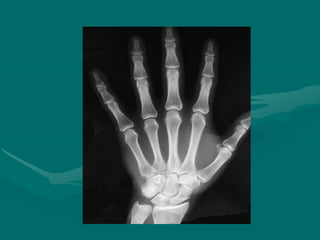
• Total of 27 bones in hand and wrist.
• These are grouped into carpals, metacarpals,
and phalanges.
• The wrist is the most complex joint in the body. It is
formed by 8 carpal bones grouped in 2 rows with very
restricted motion between them.
• All carpal bones participate in wrist function
o except for the pisiform.
• The scaphoid serves as link between each row;
therefore, it is vulnerable to fractures.
• The distal row of carpal bones is strongly attached
to the base of the second and third metacarpals,
forming a fixed unit.
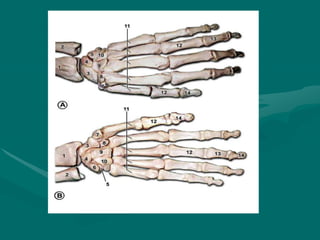
• The hand contains 5 metacarpal bone.
• First Metacarpal articulates proximally with the
trapezium.
• The other 4 metacarpals articulate with the
trapezoid, capitate, and hamate at the base.
• The hand contains 14 phalanges.
JOINTS
• All 4 distal carpal bones articulate with the
metacarpals at the carpometacarpal (CMC) joints.
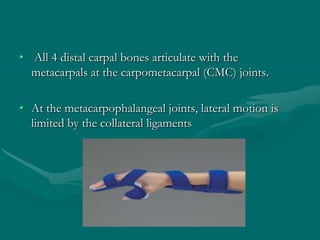
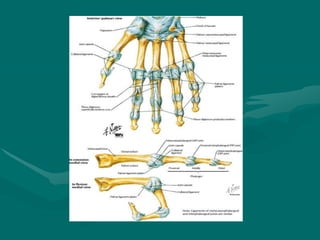
• At the metacarpophalangeal joints, lateral motion is
limited by the collateral ligaments
• At the CMC joint, the volar plate is part of the joint
capsule that attaches only to the proximal phalanx,
allowing hyperextension.
• At the interphalangeal joints:
 extension is limited by the volar plate, which attaches
to the phalanges at each side of the joint.
 Radial and ulnar motion is restricted by collateral
ligaments.
Muscles and Tendons
• The muscles of the hand are divided into:
Intrinsic and
Extrinsic group.
Extrinsic extensors
• All extensors are extrinsic and supplied by radial
nerve.
• Except for the interosseous-lumbrical complex.
• Group contains:
3 wrist extensors
A larger group of thumb and digit extensors.
• The main extensors at wrist are:
 The extensor carpi radialis brevis (ECRB)
 extensor carpi radialis longus (ECRL)
 extensor carpi ulnaris (ECU)
• At the digits, extension occurs due to:
The extensor digitorum communis,
extensor indicis proprius, and
extensor digiti minimi
• Extension at the thumb is bought about by:
The abductor pollicis longus,
extensor pollicis brevis, and
extensor pollicis longus
Extrinsic Flexors
• 3 wrist flexors
• A larger group of thumb and digit flexors
• Innervated by the median nerve
• Except for the FCU, and the FDP to the small and ring
finger, which are innervated by the ulnar nerve.
• The main Flexors at the wrist joint are:
 The flexor carpi radialis
 the flexor carpi ulnaris and
 the palmaris longus
• The digital flexors include:
Flexor Digitorum Superficialis
Flexor Digitorum Profundus
Flexor Pollicis Longus
Intrinsics
• Situated totally within the hand
• Divided into 4 groups:
the thenar,
hypothenar,
lumbrical, and
interossei muscles.
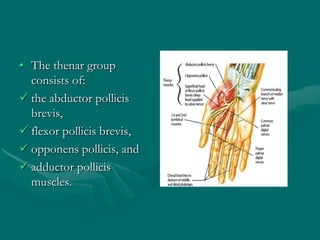
• The thenar group
consists of:
 the abductor pollicis
brevis,
 flexor pollicis brevis,
 opponens pollicis, and
 adductor pollicis
muscles.
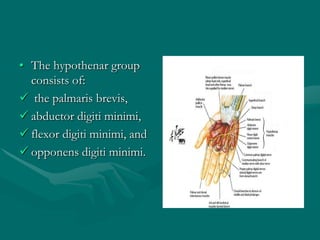
• The hypothenar group
consists of:
 the palmaris brevis,
 abductor digiti minimi,
 flexor digiti minimi, and
 opponens digiti minimi.
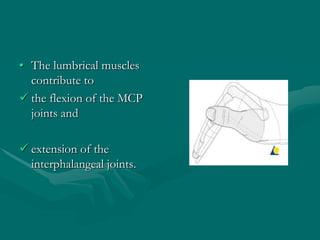
• The lumbrical muscles
contribute to
 the flexion of the MCP
joints and
 extension of the
interphalangeal joints.
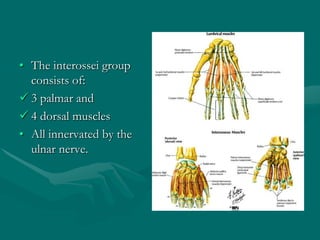
• The interossei group
consists of:
 3 palmar and
 4 dorsal muscles
• All innervated by the
ulnar nerve.
Zones of the Hand
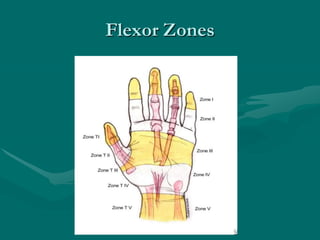
Flexor Zones
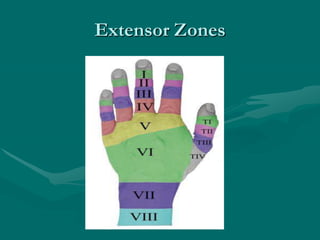
Extensor Zones
NERVES
• 3 nerves:
 Median
 Ulnar
 Radial
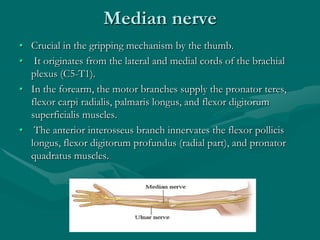
Median nerve
• Crucial in the gripping mechanism by the thumb.
• It originates from the lateral and medial cords of the brachial
plexus (C5-T1).
• In the forearm, the motor branches supply the pronator teres,
flexor carpi radialis, palmaris longus, and flexor digitorum
superficialis muscles.
• The anterior interosseus branch innervates the flexor pollicis
longus, flexor digitorum profundus (radial part), and pronator
quadratus muscles.
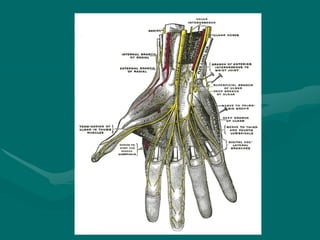
• Palmar cutaneous branch provides sensation at the
thenar eminence. Also sensory digital branches
provide sensation to the radial three and a half
fingers and corresponding palm area
• As the median nerve passes through the carpal
tunnel, the recurrent motor branch innervates the
thenar muscles
• It also innervates the index and middle finger
lumbrical muscles
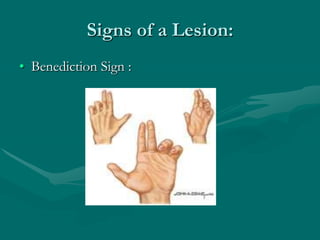
Signs of a Lesion:
• Benediction Sign :
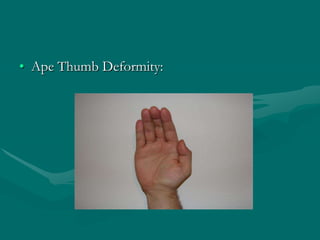
• Ape Thumb Deformity:
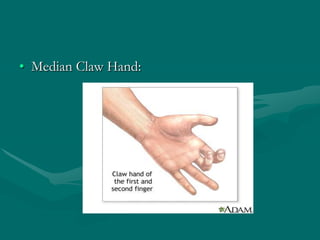
• Median Claw Hand:
Pen Test
Ulnar nerve
• Controls fine movement of the fingers
• It originates at the medial cord of the
brachial plexus (C8-T1)
• Sensory to the:
hypothenar eminence
The palmar and dorsal ulnar one and a
half fingers
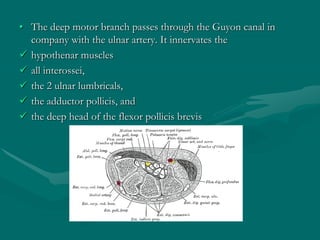
• The deep motor branch passes through the Guyon canal in
company with the ulnar artery. It innervates the
 hypothenar muscles
 all interossei,
 the 2 ulnar lumbricals,
 the adductor pollicis, and
 the deep head of the flexor pollicis brevis
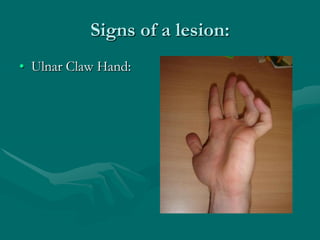
Signs of a lesion:
• Ulnar Claw Hand:
Froment’s Sign
Egawas’ Test
Card Test
Radial nerve
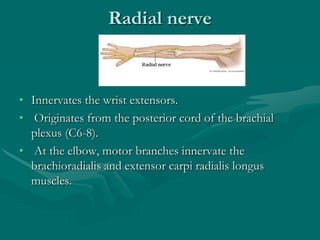
• Innervates the wrist extensors.
• Originates from the posterior cord of the brachial
plexus (C6-8).
• At the elbow, motor branches innervate the
brachioradialis and extensor carpi radialis longus
muscles.
• At the proximal forearm, the radial nerve divides into
the superficial and deep branches.
• The deep posterior interosseous branch innervates all
the muscles in the extensor compartment.
• The superficial branch provides sensation at the radial
aspect of the dorsum of the hand, the dorsum of the
thumb, and the dorsum of the radial three and a half
digits proximal to the distal interphalangeal joints.
Signs of a lesion
• Wrist Drop
• Loss of Supination:
Blood Supply
• Complex and rich vascular network
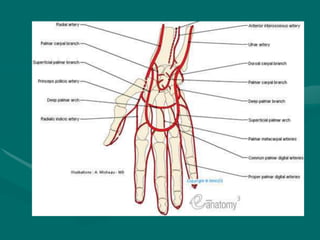
Radial Artery
• Course
• A superficial branch arises at the level of the wrist and
contributes to the superficial palmar arch.
• In the palm it gives off:
 Princeps pollicis artery and
 Radialis Indicis artery, before terminating in the deep
palmar arch.
Ulnar Artery
• It travels into the hand through the Guyon
canal, where it divides into:
• the deep palmar branch and
• the superficial palmar branch.
Superficial Palmar Arch
• Lies directly deep to the palmar fascia.
• It gives rise to the:
 volar common digital arteries and
 multiple branches to intrinsic muscles and skin.
• Distally,the common digital arteries bifurcate into the
proper digital arteries.
Deep Palmar Arch
• Lies at the base of the metacarpals, deep to
the flexor tendons.
• From its convexity it gives off three
palmar metacarpal arteries.
• Dorsally it gives off three perforating
arteries.
• Recurrent branches arise from the
concavity to supply the carpal bones
Dorsal Carpal Arch
• Formed by:
 the posterior interosseous artery and
 a dorsal perforating branch of the anterior interosseous
artery.
• Dorsal metacarpal arteries arise from a dorsal carpal
arch
MODIFIED ALLEN TEST
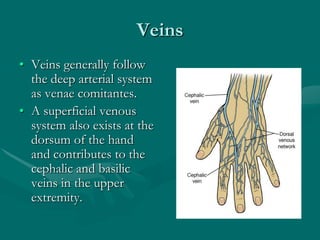
Veins
• Veins generally follow
the deep arterial system
as venae comitantes.
• A superficial venous
system also exists at the
dorsum of the hand
and contributes to the
cephalic and basilic
veins in the upper
extremity.
Deep Fascia
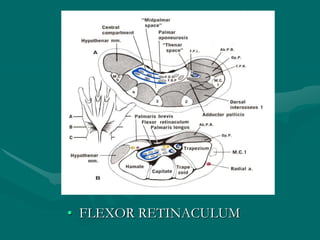
• The Flexor Retinaculum
• The Palmar Fascia
• Fibrous flexor sheaths in fingers
• The Extensor Retinaculum
• FLEXOR RETINACULUM
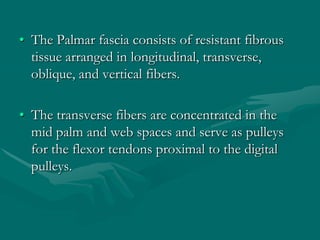
• The Palmar fascia consists of resistant fibrous
tissue arranged in longitudinal, transverse,
oblique, and vertical fibers.
• The transverse fibers are concentrated in the
mid palm and web spaces and serve as pulleys
for the flexor tendons proximal to the digital
pulleys.
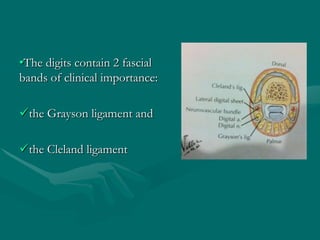
•The digits contain 2 fascial
bands of clinical importance:
the Grayson ligament and
the Cleland ligament
Pulley
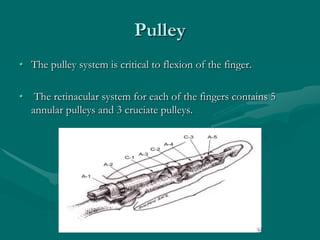
• The pulley system is critical to flexion of the finger.
• The retinacular system for each of the fingers contains 5
annular pulleys and 3 cruciate pulleys.
• The thumb has 2 annular pulleys and 1
oblique pulley.
• The system supplies mechanical advantage
by maintaining the flexor tendons close to
the joint's axis of motion. In doing so, the
pulleys prevent bowstringing.
.
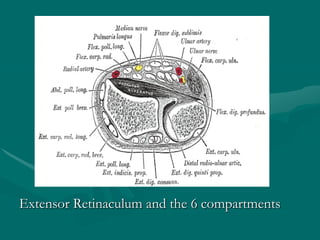
Extensor Retinaculum and the 6 compartments
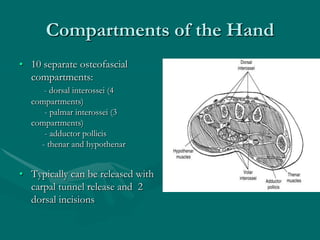
Compartments of the Hand
• 10 separate osteofascial
compartments:
- dorsal interossei (4
compartments)
- palmar interossei (3
compartments)
- adductor pollicis
- thenar and hypothenar
• Typically can be released with
carpal tunnel release and 2
dorsal incisions
SKIN
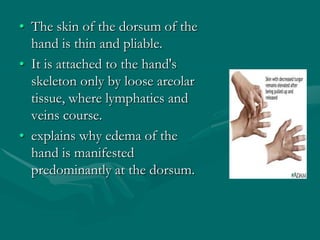
• The skin of the dorsum of the
hand is thin and pliable.
• It is attached to the hand's
skeleton only by loose areolar
tissue, where lymphatics and
veins course.
• explains why edema of the
hand is manifested
predominantly at the dorsum.
• The skin of the palmar surface of the hand is
unique
Thick
Glabrous
Less Pliable
• This enhances skin stability for proper grasping
function.
• The skin is most firmly anchored to the deep
structures at the palmar creases.
• Blood supply is through numerous small, vertical
branches from the common digital vessels.
• High concentration of sensory nerve organs
essential to the hand's normal function.
Thank You

Hand anatomy new

  • 1.
    Wrist and HandAnatomy Moderator: Dr. Asif Sultan Presented by: Qazi Manaan
  • 2.
    Overview • The anatomyof the hand is complex, intricate, and fascinating. • Absolutely essential for our everyday functional living.
  • 3.
    Bone Anatomy • Totalof 27 bones in hand and wrist. • These are grouped into carpals, metacarpals, and phalanges. • The wrist is the most complex joint in the body. It is formed by 8 carpal bones grouped in 2 rows with very restricted motion between them.
  • 5.
    • All carpalbones participate in wrist function o except for the pisiform. • The scaphoid serves as link between each row; therefore, it is vulnerable to fractures. • The distal row of carpal bones is strongly attached to the base of the second and third metacarpals, forming a fixed unit.
  • 6.
    • The handcontains 5 metacarpal bone. • First Metacarpal articulates proximally with the trapezium. • The other 4 metacarpals articulate with the trapezoid, capitate, and hamate at the base. • The hand contains 14 phalanges.
  • 8.
  • 9.
    • All 4distal carpal bones articulate with the metacarpals at the carpometacarpal (CMC) joints. • At the metacarpophalangeal joints, lateral motion is limited by the collateral ligaments
  • 10.
    • At theCMC joint, the volar plate is part of the joint capsule that attaches only to the proximal phalanx, allowing hyperextension. • At the interphalangeal joints:  extension is limited by the volar plate, which attaches to the phalanges at each side of the joint.  Radial and ulnar motion is restricted by collateral ligaments.
  • 12.
  • 13.
    • The musclesof the hand are divided into: Intrinsic and Extrinsic group.
  • 14.
    Extrinsic extensors • Allextensors are extrinsic and supplied by radial nerve. • Except for the interosseous-lumbrical complex. • Group contains: 3 wrist extensors A larger group of thumb and digit extensors.
  • 15.
    • The mainextensors at wrist are:  The extensor carpi radialis brevis (ECRB)  extensor carpi radialis longus (ECRL)  extensor carpi ulnaris (ECU)
  • 16.
    • At thedigits, extension occurs due to: The extensor digitorum communis, extensor indicis proprius, and extensor digiti minimi
  • 17.
    • Extension atthe thumb is bought about by: The abductor pollicis longus, extensor pollicis brevis, and extensor pollicis longus
  • 18.
    Extrinsic Flexors • 3wrist flexors • A larger group of thumb and digit flexors • Innervated by the median nerve • Except for the FCU, and the FDP to the small and ring finger, which are innervated by the ulnar nerve.
  • 19.
    • The mainFlexors at the wrist joint are:  The flexor carpi radialis  the flexor carpi ulnaris and  the palmaris longus
  • 20.
    • The digitalflexors include: Flexor Digitorum Superficialis Flexor Digitorum Profundus Flexor Pollicis Longus
  • 21.
    Intrinsics • Situated totallywithin the hand • Divided into 4 groups: the thenar, hypothenar, lumbrical, and interossei muscles.
  • 22.
    • The thenargroup consists of:  the abductor pollicis brevis,  flexor pollicis brevis,  opponens pollicis, and  adductor pollicis muscles.
  • 23.
    • The hypothenargroup consists of:  the palmaris brevis,  abductor digiti minimi,  flexor digiti minimi, and  opponens digiti minimi.
  • 24.
    • The lumbricalmuscles contribute to  the flexion of the MCP joints and  extension of the interphalangeal joints.
  • 25.
    • The interosseigroup consists of:  3 palmar and  4 dorsal muscles • All innervated by the ulnar nerve.
  • 26.
  • 27.
  • 28.
  • 29.
    NERVES • 3 nerves: Median  Ulnar  Radial
  • 30.
    Median nerve • Crucialin the gripping mechanism by the thumb. • It originates from the lateral and medial cords of the brachial plexus (C5-T1). • In the forearm, the motor branches supply the pronator teres, flexor carpi radialis, palmaris longus, and flexor digitorum superficialis muscles. • The anterior interosseus branch innervates the flexor pollicis longus, flexor digitorum profundus (radial part), and pronator quadratus muscles.
  • 31.
    • Palmar cutaneousbranch provides sensation at the thenar eminence. Also sensory digital branches provide sensation to the radial three and a half fingers and corresponding palm area • As the median nerve passes through the carpal tunnel, the recurrent motor branch innervates the thenar muscles • It also innervates the index and middle finger lumbrical muscles
  • 33.
    Signs of aLesion: • Benediction Sign :
  • 34.
    • Ape ThumbDeformity:
  • 35.
  • 36.
  • 37.
    Ulnar nerve • Controlsfine movement of the fingers • It originates at the medial cord of the brachial plexus (C8-T1) • Sensory to the: hypothenar eminence The palmar and dorsal ulnar one and a half fingers
  • 38.
    • The deepmotor branch passes through the Guyon canal in company with the ulnar artery. It innervates the  hypothenar muscles  all interossei,  the 2 ulnar lumbricals,  the adductor pollicis, and  the deep head of the flexor pollicis brevis
  • 39.
    Signs of alesion: • Ulnar Claw Hand:
  • 40.
  • 41.
  • 42.
  • 43.
    Radial nerve • Innervatesthe wrist extensors. • Originates from the posterior cord of the brachial plexus (C6-8). • At the elbow, motor branches innervate the brachioradialis and extensor carpi radialis longus muscles.
  • 44.
    • At theproximal forearm, the radial nerve divides into the superficial and deep branches. • The deep posterior interosseous branch innervates all the muscles in the extensor compartment. • The superficial branch provides sensation at the radial aspect of the dorsum of the hand, the dorsum of the thumb, and the dorsum of the radial three and a half digits proximal to the distal interphalangeal joints.
  • 45.
    Signs of alesion • Wrist Drop
  • 46.
    • Loss ofSupination:
  • 47.
    Blood Supply • Complexand rich vascular network
  • 48.
    Radial Artery • Course •A superficial branch arises at the level of the wrist and contributes to the superficial palmar arch. • In the palm it gives off:  Princeps pollicis artery and  Radialis Indicis artery, before terminating in the deep palmar arch.
  • 50.
    Ulnar Artery • Ittravels into the hand through the Guyon canal, where it divides into: • the deep palmar branch and • the superficial palmar branch.
  • 51.
    Superficial Palmar Arch •Lies directly deep to the palmar fascia. • It gives rise to the:  volar common digital arteries and  multiple branches to intrinsic muscles and skin. • Distally,the common digital arteries bifurcate into the proper digital arteries.
  • 52.
    Deep Palmar Arch •Lies at the base of the metacarpals, deep to the flexor tendons. • From its convexity it gives off three palmar metacarpal arteries. • Dorsally it gives off three perforating arteries. • Recurrent branches arise from the concavity to supply the carpal bones
  • 53.
    Dorsal Carpal Arch •Formed by:  the posterior interosseous artery and  a dorsal perforating branch of the anterior interosseous artery. • Dorsal metacarpal arteries arise from a dorsal carpal arch
  • 54.
  • 55.
    Veins • Veins generallyfollow the deep arterial system as venae comitantes. • A superficial venous system also exists at the dorsum of the hand and contributes to the cephalic and basilic veins in the upper extremity.
  • 56.
    Deep Fascia • TheFlexor Retinaculum • The Palmar Fascia • Fibrous flexor sheaths in fingers • The Extensor Retinaculum
  • 57.
  • 58.
    • The Palmarfascia consists of resistant fibrous tissue arranged in longitudinal, transverse, oblique, and vertical fibers. • The transverse fibers are concentrated in the mid palm and web spaces and serve as pulleys for the flexor tendons proximal to the digital pulleys.
  • 59.
    •The digits contain2 fascial bands of clinical importance: the Grayson ligament and the Cleland ligament
  • 60.
    Pulley • The pulleysystem is critical to flexion of the finger. • The retinacular system for each of the fingers contains 5 annular pulleys and 3 cruciate pulleys.
  • 61.
    • The thumbhas 2 annular pulleys and 1 oblique pulley. • The system supplies mechanical advantage by maintaining the flexor tendons close to the joint's axis of motion. In doing so, the pulleys prevent bowstringing. .
  • 62.
    Extensor Retinaculum andthe 6 compartments
  • 63.
    Compartments of theHand • 10 separate osteofascial compartments: - dorsal interossei (4 compartments) - palmar interossei (3 compartments) - adductor pollicis - thenar and hypothenar • Typically can be released with carpal tunnel release and 2 dorsal incisions
  • 65.
  • 66.
    • The skinof the dorsum of the hand is thin and pliable. • It is attached to the hand's skeleton only by loose areolar tissue, where lymphatics and veins course. • explains why edema of the hand is manifested predominantly at the dorsum.
  • 67.
    • The skinof the palmar surface of the hand is unique Thick Glabrous Less Pliable • This enhances skin stability for proper grasping function.
  • 68.
    • The skinis most firmly anchored to the deep structures at the palmar creases. • Blood supply is through numerous small, vertical branches from the common digital vessels. • High concentration of sensory nerve organs essential to the hand's normal function.
  • 69.