Dr.Sarthy.V
Dept Of Orthopaedics
SSSMCRI


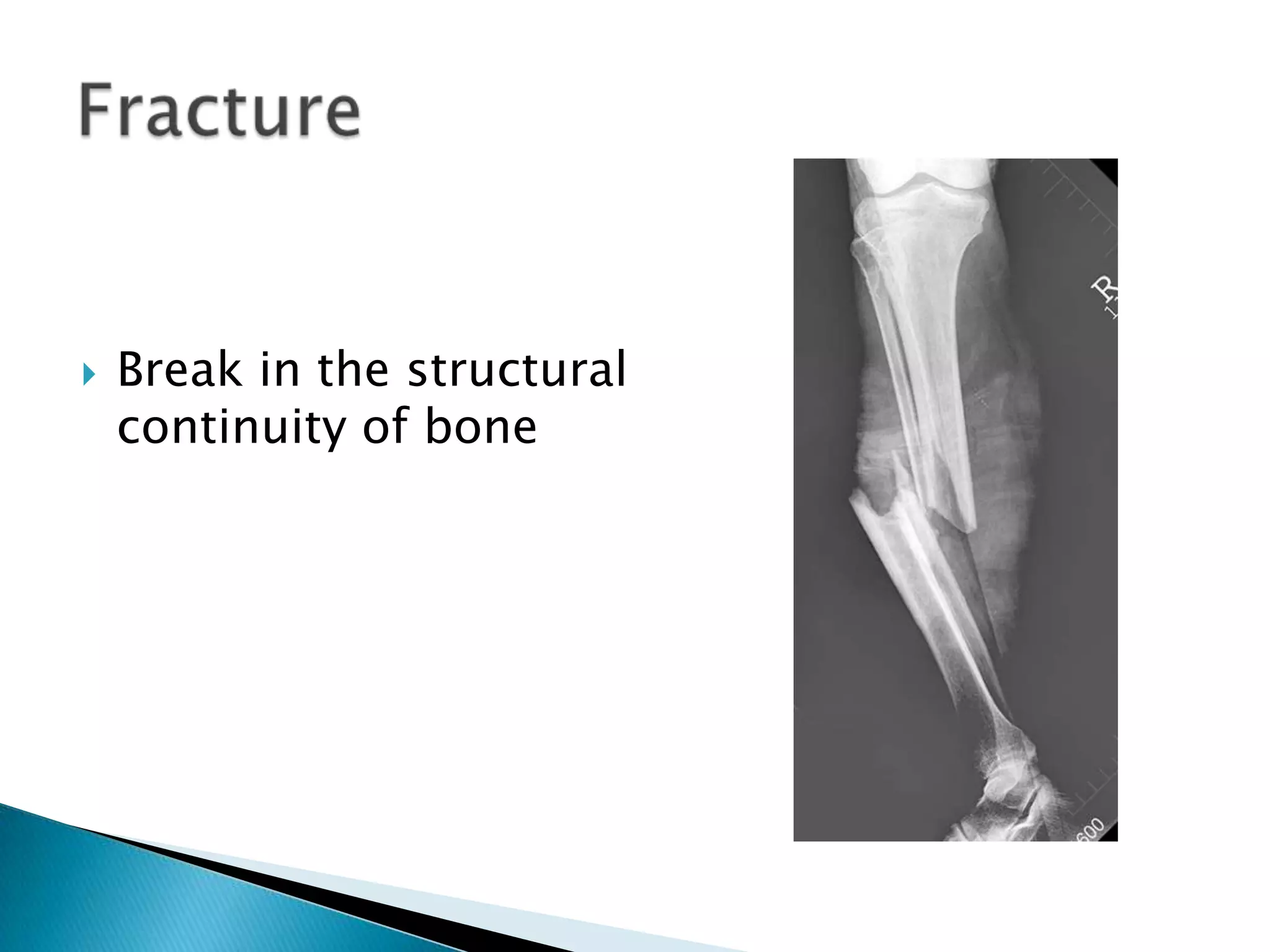
Break in the structural
continuity of bone


Injury



Repetitive Stress



Pathological










Direct force.
Indirect force
Twisting.
Bending.
Compression.
Tension.
Fatigue / Stress Fractures
Pathological Fracture.
◦
◦
◦
◦
◦
◦

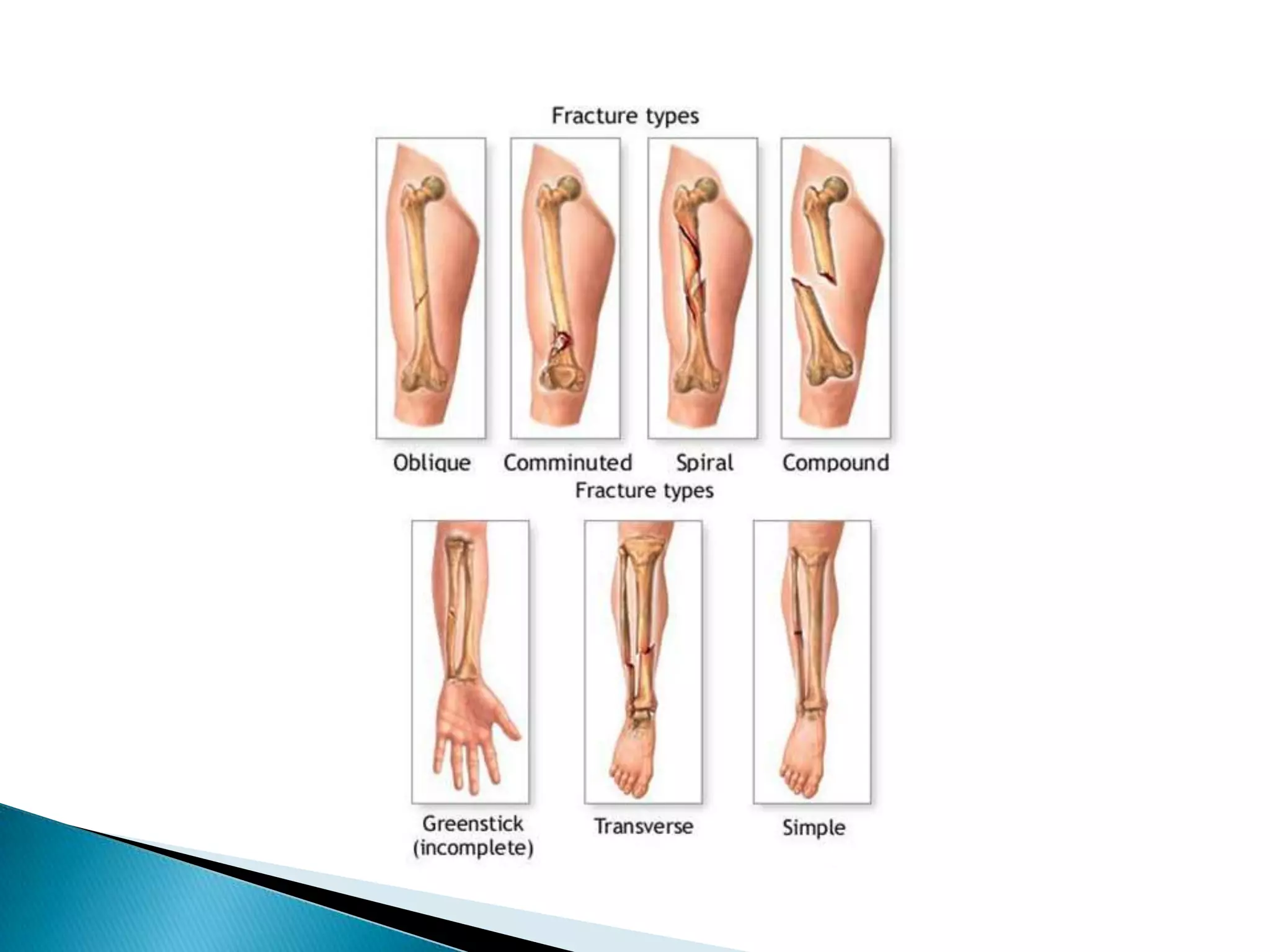
Transverse.
Oblique.
Spiral.
Impacted.
Comminuted.
Compression.

Complete

◦ Green Stick.
◦ Plastic Deformation.

InComplete


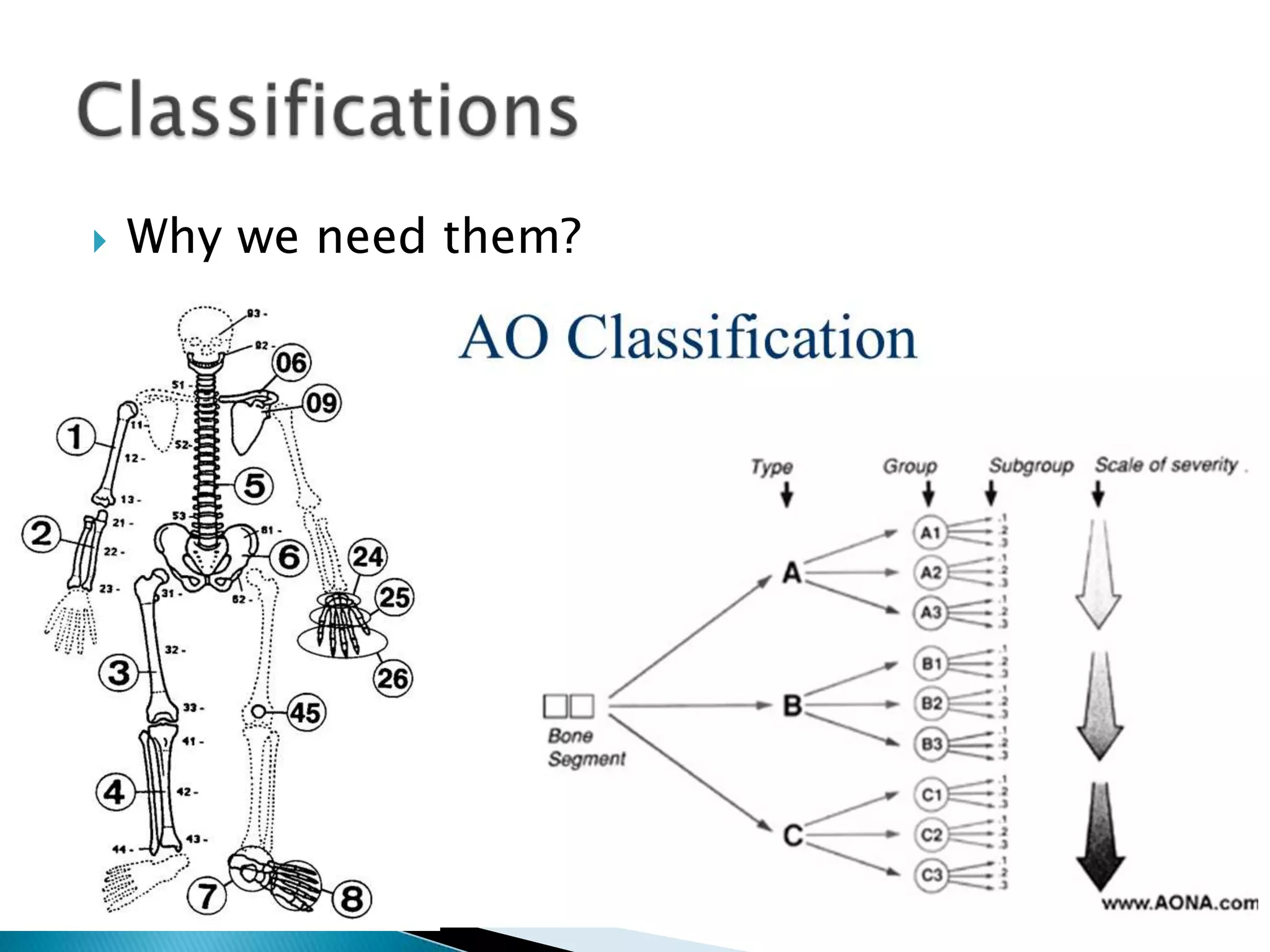
Why we need them?


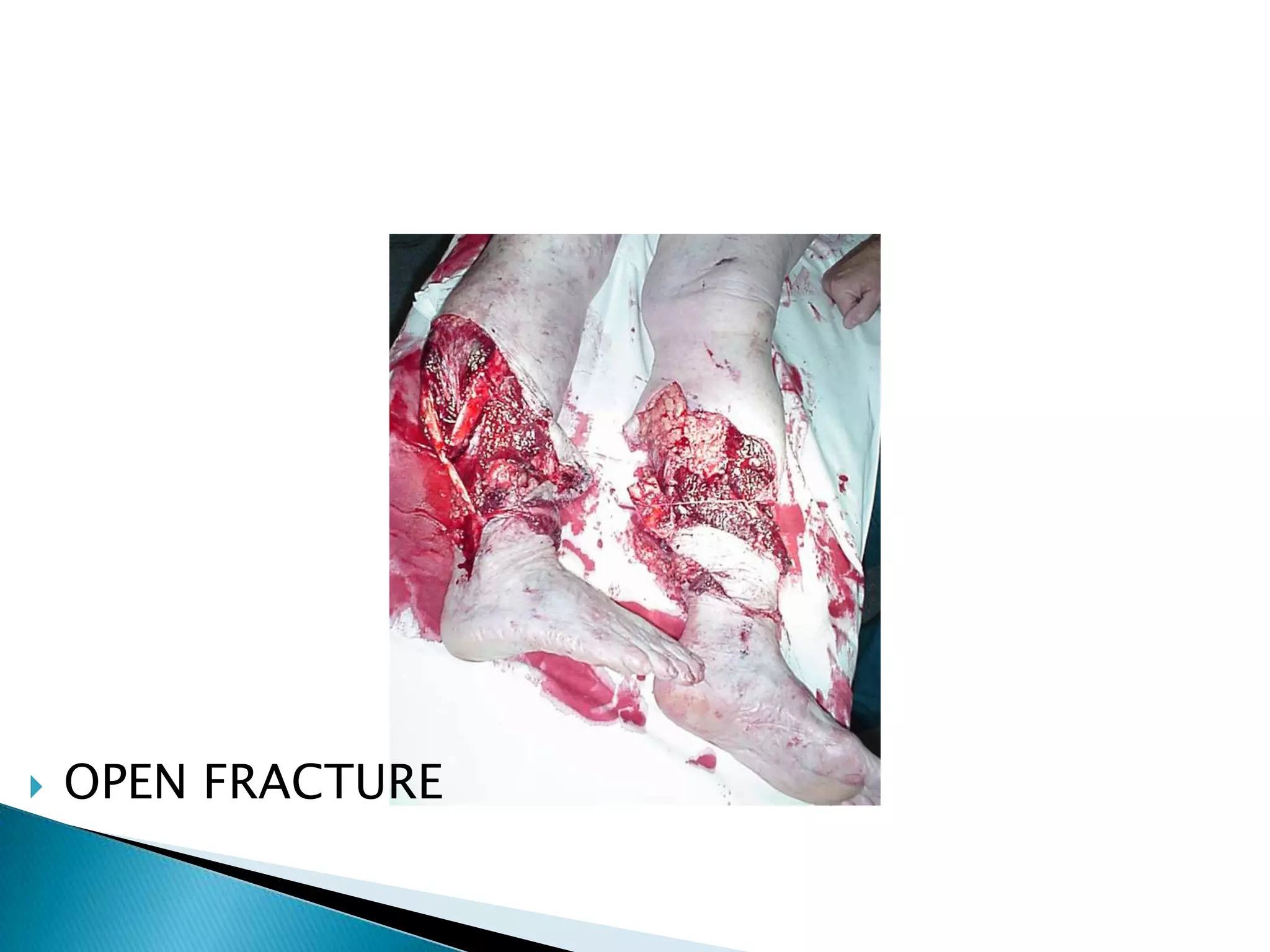
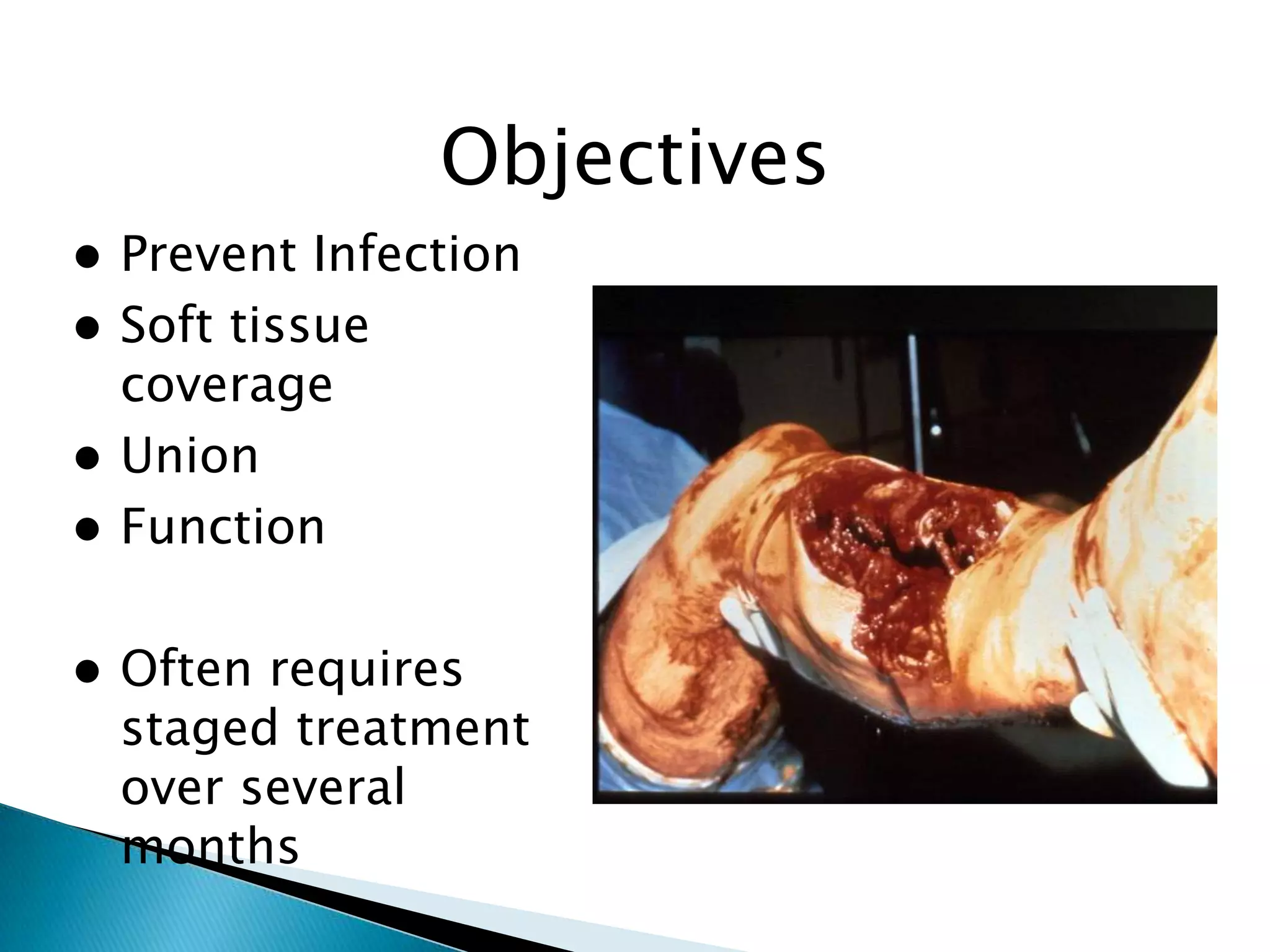
OPEN FRACTURE


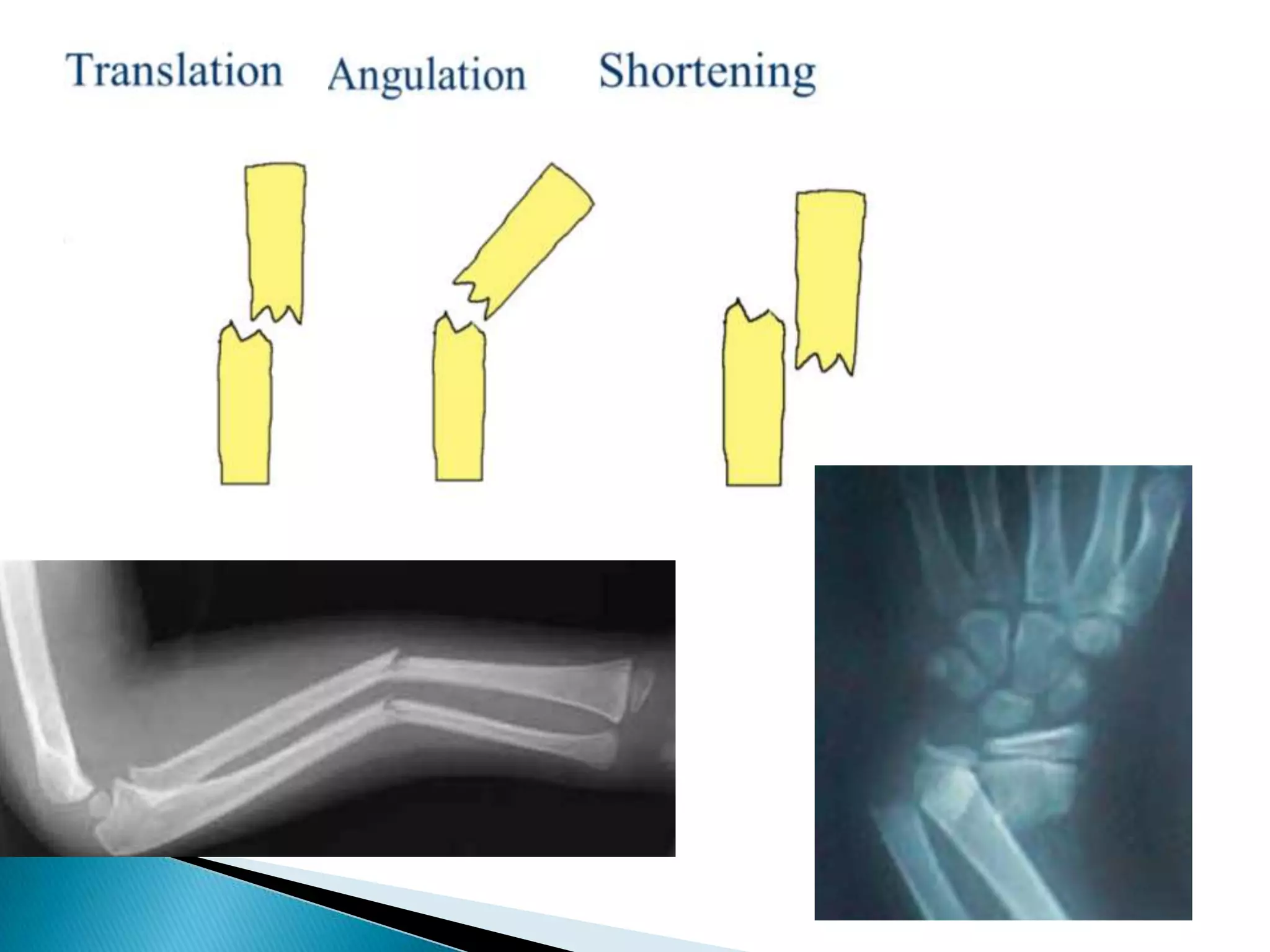
Translation.



Angulation.



Rotation.



Shortening.



Lengthening.
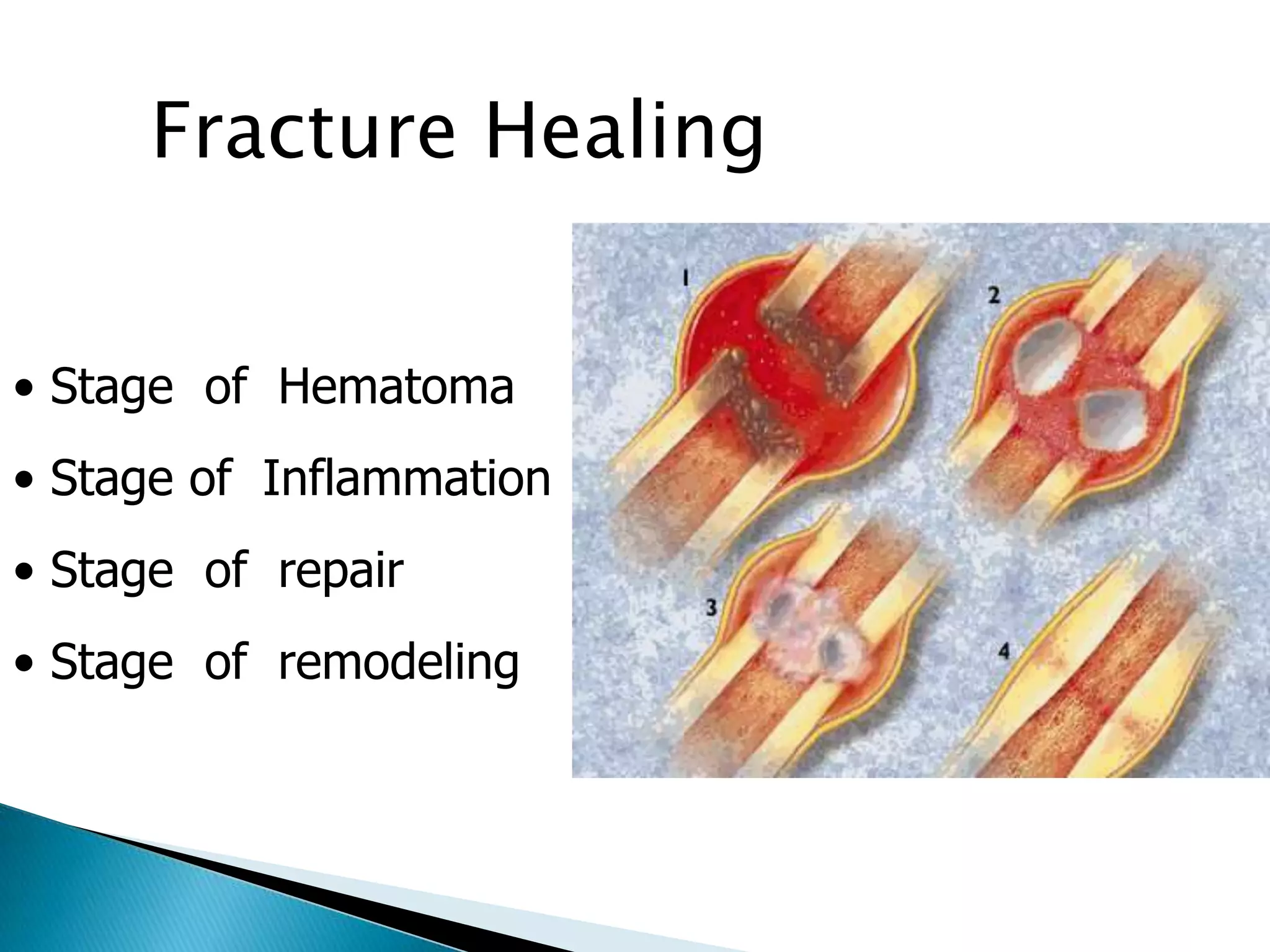
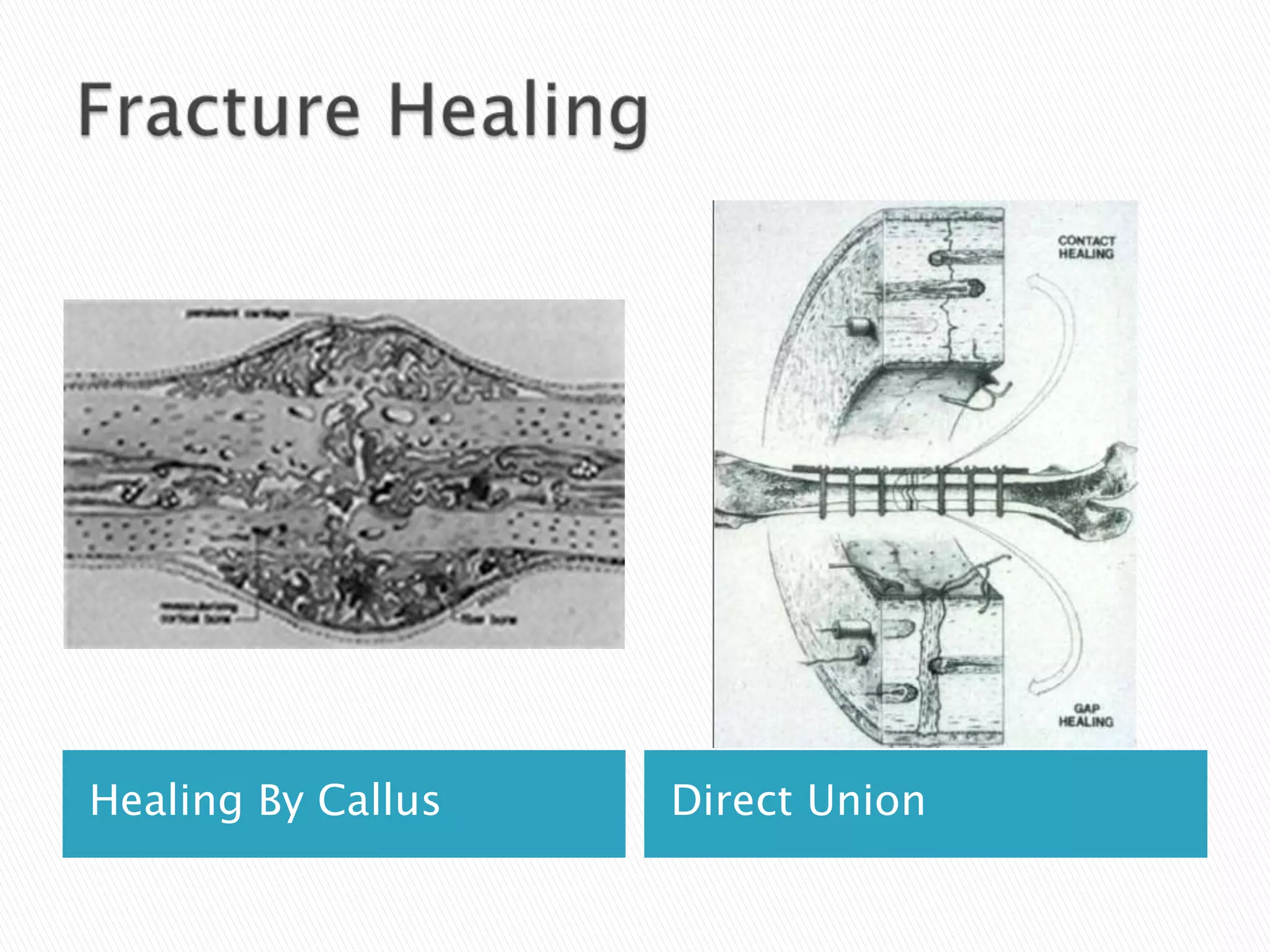
Fracture Healing
• Stage of Hematoma
• Stage of Inflammation

• Stage of repair
• Stage of remodeling
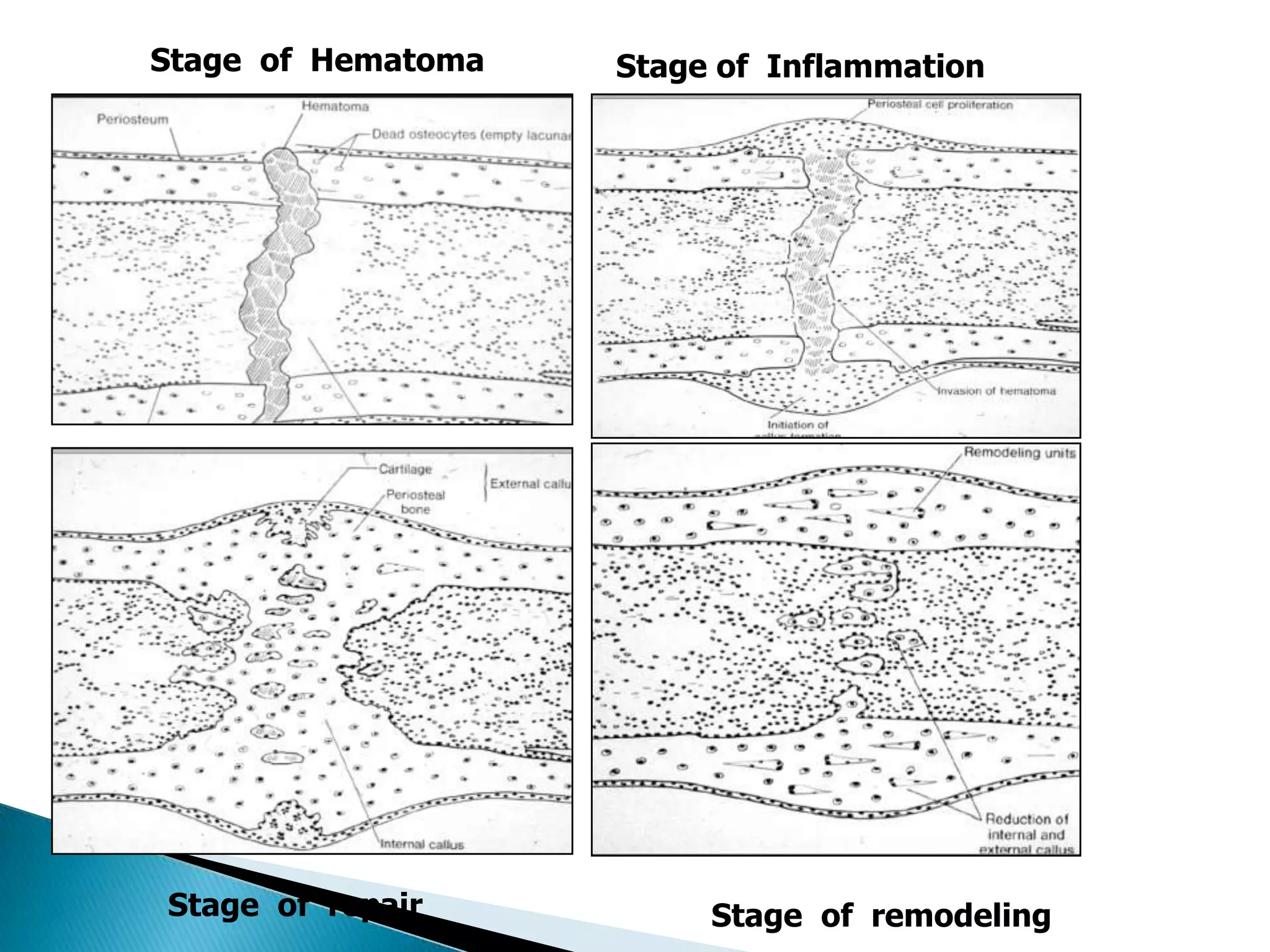
Stage of Hematoma

Stage of repair

Stage of Inflammation

Stage of remodeling
Healing By Callus

Direct Union


Alleviate pain.



To ensure union in good position.



Permit early movement of the limb & return
of function.





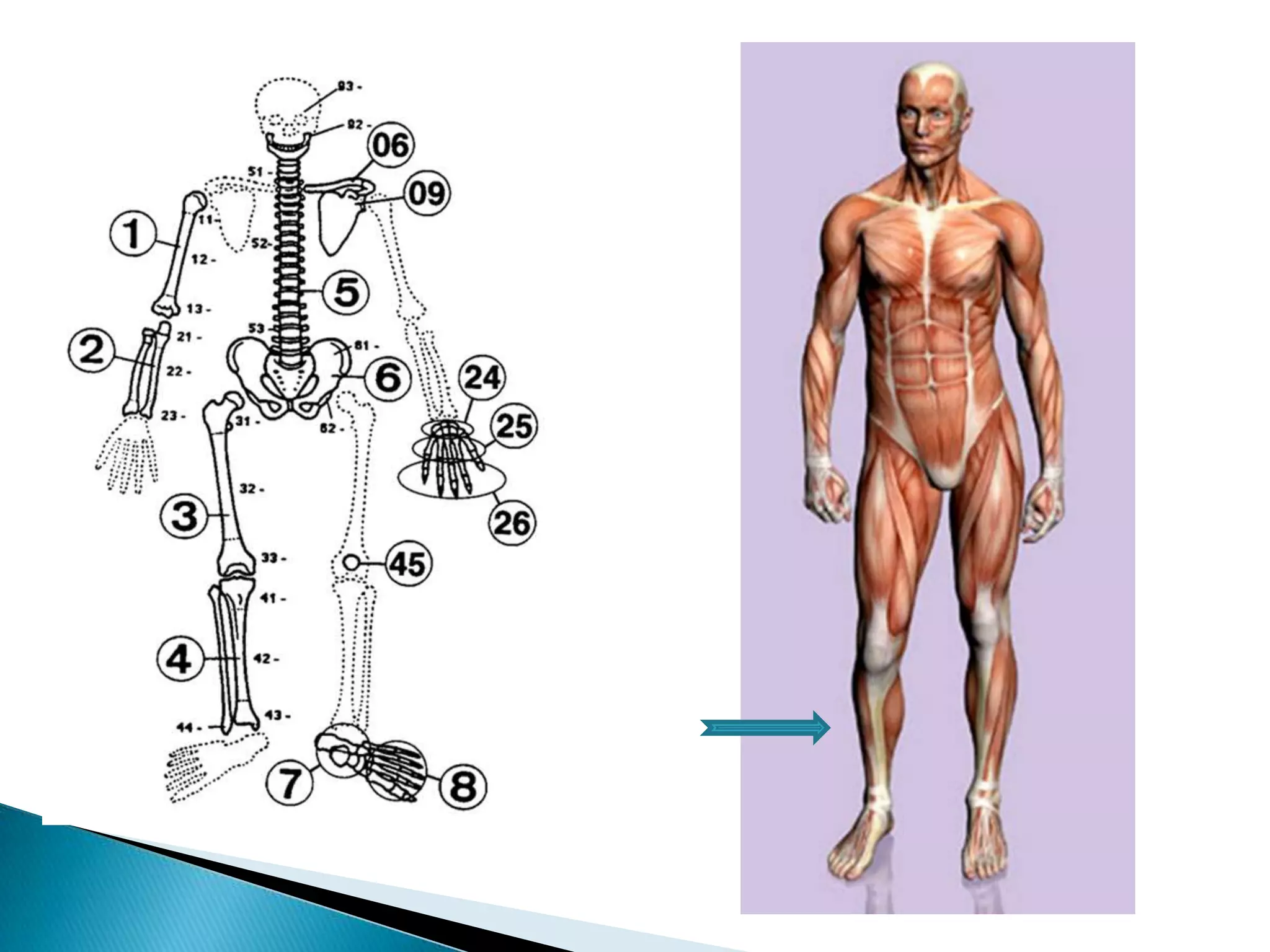
Fracture.
Types.
Causes.
Healing.

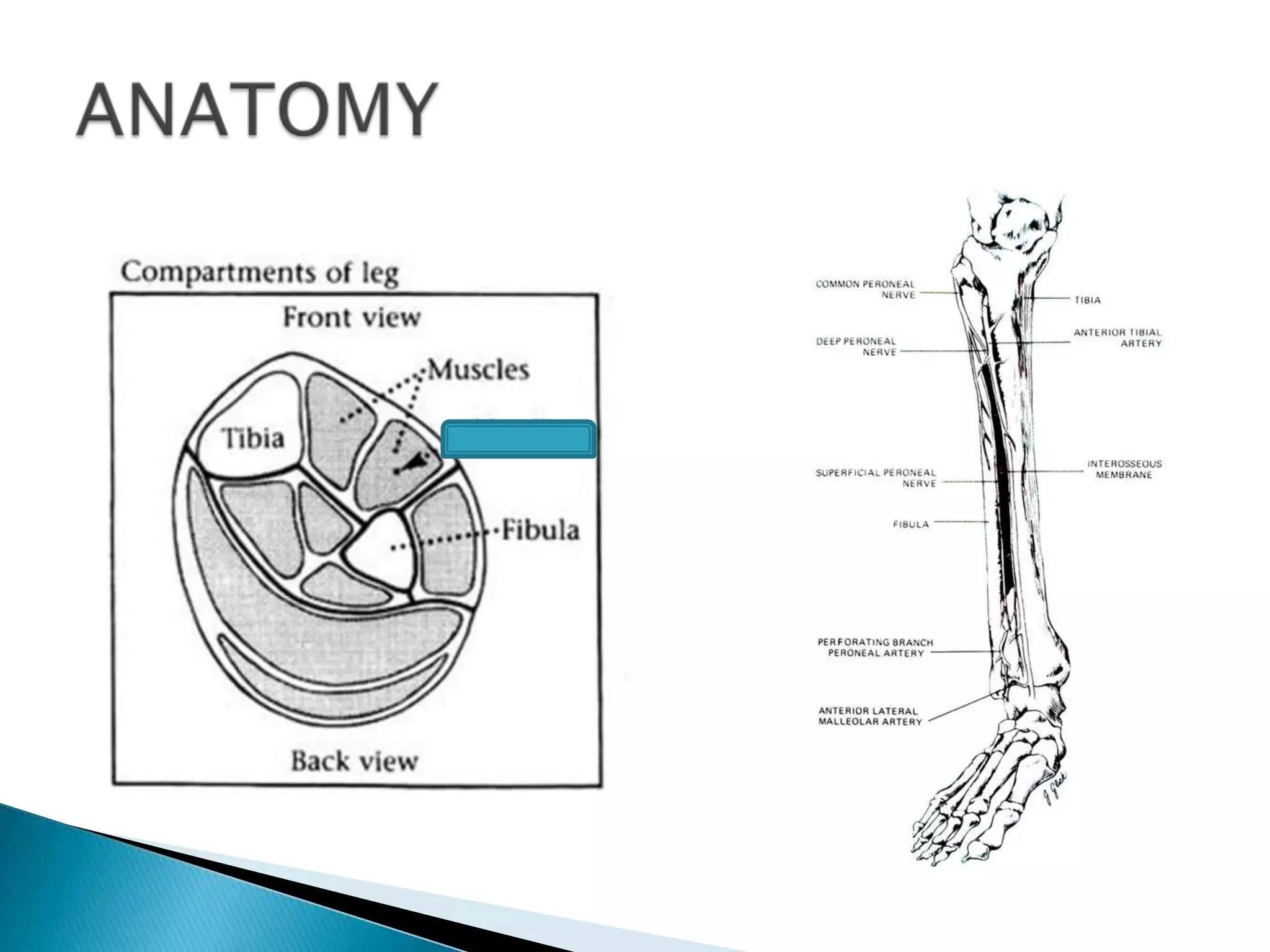
LEG?


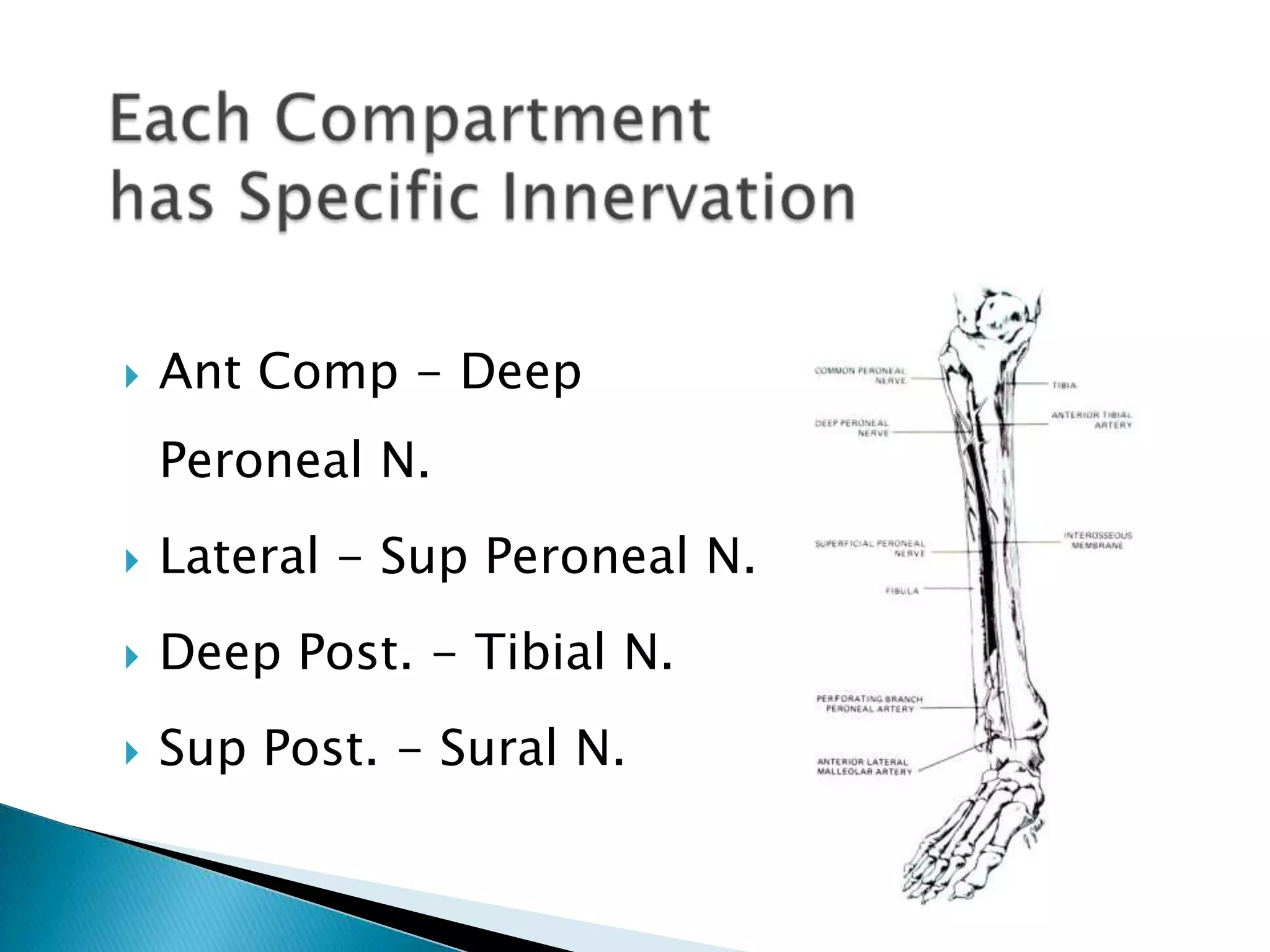
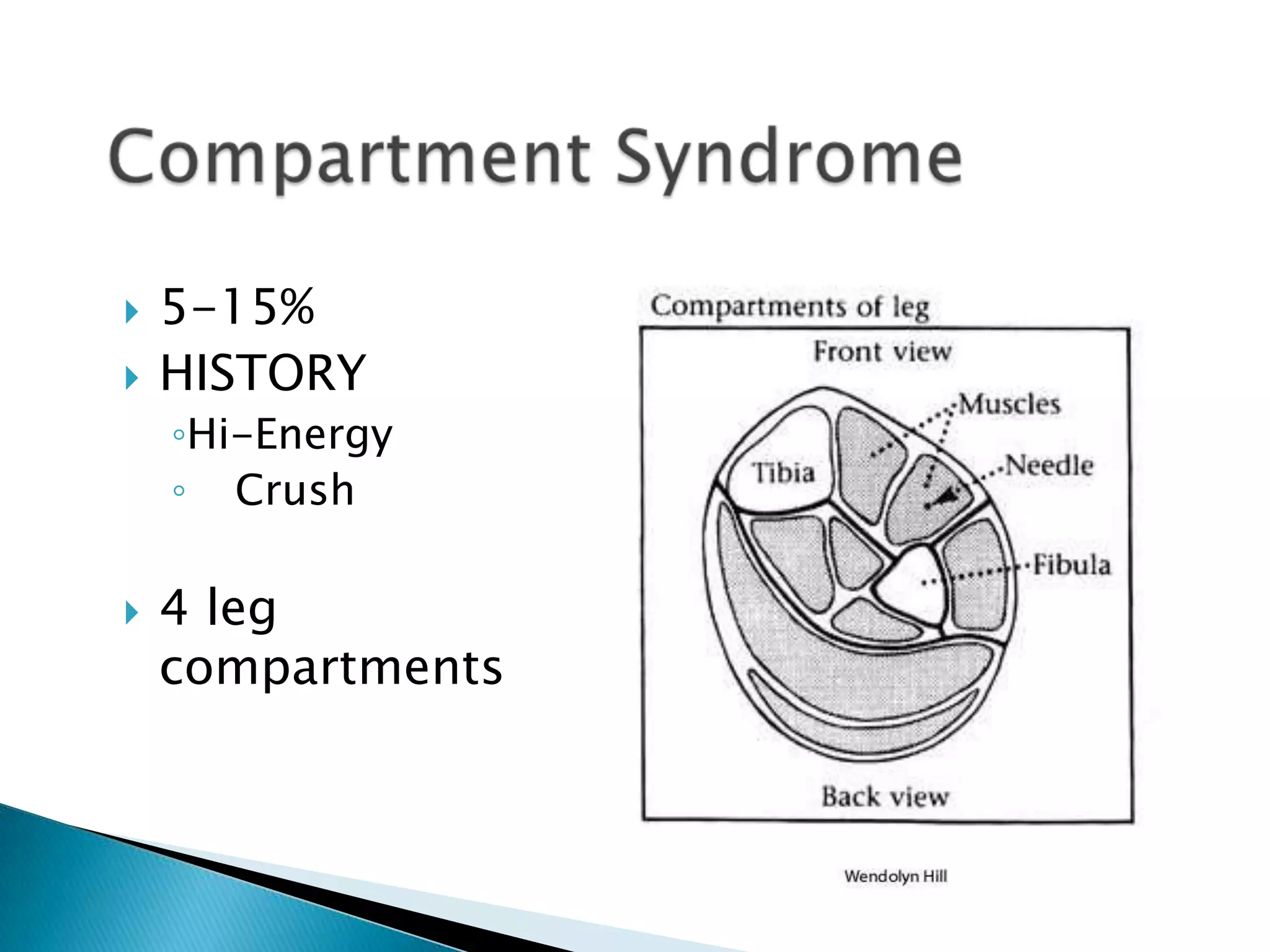
Ant Comp - Deep
Peroneal N.



Lateral - Sup Peroneal N.



Deep Post. - Tibial N.



Sup Post. - Sural N.
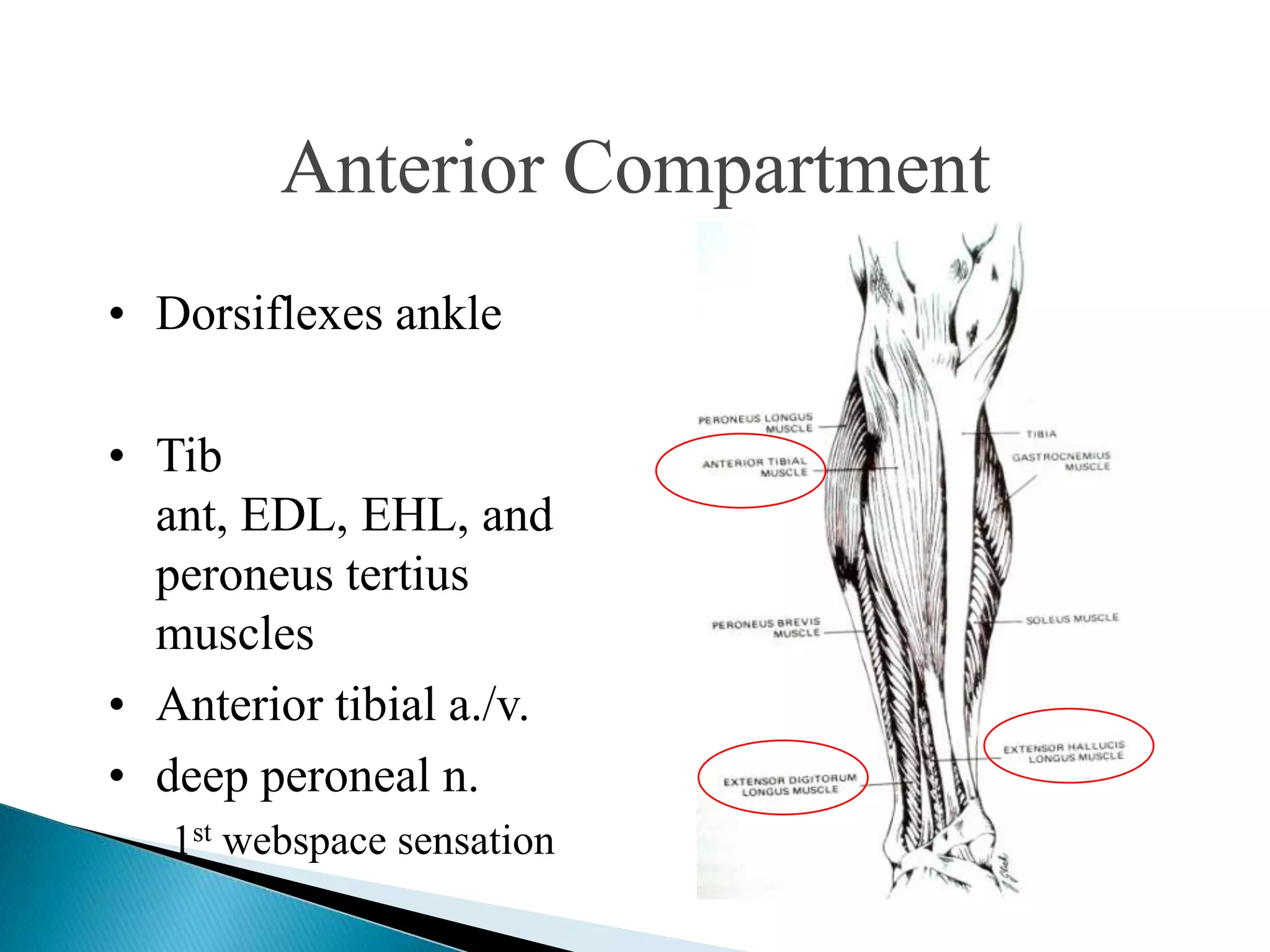
Anterior Compartment
• Dorsiflexes ankle
• Tib
ant, EDL, EHL, and
peroneus tertius
muscles
• Anterior tibial a./v.
• deep peroneal n.
1st webspace sensation
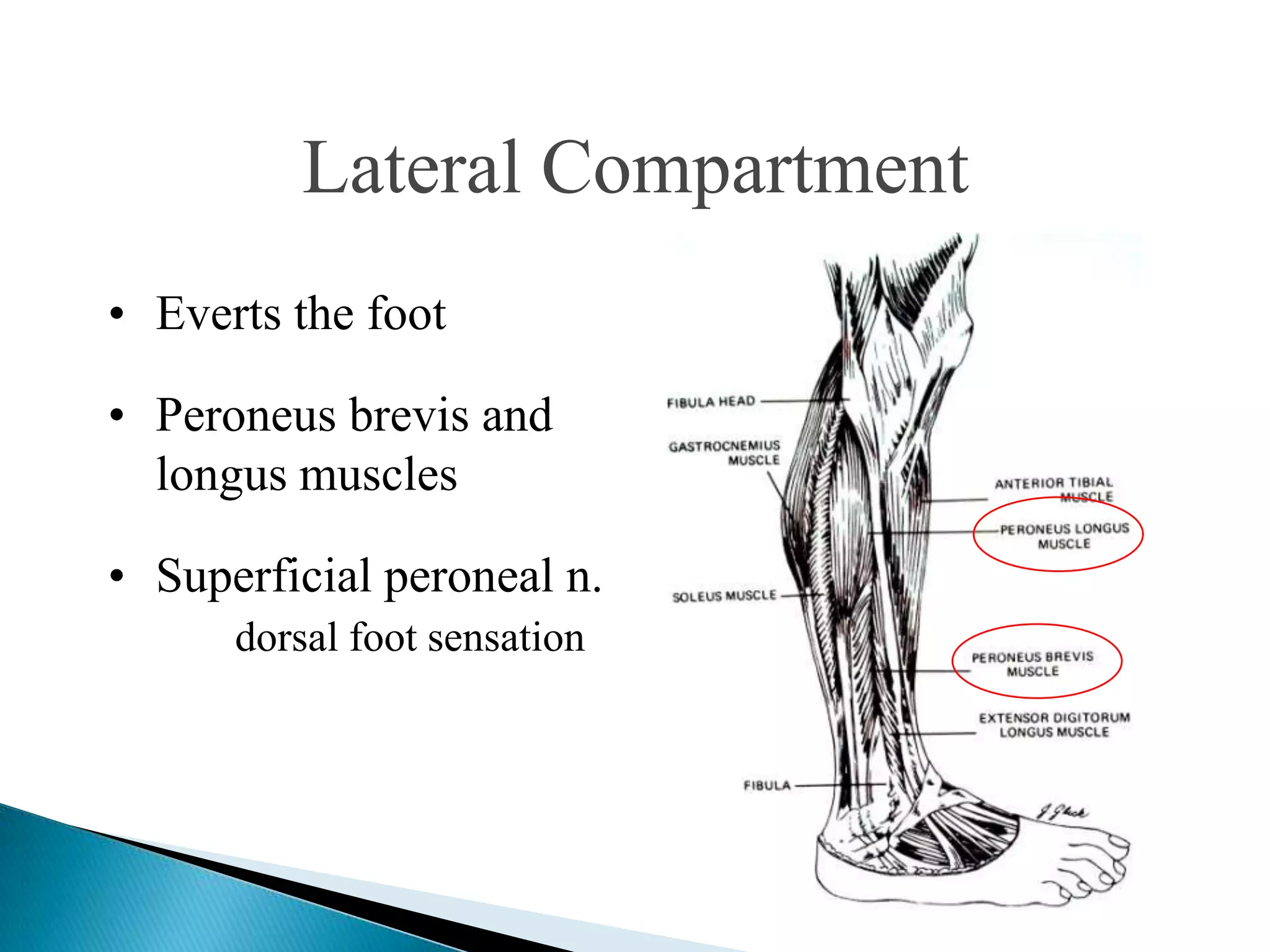
Lateral Compartment
• Everts the foot
• Peroneus brevis and
longus muscles

• Superficial peroneal n.
dorsal foot sensation
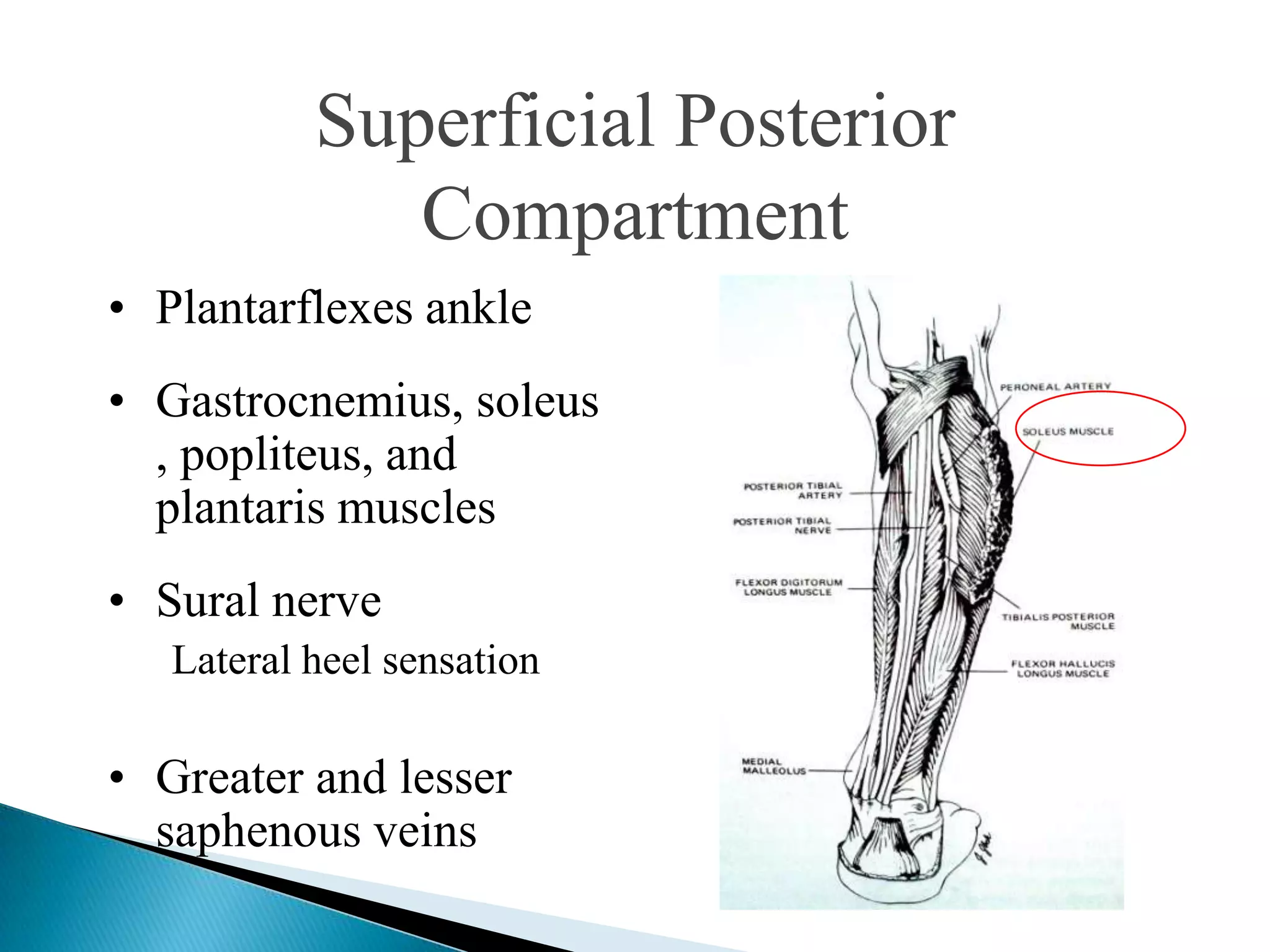
Superficial Posterior
Compartment
• Plantarflexes ankle
• Gastrocnemius, soleus
, popliteus, and
plantaris muscles
• Sural nerve
Lateral heel sensation

• Greater and lesser
saphenous veins
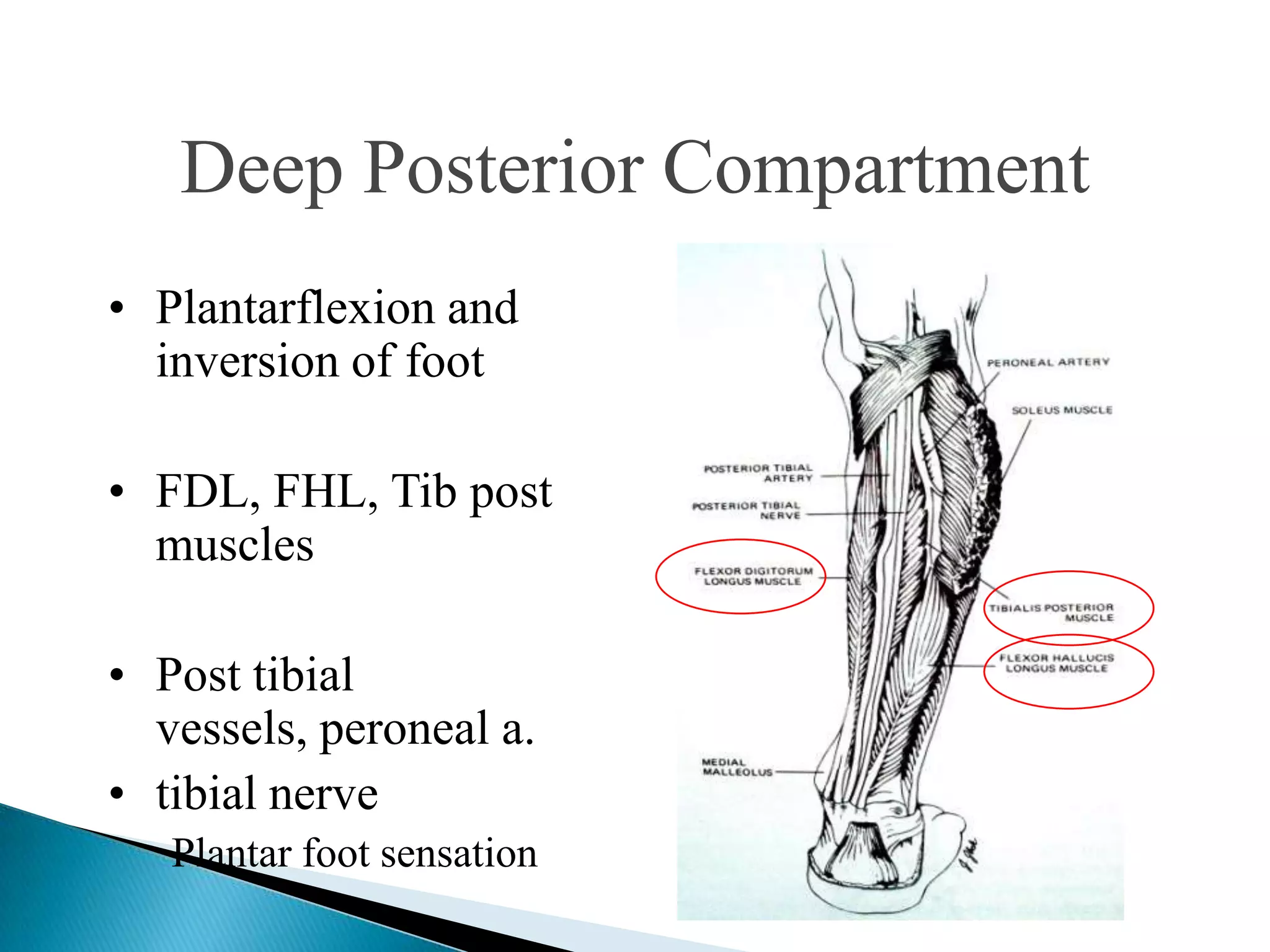
Deep Posterior Compartment
• Plantarflexion and
inversion of foot
• FDL, FHL, Tib post
muscles
• Post tibial
vessels, peroneal a.
• tibial nerve
Plantar foot sensation
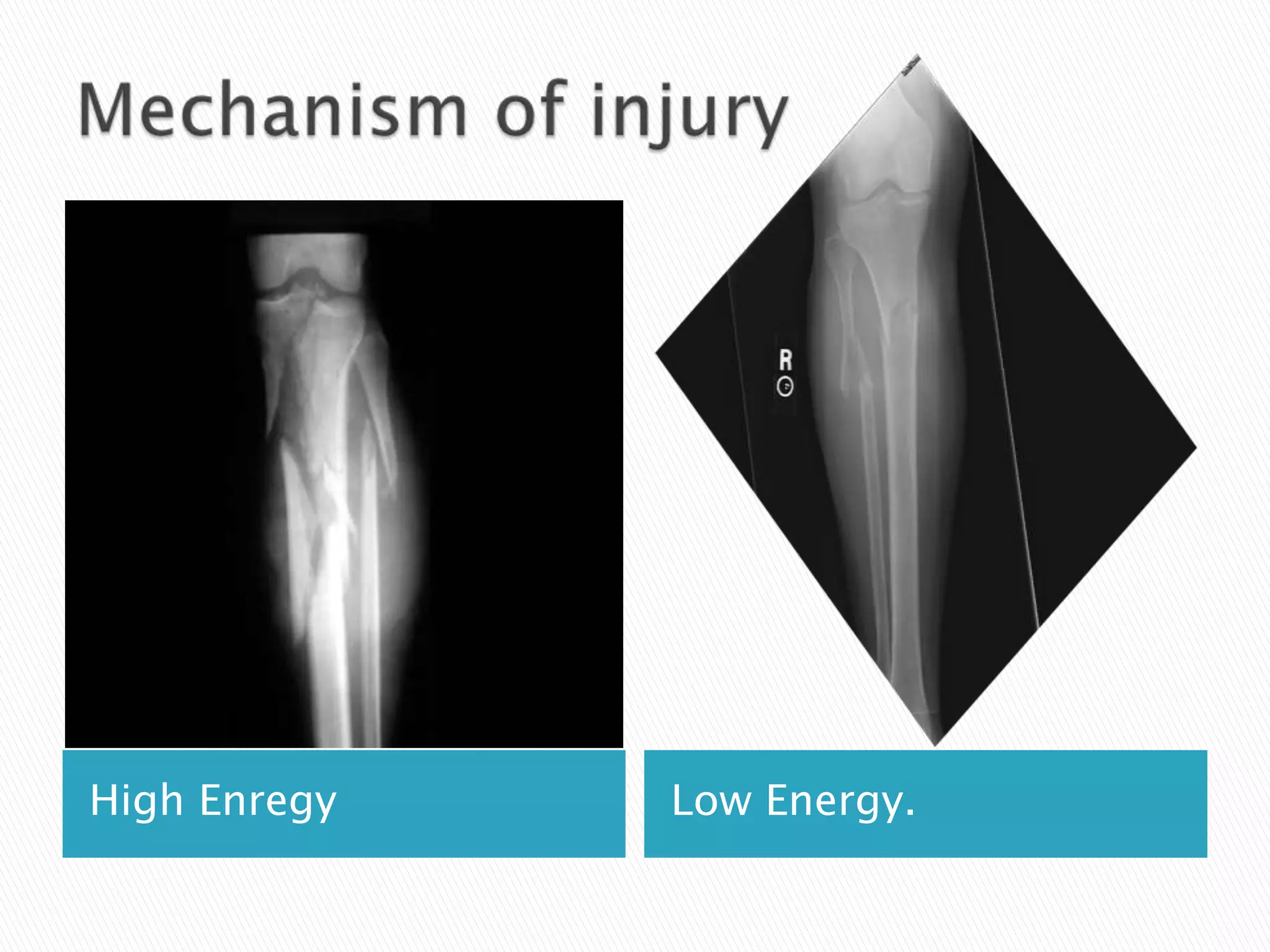
High Enregy

Low Energy.
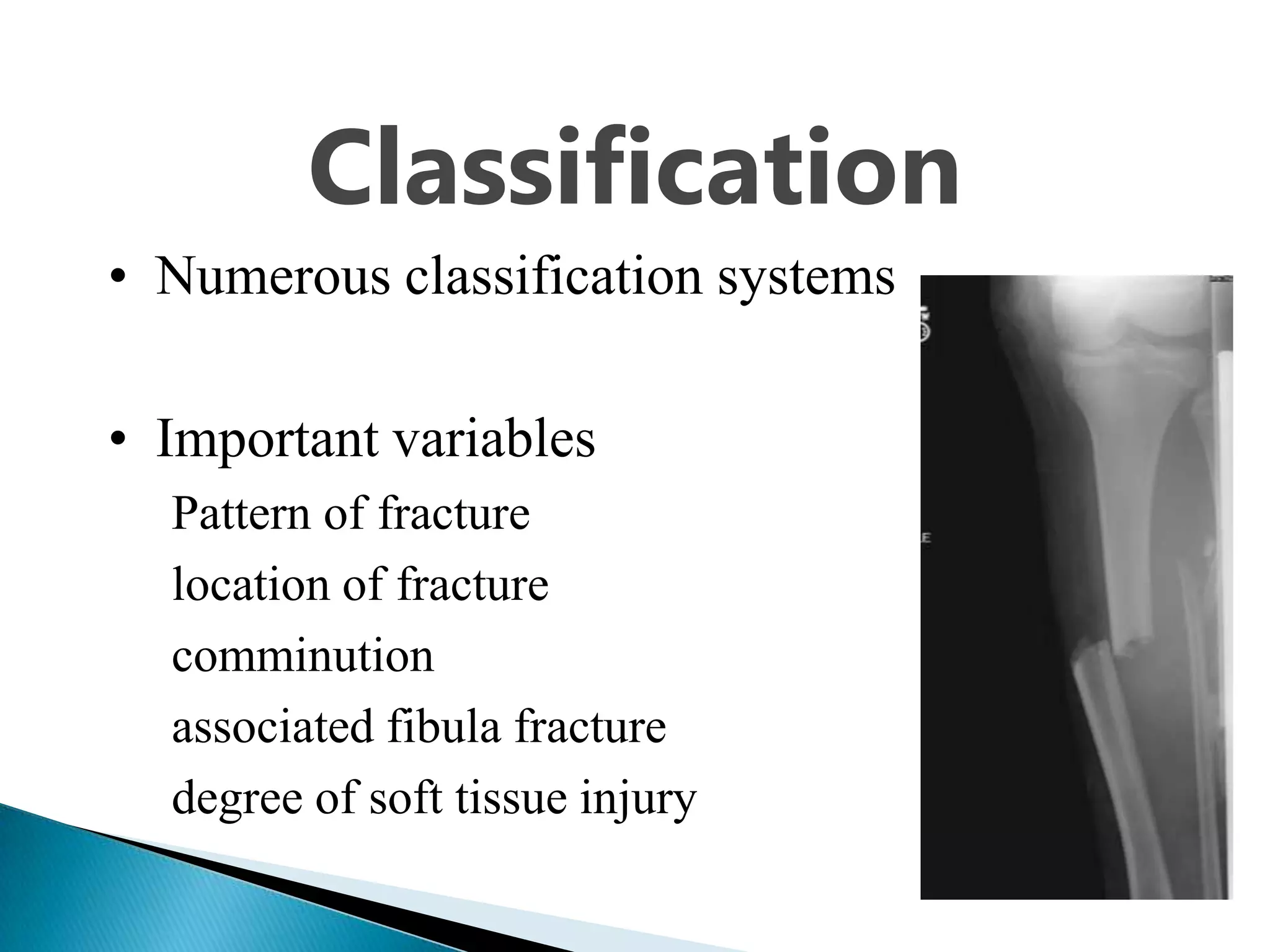
Classification
• Numerous classification systems
• Important variables
Pattern of fracture
location of fracture
comminution
associated fibula fracture
degree of soft tissue injury
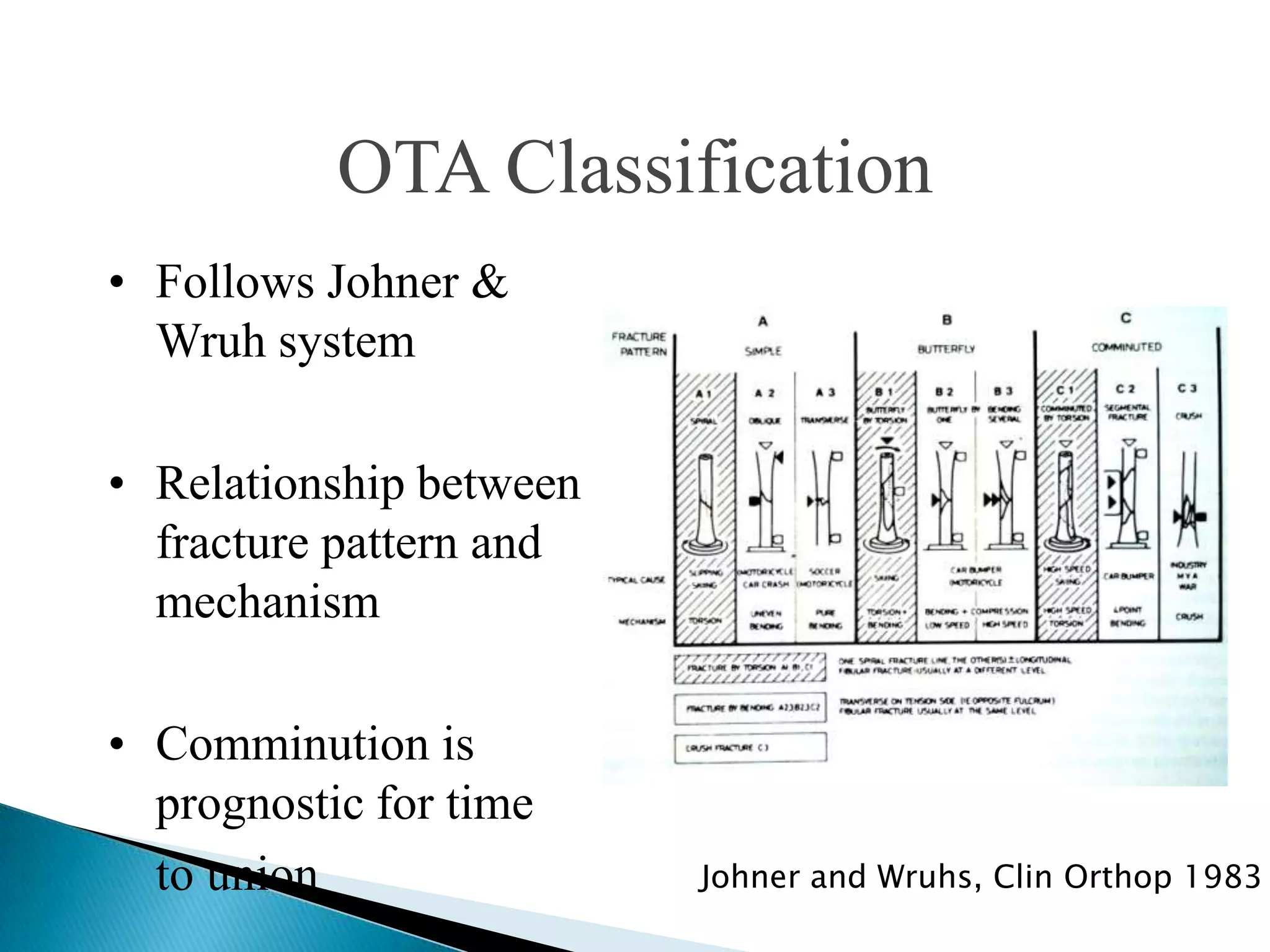
OTA Classification
• Follows Johner &
Wruh system
• Relationship between
fracture pattern and
mechanism
• Comminution is
prognostic for time
to union

Johner and Wruhs, Clin Orthop 1983
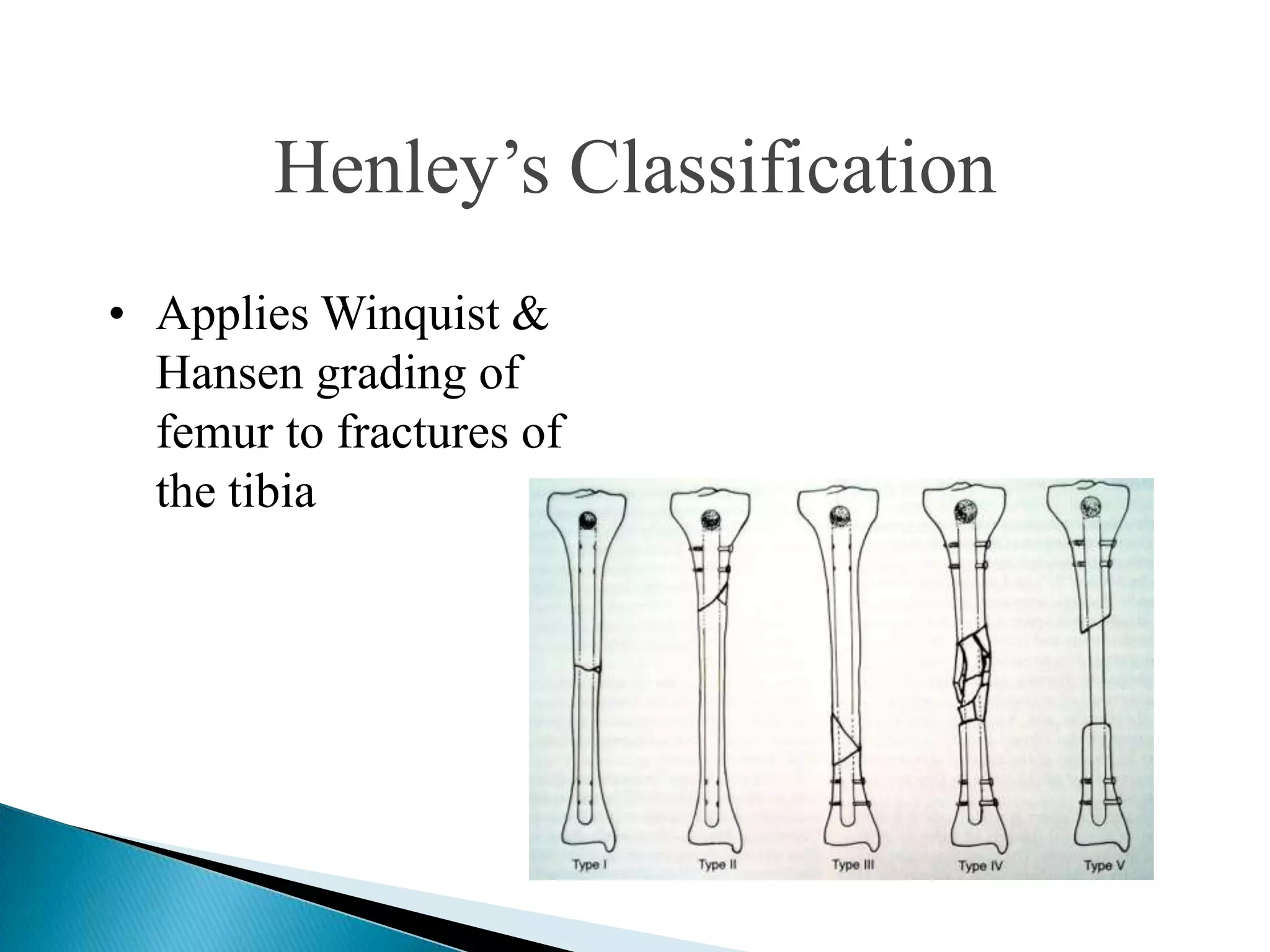
Henley‟s Classification
• Applies Winquist &
Hansen grading of
femur to fractures of
the tibia
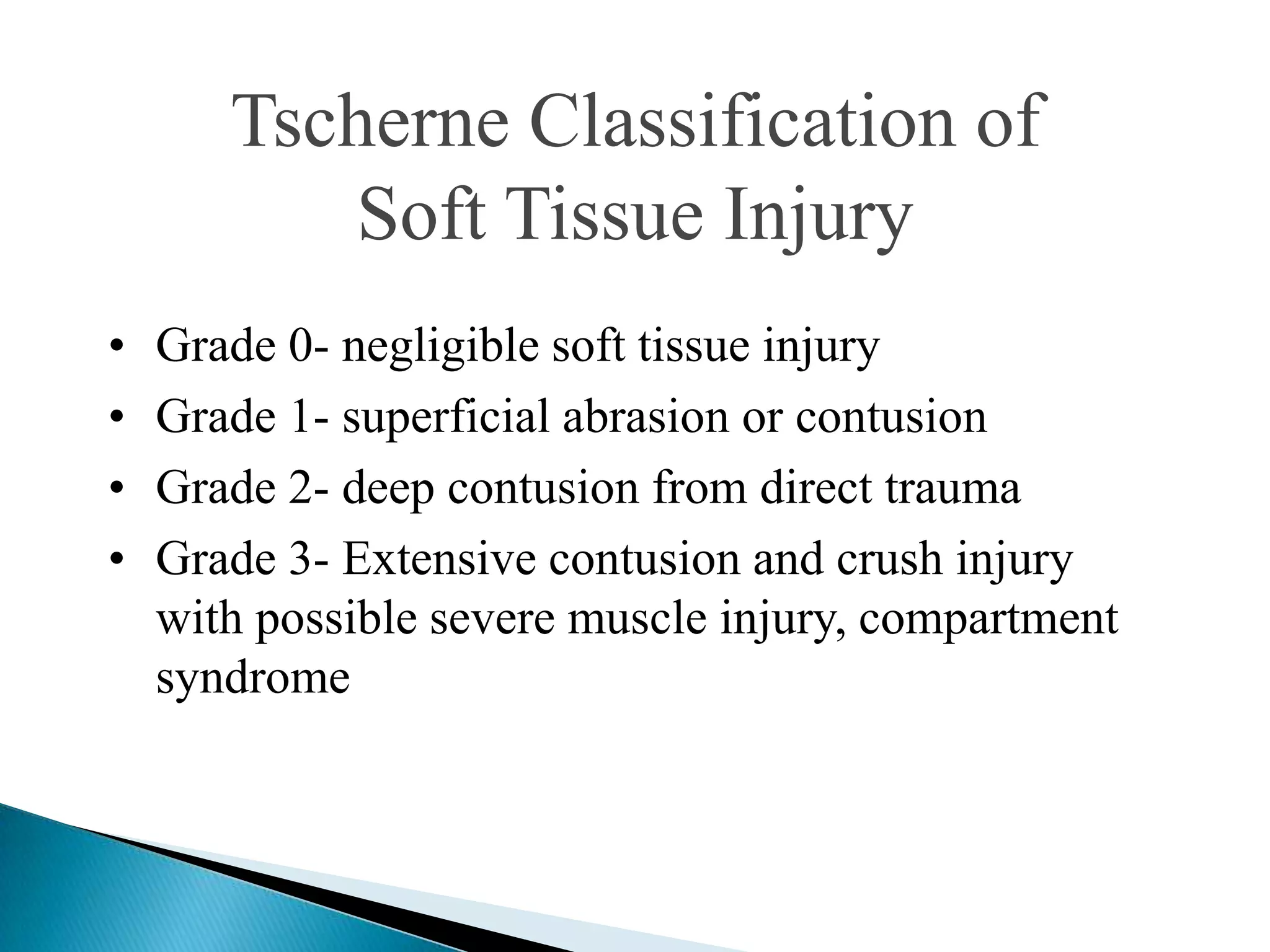
Tscherne Classification of
Soft Tissue Injury
•
•
•
•

Grade 0- negligible soft tissue injury
Grade 1- superficial abrasion or contusion
Grade 2- deep contusion from direct trauma
Grade 3- Extensive contusion and crush injury
with possible severe muscle injury, compartment
syndrome
History & Physical
• Pain, inability to bear weight, and deformity
• Local swelling and edema variable
• Careful inspection of soft tissue
envelope, including compartment swelling
• Thorough neurovascular assessment including
motor/sensory exam and distal pulses
Physical Exam
• Soft tissue injury with high-energy crush
mechanism may take several days to fully
declare itself
• Repeated exam to follow compartment
swelling
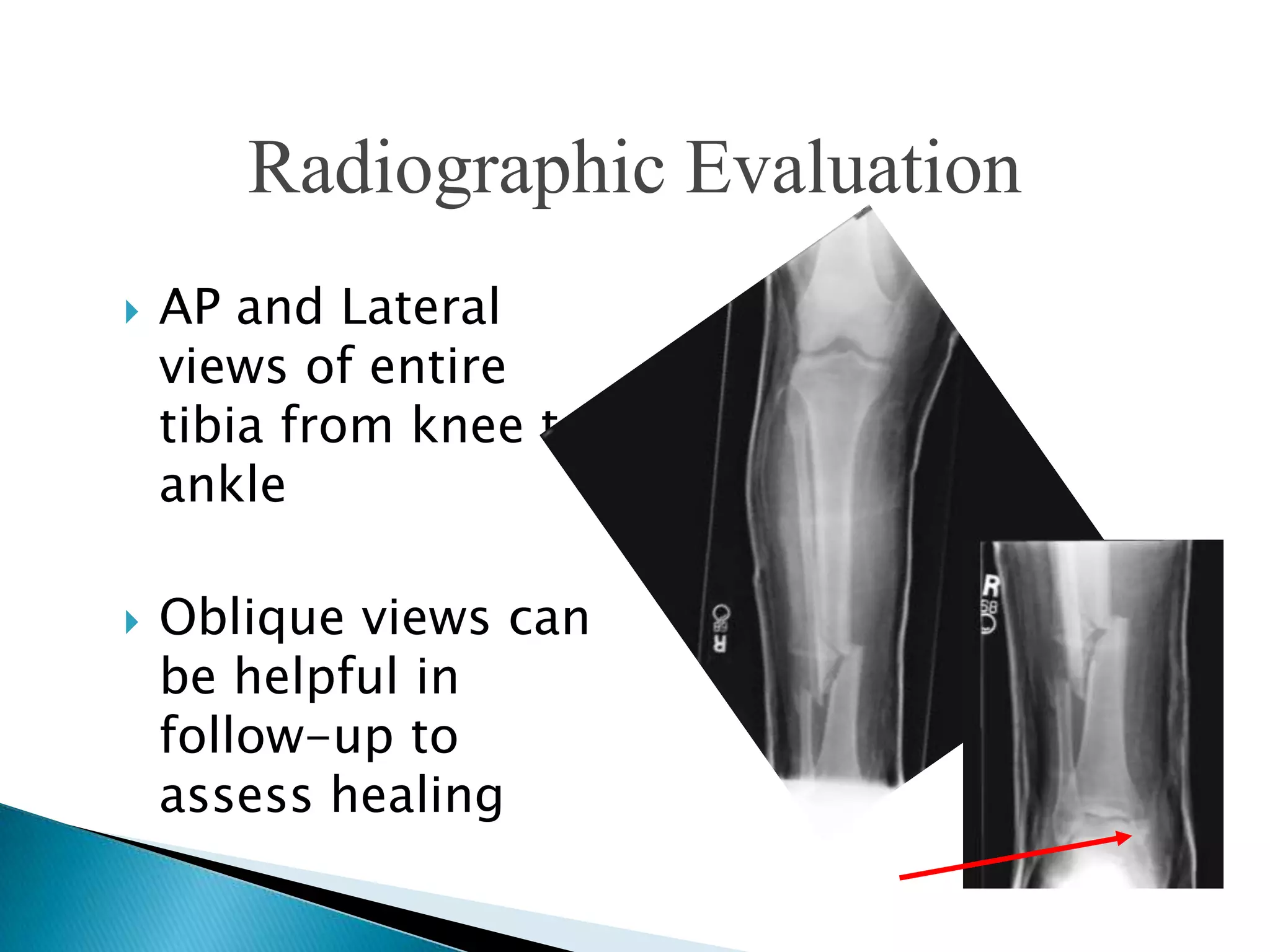
Radiographic Evaluation




AP and Lateral
views of entire
tibia from knee to
ankle
Oblique views can
be helpful in
follow-up to
assess healing
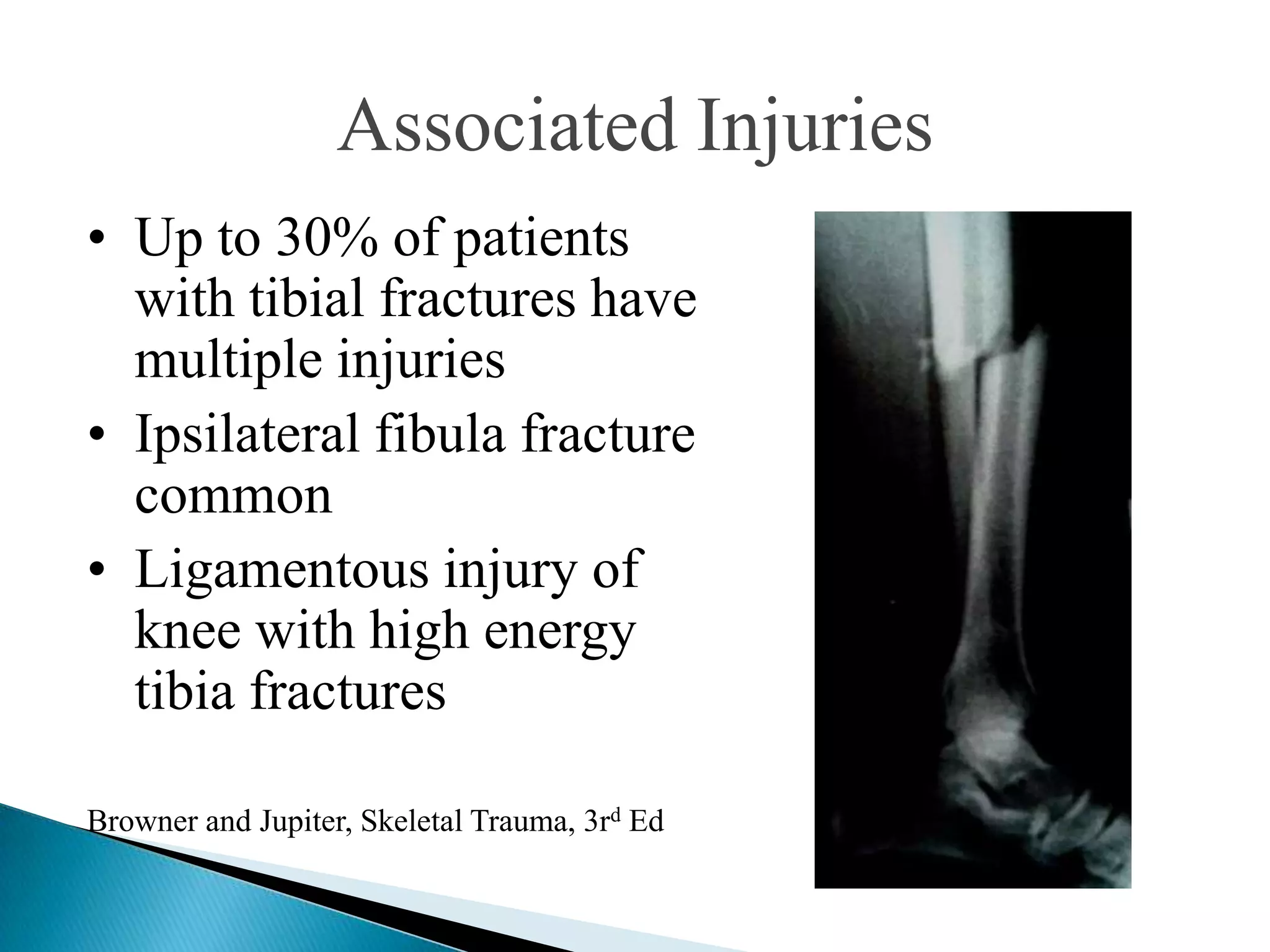
Associated Injuries
• Up to 30% of patients
with tibial fractures have
multiple injuries
• Ipsilateral fibula fracture
common
• Ligamentous injury of
knee with high energy
tibia fractures
Browner and Jupiter, Skeletal Trauma, 3rd Ed
Associated Injuries
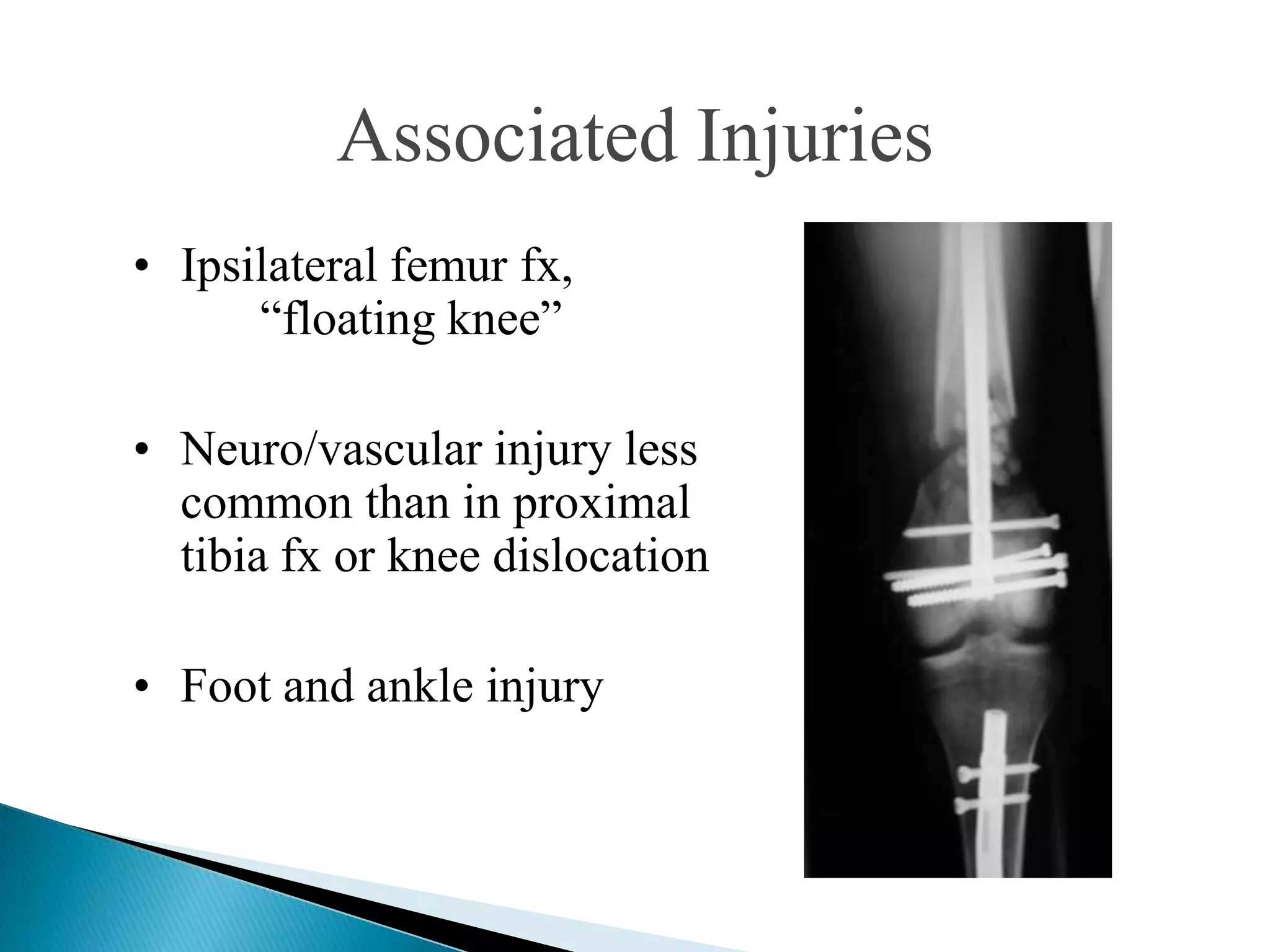
• Ipsilateral femur fx,
“floating knee”
• Neuro/vascular injury less
common than in proximal
tibia fx or knee dislocation
• Foot and ankle injury




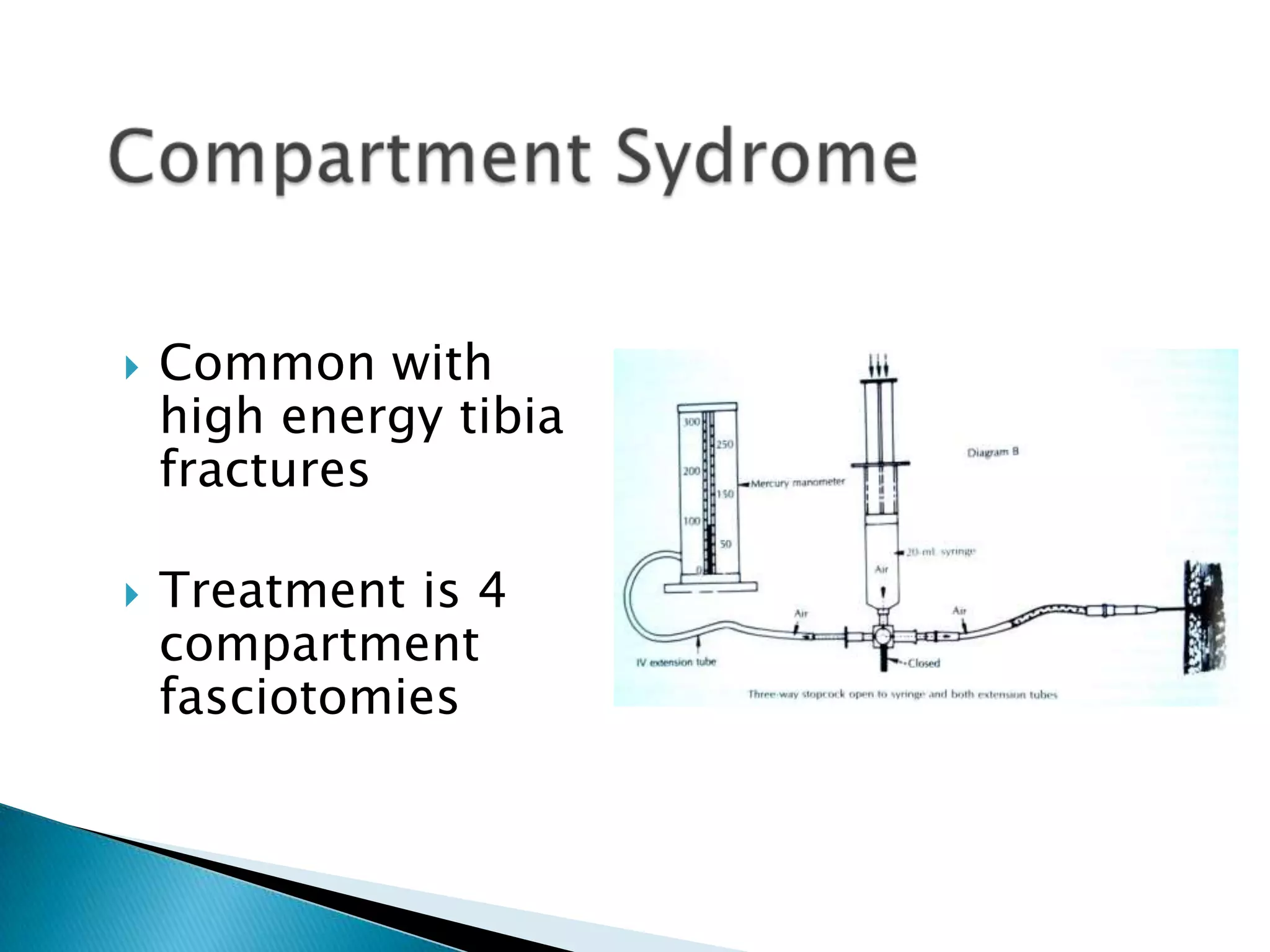
Common with
high energy tibia
fractures
Treatment is 4
compartment
fasciotomies



5-15%
HISTORY
◦Hi-Energy
◦ Crush



4 leg
compartments


Limit soft tissue damage.



Preserve or restore soft tissue cover.



Prevent or recognize & treat Compartment
Syndrome.



To obtain & hold fracture alignment.



Early weight bearing.



To start joint movements as early as possible.


Depends on the type of fracture.
◦ Open / Closed
◦ High Energy / Low Energy








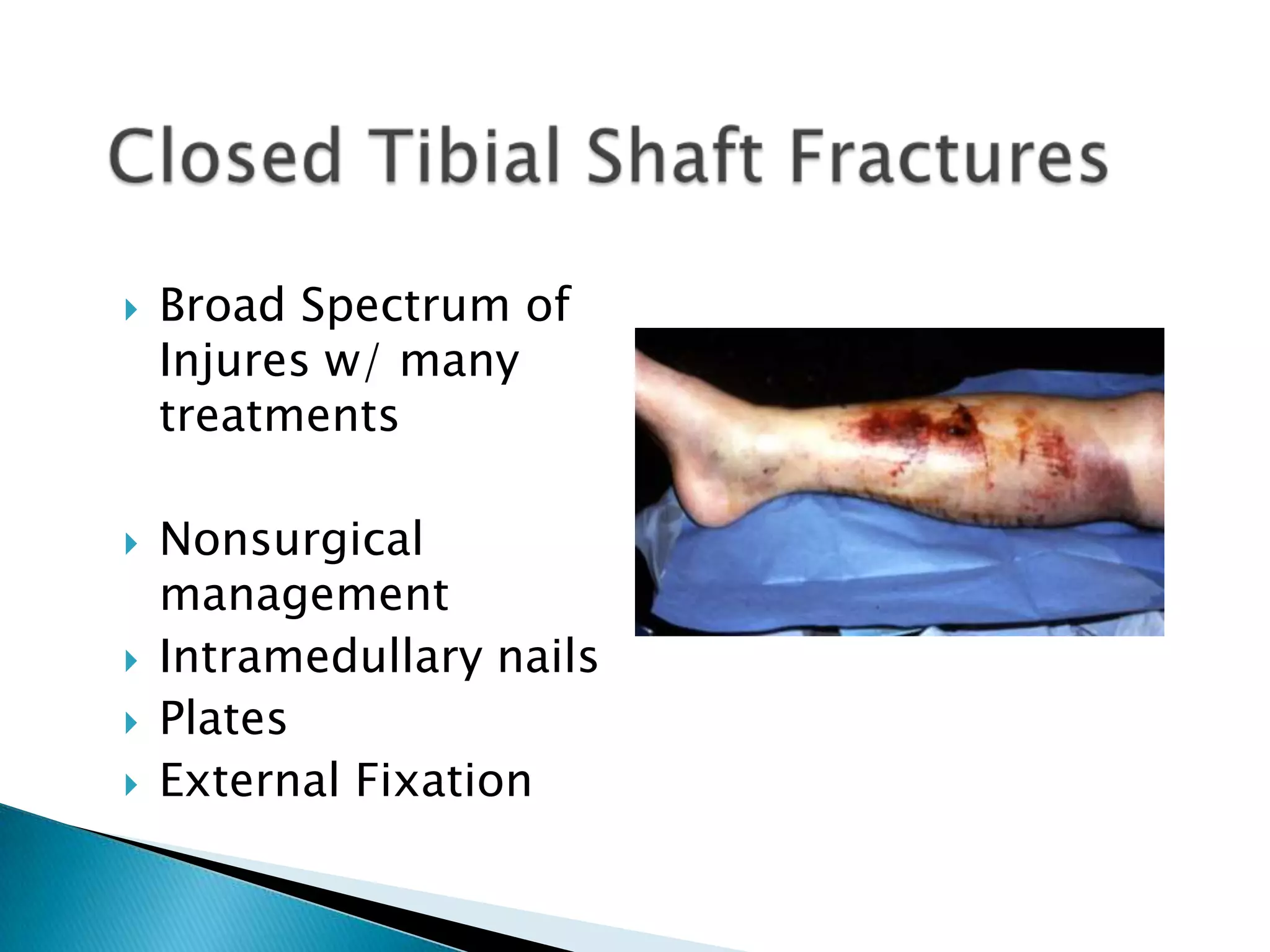
Broad Spectrum of
Injures w/ many
treatments
Nonsurgical
management
Intramedullary nails
Plates
External Fixation


Minimal soft tissue damage



Stable fracture pattern
 < 5 varus/valgus
 < 10 pro/recurvatum
 < 1 cm shortening



Ability to bear weight in cast or fx brace



Frequent follow-up
Schmidt, et.al., ICL 52, 2003


Closed Functional Treatment
◦

1,000 Tibial Fractures
60% Lost to F/u



All < 1.5cm shortening
Only 5% more than 8 varus



Average 3.7wks in long leg cast, then



◦ Functional fracture brace

Sarmiento, JBJS 1984


Long-term angular deformities may be well

tolerated without associated knee or ankle
arthrosis


Kristensen

F/U: 20-29 yr

All patients >10 degree deformity


Merchant & Dietz

F/U: 29 yrs.

◦ Outcome not associated with ang., site, immob.

(37/108 patients)
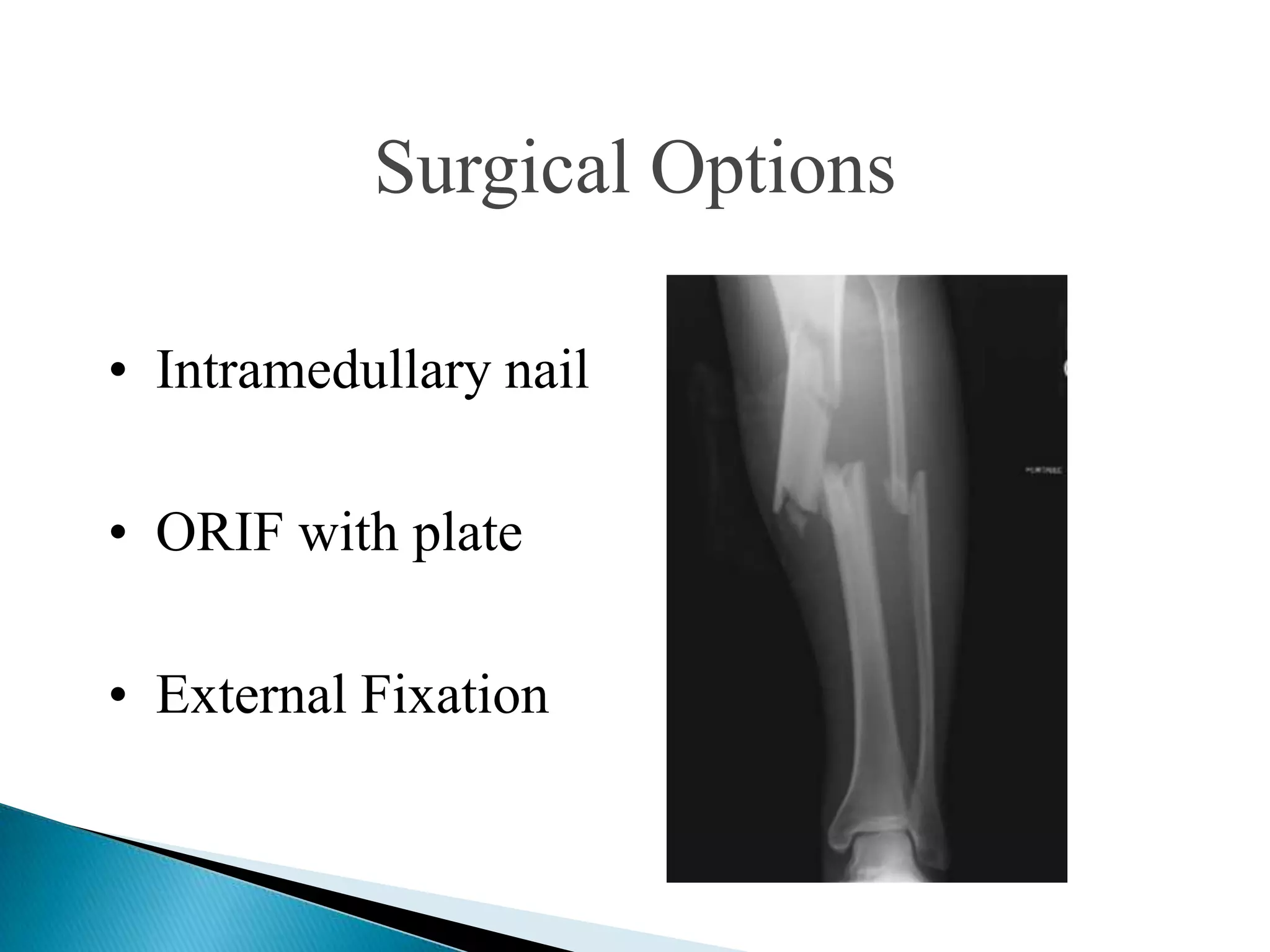
Surgical Options
• Intramedullary nail

• ORIF with plate
• External Fixation
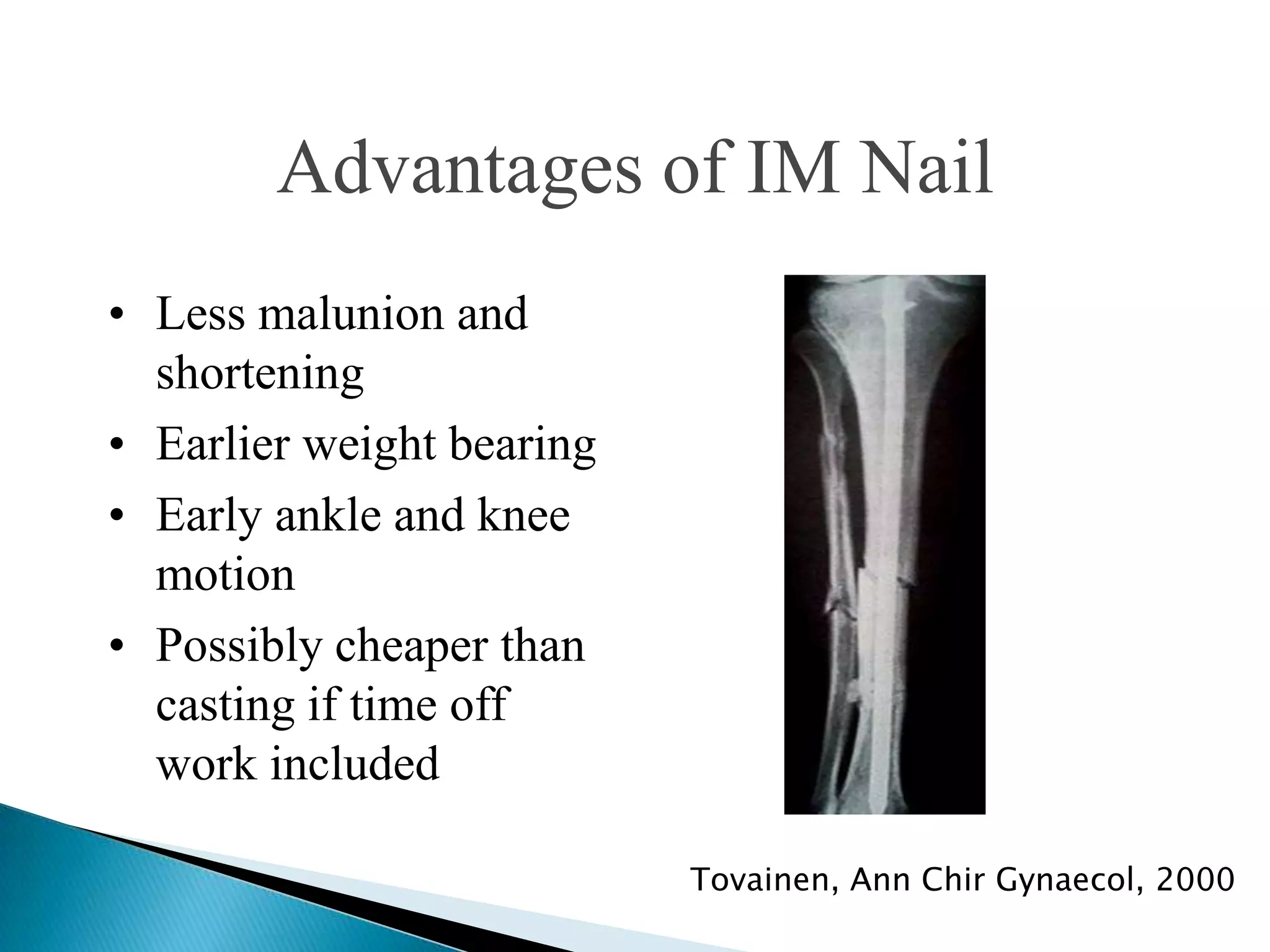
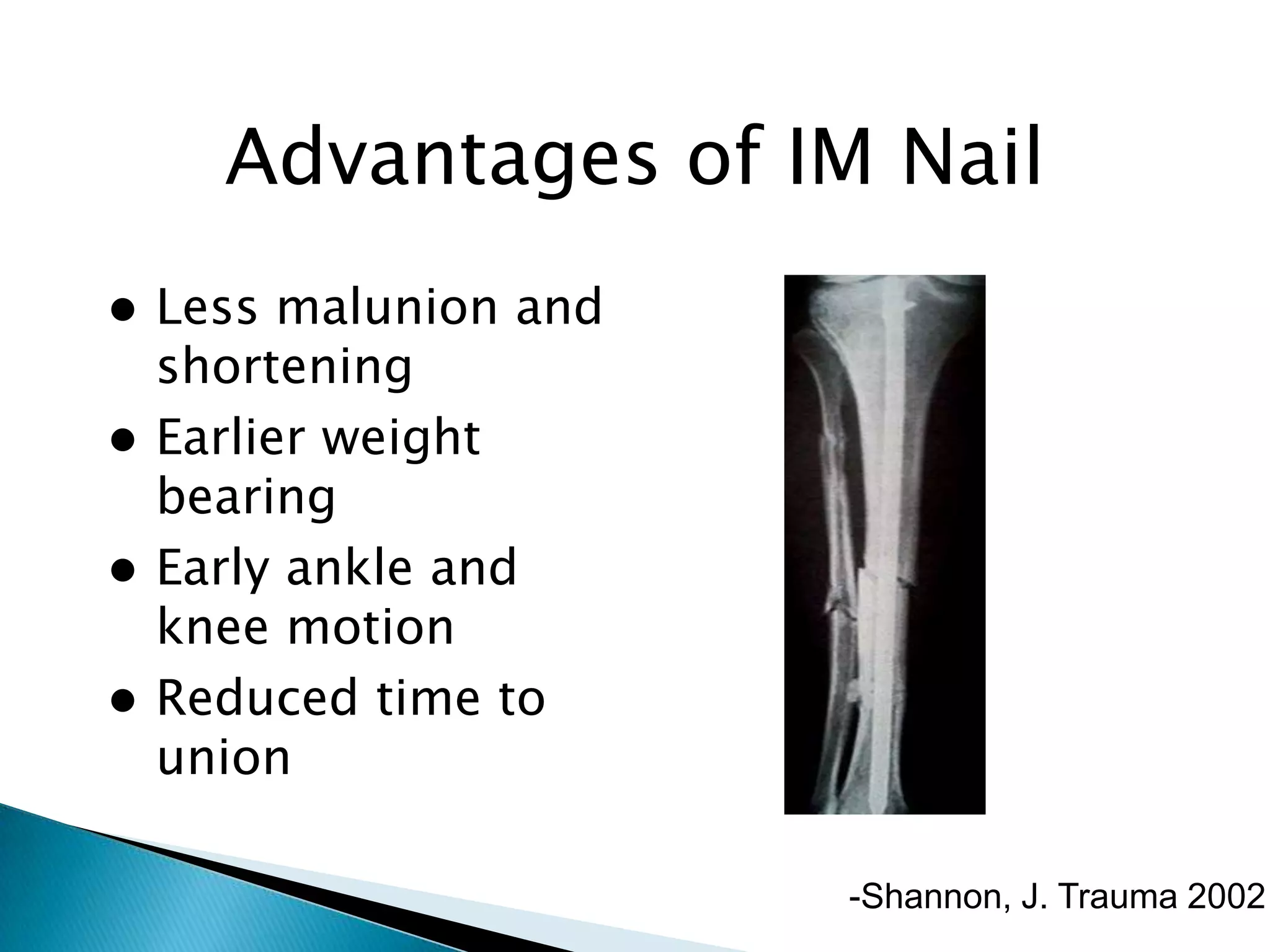
Advantages of IM Nail
• Less malunion and
shortening
• Earlier weight bearing
• Early ankle and knee
motion
• Possibly cheaper than
casting if time off
work included
Tovainen, Ann Chir Gynaecol, 2000
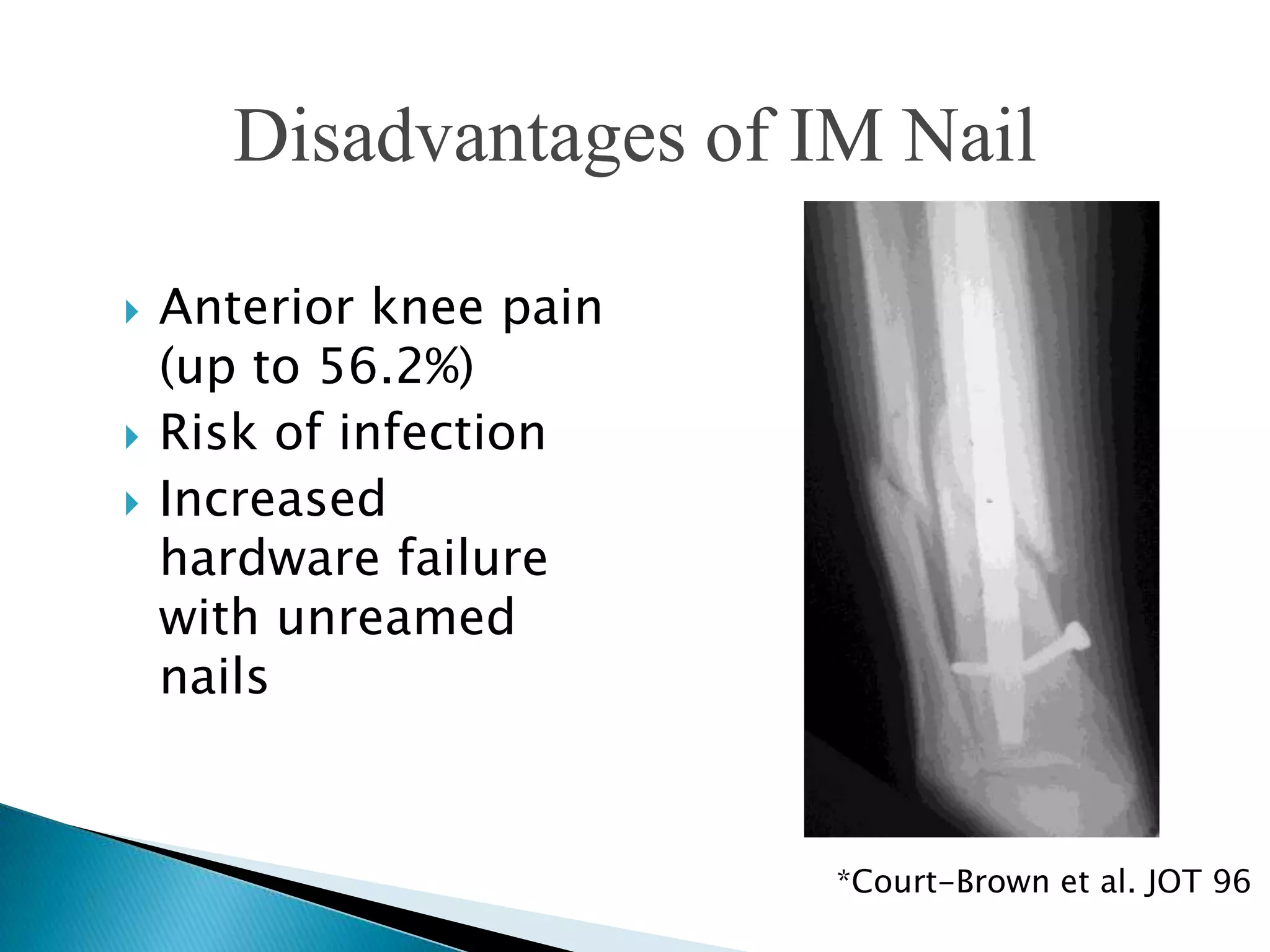
Disadvantages of IM Nail





Anterior knee pain
(up to 56.2%)
Risk of infection
Increased
hardware failure
with unreamed
nails

*Court-Brown et al. JOT 96
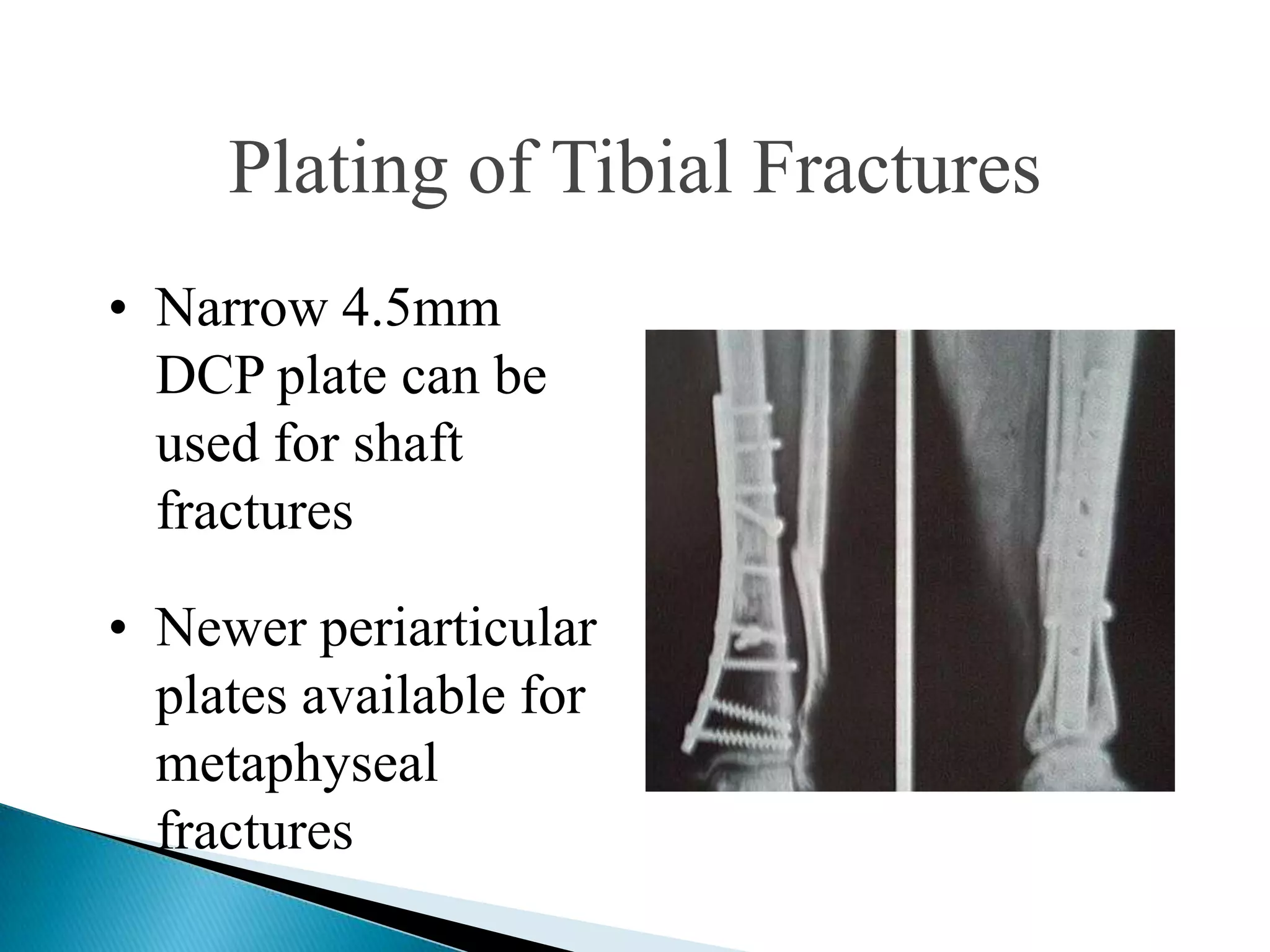
Plating of Tibial Fractures
• Narrow 4.5mm
DCP plate can be
used for shaft
fractures
• Newer periarticular
plates available for
metaphyseal
fractures
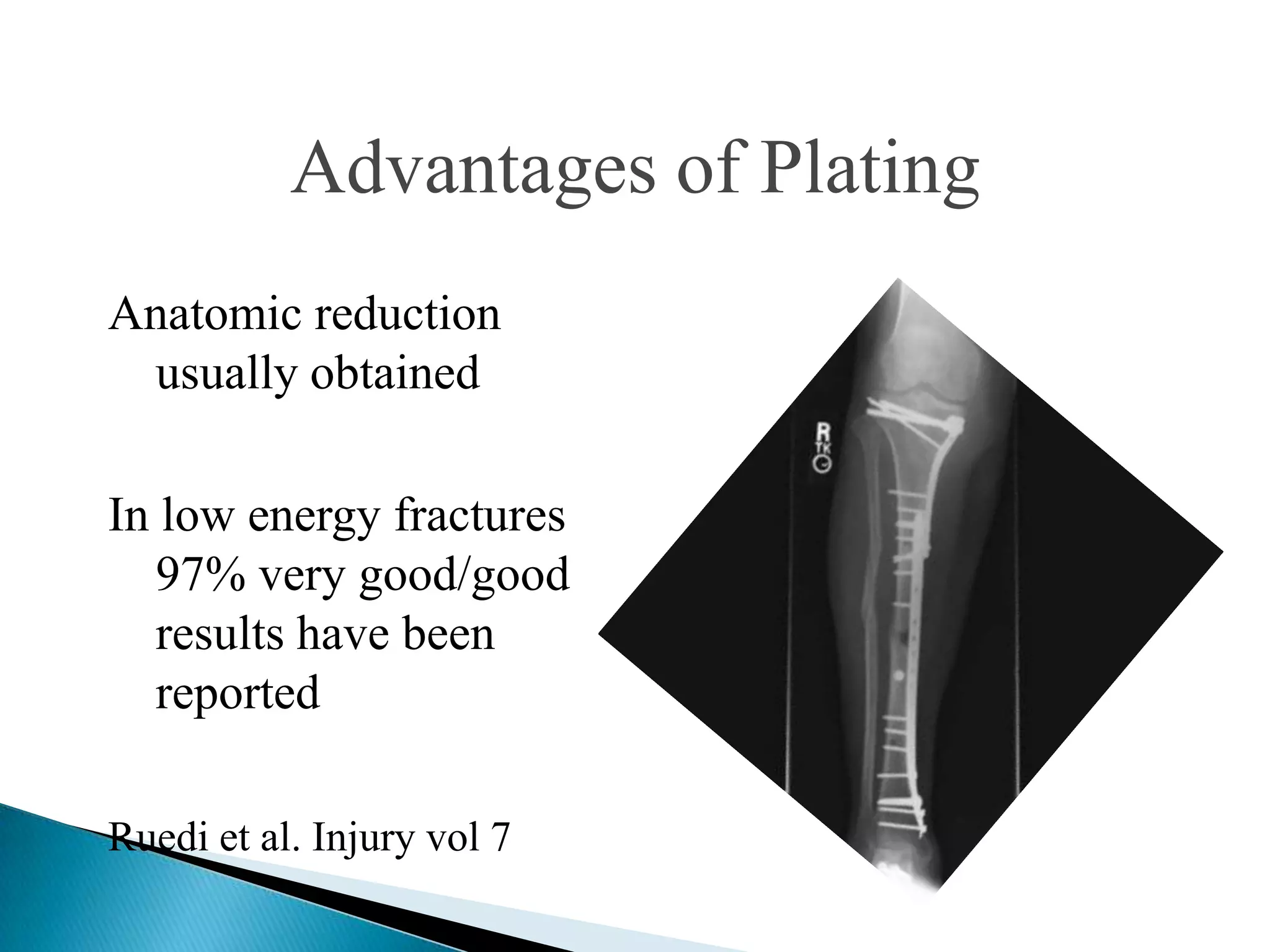
Advantages of Plating
Anatomic reduction
usually obtained
In low energy fractures
97% very good/good
results have been
reported
Ruedi et al. Injury vol 7
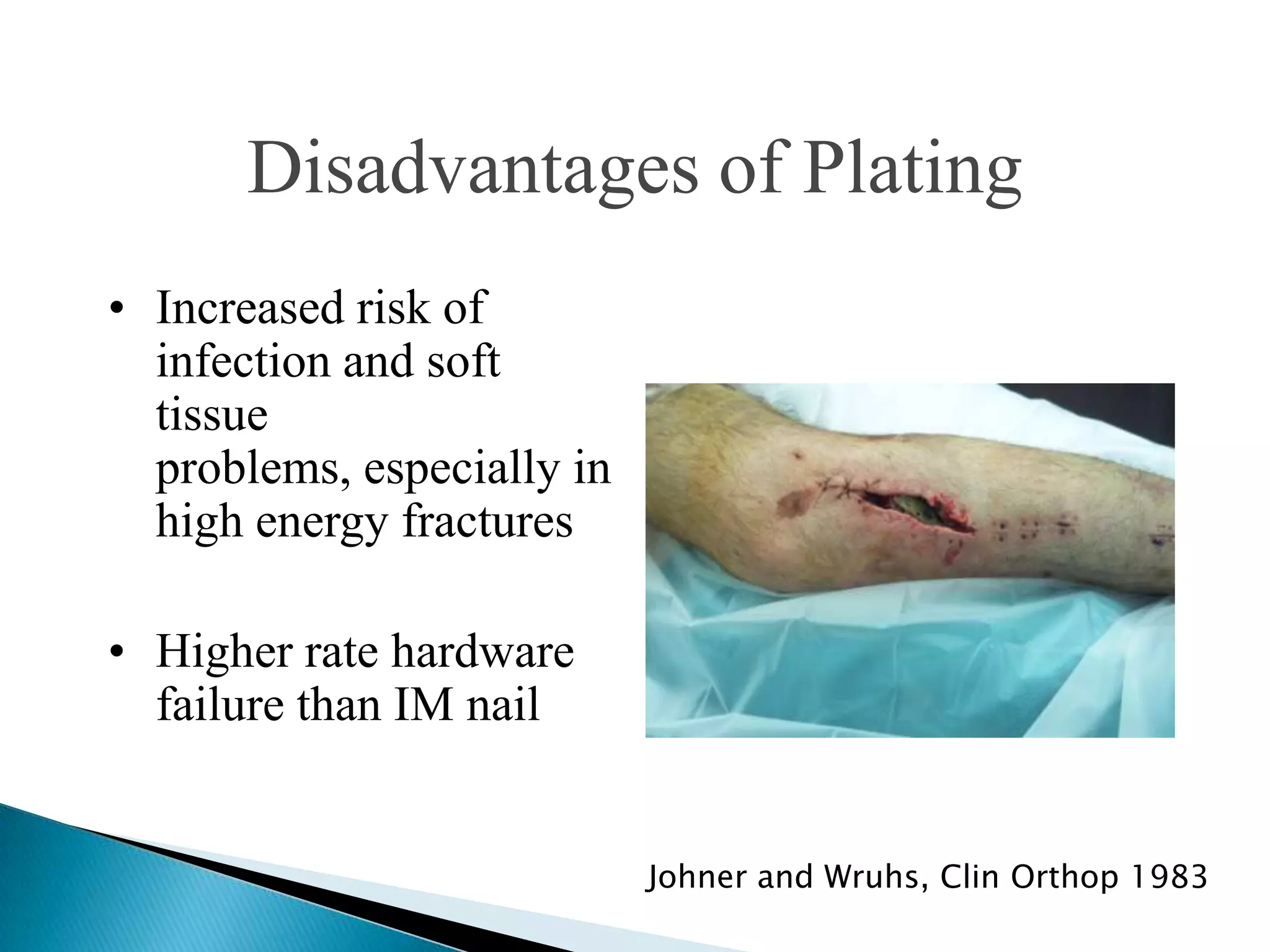
Disadvantages of Plating
• Increased risk of
infection and soft
tissue
problems, especially in
high energy fractures
• Higher rate hardware
failure than IM nail
Johner and Wruhs, Clin Orthop 1983
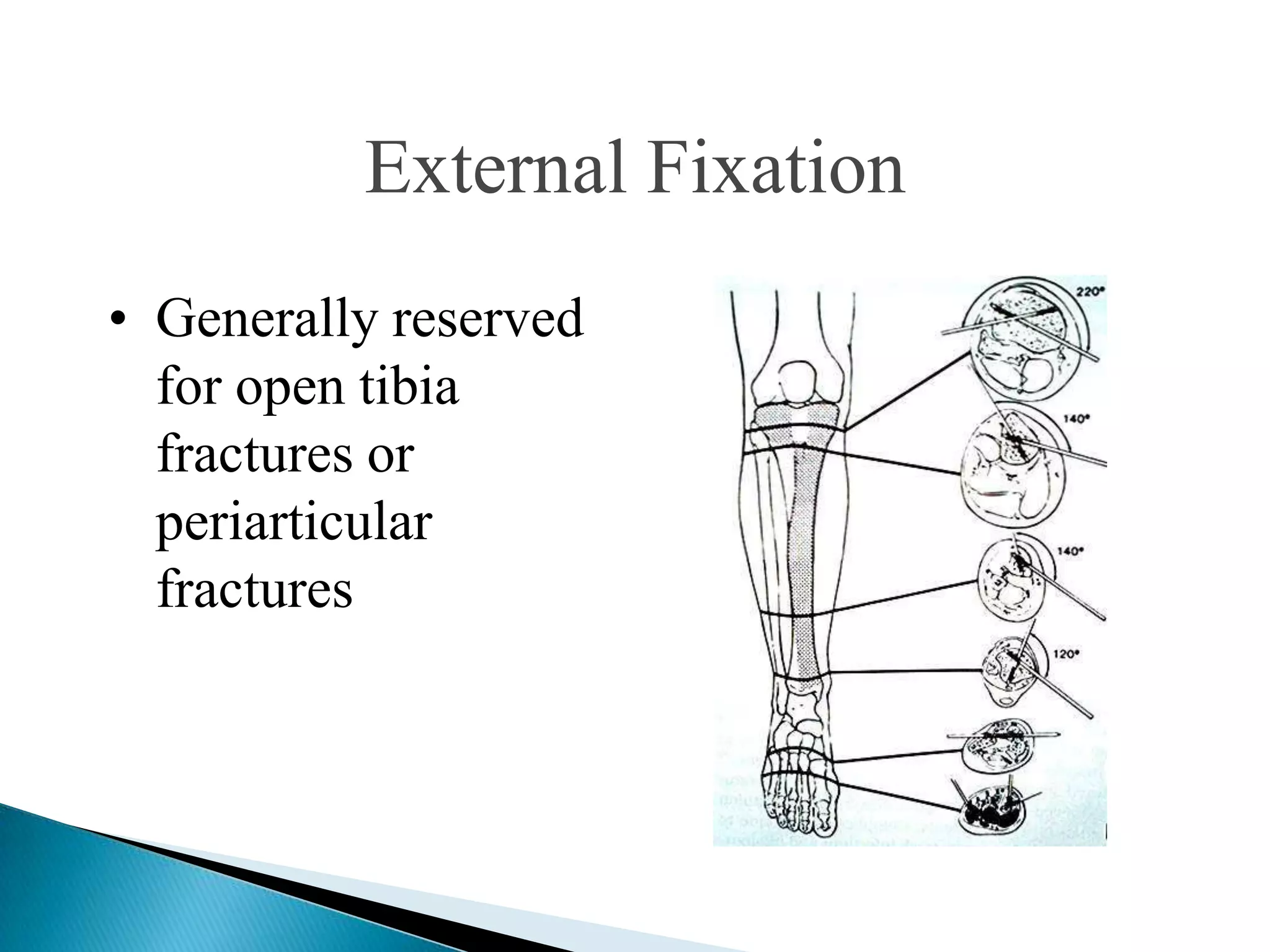
External Fixation
• Generally reserved
for open tibia
fractures or
periarticular
fractures
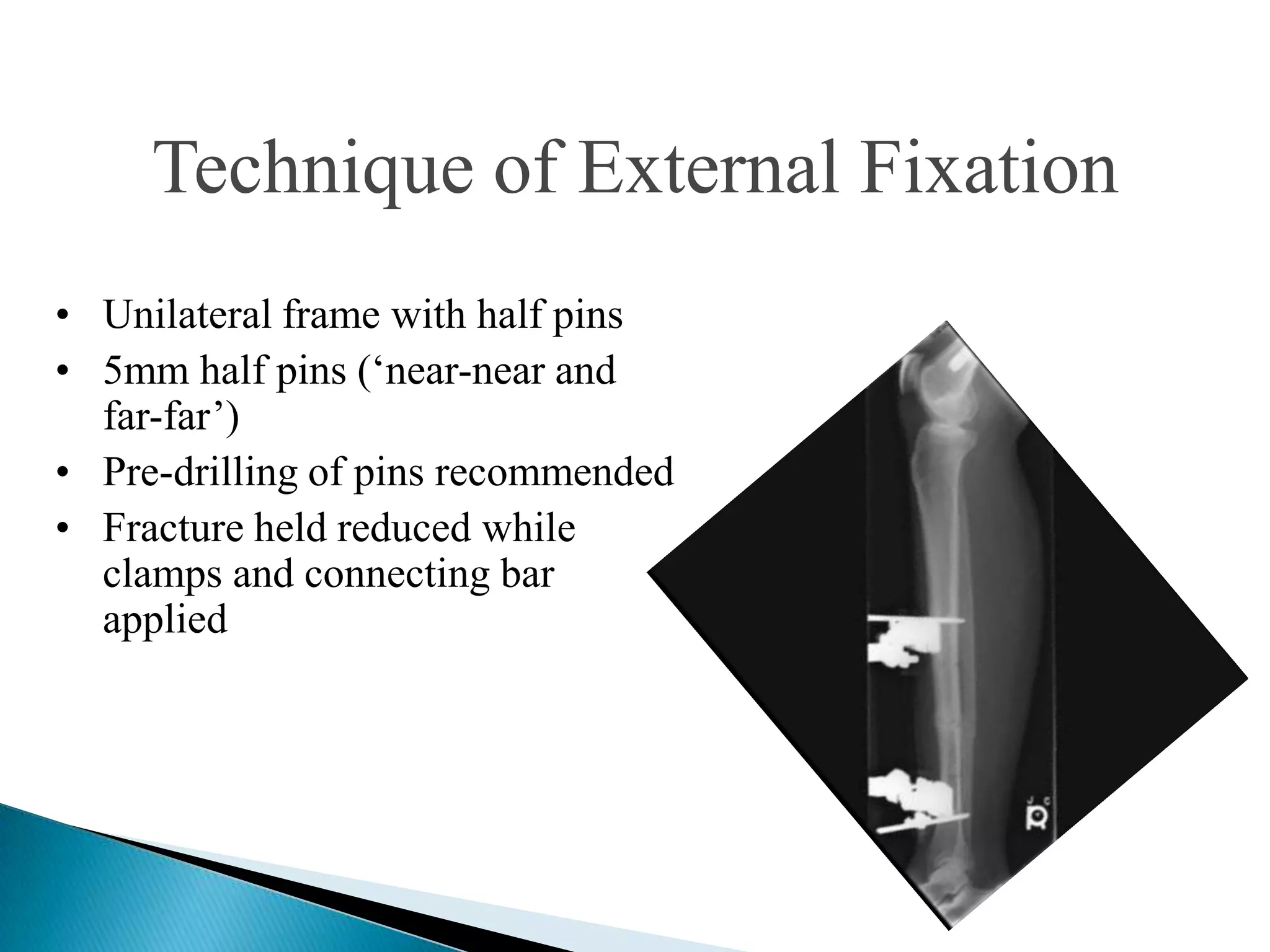
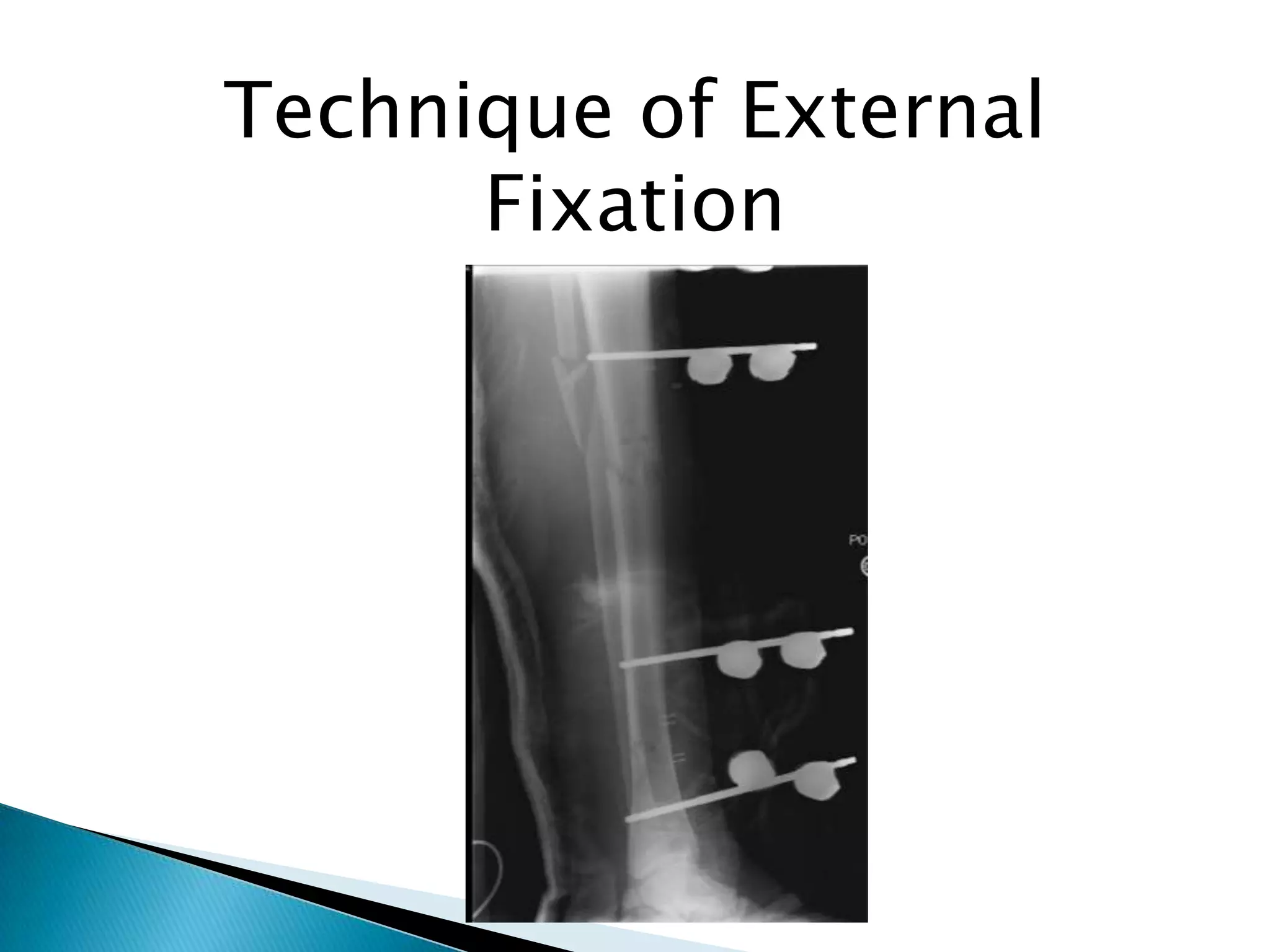
Technique of External Fixation
• Unilateral frame with half pins
• 5mm half pins („near-near and
far-far‟)
• Pre-drilling of pins recommended
• Fracture held reduced while
clamps and connecting bar
applied
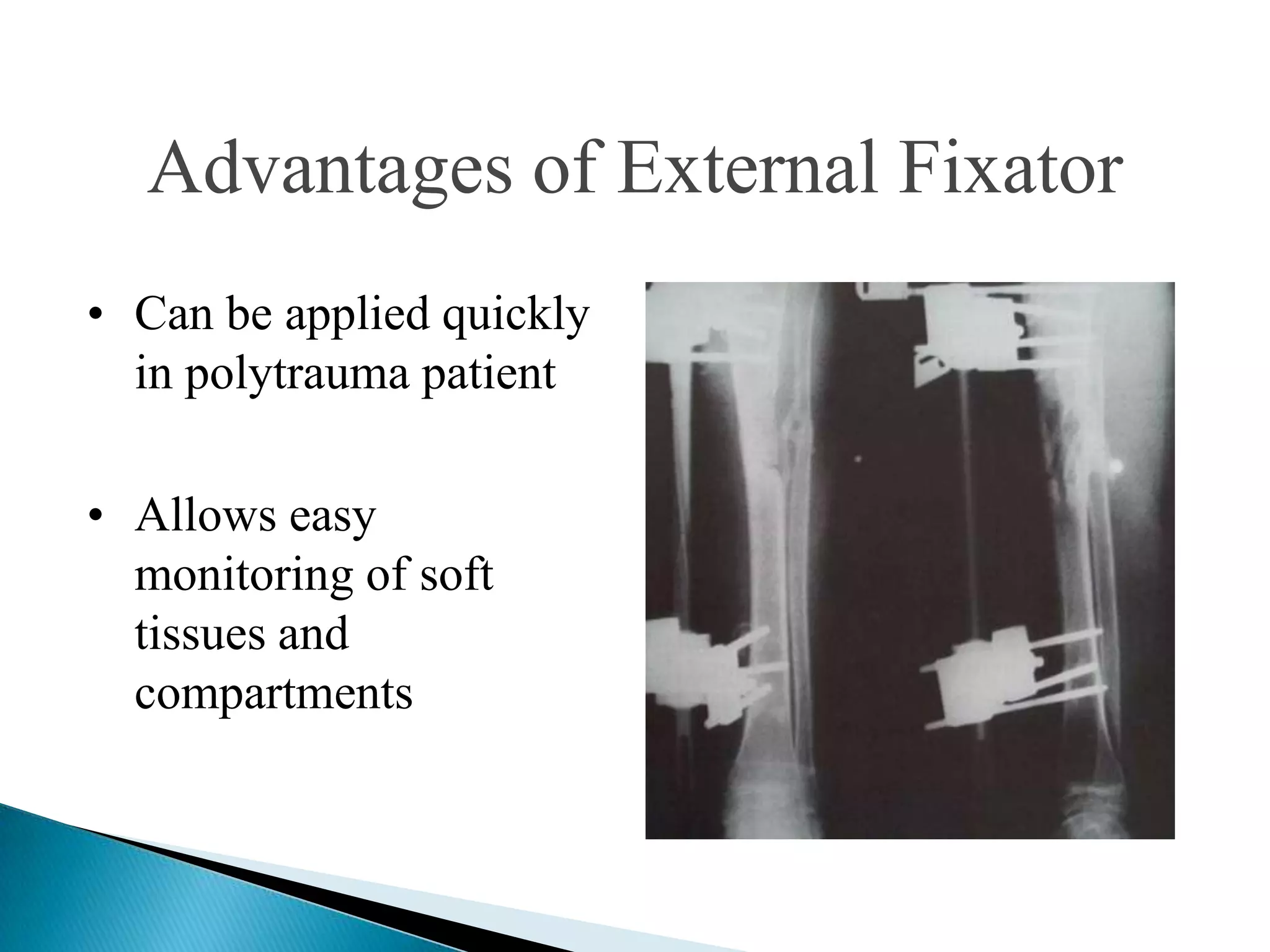
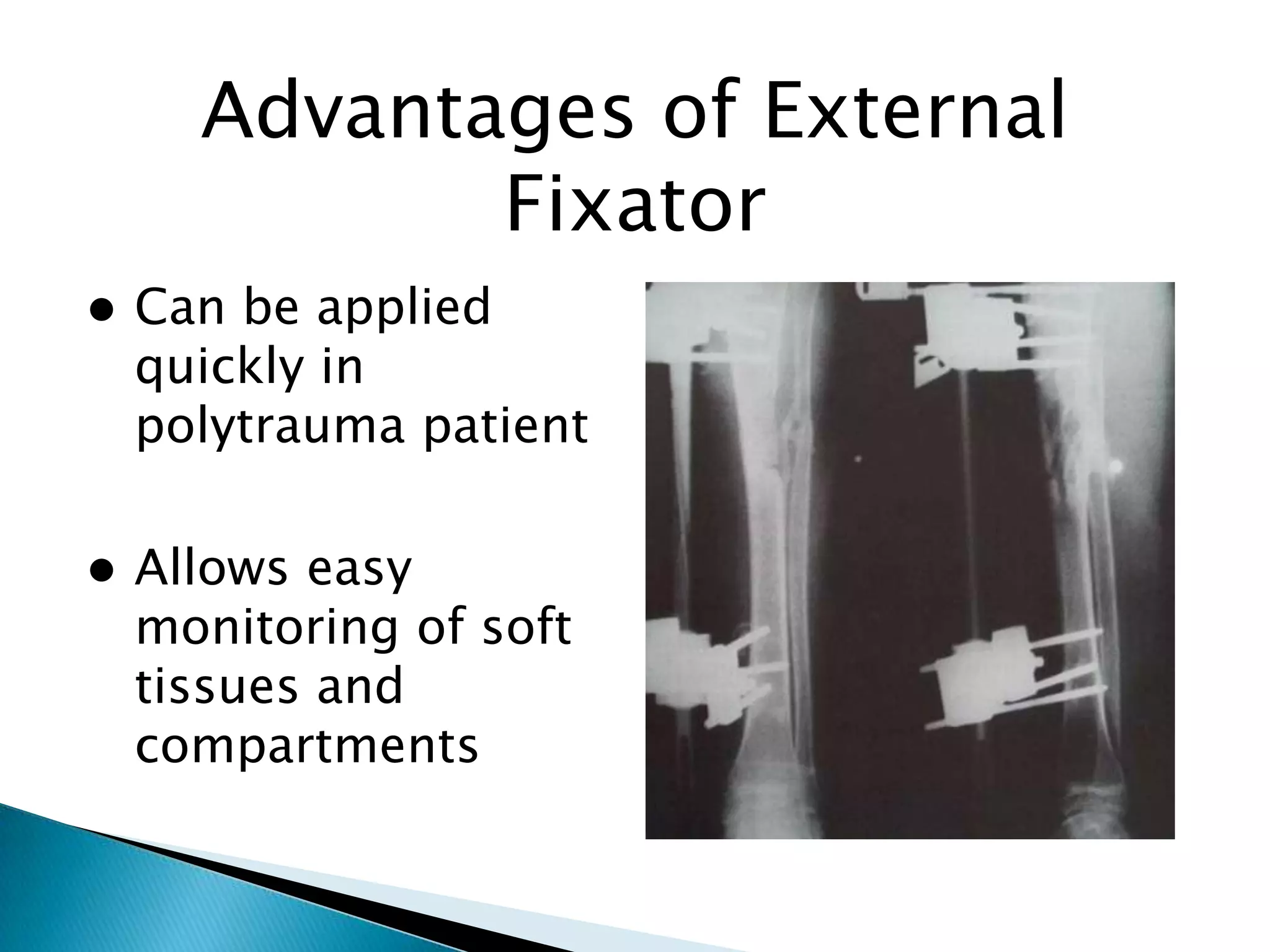
Advantages of External Fixator
• Can be applied quickly
in polytrauma patient
• Allows easy
monitoring of soft
tissues and
compartments
Outcomes of External Fixation







95% union rate for
group of closed and
open tibia fractures
20% malunion rate
Loss of reduction
associated with
removing frame prior to
union
Risk of pin track
infection
Anderson et al. Clin Orthop 1974
Edge and Denham JBJS[Br] 1981


Common fracture w/ several treatment
options.



Closed stable fxs. can be treated in a cast.



Unstable fxs. often best treated by
intramedullary nail
Objectives
Prevent Infection
 Soft tissue
coverage
 Union
 Function




Often requires
staged treatment
over several
months


Controversial issue
◦ Classically <6hrs
◦ Currently urgent, not emergent




Early antibiotics may be more critical
More wound contamination requires more
urgency and more frequency

-Bosse, JAAOS, 2002
-Skaggs, JBJS 2005





Meticulous debridement
Explore/Extend wound
Deliver bone ends for full exposure
Excise all foreign material, necrotic
muscle, unattached bone fragments, exposed
fat and fascia
◦ Infection 21% vs 9% w/ improved debridement



Fasciotomy as indicated

-Edwards, CORR 1988
-Patzakis, JAAOS 2003


D & I “Debridement & Irrigation”
No consensus on volume required



Pulse lavage



◦ May remove debris vs. harmful to osteoblasts


Antibiotics vs. Soap

-Anglen, JBJS 2005
Bead Pouches






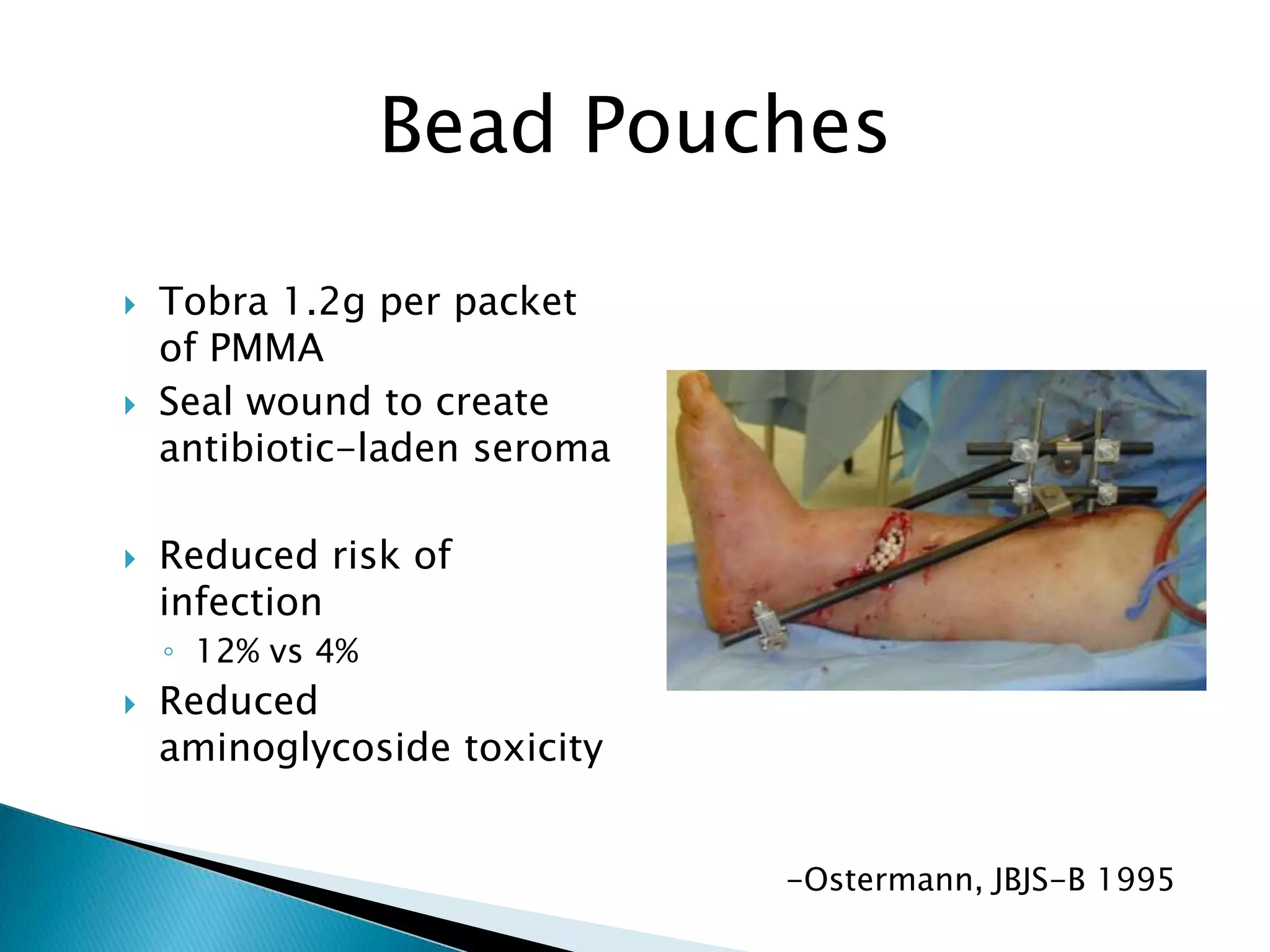
Tobra 1.2g per packet
of PMMA
Seal wound to create
antibiotic-laden seroma

Reduced risk of
infection
◦ 12% vs 4%



Reduced
aminoglycoside toxicity
-Ostermann, JBJS-B 1995




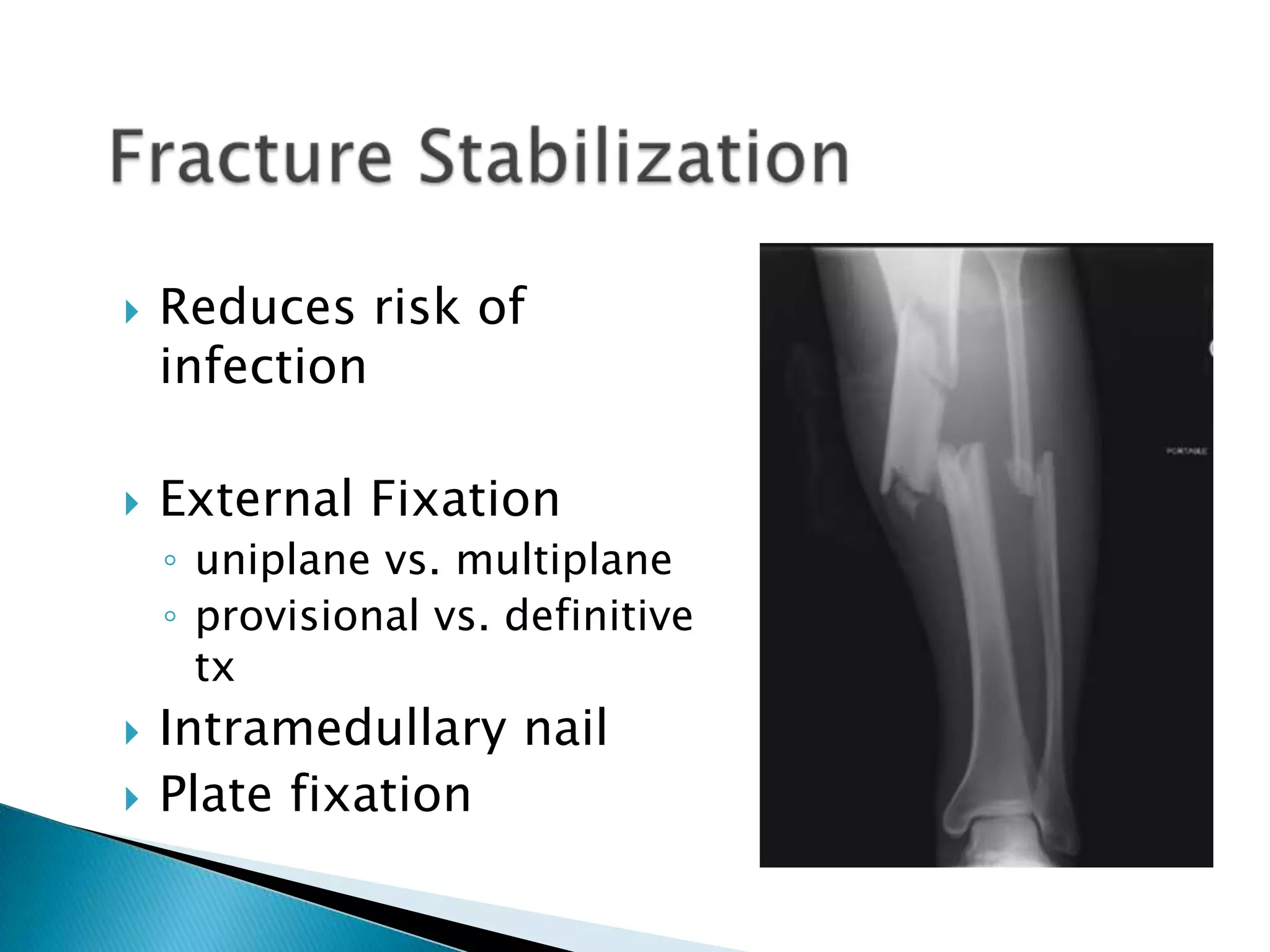
Reduces risk of
infection
External Fixation
◦ uniplane vs. multiplane
◦ provisional vs. definitive
tx




Intramedullary nail
Plate fixation
Advantages of External
Fixator


Can be applied
quickly in
polytrauma patient



Allows easy
monitoring of soft
tissues and
compartments
Technique of External
Fixation
Outcomes of External
Fixation







95% union rate for
group of closed and
open tibia fractures
20% malunion rate
Loss of reduction
associated with
removing frame
prior to union
Risk of pin track
infection

Anderson et al. Clin Orthop 1974
Edge and Denham JBJS[Br] 1981
Advantages of IM Nail
Less malunion and
shortening
 Earlier weight
bearing
 Early ankle and
knee motion
 Reduced time to
union


-Shannon, J. Trauma 2002
Infection
 Union
 Knee Pain


1-5%
>90%
56%

w/ kneeling 90%
w/ running 56%
at rest
33%

Court-Brown, JOT 1996
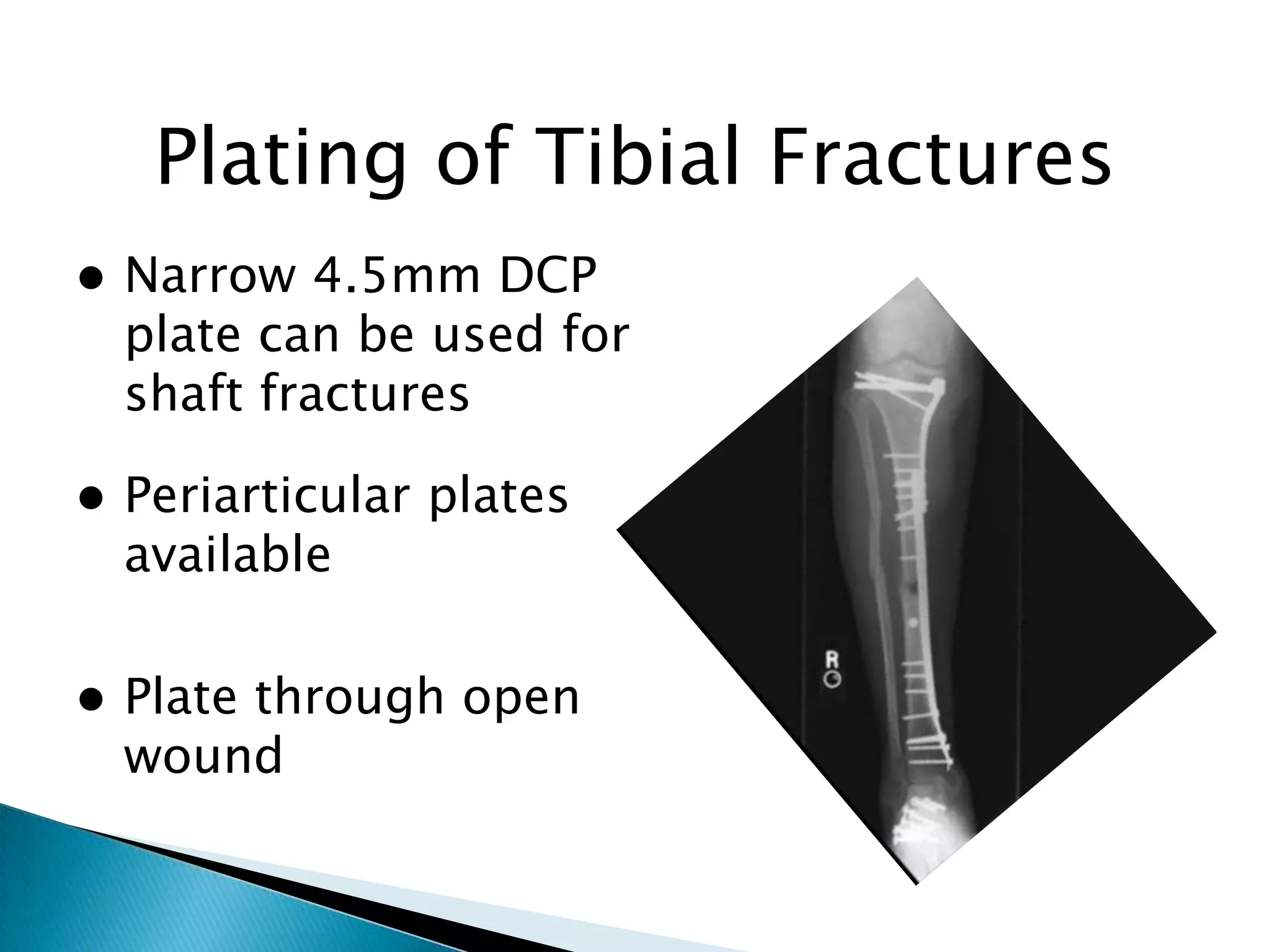
Plating of Tibial Fractures


Narrow 4.5mm DCP
plate can be used for
shaft fractures



Periarticular plates
available



Plate through open
wound
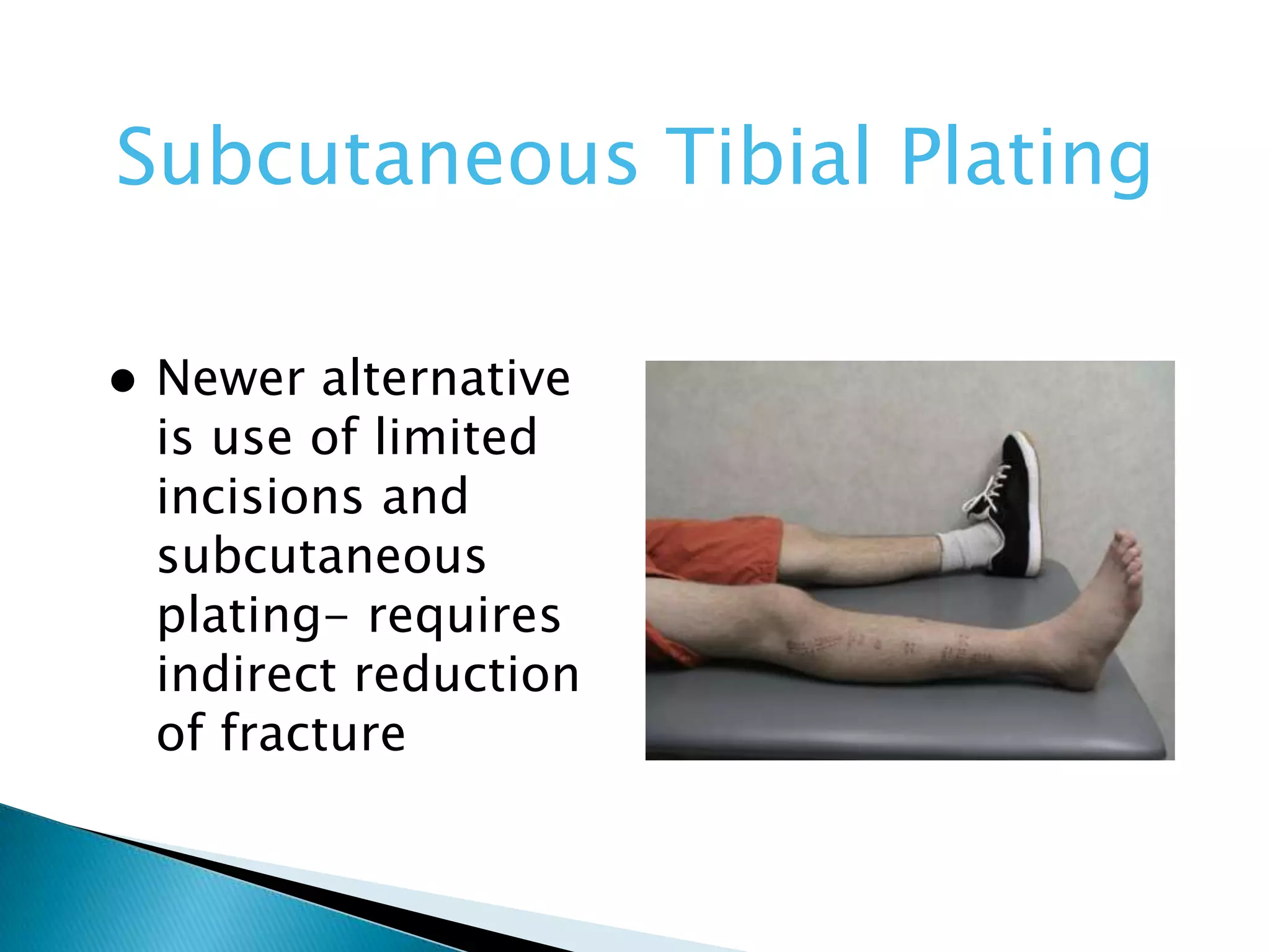
Subcutaneous Tibial Plating


Newer alternative
is use of limited
incisions and
subcutaneous
plating- requires
indirect reduction
of fracture
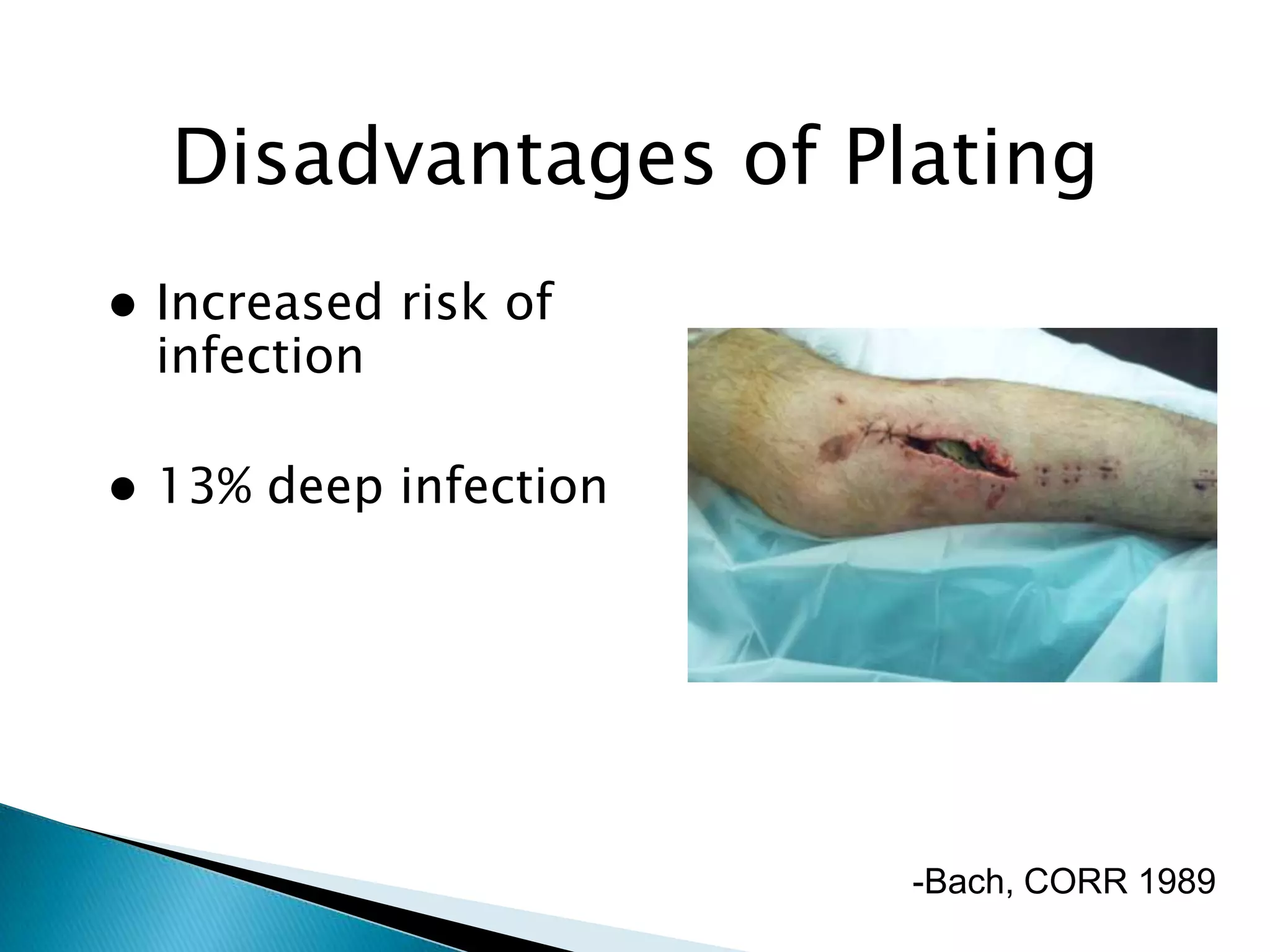
Disadvantages of Plating


Increased risk of
infection



13% deep infection

-Bach, CORR 1989






Primary closure controversial

◦ Surgical judgement gained with experience
◦ If in doubt, repeat debridement 24-72hrs

Type I and some Type II wounds can be
closed primarily or after repeat I+D
Type II and Type IIIa can be closed after
repeat debridement if clean
-Bosse, JAAOS 2002


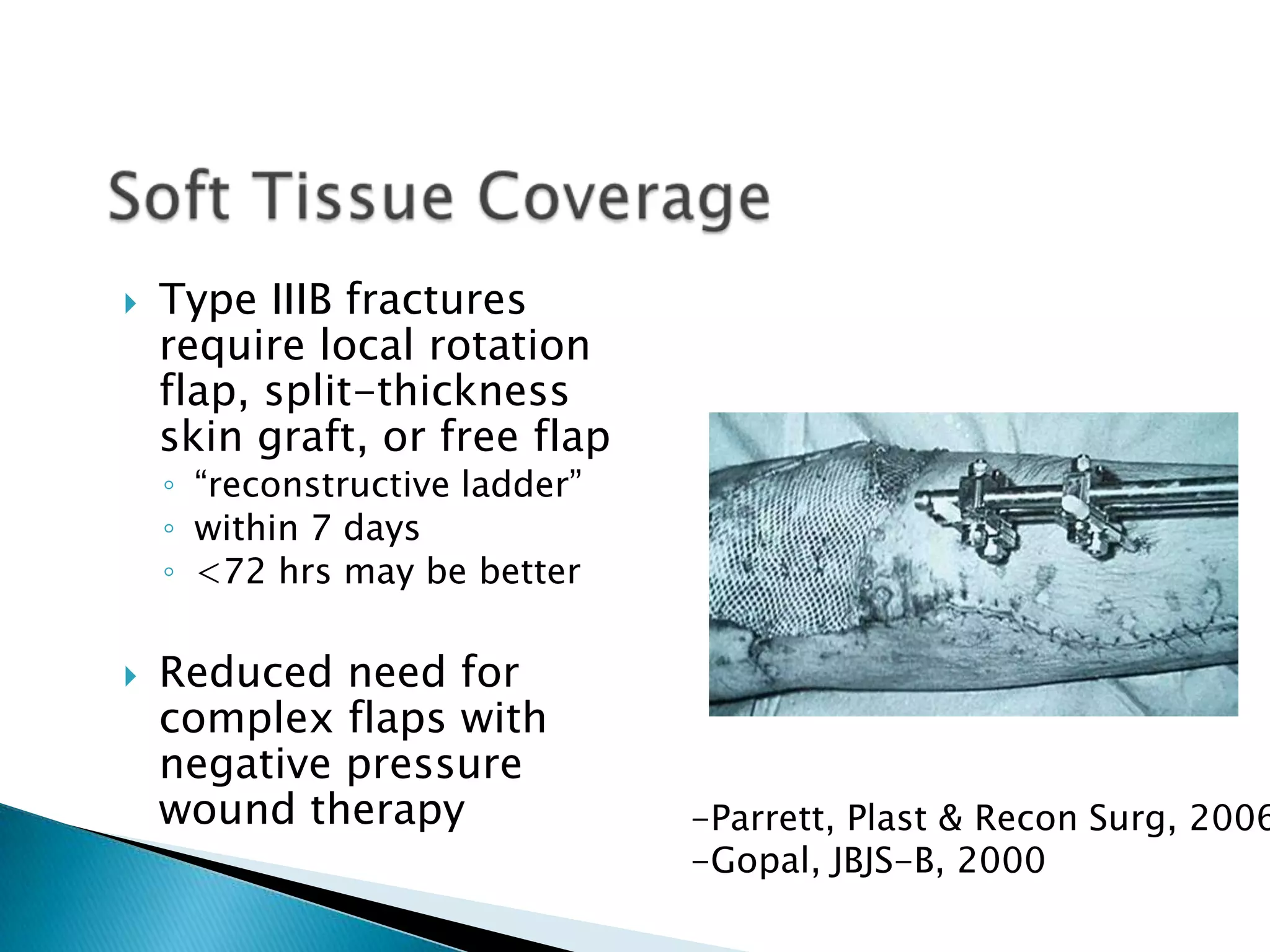
Type IIIB fractures
require local rotation
flap, split-thickness
skin graft, or free flap
◦ “reconstructive ladder”
◦ within 7 days
◦ <72 hrs may be better



Reduced need for
complex flaps with
negative pressure
wound therapy

-Parrett, Plast & Recon Surg, 2006
-Gopal, JBJS-B, 2000






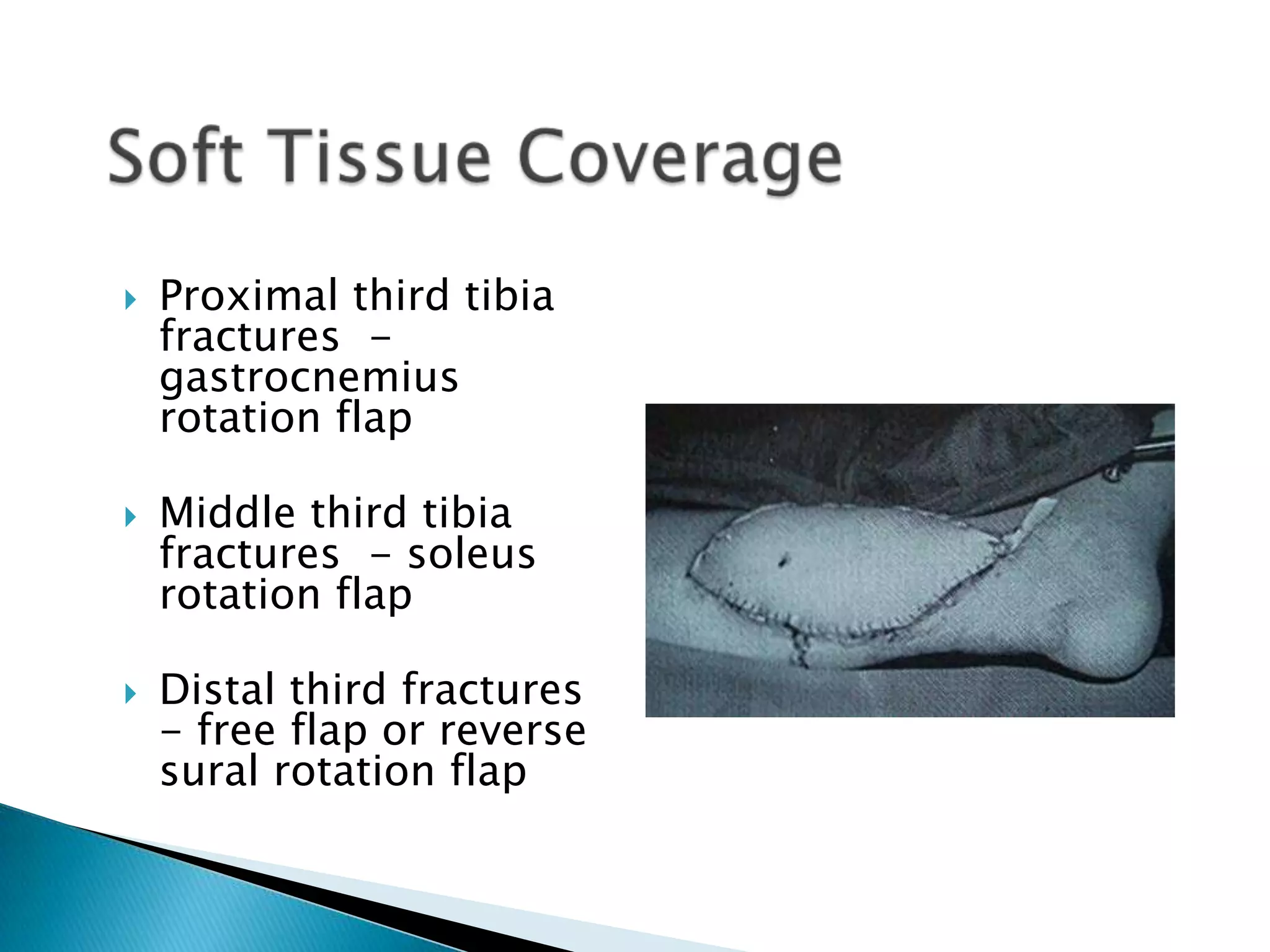
Proximal third tibia
fractures gastrocnemius
rotation flap
Middle third tibia
fractures - soleus
rotation flap
Distal third fractures
- free flap or reverse
sural rotation flap





Typically no acute bone grafting due to risk
of infection
Bone graft substitutes
BMP-2, OP-1
◦ BESST trial w/ BMP-2 in open fxs
◦ Safe, fewer infections, faster fracture healing
◦ Unknown cost effectiveness

-Govender, et.al. JBJS 2002




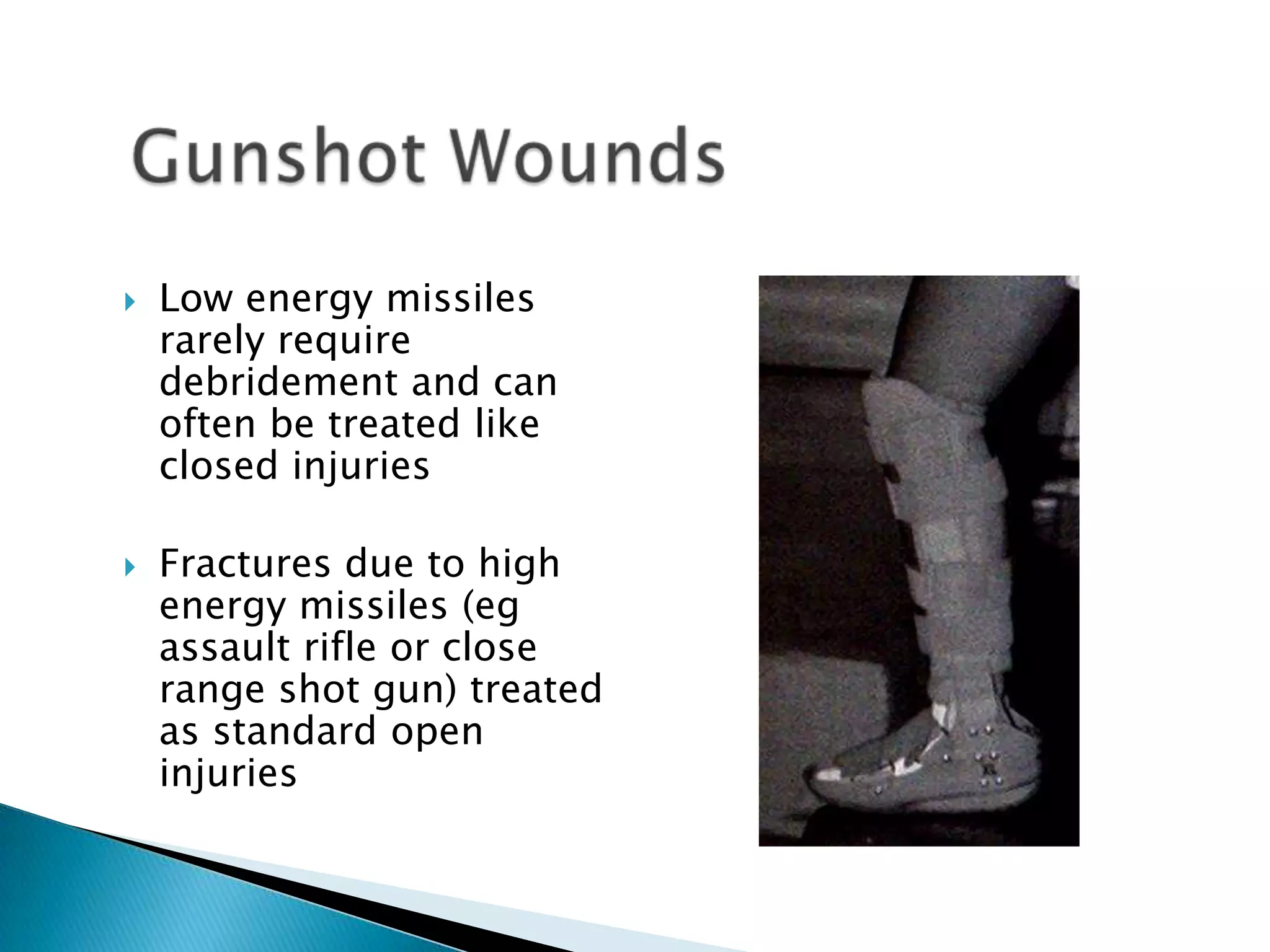
Low energy missiles
rarely require
debridement and can
often be treated like
closed injuries
Fractures due to high
energy missiles (eg
assault rifle or close
range shot gun) treated
as standard open
injuries






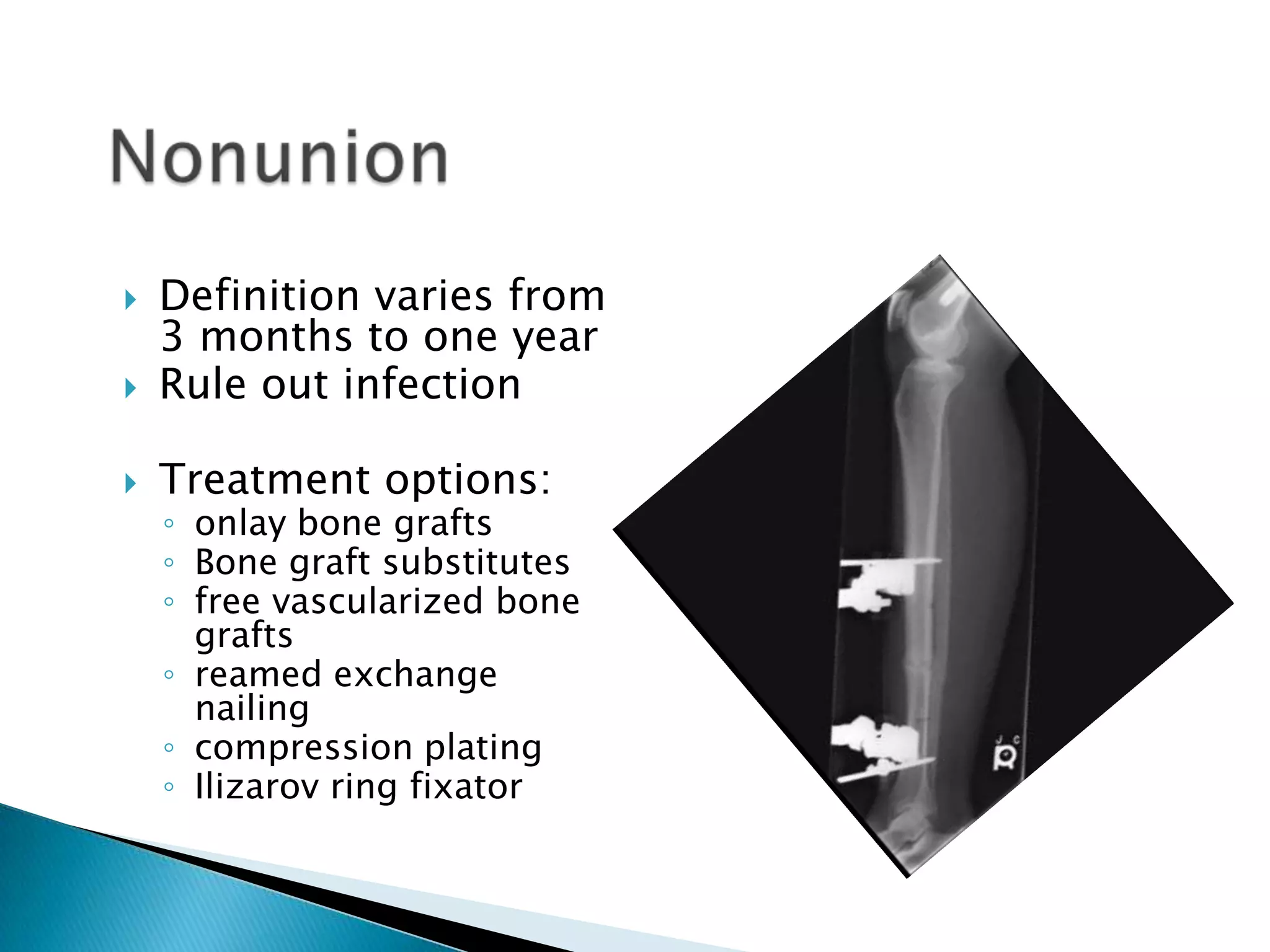
Nonunion
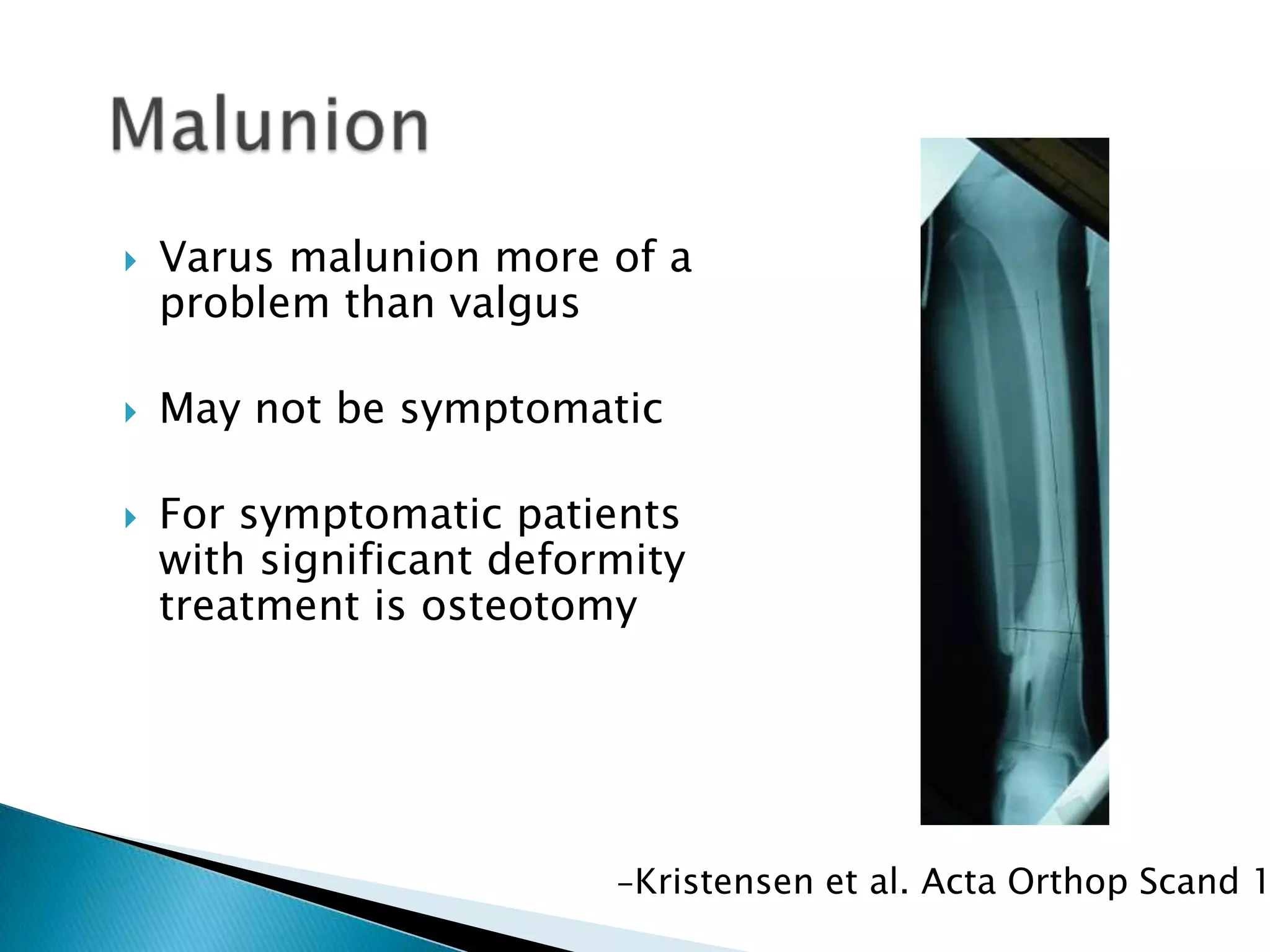
Malunion
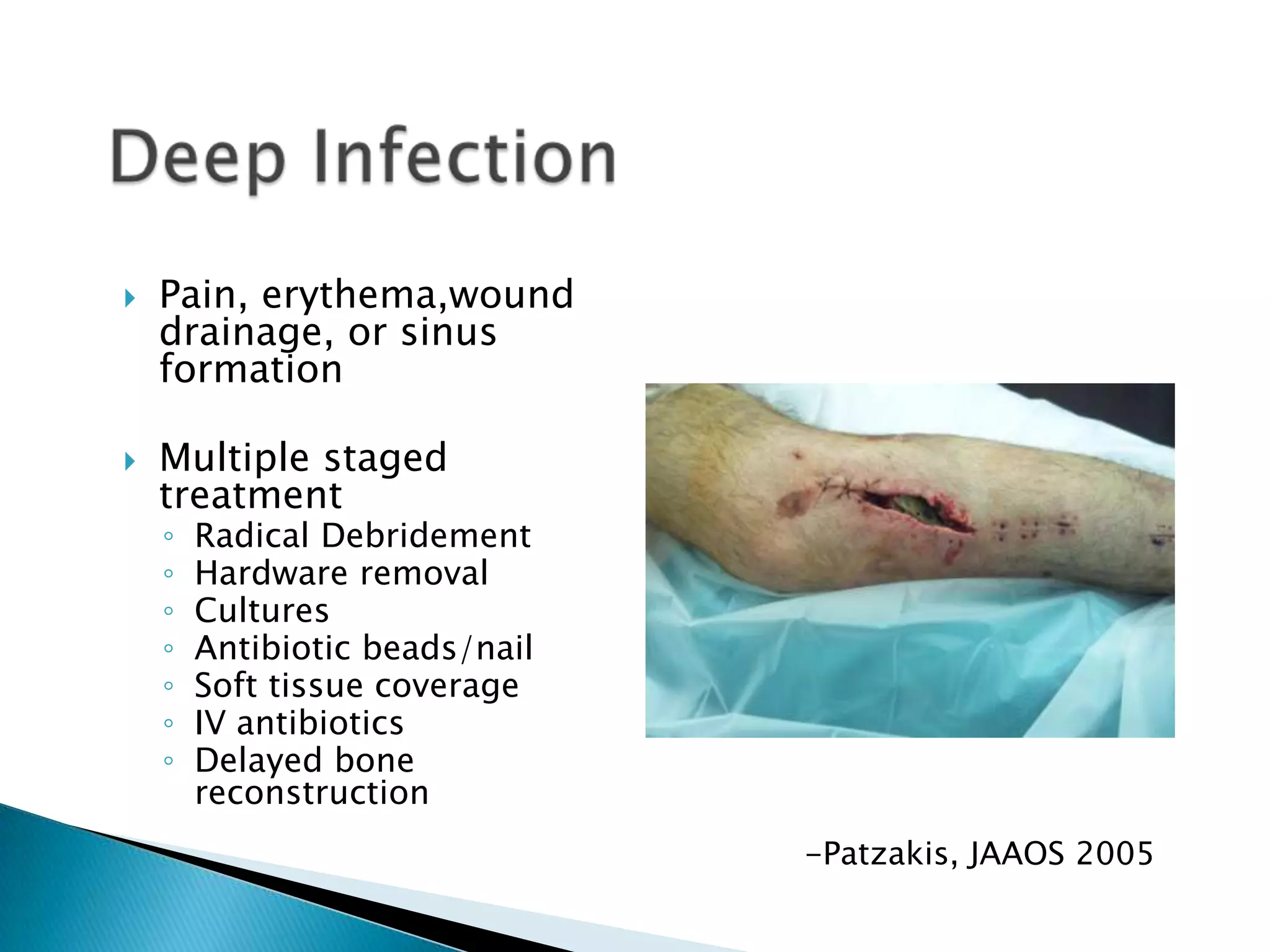
Infection- deep and superficial
Fatigue fractures
Hardware failure


Definition varies from
3 months to one year
Rule out infection



Treatment options:



◦ onlay bone grafts
◦ Bone graft substitutes
◦ free vascularized bone
grafts
◦ reamed exchange
nailing
◦ compression plating
◦ Ilizarov ring fixator


Varus malunion more of a
problem than valgus



May not be symptomatic



For symptomatic patients
with significant deformity
treatment is osteotomy

-Kristensen et al. Acta Orthop Scand 1


Ex-fix pin tracts



Should respond to elevation and appropriate
antibiotics (typically gram + cocci coverage)



High index of suspicion for deep infection
with repeat debridement required




Pain, erythema,wound
drainage, or sinus
formation
Multiple staged
treatment
◦
◦
◦
◦
◦
◦
◦

Radical Debridement
Hardware removal
Cultures
Antibiotic beads/nail
Soft tissue coverage
IV antibiotics
Delayed bone
reconstruction
-Patzakis, JAAOS 2005








Sometimes seen during rehab after
prolonged non-weight bearing
Can present with localized tenderness in
metatarsal, calcaneus, or distal fibula

Bone scan or MRI may be required to make
diagnosis as plain radiographs often normal
Treatment is temporary reduction in weight
bearing




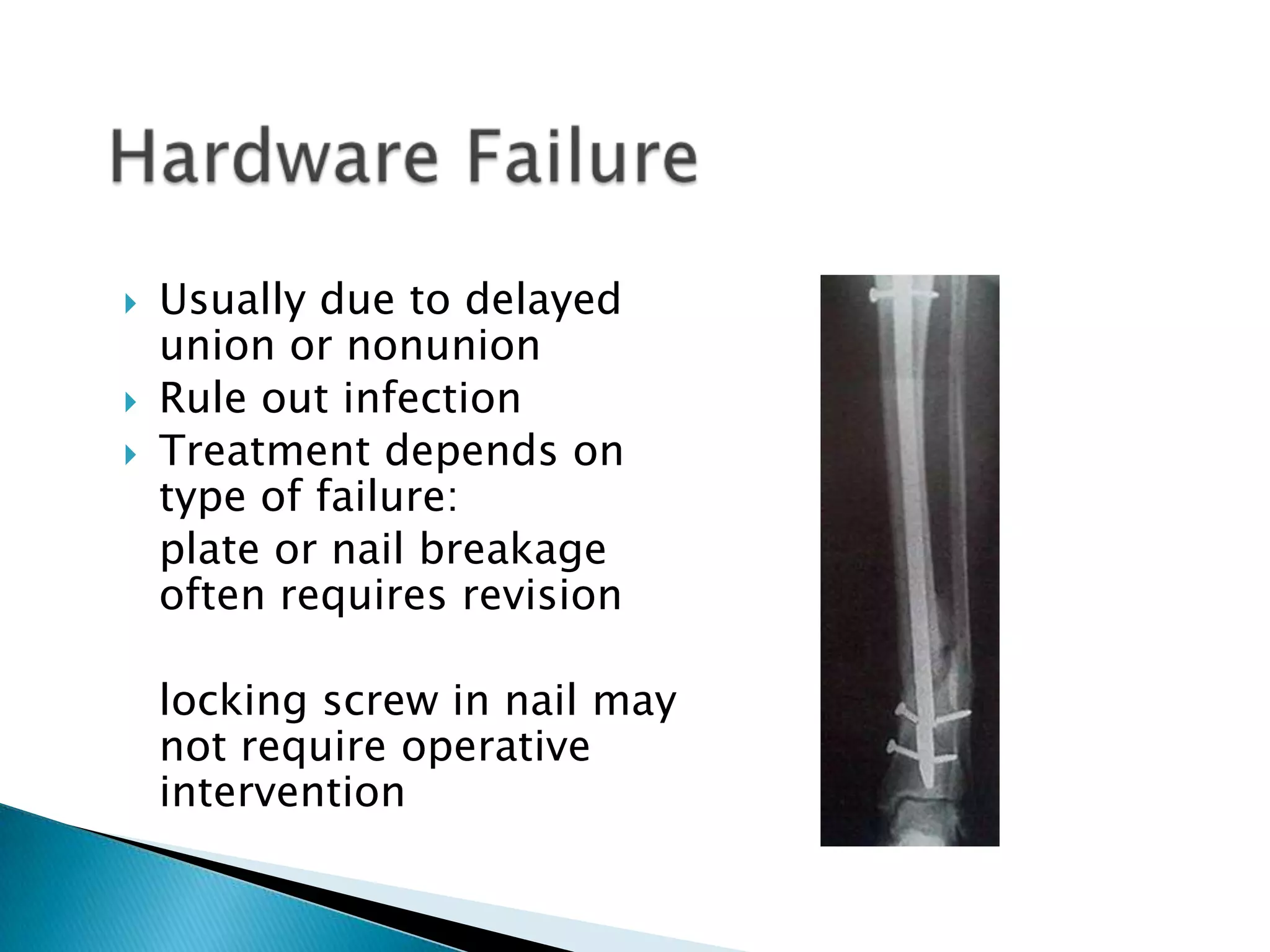
Usually due to delayed
union or nonunion
Rule out infection
Treatment depends on
type of failure:
plate or nail breakage
often requires revision
locking screw in nail may
not require operative
intervention
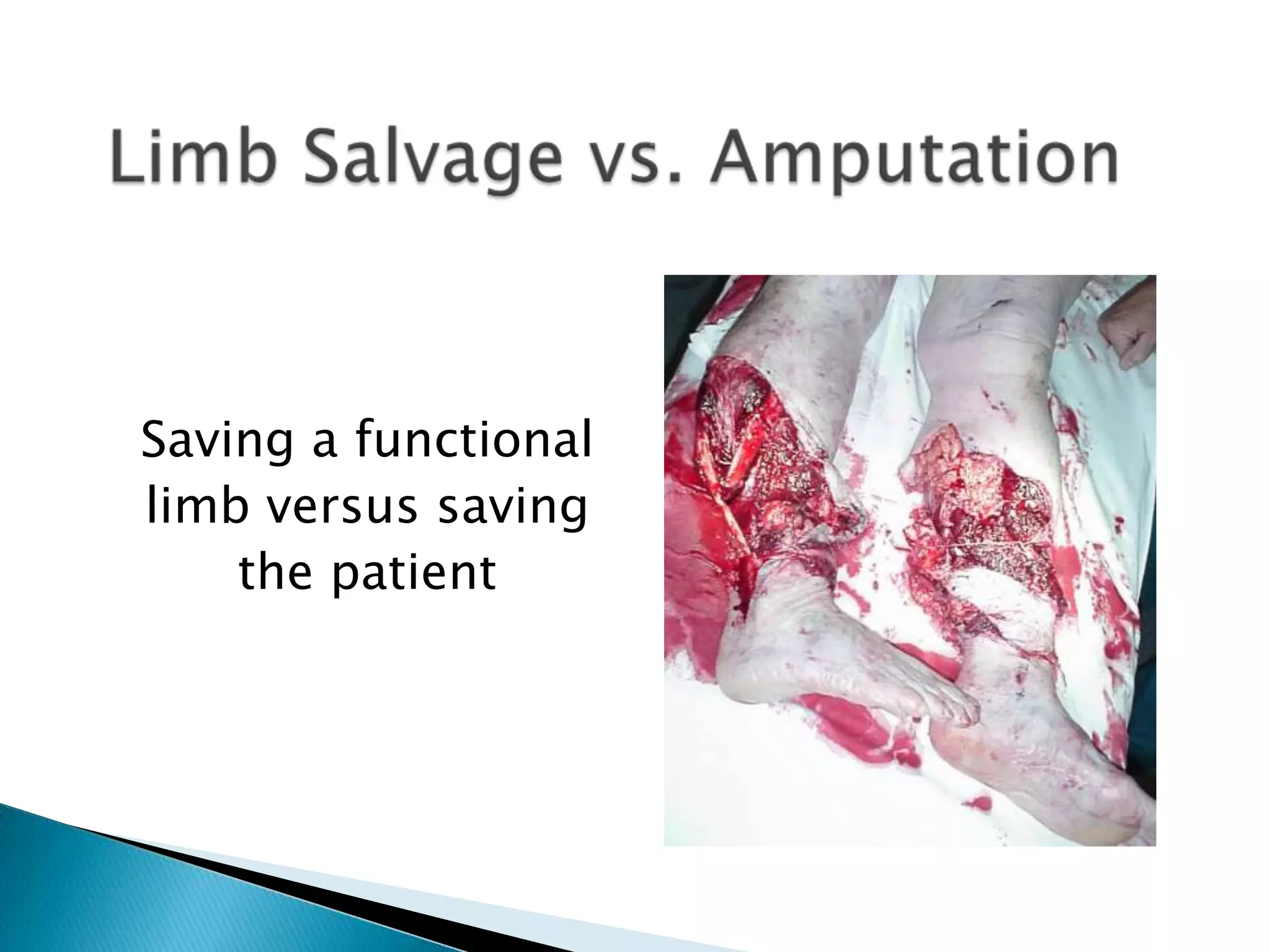
Saving a functional
limb versus saving
the patient




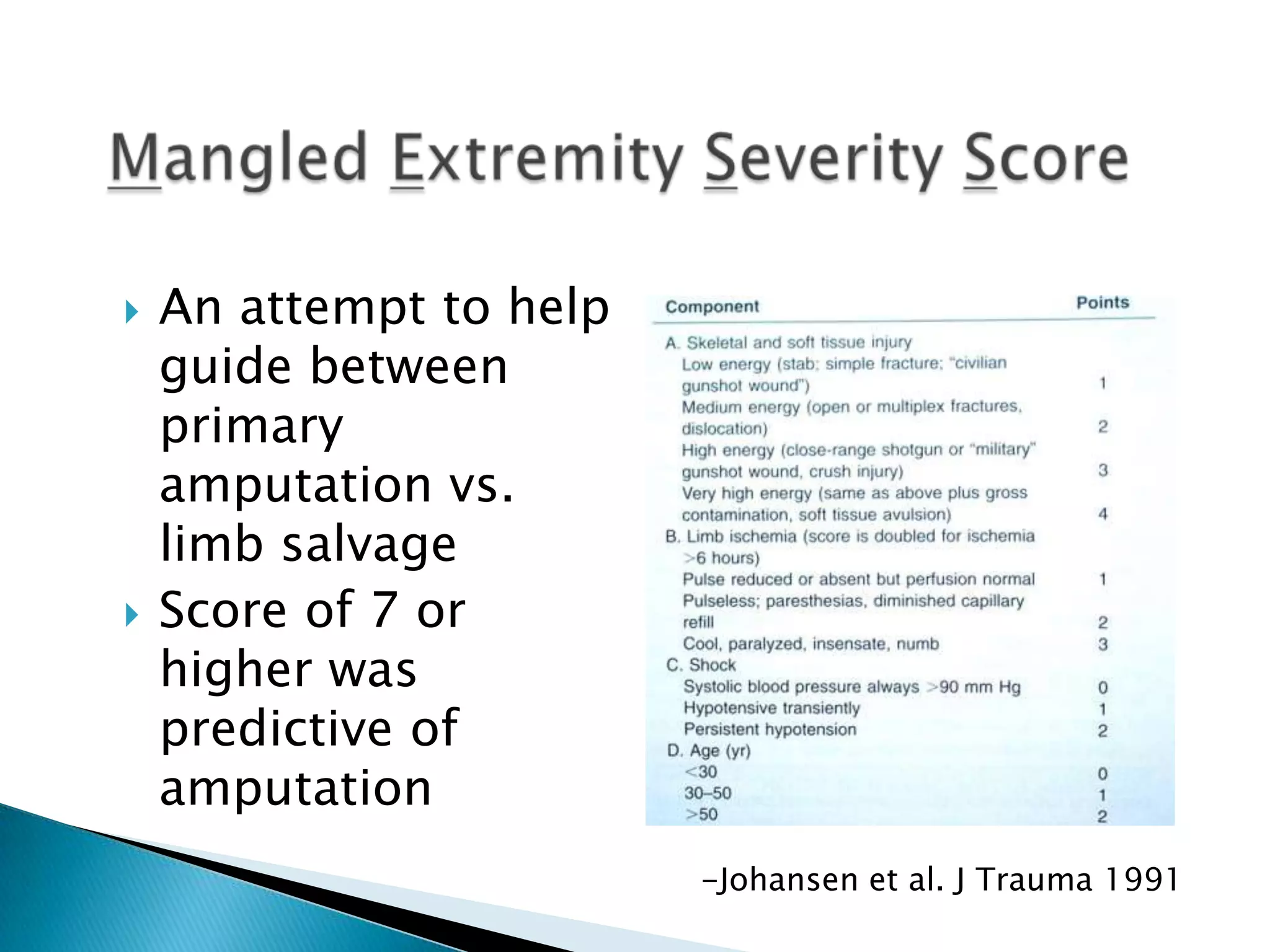
An attempt to help
guide between
primary
amputation vs.
limb salvage
Score of 7 or
higher was
predictive of
amputation
-Johansen et al. J Trauma 1991


Host factors
◦ Type A – healthy
◦ Type B – minimal
comorbidities
◦ Type C – Multiple
comorbidites, tobacc
o use, poor social
support



The four “D’s”
◦
◦
◦
◦

Disabled
Destitute
Drunk
Divorced








Fracture.
Leg.
Types Of Fracture.
Clinical Features.
Red Flags.
Management
◦ Conservative.
◦ Surgical.
When? How? Pros & Cons….
Fracture both bones leg class ug

Fracture both bones leg class ug