MANAGEMAENT OF BONE
SECONDARIES
BY :SUMMAR MOHAMED
ELMORSHIDY
SUPERVISED BY :
DR: MARWA ISMAIEL KHALAF
 Metastatic bone disease develops as a result
of the many interactions between tumor
cells and bone cells.
 This leads to disruption of normal bone
metabolism, with the increased osteoclast
activity seen in most, if not all, tumor types
providing a rational target for treatment.
 The clinical course of metastatic bone disease in multiple myeloma,
breast and prostate cancers is relatively long, with patients experiencing
sequential skeletal complications over a period of several years. And
therefore optimizing treatment is crucial
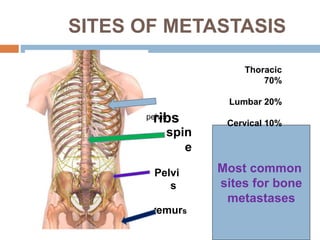
 Cancer cells target bones with an extensive blood supply: arms, legs,
ribs, spine, pelvis. Tend not to travel to hands and feet.
SITES OF METASTASIS
ribs
spin
e
pelvis
Pelvi
s
femurs
Most common
sites for bone
metastases
Thoracic
70%
Lumbar 20%
Cervical 10%
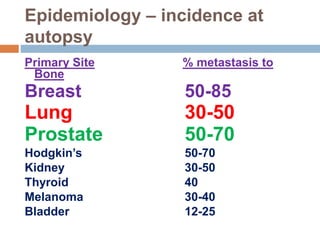
Epidemiology – incidence at
autopsy
Primary Site % metastasis to
Bone
Breast 50-85
Lung 30-50
Prostate 50-70
Hodgkin’s 50-70
Kidney 30-50
Thyroid 40
Melanoma 30-40
Bladder 12-25
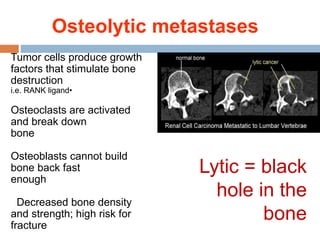
Osteolytic metastases
Tumor cells produce growth
factors that stimulate bone
destruction
•i.e. RANK ligand
Osteoclasts are activated
and break down
bone
Osteoblasts cannot build
bone back fast
enough
Decreased bone density
and strength; high risk for
fracture
Lytic = black
hole in the
bone
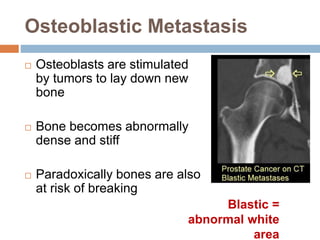
Osteoblastic Metastasis
 Osteoblasts are stimulated
by tumors to lay down new
bone
 Bone becomes abnormally
dense and stiff
 Paradoxically bones are also
at risk of breaking
Blastic =
abnormal white
area
Decision of Treatment:
 Diagnosis.
 Osseous +/- visceral crisis
 Performance status.
 Number and location
 Outcome of every modality and when
combined.
 Availability of newer therapeutic modalities.
 Expected life span.
 What do we need to achieve?
Treatment Options
 Goals:
 Attack the cancer
 Strengthen the bone
 Reduce symptoms
 Includes:
 Systemic therapy
 Local therapy
Local therapy ( 1.surgical
management) The role of surgery
Indicated if:
 previous Radio Rx/ no
response
 Radioresistant tumor
 life expectancy > three
months
 single site
 unstable spine
 no tissue diagnosis
1.Prophylactic Fixation of
metastatic deposits where there is a
risk of fracture.
2.Stabilization/Reconstruction
following pathological fracture.
3.Decompression of spinal cord &
nerve roots and stabilization for
spinal instability.
 The goals of surgical intervention for spinal surgery in patients with
metastatic bone disease includes decreasing or eliminating pain,
decompressing neural elements to protect cord function, and
mechanically stabilizing the spine.
 Anterior or posterolateral decompression, combined with
anteroposterior reconstruction, may be used in the following:
 Diagnostic spinal surgery
 Cervical spinal surgery
 Thoracic and lumbar spinal surgery
 Vertebroplasty, in which polymethylmethacrylate is percutaneously
introduced, may be a minimally invasive treatment alternative for
patients with 1- or 2-level vertebral body compression fractures.
 For the management of long bone
metastatic disease accompanied by
an impending or completed fracture,
open internal fixation is usually the
preferred method of treatment.
 Stabilization with a locked intramedullary device
followed by radiation therapy to the entire bone as
soon as the surgical wounds have healed is
preferred.
2.Radiation therapy in bone
metastasis
Indications
1. Radiosensitive tumor not previously
irradiated
2. Widespread spinal metastases with
multilevel neural compression
3. Total neurological deficits below the level of
compression > 48 hours
4. Patient’s condition (or prognosis) precludes
surgery: high surgical risk or short life
expectancy
How does RT reduce pain ?
 Cell kill – reduced tumor size and pressure effects
 Endothelial damage of micro-vasculature – reduced
blood flow.
 Reduces edema
 Reduces pain related neuro-transmitter concentrations
 Bone – promotes re-mineralisation leading to structural
stability.
Radiotherapy Modalities
 Conventional External Beam
Radiotherapy (EBRT)
 Intensity-modulated radiation therapy
(IMRT)
 Stereotactic radiotherapy
 Stereotactic radiosurgery
 Radioisotopes
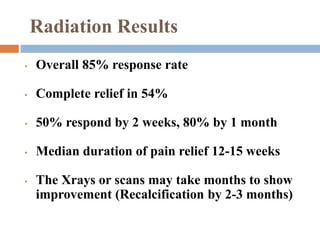
Radiation Results
• Overall 85% response rate
• Complete relief in 54%
• 50% respond by 2 weeks, 80% by 1 month
• Median duration of pain relief 12-15 weeks
• The Xrays or scans may take months to show
improvement (Recalcification by 2-3 months)
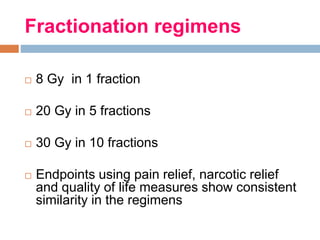
Fractionation regimens
 8 Gy in 1 fraction
 20 Gy in 5 fractions
 30 Gy in 10 fractions
 Endpoints using pain relief, narcotic relief
and quality of life measures show consistent
similarity in the regimens
Adjuvant Radiotherapy
 Done after operative decompression
 Wait 3 weeks for wound healing before
starting radiation
3.Interventional Radiology
 What is it?
 Minimally invasive procedures performed by
specialized radiologists to treat symptoms from
bone metastases
 Indications:
 To treat bone pain refractory to other conservative
pain control measures
 Specialized technique for metastatic cancer to
spine bones
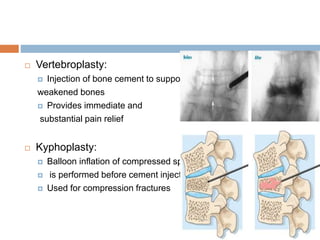
 Vertebroplasty:
 Injection of bone cement to support
weakened bones
 Provides immediate and
substantial pain relief
 Kyphoplasty:
 Balloon inflation of compressed spine bone
 is performed before cement injection
 Used for compression fractures
Other Local Techniques
 Radiofrequency Ablation (RFA) and cryoablation
 Minimally invasive procedures to “burn” or “freeze” a tumor
 Desensitizes by killing nerve endings near the metastasis
 Most commonly used for cancer in the spine
 Techniques can achieve excellent pain control
Systemic
therapy
The pivotal role of osteoclasts in
cancer induced bone destruction
 Osteoclasts are the only cells capable of
resorbing mineralised bone
 In order to grow in bones, cancer cells
must possess the capability to induce
osteoclastic bone destruction .
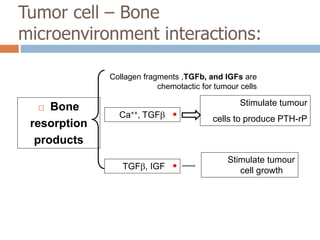
Tumor cell – Bone
microenvironment interactions:
 Bone
resorption
products
Collagen fragments ,TGFb, and IGFs are
chemotactic for tumour cells
Ca++, TGF
Stimulate tumour
cells to produce PTH-rP
TGF, IGF
Stimulate tumour
cell growth
 Most of osteolytic factors act via
osteoblast production of RANKL
 Some Circulating Cancer cells
expressingRANK
 RANKL may act as a chemotactic factor
which attracts circulating cancer cells
expressing RANK to migrate into the bone
.
 RANKL is the primary mediator of
osteoclast formation, function, and
survival and plays a vital role in
physiologic and cancer-induced bone
resorption
 Metastatic tumor cells stimulate RANKL
activity, leading to a self-reinforcing cycle
of bone resorption (“vicious cycle”
hypothesis)
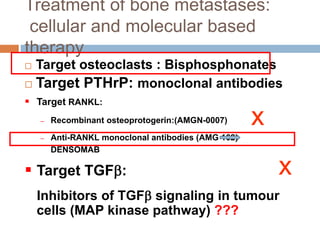
Treatment of bone metastases:
cellular and molecular based
therapy
 Target osteoclasts : Bisphosphonates
 Target PTHrP: monoclonal antibodies
 Target RANKL:
– Recombinant osteoprotogerin:(AMGN-0007)
– Anti-RANKL monoclonal antibodies (AMG 162)
DENSOMAB
 Target TGF:
Inhibitors of TGF signaling in tumour
cells (MAP kinase pathway) ???
x
x
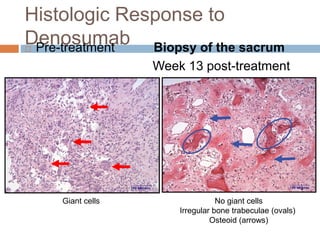
Histologic Response to
Denosumab Pre-treatment Biopsy of the sacrum
Week 13 post-treatment
Giant cells No giant cells
Irregular bone trabeculae (ovals)
Osteoid (arrows)
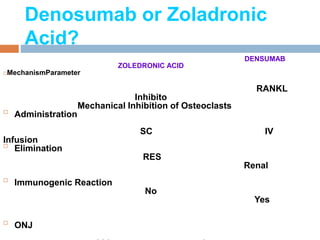
Denosumab or Zoladronic
Acid?
DENSUMAB
ZOLEDRONIC ACID
MechanismParameter
RANKL
Inhibito
Mechanical Inhibition of Osteoclasts

Administration
SC IV
Infusion

Elimination
RES
Renal

Immunogenic Reaction
No
Yes

ONJ
 In phase II trials, denosumab significantly
lowered bone turnover markers and
reduced SREs, including in patients with
elevated uNTx levels, despite IV
bisphosphonate therapy
Denosumab vs Zoledronic Acid
Pivotal Phase III SRE Prevention
Trials
 In total, > 5700 patients with bone
metastases
R
A
N
D
O
M
I
Z
A
T
I
O
N
Denosumab 120 mg SC q4w
+
Placebo IV q4w†
Zoledronic Acid 4 mg IV q4w†
+
Placebo SC q4w
Study 136[1]
Breast cancer
(N = 2049)
Study 103[2]
Prostate cancer
(N = 1904)
Study 244[3]
Other solid tumors/MM
(N = 1779)
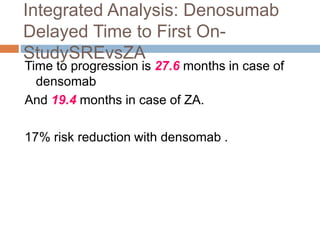
Integrated Analysis: Denosumab
Delayed Time to First On-
StudySREvsZA
Time to progression is 27.6 months in case of
densomab
And 19.4 months in case of ZA.
17% risk reduction with densomab .
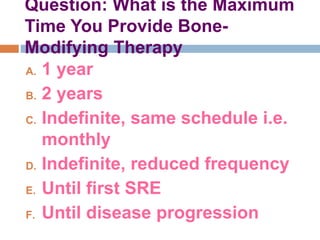
Question: What is the Maximum
Time You Provide Bone-
Modifying Therapy
A. 1 year
B. 2 years
C. Indefinite, same schedule i.e.
monthly
D. Indefinite, reduced frequency
E. Until first SRE
F. Until disease progression
Guidelines and Duration of Bone-
Targeted Therapy

ESMO
[1]

“The timing and optimal duration of bisphosphonate treatment are
unknown; benefit of duration beyond 2 yrs has not been demonstrated
. . . Long-term treatment seems wise due to ongoing risk of skeletal
events”

NCCN
[2]

“Optimal schedule and duration are unknown . . . Limited long-term
safety data indicating bisphosphonate treatment can continue beyond
2 yrs”

ASCO
[3]

“Until evidence of substantial decline (clinical judgment) in general
performance status”
Choices in Bone-Modifying
Agents
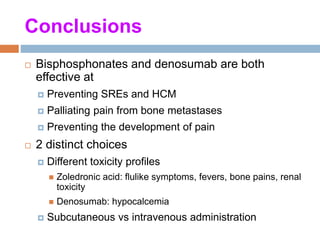
Conclusions
 Bisphosphonates and denosumab are both
effective at
 Preventing SREs and HCM
 Palliating pain from bone metastases
 Preventing the development of pain
 2 distinct choices
 Different toxicity profiles
 Zoledronic acid: flulike symptoms, fevers, bone pains, renal
toxicity
 Denosumab: hypocalcemia
 Subcutaneous vs intravenous administration
Managemaent of bone secondaries

Managemaent of bone secondaries

  • 1.
    MANAGEMAENT OF BONE SECONDARIES BY:SUMMAR MOHAMED ELMORSHIDY SUPERVISED BY : DR: MARWA ISMAIEL KHALAF
  • 2.
     Metastatic bonedisease develops as a result of the many interactions between tumor cells and bone cells.  This leads to disruption of normal bone metabolism, with the increased osteoclast activity seen in most, if not all, tumor types providing a rational target for treatment.
  • 3.
     The clinicalcourse of metastatic bone disease in multiple myeloma, breast and prostate cancers is relatively long, with patients experiencing sequential skeletal complications over a period of several years. And therefore optimizing treatment is crucial  Cancer cells target bones with an extensive blood supply: arms, legs, ribs, spine, pelvis. Tend not to travel to hands and feet.
  • 4.
    SITES OF METASTASIS ribs spin e pelvis Pelvi s femurs Mostcommon sites for bone metastases Thoracic 70% Lumbar 20% Cervical 10%
  • 5.
    Epidemiology – incidenceat autopsy Primary Site % metastasis to Bone Breast 50-85 Lung 30-50 Prostate 50-70 Hodgkin’s 50-70 Kidney 30-50 Thyroid 40 Melanoma 30-40 Bladder 12-25
  • 6.
    Osteolytic metastases Tumor cellsproduce growth factors that stimulate bone destruction •i.e. RANK ligand Osteoclasts are activated and break down bone Osteoblasts cannot build bone back fast enough Decreased bone density and strength; high risk for fracture Lytic = black hole in the bone
  • 7.
    Osteoblastic Metastasis  Osteoblastsare stimulated by tumors to lay down new bone  Bone becomes abnormally dense and stiff  Paradoxically bones are also at risk of breaking Blastic = abnormal white area
  • 8.
    Decision of Treatment: Diagnosis.  Osseous +/- visceral crisis  Performance status.  Number and location  Outcome of every modality and when combined.  Availability of newer therapeutic modalities.  Expected life span.  What do we need to achieve?
  • 9.
    Treatment Options  Goals: Attack the cancer  Strengthen the bone  Reduce symptoms  Includes:  Systemic therapy  Local therapy
  • 10.
    Local therapy (1.surgical management) The role of surgery Indicated if:  previous Radio Rx/ no response  Radioresistant tumor  life expectancy > three months  single site  unstable spine  no tissue diagnosis
  • 11.
    1.Prophylactic Fixation of metastaticdeposits where there is a risk of fracture. 2.Stabilization/Reconstruction following pathological fracture. 3.Decompression of spinal cord & nerve roots and stabilization for spinal instability.
  • 12.
     The goalsof surgical intervention for spinal surgery in patients with metastatic bone disease includes decreasing or eliminating pain, decompressing neural elements to protect cord function, and mechanically stabilizing the spine.  Anterior or posterolateral decompression, combined with anteroposterior reconstruction, may be used in the following:  Diagnostic spinal surgery  Cervical spinal surgery  Thoracic and lumbar spinal surgery  Vertebroplasty, in which polymethylmethacrylate is percutaneously introduced, may be a minimally invasive treatment alternative for patients with 1- or 2-level vertebral body compression fractures.
  • 13.
     For themanagement of long bone metastatic disease accompanied by an impending or completed fracture, open internal fixation is usually the preferred method of treatment.  Stabilization with a locked intramedullary device followed by radiation therapy to the entire bone as soon as the surgical wounds have healed is preferred.
  • 14.
    2.Radiation therapy inbone metastasis Indications 1. Radiosensitive tumor not previously irradiated 2. Widespread spinal metastases with multilevel neural compression 3. Total neurological deficits below the level of compression > 48 hours 4. Patient’s condition (or prognosis) precludes surgery: high surgical risk or short life expectancy
  • 15.
    How does RTreduce pain ?  Cell kill – reduced tumor size and pressure effects  Endothelial damage of micro-vasculature – reduced blood flow.  Reduces edema  Reduces pain related neuro-transmitter concentrations  Bone – promotes re-mineralisation leading to structural stability.
  • 16.
    Radiotherapy Modalities  ConventionalExternal Beam Radiotherapy (EBRT)  Intensity-modulated radiation therapy (IMRT)  Stereotactic radiotherapy  Stereotactic radiosurgery  Radioisotopes
  • 17.
    Radiation Results • Overall85% response rate • Complete relief in 54% • 50% respond by 2 weeks, 80% by 1 month • Median duration of pain relief 12-15 weeks • The Xrays or scans may take months to show improvement (Recalcification by 2-3 months)
  • 18.
    Fractionation regimens  8Gy in 1 fraction  20 Gy in 5 fractions  30 Gy in 10 fractions  Endpoints using pain relief, narcotic relief and quality of life measures show consistent similarity in the regimens
  • 20.
    Adjuvant Radiotherapy  Doneafter operative decompression  Wait 3 weeks for wound healing before starting radiation
  • 21.
    3.Interventional Radiology  Whatis it?  Minimally invasive procedures performed by specialized radiologists to treat symptoms from bone metastases  Indications:  To treat bone pain refractory to other conservative pain control measures  Specialized technique for metastatic cancer to spine bones
  • 22.
     Vertebroplasty:  Injectionof bone cement to support weakened bones  Provides immediate and substantial pain relief  Kyphoplasty:  Balloon inflation of compressed spine bone  is performed before cement injection  Used for compression fractures
  • 23.
    Other Local Techniques Radiofrequency Ablation (RFA) and cryoablation  Minimally invasive procedures to “burn” or “freeze” a tumor  Desensitizes by killing nerve endings near the metastasis  Most commonly used for cancer in the spine  Techniques can achieve excellent pain control
  • 24.
  • 25.
    The pivotal roleof osteoclasts in cancer induced bone destruction  Osteoclasts are the only cells capable of resorbing mineralised bone  In order to grow in bones, cancer cells must possess the capability to induce osteoclastic bone destruction .
  • 26.
    Tumor cell –Bone microenvironment interactions:  Bone resorption products Collagen fragments ,TGFb, and IGFs are chemotactic for tumour cells Ca++, TGF Stimulate tumour cells to produce PTH-rP TGF, IGF Stimulate tumour cell growth
  • 27.
     Most ofosteolytic factors act via osteoblast production of RANKL  Some Circulating Cancer cells expressingRANK  RANKL may act as a chemotactic factor which attracts circulating cancer cells expressing RANK to migrate into the bone .
  • 28.
     RANKL isthe primary mediator of osteoclast formation, function, and survival and plays a vital role in physiologic and cancer-induced bone resorption  Metastatic tumor cells stimulate RANKL activity, leading to a self-reinforcing cycle of bone resorption (“vicious cycle” hypothesis)
  • 29.
    Treatment of bonemetastases: cellular and molecular based therapy  Target osteoclasts : Bisphosphonates  Target PTHrP: monoclonal antibodies  Target RANKL: – Recombinant osteoprotogerin:(AMGN-0007) – Anti-RANKL monoclonal antibodies (AMG 162) DENSOMAB  Target TGF: Inhibitors of TGF signaling in tumour cells (MAP kinase pathway) ??? x x
  • 30.
    Histologic Response to DenosumabPre-treatment Biopsy of the sacrum Week 13 post-treatment Giant cells No giant cells Irregular bone trabeculae (ovals) Osteoid (arrows)
  • 31.
    Denosumab or Zoladronic Acid? DENSUMAB ZOLEDRONICACID MechanismParameter RANKL Inhibito Mechanical Inhibition of Osteoclasts  Administration SC IV Infusion  Elimination RES Renal  Immunogenic Reaction No Yes  ONJ
  • 32.
     In phaseII trials, denosumab significantly lowered bone turnover markers and reduced SREs, including in patients with elevated uNTx levels, despite IV bisphosphonate therapy
  • 33.
    Denosumab vs ZoledronicAcid Pivotal Phase III SRE Prevention Trials  In total, > 5700 patients with bone metastases R A N D O M I Z A T I O N Denosumab 120 mg SC q4w + Placebo IV q4w† Zoledronic Acid 4 mg IV q4w† + Placebo SC q4w Study 136[1] Breast cancer (N = 2049) Study 103[2] Prostate cancer (N = 1904) Study 244[3] Other solid tumors/MM (N = 1779)
  • 34.
    Integrated Analysis: Denosumab DelayedTime to First On- StudySREvsZA Time to progression is 27.6 months in case of densomab And 19.4 months in case of ZA. 17% risk reduction with densomab .
  • 35.
    Question: What isthe Maximum Time You Provide Bone- Modifying Therapy A. 1 year B. 2 years C. Indefinite, same schedule i.e. monthly D. Indefinite, reduced frequency E. Until first SRE F. Until disease progression
  • 36.
    Guidelines and Durationof Bone- Targeted Therapy  ESMO [1]  “The timing and optimal duration of bisphosphonate treatment are unknown; benefit of duration beyond 2 yrs has not been demonstrated . . . Long-term treatment seems wise due to ongoing risk of skeletal events”  NCCN [2]  “Optimal schedule and duration are unknown . . . Limited long-term safety data indicating bisphosphonate treatment can continue beyond 2 yrs”  ASCO [3]  “Until evidence of substantial decline (clinical judgment) in general performance status”
  • 37.
  • 38.
    Conclusions  Bisphosphonates anddenosumab are both effective at  Preventing SREs and HCM  Palliating pain from bone metastases  Preventing the development of pain  2 distinct choices  Different toxicity profiles  Zoledronic acid: flulike symptoms, fevers, bone pains, renal toxicity  Denosumab: hypocalcemia  Subcutaneous vs intravenous administration