Common Hand & Wrist
Injuries
Lorenzo Pacelli, M.D.
Scripps Clinic
Division of Orthopaedic Surgery
Disclosure
 Company Name:
 Ascension Ortho- Consultant
Common Disorders of the Hand
 General
Classification
 Fractures
 Dislocations
 Infections
 Lacerations
 Neuropathies
 Vascular disorders
 Tendonopathies
 Tumors
Injuries
Hand
Other
•Common Disorders of the
Hand
• Review of Anatomy
• Surface
• Bones and Joints
• Ligaments
• Muscles and
Tendons
• Nerves
• Vessels
Common Disorders of the Hand
 Evaluation
 History
Details of complaint
PMHx
PSHx
Social Hx
Rx
Common Disorders of the Hand
 Physical Examination
 General
 Focused
 Upper extremity
 Begins at the neck
 Focused examination of
the Hand and Wrist
 Related distant physical
finding
– Systemic
– Other musculoskeletal
anomalies
Common Disorders of the Hand
 Examination
 Inspection
 Palpation
 Range of motion
 Active
 Passive
 Provocative
maneuvers
Common Disorders of the Hand
 Sensory Exam
 Light touch
 Sharp/dull
discrimination
 Threshold
 Vibration
 Semmes-Weinstein
 2 point discrimination
 Static
 Moving
Lacerations:
Common Disorders of the Hand
 Lacerations
 Evaluation
 History
 Clean or
contaminated
 Td status
 Mechanism
– Penetrating injury?
– Bite?
– Beware dorsal
MCP injuries
Common Disorders of the Hand
 Lacerations
 X-rays
 Orthogonal views
 Fractures
 Dislocation
 Foreign material
 Soft tissue
 Air
– Joint
– Soft Tissue
Common Disorders of the Hand
 Lacerations
 Examination
 Wound evaluation
 Recognized extent of injury
 Retained foreign material
 Neurovascular status
– Before anesthesia
 ROM
– Passive/active
 Motor
– Ability
– Resting posture
– Tenodesis
– Pain?
Common Disorders of the Hand
 Lacerations
 Recognize flexor and
extensor lacerations
 Repair appropriately
 Recognize joint
penetration
 Recognize nerve
injuries
Common Disorders of the Hand
 Lacerations
 Flexor injuries
 Pain with resisted flexion may herald
injury
 Generally require OR for exploration
and repair
 Beware Zone 2 injuries
 >50% repaired
 <50% trim
 Rehabilitation protocols
Common Disorders of the Hand
 Flexor Zones
 5 Zones
 Correlate with
underlying anatomy
 Zone 2: “No man’s
land”
Common Disorders of the Hand
 Lacerations
 Extensor lacerations
 Consider position of hand
at time of injury
 Presume “fight bite”
 Pain may indicate injury
 Junctura tendinae may
allow partial/weak
extension and create false
sense of security in MCP
level injuries
Common Disorders of the Hand
 Lacerations
 Extensor lacerations
 Often under-appreciated
 Be aware of anatomy
 >50% repair
 May be done in ER at
times
Common Disorders of the Hand
 Extensor Zones
 8 Zones
 Correlate with
underlying anatomy
 Odd numbers over
joints
Common Disorders of the Hand
 Laceration
 Wound closure
 Adequate I and D
 Loose closure
 Consider drain for
contaminated or deep
wounds
 Abx for contaminated
wounds
 <24 hours
 Beware bites
 Wound check
Infections:
Common Disorders of the Hand
 Infections
 Paronychia
 Felon
 Herpetic whitlow
 Septic Tenosynovitis
 Deep space infections
 Thenar space
 Mid-palmar space
 “Horseshoe abscess”
 “Collar button abscess”
Common Disorders of the Hand
 Infections
 Group A Strep most common
 Special considerations
 Exposure to marine
environment
– Fishermen
– Mycobacterium marinum
– I and D
– Rifampin, ethambutol, TCL
 Gardening
– Rose thorn
 Sporotrix shenckii
 KISS (Super saturated
potassium iodine)
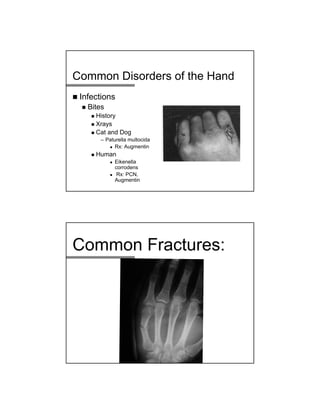
Common Disorders of the Hand
 Infections
 Bites
 History
 Xrays
 Cat and Dog
– Paturella multocida
 Rx: Augmentin
 Human
 Eikenella
corrodens
 Rx: PCN,
Augmentin
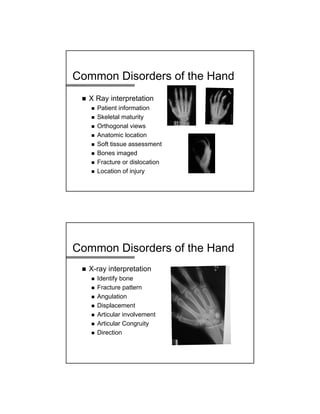
Common Fractures:
Common Disorders of the Hand
 Common fractures
 Phalanx
 Shaft, Condyles
 Metacarpals
 Head, Neck,
Shaft, CMC
 Carpus
 Distal Radius
Common Disorders of the Hand
 Fractures
 Evaluation
 Open v. closed
 Displaced v.
undisplaced
 Stable v. Unstable
 Associated
injuries
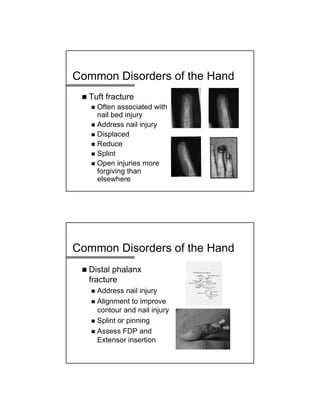
Common Disorders of the Hand
 X Ray interpretation
 Patient information
 Skeletal maturity
 Orthogonal views
 Anatomic location
 Soft tissue assessment
 Bones imaged
 Fracture or dislocation
 Location of injury
Common Disorders of the Hand
 X-ray interpretation
 Identify bone
 Fracture pattern
 Angulation
 Displacement
 Articular involvement
 Articular Congruity
 Direction
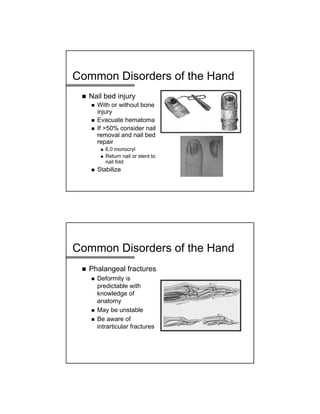
Common Disorders of the Hand
 Tuft fracture
 Often associated with
nail bed injury
 Address nail injury
 Displaced
 Reduce
 Splint
 Open injuries more
forgiving than
elsewhere
Common Disorders of the Hand
 Distal phalanx
fracture
 Address nail injury
 Alignment to improve
contour and nail injury
 Splint or pinning
 Assess FDP and
Extensor insertion
Common Disorders of the Hand
 Nail bed injury
 With or without bone
injury
 Evacuate hematoma
 If >50% consider nail
removal and nail bed
repair
 6.0 monocryl
 Return nail or stent to
nail fold
 Stabilize
Common Disorders of the Hand
 Phalangeal fractures
 Deformity is
predictable with
knowledge of
anatomy
 May be unstable
 Be aware of
intrarticular fractures
Common Disorders of the Hand
 Proximal phalanx
fracture
 Dorsal pull of
extrinsic extensor
mechanism
combined with volar
pull of intrinsics
 Volar angulation
 Potentially unstable
Common Disorders of the Hand
 Metacarpal shaft
fracture
 Intrinsic muscle pull
 Dorsal angulation
Common Disorders of the Hand
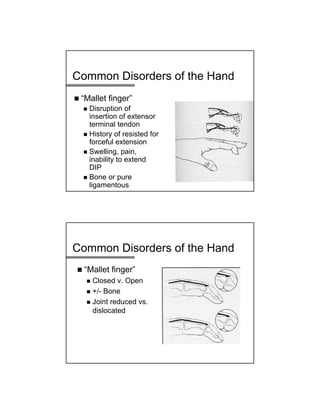
 “Mallet finger”
 Disruption of
insertion of extensor
terminal tendon
 History of resisted for
forceful extension
 Swelling, pain,
inability to extend
DIP
 Bone or pure
ligamentous
Common Disorders of the Hand
 “Mallet finger”
 Closed v. Open
 +/- Bone
 Joint reduced vs.
dislocated
Common Disorders of the Hand
 “Mallet finger”
 Tendinous
– Closed
– Acute
 6 - 8 weeks of full time extension splinting
 6 weeks of night splinting
 6 weeks of protection and return to splinting
– Chronic
 8-12 weeks initial splinting
 Increased chance of tx failure
Common Disorders of the Hand
 “Mallet finger”
 Bony
 Assess size and
displacement of
fragment
 Assess joint
congruity
Common Disorders of the Hand
 Bony “Mallet finger”
Treatment
• Non-displaced,
congruent
Extension
splint
>40% Joint surface,
subluxed
Closed pinning v.
open reduction and
pinning
Recognition and Treatment of
Hand and Wrist Injuries
 Central Slip Injury
 Rupture or avulsion of
insertion of the extensor
insertion at the middle
phalanx
 Resisted, forced
hyperextension
 Inability to extend PIP in
isolation
Recognition and Treatment of
Hand and Wrist Injuries
 Central Slip Injury
 Treatment
 Acute
– PIP extension splint x6
weeks/until competent central
slip
– DIP motion
 Chronic
– Attempt closed tx
– May requiree reconstruction if
progressive swan neck
deformity from over-pull of
terminal tendon
Common Disorders of the Hand
 FDP Avulsion
 “Rugger Jersey” finger
 History of
forcible/resisted flexion of
FDP
 More often ring finger
 Proposed reason
– Exposed location
– Watershed area/weak
area of tendon
 Inability to flex DIP
 Often present late
Common Disorders of the Hand
 FDP Avulsion
 Leddy Classification
 Governed by level of
tendon retraction and
associated bone
fragment
 Determines
treatment interval
Recognition and Treatment of
Hand and Wrist Injuries
 Fractures and
Dislocations
 Open Fractures
 Orthopedic Emergency
 Require expeditious
cleansing and debridement
 Do not close wound
 Td, and Broad spectrum
Abx
 Early referal
Recognition and Treatment of
Hand and Wrist Injuries
 Intra-articular
Fractures
 Early Referral
 Attention to articular
congruity
 More likely to require
fixation
Recognition and Treatment of
Hand and Wrist Injuries
 Finger Fractures
 Diaphyseal
 Metaphyseal
 Intra-articular
 Avulsion Type
 Unstable, Incongruent patterns
Recognition and Treatment of
Hand and Wrist Injuries
 Phalangeal condyle
 PIP fracture/dislocation
 Treatment
 Stable
– Buddy tape
– Short period of immobilization
followed by buddy taping and
ROM
 Unstable
– Small fragment, stable zone
– Large fragment, persistent
instability Potentially unstable
 Treat closed with caution
 May require operative
stabilization
Common Disorders of the Hand
 Proximal
interphalangeal
fracture/dislocation
 Pain and swelling at PIP
 History of “jamming”
injury common
 May present delayed
 Patients often self
reduce
Common Disorders of the Hand
 PIP fracture/dislocation
 Commonly dorsal dislocation
 Assess for volar fragment
and subluxation
 Potentially disabling
 May displace late if volar
fragment >25%
 Look for Dorsal Subluxation
 If volar (palmar) subluxation -
referral
Common Disorders of the Hand
 PIP
fracture/dislocation
 Treatment
 Stable
– Buddy tape
– Short period of
immobilization followed
by buddy taping and
ROM
Unstable!!
Common Disorders of the Hand
 PIP fracture/dislocation
 Treatment
 Unstable
– Small fragment, stable
zone
 Dorsal extension
block splint in stable
zone with close follow
up
– Large fragment, persistent
instability
 ORIF
Recognition and Treatment of
Hand and Wrist Injuries
 Avulsion Type
 Small, marginal
avulsions
 Usually proximal,
middle phalanx or
MC
 Attachments of
Collateral ligament
and/or volar plate
Recognition and Treatment of
Hand and Wrist Injuries
 Marginal avulsion
fractures
 If joint is stable and
congruent
 Buddy tape, early
ROM, splinting
Recognition and Treatment of
Hand and Wrist Injuries
 Metacarpal and
Phalageal Fractures
 Assessment
 Predictable patterns of
deformity
 Rotational and angular
alignment assessment
critical
 Look for overlap,
deviation, change in
plane of nail beds
Normal
Recognition and Treatment of
Hand and Wrist Injuries
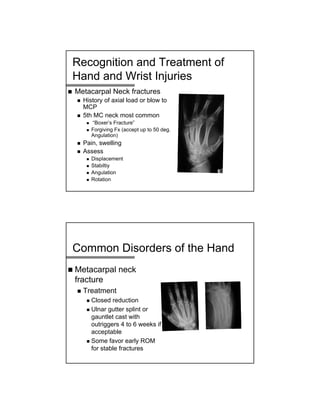
 Metacarpal Neck fractures
 History of axial load or blow to
MCP
 5th MC neck most common
 “Boxer’s Fracture”
 Forgiving Fx (accept up to 50 deg.
Angulation)
 Pain, swelling
 Assess
 Displacement
 Stabiltiy
 Angulation
 Rotation
Common Disorders of the Hand
 Metacarpal neck
fracture
 Treatment
 Closed reduction
 Ulnar gutter splint or
gauntlet cast with
outriggers 4 to 6 weeks if
acceptable
 Some favor early ROM
for stable fractures
Common Disorders of the Hand
 Metacarpal neck
fractures
 Acceptable alignment
 Extra-articular
 Index to small angulation
– 10, 20,30,40 degrees
– Mobility of 5th CMC allows
for more angulation
 < 10 degrees rotation
– No cross-over or
impingement
– Assess nail bed
alignment, alignment of
digits with flexion
Common Disorders of the Hand
 Metacarpal diaphyseal
fractures
 Closed v. open treatment
 Most isolated MC treated
closed
 Reduction parameters
 Avoid rotation
 <4-5 mm shortening
 Angulation Index to small
– 10,10,20,20
– Less angulation tolerated
proximally
Common Disorders of the Hand
 CMC
fracture/dislocation
 1st: Bennett’s fracture,
Rolando’s fx
 5th: “Baby Bennett’s”
 Unopposed force of
APL, ECU
Common Disorders of the Hand
 Bennett’s Fracture
 Non-displaced
 Unusual
 Thumb spica cast
 Close follow-up
 Displaced
 Closed v. Open reduction
and internal fixation
 Many different variations
of operative treatment
Common Disorders of the Hand
 Rolando’s Fracture
 Comminuted, intra-
articular fracture of
base of 1st MC
 May be mistaken for
Bennett’s fracture
 Unstable
 Prone to displacement,
articular incongruity,
early arthritis
 Operative treatment
Common Disorders of the Hand
 Scaphoid Fractures
 Most commonly
fractured carpal bone
 Vascular supply at risk
with fracture
 May be missed as
presentation with
“normal x-rays”
Common Disorders of the Hand
 Scaphoid fracture
 Presentation
 Fall on outstretched
hand
 Snuff box tenderness
 Scaphoid tubercle
tenderness
 May present late as
“sprained wrist”
Common Disorders of the Hand
 Scaphoid fracture
 X-ray
 5 or 6 view
“scaphoid” or
“navicular” series
– PA, lateral , oblique
– Ulnar deviation, radial
deviation, clenched
fist PA
 May be missed on
initial films
Common Disorders of the Hand
 Scaphoid fracture
 Special studies
 Bone scan
 MRI
 CT
 Tomograms
Common Disorders of the Hand
 Scaphoid fractures
 Diagnosis
 High index of suspicion
 If in doubt
– Additional views
– Immobilize and repeat
x-rays in 7-10 days
– Bone scan or MRI
Common Disorders of the Hand
 Scaphoid fractures
 Types
 Distal pole
– Most likely to heal
 Middle 1/3
 Proximal pole
– Concerning
– May warrant acute
surgical treatment
even if non-displaced
Common Disorders of the Hand
 Scaphoid fractures
 Treatment
 Non-displaced
– thumb spica cast, IP
free x 6 weeks
– Short arm, thumb spica
cast until united
– Average time to healing
- 12 weeks
Common Disorders of the Hand
 Scaphoid fractures
 Treatment
 Displaced
– > 1mm displacement
– Flexion
– Rotation
– Surgical
Common Disorders of the Hand
 Scaphoid fractures
 Non-union
 Fibrous union
 Non-union
 Avascular non-union
Common Disorders of the Hand
 Scaphoid Fractures
 Non-union
 Treatment
– ORIF
– Bone grafting
 Iliac crest
 Distal radius
 Vascularized graft
– Fixation
 None
 Pins
 Screws
Recognition and Treatment of
Hand and Wrist Injuries
 Kienbock’s disease
 Avascular necrosis of the
lunate
 4 stages
 No x-ray changes to
global collapse and
arthrosis
 May present as pain
 Often missed in early
stages
 Diagnoses early with MRI
 Treatment:
?Immobilization early
 Multiple surgical options
depending upon stage
Ligament Injuries:
Common Disorders of the Hand
 Metacarpal phalangeal
joint dislocation
 Usually secondary to
forceful hyperextension
 MCP volar plate
disruption
Common Disorders of the Hand
 MCP dislocation
 Must have true lateral x-ray
view
 Closed reduction usually
possible
 Likely requires open
reduction if button-holed
 Dorsal approach
Common Disorders of the Hand
 Ulnar Collateral
Ligament Disruption
 Most common is UCL of
thumb
 “Gamekeeper’s thumb”
 “Skier’s thumb”
 Finger Collaterals
 Usually treated closed
 Buddy tape, ROM
 UCL Thumb
 “Gamekeeper’s Thumb”
 Diagnosis
– History of acuter radial deviation of thumb
– Tenderness over UCL
– Assess for fullness
 Stener’s lesion
 Retracted UCL ligament with interposed
aponeurosis
 Poor prognosis for closed treatment
Recognition and Treatment of
Hand and Wrist Injures
Common Disorders of the Hand
 UCL Thumb
 Stress evaluation of
Thumb MCP
 Clinical evaluation
– End point
– Asymmetry
– Extension and 20 -30
degrees flexion
– Anesthetic
 Radiographs
– >30 degrees deviation
– >15 degrees deviation
compared to uninjured
side
Common Disorders of the Hand
 UCL Thumb -
“Gamekeeper’s
thumb”
 Stable UCL
 Thumb spica cast or
splint
 Unstable UCL
 Consider surgical
repair
Common Disorders of the Hand
 Ligaments of the Wrist
 Radiocarpal
 Ulnocarpal
 Interosseous
Common Disorders of the Hand
 Mayfield Classification of
wrist ligament injuries
 Progressive injury pattern
 Greater and lesser arc
injuries
 Associated fractures
 Radial styloid
 Scaphoid
 Ulnar styloid
Common Disorders of the Hand
 Carpal Instability -
Dissociative (CID)
 Disruptions of SL or LT
connection
 DISI
 Dorsal Intercalated
Instability
 VISI
 Volar Intercalated
Segmental Instability
Common Disorders of the Hand
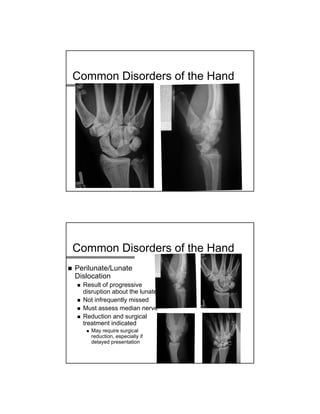
 Perilunate/Lunate
Dislocation
 Result of progressive
disruption about the lunate
 Not infrequently missed
 Must assess median nerve
 Reduction and surgical
treatment indicated
 May require surgical
reduction, especially if
delayed presentation
Common Disorders of the Hand
 Triangular
Fibrocartilage
 Major stabilizer of
the distal radioulnar
joint (DRUJ)
 Traumatic/acute or
Degenerative
Common Disorders of the Hand
 TFCC
 Presentation
 Ulnar sided wrist pain
 Insidious onset
 Acute onset
– May have history of
abrupt, rotational injury
e.g. striking ground with
golf club
Common Disorders of the Hand
 TFCC
 Degenerative
 Progressive pain
 Tenderness over
ulnocarpal joint
 Positive ulnar
impaction test
 Ulnar positive
variance
Common Disorders of the Hand
 TFCC injury
 Acute
 Traumatic injury
 May be associated with
distal radius fracture
– Higher association with
ulnar styloid avulsion on x-
ray
 Tenderness at ulnar snuff
box, distal ulna
 Instability or pain with distal
ulnar stress
Common Disorders of the Hand
 TFCC injury
 Differential diagnosis
 Hook of hamate fracture
 LT ligament injury
 Pisotriquetral injury or DJD
 Ulnar styloid injury or non-
union
 ECU tendonitis or
subluxation
 FCU tendonopathy
 DRUJ injury or DJD
 Ganglion cyst
Common Disorders of the Hand
 TFCC evaluation
 X-ray
 Assess ulnar variance
 May be normal
 MRI
 Increased signal
 May be normal
 Arthrogram
 TFCC leak
– Also seen in asymptomatic
wrists
 May be normal
 Arthroscopy
 Gold Standard
Common Disorders of the Hand
 TFCC injury
 Treatment
 Immobilization
– Eliminate Pro/Sup
– Long arm splint or cast
 Injection
 Arthroscopy
 Repair
– Peripheral
 Debridement
– Central
 Ulnar shortening
Common Disorders of the Hand
 Carpal Ligament
Disruption - Acute
 History of injury
 Tenderness
 Pain and instability
on exam
 Often missed
Normal SL
Gap
Widened
SL Gap
Common Disorders of the Hand
 Carpal Ligament
Disruption - Acute
 X-Ray evaluation
 SL, LT gap and alignment
– 3mm or greater (Terry
Thomas sign)
 suspicious
– >5mm
 confirmatory
– >1mm larger than
contralateral side
 SL angle
– Normal: 30 to 60 degrees
Normal SL
Angle
Increased
SL Angle
Common Disorders of the Hand
 Carpal Instability - Acute
 Treatment
 Dynamic
– Immobilize
 Static
– Surgical reconstruction
 Treatment of chronic
injuries not as favorable
 Untreated injuries go on to
progressive arthritis
SLAC: ScaphoLunate
Advanced Collapse
Thank You
Common Disorders of the Hand
 Compression
Neuropathies
 Carpal Tunnel Syndrome
 Cubital Tunnel Syndrome
 Pronator Syndrome
 Ulnar Tunnel Syndrome
 Radial Tunnel Syndrome
 DRSN Neuritis
Common Disorders of the Hand
 Benign Tumors and
Masses
 >95% Benign
 Most common
 Cysts
– Ganglion
– Retinacular
– Mucinous
 Soft tissue
– Giant Cell Tumors
– Hemangiomas
 Bone
– Carpal Boss
– Osteophytes
Common Disorders of the Hand
 Ganglion Cysts
 Synovial cyst
 60-70% of soft tissue
tumors of the hand
 Predominantly dorsal
wrist (70%)
 Most often arise from
SL ligament
 Volar (20%)
 Commonly arise from
STT or RC joint
 Also seen at volar MCP
 Retinacular cyst
 Arising from flexor
sheath
Common Disorders of the Hand
 Ganglion Cysts
 Gelatinous
substance filled cyst
 High concentration of
hyaluronic acid
Common Disorders of the Hand
 Ganglion Cysts
 Treatment
 Observation
 Aspiration
– Higher recurrence
rates (20%)
– Steroids ineffective
 Excision
– With stalk and portion
of capsule
– Recurrence rates as
low as 10%
Common Disorders of the Hand
 Carpal Boss
 Osteoarthritic spur
occurring at the base of
the 2nd and/or 3rd CMC
 Often confused with
ganglion cyst
 Firm, non-mobile,
occasionally tender mass
seen on slightly
supinated, oblique x-ray
 May be excised if
symptomatic

hand injuries ,.......................pdf

  • 1.
    Common Hand &Wrist Injuries Lorenzo Pacelli, M.D. Scripps Clinic Division of Orthopaedic Surgery Disclosure  Company Name:  Ascension Ortho- Consultant
  • 2.
    Common Disorders ofthe Hand  General Classification  Fractures  Dislocations  Infections  Lacerations  Neuropathies  Vascular disorders  Tendonopathies  Tumors Injuries Hand Other •Common Disorders of the Hand • Review of Anatomy • Surface • Bones and Joints • Ligaments • Muscles and Tendons • Nerves • Vessels
  • 3.
    Common Disorders ofthe Hand  Evaluation  History Details of complaint PMHx PSHx Social Hx Rx Common Disorders of the Hand  Physical Examination  General  Focused  Upper extremity  Begins at the neck  Focused examination of the Hand and Wrist  Related distant physical finding – Systemic – Other musculoskeletal anomalies
  • 4.
    Common Disorders ofthe Hand  Examination  Inspection  Palpation  Range of motion  Active  Passive  Provocative maneuvers Common Disorders of the Hand  Sensory Exam  Light touch  Sharp/dull discrimination  Threshold  Vibration  Semmes-Weinstein  2 point discrimination  Static  Moving
  • 5.
    Lacerations: Common Disorders ofthe Hand  Lacerations  Evaluation  History  Clean or contaminated  Td status  Mechanism – Penetrating injury? – Bite? – Beware dorsal MCP injuries
  • 6.
    Common Disorders ofthe Hand  Lacerations  X-rays  Orthogonal views  Fractures  Dislocation  Foreign material  Soft tissue  Air – Joint – Soft Tissue Common Disorders of the Hand  Lacerations  Examination  Wound evaluation  Recognized extent of injury  Retained foreign material  Neurovascular status – Before anesthesia  ROM – Passive/active  Motor – Ability – Resting posture – Tenodesis – Pain?
  • 7.
    Common Disorders ofthe Hand  Lacerations  Recognize flexor and extensor lacerations  Repair appropriately  Recognize joint penetration  Recognize nerve injuries Common Disorders of the Hand  Lacerations  Flexor injuries  Pain with resisted flexion may herald injury  Generally require OR for exploration and repair  Beware Zone 2 injuries  >50% repaired  <50% trim  Rehabilitation protocols
  • 8.
    Common Disorders ofthe Hand  Flexor Zones  5 Zones  Correlate with underlying anatomy  Zone 2: “No man’s land” Common Disorders of the Hand  Lacerations  Extensor lacerations  Consider position of hand at time of injury  Presume “fight bite”  Pain may indicate injury  Junctura tendinae may allow partial/weak extension and create false sense of security in MCP level injuries
  • 9.
    Common Disorders ofthe Hand  Lacerations  Extensor lacerations  Often under-appreciated  Be aware of anatomy  >50% repair  May be done in ER at times Common Disorders of the Hand  Extensor Zones  8 Zones  Correlate with underlying anatomy  Odd numbers over joints
  • 10.
    Common Disorders ofthe Hand  Laceration  Wound closure  Adequate I and D  Loose closure  Consider drain for contaminated or deep wounds  Abx for contaminated wounds  <24 hours  Beware bites  Wound check Infections:
  • 11.
    Common Disorders ofthe Hand  Infections  Paronychia  Felon  Herpetic whitlow  Septic Tenosynovitis  Deep space infections  Thenar space  Mid-palmar space  “Horseshoe abscess”  “Collar button abscess” Common Disorders of the Hand  Infections  Group A Strep most common  Special considerations  Exposure to marine environment – Fishermen – Mycobacterium marinum – I and D – Rifampin, ethambutol, TCL  Gardening – Rose thorn  Sporotrix shenckii  KISS (Super saturated potassium iodine)
  • 12.
    Common Disorders ofthe Hand  Infections  Bites  History  Xrays  Cat and Dog – Paturella multocida  Rx: Augmentin  Human  Eikenella corrodens  Rx: PCN, Augmentin Common Fractures:
  • 13.
    Common Disorders ofthe Hand  Common fractures  Phalanx  Shaft, Condyles  Metacarpals  Head, Neck, Shaft, CMC  Carpus  Distal Radius Common Disorders of the Hand  Fractures  Evaluation  Open v. closed  Displaced v. undisplaced  Stable v. Unstable  Associated injuries
  • 14.
    Common Disorders ofthe Hand  X Ray interpretation  Patient information  Skeletal maturity  Orthogonal views  Anatomic location  Soft tissue assessment  Bones imaged  Fracture or dislocation  Location of injury Common Disorders of the Hand  X-ray interpretation  Identify bone  Fracture pattern  Angulation  Displacement  Articular involvement  Articular Congruity  Direction
  • 15.
    Common Disorders ofthe Hand  Tuft fracture  Often associated with nail bed injury  Address nail injury  Displaced  Reduce  Splint  Open injuries more forgiving than elsewhere Common Disorders of the Hand  Distal phalanx fracture  Address nail injury  Alignment to improve contour and nail injury  Splint or pinning  Assess FDP and Extensor insertion
  • 16.
    Common Disorders ofthe Hand  Nail bed injury  With or without bone injury  Evacuate hematoma  If >50% consider nail removal and nail bed repair  6.0 monocryl  Return nail or stent to nail fold  Stabilize Common Disorders of the Hand  Phalangeal fractures  Deformity is predictable with knowledge of anatomy  May be unstable  Be aware of intrarticular fractures
  • 17.
    Common Disorders ofthe Hand  Proximal phalanx fracture  Dorsal pull of extrinsic extensor mechanism combined with volar pull of intrinsics  Volar angulation  Potentially unstable Common Disorders of the Hand  Metacarpal shaft fracture  Intrinsic muscle pull  Dorsal angulation
  • 18.
    Common Disorders ofthe Hand  “Mallet finger”  Disruption of insertion of extensor terminal tendon  History of resisted for forceful extension  Swelling, pain, inability to extend DIP  Bone or pure ligamentous Common Disorders of the Hand  “Mallet finger”  Closed v. Open  +/- Bone  Joint reduced vs. dislocated
  • 19.
    Common Disorders ofthe Hand  “Mallet finger”  Tendinous – Closed – Acute  6 - 8 weeks of full time extension splinting  6 weeks of night splinting  6 weeks of protection and return to splinting – Chronic  8-12 weeks initial splinting  Increased chance of tx failure Common Disorders of the Hand  “Mallet finger”  Bony  Assess size and displacement of fragment  Assess joint congruity
  • 20.
    Common Disorders ofthe Hand  Bony “Mallet finger” Treatment • Non-displaced, congruent Extension splint >40% Joint surface, subluxed Closed pinning v. open reduction and pinning Recognition and Treatment of Hand and Wrist Injuries  Central Slip Injury  Rupture or avulsion of insertion of the extensor insertion at the middle phalanx  Resisted, forced hyperextension  Inability to extend PIP in isolation
  • 21.
    Recognition and Treatmentof Hand and Wrist Injuries  Central Slip Injury  Treatment  Acute – PIP extension splint x6 weeks/until competent central slip – DIP motion  Chronic – Attempt closed tx – May requiree reconstruction if progressive swan neck deformity from over-pull of terminal tendon Common Disorders of the Hand  FDP Avulsion  “Rugger Jersey” finger  History of forcible/resisted flexion of FDP  More often ring finger  Proposed reason – Exposed location – Watershed area/weak area of tendon  Inability to flex DIP  Often present late
  • 22.
    Common Disorders ofthe Hand  FDP Avulsion  Leddy Classification  Governed by level of tendon retraction and associated bone fragment  Determines treatment interval Recognition and Treatment of Hand and Wrist Injuries  Fractures and Dislocations  Open Fractures  Orthopedic Emergency  Require expeditious cleansing and debridement  Do not close wound  Td, and Broad spectrum Abx  Early referal
  • 23.
    Recognition and Treatmentof Hand and Wrist Injuries  Intra-articular Fractures  Early Referral  Attention to articular congruity  More likely to require fixation Recognition and Treatment of Hand and Wrist Injuries  Finger Fractures  Diaphyseal  Metaphyseal  Intra-articular  Avulsion Type  Unstable, Incongruent patterns
  • 24.
    Recognition and Treatmentof Hand and Wrist Injuries  Phalangeal condyle  PIP fracture/dislocation  Treatment  Stable – Buddy tape – Short period of immobilization followed by buddy taping and ROM  Unstable – Small fragment, stable zone – Large fragment, persistent instability Potentially unstable  Treat closed with caution  May require operative stabilization Common Disorders of the Hand  Proximal interphalangeal fracture/dislocation  Pain and swelling at PIP  History of “jamming” injury common  May present delayed  Patients often self reduce
  • 25.
    Common Disorders ofthe Hand  PIP fracture/dislocation  Commonly dorsal dislocation  Assess for volar fragment and subluxation  Potentially disabling  May displace late if volar fragment >25%  Look for Dorsal Subluxation  If volar (palmar) subluxation - referral Common Disorders of the Hand  PIP fracture/dislocation  Treatment  Stable – Buddy tape – Short period of immobilization followed by buddy taping and ROM Unstable!!
  • 26.
    Common Disorders ofthe Hand  PIP fracture/dislocation  Treatment  Unstable – Small fragment, stable zone  Dorsal extension block splint in stable zone with close follow up – Large fragment, persistent instability  ORIF Recognition and Treatment of Hand and Wrist Injuries  Avulsion Type  Small, marginal avulsions  Usually proximal, middle phalanx or MC  Attachments of Collateral ligament and/or volar plate
  • 27.
    Recognition and Treatmentof Hand and Wrist Injuries  Marginal avulsion fractures  If joint is stable and congruent  Buddy tape, early ROM, splinting Recognition and Treatment of Hand and Wrist Injuries  Metacarpal and Phalageal Fractures  Assessment  Predictable patterns of deformity  Rotational and angular alignment assessment critical  Look for overlap, deviation, change in plane of nail beds Normal
  • 28.
    Recognition and Treatmentof Hand and Wrist Injuries  Metacarpal Neck fractures  History of axial load or blow to MCP  5th MC neck most common  “Boxer’s Fracture”  Forgiving Fx (accept up to 50 deg. Angulation)  Pain, swelling  Assess  Displacement  Stabiltiy  Angulation  Rotation Common Disorders of the Hand  Metacarpal neck fracture  Treatment  Closed reduction  Ulnar gutter splint or gauntlet cast with outriggers 4 to 6 weeks if acceptable  Some favor early ROM for stable fractures
  • 29.
    Common Disorders ofthe Hand  Metacarpal neck fractures  Acceptable alignment  Extra-articular  Index to small angulation – 10, 20,30,40 degrees – Mobility of 5th CMC allows for more angulation  < 10 degrees rotation – No cross-over or impingement – Assess nail bed alignment, alignment of digits with flexion Common Disorders of the Hand  Metacarpal diaphyseal fractures  Closed v. open treatment  Most isolated MC treated closed  Reduction parameters  Avoid rotation  <4-5 mm shortening  Angulation Index to small – 10,10,20,20 – Less angulation tolerated proximally
  • 30.
    Common Disorders ofthe Hand  CMC fracture/dislocation  1st: Bennett’s fracture, Rolando’s fx  5th: “Baby Bennett’s”  Unopposed force of APL, ECU Common Disorders of the Hand  Bennett’s Fracture  Non-displaced  Unusual  Thumb spica cast  Close follow-up  Displaced  Closed v. Open reduction and internal fixation  Many different variations of operative treatment
  • 31.
    Common Disorders ofthe Hand  Rolando’s Fracture  Comminuted, intra- articular fracture of base of 1st MC  May be mistaken for Bennett’s fracture  Unstable  Prone to displacement, articular incongruity, early arthritis  Operative treatment Common Disorders of the Hand  Scaphoid Fractures  Most commonly fractured carpal bone  Vascular supply at risk with fracture  May be missed as presentation with “normal x-rays”
  • 32.
    Common Disorders ofthe Hand  Scaphoid fracture  Presentation  Fall on outstretched hand  Snuff box tenderness  Scaphoid tubercle tenderness  May present late as “sprained wrist” Common Disorders of the Hand  Scaphoid fracture  X-ray  5 or 6 view “scaphoid” or “navicular” series – PA, lateral , oblique – Ulnar deviation, radial deviation, clenched fist PA  May be missed on initial films
  • 33.
    Common Disorders ofthe Hand  Scaphoid fracture  Special studies  Bone scan  MRI  CT  Tomograms Common Disorders of the Hand  Scaphoid fractures  Diagnosis  High index of suspicion  If in doubt – Additional views – Immobilize and repeat x-rays in 7-10 days – Bone scan or MRI
  • 34.
    Common Disorders ofthe Hand  Scaphoid fractures  Types  Distal pole – Most likely to heal  Middle 1/3  Proximal pole – Concerning – May warrant acute surgical treatment even if non-displaced Common Disorders of the Hand  Scaphoid fractures  Treatment  Non-displaced – thumb spica cast, IP free x 6 weeks – Short arm, thumb spica cast until united – Average time to healing - 12 weeks
  • 35.
    Common Disorders ofthe Hand  Scaphoid fractures  Treatment  Displaced – > 1mm displacement – Flexion – Rotation – Surgical Common Disorders of the Hand  Scaphoid fractures  Non-union  Fibrous union  Non-union  Avascular non-union
  • 36.
    Common Disorders ofthe Hand  Scaphoid Fractures  Non-union  Treatment – ORIF – Bone grafting  Iliac crest  Distal radius  Vascularized graft – Fixation  None  Pins  Screws Recognition and Treatment of Hand and Wrist Injuries  Kienbock’s disease  Avascular necrosis of the lunate  4 stages  No x-ray changes to global collapse and arthrosis  May present as pain  Often missed in early stages  Diagnoses early with MRI  Treatment: ?Immobilization early  Multiple surgical options depending upon stage
  • 37.
    Ligament Injuries: Common Disordersof the Hand  Metacarpal phalangeal joint dislocation  Usually secondary to forceful hyperextension  MCP volar plate disruption
  • 38.
    Common Disorders ofthe Hand  MCP dislocation  Must have true lateral x-ray view  Closed reduction usually possible  Likely requires open reduction if button-holed  Dorsal approach Common Disorders of the Hand  Ulnar Collateral Ligament Disruption  Most common is UCL of thumb  “Gamekeeper’s thumb”  “Skier’s thumb”  Finger Collaterals  Usually treated closed  Buddy tape, ROM
  • 39.
     UCL Thumb “Gamekeeper’s Thumb”  Diagnosis – History of acuter radial deviation of thumb – Tenderness over UCL – Assess for fullness  Stener’s lesion  Retracted UCL ligament with interposed aponeurosis  Poor prognosis for closed treatment Recognition and Treatment of Hand and Wrist Injures Common Disorders of the Hand  UCL Thumb  Stress evaluation of Thumb MCP  Clinical evaluation – End point – Asymmetry – Extension and 20 -30 degrees flexion – Anesthetic  Radiographs – >30 degrees deviation – >15 degrees deviation compared to uninjured side
  • 40.
    Common Disorders ofthe Hand  UCL Thumb - “Gamekeeper’s thumb”  Stable UCL  Thumb spica cast or splint  Unstable UCL  Consider surgical repair Common Disorders of the Hand  Ligaments of the Wrist  Radiocarpal  Ulnocarpal  Interosseous
  • 41.
    Common Disorders ofthe Hand  Mayfield Classification of wrist ligament injuries  Progressive injury pattern  Greater and lesser arc injuries  Associated fractures  Radial styloid  Scaphoid  Ulnar styloid Common Disorders of the Hand  Carpal Instability - Dissociative (CID)  Disruptions of SL or LT connection  DISI  Dorsal Intercalated Instability  VISI  Volar Intercalated Segmental Instability
  • 42.
    Common Disorders ofthe Hand Common Disorders of the Hand  Perilunate/Lunate Dislocation  Result of progressive disruption about the lunate  Not infrequently missed  Must assess median nerve  Reduction and surgical treatment indicated  May require surgical reduction, especially if delayed presentation
  • 43.
    Common Disorders ofthe Hand  Triangular Fibrocartilage  Major stabilizer of the distal radioulnar joint (DRUJ)  Traumatic/acute or Degenerative Common Disorders of the Hand  TFCC  Presentation  Ulnar sided wrist pain  Insidious onset  Acute onset – May have history of abrupt, rotational injury e.g. striking ground with golf club
  • 44.
    Common Disorders ofthe Hand  TFCC  Degenerative  Progressive pain  Tenderness over ulnocarpal joint  Positive ulnar impaction test  Ulnar positive variance Common Disorders of the Hand  TFCC injury  Acute  Traumatic injury  May be associated with distal radius fracture – Higher association with ulnar styloid avulsion on x- ray  Tenderness at ulnar snuff box, distal ulna  Instability or pain with distal ulnar stress
  • 45.
    Common Disorders ofthe Hand  TFCC injury  Differential diagnosis  Hook of hamate fracture  LT ligament injury  Pisotriquetral injury or DJD  Ulnar styloid injury or non- union  ECU tendonitis or subluxation  FCU tendonopathy  DRUJ injury or DJD  Ganglion cyst Common Disorders of the Hand  TFCC evaluation  X-ray  Assess ulnar variance  May be normal  MRI  Increased signal  May be normal  Arthrogram  TFCC leak – Also seen in asymptomatic wrists  May be normal  Arthroscopy  Gold Standard
  • 46.
    Common Disorders ofthe Hand  TFCC injury  Treatment  Immobilization – Eliminate Pro/Sup – Long arm splint or cast  Injection  Arthroscopy  Repair – Peripheral  Debridement – Central  Ulnar shortening Common Disorders of the Hand  Carpal Ligament Disruption - Acute  History of injury  Tenderness  Pain and instability on exam  Often missed Normal SL Gap Widened SL Gap
  • 47.
    Common Disorders ofthe Hand  Carpal Ligament Disruption - Acute  X-Ray evaluation  SL, LT gap and alignment – 3mm or greater (Terry Thomas sign)  suspicious – >5mm  confirmatory – >1mm larger than contralateral side  SL angle – Normal: 30 to 60 degrees Normal SL Angle Increased SL Angle Common Disorders of the Hand  Carpal Instability - Acute  Treatment  Dynamic – Immobilize  Static – Surgical reconstruction  Treatment of chronic injuries not as favorable  Untreated injuries go on to progressive arthritis SLAC: ScaphoLunate Advanced Collapse
  • 48.
    Thank You Common Disordersof the Hand  Compression Neuropathies  Carpal Tunnel Syndrome  Cubital Tunnel Syndrome  Pronator Syndrome  Ulnar Tunnel Syndrome  Radial Tunnel Syndrome  DRSN Neuritis
  • 49.
    Common Disorders ofthe Hand  Benign Tumors and Masses  >95% Benign  Most common  Cysts – Ganglion – Retinacular – Mucinous  Soft tissue – Giant Cell Tumors – Hemangiomas  Bone – Carpal Boss – Osteophytes Common Disorders of the Hand  Ganglion Cysts  Synovial cyst  60-70% of soft tissue tumors of the hand  Predominantly dorsal wrist (70%)  Most often arise from SL ligament  Volar (20%)  Commonly arise from STT or RC joint  Also seen at volar MCP  Retinacular cyst  Arising from flexor sheath
  • 50.
    Common Disorders ofthe Hand  Ganglion Cysts  Gelatinous substance filled cyst  High concentration of hyaluronic acid Common Disorders of the Hand  Ganglion Cysts  Treatment  Observation  Aspiration – Higher recurrence rates (20%) – Steroids ineffective  Excision – With stalk and portion of capsule – Recurrence rates as low as 10%
  • 51.
    Common Disorders ofthe Hand  Carpal Boss  Osteoarthritic spur occurring at the base of the 2nd and/or 3rd CMC  Often confused with ganglion cyst  Firm, non-mobile, occasionally tender mass seen on slightly supinated, oblique x-ray  May be excised if symptomatic