Welcome to the Infection Prevention & Control
Hand Hygiene Learning Module
This presentation will take you through the who,
what, where, why, when and how of hand
hygiene. Some important points will be reviewed
to improve your hand hygiene practice.
Please note: in this learning module we use the term “patient”, but patient also
means “client” or “resident” depending on the healthcare setting.
By the end of this presentation you will be able to:
• Identify who should practice hand hygiene
• Describe what hand hygiene is
• Identify where hand hygiene practice should take place
• Explain why hand hygiene is important
• Describe when hand hygiene is to be performed
• Describe how to perform hand hygiene using various
methods
• Describe tips for success for effective of hand hygiene
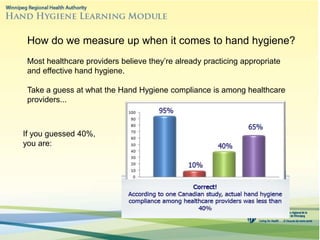
How do we measure up when it comes to hand hygiene?
Most healthcare providers believe they’re already practicing appropriate
and effective hand hygiene.
Take a guess at what the Hand Hygiene compliance is among healthcare
providers...
If you guessed 40%,
you are:
The “who, what, where, when, how
and why” of Hand Hygiene
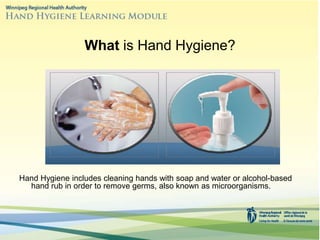
What is Hand Hygiene?
Hand Hygiene includes cleaning hands with soap and water or alcohol-based
hand rub in order to remove germs, also known as microorganisms.
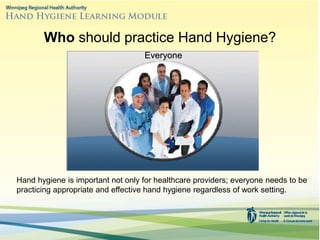
Who should practice Hand Hygiene?
Hand hygiene is important not only for healthcare providers; everyone needs to be
practicing appropriate and effective hand hygiene regardless of work setting.
Everyone
• Busy health care providers need access to hand hygiene
products where patient or patient environment contact is
taking place.
• Hand hygiene is important in all work settings, including
Acute Care, Long Term Care Facilities, Community and
Corporate sites.
• Providing alcohol-based hand rub at the point of care
(within arm’s reach) is an important system support to
improve hand hygiene.
• This enables health care providers to quickly and easily
fulfill the 4 Moments for Hand Hygiene.
Where should you perform Hand Hygiene?
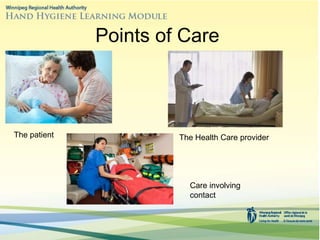
Points of Care
The patient The Health Care provider
Care involving
contact
Why do we need to learn about Hand Hygiene?
• Hand hygiene is the most important way to
prevent the spread of germs.
• Hand hygiene helps keep you healthy by
reducing the number of germs on your hands
and helps reduce the spread of germs to your
family, friends, coworkers, patients, residents or
clients.
• Using appropriate hand hygiene prevents
contamination of the patient’s, client’s, or
resident’s environment.
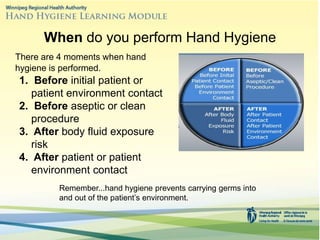
When do you perform Hand Hygiene
There are 4 moments when hand
hygiene is performed.
1. Before initial patient or
patient environment contact
2. Before aseptic or clean
procedure
3. After body fluid exposure
risk
4. After patient or patient
environment contact
Remember...hand hygiene prevents carrying germs into
and out of the patient’s environment.
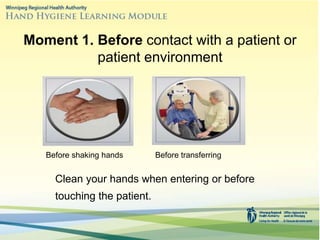
Moment 1. Before contact with a patient or
patient environment
Clean your hands when entering or before
touching the patient.
Before shaking hands Before transferring
Moment 1. Before contact with a patient or
patient environment
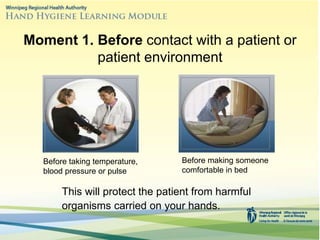
This will protect the patient from harmful
organisms carried on your hands.
Before taking temperature,
blood pressure or pulse
Before making someone
comfortable in bed
Moment 1. Before contact with patient or patient
environment
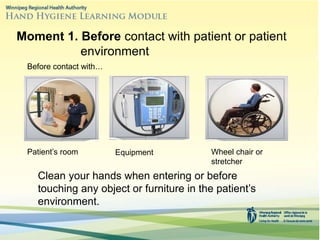
Clean your hands when entering or before
touching any object or furniture in the patient’s
environment.
Before contact with…
Patient’s room Equipment Wheel chair or
stretcher
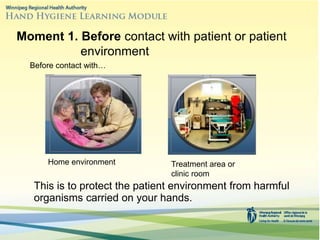
This is to protect the patient environment from harmful
organisms carried on your hands.
Moment 1. Before contact with patient or patient
environment
Before contact with…
Home environment Treatment area or
clinic room
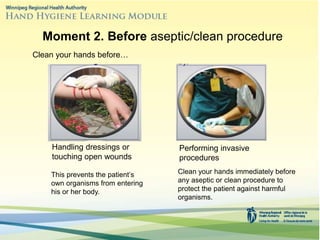
Clean your hands immediately before
any aseptic or clean procedure to
protect the patient against harmful
organisms.
Moment 2. Before aseptic/clean procedure
Clean your hands before…
Handling dressings or
touching open wounds
Performing invasive
procedures
This prevents the patient’s
own organisms from entering
his or her body.
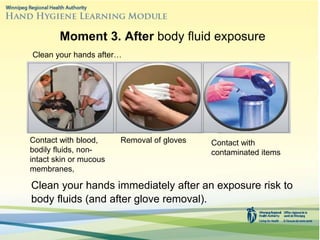
Clean your hands immediately after an exposure risk to
body fluids (and after glove removal).
Moment 3. After body fluid exposure
Clean your hands after…
Contact with blood,
bodily fluids, non-
intact skin or mucous
membranes,
Removal of gloves Contact with
contaminated items
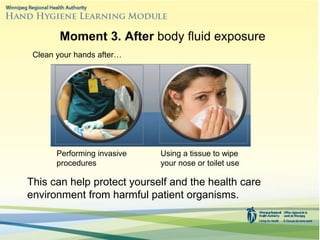
Clean your hands after…
Moment 3. After body fluid exposure
This can help protect yourself and the health care
environment from harmful patient organisms.
Performing invasive
procedures
Using a tissue to wipe
your nose or toilet use
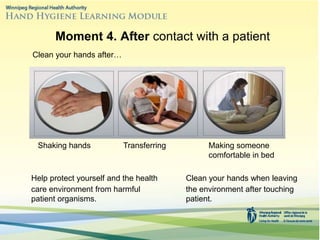
Clean your hands when leaving
the environment after touching
patient.
Moment 4. After contact with a patient
Clean your hands after…
Shaking hands Transferring Making someone
comfortable in bed
Help protect yourself and the health
care environment from harmful
patient organisms.
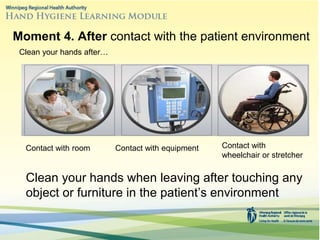
Moment 4. After contact with the patient environment
Clean your hands when leaving after touching any
object or furniture in the patient’s environment
Clean your hands after…
Contact with room Contact with equipment Contact with
wheelchair or stretcher
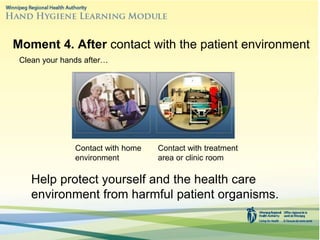
Help protect yourself and the health care
environment from harmful patient organisms.
Moment 4. After contact with the patient environment
Clean your hands after…
Contact with home
environment
Contact with treatment
area or clinic room
Let’s Review
The 4 Moments of Hand Hygiene are:
1. Before initial patient or patient
environment contact
2. Before aseptic or clean procedures
3. After body fluid exposure
4. After contact with patient or patient
environment
How to perform hand hygiene
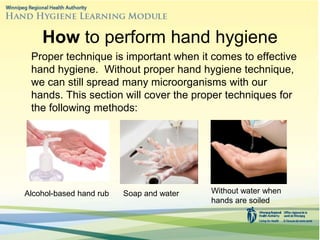
Proper technique is important when it comes to effective
hand hygiene. Without proper hand hygiene technique,
we can still spread many microorganisms with our
hands. This section will cover the proper techniques for
the following methods:
Alcohol-based hand rub Soap and water Without water when
hands are soiled
Alcohol-based hand rub
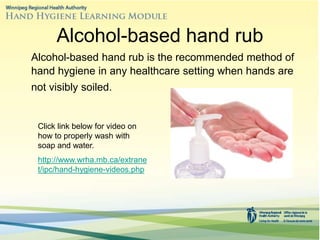
Alcohol-based hand rub is the recommended method of
hand hygiene in any healthcare setting when hands are
not visibly soiled.
Click link below for video on
how to properly wash with
soap and water.
http://www.wrha.mb.ca/extrane
t/ipc/hand-hygiene-videos.php
Alcohol-based hand rub
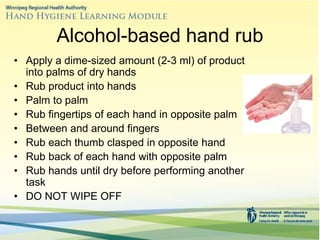
• Apply a dime-sized amount (2-3 ml) of product
into palms of dry hands
• Rub product into hands
• Palm to palm
• Rub fingertips of each hand in opposite palm
• Between and around fingers
• Rub each thumb clasped in opposite hand
• Rub back of each hand with opposite palm
• Rub hands until dry before performing another
task
• DO NOT WIPE OFF
Alcohol-based hand rub
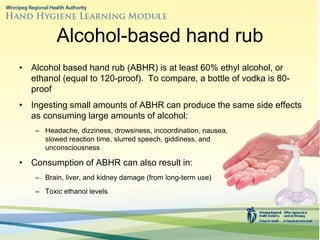
• Alcohol based hand rub (ABHR) is at least 60% ethyl alcohol, or
ethanol (equal to 120-proof). To compare, a bottle of vodka is 80-
proof
• Ingesting small amounts of ABHR can produce the same side effects
as consuming large amounts of alcohol:
– Headache, dizziness, drowsiness, incoordination, nausea,
slowed reaction time, slurred speech, giddiness, and
unconsciousness
• Consumption of ABHR can also result in:
– Brain, liver, and kidney damage (from long-term use)
– Toxic ethanol levels
Soap and Water
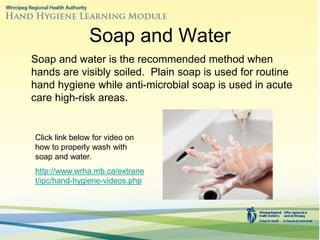
Soap and water is the recommended method when
hands are visibly soiled. Plain soap is used for routine
hand hygiene while anti-microbial soap is used in acute
care high-risk areas.
Click link below for video on
how to properly wash with
soap and water.
http://www.wrha.mb.ca/extrane
t/ipc/hand-hygiene-videos.php
Soap and Water
• Wet hands under warm running water
• Apply soap and distribute over hands
• Rub hands together vigorously for 15 seconds to create
a good lather: Palm to palm
• Rub fingertips of each hand in opposite palm
• Between and around fingers
• Rub each thumb clasped in opposite hand
• Rub back of each hand with opposite palm
• Rinse hands thoroughly under warm running water
• Pat hands dry with a paper towel
• Turn off faucet using a paper towel
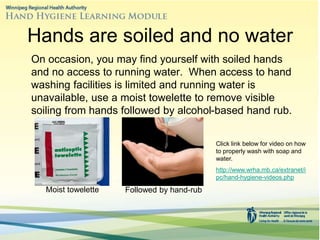
Hands are soiled and no water
On occasion, you may find yourself with soiled hands
and no access to running water. When access to hand
washing facilities is limited and running water is
unavailable, use a moist towelette to remove visible
soiling from hands followed by alcohol-based hand rub.
Moist towelette Followed by hand-rub
Click link below for video on how
to properly wash with soap and
water.
http://www.wrha.mb.ca/extranet/i
pc/hand-hygiene-videos.php
Hands are soiled and no water
• Remove visible soiling with moist towelette
• Apply a dime-sized amount of hand-rub product into
palms of dry hands
• Rub product into hands: Palm to palm
• Rub fingertips of each hand in opposite palm
• Between and around fingers
• Rub each thumb clasped in opposite hand
• Rub back of each hand with opposite palm
• Rub hands until dry before performing another task
• DO NOT WIPE OFF
“Handy” Tips
1 Artificial nails, gel nails or extenders are not to be worn
by staff who have direct patient contact.
2 Contaminated surfaces or objects should not be touched
after performing hand hygiene.
3 Avoid touching your face, especially your eyes and nose.
4 Fingernails should be kept short - no longer than ¼” or
0.635cm long.
5 Nail polish may be worn, but should be removed when
chipped.
6 Do not “top up” a partially-used hand hygiene
product dispenser.
7 If re-usable dispensers are used they must be
emptied, washed and dried prior to being refilled.
Hand lotion bottles must not be re-used.
8 Include frequently missed areas when performing
hand hygiene such as thumbs, palms, web spaces,
under nails and the backs of fingers and hands.
9 Use supplied lotions that are compatible with hand
hygiene products and gloves to minimize skin
irritation that can occur with frequent hand hygiene.
10 Wearing hand and wrist jewelry is not
recommended.
“Handy” Tips
Hand Hygiene Quiz
Select an answer. The correct response will be underlined.
1. Hand hygiene is the most important way to prevent the spread of germs
(microorganisms).
» True
» False
2. When washing hands, which of the following is important to remember?
• Wash with hottest water possible
• The focus of good hand washing is the palms
• Turn faucet off after disposing of your paper towel
• Lather and rub hands together for 15 seconds
3. Alcohol-based hand rub may be used instead of soap and water when hands
are not visibly soiled.
» True
» False
4. Which of the following is the correct order when performing hand
hygiene?
• Wet hands; Apply soap; Rub vigorously; Rinse hands
• Apply soap; Wet hands; Rub vigorously; Rinse hands
• Apply soap; Rub vigorously; Rinse hands; turn off faucet
• Wet hands; Apply alcohol based hand rub; Rub vigorously; turn off
faucet
5. When hands are visibly soiled and water is not available, how is hand
hygiene performed?
• Using a moist towelette
• Using alcohol based hand rub
• Using a moist towelette followed by alcohol-based hand rub
• Using a disinfectant wipe
Hand Hygiene Quiz
Thank you
• You’ve now completed the Hand Hygiene
Learning Module
• Thank you for participating in this
important exercise.
• Remember the 4 Moments of Hand
Hygiene…
Remember 4M
1. Before initial patient or patient
environment contact
2. Before aseptic or clean procedures
3. After body fluid exposure
4. After contact with patient or patient
environment

personal_hygiene_for_all.ppt

  • 1.
    Welcome to theInfection Prevention & Control Hand Hygiene Learning Module
  • 2.
    This presentation willtake you through the who, what, where, why, when and how of hand hygiene. Some important points will be reviewed to improve your hand hygiene practice. Please note: in this learning module we use the term “patient”, but patient also means “client” or “resident” depending on the healthcare setting.
  • 3.
    By the endof this presentation you will be able to: • Identify who should practice hand hygiene • Describe what hand hygiene is • Identify where hand hygiene practice should take place • Explain why hand hygiene is important • Describe when hand hygiene is to be performed • Describe how to perform hand hygiene using various methods • Describe tips for success for effective of hand hygiene
  • 4.
    How do wemeasure up when it comes to hand hygiene? Most healthcare providers believe they’re already practicing appropriate and effective hand hygiene. Take a guess at what the Hand Hygiene compliance is among healthcare providers... If you guessed 40%, you are:
  • 5.
    The “who, what,where, when, how and why” of Hand Hygiene
  • 6.
    What is HandHygiene? Hand Hygiene includes cleaning hands with soap and water or alcohol-based hand rub in order to remove germs, also known as microorganisms.
  • 7.
    Who should practiceHand Hygiene? Hand hygiene is important not only for healthcare providers; everyone needs to be practicing appropriate and effective hand hygiene regardless of work setting. Everyone
  • 8.
    • Busy healthcare providers need access to hand hygiene products where patient or patient environment contact is taking place. • Hand hygiene is important in all work settings, including Acute Care, Long Term Care Facilities, Community and Corporate sites. • Providing alcohol-based hand rub at the point of care (within arm’s reach) is an important system support to improve hand hygiene. • This enables health care providers to quickly and easily fulfill the 4 Moments for Hand Hygiene. Where should you perform Hand Hygiene?
  • 9.
    Points of Care Thepatient The Health Care provider Care involving contact
  • 10.
    Why do weneed to learn about Hand Hygiene? • Hand hygiene is the most important way to prevent the spread of germs. • Hand hygiene helps keep you healthy by reducing the number of germs on your hands and helps reduce the spread of germs to your family, friends, coworkers, patients, residents or clients. • Using appropriate hand hygiene prevents contamination of the patient’s, client’s, or resident’s environment.
  • 11.
    When do youperform Hand Hygiene There are 4 moments when hand hygiene is performed. 1. Before initial patient or patient environment contact 2. Before aseptic or clean procedure 3. After body fluid exposure risk 4. After patient or patient environment contact Remember...hand hygiene prevents carrying germs into and out of the patient’s environment.
  • 12.
    Moment 1. Beforecontact with a patient or patient environment Clean your hands when entering or before touching the patient. Before shaking hands Before transferring
  • 13.
    Moment 1. Beforecontact with a patient or patient environment This will protect the patient from harmful organisms carried on your hands. Before taking temperature, blood pressure or pulse Before making someone comfortable in bed
  • 14.
    Moment 1. Beforecontact with patient or patient environment Clean your hands when entering or before touching any object or furniture in the patient’s environment. Before contact with… Patient’s room Equipment Wheel chair or stretcher
  • 15.
    This is toprotect the patient environment from harmful organisms carried on your hands. Moment 1. Before contact with patient or patient environment Before contact with… Home environment Treatment area or clinic room
  • 16.
    Clean your handsimmediately before any aseptic or clean procedure to protect the patient against harmful organisms. Moment 2. Before aseptic/clean procedure Clean your hands before… Handling dressings or touching open wounds Performing invasive procedures This prevents the patient’s own organisms from entering his or her body.
  • 17.
    Clean your handsimmediately after an exposure risk to body fluids (and after glove removal). Moment 3. After body fluid exposure Clean your hands after… Contact with blood, bodily fluids, non- intact skin or mucous membranes, Removal of gloves Contact with contaminated items
  • 18.
    Clean your handsafter… Moment 3. After body fluid exposure This can help protect yourself and the health care environment from harmful patient organisms. Performing invasive procedures Using a tissue to wipe your nose or toilet use
  • 19.
    Clean your handswhen leaving the environment after touching patient. Moment 4. After contact with a patient Clean your hands after… Shaking hands Transferring Making someone comfortable in bed Help protect yourself and the health care environment from harmful patient organisms.
  • 20.
    Moment 4. Aftercontact with the patient environment Clean your hands when leaving after touching any object or furniture in the patient’s environment Clean your hands after… Contact with room Contact with equipment Contact with wheelchair or stretcher
  • 21.
    Help protect yourselfand the health care environment from harmful patient organisms. Moment 4. After contact with the patient environment Clean your hands after… Contact with home environment Contact with treatment area or clinic room
  • 22.
    Let’s Review The 4Moments of Hand Hygiene are: 1. Before initial patient or patient environment contact 2. Before aseptic or clean procedures 3. After body fluid exposure 4. After contact with patient or patient environment
  • 23.
    How to performhand hygiene Proper technique is important when it comes to effective hand hygiene. Without proper hand hygiene technique, we can still spread many microorganisms with our hands. This section will cover the proper techniques for the following methods: Alcohol-based hand rub Soap and water Without water when hands are soiled
  • 24.
    Alcohol-based hand rub Alcohol-basedhand rub is the recommended method of hand hygiene in any healthcare setting when hands are not visibly soiled. Click link below for video on how to properly wash with soap and water. http://www.wrha.mb.ca/extrane t/ipc/hand-hygiene-videos.php
  • 25.
    Alcohol-based hand rub •Apply a dime-sized amount (2-3 ml) of product into palms of dry hands • Rub product into hands • Palm to palm • Rub fingertips of each hand in opposite palm • Between and around fingers • Rub each thumb clasped in opposite hand • Rub back of each hand with opposite palm • Rub hands until dry before performing another task • DO NOT WIPE OFF
  • 26.
    Alcohol-based hand rub •Alcohol based hand rub (ABHR) is at least 60% ethyl alcohol, or ethanol (equal to 120-proof). To compare, a bottle of vodka is 80- proof • Ingesting small amounts of ABHR can produce the same side effects as consuming large amounts of alcohol: – Headache, dizziness, drowsiness, incoordination, nausea, slowed reaction time, slurred speech, giddiness, and unconsciousness • Consumption of ABHR can also result in: – Brain, liver, and kidney damage (from long-term use) – Toxic ethanol levels
  • 27.
    Soap and Water Soapand water is the recommended method when hands are visibly soiled. Plain soap is used for routine hand hygiene while anti-microbial soap is used in acute care high-risk areas. Click link below for video on how to properly wash with soap and water. http://www.wrha.mb.ca/extrane t/ipc/hand-hygiene-videos.php
  • 28.
    Soap and Water •Wet hands under warm running water • Apply soap and distribute over hands • Rub hands together vigorously for 15 seconds to create a good lather: Palm to palm • Rub fingertips of each hand in opposite palm • Between and around fingers • Rub each thumb clasped in opposite hand • Rub back of each hand with opposite palm • Rinse hands thoroughly under warm running water • Pat hands dry with a paper towel • Turn off faucet using a paper towel
  • 29.
    Hands are soiledand no water On occasion, you may find yourself with soiled hands and no access to running water. When access to hand washing facilities is limited and running water is unavailable, use a moist towelette to remove visible soiling from hands followed by alcohol-based hand rub. Moist towelette Followed by hand-rub Click link below for video on how to properly wash with soap and water. http://www.wrha.mb.ca/extranet/i pc/hand-hygiene-videos.php
  • 30.
    Hands are soiledand no water • Remove visible soiling with moist towelette • Apply a dime-sized amount of hand-rub product into palms of dry hands • Rub product into hands: Palm to palm • Rub fingertips of each hand in opposite palm • Between and around fingers • Rub each thumb clasped in opposite hand • Rub back of each hand with opposite palm • Rub hands until dry before performing another task • DO NOT WIPE OFF
  • 31.
    “Handy” Tips 1 Artificialnails, gel nails or extenders are not to be worn by staff who have direct patient contact. 2 Contaminated surfaces or objects should not be touched after performing hand hygiene. 3 Avoid touching your face, especially your eyes and nose. 4 Fingernails should be kept short - no longer than ¼” or 0.635cm long. 5 Nail polish may be worn, but should be removed when chipped.
  • 32.
    6 Do not“top up” a partially-used hand hygiene product dispenser. 7 If re-usable dispensers are used they must be emptied, washed and dried prior to being refilled. Hand lotion bottles must not be re-used. 8 Include frequently missed areas when performing hand hygiene such as thumbs, palms, web spaces, under nails and the backs of fingers and hands. 9 Use supplied lotions that are compatible with hand hygiene products and gloves to minimize skin irritation that can occur with frequent hand hygiene. 10 Wearing hand and wrist jewelry is not recommended. “Handy” Tips
  • 33.
    Hand Hygiene Quiz Selectan answer. The correct response will be underlined. 1. Hand hygiene is the most important way to prevent the spread of germs (microorganisms). » True » False 2. When washing hands, which of the following is important to remember? • Wash with hottest water possible • The focus of good hand washing is the palms • Turn faucet off after disposing of your paper towel • Lather and rub hands together for 15 seconds 3. Alcohol-based hand rub may be used instead of soap and water when hands are not visibly soiled. » True » False
  • 34.
    4. Which ofthe following is the correct order when performing hand hygiene? • Wet hands; Apply soap; Rub vigorously; Rinse hands • Apply soap; Wet hands; Rub vigorously; Rinse hands • Apply soap; Rub vigorously; Rinse hands; turn off faucet • Wet hands; Apply alcohol based hand rub; Rub vigorously; turn off faucet 5. When hands are visibly soiled and water is not available, how is hand hygiene performed? • Using a moist towelette • Using alcohol based hand rub • Using a moist towelette followed by alcohol-based hand rub • Using a disinfectant wipe Hand Hygiene Quiz
  • 35.
    Thank you • You’venow completed the Hand Hygiene Learning Module • Thank you for participating in this important exercise. • Remember the 4 Moments of Hand Hygiene…
  • 36.
    Remember 4M 1. Beforeinitial patient or patient environment contact 2. Before aseptic or clean procedures 3. After body fluid exposure 4. After contact with patient or patient environment