


Hanborq Optimizations on
  Hadoop MapReduce
          Feb.21, 2012
   Big Data Engineering Team
Motivations
•   MapReduce is a proved and successful data processing framework. It can be implemented enough
    efficient and flexible.
     – MapReduce: Simplified Data Processing on Large Clusters
     – MapReduce: A Flexible Data Processing Tool

•   Hadoop is the most popular Open Source implementation of MapReduce, but it’s not so good
    implemented.
     –   Long latency.
     –   Inefficiency with low performance.
     –   Not so flexible. Not simple enough to build, develop, etc.
     –   It has taken so long time to become mature, since 2006.

•   Our customers always challenge the latency and performance of Hadoop MapReduce.
•   The majority of real deploys cannot afford to install thousands of server. The inefficiency of Hadoop
    waste many hardware and energy.

•   It’s possible to improve the Hadoop Core and applications to achieve better experience.
     – Tenzing: A SQL Implementation On The MapReduce Framework
     – Dremel: Interactive Analysis of Web-Scale Datasets


                                                                                                            2
To build a fast architecture.

MAPREDUCE RUNTIME ENVIRONMENT


                                3
Runtime
                 Job/Task Schedule & Latency (1)
• Problem: even for a empty job, Hadoop will take tens of seconds to complete it.

• HDH Improvements:
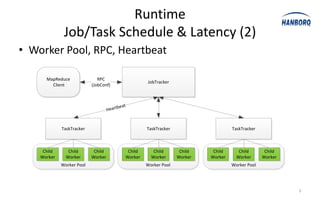
    – Worker Pool
         • Like Google Tenzing, HDH MapReduce runtime does not spawn new JVM processes for each job/task, but
           instead start these slot/worker processes at initialization phase and keep them running constantly.
         • Fast/Real-time communication between Workers and TaskTracker.
    – Transfer Job description information (JobConf, splits info, etc.) within RPC (Client->JobTracker).
         • Reduce the overhead to transfer, persist, load and parse XML files.
         • Reduce the useless and default attributes to be transferred for JobConf.
    – Heartbeat (TaskTracker)
         • Speed up the task assignment.
         • Use triggered(out-of-band ) real-time heartbeat when special event happens.
    –   Avoid duplicated loading of configuration files for Configuration Objects.
    –   Use DistributedCache to deploy job’s jar files.
    –   Avoid some unnecessary “sleep”.
    –   Avoid some big buffer/memory allocation which takes long time and to be inefficient.
    –   …

                                                                                                                 4
Runtime
              Job/Task Schedule & Latency (2)
• Worker Pool, RPC, Heartbeat

      MapReduce               RPC
                                                     JobTracker
        Client             (JobConf)


                                         beat
                                    Heart


             TaskTracker                             TaskTracker                     TaskTracker


     Child      Child       Child            Child      Child       Child    Child      Child       Child
    Worker     Worker      Worker           Worker     Worker      Worker   Worker     Worker      Worker
             Worker Pool                             Worker Pool                     Worker Pool


                                                                                                            5
Hints
• Enable these configuration properties
  – mapreduce.tasktracker.outofband.heartbeat = true
  – mapred.job.reuse.jvm.num.tasks = -1 (even through it is not
    used in HDH)


• Issues
  – Java, GC issue for a constantly running worker JVM.


                                                                  6
To build a fast engine.

MAPREDUCE PROCESSING ENGINE


                              7
Processing Engine Improvements
• Shuffle: Use sendfile to reduce data copy and context
  switch.
• Shuffle: Netty Shuffle Server (map side) and Batch Fetch
  (reduce side).
• Sort Avoidance.
  – Spilling and Partitioning, Counting Sort, Bytes Merge, Early
    Reduce, etc.
  – Hash Aggregation in job implementation.


                                                                   8
Shuffle: Use sendfile
     to reduce data copy and context switch (1)
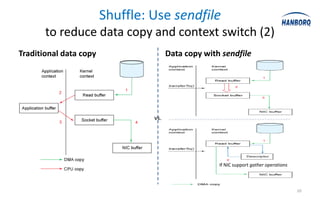
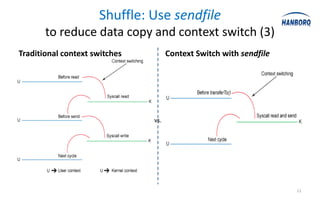
• Rewrite shuffle server with Netty using Zero Copy API to
  transfer map output data.
  – Less data copy, more efficiency
  – Less data copy, less CPU usage
  – Less context switches, less CPU usage


• Saving more CPU to do user tasks.


                                                             9
Shuffle: Use sendfile
       to reduce data copy and context switch (2)
Traditional data copy                  Data copy with sendfile


                                 vs.


                                                     If NIC support gather operations


                                                                                        10
Shuffle: Use sendfile
       to reduce data copy and context switch (3)
Traditional context switches         Context Switch with sendfile


                               vs.


                                                                    11
Shuffle:
              Netty Server & Batch Fetch (1)
• Less TCP connection overhead.
• Reduce the effect of TCP slow start.
• More important, better shuffle schedule in Reduce Phase
  result in better overall performance.

• Configuration
  – mapred-site.xml
     <property>
        <name>mapreduce.shuffle.max.maps</name>
        <value>4</value>
        <description>Reduce side batch fetch for efficient shuffle copy.</description>
     </property>


                                                                                         12
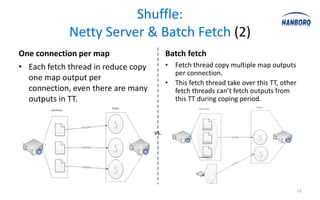
Shuffle:
             Netty Server & Batch Fetch (2)
One connection per map                     Batch fetch
• Each fetch thread in reduce copy         • Fetch thread copy multiple map outputs
                                             per connection.
  one map output per
                                           • This fetch thread take over this TT, other
  connection, even there are many            fetch threads can’t fetch outputs from
  outputs in TT.                             this TT during coping period.


                                     vs.


                                                                                          13
Shuffle:
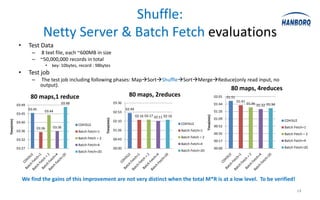
                             Netty Server & Batch Fetch evaluations
             •      Test Data
                      – 8 text file, each ~600MB in size
                      – ~50,000,000 records in total
                                  •   key: 10bytes, record : 98bytes
             •      Test job
                      –     The test job including following phases: MapSortShuffleSortMergeReduce(only read input, no
                            output).
                                                                                                                                                                   80 maps, 4reduces
                     80 maps,1 reduce                                                      80 maps, 2reduces                                             02:01   01:51
                                          03:48                                  03:36                                                                                   01:41
            03:49                                                                                                                                        01:44                   01:36 01:32 01:34
                    03:45                                                                02:49
                              03:44                                              02:53                                                                   01:26
            03:45
                                                                                                 02:16 02:17 02:11 02:16


                                                                                                                                             Time(min)
                                                                                                                                                         01:09
                                                                     Time(min)
Time(min)


            03:40                                                                02:10                                                                                                               CDH3U2
                                                   CDH3U2                                                                  CDH3U2
                                      03:36                                                                                                              00:52                                       Batch Fetch=1
                          03:36
            03:36                                  Batch Fetch=1                 01:26                                     Batch Fetch=1
                                                                                                                                                         00:35                                       Batch Fetch = 2
                                                   Batch Fetch = 2                                                         Batch Fetch = 2
            03:32                                                                00:43                                                                   00:17                                       Batch Fetch=4
                                                   Batch Fetch=4                                                           Batch Fetch=4
            03:27                                                                00:00                                                                   00:00                                       Batch Fetch=20
                                                   Batch Fetch=20                                                          Batch Fetch=20


                 We find the gains of this improvement are not very distinct when the total M*R is at a low level. To be verified!
                                                                                                                                                                                                            14
Sort Avoidance
• Many real-world jobs require shuffling, but not sorting. And the sorting bring
  much overhead.
    – Hash Aggregations
    – Hash Joins
    – Filtering and simple processing (process each record independently from other
      records)
    – …, etc.

• When sorting is turned off, the mapper feeds data to the reducer which directly
  passes the data to the Reduce() function bypassing the intermediate sorting step.
    – Spilling, Partitioning, Merging and Reducing will be more efficient.

• How to turn off sorting?
    – JobConf job = (JobConf) getConf();
    – job.setBoolean("mapred.sort.avoidance", true);

                                                                                      15
Sort Avoidance:
                  Spilling and Partitioning
• When spills, records compare by partition only.
• Partition comparison using counting sort [O(n)], not quick sort
  [O(nlog n)].


                                                                    16
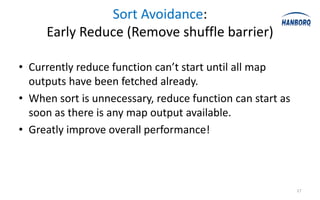
Sort Avoidance:
     Early Reduce (Remove shuffle barrier)

• Currently reduce function can’t start until all map
  outputs have been fetched already.
• When sort is unnecessary, reduce function can start as
  soon as there is any map output available.
• Greatly improve overall performance!


                                                           17
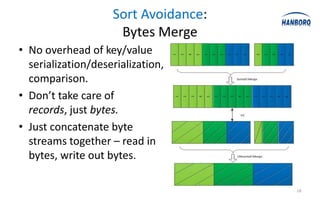
Sort Avoidance:
                     Bytes Merge
• No overhead of key/value
  serialization/deserialization,
  comparison.
• Don’t take care of
  records, just bytes.
• Just concatenate byte
  streams together – read in
  bytes, write out bytes.

                                      18
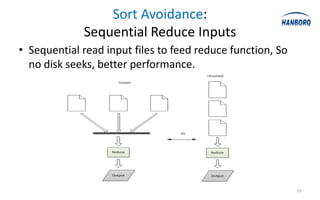
Sort Avoidance:
             Sequential Reduce Inputs
• Sequential read input files to feed reduce function, So
  no disk seeks, better performance.


                                                            19
Let’s try HDH Hadoop.

BENCHMARKS


                        20
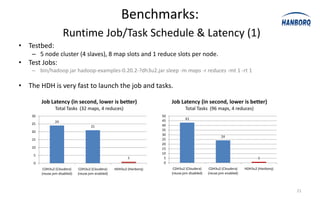
Benchmarks:
                      Runtime Job/Task Schedule & Latency (1)
• Testbed:
    – 5 node cluster (4 slaves), 8 map slots and 1 reduce slots per node.
• Test Jobs:
    – bin/hadoop jar hadoop-examples-0.20.2-?dh3u2.jar sleep -m maps -r reduces -mt 1 -rt 1

• The HDH is very fast to launch the job and tasks.

         Job Latency (in second, lower is better)                             Job Latency (in second, lower is better)
                 Total Tasks (32 maps, 4 reduces)                                     Total Tasks (96 maps, 4 reduces)
    30                                                                   50
                                                                                      43
                 24                                                      45
    25                                                                   40
                                        21
    20                                                                   35
                                                                         30
                                                                                                             24
    15                                                                   25
                                                                         20
    10                                                                   15
                                                                         10
     5
                                                             1            5                                                       1
     0                                                                    0
          CDH3u2 (Cloudera)      CDH3u2 (Cloudera)    HDH3u2 (Hanborq)         CDH3u2 (Cloudera)      CDH3u2 (Cloudera)    HDH3u2 (Hanborq)
         (reuse.jvm disabled)   (reuse.jvm enabled)                           (reuse.jvm disabled)   (reuse.jvm enabled)


                                                                                                                                              21
Benchmarks:
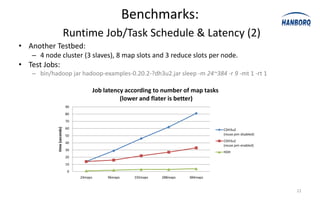
                             Runtime Job/Task Schedule & Latency (2)
• Another Testbed:
   – 4 node cluster (3 slaves), 8 map slots and 3 reduce slots per node.
• Test Jobs:
   – bin/hadoop jar hadoop-examples-0.20.2-?dh3u2.jar sleep -m 24~384 -r 9 -mt 1 -rt 1

                                           Job latency according to number of map tasks
                                                     (lower and flater is better)
                             90
                             80
                             70
                             60
            time (seconds)


                                                                                          CDH3u2
                             50                                                           (reuse.jvm disabled)
                                                                                          CDH3u2
                             40
                                                                                          (reuse.jvm enabled)
                             30
                                                                                          HDH
                             20
                             10
                              0
                                  24maps        96maps    192maps   288maps   384maps


                                                                                                                 22
Benchmarks:
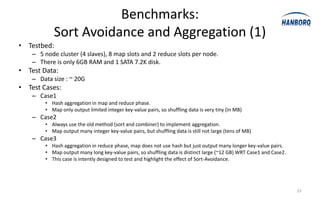
            Sort Avoidance and Aggregation (1)
• Testbed:
    – 5 node cluster (4 slaves), 8 map slots and 2 reduce slots per node.
    – There is only 6GB RAM and 1 SATA 7.2K disk.
• Test Data:
    – Data size : ~ 20G
• Test Cases:
    – Case1
        • Hash aggregation in map and reduce phase.
        • Map only output limited integer key-value pairs, so shuffling data is very tiny (in MB)
    – Case2
        • Always use the old method (sort and combiner) to implement aggregation.
        • Map output many integer key-value pairs, but shuffling data is still not large (tens of MB)
    – Case3
        • Hash aggregation in reduce phase, map does not use hash but just output many longer key-value pairs.
        • Map output many long key-value pairs, so shuffling data is distinct large (~12 GB) WRT Case1 and Case2.
        • This case is intently designed to test and highlight the effect of Sort-Avoidance.


                                                                                                                    23
Benchmarks:
                              Sort Avoidance and Aggregation (2)
                                                                   •   The Case1 and Case2 like:
      Sort Avoidance and Aggregation
                                                                        –   SELECT intA, COUNT(1) FROM T1 GROUP BY intA;
                               (lower is better)
                                                                   •   The Case3 likes:
                       2400
                                                                        –   SELECT A, B, C, D, SUM(M), SUM(N), SUM(R), SUM(P), SUM(Q) ...
                                                      2186
                       2200                                                 FROM T2 GROUP BY A, B, C, D;

                       2000

                       1800
                                                                   •   Case1:
                                                                        –   The shuffling data is very small, sorting on it is very fast in
                       1600
                                                                            memory. So the improvement just gains ~11%, which may
                       1400                                                 mainly come from the “Worker Pool implementation”..
                                                                   •   Case2:
      time (seconds)


                       1200
                                                                        –   Still use sorting to do aggregation, the tiny gains may mainly
                       1000
                                                                            come from the “Worker Pool implementation”.
                        800                                             –   This case also demonstrate the processing engine
                                                             615
                        600                                                 improvements do not bring in negative effect.

                        400
                                                                   •   Case3:
                               197 175      216 198                     –   The shuffling(and sorting in CDH3u2) data is large
                        200
                                                                            enough, the gains from Sort-Avoidance become very
                          0                                                 distinct.
                                Case1         Case2    Case3
CHD3u2 (Cloudera)                197           216      2186
HDH (Hanborq)                    175           198      615
                                                                                                                                              24
Benchmarks:
                 Sort Avoidance and Aggregation (3)
•   Testbed:
     –   4 node cluster (3 slaves), 8 map slots and 3 reduce slots per node.                                  Real Aggregration Jobs
     –   48GB RAM and 5 SATA 7.2k disks                                                                               (lower is better)
     –   Large RAM and more disks to avoid the bottleneck of disk IO                                            700


                                                                                                                600
•   Test Data:
     –   400,000,000 rows of comma separated text. ~100 bytes per row.                                          500
     –   ~40GB data in total. (then we can avoid the bottleneck of disk IO)


                                                                                             time (seconds)
                                                                                                                400

•   Query1:
                                                                                                                300
     –   Equals to: select type, sum(reqnum) from cdr group by type;
•   Query2:                                                                                                     200
     –   Equals to: select
         userid, sum(reqnum), max(reqnum), min(reqnum), avg(reqnum), sum(dur), ma                               100
         x(dur), min(dur), avg(dur) from cdr group by userid;
                                                                                                                  0
                                                                                                                       Case1-1   Case2-1   Case1-2   Case2-2
•   Case1-1: Use sort to implement aggregation of Query1                                  CDH3u2 (Cloudera)              238      603       136       206
•   Case2-1: Use sort to implement aggregation of Query2                                  HDH (Hanborq)                  233      578        96       151
•   Case1-2: Use hash(map and reduce) to implement aggregation of              Analysis:
    Query1                                                                     - Case1/2 still use sort, the gains may mainly come from Worker Pool.
                                                                               - Case 3/4 use hash aggregation, so we can benefit distinctly from
•   Case2-2: Use hash(map and reduce) to implement aggregation of
                                                                               Sort-Avoidance.
    Query2                                                                                                                                        25
Benchmarks:
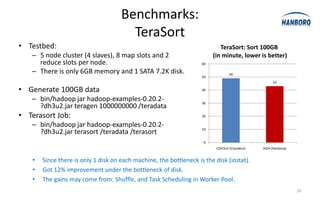
                                       TeraSort
• Testbed:                                                                  TeraSort: Sort 100GB
   – 5 node cluster (4 slaves), 8 map slots and 2                        (in minute, lower is better)
     reduce slots per node.                                         60

   – There is only 6GB memory and 1 SATA 7.2K disk.                              49
                                                                    50
                                                                                                   43

• Generate 100GB data                                               40

   – bin/hadoop jar hadoop-examples-0.20.2-                         30
     ?dh3u2.jar teragen 1000000000 /teradata
• Terasort Job:                                                     20

   – bin/hadoop jar hadoop-examples-0.20.2-                         10
     ?dh3u2.jar terasort /teradata /terasort
                                                                     0
                                                                          CDH3u2 (Cloudera)   HDH (Hanborq)


   •   Since there is only 1 disk on each machine, the bottleneck is the disk (iostat).
   •   Got 12% improvement under the bottleneck of disk.
   •   The gains may come from: Shuffle, and Task Scheduling in Worker Pool.
                                                                                                              26
Benchmarks:
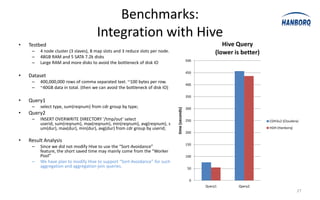
                                      Integration with Hive
•   Testbed                                                                                                   Hive Query
     –   4 node cluster (3 slaves), 8 map slots and 3 reduce slots per node.                               (lower is better)
     –   48GB RAM and 5 SATA 7.2k disks
                                                                                                500
     –   Large RAM and more disks to avoid the bottleneck of disk IO

                                                                                                450
•   Dataset
     –   400,000,000 rows of comma separated text. ~100 bytes per row.
                                                                                                400
     –   ~40GB data in total. (then we can avoid the bottleneck of disk IO)
                                                                                                350
•   Query1
     –   select type, sum(reqnum) from cdr group by type;                                       300


                                                                               time (seconds)
•   Query2
     –   INSERT OVERWRITE DIRECTORY '/tmp/out' select                                           250                            CDH3u2 (Cloudera)
         userid, sum(reqnum), max(reqnum), min(reqnum), avg(reqnum), s
         um(dur), max(dur), min(dur), avg(dur) from cdr group by userid;                                                       HDH (Hanborq)
                                                                                                200

•   Result Analysis
                                                                                                150
     –   Since we did not modify Hive to use the “Sort-Avoidance”
         feature, the short saved time may mainly come from the “Worker
         Pool”                                                                                  100
     –   We have plan to modify Hive to support “Sort-Avoidance” for such
         aggregation and aggregation-join queries.                                               50


                                                                                                  0
                                                                                                      Query1        Qyery2
                                                                                                                                               27
Benchmark More …
• The above evaluations just ran on a small cluster for
  developers, to demonstrate a quick view of our
  improvements.

• We are working on further improvements and doing
  more comprehensive evaluations on a larger and
  powerful cluster. And the result will be output as soon
  as possible.

                                                            28
To be open.

OPEN SOURCE


              29
HDH
                Hanborq Distribution with Hadoop
• HDH to make Hadoop Fast, Simple and Robust.

• HDH delivers a series of improvements on Hadoop Core, and Hadoop-
  based tools and applications for putting Hadoop to work solving Big Data
  problems in production.

• HDH may be ideal for enterprises seeking an
  integrated, fast, simple, and robust Hadoop Distribution. In particular, if
  you think your MapReduce jobs are slow and low performing, the HDH
  may be you choice.

• Like and based-on Apache Hadoop and Cloudera’s CDH, Hanborq
  delivers HDH. Except for Hadoop Core, it will include various and
  different components.
                                                                                30
Hanborq Open Source
• Github
   – Welcome to visit Hanborq’s Open Source Repositories
   – https://github.com/hanborq/

• Hadoop
   – A Hanborq optimized Hadoop Core, especially with high performance of
     MapReduce. It's the core part of HDH.

• RockStor (coming soon)
   – An Object Storage System implementation over Hadoop and HBase, which can
     provide similar service like Amazon S3 (Simple Storage Service.)

• We will continue to open source more useful projects in the future …

                                                                            31
Thank You Very Much!
 Anty Rao, Guangxian Liao, Schubert Zhang
{ant.rao, liaoguangxian, schubert.zhang}@gmail.com

    https://github.com/hanborq/hadoop
    http://www.slideshare.net/hanborq
 http://www.slideshare.net/schubertzhang

               to be continue …


                                                     32

Hanborq Optimizations on Hadoop MapReduce

  • 1.
    Hanborq Optimizations on Hadoop MapReduce Feb.21, 2012 Big Data Engineering Team
  • 2.
    Motivations • MapReduce is a proved and successful data processing framework. It can be implemented enough efficient and flexible. – MapReduce: Simplified Data Processing on Large Clusters – MapReduce: A Flexible Data Processing Tool • Hadoop is the most popular Open Source implementation of MapReduce, but it’s not so good implemented. – Long latency. – Inefficiency with low performance. – Not so flexible. Not simple enough to build, develop, etc. – It has taken so long time to become mature, since 2006. • Our customers always challenge the latency and performance of Hadoop MapReduce. • The majority of real deploys cannot afford to install thousands of server. The inefficiency of Hadoop waste many hardware and energy. • It’s possible to improve the Hadoop Core and applications to achieve better experience. – Tenzing: A SQL Implementation On The MapReduce Framework – Dremel: Interactive Analysis of Web-Scale Datasets 2
  • 3.
    To build afast architecture. MAPREDUCE RUNTIME ENVIRONMENT 3
  • 4.
    Runtime Job/Task Schedule & Latency (1) • Problem: even for a empty job, Hadoop will take tens of seconds to complete it. • HDH Improvements: – Worker Pool • Like Google Tenzing, HDH MapReduce runtime does not spawn new JVM processes for each job/task, but instead start these slot/worker processes at initialization phase and keep them running constantly. • Fast/Real-time communication between Workers and TaskTracker. – Transfer Job description information (JobConf, splits info, etc.) within RPC (Client->JobTracker). • Reduce the overhead to transfer, persist, load and parse XML files. • Reduce the useless and default attributes to be transferred for JobConf. – Heartbeat (TaskTracker) • Speed up the task assignment. • Use triggered(out-of-band ) real-time heartbeat when special event happens. – Avoid duplicated loading of configuration files for Configuration Objects. – Use DistributedCache to deploy job’s jar files. – Avoid some unnecessary “sleep”. – Avoid some big buffer/memory allocation which takes long time and to be inefficient. – … 4
  • 5.
    Runtime Job/Task Schedule & Latency (2) • Worker Pool, RPC, Heartbeat MapReduce RPC JobTracker Client (JobConf) beat Heart TaskTracker TaskTracker TaskTracker Child Child Child Child Child Child Child Child Child Worker Worker Worker Worker Worker Worker Worker Worker Worker Worker Pool Worker Pool Worker Pool 5
  • 6.
    Hints • Enable theseconfiguration properties – mapreduce.tasktracker.outofband.heartbeat = true – mapred.job.reuse.jvm.num.tasks = -1 (even through it is not used in HDH) • Issues – Java, GC issue for a constantly running worker JVM. 6
  • 7.
    To build afast engine. MAPREDUCE PROCESSING ENGINE 7
  • 8.
    Processing Engine Improvements •Shuffle: Use sendfile to reduce data copy and context switch. • Shuffle: Netty Shuffle Server (map side) and Batch Fetch (reduce side). • Sort Avoidance. – Spilling and Partitioning, Counting Sort, Bytes Merge, Early Reduce, etc. – Hash Aggregation in job implementation. 8
  • 9.
    Shuffle: Use sendfile to reduce data copy and context switch (1) • Rewrite shuffle server with Netty using Zero Copy API to transfer map output data. – Less data copy, more efficiency – Less data copy, less CPU usage – Less context switches, less CPU usage • Saving more CPU to do user tasks. 9
  • 10.
    Shuffle: Use sendfile to reduce data copy and context switch (2) Traditional data copy Data copy with sendfile vs. If NIC support gather operations 10
  • 11.
    Shuffle: Use sendfile to reduce data copy and context switch (3) Traditional context switches Context Switch with sendfile vs. 11
  • 12.
    Shuffle: Netty Server & Batch Fetch (1) • Less TCP connection overhead. • Reduce the effect of TCP slow start. • More important, better shuffle schedule in Reduce Phase result in better overall performance. • Configuration – mapred-site.xml <property> <name>mapreduce.shuffle.max.maps</name> <value>4</value> <description>Reduce side batch fetch for efficient shuffle copy.</description> </property> 12
  • 13.
    Shuffle: Netty Server & Batch Fetch (2) One connection per map Batch fetch • Each fetch thread in reduce copy • Fetch thread copy multiple map outputs per connection. one map output per • This fetch thread take over this TT, other connection, even there are many fetch threads can’t fetch outputs from outputs in TT. this TT during coping period. vs. 13
  • 14.
    Shuffle: Netty Server & Batch Fetch evaluations • Test Data – 8 text file, each ~600MB in size – ~50,000,000 records in total • key: 10bytes, record : 98bytes • Test job – The test job including following phases: MapSortShuffleSortMergeReduce(only read input, no output). 80 maps, 4reduces 80 maps,1 reduce 80 maps, 2reduces 02:01 01:51 03:48 03:36 01:41 03:49 01:44 01:36 01:32 01:34 03:45 02:49 03:44 02:53 01:26 03:45 02:16 02:17 02:11 02:16 Time(min) 01:09 Time(min) Time(min) 03:40 02:10 CDH3U2 CDH3U2 CDH3U2 03:36 00:52 Batch Fetch=1 03:36 03:36 Batch Fetch=1 01:26 Batch Fetch=1 00:35 Batch Fetch = 2 Batch Fetch = 2 Batch Fetch = 2 03:32 00:43 00:17 Batch Fetch=4 Batch Fetch=4 Batch Fetch=4 03:27 00:00 00:00 Batch Fetch=20 Batch Fetch=20 Batch Fetch=20 We find the gains of this improvement are not very distinct when the total M*R is at a low level. To be verified! 14
  • 15.
    Sort Avoidance • Manyreal-world jobs require shuffling, but not sorting. And the sorting bring much overhead. – Hash Aggregations – Hash Joins – Filtering and simple processing (process each record independently from other records) – …, etc. • When sorting is turned off, the mapper feeds data to the reducer which directly passes the data to the Reduce() function bypassing the intermediate sorting step. – Spilling, Partitioning, Merging and Reducing will be more efficient. • How to turn off sorting? – JobConf job = (JobConf) getConf(); – job.setBoolean("mapred.sort.avoidance", true); 15
  • 16.
    Sort Avoidance: Spilling and Partitioning • When spills, records compare by partition only. • Partition comparison using counting sort [O(n)], not quick sort [O(nlog n)]. 16
  • 17.
    Sort Avoidance: Early Reduce (Remove shuffle barrier) • Currently reduce function can’t start until all map outputs have been fetched already. • When sort is unnecessary, reduce function can start as soon as there is any map output available. • Greatly improve overall performance! 17
  • 18.
    Sort Avoidance: Bytes Merge • No overhead of key/value serialization/deserialization, comparison. • Don’t take care of records, just bytes. • Just concatenate byte streams together – read in bytes, write out bytes. 18
  • 19.
    Sort Avoidance: Sequential Reduce Inputs • Sequential read input files to feed reduce function, So no disk seeks, better performance. 19
  • 20.
    Let’s try HDHHadoop. BENCHMARKS 20
  • 21.
    Benchmarks: Runtime Job/Task Schedule & Latency (1) • Testbed: – 5 node cluster (4 slaves), 8 map slots and 1 reduce slots per node. • Test Jobs: – bin/hadoop jar hadoop-examples-0.20.2-?dh3u2.jar sleep -m maps -r reduces -mt 1 -rt 1 • The HDH is very fast to launch the job and tasks. Job Latency (in second, lower is better) Job Latency (in second, lower is better) Total Tasks (32 maps, 4 reduces) Total Tasks (96 maps, 4 reduces) 30 50 43 24 45 25 40 21 20 35 30 24 15 25 20 10 15 10 5 1 5 1 0 0 CDH3u2 (Cloudera) CDH3u2 (Cloudera) HDH3u2 (Hanborq) CDH3u2 (Cloudera) CDH3u2 (Cloudera) HDH3u2 (Hanborq) (reuse.jvm disabled) (reuse.jvm enabled) (reuse.jvm disabled) (reuse.jvm enabled) 21
  • 22.
    Benchmarks: Runtime Job/Task Schedule & Latency (2) • Another Testbed: – 4 node cluster (3 slaves), 8 map slots and 3 reduce slots per node. • Test Jobs: – bin/hadoop jar hadoop-examples-0.20.2-?dh3u2.jar sleep -m 24~384 -r 9 -mt 1 -rt 1 Job latency according to number of map tasks (lower and flater is better) 90 80 70 60 time (seconds) CDH3u2 50 (reuse.jvm disabled) CDH3u2 40 (reuse.jvm enabled) 30 HDH 20 10 0 24maps 96maps 192maps 288maps 384maps 22
  • 23.
    Benchmarks: Sort Avoidance and Aggregation (1) • Testbed: – 5 node cluster (4 slaves), 8 map slots and 2 reduce slots per node. – There is only 6GB RAM and 1 SATA 7.2K disk. • Test Data: – Data size : ~ 20G • Test Cases: – Case1 • Hash aggregation in map and reduce phase. • Map only output limited integer key-value pairs, so shuffling data is very tiny (in MB) – Case2 • Always use the old method (sort and combiner) to implement aggregation. • Map output many integer key-value pairs, but shuffling data is still not large (tens of MB) – Case3 • Hash aggregation in reduce phase, map does not use hash but just output many longer key-value pairs. • Map output many long key-value pairs, so shuffling data is distinct large (~12 GB) WRT Case1 and Case2. • This case is intently designed to test and highlight the effect of Sort-Avoidance. 23
  • 24.
    Benchmarks: Sort Avoidance and Aggregation (2) • The Case1 and Case2 like: Sort Avoidance and Aggregation – SELECT intA, COUNT(1) FROM T1 GROUP BY intA; (lower is better) • The Case3 likes: 2400 – SELECT A, B, C, D, SUM(M), SUM(N), SUM(R), SUM(P), SUM(Q) ... 2186 2200 FROM T2 GROUP BY A, B, C, D; 2000 1800 • Case1: – The shuffling data is very small, sorting on it is very fast in 1600 memory. So the improvement just gains ~11%, which may 1400 mainly come from the “Worker Pool implementation”.. • Case2: time (seconds) 1200 – Still use sorting to do aggregation, the tiny gains may mainly 1000 come from the “Worker Pool implementation”. 800 – This case also demonstrate the processing engine 615 600 improvements do not bring in negative effect. 400 • Case3: 197 175 216 198 – The shuffling(and sorting in CDH3u2) data is large 200 enough, the gains from Sort-Avoidance become very 0 distinct. Case1 Case2 Case3 CHD3u2 (Cloudera) 197 216 2186 HDH (Hanborq) 175 198 615 24
  • 25.
    Benchmarks: Sort Avoidance and Aggregation (3) • Testbed: – 4 node cluster (3 slaves), 8 map slots and 3 reduce slots per node. Real Aggregration Jobs – 48GB RAM and 5 SATA 7.2k disks (lower is better) – Large RAM and more disks to avoid the bottleneck of disk IO 700 600 • Test Data: – 400,000,000 rows of comma separated text. ~100 bytes per row. 500 – ~40GB data in total. (then we can avoid the bottleneck of disk IO) time (seconds) 400 • Query1: 300 – Equals to: select type, sum(reqnum) from cdr group by type; • Query2: 200 – Equals to: select userid, sum(reqnum), max(reqnum), min(reqnum), avg(reqnum), sum(dur), ma 100 x(dur), min(dur), avg(dur) from cdr group by userid; 0 Case1-1 Case2-1 Case1-2 Case2-2 • Case1-1: Use sort to implement aggregation of Query1 CDH3u2 (Cloudera) 238 603 136 206 • Case2-1: Use sort to implement aggregation of Query2 HDH (Hanborq) 233 578 96 151 • Case1-2: Use hash(map and reduce) to implement aggregation of Analysis: Query1 - Case1/2 still use sort, the gains may mainly come from Worker Pool. - Case 3/4 use hash aggregation, so we can benefit distinctly from • Case2-2: Use hash(map and reduce) to implement aggregation of Sort-Avoidance. Query2 25
  • 26.
    Benchmarks: TeraSort • Testbed: TeraSort: Sort 100GB – 5 node cluster (4 slaves), 8 map slots and 2 (in minute, lower is better) reduce slots per node. 60 – There is only 6GB memory and 1 SATA 7.2K disk. 49 50 43 • Generate 100GB data 40 – bin/hadoop jar hadoop-examples-0.20.2- 30 ?dh3u2.jar teragen 1000000000 /teradata • Terasort Job: 20 – bin/hadoop jar hadoop-examples-0.20.2- 10 ?dh3u2.jar terasort /teradata /terasort 0 CDH3u2 (Cloudera) HDH (Hanborq) • Since there is only 1 disk on each machine, the bottleneck is the disk (iostat). • Got 12% improvement under the bottleneck of disk. • The gains may come from: Shuffle, and Task Scheduling in Worker Pool. 26
  • 27.
    Benchmarks: Integration with Hive • Testbed Hive Query – 4 node cluster (3 slaves), 8 map slots and 3 reduce slots per node. (lower is better) – 48GB RAM and 5 SATA 7.2k disks 500 – Large RAM and more disks to avoid the bottleneck of disk IO 450 • Dataset – 400,000,000 rows of comma separated text. ~100 bytes per row. 400 – ~40GB data in total. (then we can avoid the bottleneck of disk IO) 350 • Query1 – select type, sum(reqnum) from cdr group by type; 300 time (seconds) • Query2 – INSERT OVERWRITE DIRECTORY '/tmp/out' select 250 CDH3u2 (Cloudera) userid, sum(reqnum), max(reqnum), min(reqnum), avg(reqnum), s um(dur), max(dur), min(dur), avg(dur) from cdr group by userid; HDH (Hanborq) 200 • Result Analysis 150 – Since we did not modify Hive to use the “Sort-Avoidance” feature, the short saved time may mainly come from the “Worker Pool” 100 – We have plan to modify Hive to support “Sort-Avoidance” for such aggregation and aggregation-join queries. 50 0 Query1 Qyery2 27
  • 28.
    Benchmark More … •The above evaluations just ran on a small cluster for developers, to demonstrate a quick view of our improvements. • We are working on further improvements and doing more comprehensive evaluations on a larger and powerful cluster. And the result will be output as soon as possible. 28
  • 29.
  • 30.
    HDH Hanborq Distribution with Hadoop • HDH to make Hadoop Fast, Simple and Robust. • HDH delivers a series of improvements on Hadoop Core, and Hadoop- based tools and applications for putting Hadoop to work solving Big Data problems in production. • HDH may be ideal for enterprises seeking an integrated, fast, simple, and robust Hadoop Distribution. In particular, if you think your MapReduce jobs are slow and low performing, the HDH may be you choice. • Like and based-on Apache Hadoop and Cloudera’s CDH, Hanborq delivers HDH. Except for Hadoop Core, it will include various and different components. 30
  • 31.
    Hanborq Open Source •Github – Welcome to visit Hanborq’s Open Source Repositories – https://github.com/hanborq/ • Hadoop – A Hanborq optimized Hadoop Core, especially with high performance of MapReduce. It's the core part of HDH. • RockStor (coming soon) – An Object Storage System implementation over Hadoop and HBase, which can provide similar service like Amazon S3 (Simple Storage Service.) • We will continue to open source more useful projects in the future … 31
  • 32.
    Thank You VeryMuch! Anty Rao, Guangxian Liao, Schubert Zhang {ant.rao, liaoguangxian, schubert.zhang}@gmail.com https://github.com/hanborq/hadoop http://www.slideshare.net/hanborq http://www.slideshare.net/schubertzhang to be continue … 32