SCM Dashboard
Monitoring Code Velocity at the Product /
Project / Branch level


Prakash Ranade
AGENDA


   •  What is SCM Dashboard?
   •  Why is SCM Dashboard needed?
   •  Where is it used?
   •  How does it look?
   •  Challenges in building SCM Dashboard
   •  Goals in designing SCM Dashboard
   •  Technology in building SCM Dashboard
   •  Conclusion
What is SCM Dashboard?


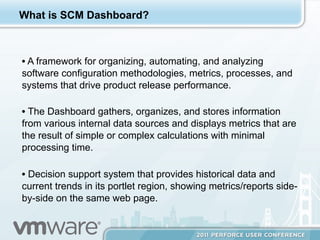
•  A framework for organizing, automating, and analyzing
software configuration methodologies, metrics, processes, and
systems that drive product release performance.

•  The Dashboard gathers, organizes, and stores information
from various internal data sources and displays metrics that are
the result of simple or complex calculations with minimal
processing time.

•  Decision support system that provides historical data and
current trends in its portlet region, showing metrics/reports side-
by-side on the same web page.
Why is SCM Dashboard needed?


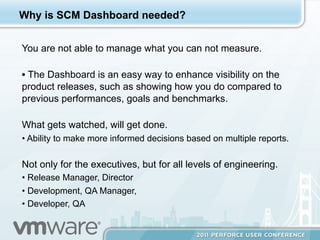
You are not able to manage what you can not measure.

•  The Dashboard is an easy way to enhance visibility on the
product releases, such as showing how you do compared to
previous performances, goals and benchmarks.

What gets watched, will get done.
•  Ability to make more informed decisions based on multiple reports.

Not only for the executives, but for all levels of engineering.
•  Release Manager, Director
•  Development, QA Manager,
•  Developer, QA
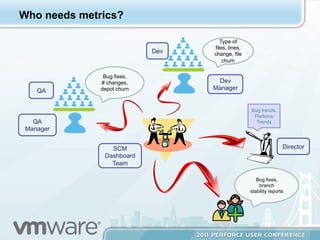
Who needs metrics?

                                     Type of
                                  files, lines,
                            Dev   change, file
                                      churn

               Bug fixes,
              # changes,           Dev
    QA        depot churn         Manager


                                                  Bug trends,
                                                   Perforce
   QA                                               Trends
 Manager


                 SCM                                              Director
               Dashboard
                 Team

                                                     Bug fixes,
                                                      branch
                                                  stability reports
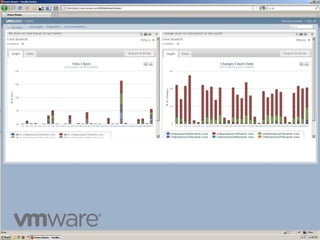
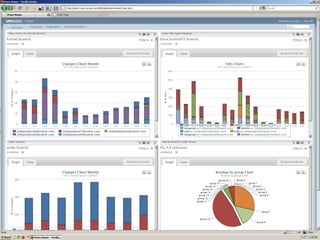
How does it look?
How does it look?
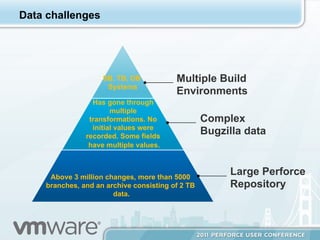
Data challenges


                    SB, TB, OB           Multiple Build
                     Systems
                                         Environments
                 Has gone through
                       multiple
                transformations. No               Complex
                 initial values were
               recorded. Some fields
                                                  Bugzilla data
                have multiple values.


     Above 3 million changes, more than 5000
                                                       Large Perforce
    branches, and an archive consisting of 2 TB        Repository
                       data.
Dashboard Goals


         Speed                      Sharing                     Portal

•  Max. 5 seconds            •  Social Engineering     •  Ability to configure
   response time for the     •  Easy to share charts      multiple metrics on a
   requests                                               single page.
                                and reports among
•  Provides frequent, or        team members           •  Ability to fine tune
   at least daily, updates                                settings and filters on
                             •  Easy to make project
•  Bases project status                                   charts and reports.
                                dashboards
   on incremental data                                 •  Ability to drill downs
   updates                                                and form
                                                          aggregations.
Building blocks
An Architecture based on Hadoop and MongoDB

•  Hadoop is a open-source software used for breaking a big job
into smaller tasks, performing each task and collecting the results.
•  MapReduce is a programming model for data processing,
working by breaking the processing into two phases, a map phase
and a reduce phase.
•  Hadoop streaming is a utility that comes with the distribution,
allowing you to create and run MapReduce jobs in Python.
•  The HDFS is a filesystem that stores large files across multiple
machines and achieves reliability by replicating the data across
multiple hosts.
•  MongoDB is a document based database system. Each document
can be thought of as a large hash object. There are keys(columns)
with values which can be anything such as hashes, arrays,
numbers, serialized objects, etc.
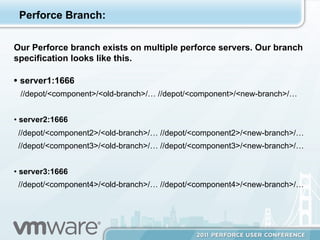
Perforce Branch:

Our Perforce branch exists on multiple perforce servers. Our branch
specification looks like this.

•  server1:1666
 //depot/<component>/<old-branch>/… //depot/<component>/<new-branch>/…


•  server2:1666
 //depot/<component2>/<old-branch>/… //depot/<component2>/<new-branch>/…
 //depot/<component3>/<old-branch>/… //depot/<component3>/<new-branch>/…


•  server3:1666
 //depot/<component4>/<old-branch>/… //depot/<component4>/<new-branch>/…
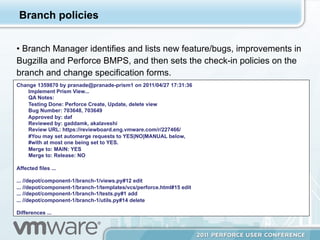
Branch policies


•  Branch Manager identifies and lists new feature/bugs, improvements in
Bugzilla and Perforce BMPS, and then sets the check-in policies on the
branch and change specification forms.
Change 1359870 by pranade@pranade-prism1 on 2011/04/27 17:31:36
    Implement Prism View...
    QA Notes:
    Testing Done: Perforce Create, Update, delete view
    Bug Number: 703648, 703649
   Approved by: daf
    Reviewed by: gaddamk, akalaveshi
    Review URL: https://reviewboard.eng.vmware.com/r/227466/
    #You may set automerge requests to YES|NO|MANUAL below,
    #with at most one being set to YES.
    Merge to: MAIN: YES
    Merge to: Release: NO

Affected files ...

... //depot/component-1/branch-1/views.py#12 edit
... //depot/component-1/branch-1/templates/vcs/perforce.html#15 edit
... //depot/component-1/branch-1/tests.py#1 add
... //depot/component-1/branch-1/utils.py#14 delete

Differences ...
Perforce Data collection

•  “p4 describe” displays the details of the changeset, as follows:
   The changelist number
   The changelist creator name and workspace name
   The date when the changelist created
   The changelist’s description
   The submitted file lists and the code diffs


•  We have a Perforce data dumper script which connect to
perforce servers and dumps the “p4 describe” output of the
submitted changelist.

•  The Perforce data dumper script dumps output in 64 MB file
chunks, which are then copied to HDFS.
MapReduce

•  We have a Perforce data dumper script which connect to perforce
servers and dumps the “p4 describe” output of the submitted
changelist. Each MapReduce script scans all the information from a
“p4 describe” output. The following reports can be created by writing
different MapReduce scripts:
        Number of submitted changes per depot path
        File information like add, edit, integrate, branch, delete
        File types such as “c”, “py”, “pl”, “java”, etc.
        Number of lines added, removed, modified
        Most revised files and least revised files
        Bug number and bug status
        Reviewers and test case information
        Change submitter names and group mapping
        Depot path and branch spec mapping
Python MapReduce

•  MapReduce programs are much easier to develop in a scripting
language using the Streaming API tool. Hadoop MapReduce provides
automatic parallelization and distribution, fault-tolerance, and status
and monitoring tools.

•  Hadoop Streaming interacts with programs that use the Unix
streaming paradigm. Inputs come in through STDIN and outputs go to
STDOUT. The data has to be text based and each line is considered a
record. The overall data flow in Hadoop streaming is like a pipe where
data streams in through the mapper and the sorted output streams out
through the reducer. In pseudo-code using Unix’s command line
notation, it comes up as the following:

        cat [input_file] | [mapper] | sort | [reducer] > [output_file]
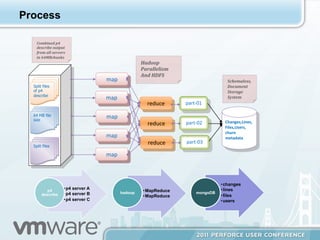
Process

    Combined	
  p4	
  
    describe	
  output	
  
    from	
  all	
  servers	
  
    in	
  64MBchunks
                                                          Hadoop	
  
                                                          Parallelism	
  
                                                          And	
  HDFS
                                           map                                               Schemaless,	
  
  Split files                                                                                Document	
  
  of p4                                                                                      Storage	
  
  describe
                                           map                                               System
                                                             reduce         part-­‐01

  64 MB file
  size
                                           map
                                                             reduce         part-­‐02       Changes,Lines,
                                                                                            Files,Users,	
  
                                                                                            churn	
  
                                           map                                              metadata
                                                             reduce         part-­‐03
  Split files

                                           map


                                                                                           • changes
                           • p4 server A                                                   • lines
           p4
                                                 hadoop    • MapReduce           mongoDB
        describe           • p4 server B                                                   • files
                                                           • MapReduce
                           • p4 server C                                                   • users
def dump_to_reducer(srvr, chng, depotfiles):               def main():
  if srvr and depotfiles and chng:                            depot2count = {}
      for filename in depotfiles:                             final_changes = {}
         print "%s|%st%s" % (srvr, filename, str(chng))       for line in sys.stdin:
                                                                 try:
def main():                                                          p4srvr_depotpath, date_chng = line.split('t',1)
  chng, depot_files, l = 0, set(), os.linesep                    except:
  p4srvr = site_perforce_servers(site.perforce_servers)              continue
  for line in sys.stdin:                                          if (not p4srvr_depotpath) and (not date_chng):
    line = line.rstrip(l)                                            print >> sys.stderr, line
    if line and line.count('/')==80:                                 continue
         srvr = match_begin_line(line, p4srvr)                   dt, change = date_chng.split('.')
         if srvr:                                                change = change.rstrip(l)
             chng, depot_files = 0, set()                        depot_hash = depot2count.setdefault
             continue                                      (p4srvr_depotpath,{})
    if line and line.count('%')==80:                             depot_hash.setdefault(dt,0)
         srvr = match_end_line(line, p4srvr)                     chng_set = depot2count[p4srvr_depotpath][dt]
         if srvr:                                                depot2count[p4srvr_depotpath][dt] = int(change)
             dump_to_reducer(srvr, chng, depot_files)          for (p4srvr_depotpath, dt) in depot2count.items():
             continue                                            for (dt, chngset) in dt.items():
     if line and line[0:7]=='Change ':                               print json.dumps
         chng = dtgrep(line)                               ({'p4srvr_depotpath':p4srvr_depotpath, 'date': dt,
         continue                                          'changes': chngset})
     if line and line[0:6]=='... //':
         flgrep(line, depot_files)


                                  Python                                                     Python
                                  Mapper script                                              Reducer script
mdb = mongo_utils.Vcs_Stats(collection_name="depot_churn")

   mdb.collection.create_index([('p4srvr_depotpath', pymongo.ASCENDING), ('date',
pymongo.ASCENDING)])

     for line in datafile.readlines():
           data = json.loads(line)
           p4srvr_depotpath = "%s" % data['p4srvr_depotpath']
           dstr = data['date']
           yy, mm, dd, hh, MM, ss = dstr[0:4], dstr[4:6], dstr[6:8], dstr[8:10], dstr[10:12], dstr
[12:14]
           changes = data['changes']
           new_data = []
           mongo_data = {'p4srvr_depotpath':p4srvr_depotpath,
                         'date‘:datetime.datetime(yy,mm,dd,hh,MM,ss),
                            'changes':changes, '_id':"%s/%s:%s"%
(p4srvr_depotpath,dstr,changes)}
           mdb.collection.insert(mongo_data)
      mdb.collection.ensure_index([('p4srvr_depotpath', pymongo.ASCENDING), ('date',
pymongo.ASCENDING)])


                                                                                 mongodb
                                                                                 upload script
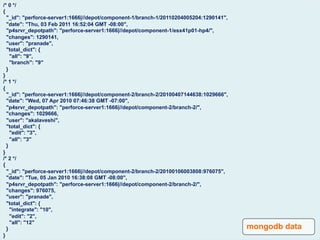
/* 0 */
{
  "_id": "perforce-server1:1666|//depot/component-1/branch-1/20110204005204:1290141",
  "date": "Thu, 03 Feb 2011 16:52:04 GMT -08:00",
  "p4srvr_depotpath": "perforce-server1:1666|//depot/component-1/esx41p01-hp4/",
  "changes": 1290141,
  "user": "pranade",
  "total_dict": {
    "all": "9",
    "branch": "9"
  }
}
/* 1 */
{
  "_id": "perforce-server1:1666|//depot/component-2/branch-2/20100407144638:1029666",
  "date": "Wed, 07 Apr 2010 07:46:38 GMT -07:00",
  "p4srvr_depotpath": "perforce-server1:1666|//depot/component-2/branch-2/",
  "changes": 1029666,
  "user": "akalaveshi",
  "total_dict": {
    "edit": "3",
    "all": "3"
  }
}
/* 2 */
{
  "_id": "perforce-server1:1666|//depot/component-2/branch-2/20100106003808:976075",
  "date": "Tue, 05 Jan 2010 16:38:08 GMT -08:00",
  "p4srvr_depotpath": "perforce-server1:1666|//depot/component-2/branch-2/",
  "changes": 976075,
  "user": "pranade",
  "total_dict": {
    "integrate": "10",
    "edit": "2",
    "all": "12"
  }                                                                                     mongodb data
}
Conclusion


•  We have designed a framework called SCM Dashboard.

•  “p4 describe” command contains most of the information.

•  Hadoop: horizontally scalable computational solution.
Streaming makes MapReduce programming easy.

•  Mongodb: Document model, dynamic queries, comprehensive
data models.
QUESTIONS?

SCM Dashboard

  • 1.
    SCM Dashboard Monitoring CodeVelocity at the Product / Project / Branch level Prakash Ranade
  • 2.
    AGENDA •  What is SCM Dashboard? •  Why is SCM Dashboard needed? •  Where is it used? •  How does it look? •  Challenges in building SCM Dashboard •  Goals in designing SCM Dashboard •  Technology in building SCM Dashboard •  Conclusion
  • 3.
    What is SCMDashboard? •  A framework for organizing, automating, and analyzing software configuration methodologies, metrics, processes, and systems that drive product release performance. •  The Dashboard gathers, organizes, and stores information from various internal data sources and displays metrics that are the result of simple or complex calculations with minimal processing time. •  Decision support system that provides historical data and current trends in its portlet region, showing metrics/reports side- by-side on the same web page.
  • 4.
    Why is SCMDashboard needed? You are not able to manage what you can not measure. •  The Dashboard is an easy way to enhance visibility on the product releases, such as showing how you do compared to previous performances, goals and benchmarks. What gets watched, will get done. •  Ability to make more informed decisions based on multiple reports. Not only for the executives, but for all levels of engineering. •  Release Manager, Director •  Development, QA Manager, •  Developer, QA
  • 5.
    Who needs metrics? Type of files, lines, Dev change, file churn Bug fixes, # changes, Dev QA depot churn Manager Bug trends, Perforce QA Trends Manager SCM Director Dashboard Team Bug fixes, branch stability reports
  • 6.
  • 7.
  • 8.
    Data challenges SB, TB, OB Multiple Build Systems Environments Has gone through multiple transformations. No Complex initial values were recorded. Some fields Bugzilla data have multiple values. Above 3 million changes, more than 5000 Large Perforce branches, and an archive consisting of 2 TB Repository data.
  • 9.
    Dashboard Goals Speed Sharing Portal •  Max. 5 seconds •  Social Engineering •  Ability to configure response time for the •  Easy to share charts multiple metrics on a requests single page. and reports among •  Provides frequent, or team members •  Ability to fine tune at least daily, updates settings and filters on •  Easy to make project •  Bases project status charts and reports. dashboards on incremental data •  Ability to drill downs updates and form aggregations.
  • 10.
  • 11.
    An Architecture basedon Hadoop and MongoDB •  Hadoop is a open-source software used for breaking a big job into smaller tasks, performing each task and collecting the results. •  MapReduce is a programming model for data processing, working by breaking the processing into two phases, a map phase and a reduce phase. •  Hadoop streaming is a utility that comes with the distribution, allowing you to create and run MapReduce jobs in Python. •  The HDFS is a filesystem that stores large files across multiple machines and achieves reliability by replicating the data across multiple hosts. •  MongoDB is a document based database system. Each document can be thought of as a large hash object. There are keys(columns) with values which can be anything such as hashes, arrays, numbers, serialized objects, etc.
  • 12.
    Perforce Branch: Our Perforcebranch exists on multiple perforce servers. Our branch specification looks like this. •  server1:1666 //depot/<component>/<old-branch>/… //depot/<component>/<new-branch>/… •  server2:1666 //depot/<component2>/<old-branch>/… //depot/<component2>/<new-branch>/… //depot/<component3>/<old-branch>/… //depot/<component3>/<new-branch>/… •  server3:1666 //depot/<component4>/<old-branch>/… //depot/<component4>/<new-branch>/…
  • 13.
    Branch policies •  BranchManager identifies and lists new feature/bugs, improvements in Bugzilla and Perforce BMPS, and then sets the check-in policies on the branch and change specification forms. Change 1359870 by pranade@pranade-prism1 on 2011/04/27 17:31:36 Implement Prism View... QA Notes: Testing Done: Perforce Create, Update, delete view Bug Number: 703648, 703649 Approved by: daf Reviewed by: gaddamk, akalaveshi Review URL: https://reviewboard.eng.vmware.com/r/227466/ #You may set automerge requests to YES|NO|MANUAL below, #with at most one being set to YES. Merge to: MAIN: YES Merge to: Release: NO Affected files ... ... //depot/component-1/branch-1/views.py#12 edit ... //depot/component-1/branch-1/templates/vcs/perforce.html#15 edit ... //depot/component-1/branch-1/tests.py#1 add ... //depot/component-1/branch-1/utils.py#14 delete Differences ...
  • 14.
    Perforce Data collection • “p4 describe” displays the details of the changeset, as follows: The changelist number The changelist creator name and workspace name The date when the changelist created The changelist’s description The submitted file lists and the code diffs •  We have a Perforce data dumper script which connect to perforce servers and dumps the “p4 describe” output of the submitted changelist. •  The Perforce data dumper script dumps output in 64 MB file chunks, which are then copied to HDFS.
  • 15.
    MapReduce •  We havea Perforce data dumper script which connect to perforce servers and dumps the “p4 describe” output of the submitted changelist. Each MapReduce script scans all the information from a “p4 describe” output. The following reports can be created by writing different MapReduce scripts: Number of submitted changes per depot path File information like add, edit, integrate, branch, delete File types such as “c”, “py”, “pl”, “java”, etc. Number of lines added, removed, modified Most revised files and least revised files Bug number and bug status Reviewers and test case information Change submitter names and group mapping Depot path and branch spec mapping
  • 16.
    Python MapReduce •  MapReduceprograms are much easier to develop in a scripting language using the Streaming API tool. Hadoop MapReduce provides automatic parallelization and distribution, fault-tolerance, and status and monitoring tools. •  Hadoop Streaming interacts with programs that use the Unix streaming paradigm. Inputs come in through STDIN and outputs go to STDOUT. The data has to be text based and each line is considered a record. The overall data flow in Hadoop streaming is like a pipe where data streams in through the mapper and the sorted output streams out through the reducer. In pseudo-code using Unix’s command line notation, it comes up as the following: cat [input_file] | [mapper] | sort | [reducer] > [output_file]
  • 17.
    Process Combined  p4   describe  output   from  all  servers   in  64MBchunks Hadoop   Parallelism   And  HDFS map Schemaless,   Split files Document   of p4 Storage   describe map System reduce part-­‐01 64 MB file size map reduce part-­‐02 Changes,Lines, Files,Users,   churn   map metadata reduce part-­‐03 Split files map • changes • p4 server A • lines p4 hadoop • MapReduce mongoDB describe • p4 server B • files • MapReduce • p4 server C • users
  • 18.
    def dump_to_reducer(srvr, chng,depotfiles): def main(): if srvr and depotfiles and chng: depot2count = {} for filename in depotfiles: final_changes = {} print "%s|%st%s" % (srvr, filename, str(chng)) for line in sys.stdin: try: def main(): p4srvr_depotpath, date_chng = line.split('t',1) chng, depot_files, l = 0, set(), os.linesep except: p4srvr = site_perforce_servers(site.perforce_servers) continue for line in sys.stdin: if (not p4srvr_depotpath) and (not date_chng): line = line.rstrip(l) print >> sys.stderr, line if line and line.count('/')==80: continue srvr = match_begin_line(line, p4srvr) dt, change = date_chng.split('.') if srvr: change = change.rstrip(l) chng, depot_files = 0, set() depot_hash = depot2count.setdefault continue (p4srvr_depotpath,{}) if line and line.count('%')==80: depot_hash.setdefault(dt,0) srvr = match_end_line(line, p4srvr) chng_set = depot2count[p4srvr_depotpath][dt] if srvr: depot2count[p4srvr_depotpath][dt] = int(change) dump_to_reducer(srvr, chng, depot_files) for (p4srvr_depotpath, dt) in depot2count.items(): continue for (dt, chngset) in dt.items(): if line and line[0:7]=='Change ': print json.dumps chng = dtgrep(line) ({'p4srvr_depotpath':p4srvr_depotpath, 'date': dt, continue 'changes': chngset}) if line and line[0:6]=='... //': flgrep(line, depot_files) Python Python Mapper script Reducer script
  • 19.
    mdb = mongo_utils.Vcs_Stats(collection_name="depot_churn") mdb.collection.create_index([('p4srvr_depotpath', pymongo.ASCENDING), ('date', pymongo.ASCENDING)]) for line in datafile.readlines(): data = json.loads(line) p4srvr_depotpath = "%s" % data['p4srvr_depotpath'] dstr = data['date'] yy, mm, dd, hh, MM, ss = dstr[0:4], dstr[4:6], dstr[6:8], dstr[8:10], dstr[10:12], dstr [12:14] changes = data['changes'] new_data = [] mongo_data = {'p4srvr_depotpath':p4srvr_depotpath, 'date‘:datetime.datetime(yy,mm,dd,hh,MM,ss), 'changes':changes, '_id':"%s/%s:%s"% (p4srvr_depotpath,dstr,changes)} mdb.collection.insert(mongo_data) mdb.collection.ensure_index([('p4srvr_depotpath', pymongo.ASCENDING), ('date', pymongo.ASCENDING)]) mongodb upload script
  • 20.
    /* 0 */ { "_id": "perforce-server1:1666|//depot/component-1/branch-1/20110204005204:1290141", "date": "Thu, 03 Feb 2011 16:52:04 GMT -08:00", "p4srvr_depotpath": "perforce-server1:1666|//depot/component-1/esx41p01-hp4/", "changes": 1290141, "user": "pranade", "total_dict": { "all": "9", "branch": "9" } } /* 1 */ { "_id": "perforce-server1:1666|//depot/component-2/branch-2/20100407144638:1029666", "date": "Wed, 07 Apr 2010 07:46:38 GMT -07:00", "p4srvr_depotpath": "perforce-server1:1666|//depot/component-2/branch-2/", "changes": 1029666, "user": "akalaveshi", "total_dict": { "edit": "3", "all": "3" } } /* 2 */ { "_id": "perforce-server1:1666|//depot/component-2/branch-2/20100106003808:976075", "date": "Tue, 05 Jan 2010 16:38:08 GMT -08:00", "p4srvr_depotpath": "perforce-server1:1666|//depot/component-2/branch-2/", "changes": 976075, "user": "pranade", "total_dict": { "integrate": "10", "edit": "2", "all": "12" } mongodb data }
  • 21.
    Conclusion •  We havedesigned a framework called SCM Dashboard. •  “p4 describe” command contains most of the information. •  Hadoop: horizontally scalable computational solution. Streaming makes MapReduce programming easy. •  Mongodb: Document model, dynamic queries, comprehensive data models.
  • 22.