Distributed Data 
 processing in a Cloud

                  Rajiv Chittajallu 
                    Yahoo! Inc
              rajive@yahoo-inc.com

Software as a Service and Cloud Computing Workshop
            ISEC2008, Hyderabad, India
                 22 February 2008
Desiderata


    
         Operate scalably
              – Petabytes of data on thousands on nodes
              – Much larger that RAM, disk I/O required
    • Operate economically
              – Minimize $ spent on CPU cycles, disk, RAM, network
              – Lash thousands of commodity PCs into an effective compute 
                and storage platform
    • Operate reliably
              – In a large enough cluster something is always broken
              – Seamlessly protect user data and computations from 
                hardware and software flakiness


Yahoo! Inc.
Problem: bandwidth to data


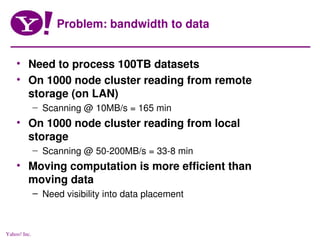
    • Need to process 100TB datasets 
    • On 1000 node cluster reading from remote 
      storage (on LAN)
              – Scanning @ 10MB/s = 165 min
    • On 1000 node cluster reading from local 
      storage
              – Scanning @ 50­200MB/s = 33­8 min
    • Moving computation is more efficient than 
      moving data
              – Need visibility into data placement


Yahoo! Inc.
Problem: scaling reliably is hard


    • Need to store petabytes of data
              – On 1000s of nodes 
              – MTBF < 1 day
              – With so many disks, nodes, switches something is always 
                broken
    • Need fault tolerant store
              – Handle hardware faults transparently and efficiently
              – Provide reasonable availability guarantees


Yahoo! Inc.
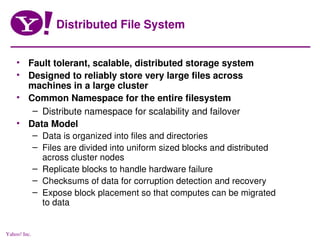
Distributed File System


    • Fault tolerant, scalable, distributed storage system
    • Designed to reliably store very large files across 
      machines in a large cluster
    • Common Namespace for the entire filesystem
       – Distribute namespace for scalability and failover
    • Data Model
       – Data is organized into files and directories
       – Files are divided into uniform sized blocks and distributed 
         across cluster nodes
       – Replicate blocks to handle hardware failure
       – Checksums of data for corruption detection and recovery
       – Expose block placement so that computes can be migrated 
         to data


Yahoo! Inc.
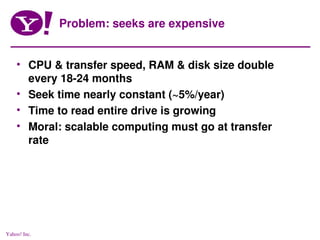
Problem: seeks are expensive 


    • CPU & transfer speed, RAM & disk size double 
      every 18­24 months 
    • Seek time nearly constant (~5%/year) 
    • Time to read entire drive is growing
    • Moral: scalable computing must go at transfer 
      rate


Yahoo! Inc.
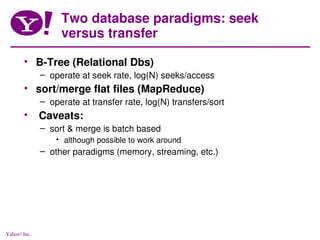
Two database paradigms: seek 
                   versus transfer

       • B­Tree (Relational Dbs) 
              – operate at seek rate, log(N) seeks/access 
       • sort/merge flat files (MapReduce) 
              – operate at transfer rate, log(N) transfers/sort
       •  Caveats:
              – sort & merge is batch based
                  • although possible to work around 
              – other paradigms (memory, streaming, etc.)


Yahoo! Inc.
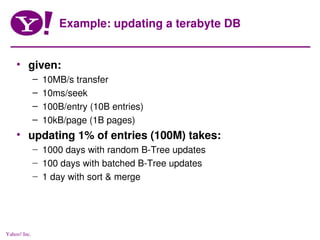
Example: updating a terabyte DB 


    • given:
              –   10MB/s transfer
              –   10ms/seek
              –   100B/entry (10B entries)
              –   10kB/page (1B pages) 
    • updating 1% of entries (100M) takes: 
              – 1000 days with random B­Tree updates 
              – 100 days with batched B­Tree updates 
              – 1 day with sort & merge


Yahoo! Inc.
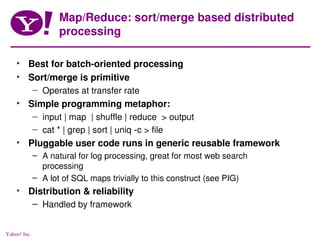
Map/Reduce: sort/merge based distributed 
                     processing

    • Best for batch­oriented processing
    • Sort/merge is primitive
       – Operates at transfer rate 
    • Simple programming metaphor:
       – input | map  | shuffle | reduce  > output 
       – cat * | grep | sort | uniq ­c > file
    • Pluggable user code runs in generic reusable framework
              – A natural for log processing, great for most web search 
                processing
              – A lot of SQL maps trivially to this construct (see PIG)
    • Distribution & reliability
       – Handled by framework


Yahoo! Inc.
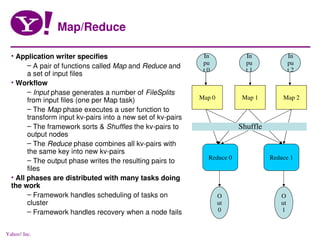
Map/Reduce

  • Application writer specifies                               In             In            In
        – A pair of functions called Map and Reduce and        pu             pu            pu
                                                               t 0            t 1           t 2
        a set of input files
  • Workflow
        – Input phase generates a number of FileSplits 
        from input files (one per Map task)                   Map 0          Map 1        Map 2
        – The Map phase executes a user function to 
        transform input kv­pairs into a new set of kv­pairs
        – The framework sorts & Shuffles the kv­pairs to                    Shuffle
        output nodes
        – The Reduce phase combines all kv­pairs with 
        the same key into new kv­pairs
        – The output phase writes the resulting pairs to         Reduce 0             Reduce 1
        files
  • All phases are distributed with many tasks doing 
  the work
        – Framework handles scheduling of tasks on                    O                  O
        cluster                                                       ut                 ut 
        – Framework handles recovery when a node fails                0                  1


Yahoo! Inc.
Map/Reduce features


    • Fine grained Map and Reduce tasks
              – Improved load balancing
              – Faster recovery from failed tasks
    • Locality optimizations
              –   With big data, bandwidth to data is a problem
              –   Map­Reduce + DFS is a very effective solution
              –   Map­Reduce queries DFS for locations of input data
              –   Map tasks are scheduled local to the inputs when possible
    • Re­execution and Speculative execution
              –   In a large cluster, some nodes are always slow or flaky
              –   Introduces long tails or failures in computation
              –   Framework re­executes failed jobs
              –   Framework runs multiple instances of last few tasks and uses the 
                  ones that finish first


Yahoo! Inc.
Map/Reduce: pros and cons


     • Developing large scale systems is expensive, this 
       is a shared platform
              – Reduces development and debug time
              – Leverages common optimizations, tools etc.
     • Not always a natural fit
              – With moderate force, many things will fit
     • Not always optimal
              – But not far off, and often cheaper in the end


Yahoo! Inc.
Hadoop


    • Apache Software Foundation project
              –   Framework for running applications on large clusters of commodity hardware
              –   Since we’ve convinced Doug Cutting to split Hadoop into a separate project, Yahoo! is the 
                  main contributor of source code to the infrastructure base.
              –   A search startup has adapted Hadoop to run on Amazon’s EC2 and S3, and has contributed 
                  hBase, a BigTable­like extension.
                    • http://hadoop.apache.org/hbase/

    • Includes
              – HDFS ­ a distributed filesystem
              – Map/Reduce ­ offline computing engine
              – Hbase – online data access
    • Still pre­1.0, but already used by many
              – http://wiki.apache.org/hadoop/PoweredBy
              – alpha (0.16) release available for download
    • http://lucene.apache.org/hadoop
Yahoo! Inc.
Hadoop Map/Reduce architecture


    • Master­Slave architecture
    • Map/Reduce Master “Jobtracker”
              – Accepts MR jobs submitted by users
              – Assigns Map and Reduce tasks to Tasktrackers
              – Monitors task and tasktracker status, re­executes tasks 
                upon failure 
    • Map/Reduce Slaves “Tasktrackers”
              – Run Map and Reduce tasks upon instruction from the 
                Jobtracker
              – Manage storage and transmission of intermediate output


Yahoo! Inc.
HDFS Architecture

    • Master­Slave architecture
    • DFS Master “Namenode”
       – Manages the filesystem namespace
       – Controls read/write access to files
       – Manages block replication
       – Checkpoints namespace and journals namespace 
       changes for reliability
    • DFS Slaves “Datanodes”
       – Serve read/write requests from clients
       – Perform replication tasks upon instruction by namenode


Yahoo! Inc.
HDFS

    • Notable differences from mainstream 
      DFS work
              – Single ‘storage + compute’ cluster vs. Separate 
                clusters
              – Simple I/O centric API vs. Attempts at POSIX 
                compliance
                 •  Not against POSIX but currently prioritizing scale and reliability


Yahoo! Inc.
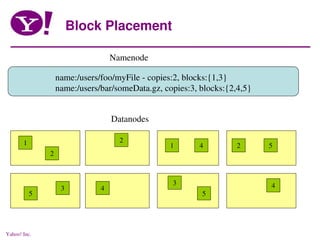
Block Placement

                                   Namenode

                   name:/users/foo/myFile ­ copies:2, blocks:{1,3}
                   name:/users/bar/someData.gz, copies:3, blocks:{2,4,5}


                                   Datanodes

       1                             2
                                                  1       4         2      5
               2


                                                  3                        4
                    3          4
           5                                              5


Yahoo! Inc.
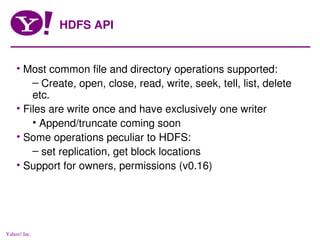
HDFS API


    • Most common file and directory operations supported:
        – Create, open, close, read, write, seek, tell, list, delete 
        etc.
    • Files are write once and have exclusively one writer
        • Append/truncate coming soon
    • Some operations peculiar to HDFS:
        – set replication, get block locations
    • Support for owners, permissions (v0.16)


Yahoo! Inc.
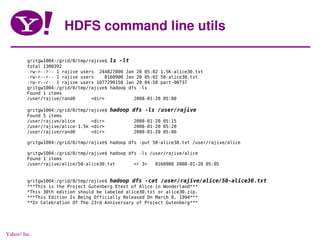
HDFS command line utils

         gritgw1004:/grid/0/tmp/rajive$ ls -lt
         total 1300392
         -rw-r--r-- 1 rajive users 244827000 Jan 20 05:02 1.5K-alice30.txt
         -rw-r--r-- 1 rajive users    8160900 Jan 20 05:02 50-alice30.txt
         -rw-r--r-- 1 rajive users 1077290150 Jan 20 04:58 part-00737
         gritgw1004:/grid/0/tmp/rajive$ hadoop dfs -ls
         Found 1 items
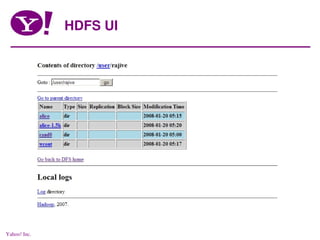
         /user/rajive/rand0      <dir>           2008-01-20 05:00

         gritgw1004:/grid/0/tmp/rajive$   hadoop dfs -ls /user/rajive
         Found 5 items
         /user/rajive/alice      <dir>           2008-01-20 05:15
         /user/rajive/alice-1.5k <dir>           2008-01-20 05:20
         /user/rajive/rand0      <dir>           2008-01-20 05:00

         gritgw1004:/grid/0/tmp/rajive$ hadoop dfs -put 50-alice30.txt /user/rajive/alice

         gritgw1004:/grid/0/tmp/rajive$ hadoop dfs -ls /user/rajive/alice
         Found 1 items
         /user/rajive/alice/50-alice30.txt       <r 3>   8160900 2008-01-20 05:05


         gritgw1004:/grid/0/tmp/rajive$ hadoop dfs -cat /user/rajive/alice/50-alice30.txt
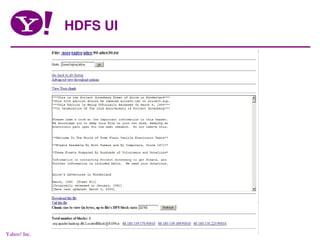
         ***This is the Project Gutenberg Etext of Alice in Wonderland***
         *This 30th edition should be labeled alice30.txt or alice30.zip.
         ***This Edition Is Being Officially Released On March 8, 1994***
         **In Celebration Of The 23rd Anniversary of Project Gutenberg***


Yahoo! Inc.
HDFS UI


Yahoo! Inc.
HDFS UI


Yahoo! Inc.
HDFS UI


Yahoo! Inc.
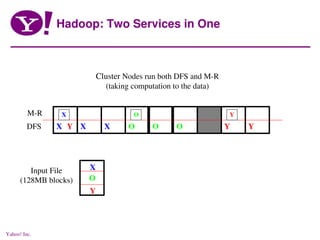
Hadoop: Two Services in One


                           Cluster Nodes run both DFS and M­R
                             (taking computation to the data)


         M­R     X                   O                          Y
         DFS   X Y X         X      O      O      O             Y   Y


         Input File    X
      (128MB blocks)   O
                       Y


Yahoo! Inc.
HOD (Hadoop on Demand)


     • Map/Reduce is just one programming model
     • Hadoop is not a resource manager or scheduler
              – Most sites already have a deployed solution
     • HOD
              –   Bridge between Hadoop and resource managers
              –   Currently supports Torque
              –   Part of contrib in Hadoop 0.16 release
              –   http://hadoop.apache.org/core/docs/current/hod.html


Yahoo! Inc.
HOD: Provisioning Hadoop


     • Hadoop is submitted like any other job
     • User specifies number of nodes desired
     • HOD deals with allocation and setup
              – Allocates requested nodes
              – Brings up Map/Reduce and (optionally) HDFS daemons
     • User submits Map/Reduce jobs


Yahoo! Inc.
HOD Benefits


     • Effective usage of the grid
              – No need to do ‘social scheduling’
              – No need for static node allocation
     • Automated setup for Hadoop
              – Users / Ops no longer need to know where and how to bring up 

                daemons


Yahoo! Inc.
Running Jobs

         gritgw1004:/grid/0/tmp/rajive$ hod -m 5
         HDFS UI on grit1002.yahooresearchcluster.com:50070
         Mapred UI on grit1278.yahooresearchcluster.com:55118

         Hadoop config file in: /grid/0/kryptonite/hod/tmp/hod-15575-tmp/hadoop-
            site.xml

         allocation information:

               1 job tracker node
               4 task tracker nodes
               5 nodes in total


         [hod] (rajive) >>


Yahoo! Inc.
Running Jobs

                      run jar /grid/0/hadoop/current/hadoop-examples.jar wordcount
         [hod] (rajive) >>
              /user/rajive/alice-1.5k /user/rajive/wcout2
         08/01/20 05:21:26   WARN mapred.JobConf: Deprecated resource 'mapred-default.xml' is being loaded, please discontinue its
               usage!
         08/01/20 05:21:27   INFO   mapred.FileInputFormat: Total input paths to process : 1
         08/01/20 05:21:30   INFO   mapred.JobClient: Running job: job_200801200511_0002
         08/01/20 05:21:31   INFO   mapred.JobClient: map 0% reduce 0%
         08/01/20 05:21:38   INFO   mapred.JobClient: map 3% reduce 0%
         08/01/20 05:21:42   INFO   mapred.JobClient: map 12% reduce 0%
         08/01/20 05:21:48   INFO   mapred.JobClient: map 20% reduce 0%
         08/01/20 05:22:12   INFO   mapred.JobClient: map 27% reduce 0%
         08/01/20 05:22:18   INFO   mapred.JobClient: map 37% reduce 0%
         08/01/20 05:22:21   INFO   mapred.JobClient: map 41% reduce 0%
         08/01/20 05:22:41   INFO   mapred.JobClient: map 45% reduce 0%
         08/01/20 05:22:48   INFO   mapred.JobClient: map 54% reduce 0%
         08/01/20 05:22:51   INFO   mapred.JobClient: map 59% reduce 0%
         08/01/20 05:22:59   INFO   mapred.JobClient: map 62% reduce 0%
         08/01/20 05:23:19   INFO   mapred.JobClient: map 71% reduce 0%
         08/01/20 05:23:22   INFO   mapred.JobClient: map 76% reduce 0%
         08/01/20 05:23:29   INFO   mapred.JobClient: map 83% reduce 0%
         08/01/20 05:23:49   INFO   mapred.JobClient: map 88% reduce 0%
         08/01/20 05:23:52   INFO   mapred.JobClient: map 93% reduce 0%
         08/01/20 05:23:59   INFO   mapred.JobClient: map 100% reduce 0%
         08/01/20 05:24:19   INFO   mapred.JobClient: map 100% reduce 100%
         08/01/20 05:24:20   INFO   mapred.JobClient: Job complete: job_200801200511_0002
         08/01/20 05:24:20   INFO   mapred.JobClient: Counters: 11
         08/01/20 05:24:20   INFO   mapred.JobClient:   Job Counters
         08/01/20 05:24:20   INFO   mapred.JobClient:     Launched map tasks=2
         08/01/20 05:24:20   INFO   mapred.JobClient:     Launched reduce tasks=1
         08/01/20 05:24:20   INFO   mapred.JobClient:   Map-Reduce Framework
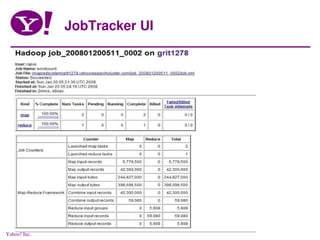
         08/01/20 05:24:20   INFO   mapred.JobClient:     Map input records=5779500
         08/01/20 05:24:20   INFO   mapred.JobClient:     Map output records=42300000
         08/01/20 05:24:20   INFO   mapred.JobClient:     Map input bytes=244827000
         08/01/20 05:24:20   INFO   mapred.JobClient:     Map output bytes=398698500
         08/01/20 05:24:20   INFO   mapred.JobClient:     Combine input records=42300000
         08/01/20 05:24:20   INFO   mapred.JobClient:     Combine output records=59080
         08/01/20 05:24:20   INFO   mapred.JobClient:     Reduce input groups=5908
         08/01/20 05:24:20   INFO   mapred.JobClient:     Reduce input records=59080
         08/01/20 05:24:20   INFO   mapred.JobClient:     Reduce output records=5908

         [hod] (rajive) >>
Yahoo! Inc.
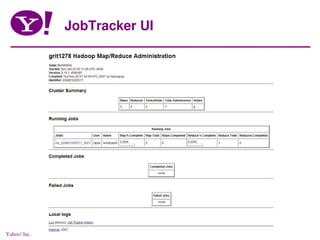
JobTracker UI


Yahoo! Inc.
JobTracker UI


Yahoo! Inc.
Thank you

         • Questions?

         •    Hadoop: http://hadoop.apache.org
         •    Blog http://developer.yahoo.com/blogs/hadoop
         •    This presentation: http://public.yahoo.com/rajive/isec2008.pdf
         •    email: rajive@yahoo­inc.com


Yahoo! Inc.

Distributed Data processing in a Cloud

  • 1.
    Distributed Data  processing in a Cloud Rajiv Chittajallu  Yahoo! Inc rajive@yahoo-inc.com Software as a Service and Cloud Computing Workshop ISEC2008, Hyderabad, India 22 February 2008
  • 2.
    Desiderata  Operate scalably – Petabytes of data on thousands on nodes – Much larger that RAM, disk I/O required • Operate economically – Minimize $ spent on CPU cycles, disk, RAM, network – Lash thousands of commodity PCs into an effective compute  and storage platform • Operate reliably – In a large enough cluster something is always broken – Seamlessly protect user data and computations from  hardware and software flakiness Yahoo! Inc.
  • 3.
    Problem: bandwidth to data • Need to process 100TB datasets  • On 1000 node cluster reading from remote  storage (on LAN) – Scanning @ 10MB/s = 165 min • On 1000 node cluster reading from local  storage – Scanning @ 50­200MB/s = 33­8 min • Moving computation is more efficient than  moving data – Need visibility into data placement Yahoo! Inc.
  • 4.
    Problem: scaling reliably is hard • Need to store petabytes of data – On 1000s of nodes  – MTBF < 1 day – With so many disks, nodes, switches something is always  broken • Need fault tolerant store – Handle hardware faults transparently and efficiently – Provide reasonable availability guarantees Yahoo! Inc.
  • 5.
    Distributed File System • Fault tolerant, scalable, distributed storage system • Designed to reliably store very large files across  machines in a large cluster • Common Namespace for the entire filesystem – Distribute namespace for scalability and failover • Data Model – Data is organized into files and directories – Files are divided into uniform sized blocks and distributed  across cluster nodes – Replicate blocks to handle hardware failure – Checksums of data for corruption detection and recovery – Expose block placement so that computes can be migrated  to data Yahoo! Inc.
  • 6.
    Problem: seeks are expensive  • CPU & transfer speed, RAM & disk size double  every 18­24 months  • Seek time nearly constant (~5%/year)  • Time to read entire drive is growing • Moral: scalable computing must go at transfer  rate Yahoo! Inc.
  • 7.
    Two database paradigms: seek  versus transfer • B­Tree (Relational Dbs)  – operate at seek rate, log(N) seeks/access  • sort/merge flat files (MapReduce)  – operate at transfer rate, log(N) transfers/sort •  Caveats: – sort & merge is batch based • although possible to work around  – other paradigms (memory, streaming, etc.) Yahoo! Inc.
  • 8.
    Example: updating a terabyte DB  • given: – 10MB/s transfer – 10ms/seek – 100B/entry (10B entries) – 10kB/page (1B pages)  • updating 1% of entries (100M) takes:  – 1000 days with random B­Tree updates  – 100 days with batched B­Tree updates  – 1 day with sort & merge Yahoo! Inc.
  • 9.
    Map/Reduce: sort/merge based distributed  processing • Best for batch­oriented processing • Sort/merge is primitive – Operates at transfer rate  • Simple programming metaphor: – input | map  | shuffle | reduce  > output  – cat * | grep | sort | uniq ­c > file • Pluggable user code runs in generic reusable framework – A natural for log processing, great for most web search  processing – A lot of SQL maps trivially to this construct (see PIG) • Distribution & reliability – Handled by framework Yahoo! Inc.
  • 10.
    Map/Reduce • Application writer specifies  In In In – A pair of functions called Map and Reduce and  pu pu pu t 0 t 1 t 2 a set of input files • Workflow – Input phase generates a number of FileSplits  from input files (one per Map task) Map 0 Map 1 Map 2 – The Map phase executes a user function to  transform input kv­pairs into a new set of kv­pairs – The framework sorts & Shuffles the kv­pairs to  Shuffle output nodes – The Reduce phase combines all kv­pairs with  the same key into new kv­pairs – The output phase writes the resulting pairs to  Reduce 0 Reduce 1 files • All phases are distributed with many tasks doing  the work – Framework handles scheduling of tasks on  O O cluster ut  ut  – Framework handles recovery when a node fails 0 1 Yahoo! Inc.
  • 11.
    Map/Reduce features • Fine grained Map and Reduce tasks – Improved load balancing – Faster recovery from failed tasks • Locality optimizations – With big data, bandwidth to data is a problem – Map­Reduce + DFS is a very effective solution – Map­Reduce queries DFS for locations of input data – Map tasks are scheduled local to the inputs when possible • Re­execution and Speculative execution – In a large cluster, some nodes are always slow or flaky – Introduces long tails or failures in computation – Framework re­executes failed jobs – Framework runs multiple instances of last few tasks and uses the  ones that finish first Yahoo! Inc.
  • 12.
    Map/Reduce: pros and cons • Developing large scale systems is expensive, this  is a shared platform – Reduces development and debug time – Leverages common optimizations, tools etc. • Not always a natural fit – With moderate force, many things will fit • Not always optimal – But not far off, and often cheaper in the end Yahoo! Inc.
  • 13.
    Hadoop • Apache Software Foundation project – Framework for running applications on large clusters of commodity hardware – Since we’ve convinced Doug Cutting to split Hadoop into a separate project, Yahoo! is the  main contributor of source code to the infrastructure base. – A search startup has adapted Hadoop to run on Amazon’s EC2 and S3, and has contributed  hBase, a BigTable­like extension. • http://hadoop.apache.org/hbase/ • Includes – HDFS ­ a distributed filesystem – Map/Reduce ­ offline computing engine – Hbase – online data access • Still pre­1.0, but already used by many – http://wiki.apache.org/hadoop/PoweredBy – alpha (0.16) release available for download • http://lucene.apache.org/hadoop Yahoo! Inc.
  • 14.
    Hadoop Map/Reduce architecture • Master­Slave architecture • Map/Reduce Master “Jobtracker” – Accepts MR jobs submitted by users – Assigns Map and Reduce tasks to Tasktrackers – Monitors task and tasktracker status, re­executes tasks  upon failure  • Map/Reduce Slaves “Tasktrackers” – Run Map and Reduce tasks upon instruction from the  Jobtracker – Manage storage and transmission of intermediate output Yahoo! Inc.
  • 15.
    HDFS Architecture • Master­Slave architecture • DFS Master “Namenode” – Manages the filesystem namespace – Controls read/write access to files – Manages block replication – Checkpoints namespace and journals namespace  changes for reliability • DFS Slaves “Datanodes” – Serve read/write requests from clients – Perform replication tasks upon instruction by namenode Yahoo! Inc.
  • 16.
    HDFS • Notable differences from mainstream  DFS work – Single ‘storage + compute’ cluster vs. Separate  clusters – Simple I/O centric API vs. Attempts at POSIX  compliance •  Not against POSIX but currently prioritizing scale and reliability Yahoo! Inc.
  • 17.
    Block Placement Namenode name:/users/foo/myFile ­ copies:2, blocks:{1,3} name:/users/bar/someData.gz, copies:3, blocks:{2,4,5} Datanodes 1 2 1 4 2 5 2 3 4 3 4 5 5 Yahoo! Inc.
  • 18.
    HDFS API • Most common file and directory operations supported: – Create, open, close, read, write, seek, tell, list, delete  etc. • Files are write once and have exclusively one writer • Append/truncate coming soon • Some operations peculiar to HDFS: – set replication, get block locations • Support for owners, permissions (v0.16) Yahoo! Inc.
  • 19.
    HDFS command line utils gritgw1004:/grid/0/tmp/rajive$ ls -lt total 1300392 -rw-r--r-- 1 rajive users 244827000 Jan 20 05:02 1.5K-alice30.txt -rw-r--r-- 1 rajive users 8160900 Jan 20 05:02 50-alice30.txt -rw-r--r-- 1 rajive users 1077290150 Jan 20 04:58 part-00737 gritgw1004:/grid/0/tmp/rajive$ hadoop dfs -ls Found 1 items /user/rajive/rand0 <dir> 2008-01-20 05:00 gritgw1004:/grid/0/tmp/rajive$ hadoop dfs -ls /user/rajive Found 5 items /user/rajive/alice <dir> 2008-01-20 05:15 /user/rajive/alice-1.5k <dir> 2008-01-20 05:20 /user/rajive/rand0 <dir> 2008-01-20 05:00 gritgw1004:/grid/0/tmp/rajive$ hadoop dfs -put 50-alice30.txt /user/rajive/alice gritgw1004:/grid/0/tmp/rajive$ hadoop dfs -ls /user/rajive/alice Found 1 items /user/rajive/alice/50-alice30.txt <r 3> 8160900 2008-01-20 05:05 gritgw1004:/grid/0/tmp/rajive$ hadoop dfs -cat /user/rajive/alice/50-alice30.txt ***This is the Project Gutenberg Etext of Alice in Wonderland*** *This 30th edition should be labeled alice30.txt or alice30.zip. ***This Edition Is Being Officially Released On March 8, 1994*** **In Celebration Of The 23rd Anniversary of Project Gutenberg*** Yahoo! Inc.
  • 20.
  • 21.
  • 22.
  • 23.
    Hadoop: Two Services in One Cluster Nodes run both DFS and M­R (taking computation to the data) M­R X O Y DFS X Y X X O O O Y Y Input File X (128MB blocks) O Y Yahoo! Inc.
  • 24.
    HOD (Hadoop on Demand) • Map/Reduce is just one programming model • Hadoop is not a resource manager or scheduler – Most sites already have a deployed solution • HOD – Bridge between Hadoop and resource managers – Currently supports Torque – Part of contrib in Hadoop 0.16 release – http://hadoop.apache.org/core/docs/current/hod.html Yahoo! Inc.
  • 25.
    HOD: Provisioning Hadoop • Hadoop is submitted like any other job • User specifies number of nodes desired • HOD deals with allocation and setup – Allocates requested nodes – Brings up Map/Reduce and (optionally) HDFS daemons • User submits Map/Reduce jobs Yahoo! Inc.
  • 26.
    HOD Benefits • Effective usage of the grid – No need to do ‘social scheduling’ – No need for static node allocation • Automated setup for Hadoop – Users / Ops no longer need to know where and how to bring up  daemons Yahoo! Inc.
  • 27.
    Running Jobs gritgw1004:/grid/0/tmp/rajive$ hod -m 5 HDFS UI on grit1002.yahooresearchcluster.com:50070 Mapred UI on grit1278.yahooresearchcluster.com:55118 Hadoop config file in: /grid/0/kryptonite/hod/tmp/hod-15575-tmp/hadoop- site.xml allocation information: 1 job tracker node 4 task tracker nodes 5 nodes in total [hod] (rajive) >> Yahoo! Inc.
  • 28.
    Running Jobs run jar /grid/0/hadoop/current/hadoop-examples.jar wordcount [hod] (rajive) >> /user/rajive/alice-1.5k /user/rajive/wcout2 08/01/20 05:21:26 WARN mapred.JobConf: Deprecated resource 'mapred-default.xml' is being loaded, please discontinue its usage! 08/01/20 05:21:27 INFO mapred.FileInputFormat: Total input paths to process : 1 08/01/20 05:21:30 INFO mapred.JobClient: Running job: job_200801200511_0002 08/01/20 05:21:31 INFO mapred.JobClient: map 0% reduce 0% 08/01/20 05:21:38 INFO mapred.JobClient: map 3% reduce 0% 08/01/20 05:21:42 INFO mapred.JobClient: map 12% reduce 0% 08/01/20 05:21:48 INFO mapred.JobClient: map 20% reduce 0% 08/01/20 05:22:12 INFO mapred.JobClient: map 27% reduce 0% 08/01/20 05:22:18 INFO mapred.JobClient: map 37% reduce 0% 08/01/20 05:22:21 INFO mapred.JobClient: map 41% reduce 0% 08/01/20 05:22:41 INFO mapred.JobClient: map 45% reduce 0% 08/01/20 05:22:48 INFO mapred.JobClient: map 54% reduce 0% 08/01/20 05:22:51 INFO mapred.JobClient: map 59% reduce 0% 08/01/20 05:22:59 INFO mapred.JobClient: map 62% reduce 0% 08/01/20 05:23:19 INFO mapred.JobClient: map 71% reduce 0% 08/01/20 05:23:22 INFO mapred.JobClient: map 76% reduce 0% 08/01/20 05:23:29 INFO mapred.JobClient: map 83% reduce 0% 08/01/20 05:23:49 INFO mapred.JobClient: map 88% reduce 0% 08/01/20 05:23:52 INFO mapred.JobClient: map 93% reduce 0% 08/01/20 05:23:59 INFO mapred.JobClient: map 100% reduce 0% 08/01/20 05:24:19 INFO mapred.JobClient: map 100% reduce 100% 08/01/20 05:24:20 INFO mapred.JobClient: Job complete: job_200801200511_0002 08/01/20 05:24:20 INFO mapred.JobClient: Counters: 11 08/01/20 05:24:20 INFO mapred.JobClient: Job Counters 08/01/20 05:24:20 INFO mapred.JobClient: Launched map tasks=2 08/01/20 05:24:20 INFO mapred.JobClient: Launched reduce tasks=1 08/01/20 05:24:20 INFO mapred.JobClient: Map-Reduce Framework 08/01/20 05:24:20 INFO mapred.JobClient: Map input records=5779500 08/01/20 05:24:20 INFO mapred.JobClient: Map output records=42300000 08/01/20 05:24:20 INFO mapred.JobClient: Map input bytes=244827000 08/01/20 05:24:20 INFO mapred.JobClient: Map output bytes=398698500 08/01/20 05:24:20 INFO mapred.JobClient: Combine input records=42300000 08/01/20 05:24:20 INFO mapred.JobClient: Combine output records=59080 08/01/20 05:24:20 INFO mapred.JobClient: Reduce input groups=5908 08/01/20 05:24:20 INFO mapred.JobClient: Reduce input records=59080 08/01/20 05:24:20 INFO mapred.JobClient: Reduce output records=5908 [hod] (rajive) >> Yahoo! Inc.
  • 29.
  • 30.
  • 31.
    Thank you • Questions? • Hadoop: http://hadoop.apache.org • Blog http://developer.yahoo.com/blogs/hadoop • This presentation: http://public.yahoo.com/rajive/isec2008.pdf • email: rajive@yahoo­inc.com Yahoo! Inc.