June 14, 2012

Optimizing MapReduce Job
Performance
Todd Lipcon [@tlipcon]
Introductions

    • Software Engineer at Cloudera since 2009
    • Committer and PMC member on HDFS,
      MapReduce, and HBase
    • Spend lots of time looking at full stack
      performance

    • This talk is to help you develop faster jobs
      – If you want to hear about how we made Hadoop
        faster, see my Hadoop World 2011 talk on
        cloudera.com

2
                       ©2011 Cloudera, Inc. All Rights Reserved.
Aspects of Performance

    • Algorithmic performance
      – big-O, join strategies, data
        structures, asymptotes
    • Physical performance
      – Hardware (disks, CPUs, etc)
    • Implementation performance
      – Efficiency of code, avoiding extra work
      – Make good use of available physical perf


3
                       ©2011 Cloudera, Inc. All Rights Reserved.
Performance fundamentals

    • You can’t tune what you don’t
      understand
      – MR’s strength as a framework is its black-box
        nature
      – To get optimal performance, you have to
        understand the internals

    • This presentation: understanding the
      black box

4
                      ©2011 Cloudera, Inc. All Rights Reserved.
Performance fundamentals (2)

    • You can’t improve what you can’t
      measure
      – Ganglia/Cacti/Cloudera Manager/etc a must
      – Top 4 metrics: CPU, Memory, Disk, Network
      – MR job metrics: slot-seconds, CPU-seconds,
        task wall-clocks, and I/O


    • Before you start: run jobs, gather data


5
                     ©2011 Cloudera, Inc. All Rights Reserved.
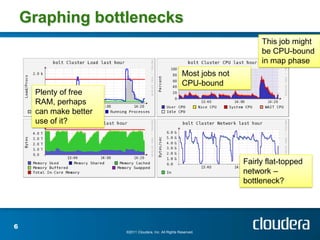
Graphing bottlenecks
                                                                             This job might
                                                                             be CPU-bound
                                                                             in map phase
                                                        Most jobs not
                                                        CPU-bound
     Plenty of free
     RAM, perhaps
     can make better
     use of it?


                                                                        Fairly flat-topped
                                                                        network –
                                                                        bottleneck?


6
                       ©2011 Cloudera, Inc. All Rights Reserved.
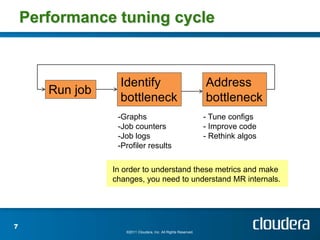
Performance tuning cycle


                   Identify                                     Address
       Run job
                   bottleneck                                   bottleneck
                  -Graphs                                       - Tune configs
                  -Job counters                                 - Improve code
                  -Job logs                                     - Rethink algos
                  -Profiler results

                 In order to understand these metrics and make
                 changes, you need to understand MR internals.


7
                    ©2011 Cloudera, Inc. All Rights Reserved.
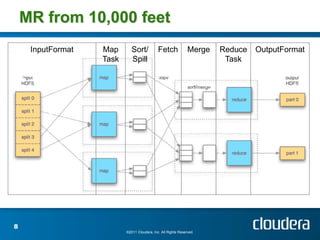
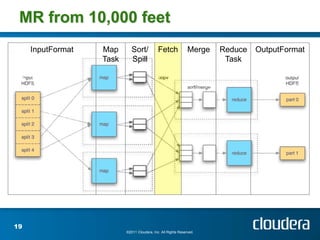
MR from 10,000 feet
     InputFormat   Map       Sort/           Fetch             Merge   Reduce   OutputFormat
                   Task      Spill                                      Task


8
                          ©2011 Cloudera, Inc. All Rights Reserved.
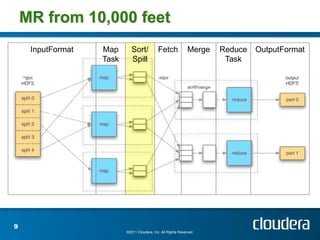
MR from 10,000 feet
     InputFormat   Map       Sort/           Fetch             Merge   Reduce   OutputFormat
                   Task      Spill                                      Task


9
                          ©2011 Cloudera, Inc. All Rights Reserved.
Map-side sort/spill overview
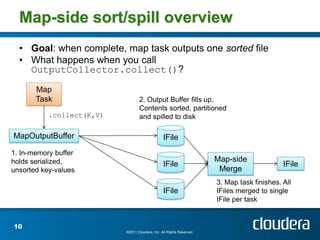
  • Goal: when complete, map task outputs one sorted file
  • What happens when you call
    OutputCollector.collect()?

       Map
       Task                       2. Output Buffer fills up.
                                  Contents sorted, partitioned
           .collect(K,V)          and spilled to disk

MapOutputBuffer                                  IFile
1. In-memory buffer
holds serialized,                                                      Map-side
                                                 IFile                                       IFile
unsorted key-values                                                     Merge
                                                                       3. Map task finishes. All
                                                 IFile                 IFiles merged to single
                                                                       IFile per task


10
                           ©2011 Cloudera, Inc. All Rights Reserved.
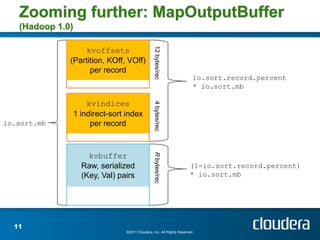
Zooming further: MapOutputBuffer
   (Hadoop 1.0)


                                                  12 bytes/rec
                  kvoffsets
              (Partition, KOff, VOff)
                    per record
                                                                          io.sort.record.percent
                                                                          * io.sort.mb

                      kvindices


                                                  4 bytes/rec
                  1 indirect-sort index
io.sort.mb             per record


                      kvbuffer                    R bytes/rec

                    Raw, serialized                                     (1-io.sort.record.percent)
                    (Key, Val) pairs                                    * io.sort.mb


  11
                                  ©2011 Cloudera, Inc. All Rights Reserved.
MapOutputBuffer spill behavior

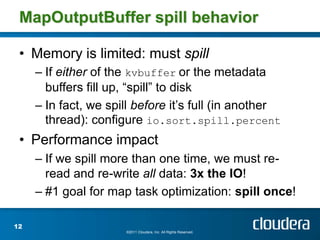
 • Memory is limited: must spill
     – If either of the kvbuffer or the metadata
       buffers fill up, “spill” to disk
     – In fact, we spill before it’s full (in another
       thread): configure io.sort.spill.percent
 • Performance impact
     – If we spill more than one time, we must re-
       read and re-write all data: 3x the IO!
     – #1 goal for map task optimization: spill once!

12
                      ©2011 Cloudera, Inc. All Rights Reserved.
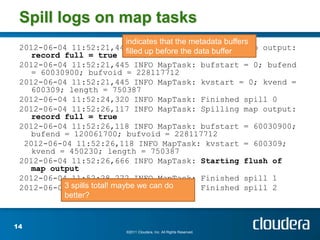
Spill counters on map tasks

 • ratio of Spilled Records vs Map Output
   Records
     – if unequal, then you are doing more than one
       spill
 • FILE: Number of bytes read/written
     – get a sense of I/O amplification due to spilling


13
                      ©2011 Cloudera, Inc. All Rights Reserved.
Spill logs on map tasks
                       indicates that the metadata buffers
 2012-06-04 11:52:21,445 INFO before the data buffer map output:
                       filled up MapTask: Spilling
    record full = true
 2012-06-04 11:52:21,445 INFO MapTask: bufstart = 0; bufend
    = 60030900; bufvoid = 228117712
 2012-06-04 11:52:21,445 INFO MapTask: kvstart = 0; kvend =
    600309; length = 750387
 2012-06-04 11:52:24,320 INFO MapTask: Finished spill 0
 2012-06-04 11:52:26,117 INFO MapTask: Spilling map output:
    record full = true
 2012-06-04 11:52:26,118 INFO MapTask: bufstart = 60030900;
    bufend = 120061700; bufvoid = 228117712
  2012-06-04 11:52:26,118 INFO MapTask: kvstart = 600309;
    kvend = 450230; length = 750387
 2012-06-04 11:52:26,666 INFO MapTask: Starting flush of
    map output
 2012-06-04 11:52:28,272 INFO MapTask: Finished spill 1
 2012-06-04 spills total! maybeINFO MapTask: Finished spill 2
           3 11:52:29,105 we can do
           better?


14
                         ©2011 Cloudera, Inc. All Rights Reserved.
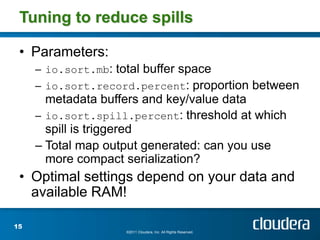
Tuning to reduce spills

 • Parameters:
     – io.sort.mb: total buffer space
     – io.sort.record.percent: proportion between
       metadata buffers and key/value data
     – io.sort.spill.percent: threshold at which
       spill is triggered
     – Total map output generated: can you use
       more compact serialization?
 • Optimal settings depend on your data and
   available RAM!

15
                     ©2011 Cloudera, Inc. All Rights Reserved.
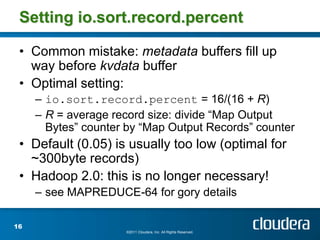
Setting io.sort.record.percent

 • Common mistake: metadata buffers fill up
   way before kvdata buffer
 • Optimal setting:
     – io.sort.record.percent = 16/(16 + R)
     – R = average record size: divide “Map Output
       Bytes” counter by “Map Output Records” counter
 • Default (0.05) is usually too low (optimal for
   ~300byte records)
 • Hadoop 2.0: this is no longer necessary!
     – see MAPREDUCE-64 for gory details

16
                     ©2011 Cloudera, Inc. All Rights Reserved.
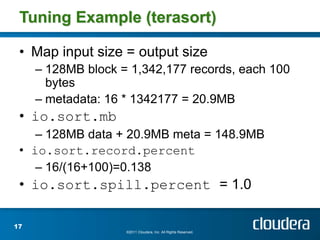
Tuning Example (terasort)

 • Map input size = output size
     – 128MB block = 1,342,177 records, each 100
       bytes
     – metadata: 16 * 1342177 = 20.9MB
 • io.sort.mb
    – 128MB data + 20.9MB meta = 148.9MB
 • io.sort.record.percent
    – 16/(16+100)=0.138
 • io.sort.spill.percent = 1.0

17
                    ©2011 Cloudera, Inc. All Rights Reserved.
More tips on spill tuning
 • Biggest win is going from 2 spills to 1 spill
     – 3 spills is approximately the same speed as 2 spills
       (same IO amplificatoin)
 • Calculate if it’s even possible, given your heap
   size
     – io.sort.mb has to fit within your Java heap (plus
       whatever RAM your Mapper needs, plus ~30% for
       overhead)
 • Only bother if this is the bottleneck!
     – Look at map task logs: if the merge step at the end is
       taking a fraction of a second, not worth it!
     – Typically most impact on jobs with big shuffle
       (sort/dedup)


18
                        ©2011 Cloudera, Inc. All Rights Reserved.
MR from 10,000 feet
     InputFormat   Map       Sort/           Fetch             Merge   Reduce   OutputFormat
                   Task      Spill                                      Task


19
                          ©2011 Cloudera, Inc. All Rights Reserved.
Reducer fetch tuning

 • Reducers fetch map output via HTTP
 • Tuning parameters:
     – Server side: tasktracker.http.threads
     – Client side:
      mapred.reduce.parallel.copies
 • Turns out this is not so interesting
     – follow the best practices from Hadoop:
       Definitive Guide


20
                      ©2011 Cloudera, Inc. All Rights Reserved.
Improving fetch bottlenecks

 • Reduce intermediate data
     – Implement a Combiner: less data transfers faster
     – Enable intermediate compression: Snappy is
       easy to enable; trades off some CPU for less
       IO/network
 • Double-check for network issues
     – Frame errors, NICs auto-negotiated to 100mbit,
       etc: one or two slow hosts can bottleneck a job
     – Tell-tale sign: all maps are done, and reducers sit
       in fetch stage for many minutes (look at logs)


21
                       ©2011 Cloudera, Inc. All Rights Reserved.
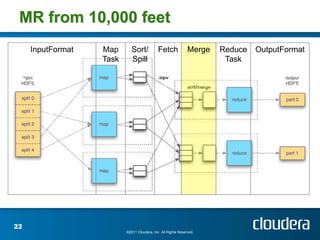
MR from 10,000 feet
     InputFormat   Map       Sort/           Fetch             Merge   Reduce   OutputFormat
                   Task      Spill                                      Task


22
                          ©2011 Cloudera, Inc. All Rights Reserved.
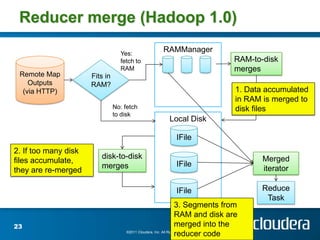
Reducer merge (Hadoop 1.0)

                                  Yes:
                                                   RAMManager
                                  fetch to                                      RAM-to-disk
                                  RAM                                           merges
 Remote Map           Fits in
    Outputs           RAM?
  (via HTTP)                                                                     1. Data accumulated
                                                                                 in RAM is merged to
                                No: fetch                                        disk files
                                to disk
                                                      Local Disk

                                                         IFile
2. If too many disk
                         disk-to-disk                                                   Merged
files accumulate,                                        IFile
                         merges                                                         iterator
they are re-merged

                                                         IFile                          Reduce
                                                                                         Task
                                                                  3. Segments from
                                                                  RAM and disk are
23                                                                merged into the
                                                                  reducer code
                                     ©2011 Cloudera, Inc. All Rights Reserved.
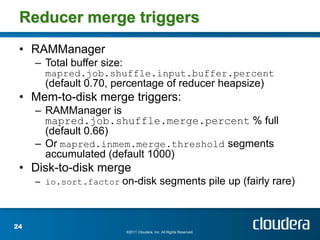
Reducer merge triggers
 • RAMManager
     – Total buffer size:
       mapred.job.shuffle.input.buffer.percent
       (default 0.70, percentage of reducer heapsize)
 • Mem-to-disk merge triggers:
     – RAMManager is
       mapred.job.shuffle.merge.percent % full
       (default 0.66)
     – Or mapred.inmem.merge.threshold segments
       accumulated (default 1000)
 • Disk-to-disk merge
     – io.sort.factor on-disk segments pile up (fairly rare)


24
                            ©2011 Cloudera, Inc. All Rights Reserved.
Final merge phase

 • MR assumes that reducer code needs the
   full heap worth of RAM
     – Spills all in-RAM segments before running
       user code to free memory
 • This isn’t true if your reducer is simple
     – eg sort, simple aggregation, etc with no state
 • Configure
     mapred.job.reduce.input.buffer.percent to
     0.70 to keep reducer input data in RAM


25
                      ©2011 Cloudera, Inc. All Rights Reserved.
Reducer merge counters

 • FILE: number of bytes read/written
     – Ideally close to 0 if you can fit in RAM
 • Spilled records:
     – Ideally close to 0. If significantly more than
       reduce input records, job is hitting a multi-
       pass merge which is quite expensive


26
                      ©2011 Cloudera, Inc. All Rights Reserved.
Tuning reducer merge

 • Configure
     mapred.job.reduce.input.buffer.percent
   to 0.70 to keep data in RAM if you don’t
   have any state in reducer
 • Experiment with setting
   mapred.inmem.merge.threshold to 0 to
   avoid spills
 • Hadoop 2.0: experiment with
     mapreduce.reduce.merge.memtomem.enabled


27
                   ©2011 Cloudera, Inc. All Rights Reserved.
Rules of thumb for # maps/reduces

 • Aim for map tasks running 1-3 minutes each
     – Too small: wasted startup overhead, less efficient
       shuffle
     – Too big: not enough parallelism, harder to share
       cluster
 • Reduce task count:
     – Large reduce phase: base on cluster slot count (a
       few GB per reducer)
     – Small reduce phase: fewer reducers will result in
       more efficient shuffle phase


28
                       ©2011 Cloudera, Inc. All Rights Reserved.
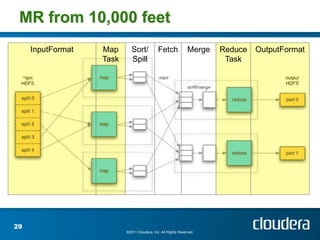
MR from 10,000 feet
     InputFormat   Map       Sort/           Fetch             Merge   Reduce   OutputFormat
                   Task      Spill                                      Task


29
                          ©2011 Cloudera, Inc. All Rights Reserved.
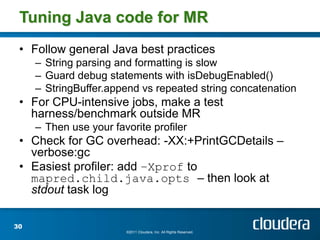
Tuning Java code for MR
 • Follow general Java best practices
     – String parsing and formatting is slow
     – Guard debug statements with isDebugEnabled()
     – StringBuffer.append vs repeated string concatenation
 • For CPU-intensive jobs, make a test
   harness/benchmark outside MR
     – Then use your favorite profiler
 • Check for GC overhead: -XX:+PrintGCDetails –
   verbose:gc
 • Easiest profiler: add –Xprof to
   mapred.child.java.opts – then look at
   stdout task log

30
                        ©2011 Cloudera, Inc. All Rights Reserved.
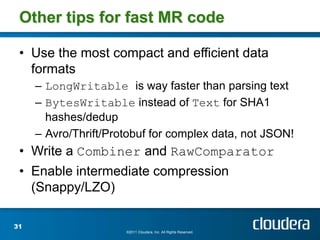
Other tips for fast MR code

 • Use the most compact and efficient data
   formats
     – LongWritable is way faster than parsing text
     – BytesWritable instead of Text for SHA1
       hashes/dedup
     – Avro/Thrift/Protobuf for complex data, not JSON!
 • Write a Combiner and RawComparator
 • Enable intermediate compression
   (Snappy/LZO)

31
                      ©2011 Cloudera, Inc. All Rights Reserved.
Summary

 • Understanding MR internals helps understand
   configurations and tuning
 • Focus your tuning effort on things that are
   bottlenecks, following a scientific approach
 • Don’t forget that you can always just add nodes!
     – Spending 1 month of engineer time to make your job
       20% faster is not worth it if you have a 10 node
       cluster!
 • We’re working on simplifying this where we can,
   but deep understanding will always allow more
   efficient jobs


32
                       ©2011 Cloudera, Inc. All Rights Reserved.
Questions?

    @tlipcon
todd@cloudera.com

Hadoop Summit 2012 | Optimizing MapReduce Job Performance

  • 1.
    June 14, 2012 OptimizingMapReduce Job Performance Todd Lipcon [@tlipcon]
  • 2.
    Introductions • Software Engineer at Cloudera since 2009 • Committer and PMC member on HDFS, MapReduce, and HBase • Spend lots of time looking at full stack performance • This talk is to help you develop faster jobs – If you want to hear about how we made Hadoop faster, see my Hadoop World 2011 talk on cloudera.com 2 ©2011 Cloudera, Inc. All Rights Reserved.
  • 3.
    Aspects of Performance • Algorithmic performance – big-O, join strategies, data structures, asymptotes • Physical performance – Hardware (disks, CPUs, etc) • Implementation performance – Efficiency of code, avoiding extra work – Make good use of available physical perf 3 ©2011 Cloudera, Inc. All Rights Reserved.
  • 4.
    Performance fundamentals • You can’t tune what you don’t understand – MR’s strength as a framework is its black-box nature – To get optimal performance, you have to understand the internals • This presentation: understanding the black box 4 ©2011 Cloudera, Inc. All Rights Reserved.
  • 5.
    Performance fundamentals (2) • You can’t improve what you can’t measure – Ganglia/Cacti/Cloudera Manager/etc a must – Top 4 metrics: CPU, Memory, Disk, Network – MR job metrics: slot-seconds, CPU-seconds, task wall-clocks, and I/O • Before you start: run jobs, gather data 5 ©2011 Cloudera, Inc. All Rights Reserved.
  • 6.
    Graphing bottlenecks This job might be CPU-bound in map phase Most jobs not CPU-bound Plenty of free RAM, perhaps can make better use of it? Fairly flat-topped network – bottleneck? 6 ©2011 Cloudera, Inc. All Rights Reserved.
  • 7.
    Performance tuning cycle Identify Address Run job bottleneck bottleneck -Graphs - Tune configs -Job counters - Improve code -Job logs - Rethink algos -Profiler results In order to understand these metrics and make changes, you need to understand MR internals. 7 ©2011 Cloudera, Inc. All Rights Reserved.
  • 8.
    MR from 10,000feet InputFormat Map Sort/ Fetch Merge Reduce OutputFormat Task Spill Task 8 ©2011 Cloudera, Inc. All Rights Reserved.
  • 9.
    MR from 10,000feet InputFormat Map Sort/ Fetch Merge Reduce OutputFormat Task Spill Task 9 ©2011 Cloudera, Inc. All Rights Reserved.
  • 10.
    Map-side sort/spill overview • Goal: when complete, map task outputs one sorted file • What happens when you call OutputCollector.collect()? Map Task 2. Output Buffer fills up. Contents sorted, partitioned .collect(K,V) and spilled to disk MapOutputBuffer IFile 1. In-memory buffer holds serialized, Map-side IFile IFile unsorted key-values Merge 3. Map task finishes. All IFile IFiles merged to single IFile per task 10 ©2011 Cloudera, Inc. All Rights Reserved.
  • 11.
    Zooming further: MapOutputBuffer (Hadoop 1.0) 12 bytes/rec kvoffsets (Partition, KOff, VOff) per record io.sort.record.percent * io.sort.mb kvindices 4 bytes/rec 1 indirect-sort index io.sort.mb per record kvbuffer R bytes/rec Raw, serialized (1-io.sort.record.percent) (Key, Val) pairs * io.sort.mb 11 ©2011 Cloudera, Inc. All Rights Reserved.
  • 12.
    MapOutputBuffer spill behavior • Memory is limited: must spill – If either of the kvbuffer or the metadata buffers fill up, “spill” to disk – In fact, we spill before it’s full (in another thread): configure io.sort.spill.percent • Performance impact – If we spill more than one time, we must re- read and re-write all data: 3x the IO! – #1 goal for map task optimization: spill once! 12 ©2011 Cloudera, Inc. All Rights Reserved.
  • 13.
    Spill counters onmap tasks • ratio of Spilled Records vs Map Output Records – if unequal, then you are doing more than one spill • FILE: Number of bytes read/written – get a sense of I/O amplification due to spilling 13 ©2011 Cloudera, Inc. All Rights Reserved.
  • 14.
    Spill logs onmap tasks indicates that the metadata buffers 2012-06-04 11:52:21,445 INFO before the data buffer map output: filled up MapTask: Spilling record full = true 2012-06-04 11:52:21,445 INFO MapTask: bufstart = 0; bufend = 60030900; bufvoid = 228117712 2012-06-04 11:52:21,445 INFO MapTask: kvstart = 0; kvend = 600309; length = 750387 2012-06-04 11:52:24,320 INFO MapTask: Finished spill 0 2012-06-04 11:52:26,117 INFO MapTask: Spilling map output: record full = true 2012-06-04 11:52:26,118 INFO MapTask: bufstart = 60030900; bufend = 120061700; bufvoid = 228117712 2012-06-04 11:52:26,118 INFO MapTask: kvstart = 600309; kvend = 450230; length = 750387 2012-06-04 11:52:26,666 INFO MapTask: Starting flush of map output 2012-06-04 11:52:28,272 INFO MapTask: Finished spill 1 2012-06-04 spills total! maybeINFO MapTask: Finished spill 2 3 11:52:29,105 we can do better? 14 ©2011 Cloudera, Inc. All Rights Reserved.
  • 15.
    Tuning to reducespills • Parameters: – io.sort.mb: total buffer space – io.sort.record.percent: proportion between metadata buffers and key/value data – io.sort.spill.percent: threshold at which spill is triggered – Total map output generated: can you use more compact serialization? • Optimal settings depend on your data and available RAM! 15 ©2011 Cloudera, Inc. All Rights Reserved.
  • 16.
    Setting io.sort.record.percent •Common mistake: metadata buffers fill up way before kvdata buffer • Optimal setting: – io.sort.record.percent = 16/(16 + R) – R = average record size: divide “Map Output Bytes” counter by “Map Output Records” counter • Default (0.05) is usually too low (optimal for ~300byte records) • Hadoop 2.0: this is no longer necessary! – see MAPREDUCE-64 for gory details 16 ©2011 Cloudera, Inc. All Rights Reserved.
  • 17.
    Tuning Example (terasort) • Map input size = output size – 128MB block = 1,342,177 records, each 100 bytes – metadata: 16 * 1342177 = 20.9MB • io.sort.mb – 128MB data + 20.9MB meta = 148.9MB • io.sort.record.percent – 16/(16+100)=0.138 • io.sort.spill.percent = 1.0 17 ©2011 Cloudera, Inc. All Rights Reserved.
  • 18.
    More tips onspill tuning • Biggest win is going from 2 spills to 1 spill – 3 spills is approximately the same speed as 2 spills (same IO amplificatoin) • Calculate if it’s even possible, given your heap size – io.sort.mb has to fit within your Java heap (plus whatever RAM your Mapper needs, plus ~30% for overhead) • Only bother if this is the bottleneck! – Look at map task logs: if the merge step at the end is taking a fraction of a second, not worth it! – Typically most impact on jobs with big shuffle (sort/dedup) 18 ©2011 Cloudera, Inc. All Rights Reserved.
  • 19.
    MR from 10,000feet InputFormat Map Sort/ Fetch Merge Reduce OutputFormat Task Spill Task 19 ©2011 Cloudera, Inc. All Rights Reserved.
  • 20.
    Reducer fetch tuning • Reducers fetch map output via HTTP • Tuning parameters: – Server side: tasktracker.http.threads – Client side: mapred.reduce.parallel.copies • Turns out this is not so interesting – follow the best practices from Hadoop: Definitive Guide 20 ©2011 Cloudera, Inc. All Rights Reserved.
  • 21.
    Improving fetch bottlenecks • Reduce intermediate data – Implement a Combiner: less data transfers faster – Enable intermediate compression: Snappy is easy to enable; trades off some CPU for less IO/network • Double-check for network issues – Frame errors, NICs auto-negotiated to 100mbit, etc: one or two slow hosts can bottleneck a job – Tell-tale sign: all maps are done, and reducers sit in fetch stage for many minutes (look at logs) 21 ©2011 Cloudera, Inc. All Rights Reserved.
  • 22.
    MR from 10,000feet InputFormat Map Sort/ Fetch Merge Reduce OutputFormat Task Spill Task 22 ©2011 Cloudera, Inc. All Rights Reserved.
  • 23.
    Reducer merge (Hadoop1.0) Yes: RAMManager fetch to RAM-to-disk RAM merges Remote Map Fits in Outputs RAM? (via HTTP) 1. Data accumulated in RAM is merged to No: fetch disk files to disk Local Disk IFile 2. If too many disk disk-to-disk Merged files accumulate, IFile merges iterator they are re-merged IFile Reduce Task 3. Segments from RAM and disk are 23 merged into the reducer code ©2011 Cloudera, Inc. All Rights Reserved.
  • 24.
    Reducer merge triggers • RAMManager – Total buffer size: mapred.job.shuffle.input.buffer.percent (default 0.70, percentage of reducer heapsize) • Mem-to-disk merge triggers: – RAMManager is mapred.job.shuffle.merge.percent % full (default 0.66) – Or mapred.inmem.merge.threshold segments accumulated (default 1000) • Disk-to-disk merge – io.sort.factor on-disk segments pile up (fairly rare) 24 ©2011 Cloudera, Inc. All Rights Reserved.
  • 25.
    Final merge phase • MR assumes that reducer code needs the full heap worth of RAM – Spills all in-RAM segments before running user code to free memory • This isn’t true if your reducer is simple – eg sort, simple aggregation, etc with no state • Configure mapred.job.reduce.input.buffer.percent to 0.70 to keep reducer input data in RAM 25 ©2011 Cloudera, Inc. All Rights Reserved.
  • 26.
    Reducer merge counters • FILE: number of bytes read/written – Ideally close to 0 if you can fit in RAM • Spilled records: – Ideally close to 0. If significantly more than reduce input records, job is hitting a multi- pass merge which is quite expensive 26 ©2011 Cloudera, Inc. All Rights Reserved.
  • 27.
    Tuning reducer merge • Configure mapred.job.reduce.input.buffer.percent to 0.70 to keep data in RAM if you don’t have any state in reducer • Experiment with setting mapred.inmem.merge.threshold to 0 to avoid spills • Hadoop 2.0: experiment with mapreduce.reduce.merge.memtomem.enabled 27 ©2011 Cloudera, Inc. All Rights Reserved.
  • 28.
    Rules of thumbfor # maps/reduces • Aim for map tasks running 1-3 minutes each – Too small: wasted startup overhead, less efficient shuffle – Too big: not enough parallelism, harder to share cluster • Reduce task count: – Large reduce phase: base on cluster slot count (a few GB per reducer) – Small reduce phase: fewer reducers will result in more efficient shuffle phase 28 ©2011 Cloudera, Inc. All Rights Reserved.
  • 29.
    MR from 10,000feet InputFormat Map Sort/ Fetch Merge Reduce OutputFormat Task Spill Task 29 ©2011 Cloudera, Inc. All Rights Reserved.
  • 30.
    Tuning Java codefor MR • Follow general Java best practices – String parsing and formatting is slow – Guard debug statements with isDebugEnabled() – StringBuffer.append vs repeated string concatenation • For CPU-intensive jobs, make a test harness/benchmark outside MR – Then use your favorite profiler • Check for GC overhead: -XX:+PrintGCDetails – verbose:gc • Easiest profiler: add –Xprof to mapred.child.java.opts – then look at stdout task log 30 ©2011 Cloudera, Inc. All Rights Reserved.
  • 31.
    Other tips forfast MR code • Use the most compact and efficient data formats – LongWritable is way faster than parsing text – BytesWritable instead of Text for SHA1 hashes/dedup – Avro/Thrift/Protobuf for complex data, not JSON! • Write a Combiner and RawComparator • Enable intermediate compression (Snappy/LZO) 31 ©2011 Cloudera, Inc. All Rights Reserved.
  • 32.
    Summary • UnderstandingMR internals helps understand configurations and tuning • Focus your tuning effort on things that are bottlenecks, following a scientific approach • Don’t forget that you can always just add nodes! – Spending 1 month of engineer time to make your job 20% faster is not worth it if you have a 10 node cluster! • We’re working on simplifying this where we can, but deep understanding will always allow more efficient jobs 32 ©2011 Cloudera, Inc. All Rights Reserved.
  • 33.
    Questions? @tlipcon todd@cloudera.com