

en love da Homoeopathy
HAEMATEMESIS
HAEMATEMESIS
HAEMATEMESIS
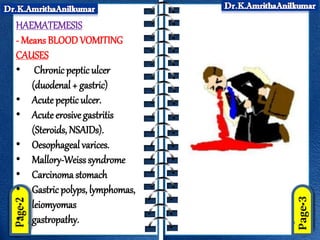
- Means BLOODVOMITING
CAUSES
• Chronic peptic ulcer
(duodenal + gastric)
• Acute pepticulcer.
• Acute erosive gastritis
(Steroids, NSAIDs).
• Oesophageal varices.
• Mallory-Weisssyndrome
• Carcinoma stomach
• Gastric polyps, lymphomas,
leiomyomas
• gastropathy.
• Bleeding disorders.
• Pernicious anaemia.
• Thrombocytopenia
• Gastric antral vascular
ectasia
• It is a rare endoscopically
confirmedcondition which
shows segmenteddilated
vessel meshes in the antral
mucosa(watermelon/tiger
stripe stomach).
• It is oftenassociated with
achlorhydria &
hypergastrinaemia.
• It is common in middle aged
females; common in liver
diseases (25%) and
autoimmune connective tissue
disorders.
• Pathologically it shows
mucosal fibromuscular
hyperplasia and hyalinisation.
• Dieulafoy’s disease
• A gastricarteriovenous
malfor mation whichis
covered by apparently
normal mucosa.
• It occurs in proximal
stomachnear OG junction
(within 6 cm) along lesser
curve
• Bleeding often may be
severe and torrential
• Vasculitis or atheroma are
absent in the vessel.
• It is 5%of nonvariceal
upper GI bleed.
• A large 1–3 mm tortuous
abnormal submucosal
artery(AVM) is the cause,
whichdue to its pulsation
erodes themucosa to expose
itself to acidwhich further
erodes the artery causing
bleeding
INVESTIGATION
• Endoscopy and
endoscopictherapy or
excision of the lesionis
required.
• Angiography can be
done to confirmthe
diseaseand to do
therapeutic embolisation
using gel foam.
.
• Failure of endoscopic or
angiographic therapy needs
gastrotomy& excisionof
the entire lesion—gastric
wedge resection.
• It canbe done by
open/laparoscopic
approach.
• Prior endoscopictattooing is
mandatory to identify the
lesion during resection
TREATMENT
• Evaluation of patient by
measuring BP
• Pulse, respirationlooking for
features of shock
• Oxygensaturation,
• investigatingfor Hb%, blood
grouping
• Blood urea, serumcreatinine
• LFT
• Prothrombintime
• Plateletcount
• Arterial blood gas analysis,
• Gastroscopy.
• Initial treatment is
central line insertion,
fluid and blood
replacement;
catheterisation
• critical care (ICU)
• Antibiotics
• Treatment of
complications like sepsis,
DIC, ARDS.
• Specific treatment—
opensurgeryfor
uncontrolled bleeding
• Ligation of
gastroduodenal artery
• Underrunning of ulcer bed
with pyloroplasty
• Gastrectomy
• ligation of varices with
devascularisation.
• Definitive surgeryfor
underlying cause—shunt
surgery; vagotomy and GJ;
• Gastrectomy; splenectomy,
etc.
REFERENCE
1. SRB's Manual of Surgery
by SriramBhat M
2. A Manual on Clinical
Surgeryby Das
3. A Concise textbookof
Surgeryby Das
A
Special Thanks
To A Very
Special Doctor

Haematemesis

  • 1.
    en love daHomoeopathy HAEMATEMESIS
  • 2.
  • 3.
    HAEMATEMESIS - Means BLOODVOMITING CAUSES •Chronic peptic ulcer (duodenal + gastric) • Acute pepticulcer. • Acute erosive gastritis (Steroids, NSAIDs). • Oesophageal varices. • Mallory-Weisssyndrome • Carcinoma stomach • Gastric polyps, lymphomas, leiomyomas • gastropathy.
  • 4.
    • Bleeding disorders. •Pernicious anaemia. • Thrombocytopenia • Gastric antral vascular ectasia • It is a rare endoscopically confirmedcondition which shows segmenteddilated vessel meshes in the antral mucosa(watermelon/tiger stripe stomach). • It is oftenassociated with achlorhydria & hypergastrinaemia. • It is common in middle aged females; common in liver diseases (25%) and autoimmune connective tissue disorders. • Pathologically it shows mucosal fibromuscular hyperplasia and hyalinisation. • Dieulafoy’s disease • A gastricarteriovenous malfor mation whichis covered by apparently normal mucosa.
  • 5.
    • It occursin proximal stomachnear OG junction (within 6 cm) along lesser curve • Bleeding often may be severe and torrential • Vasculitis or atheroma are absent in the vessel. • It is 5%of nonvariceal upper GI bleed. • A large 1–3 mm tortuous abnormal submucosal artery(AVM) is the cause, whichdue to its pulsation erodes themucosa to expose itself to acidwhich further erodes the artery causing bleeding
  • 6.
    INVESTIGATION • Endoscopy and endoscopictherapyor excision of the lesionis required. • Angiography can be done to confirmthe diseaseand to do therapeutic embolisation using gel foam. . • Failure of endoscopic or angiographic therapy needs gastrotomy& excisionof the entire lesion—gastric wedge resection. • It canbe done by open/laparoscopic approach. • Prior endoscopictattooing is mandatory to identify the lesion during resection
  • 7.
    TREATMENT • Evaluation ofpatient by measuring BP • Pulse, respirationlooking for features of shock • Oxygensaturation, • investigatingfor Hb%, blood grouping • Blood urea, serumcreatinine • LFT • Prothrombintime • Plateletcount • Arterial blood gas analysis, • Gastroscopy. • Initial treatment is central line insertion, fluid and blood replacement; catheterisation • critical care (ICU) • Antibiotics • Treatment of complications like sepsis, DIC, ARDS. • Specific treatment— opensurgeryfor uncontrolled bleeding • Ligation of gastroduodenal artery
  • 8.
    • Underrunning ofulcer bed with pyloroplasty • Gastrectomy • ligation of varices with devascularisation. • Definitive surgeryfor underlying cause—shunt surgery; vagotomy and GJ; • Gastrectomy; splenectomy, etc. REFERENCE 1. SRB's Manual of Surgery by SriramBhat M 2. A Manual on Clinical Surgeryby Das 3. A Concise textbookof Surgeryby Das
  • 9.
    A Special Thanks To AVery Special Doctor