en love da Homoeopathy
VARICOCELE
VARICOCELE
VARICOCELE
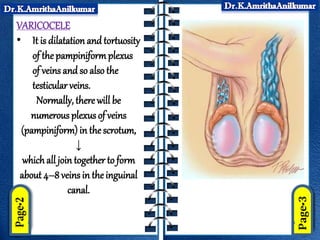
• It is dilatation and tortuosity
of thepampiniform plexus
of veins and so also the
testicular veins.
Normally, there will be
numerous plexus of veins
(pampiniform) in the scrotum,
↓
whichall join together to form
about 4–8 veins in the inguinal
canal.
↓
Above, in the abdominal cavity,
↓
in the posterior abdominal wall
↓
all join to forma single
testicular vein.
↓
On left side, it drains the left
renal vein
↓
on the right side it drains the
inferior vena cava.
INCIDENCE
• Varicocele is common in
tall, thinyoung men.
• More commonon the left
side, but oftencan be
bilateral.
FEATURES
• Commonly, it is idiopathic
in origin,
• may be due to absence or
incompetent valveat the
junction of left testicular
vein and left renal vein
causing inefficient
drainage of blood.
• Other reasonis, due to
perpendicular (right angle)
entryof the left testicular
veinintothe left renal vein.
• In left-sidedrenal cell
carcinoma, tumour
proliferates intothe left renal
vein and blocks the entry of
left testicular veincausing
varicocele on left side which is
irreducible
• Varicocele causes increased
temperaturein thescrotum
whichdepresses the
spermatogenesis and so
causes infertility(correctable
infertility).
TYPES
• Primary/idiopathic
↓
No cause is found.
↓
Thereis incompetence of
valves of the testicular vein.
↓
It is commonon left side
↓
becauseleft testicular vein
joins left renal vein
perpendicularly
↓
and left side vein is longer and
liable to get compressed by
loadedsigmoid colon.
↓
Left renal vein is often
compressed betweenaortaand
SMA.
• Secondary
↓
due to specific cause likeleft-
sided renal cell carcinoma
↓
with a tumour thrombus in left
renal vein
↓
causing obstruction to venous
flow of left testicular vein.
CLINICALFEATURES
• Bow sign
• After holding the varicocele
betweenthumband fingers
↓
patient is asked to bow.
↓
Varicocele gets reduced in size.
↓
Bowing reduces the blood flow of
testicular vein and pampiniform
plexus
↓
causing reduction in size.
↓
Grading of varicocele
I. Small
II. Moderate
III. Large
IV. Severely tortuous.
DIFFERENTIAL DIAGNOSIS
• Hydrocele.
• Inguinal hernia.
• Lymph varix.
• Lipoma of the cord.
INVESTIGATION
• Venous Doppler of the
scrotumand groin.
• Ultrasoundabdomento look
for kidneytumour.
• Semenanalysis
TREATMENT
• Palomo’s operation:
• Suprainguinal
extraperitoneal
ligation of the
testicular vein.
• Inguinal approach
(Ivanissevichapproach):
Easier and safer.
• Subinguinalapproach
• Scrotal approach: In case of
grade IV, veins haveto be
excised throughthis
approach.
• Laparoscopic approach
INDICATIONS OF SURGERY™
• Pain™
• Oligospermia—usually in
6–12 weeks oligospermia
improves verywell and also
the conception rate
COMPLICATION
• Haemorrhage
• scrotal haematoma ™
• Infection
• pyocele ™
• Injury to testicular artery ™
• Injury to ilioinguinal nerve
and pain.
REFERENCE
1. SRB's Manual of Surgery
by SriramBhat M
2. A Manual on Clinical
Surgeryby Das
3. A Concise textbookof
Surgeryby Das
A
Special Thanks
To A Very
Special Doctor

Varicocele by Dr.K.AmrithaAnilkumar

  • 1.
    en love daHomoeopathy VARICOCELE
  • 2.
  • 3.
    VARICOCELE • It isdilatation and tortuosity of thepampiniform plexus of veins and so also the testicular veins. Normally, there will be numerous plexus of veins (pampiniform) in the scrotum, ↓ whichall join together to form about 4–8 veins in the inguinal canal.
  • 4.
    ↓ Above, in theabdominal cavity, ↓ in the posterior abdominal wall ↓ all join to forma single testicular vein. ↓ On left side, it drains the left renal vein ↓ on the right side it drains the inferior vena cava. INCIDENCE • Varicocele is common in tall, thinyoung men. • More commonon the left side, but oftencan be bilateral. FEATURES • Commonly, it is idiopathic in origin, • may be due to absence or incompetent valveat the junction of left testicular vein and left renal vein causing inefficient drainage of blood.
  • 5.
    • Other reasonis,due to perpendicular (right angle) entryof the left testicular veinintothe left renal vein. • In left-sidedrenal cell carcinoma, tumour proliferates intothe left renal vein and blocks the entry of left testicular veincausing varicocele on left side which is irreducible • Varicocele causes increased temperaturein thescrotum whichdepresses the spermatogenesis and so causes infertility(correctable infertility).
  • 6.
    TYPES • Primary/idiopathic ↓ No causeis found. ↓ Thereis incompetence of valves of the testicular vein. ↓ It is commonon left side ↓ becauseleft testicular vein joins left renal vein perpendicularly ↓ and left side vein is longer and liable to get compressed by loadedsigmoid colon. ↓ Left renal vein is often compressed betweenaortaand SMA.
  • 7.
    • Secondary ↓ due tospecific cause likeleft- sided renal cell carcinoma ↓ with a tumour thrombus in left renal vein ↓ causing obstruction to venous flow of left testicular vein. CLINICALFEATURES • Bow sign • After holding the varicocele betweenthumband fingers ↓ patient is asked to bow. ↓ Varicocele gets reduced in size. ↓ Bowing reduces the blood flow of testicular vein and pampiniform plexus
  • 8.
    ↓ causing reduction insize. ↓ Grading of varicocele I. Small II. Moderate III. Large IV. Severely tortuous. DIFFERENTIAL DIAGNOSIS • Hydrocele. • Inguinal hernia. • Lymph varix. • Lipoma of the cord. INVESTIGATION • Venous Doppler of the scrotumand groin. • Ultrasoundabdomento look for kidneytumour. • Semenanalysis
  • 9.
    TREATMENT • Palomo’s operation: •Suprainguinal extraperitoneal ligation of the testicular vein. • Inguinal approach (Ivanissevichapproach): Easier and safer. • Subinguinalapproach • Scrotal approach: In case of grade IV, veins haveto be excised throughthis approach. • Laparoscopic approach INDICATIONS OF SURGERY™ • Pain™ • Oligospermia—usually in 6–12 weeks oligospermia improves verywell and also the conception rate COMPLICATION • Haemorrhage • scrotal haematoma ™ • Infection • pyocele ™ • Injury to testicular artery ™ • Injury to ilioinguinal nerve and pain.
  • 10.
    REFERENCE 1. SRB's Manualof Surgery by SriramBhat M 2. A Manual on Clinical Surgeryby Das 3. A Concise textbookof Surgeryby Das
  • 11.
    A Special Thanks To AVery Special Doctor