


en love da Homoeopathy
HYDROCELE
HYDROCELE
HYDROCELE
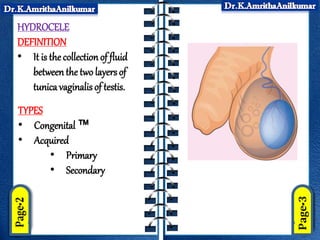
DEFINITION
• It is the collectionof fluid
betweenthe two layersof
tunica vaginalis of testis.
TYPES
• Congenital ™
• Acquired
• Primary
• Secondary
AETIOLOGY
• Defective absorption of fluid
by the tunicavaginalis,
probably due to damage to
the endothelial wall by low-
grade infection.
• Excessiveproductionof fluid
as in secondary hydrocele.
• Interference withdrainage of
fluid by lymphaticvessels of
the cord.
• Communicationwiththe
peritoneal cavity.
FEATURES
• Hydrocele fluid is
amber-colouredwith
specificgravity of 1.022
to 1.024.
• It contains water, salts,
albumin, fibrinogen.
• Per se, hydrocele fluid
does not clot, but if it
comes in contact with
the blood, fibrinogen
gets activated and clots
firmly.
• Oftenfluidcontains
cholesterol and tyrosine
crystals.
• Cysts which contain
cholesterol crystals ™
• Vaginal hydrocele ™
• Branchial cysts ™
• Dentigerous cyst
TYPES
PRIMARYVAGINAL
HYDROCELE
• Occurs in middle-aged,
commonin tropical
countries.
Testis is not palpable as it
usually attains a large size
↓
(unlikesecondaryhydroceles
whichare small, except in
filarial hydrocele).
.
↓
Fluctuant (elicited by, fixing
the hydrocele with hand
↓
and feeling for the fluid
movement using fingers placed
in two perpendicular
directions).
↓
Initially transilluminant
(elicited in front of the swelling,
side to side)
↓
but long-standing hydrocele is
nontransilluminant
↓
(due to thickened dartos,
thicke ned spermaticfascia,
thickenedhydrocele sac,
infected content, chylous
fluid, oftenfilarial hydrocele,
haematocele).
↓
Canget abovethe swelling
(you can feel only cord
structures
↓
and nothing else at the root of
the scrotum, unlike in
hernia).
↓
Testicular sensation canbe
elicitedin vaginal hydrocele
↓
by transmitting the pressure
sensation through the fluid.
↓
Swellings which are brilliantly
transilluminant
• Epididymal cyst ™
• Cystichygroma ™
• Ranula ™
• Meningocele
Infantile Hydrocele
• Here tunica and processus
vaginalis (hydrocele)are
distendedup to internal ring,
but sac has no con nection
with the general peritoneal
cavity.
Congenital Hydrocele
• Processus vaginalis
communicates with the
peritoneal cavity.
As this communicating orifice
is too small,
↓
bowel does not descend
↓
and so hernia usually will not
develop.
↓
Whilelying down, fluid
disappears gradually and
whilestanding fluid recollects.
↓
Hydrocele cannot be emptied
by digital pressure as it causes
“invertedink bottle” effect.
↓
Ascites, tuberculous
peritonitis are the aetiologies
for the same
Encysted Hydrocele of the Cord
• It is the fluidcollectionin a
portionof patent funicular
processpart of the tunica
vaginalis;
• but closed above and below;
located in
inguinal/inguinoscrotal/scro
tal part which is fluctuant
and transilluminant.
• On gentle traction to the
testis, the swelling becomes
less mobile (traction test).
DIFFERENTIAL
DIAGNOSIS
• Epididymal cyst
• inguinal hernia
• lipoma of cord,
varicocele.
TREATMENT
• Treatment is excision
under local
anaesthesia
Hydrocele-en-bisac(Bilocular
Hydrocele)
• Hydrocele has got two
intercommunicating sacs,
one aboveand one below
the neck of the scrotum.
• Upper one lies superficial
or in the inguinal canal or
may insinuateitself
betweenthe muscle
layers—cross-fluctuant
Hydrocele of the Canal of Nuck
• It occurs in females, in
relationto the round
ligament, alwaysin the
inguinal canal.
• Hydrocele of theHernial
Sac
• It is due to adhesions of the
content of hernial sac.
• Fluidsecreted collects in
the hernial sac and forms
hydrocele of the hernial
sac.
SECONDARYVAGINAL
HYDROCELE
Causes
• It is usually small, lax and
testis is usually palpable
(unlike primary hydrocele).
Exceptionis, secondary
hydrocele due to filariasis.
• It can be very large.
Infection:
• Filariasis Tuberculosis
of epididymis - have
secondary hydrocele
• Syphilis Injury:
Trauma
• Postherniorrhaphy
• hydrocele Tumour:
Malignancy
• Secondaryhydrocele
rarely attains large
size
Postherniorrhaphy Hydrocele
• It is a secondary hydrocele
occurring after the surgery
for inguinal hernia.
• It is due to the damageto
lymphatic vessels of the
tunica vaginalis
• It is treatedlike any
hydrocele but usually after
about 6 months.
• Filarial Hydrocele and
Chylocele
• Occurs commonlyin
coastal region, and in
and aroundthe equator.
• Usually occurs after
repeated attacks of
filarial epididymitis.
• Hydrocele is usually of
large size and the sac is
thickened.
• Fluidcontains fat, richin
cholesterol, and is derived
fromruptured lymph
varixinto the tunica.
• It is often difficult to
differentiatefromprimary
hydrocele.
COMPLICATION
• Hydrocele
• Infection™
• Pyocele ™
• Haematocele™
• Atrophy of testis ™
• Infertility ™
• Hernia of hydrocele sac
(rare)
DIFFERENTIAL DIAGNOSIS
• Inguinal hernia™
• Epididymal cyst ™
• Spermatocele ™
• Testicular tumour™
• Scrotal oedema
TREATMENT
Surgery
• Sub-total excision™
• Partial excision and
eversion(Jaboulay’s opera
tion) ™
• Evacuation and eversion ™
• Lord’s plication
• Surgeries for hydrocele ™
• Subtotal excisionof the
sac ™
Jaboulay’s operation™
• Evacuation and eversion ™
• Lord’s plication™
Sharma
and Jhawer’s technique
COMPLICATION OF SURGERY
• Reactionary haemorrhage
• Infection™
• Pyocele ™
• Sinus formation ™
• Recurrent hydrocele
• Conditions which cause loss
of testicular sensation
i. Testicular tumour
ii. Lepraorchitis
iii. Syphilitic orchitis
iv. Chronichaematocele
• Conditions where
orchidectomy is done in
hydrocele ™
• Pyocele with testicular
destruction ™
• Clottedhaematocele with
testicular destruction
REFERENCE
1. SRB's Manual of Surgery
by SriramBhatM
2. A Manual on Clinical
Surgeryby Das
3. A Concise textbookof
Surgeryby Das
A
Special Thanks
To A Very
Special Doctor

Hydrocele by Dr.K.AmrithaAnilkumar

  • 1.
    en love daHomoeopathy HYDROCELE
  • 2.
  • 3.
    HYDROCELE DEFINITION • It isthe collectionof fluid betweenthe two layersof tunica vaginalis of testis. TYPES • Congenital ™ • Acquired • Primary • Secondary
  • 4.
    AETIOLOGY • Defective absorptionof fluid by the tunicavaginalis, probably due to damage to the endothelial wall by low- grade infection. • Excessiveproductionof fluid as in secondary hydrocele. • Interference withdrainage of fluid by lymphaticvessels of the cord. • Communicationwiththe peritoneal cavity. FEATURES • Hydrocele fluid is amber-colouredwith specificgravity of 1.022 to 1.024. • It contains water, salts, albumin, fibrinogen. • Per se, hydrocele fluid does not clot, but if it comes in contact with the blood, fibrinogen gets activated and clots firmly.
  • 5.
    • Oftenfluidcontains cholesterol andtyrosine crystals. • Cysts which contain cholesterol crystals ™ • Vaginal hydrocele ™ • Branchial cysts ™ • Dentigerous cyst TYPES PRIMARYVAGINAL HYDROCELE • Occurs in middle-aged, commonin tropical countries. Testis is not palpable as it usually attains a large size ↓ (unlikesecondaryhydroceles whichare small, except in filarial hydrocele).
  • 6.
    . ↓ Fluctuant (elicited by,fixing the hydrocele with hand ↓ and feeling for the fluid movement using fingers placed in two perpendicular directions). ↓ Initially transilluminant (elicited in front of the swelling, side to side) ↓ but long-standing hydrocele is nontransilluminant ↓ (due to thickened dartos, thicke ned spermaticfascia, thickenedhydrocele sac, infected content, chylous fluid, oftenfilarial hydrocele, haematocele). ↓ Canget abovethe swelling (you can feel only cord structures ↓ and nothing else at the root of the scrotum, unlike in hernia).
  • 7.
    ↓ Testicular sensation canbe elicitedinvaginal hydrocele ↓ by transmitting the pressure sensation through the fluid. ↓ Swellings which are brilliantly transilluminant • Epididymal cyst ™ • Cystichygroma ™ • Ranula ™ • Meningocele Infantile Hydrocele • Here tunica and processus vaginalis (hydrocele)are distendedup to internal ring, but sac has no con nection with the general peritoneal cavity.
  • 8.
    Congenital Hydrocele • Processusvaginalis communicates with the peritoneal cavity. As this communicating orifice is too small, ↓ bowel does not descend ↓ and so hernia usually will not develop. ↓ Whilelying down, fluid disappears gradually and whilestanding fluid recollects. ↓ Hydrocele cannot be emptied by digital pressure as it causes “invertedink bottle” effect. ↓ Ascites, tuberculous peritonitis are the aetiologies for the same
  • 9.
    Encysted Hydrocele ofthe Cord • It is the fluidcollectionin a portionof patent funicular processpart of the tunica vaginalis; • but closed above and below; located in inguinal/inguinoscrotal/scro tal part which is fluctuant and transilluminant. • On gentle traction to the testis, the swelling becomes less mobile (traction test). DIFFERENTIAL DIAGNOSIS • Epididymal cyst • inguinal hernia • lipoma of cord, varicocele. TREATMENT • Treatment is excision under local anaesthesia
  • 10.
    Hydrocele-en-bisac(Bilocular Hydrocele) • Hydrocele hasgot two intercommunicating sacs, one aboveand one below the neck of the scrotum. • Upper one lies superficial or in the inguinal canal or may insinuateitself betweenthe muscle layers—cross-fluctuant Hydrocele of the Canal of Nuck • It occurs in females, in relationto the round ligament, alwaysin the inguinal canal. • Hydrocele of theHernial Sac • It is due to adhesions of the content of hernial sac. • Fluidsecreted collects in the hernial sac and forms hydrocele of the hernial sac.
  • 11.
    SECONDARYVAGINAL HYDROCELE Causes • It isusually small, lax and testis is usually palpable (unlike primary hydrocele). Exceptionis, secondary hydrocele due to filariasis. • It can be very large. Infection: • Filariasis Tuberculosis of epididymis - have secondary hydrocele • Syphilis Injury: Trauma • Postherniorrhaphy • hydrocele Tumour: Malignancy • Secondaryhydrocele rarely attains large size
  • 12.
    Postherniorrhaphy Hydrocele • Itis a secondary hydrocele occurring after the surgery for inguinal hernia. • It is due to the damageto lymphatic vessels of the tunica vaginalis • It is treatedlike any hydrocele but usually after about 6 months. • Filarial Hydrocele and Chylocele • Occurs commonlyin coastal region, and in and aroundthe equator. • Usually occurs after repeated attacks of filarial epididymitis. • Hydrocele is usually of large size and the sac is thickened. • Fluidcontains fat, richin cholesterol, and is derived fromruptured lymph varixinto the tunica.
  • 13.
    • It isoften difficult to differentiatefromprimary hydrocele. COMPLICATION • Hydrocele • Infection™ • Pyocele ™ • Haematocele™ • Atrophy of testis ™ • Infertility ™ • Hernia of hydrocele sac (rare) DIFFERENTIAL DIAGNOSIS • Inguinal hernia™ • Epididymal cyst ™ • Spermatocele ™ • Testicular tumour™ • Scrotal oedema
  • 14.
    TREATMENT Surgery • Sub-total excision™ •Partial excision and eversion(Jaboulay’s opera tion) ™ • Evacuation and eversion ™ • Lord’s plication • Surgeries for hydrocele ™ • Subtotal excisionof the sac ™ Jaboulay’s operation™ • Evacuation and eversion ™ • Lord’s plication™ Sharma and Jhawer’s technique COMPLICATION OF SURGERY • Reactionary haemorrhage • Infection™ • Pyocele ™ • Sinus formation ™ • Recurrent hydrocele • Conditions which cause loss of testicular sensation i. Testicular tumour ii. Lepraorchitis iii. Syphilitic orchitis iv. Chronichaematocele
  • 15.
    • Conditions where orchidectomyis done in hydrocele ™ • Pyocele with testicular destruction ™ • Clottedhaematocele with testicular destruction REFERENCE 1. SRB's Manual of Surgery by SriramBhatM 2. A Manual on Clinical Surgeryby Das 3. A Concise textbookof Surgeryby Das
  • 16.
    A Special Thanks To AVery Special Doctor