International
OPEN ACCESS Journal
Of Modern Engineering Research (IJMER)
| IJMER | ISSN: 2249–6645 | www.ijmer.com | Vol. 5 | Iss.3| Mar. 2015 | 49|
Experimental Investigation of Electrode Wear in Die-Sinking
EDM on Different Pulse-on &off Time (µs) in Cylindrical
Copper Electrode
Bharat Raj Bundel
Department of Mechanical Engineering, Shri Jagdish Prasad Jhabarmal Tibrewala University (JJTU),
Jhunjunu Rajasthan, India
I. Introduction
A. Electrical Discharge Machining
Electrical Discharge Machining (EDM) is an electrical thermal non-traditional machining process,
where electrical energy is used to generate electrical spark and material removal mainly occurs due to thermal
energy of the spark. EDM is mainly used to machine high temperature resistance alloy. EDM can be used to
machine difficult geometries in small batches. Work material to be machined by EDM has to be electrically
conductive. In EDM, a potential difference is applied between the tool (electrode) and work piece. Both the tool
and work piece material are to be conductors of electricity. Tool and work piece are immersed in a dielectric
medium. Generally kerosene is used as a dielectric medium. A gap is maintained between tool and work piece.
Depending upon the applied potential difference and the gap between the tool and work piece, an electric field
would be established. Generally the tool is connected to the negative terminal of generator and the work piece
to the positive terminal. As the electric field is established between the tool and work piece, the free electrons on
the tool are subjected to the electrostatic forces. If the work function or the bonding energy of the electron is
less, electron would be emitted from the tool. Such emission of electrons are called cold emission. The cold
emitted electrons are then accelerated towards the work piece through the dielectric medium. As they gain
velocity and energy, start moving towards the work piece, there would be collision between the electron and
dielectric molecules. Such collision may result in ionization of energy of the electron. Thus as the electron get
accelerated, more positive ions and electrons would get generated due to collisions. This cyclic process would
increase the concentration of electrons and ions in the dielectric medium between tool and work piece at the
spark gap. A large number of electrons will flow from the tool to the work piece and ions from work piece to the
tool. Such movement of electrons and ions can be visually seen as a spark. Thus the electrical energy is
dissipated as the thermal energy of the spark. The high speed electrons then impinge on the work piece and ions
on the tool. The kinetic energy of electrons and ions on impact with the surface of the work piece and electrode
respectively would be converted in to thermal energy. Such intense localized heat flux leads to rise in
temperature which would be in excess of ten thousand degree Celsius. Such localized extreme rise in
temperature leads to metal removal. Material removal occur due to instant vaporization of the material as well as
melting. The molten metal is not removed completely but only partially. Generally the work piece is made
ABSTRACT: EDM is an advanced machining method for manufacturing, hard material parts which
are difficult to machine by conventional machining process. There are various type of products which
can be produced by using Die-sinking EDM, such as dies, moulds. Parts of aerospace, automobile
industry and surgical components can be finished machined by EDM. In present scenario numbers of
researchers have explored a number of ways to improve EDM efficiency. The optimum selection of
manufacturing condition is very important in manufacturing processes as they determine surface
quality, dimensional accuracy of the obtained parts. This experimental investigation is mainly focused
on electrode wear in cylindrical copper electrode on different pulse-on & off time (µs) at constant
current(amp.) which is an important parameter. In this experimental work, an investigation has been
made to optimize the response parameter (electrode wear) of EDM on die-steel with electrolytic
cylindrical copper electrode. Die-steel (HRC-58) is widely used in production of dies. In this
investigation copper has been taken as electrode and die-steel as a work piece. Electrode wear has
been investigated in the form of weight (gm) and length (mm.) of electrode on different input process
parameters. viz constant discharge current (amp.), pulse on time (T-on), pulse off time (T-off)
Keywords: Current(amp.); Length(mm.);T-on(µs);T-off(µs); Weight(gm)
Experimental Investigation of Electrode Wear in Die-Sinking EDM………….
| IJMER | ISSN: 2249–6645 | www.ijmer.com | Vol. 5 | Iss.3| Mar. 2015 | 50|
positive and the electrode negative. Hence the electrons strike the work piece leading to crater formation due to
high temperature and melting and material removal. Similarly positive ions impinge on the electrode (tool)
leading to wear. It is very needful to find out the wear which is produced in electrode (tool) due to different
voltage, pulse on& off time and current(amp.) so that at the particular condition of voltage, pulse on& off time
and current(amp.) EDM can be set and then efficiency will be increased. In EDM the generator is used to apply
voltage pulses between electrode and work piece. Only sparking is desired in EDM rather than arcing . Arcing is
used localized material removal at a particular point whereas sparks get distributed all over the electrode surface
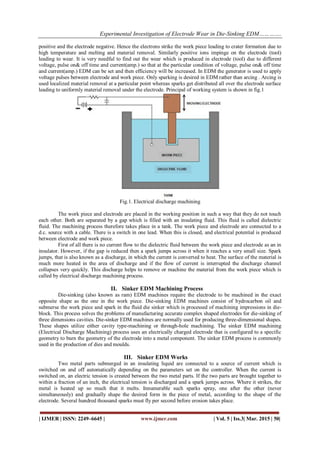
leading to uniformly material removal under the electrode. Principal of working system is shown in fig.1
Fig.1. Electrical discharge machining
The work piece and electrode are placed in the working position in such a way that they do not touch
each other. Both are separated by a gap which is filled with an insulating fluid. This fluid is called dielectric
fluid. The machining process therefore takes place in a tank. The work piece and electrode are connected to a
d.c. source with a cable. There is a switch in one lead. When this is closed, and electrical potential is produced
between electrode and work piece.
First of all there is no current flow to the dielectric fluid between the work piece and electrode as an in
insulator. However, if the gap is reduced then a spark jumps across it when it reaches a very small size. Spark
jumps, that is also known as a discharge, in which the current is converted to heat. The surface of the material is
much more heated in the area of discharge and if the flow of current is interrupted the discharge channel
collapses very quickly. This discharge helps to remove or machine the material from the work piece which is
called by electrical discharge machining process.
II. Sinker EDM Machining Process
Die-sinking (also known as ram) EDM machines require the electrode to be machined in the exact
opposite shape as the one in the work piece. Die-sinking EDM machines consist of hydrocarbon oil and
submerse the work piece and spark in the fluid die sinker which is processed of machining impressions in die-
block. This process solves the problems of manufacturing accurate complex shaped electrodes for die-sinking of
three dimensions cavities. Die-sinker EDM machines are normally used for producing three-dimensional shapes.
These shapes utilize either cavity type-machining or through-hole machining. The sinker EDM machining
(Electrical Discharge Machining) process uses an electrically charged electrode that is configured to a specific
geometry to burn the geometry of the electrode into a metal component. The sinker EDM process is commonly
used in the production of dies and moulds.
III. Sinker EDM Works
Two metal parts submerged in an insulating liquid are connected to a source of current which is
switched on and off automatically depending on the parameters set on the controller. When the current is
switched on, an electric tension is created between the two metal parts. If the two parts are brought together to
within a fraction of an inch, the electrical tension is discharged and a spark jumps across. Where it strikes, the
metal is heated up so much that it melts. Innumerable such sparks spray, one after the other (never
simultaneously) and gradually shape the desired form in the piece of metal, according to the shape of the
electrode. Several hundred thousand sparks must fly per second before erosion takes place.
Experimental Investigation of Electrode Wear in Die-Sinking EDM………….
| IJMER | ISSN: 2249–6645 | www.ijmer.com | Vol. 5 | Iss.3| Mar. 2015 | 51|
IV. Die-Sinking EDM Machining
Die sinking EDM is a kind of machining of varying the shape of electrode to the work piece and the
shape of the electrode is changed by sparks. Die-sinking sparking occurs across the end surface and from the
corners of the electrode. Spark length is set by the machine controls. Sparks produce from the electrode corners,
producing a clearance between the electrode corner and the sidewalls of the work piece. The machined clearance
between the electrode corner and work piece sidewall is the spark overcut. The electrode-end sparking surface,
plus the sidewall over cut distance, is the sparking area. Die sinking (known as ram also) type EDM machine
requires the electrode to be machined in the exact opposite shape as the one in the work piece.
V. Electrode Wear
The shape of electrode which is changed by sparks. This change is called electrode wear. The ratio of
the amount of machining of the work piece to the amount of electrode wear is called electrode wear ratio, and it
is important on varying the shape of the electrode to the work piece. Electrode wear ratio changes due to the
combination of electrode and work piece material, polarity of the voltage to apply, duration of the spark etc.
Electrode wear is an important affecting factor in die-sinking EDM. Which influences the metal removal rate
and surface roughness. It is really important to know that how and why electrode wear occurs in order to
achieve maximum EDM efficiency.
In this experimental study Electrode wear has been investigated in cylindrical copper electrode on die-
steel as a work piece material. Electrode wear has been investigated in the form of weight (gm) and length
(mm). This electrode wear is called end wear which is the common form of wear and is defined as the reduction
in length of electrode during the machining process. End wear is the only type of wear that can be reduced by
operating parameters.
VI. Experimentation
This study is carried out to find out the electrode wear in cylindrical copper material in die-sinking
EDM and compaired the wear of copper electrode on different input process parameters and optimized the
electrode wear at certain conditions.
A) Input process parameters:-
Discharge current (amp.), Pulse on time (T-on in µs), Pulse off time (T-off in µs), Depth of machining(mm),
Voltage.
B) Response parameter
Weight (gm) of electrode, Length (mm) of electrode
C) Specification of EDM
The EDM used for the experiment is Die-sinking Electrical Discharge Machining Model No- Sparkonix 25-
amp.
D) Electrode piece material
Copper
E) Work piece material
Die-steel (HRC-58)
F) Die-electric fluid
Kerosene
VII. Experimental Results For Electrode Wear
Electrode Material-Copper, Depth of Machining-1mm. 50V
Table-1 Work piece-Die-steel
Experimental Investigation of Electrode Wear in Die-Sinking EDM………….
| IJMER | ISSN: 2249–6645 | www.ijmer.com | Vol. 5 | Iss.3| Mar. 2015 | 52|
Fig. 2
Fig. 3
Electrode Material-Copper, Depth of Machining-1mm. 50V
Table-2 Work piece-Die-steel
0
100
200
300
400
500
600
1 2 3
4
5
weight (gm.)
Time-on(µs)
Time-off(µs)
Current (Amp.)
1 2 3 4 5
0
100
200
300
400
500
600
700
800
Current (Amp.)
Time-off(µs)
Time-on(µs)
weight (gm.)
Experimental Investigation of Electrode Wear in Die-Sinking EDM………….
| IJMER | ISSN: 2249–6645 | www.ijmer.com | Vol. 5 | Iss.3| Mar. 2015 | 53|
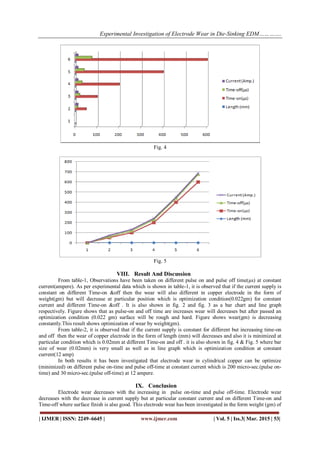
Fig. 4
Fig. 5
VIII. Result And Discussion
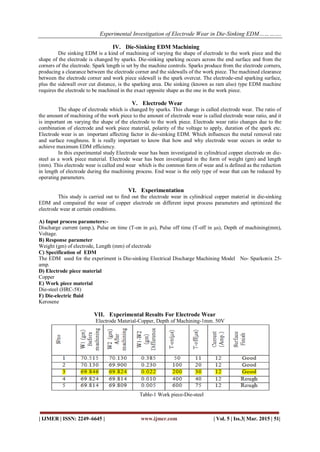
From table-1, Observations have been taken on different pulse on and pulse off time(µs) at constant
current(ampere). As per experimental data which is shown in table-1, it is observed that if the current supply is
constant on different Time-on &off then the wear will also different in copper electrode in the form of
weight(gm) but will decrease at particular position which is optimization condition(0.022gm) for constant
current and different Time-on &off . It is also shown in fig. 2 and fig. 3 as a bar chart and line graph
respectively. Figure shows that as pulse-on and off time are increases wear will decreases but after passed an
optimization condition (0.022 gm) surface will be rough and hard. Figure shows wear(gm) is decreasing
constantly.This result shows optimization of wear by weight(gm).
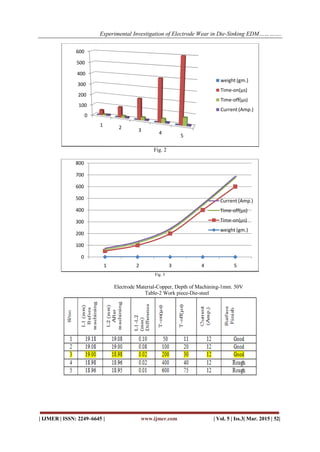
From table-2, it is observed that if the current supply is constant for different but increasing time-on
and off then the wear of copper electrode in the form of length (mm) will decreases and also it is minimized at
particular condition which is 0.02mm at different Time-on and off . it is also shown in fig. 4 & Fig. 5 where bar
size of wear (0.02mm) is very small as well as in line graph which is optimization condition at constant
current(12 amp)
In both results it has been investigated that electrode wear in cylindrical copper can be optimize
(minimized) on different pulse on-time and pulse off-time at constant current which is 200 micro-sec.(pulse on-
time) and 30 micro-sec.(pulse off-time) at 12 ampere.
IX. Conclusion
Electrode wear decreases with the increasing in pulse on-time and pulse off-time. Electrode wear
decreases with the decrease in current supply but at particular constant current and on different Time-on and
Time-off where surface finish is also good. This electrode wear has been investigated in the form weight (gm) of
Experimental Investigation of Electrode Wear in Die-Sinking EDM………….
| IJMER | ISSN: 2249–6645 | www.ijmer.com | Vol. 5 | Iss.3| Mar. 2015 | 54|
cylindrical copper electrode. It has been also investigated that electrode wear in the form of length (mm)
decreases with the increasing in Time-on and Time-off when current is constant. From this experimental
investigation it has been concluded that cylindrical copper electrode can be used for long time without
redressing the electrode. Due to less wear die-sinking EDM will provide an economic advantage for making
different holes and cavities.
REFERENCES
[1] Bergaley, Ajeet., Sharma, Narendra. (2013), “Optimization Of Electrical And Non Electrical Factor In Edm For
Machining Die Steel Using Copper Electrode By Adopting Taghuchi Technique” International Journal of Innovative
Technology And Exploraing Engineering , Vol. 3, Issue 3, Pp44-48, Issn:2278-3075.
[2] Choudhary, Rajesh., Kumar, H and Garg, R. K. (2010), “Analysis And Evaluation Of Heat Affected Zones In
Electric Discharge Machining Of En-31 Die Steel” Indian Journal Of Engineering & Material Science, Vol. 17,
Pp91-98.
[3] Daneshmand, Saeed., Kahrizi, Ehsan Farahmand., Abedi,Esmail and Abdolhosseni, M. Mir. (2013), “Influence Of
Machining Parameters On Electro Discharge Machining Of Ni-Ti Shape Memory Alloys” International Journal Of
Electrochemical Science, Pp.3095-3104.
[4] Gao, Quing., Zhang, Quin-He., Su, Shu-Peng and Zhang, Jian-Hua. (2008), “Parameter Optimization Model In
Electrical Discharge Machining Process” Journal Of Zhejiang University Science A, Issn:1673-565x (Print),
Issn:1862-1775 (Online), 9(1), Pp.104-108.
[5] Gopalkannan, Subramanian and Senthilvelan, Thiagarajan. (2012), “Effect Of Electrode Material On Electrode
Discharge Machining Of 316 L And 17-4 Ph Stainless Steels” Journal Of Minerals And Materials Characterization
And Engineering, Pp. 685-690.
[6] Jameson, Elman C. (2001), “Electrical Discharge Machining” Society Of Manufacturing Engineers,
ISBN:087263521x, 9780872635210, Pp.1-329, Technology & Engineering, Manufacturing.
[7] http://mechtorrent.blogspot.in, “Electrical Discharge Machining” Mech Torrent, Issue June, 14, 2013.

Experimental Investigation of Electrode Wear in Die-Sinking EDM on Different Pulse-on &off Time (µs) in Cylindrical Copper Electrode

  • 1.
    International OPEN ACCESS Journal OfModern Engineering Research (IJMER) | IJMER | ISSN: 2249–6645 | www.ijmer.com | Vol. 5 | Iss.3| Mar. 2015 | 49| Experimental Investigation of Electrode Wear in Die-Sinking EDM on Different Pulse-on &off Time (µs) in Cylindrical Copper Electrode Bharat Raj Bundel Department of Mechanical Engineering, Shri Jagdish Prasad Jhabarmal Tibrewala University (JJTU), Jhunjunu Rajasthan, India I. Introduction A. Electrical Discharge Machining Electrical Discharge Machining (EDM) is an electrical thermal non-traditional machining process, where electrical energy is used to generate electrical spark and material removal mainly occurs due to thermal energy of the spark. EDM is mainly used to machine high temperature resistance alloy. EDM can be used to machine difficult geometries in small batches. Work material to be machined by EDM has to be electrically conductive. In EDM, a potential difference is applied between the tool (electrode) and work piece. Both the tool and work piece material are to be conductors of electricity. Tool and work piece are immersed in a dielectric medium. Generally kerosene is used as a dielectric medium. A gap is maintained between tool and work piece. Depending upon the applied potential difference and the gap between the tool and work piece, an electric field would be established. Generally the tool is connected to the negative terminal of generator and the work piece to the positive terminal. As the electric field is established between the tool and work piece, the free electrons on the tool are subjected to the electrostatic forces. If the work function or the bonding energy of the electron is less, electron would be emitted from the tool. Such emission of electrons are called cold emission. The cold emitted electrons are then accelerated towards the work piece through the dielectric medium. As they gain velocity and energy, start moving towards the work piece, there would be collision between the electron and dielectric molecules. Such collision may result in ionization of energy of the electron. Thus as the electron get accelerated, more positive ions and electrons would get generated due to collisions. This cyclic process would increase the concentration of electrons and ions in the dielectric medium between tool and work piece at the spark gap. A large number of electrons will flow from the tool to the work piece and ions from work piece to the tool. Such movement of electrons and ions can be visually seen as a spark. Thus the electrical energy is dissipated as the thermal energy of the spark. The high speed electrons then impinge on the work piece and ions on the tool. The kinetic energy of electrons and ions on impact with the surface of the work piece and electrode respectively would be converted in to thermal energy. Such intense localized heat flux leads to rise in temperature which would be in excess of ten thousand degree Celsius. Such localized extreme rise in temperature leads to metal removal. Material removal occur due to instant vaporization of the material as well as melting. The molten metal is not removed completely but only partially. Generally the work piece is made ABSTRACT: EDM is an advanced machining method for manufacturing, hard material parts which are difficult to machine by conventional machining process. There are various type of products which can be produced by using Die-sinking EDM, such as dies, moulds. Parts of aerospace, automobile industry and surgical components can be finished machined by EDM. In present scenario numbers of researchers have explored a number of ways to improve EDM efficiency. The optimum selection of manufacturing condition is very important in manufacturing processes as they determine surface quality, dimensional accuracy of the obtained parts. This experimental investigation is mainly focused on electrode wear in cylindrical copper electrode on different pulse-on & off time (µs) at constant current(amp.) which is an important parameter. In this experimental work, an investigation has been made to optimize the response parameter (electrode wear) of EDM on die-steel with electrolytic cylindrical copper electrode. Die-steel (HRC-58) is widely used in production of dies. In this investigation copper has been taken as electrode and die-steel as a work piece. Electrode wear has been investigated in the form of weight (gm) and length (mm.) of electrode on different input process parameters. viz constant discharge current (amp.), pulse on time (T-on), pulse off time (T-off) Keywords: Current(amp.); Length(mm.);T-on(µs);T-off(µs); Weight(gm)
  • 2.
    Experimental Investigation ofElectrode Wear in Die-Sinking EDM…………. | IJMER | ISSN: 2249–6645 | www.ijmer.com | Vol. 5 | Iss.3| Mar. 2015 | 50| positive and the electrode negative. Hence the electrons strike the work piece leading to crater formation due to high temperature and melting and material removal. Similarly positive ions impinge on the electrode (tool) leading to wear. It is very needful to find out the wear which is produced in electrode (tool) due to different voltage, pulse on& off time and current(amp.) so that at the particular condition of voltage, pulse on& off time and current(amp.) EDM can be set and then efficiency will be increased. In EDM the generator is used to apply voltage pulses between electrode and work piece. Only sparking is desired in EDM rather than arcing . Arcing is used localized material removal at a particular point whereas sparks get distributed all over the electrode surface leading to uniformly material removal under the electrode. Principal of working system is shown in fig.1 Fig.1. Electrical discharge machining The work piece and electrode are placed in the working position in such a way that they do not touch each other. Both are separated by a gap which is filled with an insulating fluid. This fluid is called dielectric fluid. The machining process therefore takes place in a tank. The work piece and electrode are connected to a d.c. source with a cable. There is a switch in one lead. When this is closed, and electrical potential is produced between electrode and work piece. First of all there is no current flow to the dielectric fluid between the work piece and electrode as an in insulator. However, if the gap is reduced then a spark jumps across it when it reaches a very small size. Spark jumps, that is also known as a discharge, in which the current is converted to heat. The surface of the material is much more heated in the area of discharge and if the flow of current is interrupted the discharge channel collapses very quickly. This discharge helps to remove or machine the material from the work piece which is called by electrical discharge machining process. II. Sinker EDM Machining Process Die-sinking (also known as ram) EDM machines require the electrode to be machined in the exact opposite shape as the one in the work piece. Die-sinking EDM machines consist of hydrocarbon oil and submerse the work piece and spark in the fluid die sinker which is processed of machining impressions in die- block. This process solves the problems of manufacturing accurate complex shaped electrodes for die-sinking of three dimensions cavities. Die-sinker EDM machines are normally used for producing three-dimensional shapes. These shapes utilize either cavity type-machining or through-hole machining. The sinker EDM machining (Electrical Discharge Machining) process uses an electrically charged electrode that is configured to a specific geometry to burn the geometry of the electrode into a metal component. The sinker EDM process is commonly used in the production of dies and moulds. III. Sinker EDM Works Two metal parts submerged in an insulating liquid are connected to a source of current which is switched on and off automatically depending on the parameters set on the controller. When the current is switched on, an electric tension is created between the two metal parts. If the two parts are brought together to within a fraction of an inch, the electrical tension is discharged and a spark jumps across. Where it strikes, the metal is heated up so much that it melts. Innumerable such sparks spray, one after the other (never simultaneously) and gradually shape the desired form in the piece of metal, according to the shape of the electrode. Several hundred thousand sparks must fly per second before erosion takes place.
  • 3.
    Experimental Investigation ofElectrode Wear in Die-Sinking EDM…………. | IJMER | ISSN: 2249–6645 | www.ijmer.com | Vol. 5 | Iss.3| Mar. 2015 | 51| IV. Die-Sinking EDM Machining Die sinking EDM is a kind of machining of varying the shape of electrode to the work piece and the shape of the electrode is changed by sparks. Die-sinking sparking occurs across the end surface and from the corners of the electrode. Spark length is set by the machine controls. Sparks produce from the electrode corners, producing a clearance between the electrode corner and the sidewalls of the work piece. The machined clearance between the electrode corner and work piece sidewall is the spark overcut. The electrode-end sparking surface, plus the sidewall over cut distance, is the sparking area. Die sinking (known as ram also) type EDM machine requires the electrode to be machined in the exact opposite shape as the one in the work piece. V. Electrode Wear The shape of electrode which is changed by sparks. This change is called electrode wear. The ratio of the amount of machining of the work piece to the amount of electrode wear is called electrode wear ratio, and it is important on varying the shape of the electrode to the work piece. Electrode wear ratio changes due to the combination of electrode and work piece material, polarity of the voltage to apply, duration of the spark etc. Electrode wear is an important affecting factor in die-sinking EDM. Which influences the metal removal rate and surface roughness. It is really important to know that how and why electrode wear occurs in order to achieve maximum EDM efficiency. In this experimental study Electrode wear has been investigated in cylindrical copper electrode on die- steel as a work piece material. Electrode wear has been investigated in the form of weight (gm) and length (mm). This electrode wear is called end wear which is the common form of wear and is defined as the reduction in length of electrode during the machining process. End wear is the only type of wear that can be reduced by operating parameters. VI. Experimentation This study is carried out to find out the electrode wear in cylindrical copper material in die-sinking EDM and compaired the wear of copper electrode on different input process parameters and optimized the electrode wear at certain conditions. A) Input process parameters:- Discharge current (amp.), Pulse on time (T-on in µs), Pulse off time (T-off in µs), Depth of machining(mm), Voltage. B) Response parameter Weight (gm) of electrode, Length (mm) of electrode C) Specification of EDM The EDM used for the experiment is Die-sinking Electrical Discharge Machining Model No- Sparkonix 25- amp. D) Electrode piece material Copper E) Work piece material Die-steel (HRC-58) F) Die-electric fluid Kerosene VII. Experimental Results For Electrode Wear Electrode Material-Copper, Depth of Machining-1mm. 50V Table-1 Work piece-Die-steel
  • 4.
    Experimental Investigation ofElectrode Wear in Die-Sinking EDM…………. | IJMER | ISSN: 2249–6645 | www.ijmer.com | Vol. 5 | Iss.3| Mar. 2015 | 52| Fig. 2 Fig. 3 Electrode Material-Copper, Depth of Machining-1mm. 50V Table-2 Work piece-Die-steel 0 100 200 300 400 500 600 1 2 3 4 5 weight (gm.) Time-on(µs) Time-off(µs) Current (Amp.) 1 2 3 4 5 0 100 200 300 400 500 600 700 800 Current (Amp.) Time-off(µs) Time-on(µs) weight (gm.)
  • 5.
    Experimental Investigation ofElectrode Wear in Die-Sinking EDM…………. | IJMER | ISSN: 2249–6645 | www.ijmer.com | Vol. 5 | Iss.3| Mar. 2015 | 53| Fig. 4 Fig. 5 VIII. Result And Discussion From table-1, Observations have been taken on different pulse on and pulse off time(µs) at constant current(ampere). As per experimental data which is shown in table-1, it is observed that if the current supply is constant on different Time-on &off then the wear will also different in copper electrode in the form of weight(gm) but will decrease at particular position which is optimization condition(0.022gm) for constant current and different Time-on &off . It is also shown in fig. 2 and fig. 3 as a bar chart and line graph respectively. Figure shows that as pulse-on and off time are increases wear will decreases but after passed an optimization condition (0.022 gm) surface will be rough and hard. Figure shows wear(gm) is decreasing constantly.This result shows optimization of wear by weight(gm). From table-2, it is observed that if the current supply is constant for different but increasing time-on and off then the wear of copper electrode in the form of length (mm) will decreases and also it is minimized at particular condition which is 0.02mm at different Time-on and off . it is also shown in fig. 4 & Fig. 5 where bar size of wear (0.02mm) is very small as well as in line graph which is optimization condition at constant current(12 amp) In both results it has been investigated that electrode wear in cylindrical copper can be optimize (minimized) on different pulse on-time and pulse off-time at constant current which is 200 micro-sec.(pulse on- time) and 30 micro-sec.(pulse off-time) at 12 ampere. IX. Conclusion Electrode wear decreases with the increasing in pulse on-time and pulse off-time. Electrode wear decreases with the decrease in current supply but at particular constant current and on different Time-on and Time-off where surface finish is also good. This electrode wear has been investigated in the form weight (gm) of
  • 6.
    Experimental Investigation ofElectrode Wear in Die-Sinking EDM…………. | IJMER | ISSN: 2249–6645 | www.ijmer.com | Vol. 5 | Iss.3| Mar. 2015 | 54| cylindrical copper electrode. It has been also investigated that electrode wear in the form of length (mm) decreases with the increasing in Time-on and Time-off when current is constant. From this experimental investigation it has been concluded that cylindrical copper electrode can be used for long time without redressing the electrode. Due to less wear die-sinking EDM will provide an economic advantage for making different holes and cavities. REFERENCES [1] Bergaley, Ajeet., Sharma, Narendra. (2013), “Optimization Of Electrical And Non Electrical Factor In Edm For Machining Die Steel Using Copper Electrode By Adopting Taghuchi Technique” International Journal of Innovative Technology And Exploraing Engineering , Vol. 3, Issue 3, Pp44-48, Issn:2278-3075. [2] Choudhary, Rajesh., Kumar, H and Garg, R. K. (2010), “Analysis And Evaluation Of Heat Affected Zones In Electric Discharge Machining Of En-31 Die Steel” Indian Journal Of Engineering & Material Science, Vol. 17, Pp91-98. [3] Daneshmand, Saeed., Kahrizi, Ehsan Farahmand., Abedi,Esmail and Abdolhosseni, M. Mir. (2013), “Influence Of Machining Parameters On Electro Discharge Machining Of Ni-Ti Shape Memory Alloys” International Journal Of Electrochemical Science, Pp.3095-3104. [4] Gao, Quing., Zhang, Quin-He., Su, Shu-Peng and Zhang, Jian-Hua. (2008), “Parameter Optimization Model In Electrical Discharge Machining Process” Journal Of Zhejiang University Science A, Issn:1673-565x (Print), Issn:1862-1775 (Online), 9(1), Pp.104-108. [5] Gopalkannan, Subramanian and Senthilvelan, Thiagarajan. (2012), “Effect Of Electrode Material On Electrode Discharge Machining Of 316 L And 17-4 Ph Stainless Steels” Journal Of Minerals And Materials Characterization And Engineering, Pp. 685-690. [6] Jameson, Elman C. (2001), “Electrical Discharge Machining” Society Of Manufacturing Engineers, ISBN:087263521x, 9780872635210, Pp.1-329, Technology & Engineering, Manufacturing. [7] http://mechtorrent.blogspot.in, “Electrical Discharge Machining” Mech Torrent, Issue June, 14, 2013.