GUIDED BY:
Prof. S.S Singh
PRESENTED BY :
ASHIS KUMAR JENA
REGD NO-1101304073
ANSHUL NISHANT KANDULNA
REDG NO-1101304072
MECHANICAL ENGINEERING
7th sem
 OBJECTIVES
 INTRODUCTION
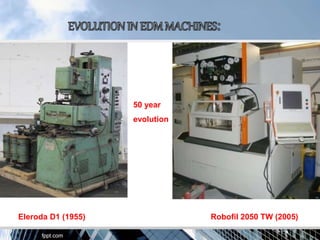
 EVOLUTION IN EDM MACHINES
 TYPES OF EDM
 CONSTRUCTION
 WORKING PRINCIPLE
 TOOL MATERIAL
 MEDIUM
 MACHINING RATIO
 PROCESS PARAMETERS
 ADVANTAGES
 DISADVANTAGES
 APPLICATIONS
 REFERENCE
 TO study about Electro discharge machine.
 To give small introduction about the types of electro
discharge machining.
 To study the process parameter of EDM machine.
 The history of EDM itself begins in 1943, with the invention of its
principle by Russian scientists Boris and Natalya Lazarenko in
Moscow.
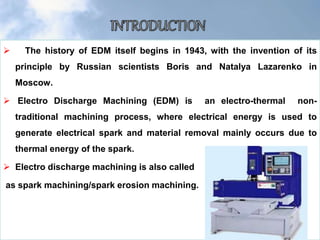
 Electro Discharge Machining (EDM) is an electro-thermal non-
traditional machining process, where electrical energy is used to
generate electrical spark and material removal mainly occurs due to
thermal energy of the spark.
 Electro discharge machining is also called
as spark machining/spark erosion machining.
50 year
evolution
Eleroda D1 (1955) Robofil 2050 TW (2005)
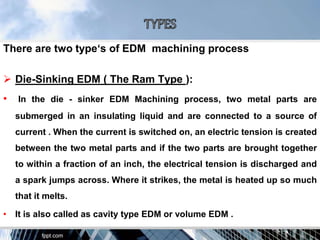
There are two type‘s of EDM machining process
 Die-Sinking EDM ( The Ram Type ):
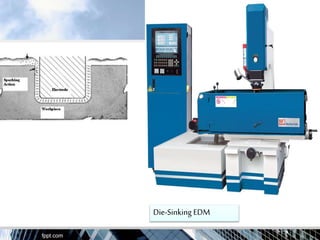
• In the die - sinker EDM Machining process, two metal parts are
submerged in an insulating liquid and are connected to a source of
current . When the current is switched on, an electric tension is created
between the two metal parts and if the two parts are brought together
to within a fraction of an inch, the electrical tension is discharged and
a spark jumps across. Where it strikes, the metal is heated up so much
that it melts.
• It is also called as cavity type EDM or volume EDM .
Die-Sinking EDM
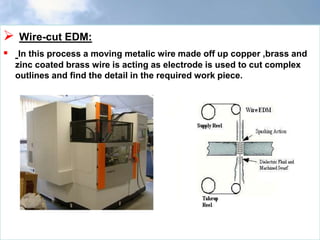
 Wire-cut EDM:
 In this process a moving metalic wire made off up copper ,brass and
zinc coated brass wire is acting as electrode is used to cut complex
outlines and find the detail in the required work piece.
CONSTRUCTION
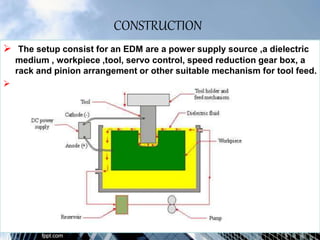
 The setup consist for an EDM are a power supply source ,a dielectric
medium , workpiece ,tool, servo control, speed reduction gear box, a
rack and pinion arrangement or other suitable mechanism for tool feed.

 In EDM the tool is connected to the negative terminal of DC power
supply act as cathode and the workpiece is connected to positive
terminal of DC power supply, act as anode.
 A gap is maintained between the tool and the work piece which is
called as spark gap , the spark gap is usually varies from 0.005mm to
0.05mm.The spark gap is feed by dielectric which brake down when a
proper dc voltage is applied between the tool and the work piece.
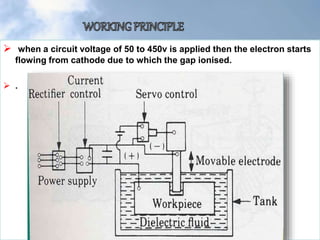
 when a circuit voltage of 50 to 450v is applied then the electron starts
flowing from cathode due to which the gap ionised.
 .
 So there is drop in resistance and discharge of electric energy results
in electrical brake down . so large amount of spark is generated.
 The spark discharges heat to the work piece material with
considerable force and velocity and results in development of high
temperature around 10000`c.
 These forces the work piece to melt and a portion of it is vaporized ,
these portion is taken away from the spark gap by the flow of dielectric
through it.
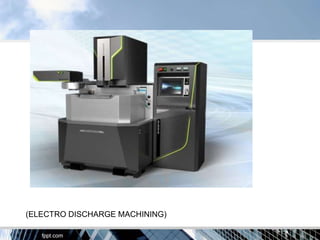
(ELECTRO DISCHARGE MACHINING)
 The commonly used tool materials are brass, copper and some other
materials like cast iron , tungsten ,graphite , and alloys of silver etc.
 Thus the basic characteristics of electrode materials are:
 High electrical conductivity.
• High thermal conductivity .
 High density.
 High melting point.
 Cheap cost.
 The tool should be made of
Same material as the work piece.
 In EDM material removal generally takes place due to thermal
evaporation and melting .The main aim of providing dielectric is to
maintain a oxygen free environment and it should have strong
dielectric resistance so that it does not breakdown so easily.
 Dielectric is used as medium in EDM. The commonly used dielectrics
are paraffin or some light oil like transformer oil or kerosene.
 We know
machining ratio=material removal rate / tool wear
• The material removal rate of the work piece is the volume of the material
removed per minute.
 So machining ratio depends upon the melting temp. of tool and work piece
 If melting temp. of tool = melting temp. of work piece then machining ratio will
be 1 to 2.
 If melting temp. of tool > melting temp. of work piece then machining ratio will
be 8 to 10.
 If melting temperature of tool < melting temperature of work piece then
machining ratio will be 0.1 to 0.3.
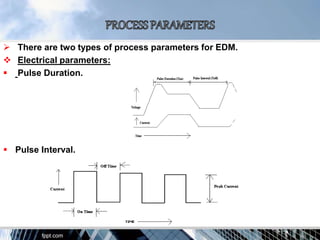
 There are two types of process parameters for EDM.
 Electrical parameters:
 Pulse Duration.
 Pulse Interval.
 Electrode gap (spark gap).
 Polarity.
 Non electrical parameters:
 Rotation of Tool Electrode
 Tool material (Electrode)
 Tool Geometry
 The deep hole can be produced.
 Material removal cost is very low.
 The operation is noiseless.
 The machined surface are free of stress.
 Any material that is electrically conductive can be cut using the EDM process .
 Complex dies sections and moulds can be produced accurately, faster, and at
lower costs.
 Hardened work pieces can be machined easily.
 The work piece material must be electric conductive.
 Perfect square corners cannot be produced by EDM.
 It is only used for machining of small work pieces.
 Dielectric vapour can be dangerous.
 The energy required for the operation is more than that of the
conventional process and hence will be more expensive.
 in the aerospace, automobile and electronics industries in which
production quantities are relatively low.
 It is used to machine extremely hard materials that are difficult to
machine like alloys, tool steels, tungsten carbides etc .
 It is used for forging, extrusion, wire drawing, thread cutting .
 It is used for internal thread cutting and helical gear cutting .
 It is used for machining sharp edges .
 Ceramic materials that are difficult to machine can be machined by the
EDM machining process.
 International Journal of Engineering Science and Technology Vol. 2(6),
2010, 2172-2191.
 International Journal of Modern Engineering Research (IJMER) .
 REPUBLIC OF IRAQ. MINISTRY OF HIGHER EDUCATION &SCIENTIFIC
RESEARCH. UNIVERSITY OF TECHNOLOGY PRODUCTION & METALLURGY
ENG. DEP. CONSIDEORATION OF GRADUATIN.
 Version 2 ME, IIT Kharagpur .
 Mohan, B., Rajadurai, A., Satyanarayana, K. G Journal of Materials Processing
Technology
Ashis
Ashis

Ashis

  • 1.
    GUIDED BY: Prof. S.SSingh PRESENTED BY : ASHIS KUMAR JENA REGD NO-1101304073 ANSHUL NISHANT KANDULNA REDG NO-1101304072 MECHANICAL ENGINEERING 7th sem
  • 2.
     OBJECTIVES  INTRODUCTION EVOLUTION IN EDM MACHINES  TYPES OF EDM  CONSTRUCTION  WORKING PRINCIPLE  TOOL MATERIAL  MEDIUM  MACHINING RATIO  PROCESS PARAMETERS  ADVANTAGES  DISADVANTAGES  APPLICATIONS  REFERENCE
  • 3.
     TO studyabout Electro discharge machine.  To give small introduction about the types of electro discharge machining.  To study the process parameter of EDM machine.
  • 4.
     The historyof EDM itself begins in 1943, with the invention of its principle by Russian scientists Boris and Natalya Lazarenko in Moscow.  Electro Discharge Machining (EDM) is an electro-thermal non- traditional machining process, where electrical energy is used to generate electrical spark and material removal mainly occurs due to thermal energy of the spark.  Electro discharge machining is also called as spark machining/spark erosion machining.
  • 5.
    50 year evolution Eleroda D1(1955) Robofil 2050 TW (2005)
  • 6.
    There are twotype‘s of EDM machining process  Die-Sinking EDM ( The Ram Type ): • In the die - sinker EDM Machining process, two metal parts are submerged in an insulating liquid and are connected to a source of current . When the current is switched on, an electric tension is created between the two metal parts and if the two parts are brought together to within a fraction of an inch, the electrical tension is discharged and a spark jumps across. Where it strikes, the metal is heated up so much that it melts. • It is also called as cavity type EDM or volume EDM .
  • 7.
  • 8.
     Wire-cut EDM: In this process a moving metalic wire made off up copper ,brass and zinc coated brass wire is acting as electrode is used to cut complex outlines and find the detail in the required work piece.
  • 9.
    CONSTRUCTION  The setupconsist for an EDM are a power supply source ,a dielectric medium , workpiece ,tool, servo control, speed reduction gear box, a rack and pinion arrangement or other suitable mechanism for tool feed. 
  • 10.
     In EDMthe tool is connected to the negative terminal of DC power supply act as cathode and the workpiece is connected to positive terminal of DC power supply, act as anode.  A gap is maintained between the tool and the work piece which is called as spark gap , the spark gap is usually varies from 0.005mm to 0.05mm.The spark gap is feed by dielectric which brake down when a proper dc voltage is applied between the tool and the work piece.
  • 11.
     when acircuit voltage of 50 to 450v is applied then the electron starts flowing from cathode due to which the gap ionised.  .
  • 12.
     So thereis drop in resistance and discharge of electric energy results in electrical brake down . so large amount of spark is generated.  The spark discharges heat to the work piece material with considerable force and velocity and results in development of high temperature around 10000`c.  These forces the work piece to melt and a portion of it is vaporized , these portion is taken away from the spark gap by the flow of dielectric through it.
  • 13.
  • 14.
     The commonlyused tool materials are brass, copper and some other materials like cast iron , tungsten ,graphite , and alloys of silver etc.  Thus the basic characteristics of electrode materials are:  High electrical conductivity. • High thermal conductivity .  High density.  High melting point.  Cheap cost.  The tool should be made of Same material as the work piece.
  • 15.
     In EDMmaterial removal generally takes place due to thermal evaporation and melting .The main aim of providing dielectric is to maintain a oxygen free environment and it should have strong dielectric resistance so that it does not breakdown so easily.  Dielectric is used as medium in EDM. The commonly used dielectrics are paraffin or some light oil like transformer oil or kerosene.
  • 16.
     We know machiningratio=material removal rate / tool wear • The material removal rate of the work piece is the volume of the material removed per minute.  So machining ratio depends upon the melting temp. of tool and work piece  If melting temp. of tool = melting temp. of work piece then machining ratio will be 1 to 2.  If melting temp. of tool > melting temp. of work piece then machining ratio will be 8 to 10.  If melting temperature of tool < melting temperature of work piece then machining ratio will be 0.1 to 0.3.
  • 17.
     There aretwo types of process parameters for EDM.  Electrical parameters:  Pulse Duration.  Pulse Interval.
  • 18.
     Electrode gap(spark gap).  Polarity.  Non electrical parameters:  Rotation of Tool Electrode  Tool material (Electrode)  Tool Geometry
  • 19.
     The deephole can be produced.  Material removal cost is very low.  The operation is noiseless.  The machined surface are free of stress.  Any material that is electrically conductive can be cut using the EDM process .  Complex dies sections and moulds can be produced accurately, faster, and at lower costs.  Hardened work pieces can be machined easily.
  • 20.
     The workpiece material must be electric conductive.  Perfect square corners cannot be produced by EDM.  It is only used for machining of small work pieces.  Dielectric vapour can be dangerous.  The energy required for the operation is more than that of the conventional process and hence will be more expensive.
  • 21.
     in theaerospace, automobile and electronics industries in which production quantities are relatively low.  It is used to machine extremely hard materials that are difficult to machine like alloys, tool steels, tungsten carbides etc .  It is used for forging, extrusion, wire drawing, thread cutting .  It is used for internal thread cutting and helical gear cutting .  It is used for machining sharp edges .  Ceramic materials that are difficult to machine can be machined by the EDM machining process.
  • 22.
     International Journalof Engineering Science and Technology Vol. 2(6), 2010, 2172-2191.  International Journal of Modern Engineering Research (IJMER) .  REPUBLIC OF IRAQ. MINISTRY OF HIGHER EDUCATION &SCIENTIFIC RESEARCH. UNIVERSITY OF TECHNOLOGY PRODUCTION & METALLURGY ENG. DEP. CONSIDEORATION OF GRADUATIN.  Version 2 ME, IIT Kharagpur .  Mohan, B., Rajadurai, A., Satyanarayana, K. G Journal of Materials Processing Technology