
Presented by
Mr. Amol Jalinder Torane
TE (Mechanical)
Under the Guidance of
Prof. Parag Marathe
Department of Mechanical Engineering
Dr. D. Y. Patil SOE Lohegaon, Pune – 412105.
For A. Y. 2016-17
Contents of Seminar
Introduction
Literature review
Basic principle of EDM
Construction and working
Types of EDM process
Burr formation in micro machining
De-burring using EDM
Di-electric fluid
Methods of fluid application
Quantification of results
Advantages/ Disadvantages / Applications
Dr. D. Y. Patil School of Engineering,Lohegaon,
Pune. 2
Introduction
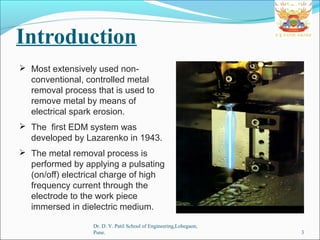
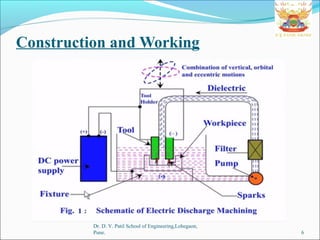
 Most extensively used non-
conventional, controlled metal
removal process that is used to
remove metal by means of
electrical spark erosion.
 The first EDM system was
developed by Lazarenko in 1943.
 The metal removal process is
performed by applying a pulsating
(on/off) electrical charge of high
frequency current through the
electrode to the work piece
immersed in dielectric medium.
3
Dr. D. Y. Patil School of Engineering,Lohegaon,
Pune.
Dr. D. Y. Patil School of Engineering Lohegaon ,Pune.
Sr.
No.
Title of Paper
Type of
document &
Published Year
Topic /Conclusion of Paper Retrieval for My Seminar
1
Evolution of Electrical
Discharge Machining: A
Review.
International Journal
of Science and
Research (2015).
The Material Removal Rate by using EDM
can be achieve as high as 5162 mm^3/min.
2
Electrode Wear Protection
Mechanism in micro-EDM.
Journal of Materials
Processing
Technology (2015).
A Diamond like amorphous carbon layer
embedded with the micro sized metallic
debris is deposited on the erosion front of the
electrode.
3
Super-Finished Surfaces
using micro-EDM.
ISEM 2013
A Stray Capacitance Sinking EDM machine
offers the Capability to achieve Super-
Finished Surfaces.
4
Optimization of Machining
Parameters in EDM Process
using cast and Sintered
Electrode.
ICMPC 2014
The cast copper and sintered powder
metallurgy copper have been considered as
tool electrodes to machine the fore said
workpieces.
5
Accuracy Improvement
Through the use of EdM
Machining Instead of
Conventional Machining.
Journal of Materials
Processing
Technology (2016)
Instead of using conventional process we
shall use non- conventional process such as
EDM for getting higher MMR, along with
higher accuracy in terms of quality of the
work.
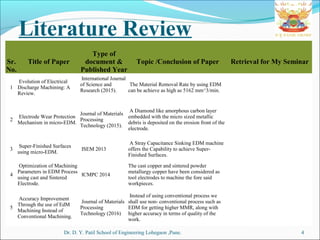
Literature Review
4
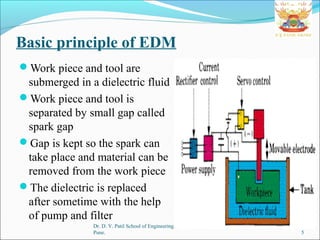
Basic principle of EDM
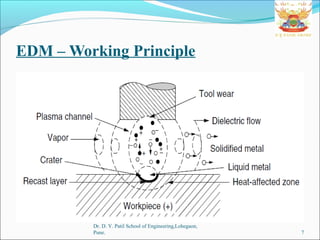
Work piece and tool are
submerged in a dielectric fluid
Work piece and tool is
separated by small gap called
spark gap
Gap is kept so the spark can
take place and material can be
removed from the work piece
The dielectric is replaced
after sometime with the help
of pump and filter
Dr. D. Y. Patil School of Engineering,Lohegaon,
Pune. 5
Construction and Working
Dr. D. Y. Patil School of Engineering,Lohegaon,
Pune. 6
EDM – Working Principle
Dr. D. Y. Patil School of Engineering,Lohegaon,
Pune. 7
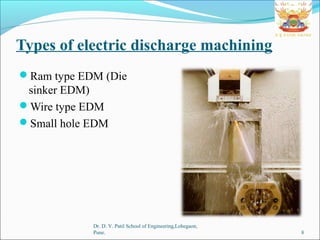
Types of electric discharge machining
Ram type EDM (Die
sinker EDM)
Wire type EDM
Small hole EDM
Dr. D. Y. Patil School of Engineering,Lohegaon,
Pune. 8
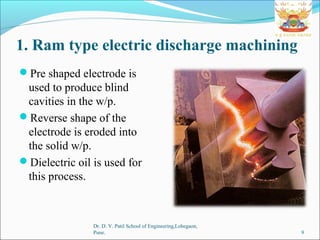
1. Ram type electric discharge machining
Pre shaped electrode is
used to produce blind
cavities in the w/p.
Reverse shape of the
electrode is eroded into
the solid w/p.
Dielectric oil is used for
this process.
Dr. D. Y. Patil School of Engineering,Lohegaon,
Pune. 9
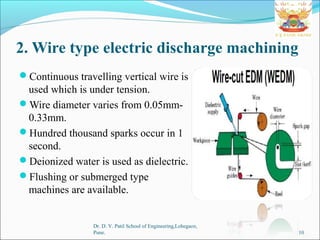
2. Wire type electric discharge machining
Continuous travelling vertical wire is
used which is under tension.
Wire diameter varies from 0.05mm-
0.33mm.
Hundred thousand sparks occur in 1
second.
Deionized water is used as dielectric.
Flushing or submerged type
machines are available.
Dr. D. Y. Patil School of Engineering,Lohegaon,
Pune. 10
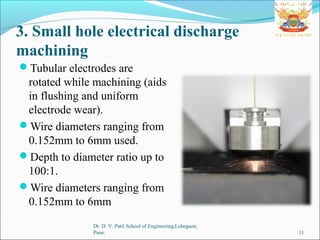
3. Small hole electrical discharge
machining
Tubular electrodes are
rotated while machining (aids
in flushing and uniform
electrode wear).
Wire diameters ranging from
0.152mm to 6mm used.
Depth to diameter ratio up to
100:1.
Wire diameters ranging from
0.152mm to 6mm
Dr. D. Y. Patil School of Engineering,Lohegaon,
Pune. 11
“De-Burring using Electric
Discharge Machining”
Dr. D. Y. Patil School of Engineering,Lohegaon,
Pune. 12
Burr formation in machining
Dr. D. Y. Patil School of Engineering,Lohegaon,
Pune. 13
A burr is a raised edge or small piece of material
remaining attached to a workpiece after a modification
process.
It is usually an unwanted piece of material and is removed
with a deburring tool in a process called 'deburring'. Burrs
are most commonly created by machining operations,
such as grinding, drilling, milling, engraving or turning. It
may be present in the form of a fine wire on the edge of a
freshly sharpened tool or as a raised portion of a surface
Burr formation in machining
Dr. D. Y. Patil School of Engineering,Lohegaon,
Pune. 14
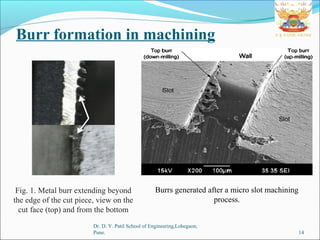
Fig. 1. Metal burr extending beyond
the edge of the cut piece, view on the
cut face (top) and from the bottom
Burrs generated after a micro slot machining
process.
Definition of burr Geometry
Dr. D. Y. Patil School of Engineering,Lohegaon,
Pune. 15
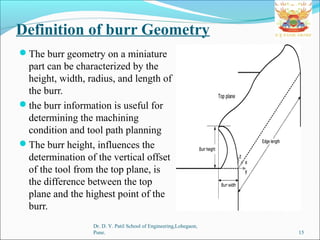
The burr geometry on a miniature
part can be characterized by the
height, width, radius, and length of
the burr.
the burr information is useful for
determining the machining
condition and tool path planning
The burr height, influences the
determination of the vertical offset
of the tool from the top plane, is
the difference between the top
plane and the highest point of the
burr.
Deburring using electro discharge
machining
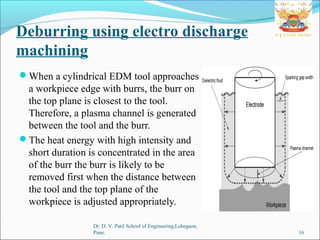
When a cylindrical EDM tool approaches
a workpiece edge with burrs, the burr on
the top plane is closest to the tool.
Therefore, a plasma channel is generated
between the tool and the burr.
The heat energy with high intensity and
short duration is concentrated in the area
of the burr the burr is likely to be
removed first when the distance between
the tool and the top plane of the
workpiece is adjusted appropriately.
Dr. D. Y. Patil School of Engineering,Lohegaon,
Pune. 16
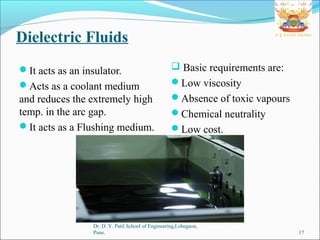
Dielectric Fluids
It acts as an insulator.
Acts as a coolant medium
and reduces the extremely high
temp. in the arc gap.
It acts as a Flushing medium.
Dr. D. Y. Patil School of Engineering,Lohegaon,
Pune. 17
 Basic requirements are:
Low viscosity
Absence of toxic vapours
Chemical neutrality
Low cost.
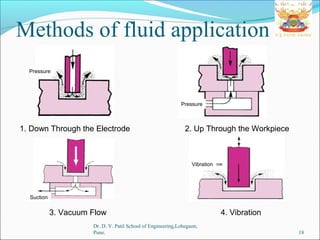
Methods of fluid application
Dr. D. Y. Patil School of Engineering,Lohegaon,
Pune. 18
Pressure
1. Down Through the Electrode
Pressure
2. Up Through the Workpiece
Suction
3. Vacuum Flow
Vibration
4. Vibration
Deburring process
Dr. D. Y. Patil School of Engineering,Lohegaon,
Pune. 19
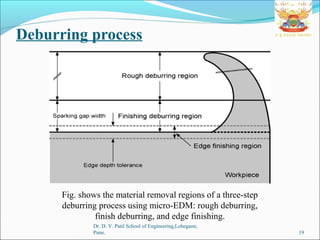
Fig. shows the material removal regions of a three-step
deburring process using micro-EDM: rough deburring,
finish deburring, and edge finishing.
Quantification of Results
Dr. D. Y. Patil School of Engineering,Lohegaon,
Pune. 20
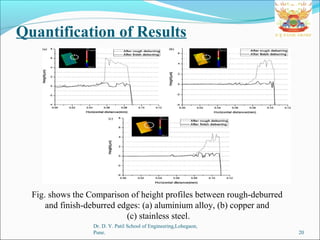
Fig. shows the Comparison of height profiles between rough-deburred
and finish-deburred edges: (a) aluminium alloy, (b) copper and
(c) stainless steel.
Advantages of electric discharge
machining
 Any electrically conductive material can be
cut.
 Hardened and exotic materials can be
machined with ease.
 Complex sections can be produced
accurately, faster and at lower rates.
 Burr free operation.
 Fragile and thin sections like webs or fins
can be easily machined without
deformation of the part.
 No cutting forces induced.
 Superior finish, accuracy and repeatability.
 Minimum operator intervention.
Dr. D. Y. Patil School of Engineering,Lohegaon,
Pune. 21
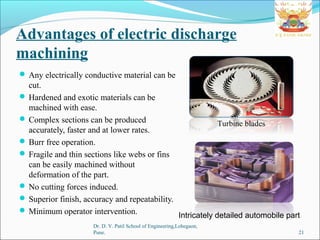
Turbine blades
Intricately detailed automobile part
Limitations of electric discharge
machining
Not suitable for non-conductors.
Low metal removal process as compared to chip machining.
Matte type appearance is obtained and further polishing is
required if gloss finish is needed.
Rapid electrode wear makes the process more costly.
Smoke produced is harmful to lungs and eyes.
Chances of flash fire in dielectric fluid (oil).
Specific power consumption is high.
Dr. D. Y. Patil School of Engineering,Lohegaon,
Pune. 22
Applications of electric discharge
machining
Die making.
Aerospace components.
Form tools.
Stamping tools.
Medical and dental
instrumentation.
Prototype parts.
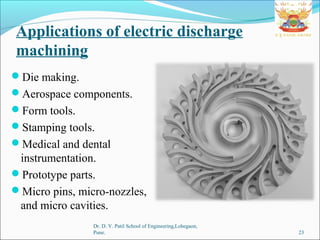
Micro pins, micro-nozzles,
and micro cavities.
Dr. D. Y. Patil School of Engineering,Lohegaon,
Pune. 23
References
Papers from Journals:
 Young Hun Jeong, Byung HanYoo, Han Ul Lee, Byung-Kwon Min, Dong-Woo
Cho, Sang Jo Lee, “DE-burring micro-features using micro-EDM’ Journal of
Materials Processing Technology
 S. Ravinder Reddy, Anil Kumar N, K. Prashanth Reddy, G Sudhir Kumar
Yadav, DR. Dipak Ranjan Jana, “Accuracy improvement through the use of
electronic discharge machining instead of conventional machining”,
International Education & Reserch Journal. E-ISSN No.- 2454-9916, Volume 2,
Isue 3, March 2016.
 U. Maradia, M. Boccadoro, J. Stirnimann, F. Kuster, K. Wegener, “Electrode
wear protection mechanism in meso-micro-EDM”, Journal of Material
Processing Technology223 (2015) 22-33, Elsevier.
 Vishal Pathania, Narinder Singh Jassal, “Brif Chronological Study of the
Evolution of Electrical Discharge Machining- A Review”, International Journal
of Science and Research, 2319-7064, Index Copernius Value (2015).
24
Dr. D. Y. Patil School of Engineering,Lohegaon,
Pune.
Questions
Dr. D. Y. Patil School of Engineering,Lohegaon,
Pune. 25
THANK YOU !
Dr. D. Y. Patil School of Engineering,Lohegaon,
Pune. 26

De burring using edm

  • 1.
    Presented by Mr. AmolJalinder Torane TE (Mechanical) Under the Guidance of Prof. Parag Marathe Department of Mechanical Engineering Dr. D. Y. Patil SOE Lohegaon, Pune – 412105. For A. Y. 2016-17
  • 2.
    Contents of Seminar Introduction Literaturereview Basic principle of EDM Construction and working Types of EDM process Burr formation in micro machining De-burring using EDM Di-electric fluid Methods of fluid application Quantification of results Advantages/ Disadvantages / Applications Dr. D. Y. Patil School of Engineering,Lohegaon, Pune. 2
  • 3.
    Introduction  Most extensivelyused non- conventional, controlled metal removal process that is used to remove metal by means of electrical spark erosion.  The first EDM system was developed by Lazarenko in 1943.  The metal removal process is performed by applying a pulsating (on/off) electrical charge of high frequency current through the electrode to the work piece immersed in dielectric medium. 3 Dr. D. Y. Patil School of Engineering,Lohegaon, Pune.
  • 4.
    Dr. D. Y.Patil School of Engineering Lohegaon ,Pune. Sr. No. Title of Paper Type of document & Published Year Topic /Conclusion of Paper Retrieval for My Seminar 1 Evolution of Electrical Discharge Machining: A Review. International Journal of Science and Research (2015). The Material Removal Rate by using EDM can be achieve as high as 5162 mm^3/min. 2 Electrode Wear Protection Mechanism in micro-EDM. Journal of Materials Processing Technology (2015). A Diamond like amorphous carbon layer embedded with the micro sized metallic debris is deposited on the erosion front of the electrode. 3 Super-Finished Surfaces using micro-EDM. ISEM 2013 A Stray Capacitance Sinking EDM machine offers the Capability to achieve Super- Finished Surfaces. 4 Optimization of Machining Parameters in EDM Process using cast and Sintered Electrode. ICMPC 2014 The cast copper and sintered powder metallurgy copper have been considered as tool electrodes to machine the fore said workpieces. 5 Accuracy Improvement Through the use of EdM Machining Instead of Conventional Machining. Journal of Materials Processing Technology (2016) Instead of using conventional process we shall use non- conventional process such as EDM for getting higher MMR, along with higher accuracy in terms of quality of the work. Literature Review 4
  • 5.
    Basic principle ofEDM Work piece and tool are submerged in a dielectric fluid Work piece and tool is separated by small gap called spark gap Gap is kept so the spark can take place and material can be removed from the work piece The dielectric is replaced after sometime with the help of pump and filter Dr. D. Y. Patil School of Engineering,Lohegaon, Pune. 5
  • 6.
    Construction and Working Dr.D. Y. Patil School of Engineering,Lohegaon, Pune. 6
  • 7.
    EDM – WorkingPrinciple Dr. D. Y. Patil School of Engineering,Lohegaon, Pune. 7
  • 8.
    Types of electricdischarge machining Ram type EDM (Die sinker EDM) Wire type EDM Small hole EDM Dr. D. Y. Patil School of Engineering,Lohegaon, Pune. 8
  • 9.
    1. Ram typeelectric discharge machining Pre shaped electrode is used to produce blind cavities in the w/p. Reverse shape of the electrode is eroded into the solid w/p. Dielectric oil is used for this process. Dr. D. Y. Patil School of Engineering,Lohegaon, Pune. 9
  • 10.
    2. Wire typeelectric discharge machining Continuous travelling vertical wire is used which is under tension. Wire diameter varies from 0.05mm- 0.33mm. Hundred thousand sparks occur in 1 second. Deionized water is used as dielectric. Flushing or submerged type machines are available. Dr. D. Y. Patil School of Engineering,Lohegaon, Pune. 10
  • 11.
    3. Small holeelectrical discharge machining Tubular electrodes are rotated while machining (aids in flushing and uniform electrode wear). Wire diameters ranging from 0.152mm to 6mm used. Depth to diameter ratio up to 100:1. Wire diameters ranging from 0.152mm to 6mm Dr. D. Y. Patil School of Engineering,Lohegaon, Pune. 11
  • 12.
    “De-Burring using Electric DischargeMachining” Dr. D. Y. Patil School of Engineering,Lohegaon, Pune. 12
  • 13.
    Burr formation inmachining Dr. D. Y. Patil School of Engineering,Lohegaon, Pune. 13 A burr is a raised edge or small piece of material remaining attached to a workpiece after a modification process. It is usually an unwanted piece of material and is removed with a deburring tool in a process called 'deburring'. Burrs are most commonly created by machining operations, such as grinding, drilling, milling, engraving or turning. It may be present in the form of a fine wire on the edge of a freshly sharpened tool or as a raised portion of a surface
  • 14.
    Burr formation inmachining Dr. D. Y. Patil School of Engineering,Lohegaon, Pune. 14 Fig. 1. Metal burr extending beyond the edge of the cut piece, view on the cut face (top) and from the bottom Burrs generated after a micro slot machining process.
  • 15.
    Definition of burrGeometry Dr. D. Y. Patil School of Engineering,Lohegaon, Pune. 15 The burr geometry on a miniature part can be characterized by the height, width, radius, and length of the burr. the burr information is useful for determining the machining condition and tool path planning The burr height, influences the determination of the vertical offset of the tool from the top plane, is the difference between the top plane and the highest point of the burr.
  • 16.
    Deburring using electrodischarge machining When a cylindrical EDM tool approaches a workpiece edge with burrs, the burr on the top plane is closest to the tool. Therefore, a plasma channel is generated between the tool and the burr. The heat energy with high intensity and short duration is concentrated in the area of the burr the burr is likely to be removed first when the distance between the tool and the top plane of the workpiece is adjusted appropriately. Dr. D. Y. Patil School of Engineering,Lohegaon, Pune. 16
  • 17.
    Dielectric Fluids It actsas an insulator. Acts as a coolant medium and reduces the extremely high temp. in the arc gap. It acts as a Flushing medium. Dr. D. Y. Patil School of Engineering,Lohegaon, Pune. 17  Basic requirements are: Low viscosity Absence of toxic vapours Chemical neutrality Low cost.
  • 18.
    Methods of fluidapplication Dr. D. Y. Patil School of Engineering,Lohegaon, Pune. 18 Pressure 1. Down Through the Electrode Pressure 2. Up Through the Workpiece Suction 3. Vacuum Flow Vibration 4. Vibration
  • 19.
    Deburring process Dr. D.Y. Patil School of Engineering,Lohegaon, Pune. 19 Fig. shows the material removal regions of a three-step deburring process using micro-EDM: rough deburring, finish deburring, and edge finishing.
  • 20.
    Quantification of Results Dr.D. Y. Patil School of Engineering,Lohegaon, Pune. 20 Fig. shows the Comparison of height profiles between rough-deburred and finish-deburred edges: (a) aluminium alloy, (b) copper and (c) stainless steel.
  • 21.
    Advantages of electricdischarge machining  Any electrically conductive material can be cut.  Hardened and exotic materials can be machined with ease.  Complex sections can be produced accurately, faster and at lower rates.  Burr free operation.  Fragile and thin sections like webs or fins can be easily machined without deformation of the part.  No cutting forces induced.  Superior finish, accuracy and repeatability.  Minimum operator intervention. Dr. D. Y. Patil School of Engineering,Lohegaon, Pune. 21 Turbine blades Intricately detailed automobile part
  • 22.
    Limitations of electricdischarge machining Not suitable for non-conductors. Low metal removal process as compared to chip machining. Matte type appearance is obtained and further polishing is required if gloss finish is needed. Rapid electrode wear makes the process more costly. Smoke produced is harmful to lungs and eyes. Chances of flash fire in dielectric fluid (oil). Specific power consumption is high. Dr. D. Y. Patil School of Engineering,Lohegaon, Pune. 22
  • 23.
    Applications of electricdischarge machining Die making. Aerospace components. Form tools. Stamping tools. Medical and dental instrumentation. Prototype parts. Micro pins, micro-nozzles, and micro cavities. Dr. D. Y. Patil School of Engineering,Lohegaon, Pune. 23
  • 24.
    References Papers from Journals: Young Hun Jeong, Byung HanYoo, Han Ul Lee, Byung-Kwon Min, Dong-Woo Cho, Sang Jo Lee, “DE-burring micro-features using micro-EDM’ Journal of Materials Processing Technology  S. Ravinder Reddy, Anil Kumar N, K. Prashanth Reddy, G Sudhir Kumar Yadav, DR. Dipak Ranjan Jana, “Accuracy improvement through the use of electronic discharge machining instead of conventional machining”, International Education & Reserch Journal. E-ISSN No.- 2454-9916, Volume 2, Isue 3, March 2016.  U. Maradia, M. Boccadoro, J. Stirnimann, F. Kuster, K. Wegener, “Electrode wear protection mechanism in meso-micro-EDM”, Journal of Material Processing Technology223 (2015) 22-33, Elsevier.  Vishal Pathania, Narinder Singh Jassal, “Brif Chronological Study of the Evolution of Electrical Discharge Machining- A Review”, International Journal of Science and Research, 2319-7064, Index Copernius Value (2015). 24 Dr. D. Y. Patil School of Engineering,Lohegaon, Pune.
  • 25.
    Questions Dr. D. Y.Patil School of Engineering,Lohegaon, Pune. 25
  • 26.
    THANK YOU ! Dr.D. Y. Patil School of Engineering,Lohegaon, Pune. 26