1400-1800 
Chapter 3
Section 1
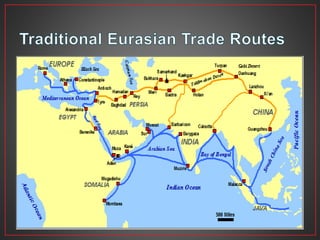
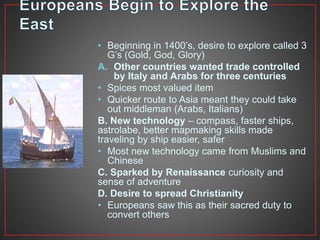
• Beginning in 1400’s, desire to explore called 3 
G’s (Gold, God, Glory) 
A. Other countries wanted trade controlled 
by Italy and Arabs for three centuries 
• Spices most valued item 
• Quicker route to Asia meant they could take 
out middleman (Arabs, Italians) 
B. New technology – compass, faster ships, 
astrolabe, better mapmaking skills made 
traveling by ship easier, safer 
• Most new technology came from Muslims and 
Chinese 
C. Sparked by Renaissance curiosity and 
sense of adventure 
D. Desire to spread Christianity 
• Europeans saw this as their sacred duty to 
convert others
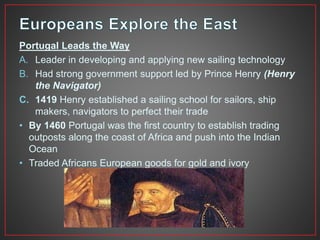
Portugal Leads the Way 
A. Leader in developing and applying new sailing technology 
B. Had strong government support led by Prince Henry (Henry 
the Navigator) 
C. 1419 Henry established a sailing school for sailors, ship 
makers, navigators to perfect their trade 
• By 1460 Portugal was the first country to establish trading 
outposts along the coast of Africa and push into the Indian 
Ocean 
• Traded Africans European goods for gold and ivory
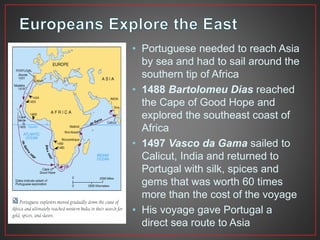
• Portuguese needed to reach Asia 
by sea and had to sail around the 
southern tip of Africa 
• 1488 Bartolomeu Dias reached 
the Cape of Good Hope and 
explored the southeast coast of 
Africa 
• 1497 Vasco da Gama sailed to 
Calicut, India and returned to 
Portugal with silk, spices and 
gems that was worth 60 times 
more than the cost of the voyage 
• His voyage gave Portugal a 
direct sea route to Asia
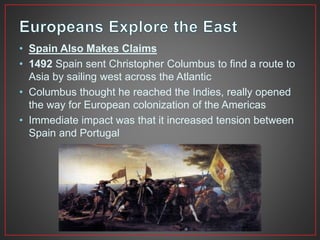
• Spain Also Makes Claims 
• 1492 Spain sent Christopher Columbus to find a route to 
Asia by sailing west across the Atlantic 
• Columbus thought he reached the Indies, really opened 
the way for European colonization of the Americas 
• Immediate impact was that it increased tension between 
Spain and Portugal
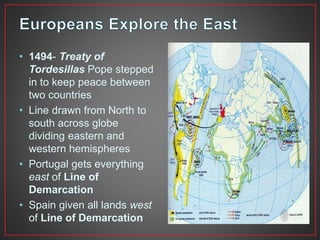
• 1494- Treaty of 
Tordesillas Pope stepped 
in to keep peace between 
two countries 
• Line drawn from North to 
south across globe 
dividing eastern and 
western hemispheres 
• Portugal gets everything 
east of Line of 
Demarcation 
• Spain given all lands west 
of Line of Demarcation
• Trading Empires in the Indian Ocean 
• Portugal took control of the spice trade from Muslim 
merchants after da Gama’s voyage 
1. 1509 extended control over region by defeating Mughal 
navy off the coast of India 
2. 1510 Portuguese capture port city of Goa, India; it 
became center of their trading empire 
3. 1511 Portuguese seize control of Strait of Malacca, 
gave them control of the spice Islands 
• Portugal began to break the Muslim domination of 
Eastern trade 
• Brought back goods at 20% of the prices charged by 
Arab and Italian traders 
• More Europeans could afford items
• Success of Portugal attracted other European 
countries 
• 1521 Spain claimed Philippine Islands 
Dutch Traders 
• Around 1600 the Dutch and English became a 
sea powers 
• English and Dutch began to take away 
Portuguese power 
• Each country formed an East India Company 
• Each company had power to print money, make 
treaties and raise armies 
• Dutch East India Company most powerful in 
region 
• 1619 Dutch establish trading post in Java and 
took Straits of Malacca and Spice Islands from 
Portugal 
• Dutch began to expand across the region and 
their capital in Europe, Amsterdam became a 
leading commercial center 
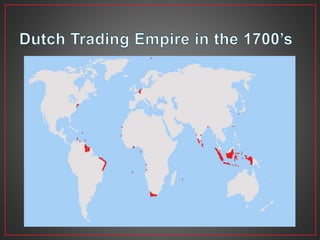
• By 1700 Dutch controlled most trade in Indian 
Ocean
British and French Traders 
• By 1700 English and French began to gain a foothold in 
region 
• English focused on India and developed a successful 
business in the cloth trade (established British East India 
Company) 
• France tried to establish a foothold in India but was not 
as successful 
• European countries took control of port cities but 
their influence did not extend beyond the ports 
• Their influence was not felt by most people in Asia
Section 2
 China was the dominant power in Asia and 
Europeans wanted to trade with them 
Ming Dynasty 
 1368-1644 Ming Dynasty ruled China 
 Korea and Southeast Asia paid tribute (payment 
by one group to another to show submission) to 
Ming emperors, China expected Europeans to do 
the same 
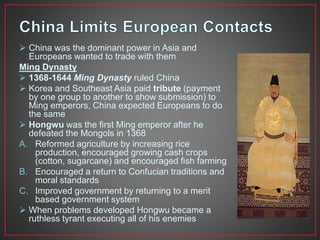
 Hongwu was the first Ming emperor after he 
defeated the Mongols in 1368 
A. Reformed agriculture by increasing rice 
production, encouraged growing cash crops 
(cotton, sugarcane) and encouraged fish farming 
B. Encouraged a return to Confucian traditions and 
moral standards 
C. Improved government by returning to a merit 
based government system 
 When problems developed Hongwu became a 
ruthless tyrant executing all of his enemies
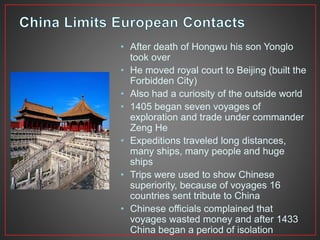
• After death of Hongwu his son Yonglo 
took over 
• He moved royal court to Beijing (built the 
Forbidden City) 
• Also had a curiosity of the outside world 
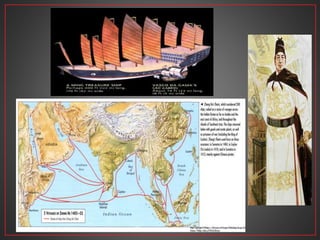
• 1405 began seven voyages of 
exploration and trade under commander 
Zeng He 
• Expeditions traveled long distances, 
many ships, many people and huge 
ships 
• Trips were used to show Chinese 
superiority, because of voyages 16 
countries sent tribute to China 
• Chinese officials complained that 
voyages wasted money and after 1433 
China began a period of isolation
• Trade policies of 1500’s reflected isolation 
• To keep influence of outsiders to a minimum 
• Only the government could conduct trade 
through 3 ports- Canton, Macao and Ningbo 
• European demand for goods led to smuggling 
• Helped improve economy of China- led to 
increase in manufacturing of ceramics and silk 
making 
• Commerce and manufacturing seen as lower 
class jobs and not held in high regard in 
China, kept China from industrializing 
• Government supported agriculture 
• Taxes were low on agriculture and high on 
manufacturing
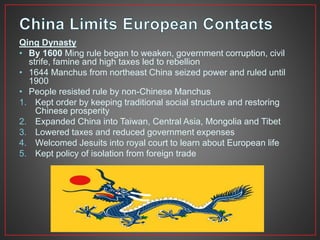
Qing Dynasty 
• By 1600 Ming rule began to weaken, government corruption, civil 
strife, famine and high taxes led to rebellion 
• 1644 Manchus from northeast China seized power and ruled until 
1900 
• People resisted rule by non-Chinese Manchus 
1. Kept order by keeping traditional social structure and restoring 
Chinese prosperity 
2. Expanded China into Taiwan, Central Asia, Mongolia and Tibet 
3. Lowered taxes and reduced government expenses 
4. Welcomed Jesuits into royal court to learn about European life 
5. Kept policy of isolation from foreign trade
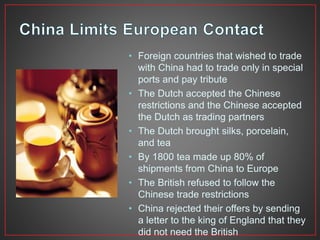
• Foreign countries that wished to trade 
with China had to trade only in special 
ports and pay tribute 
• The Dutch accepted the Chinese 
restrictions and the Chinese accepted 
the Dutch as trading partners 
• The Dutch brought silks, porcelain, 
and tea 
• By 1800 tea made up 80% of 
shipments from China to Europe 
• The British refused to follow the 
Chinese trade restrictions 
• China rejected their offers by sending 
a letter to the king of England that they 
did not need the British
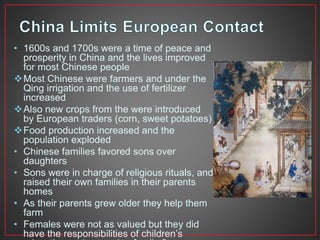
• 1600s and 1700s were a time of peace and 
prosperity in China and the lives improved 
for most Chinese people 
Most Chinese were farmers and under the 
Qing irrigation and the use of fertilizer 
increased 
Also new crops from the were introduced 
by European traders (corn, sweet potatoes) 
Food production increased and the 
population exploded 
• Chinese families favored sons over 
daughters 
• Sons were in charge of religious rituals, and 
raised their own families in their parents 
homes 
• As their parents grew older they help them 
farm 
• Females were not as valued but they did 
have the responsibilities of children’s 
education and managing family finances
Section 3
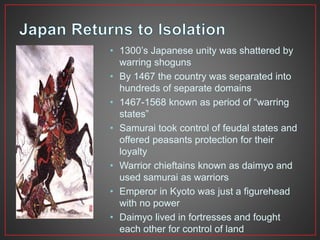
• 1300’s Japanese unity was shattered by 
warring shoguns 
• By 1467 the country was separated into 
hundreds of separate domains 
• 1467-1568 known as period of “warring 
states” 
• Samurai took control of feudal states and 
offered peasants protection for their 
loyalty 
• Warrior chieftains known as daimyo and 
used samurai as warriors 
• Emperor in Kyoto was just a figurehead 
with no power 
• Daimyo lived in fortresses and fought 
each other for control of land
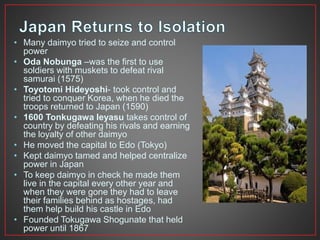
• Many daimyo tried to seize and control 
power 
• Oda Nobunga –was the first to use 
soldiers with muskets to defeat rival 
samurai (1575) 
• Toyotomi Hideyoshi- took control and 
tried to conquer Korea, when he died the 
troops returned to Japan (1590) 
• 1600 Tonkugawa Ieyasu takes control of 
country by defeating his rivals and earning 
the loyalty of other daimyo 
• He moved the capital to Edo (Tokyo) 
• Kept daimyo tamed and helped centralize 
power in Japan 
• To keep daimyo in check he made them 
live in the capital every other year and 
when they were gone they had to leave 
their families behind as hostages, had 
them help build his castle in Edo 
• Founded Tokugawa Shogunate that held 
power until 1867
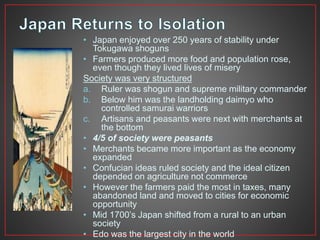
• Japan enjoyed over 250 years of stability under 
Tokugawa shoguns 
• Farmers produced more food and population rose, 
even though they lived lives of misery 
Society was very structured 
a. Ruler was shogun and supreme military commander 
b. Below him was the landholding daimyo who 
controlled samurai warriors 
c. Artisans and peasants were next with merchants at 
the bottom 
• 4/5 of society were peasants 
• Merchants became more important as the economy 
expanded 
• Confucian ideas ruled society and the ideal citizen 
depended on agriculture not commerce 
• However the farmers paid the most in taxes, many 
abandoned land and moved to cities for economic 
opportunity 
• Mid 1700’s Japan shifted from a rural to an urban 
society 
• Edo was the largest city in the world
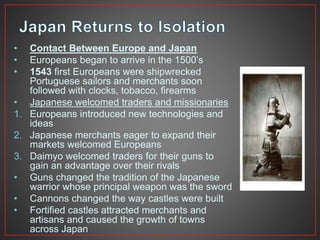
• Contact Between Europe and Japan 
• Europeans began to arrive in the 1500’s 
• 1543 first Europeans were shipwrecked 
Portuguese sailors and merchants soon 
followed with clocks, tobacco, firearms 
• Japanese welcomed traders and missionaries 
1. Europeans introduced new technologies and 
ideas 
2. Japanese merchants eager to expand their 
markets welcomed Europeans 
3. Daimyo welcomed traders for their guns to 
gain an advantage over their rivals 
• Guns changed the tradition of the Japanese 
warrior whose principal weapon was the sword 
• Cannons changed the way castles were built 
• Fortified castles attracted merchants and 
artisans and caused the growth of towns 
across Japan
• 1549 first missionaries came to Japan 
• Catholic Jesuits, Franciscans and Dominican 
missionaries came to convert the Japanese 
• By 1600 they had converted over 300,000 Japanese 
• Missionaries teachings went against traditional 
Japanese beliefs and by 1612 Christianity was 
banned and Tokugawa Shoguns focused on ridding 
the country of them 
• 1637 situation came to a head after rebellion led by 
Christians 
• All Christian missionaries were kicked out of China 
and all Japanese had to demonstrate faithfulness to 
some branch of Buddhism
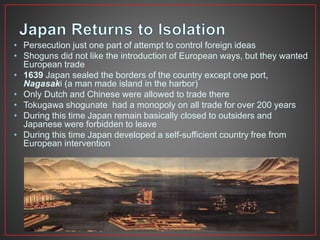
• Persecution just one part of attempt to control foreign ideas 
• Shoguns did not like the introduction of European ways, but they wanted 
European trade 
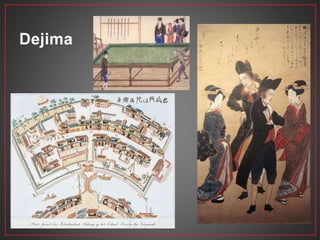
• 1639 Japan sealed the borders of the country except one port, 
Nagasaki (a man made island in the harbor) 
• Only Dutch and Chinese were allowed to trade there 
• Tokugawa shogunate had a monopoly on all trade for over 200 years 
• During this time Japan remain basically closed to outsiders and 
Japanese were forbidden to leave 
• During this time Japan developed a self-sufficient country free from 
European intervention
Dejima
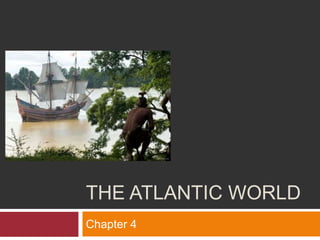
THE ATLANTIC WORLD 
Chapter 4
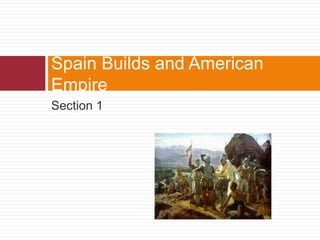
Spain Builds and American 
Empire 
Section 1
Spain Builds and American 
Empire 
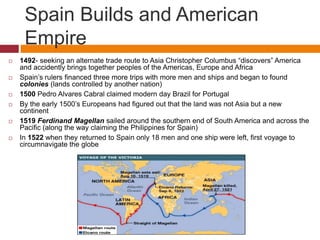
 1492- seeking an alternate trade route to Asia Christopher Columbus “discovers” America 
and accidently brings together peoples of the Americas, Europe and Africa 
 Spain’s rulers financed three more trips with more men and ships and began to found 
colonies (lands controlled by another nation) 
 1500 Pedro Alvares Cabral claimed modern day Brazil for Portugal 
 By the early 1500’s Europeans had figured out that the land was not Asia but a new 
continent 
 1519 Ferdinand Magellan sailed around the southern end of South America and across the 
Pacific (along the way claiming the Philippines for Spain) 
 In 1522 when they returned to Spain only 18 men and one ship were left, first voyage to 
circumnavigate the globe
Spain Builds an American 
Empire 
 Spanish were first European 
explorers and settlers of the 
Americas 
 Made Spain a very wealthy country 
and their culture influenced the 
cultures of North and South America 
that exists today 
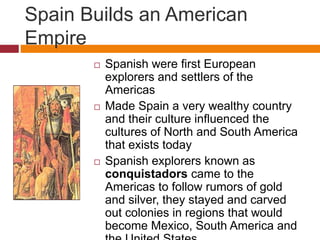
 Spanish explorers known as 
conquistadors came to the 
Americas to follow rumors of gold 
and silver, they stayed and carved 
out colonies in regions that would 
become Mexico, South America and 
the United States
Spain Builds an American 
Empire 
Spanish Conquests in Mexico 
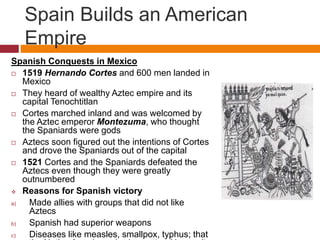
 1519 Hernando Cortes and 600 men landed in 
Mexico 
 They heard of wealthy Aztec empire and its 
capital Tenochtitlan 
 Cortes marched inland and was welcomed by 
the Aztec emperor Montezuma, who thought 
the Spaniards were gods 
 Aztecs soon figured out the intentions of Cortes 
and drove the Spaniards out of the capital 
 1521 Cortes and the Spaniards defeated the 
Aztecs even though they were greatly 
outnumbered 
 Reasons for Spanish victory 
a) Made allies with groups that did not like 
Aztecs 
b) Spanish had superior weapons 
c) Diseases like measles, smallpox, typhus; that 
the Native Americans had no natural immunity
Effects of Old World Disease 
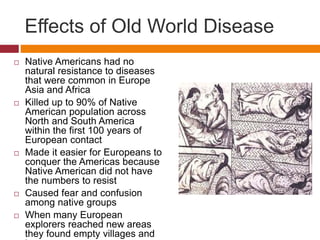
 Native Americans had no 
natural resistance to diseases 
that were common in Europe 
Asia and Africa 
 Killed up to 90% of Native 
American population across 
North and South America 
within the first 100 years of 
European contact 
 Made it easier for Europeans to 
conquer the Americas because 
Native American did not have 
the numbers to resist 
 Caused fear and confusion 
among native groups 
 When many European 
explorers reached new areas 
they found empty villages and 
towns
Spain Builds an American 
Empire 
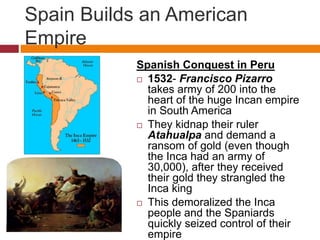
Spanish Conquest in Peru 
 1532- Francisco Pizarro 
takes army of 200 into the 
heart of the huge Incan empire 
in South America 
 They kidnap their ruler 
Atahualpa and demand a 
ransom of gold (even though 
the Inca had an army of 
30,000), after they received 
their gold they strangled the 
Inca king 
 This demoralized the Inca 
people and the Spaniards 
quickly seized control of their 
empire
Spain Builds an American 
Empire 
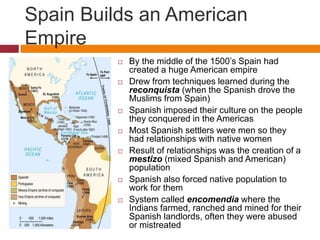
 By the middle of the 1500’s Spain had 
created a huge American empire 
 Drew from techniques learned during the 
reconquista (when the Spanish drove the 
Muslims from Spain) 
 Spanish imposed their culture on the people 
they conquered in the Americas 
 Most Spanish settlers were men so they 
had relationships with native women 
 Result of relationships was the creation of a 
mestizo (mixed Spanish and American) 
population 
 Spanish also forced native population to 
work for them 
 System called encomendia where the 
Indians farmed, ranched and mined for their 
Spanish landlords, often they were abused 
or mistreated
Portuguese Empire in America 
 One area that remained outside of 
European influence was Brazil 
 Region was given to Portugal because of 
Treaty of Tordesillas and claimed by Brazil 
in 1500 
 Colonists settled coastal areas and built 
huge sugar plantations 
 The demand for sugar was great in 
Europe and made huge profits for 
Portugal
Spain Builds an American 
Empire 
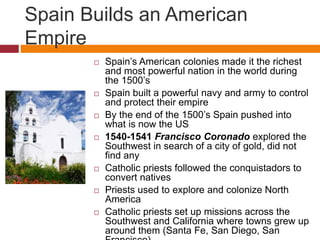
 Spain’s American colonies made it the richest 
and most powerful nation in the world during 
the 1500’s 
 Spain built a powerful navy and army to control 
and protect their empire 
 By the end of the 1500’s Spain pushed into 
what is now the US 
 1540-1541 Francisco Coronado explored the 
Southwest in search of a city of gold, did not 
find any 
 Catholic priests followed the conquistadors to 
convert natives 
 Priests used to explore and colonize North 
America 
 Catholic priests set up missions across the 
Southwest and California where towns grew up 
around them (Santa Fe, San Diego, San 
Francisco)
Spain Builds an American 
Empire 
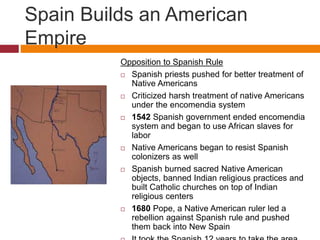
Opposition to Spanish Rule 
 Spanish priests pushed for better treatment of 
Native Americans 
 Criticized harsh treatment of native Americans 
under the encomendia system 
 1542 Spanish government ended encomendia 
system and began to use African slaves for 
labor 
 Native Americans began to resist Spanish 
colonizers as well 
 Spanish burned sacred Native American 
objects, banned Indian religious practices and 
built Catholic churches on top of Indian 
religious centers 
 1680 Pope, a Native American ruler led a 
rebellion against Spanish rule and pushed 
them back into New Spain 
 It took the Spanish 12 years to take the area
Europeans Settle North 
America 
Section 2
Europeans Settle North 
America 
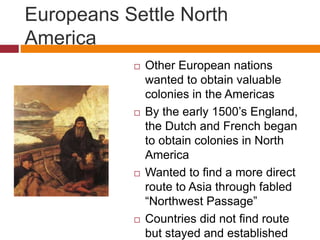
 Other European nations 
wanted to obtain valuable 
colonies in the Americas 
 By the early 1500’s England, 
the Dutch and French began 
to obtain colonies in North 
America 
 Wanted to find a more direct 
route to Asia through fabled 
“Northwest Passage” 
 Countries did not find route 
but stayed and established
Europeans Settle North 
America 
New France 
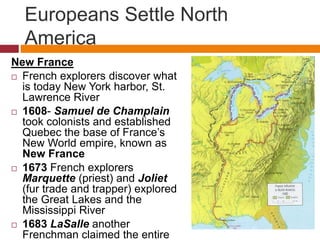
 French explorers discover what 
is today New York harbor, St. 
Lawrence River 
 1608- Samuel de Champlain 
took colonists and established 
Quebec the base of France’s 
New World empire, known as 
New France 
 1673 French explorers 
Marquette (priest) and Joliet 
(fur trade and trapper) explored 
the Great Lakes and the 
Mississippi River 
 1683 LaSalle another 
Frenchman claimed the entire
Europeans Settle North 
America 
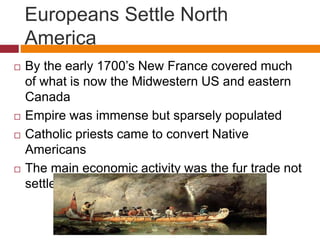
 By the early 1700’s New France covered much 
of what is now the Midwestern US and eastern 
Canada 
 Empire was immense but sparsely populated 
 Catholic priests came to convert Native 
Americans 
 The main economic activity was the fur trade not 
settlement and occupying territory
Europeans Settle North 
America 
English Arrive in North 
America 
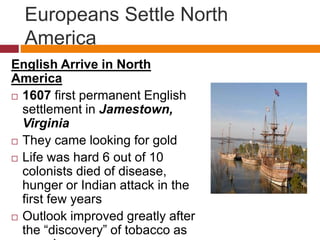
 1607 first permanent English 
settlement in Jamestown, 
Virginia 
 They came looking for gold 
 Life was hard 6 out of 10 
colonists died of disease, 
hunger or Indian attack in the 
first few years 
 Outlook improved greatly after 
the “discovery” of tobacco as 
a cash crop
Europeans Settle North 
America 
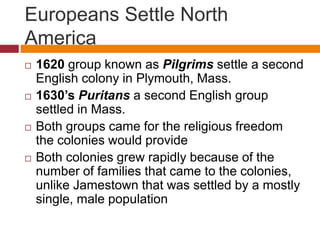
 1620 group known as Pilgrims settle a second 
English colony in Plymouth, Mass. 
 1630’s Puritans a second English group 
settled in Mass. 
 Both groups came for the religious freedom 
the colonies would provide 
 Both colonies grew rapidly because of the 
number of families that came to the colonies, 
unlike Jamestown that was settled by a mostly 
single, male population
Europeans Settle North 
America 
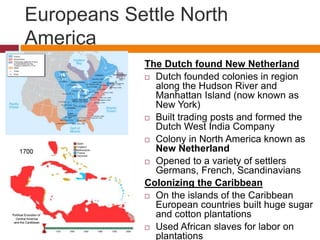
The Dutch found New Netherland 
 Dutch founded colonies in region 
along the Hudson River and 
Manhattan Island (now known as 
New York) 
 Built trading posts and formed the 
Dutch West India Company 
 Colony in North America known as 
New Netherland 
 Opened to a variety of settlers 
Germans, French, Scandinavians 
Colonizing the Caribbean 
 On the islands of the Caribbean 
European countries built huge sugar 
and cotton plantations 
 Used African slaves for labor on 
plantations
Europeans Settle North 
America 
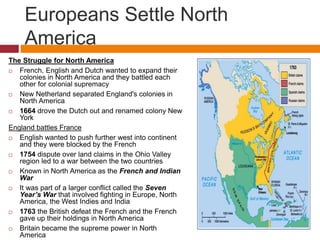
The Struggle for North America 
 French, English and Dutch wanted to expand their 
colonies in North America and they battled each 
other for colonial supremacy 
 New Netherland separated England's colonies in 
North America 
 1664 drove the Dutch out and renamed colony New 
York 
England battles France 
 English wanted to push further west into continent 
and they were blocked by the French 
 1754 dispute over land claims in the Ohio Valley 
region led to a war between the two countries 
 Known in North America as the French and Indian 
War 
 It was part of a larger conflict called the Seven 
Year’s War that involved fighting in Europe, North 
America, the West Indies and India 
 1763 the British defeat the French and the French 
gave up their holdings in North America 
 Britain became the supreme power in North 
America
Europeans Settle North 
America 
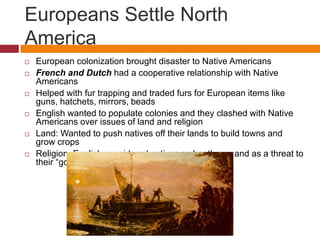
 European colonization brought disaster to Native Americans 
 French and Dutch had a cooperative relationship with Native 
Americans 
 Helped with fur trapping and traded furs for European items like 
guns, hatchets, mirrors, beads 
 English wanted to populate colonies and they clashed with Native 
Americans over issues of land and religion 
 Land: Wanted to push natives off their lands to build towns and 
grow crops 
 Religion: English considered natives as heathens and as a threat to 
their “godly” society
Europeans Settle North 
America 
 Native American and English hostility grew 
 1622 Colonists in Jamestown and the Powhatan tribe 
fought 
 1675- One of the bloodiest colonial conflicts was 
known as King Philipp's War 
 Chief Metacom (King Philipp) tried to unite Native 
Americans against English settlers 
 After a year the colonists defeated the Indians and put 
an end to Native American resistance in the English 
colonies 
 More destructive than European guns was disease 
that devastated the population 
 One effect of the loss was a severe labor shortage 
across the colonies, so the colonists turned to another
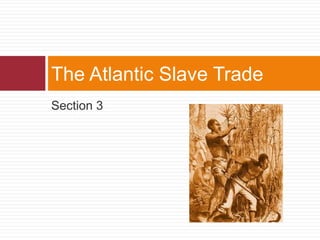
The Atlantic Slave Trade 
Section 3
The Atlantic Slave Trade 
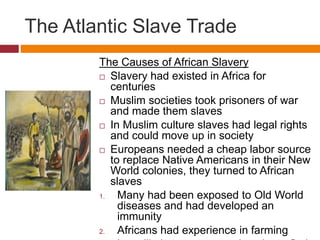
The Causes of African Slavery 
 Slavery had existed in Africa for 
centuries 
 Muslim societies took prisoners of war 
and made them slaves 
 In Muslim culture slaves had legal rights 
and could move up in society 
 Europeans needed a cheap labor source 
to replace Native Americans in their New 
World colonies, they turned to African 
slaves 
1. Many had been exposed to Old World 
diseases and had developed an 
immunity 
2. Africans had experience in farming 
Less likely to escape and easier to find
The Atlantic Slave Trade 
 Atlantic Slave Trade developed over the next three 
centuries , turned into a massive enterprise 
 Over that time 9.5 million Africans had been sent to the 
Americas 
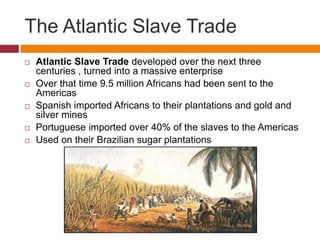
 Spanish imported Africans to their plantations and gold and 
silver mines 
 Portuguese imported over 40% of the slaves to the Americas 
 Used on their Brazilian sugar plantations
The Atlantic Slave Trade 
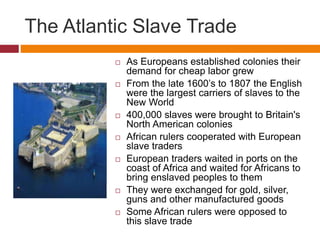
 As Europeans established colonies their 
demand for cheap labor grew 
 From the late 1600’s to 1807 the English 
were the largest carriers of slaves to the 
New World 
 400,000 slaves were brought to Britain's 
North American colonies 
 African rulers cooperated with European 
slave traders 
 European traders waited in ports on the 
coast of Africa and waited for Africans to 
bring enslaved peoples to them 
 They were exchanged for gold, silver, 
guns and other manufactured goods 
 Some African rulers were opposed to 
this slave trade
The Atlantic Slave Trade 
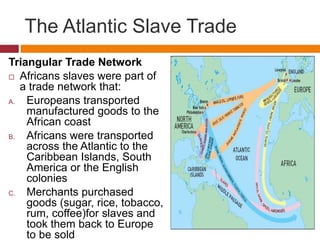
Triangular Trade Network 
 Africans slaves were part of 
a trade network that: 
A. Europeans transported 
manufactured goods to the 
African coast 
B. Africans were transported 
across the Atlantic to the 
Caribbean Islands, South 
America or the English 
colonies 
C. Merchants purchased 
goods (sugar, rice, tobacco, 
rum, coffee)for slaves and 
took them back to Europe 
to be sold
The Atlantic Slave Trade 
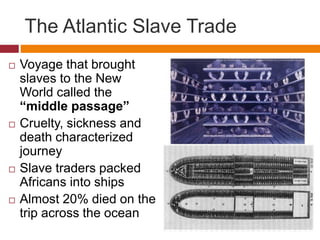
 Voyage that brought 
slaves to the New 
World called the 
“middle passage” 
 Cruelty, sickness and 
death characterized 
journey 
 Slave traders packed 
Africans into ships 
 Almost 20% died on the 
trip across the ocean
The Atlantic Slave Trade 
Slavery in the Americas 
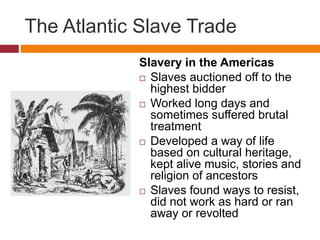
 Slaves auctioned off to the 
highest bidder 
 Worked long days and 
sometimes suffered brutal 
treatment 
 Developed a way of life 
based on cultural heritage, 
kept alive music, stories and 
religion of ancestors 
 Slaves found ways to resist, 
did not work as hard or ran 
away or revolted
The Atlantic Slave Trade 
 Had a profound impact on Americas and Africa 
Africa 
1. Many African culture lost generations of their fittest 
members (young and able) to the slave trade 
2. Families were torn apart 
3. The slave trade introduced guns to the continent of Africa 
The Americas/ New World 
1. Slave contributed to the growth of the Americas through 
their labor and their expertise in agriculture 
2. They brought their culture (music, art, food, religion) and it 
became mixed with the cultures of the New World 
3. Many nations today have mixed race populations and 
significant African- American populations
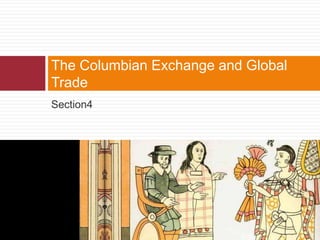
The Columbian Exchange and Global 
Trade 
Section4
The Columbian Exchange and Global 
Trade 
 Colonization of the Americas caused voluntary and involuntary 
migration of people and the introduction of goods from each 
continent 
 Exchange resulted in new business and trade practices in Europe 
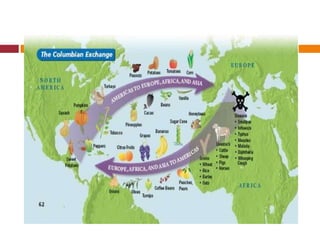
 Columbian Exchange- global transfer of foods, plants and 
animals during the colonization of the Americas 
 Ships brought back items to Europe never seen before, many 
became food sources for the Europeans 
 Two most important were potatoes and corn 
 Both were inexpensive to grow and supplied nutrition 
 Both played a significant role in boosting the world’s population 
 Europeans introduced: livestock animals to the Americas (cows, 
sheep, pigs, horses), foods from Africa were introduced (bananas, 
peas, yams), grains from Europe (wheat, rice) 
 Disease was part of the Columbian exchange
The Columbian Exchange and Global 
Trade 
Global Trade 
 Europe opened up the Atlantic world and caused a 
blending of three distinct cultures 
 New wealth and overseas trade led to new business 
practices 
 Growth of capitalism (an economic system based on 
private ownership and owned to make a profit) 
 No longer were governments the sole owners of great wealth 
 Many merchants gained wealth and used money to invest in 
other enterprises and businesses flourished 
 Increase in gold and silver from New World led to an increase 
in the money supply and things began to cost more for 
average Europeans
The Columbian Exchange and Global 
Trade 
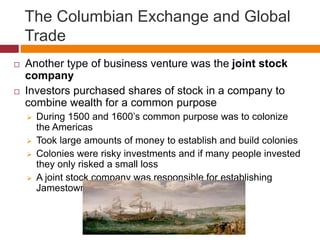
 Another type of business venture was the joint stock 
company 
 Investors purchased shares of stock in a company to 
combine wealth for a common purpose 
 During 1500 and 1600’s common purpose was to colonize 
the Americas 
 Took large amounts of money to establish and build colonies 
 Colonies were risky investments and if many people invested 
they only risked a small loss 
 A joint stock company was responsible for establishing 
Jamestown
The Columbian Exchange and Global 
Trade 
The Growth of Mercantilism 
 Mercantilism was a new economic policy adopted by 
European countries at this time 
 Countries power depended on its wealth, allowed 
countries to purchase goods and develop strong 
navies for trade 
 Goal was to attain as much wealth as possible 
 Nation could increase its wealth in two ways: 
 Obtain as much gold and silver as possible 
 Establish a favorable balance of trade by selling more that 
they purchased 
 Ultimate goal was to not depend on other countries for 
goods so they had to establish colonies to provide 
what they did not have 
 Colonies also provided a market for good to be sold
The Columbian Exchange and Global 
Trade 
Economic Revolution Changes European 
Society 
1. Spurred the growth of towns 
2. Led to the rise of a merchant class who 
controlled great wealth 
3. Led to the creation of nations and helped 
expand the power of European monarchs 
4. Majority of Europeans remained poor

Age of exploration and isolation

  • 1.
  • 2.
  • 4.
    • Beginning in1400’s, desire to explore called 3 G’s (Gold, God, Glory) A. Other countries wanted trade controlled by Italy and Arabs for three centuries • Spices most valued item • Quicker route to Asia meant they could take out middleman (Arabs, Italians) B. New technology – compass, faster ships, astrolabe, better mapmaking skills made traveling by ship easier, safer • Most new technology came from Muslims and Chinese C. Sparked by Renaissance curiosity and sense of adventure D. Desire to spread Christianity • Europeans saw this as their sacred duty to convert others
  • 5.
    Portugal Leads theWay A. Leader in developing and applying new sailing technology B. Had strong government support led by Prince Henry (Henry the Navigator) C. 1419 Henry established a sailing school for sailors, ship makers, navigators to perfect their trade • By 1460 Portugal was the first country to establish trading outposts along the coast of Africa and push into the Indian Ocean • Traded Africans European goods for gold and ivory
  • 6.
    • Portuguese neededto reach Asia by sea and had to sail around the southern tip of Africa • 1488 Bartolomeu Dias reached the Cape of Good Hope and explored the southeast coast of Africa • 1497 Vasco da Gama sailed to Calicut, India and returned to Portugal with silk, spices and gems that was worth 60 times more than the cost of the voyage • His voyage gave Portugal a direct sea route to Asia
  • 7.
    • Spain AlsoMakes Claims • 1492 Spain sent Christopher Columbus to find a route to Asia by sailing west across the Atlantic • Columbus thought he reached the Indies, really opened the way for European colonization of the Americas • Immediate impact was that it increased tension between Spain and Portugal
  • 8.
    • 1494- Treatyof Tordesillas Pope stepped in to keep peace between two countries • Line drawn from North to south across globe dividing eastern and western hemispheres • Portugal gets everything east of Line of Demarcation • Spain given all lands west of Line of Demarcation
  • 9.
    • Trading Empiresin the Indian Ocean • Portugal took control of the spice trade from Muslim merchants after da Gama’s voyage 1. 1509 extended control over region by defeating Mughal navy off the coast of India 2. 1510 Portuguese capture port city of Goa, India; it became center of their trading empire 3. 1511 Portuguese seize control of Strait of Malacca, gave them control of the spice Islands • Portugal began to break the Muslim domination of Eastern trade • Brought back goods at 20% of the prices charged by Arab and Italian traders • More Europeans could afford items
  • 10.
    • Success ofPortugal attracted other European countries • 1521 Spain claimed Philippine Islands Dutch Traders • Around 1600 the Dutch and English became a sea powers • English and Dutch began to take away Portuguese power • Each country formed an East India Company • Each company had power to print money, make treaties and raise armies • Dutch East India Company most powerful in region • 1619 Dutch establish trading post in Java and took Straits of Malacca and Spice Islands from Portugal • Dutch began to expand across the region and their capital in Europe, Amsterdam became a leading commercial center • By 1700 Dutch controlled most trade in Indian Ocean
  • 12.
    British and FrenchTraders • By 1700 English and French began to gain a foothold in region • English focused on India and developed a successful business in the cloth trade (established British East India Company) • France tried to establish a foothold in India but was not as successful • European countries took control of port cities but their influence did not extend beyond the ports • Their influence was not felt by most people in Asia
  • 13.
  • 14.
     China wasthe dominant power in Asia and Europeans wanted to trade with them Ming Dynasty  1368-1644 Ming Dynasty ruled China  Korea and Southeast Asia paid tribute (payment by one group to another to show submission) to Ming emperors, China expected Europeans to do the same  Hongwu was the first Ming emperor after he defeated the Mongols in 1368 A. Reformed agriculture by increasing rice production, encouraged growing cash crops (cotton, sugarcane) and encouraged fish farming B. Encouraged a return to Confucian traditions and moral standards C. Improved government by returning to a merit based government system  When problems developed Hongwu became a ruthless tyrant executing all of his enemies
  • 15.
    • After deathof Hongwu his son Yonglo took over • He moved royal court to Beijing (built the Forbidden City) • Also had a curiosity of the outside world • 1405 began seven voyages of exploration and trade under commander Zeng He • Expeditions traveled long distances, many ships, many people and huge ships • Trips were used to show Chinese superiority, because of voyages 16 countries sent tribute to China • Chinese officials complained that voyages wasted money and after 1433 China began a period of isolation
  • 17.
    • Trade policiesof 1500’s reflected isolation • To keep influence of outsiders to a minimum • Only the government could conduct trade through 3 ports- Canton, Macao and Ningbo • European demand for goods led to smuggling • Helped improve economy of China- led to increase in manufacturing of ceramics and silk making • Commerce and manufacturing seen as lower class jobs and not held in high regard in China, kept China from industrializing • Government supported agriculture • Taxes were low on agriculture and high on manufacturing
  • 18.
    Qing Dynasty •By 1600 Ming rule began to weaken, government corruption, civil strife, famine and high taxes led to rebellion • 1644 Manchus from northeast China seized power and ruled until 1900 • People resisted rule by non-Chinese Manchus 1. Kept order by keeping traditional social structure and restoring Chinese prosperity 2. Expanded China into Taiwan, Central Asia, Mongolia and Tibet 3. Lowered taxes and reduced government expenses 4. Welcomed Jesuits into royal court to learn about European life 5. Kept policy of isolation from foreign trade
  • 19.
    • Foreign countriesthat wished to trade with China had to trade only in special ports and pay tribute • The Dutch accepted the Chinese restrictions and the Chinese accepted the Dutch as trading partners • The Dutch brought silks, porcelain, and tea • By 1800 tea made up 80% of shipments from China to Europe • The British refused to follow the Chinese trade restrictions • China rejected their offers by sending a letter to the king of England that they did not need the British
  • 20.
    • 1600s and1700s were a time of peace and prosperity in China and the lives improved for most Chinese people Most Chinese were farmers and under the Qing irrigation and the use of fertilizer increased Also new crops from the were introduced by European traders (corn, sweet potatoes) Food production increased and the population exploded • Chinese families favored sons over daughters • Sons were in charge of religious rituals, and raised their own families in their parents homes • As their parents grew older they help them farm • Females were not as valued but they did have the responsibilities of children’s education and managing family finances
  • 21.
  • 22.
    • 1300’s Japaneseunity was shattered by warring shoguns • By 1467 the country was separated into hundreds of separate domains • 1467-1568 known as period of “warring states” • Samurai took control of feudal states and offered peasants protection for their loyalty • Warrior chieftains known as daimyo and used samurai as warriors • Emperor in Kyoto was just a figurehead with no power • Daimyo lived in fortresses and fought each other for control of land
  • 23.
    • Many daimyotried to seize and control power • Oda Nobunga –was the first to use soldiers with muskets to defeat rival samurai (1575) • Toyotomi Hideyoshi- took control and tried to conquer Korea, when he died the troops returned to Japan (1590) • 1600 Tonkugawa Ieyasu takes control of country by defeating his rivals and earning the loyalty of other daimyo • He moved the capital to Edo (Tokyo) • Kept daimyo tamed and helped centralize power in Japan • To keep daimyo in check he made them live in the capital every other year and when they were gone they had to leave their families behind as hostages, had them help build his castle in Edo • Founded Tokugawa Shogunate that held power until 1867
  • 24.
    • Japan enjoyedover 250 years of stability under Tokugawa shoguns • Farmers produced more food and population rose, even though they lived lives of misery Society was very structured a. Ruler was shogun and supreme military commander b. Below him was the landholding daimyo who controlled samurai warriors c. Artisans and peasants were next with merchants at the bottom • 4/5 of society were peasants • Merchants became more important as the economy expanded • Confucian ideas ruled society and the ideal citizen depended on agriculture not commerce • However the farmers paid the most in taxes, many abandoned land and moved to cities for economic opportunity • Mid 1700’s Japan shifted from a rural to an urban society • Edo was the largest city in the world
  • 25.
    • Contact BetweenEurope and Japan • Europeans began to arrive in the 1500’s • 1543 first Europeans were shipwrecked Portuguese sailors and merchants soon followed with clocks, tobacco, firearms • Japanese welcomed traders and missionaries 1. Europeans introduced new technologies and ideas 2. Japanese merchants eager to expand their markets welcomed Europeans 3. Daimyo welcomed traders for their guns to gain an advantage over their rivals • Guns changed the tradition of the Japanese warrior whose principal weapon was the sword • Cannons changed the way castles were built • Fortified castles attracted merchants and artisans and caused the growth of towns across Japan
  • 26.
    • 1549 firstmissionaries came to Japan • Catholic Jesuits, Franciscans and Dominican missionaries came to convert the Japanese • By 1600 they had converted over 300,000 Japanese • Missionaries teachings went against traditional Japanese beliefs and by 1612 Christianity was banned and Tokugawa Shoguns focused on ridding the country of them • 1637 situation came to a head after rebellion led by Christians • All Christian missionaries were kicked out of China and all Japanese had to demonstrate faithfulness to some branch of Buddhism
  • 27.
    • Persecution justone part of attempt to control foreign ideas • Shoguns did not like the introduction of European ways, but they wanted European trade • 1639 Japan sealed the borders of the country except one port, Nagasaki (a man made island in the harbor) • Only Dutch and Chinese were allowed to trade there • Tokugawa shogunate had a monopoly on all trade for over 200 years • During this time Japan remain basically closed to outsiders and Japanese were forbidden to leave • During this time Japan developed a self-sufficient country free from European intervention
  • 28.
  • 29.
  • 30.
    Spain Builds andAmerican Empire Section 1
  • 31.
    Spain Builds andAmerican Empire  1492- seeking an alternate trade route to Asia Christopher Columbus “discovers” America and accidently brings together peoples of the Americas, Europe and Africa  Spain’s rulers financed three more trips with more men and ships and began to found colonies (lands controlled by another nation)  1500 Pedro Alvares Cabral claimed modern day Brazil for Portugal  By the early 1500’s Europeans had figured out that the land was not Asia but a new continent  1519 Ferdinand Magellan sailed around the southern end of South America and across the Pacific (along the way claiming the Philippines for Spain)  In 1522 when they returned to Spain only 18 men and one ship were left, first voyage to circumnavigate the globe
  • 32.
    Spain Builds anAmerican Empire  Spanish were first European explorers and settlers of the Americas  Made Spain a very wealthy country and their culture influenced the cultures of North and South America that exists today  Spanish explorers known as conquistadors came to the Americas to follow rumors of gold and silver, they stayed and carved out colonies in regions that would become Mexico, South America and the United States
  • 33.
    Spain Builds anAmerican Empire Spanish Conquests in Mexico  1519 Hernando Cortes and 600 men landed in Mexico  They heard of wealthy Aztec empire and its capital Tenochtitlan  Cortes marched inland and was welcomed by the Aztec emperor Montezuma, who thought the Spaniards were gods  Aztecs soon figured out the intentions of Cortes and drove the Spaniards out of the capital  1521 Cortes and the Spaniards defeated the Aztecs even though they were greatly outnumbered  Reasons for Spanish victory a) Made allies with groups that did not like Aztecs b) Spanish had superior weapons c) Diseases like measles, smallpox, typhus; that the Native Americans had no natural immunity
  • 34.
    Effects of OldWorld Disease  Native Americans had no natural resistance to diseases that were common in Europe Asia and Africa  Killed up to 90% of Native American population across North and South America within the first 100 years of European contact  Made it easier for Europeans to conquer the Americas because Native American did not have the numbers to resist  Caused fear and confusion among native groups  When many European explorers reached new areas they found empty villages and towns
  • 35.
    Spain Builds anAmerican Empire Spanish Conquest in Peru  1532- Francisco Pizarro takes army of 200 into the heart of the huge Incan empire in South America  They kidnap their ruler Atahualpa and demand a ransom of gold (even though the Inca had an army of 30,000), after they received their gold they strangled the Inca king  This demoralized the Inca people and the Spaniards quickly seized control of their empire
  • 36.
    Spain Builds anAmerican Empire  By the middle of the 1500’s Spain had created a huge American empire  Drew from techniques learned during the reconquista (when the Spanish drove the Muslims from Spain)  Spanish imposed their culture on the people they conquered in the Americas  Most Spanish settlers were men so they had relationships with native women  Result of relationships was the creation of a mestizo (mixed Spanish and American) population  Spanish also forced native population to work for them  System called encomendia where the Indians farmed, ranched and mined for their Spanish landlords, often they were abused or mistreated
  • 37.
    Portuguese Empire inAmerica  One area that remained outside of European influence was Brazil  Region was given to Portugal because of Treaty of Tordesillas and claimed by Brazil in 1500  Colonists settled coastal areas and built huge sugar plantations  The demand for sugar was great in Europe and made huge profits for Portugal
  • 38.
    Spain Builds anAmerican Empire  Spain’s American colonies made it the richest and most powerful nation in the world during the 1500’s  Spain built a powerful navy and army to control and protect their empire  By the end of the 1500’s Spain pushed into what is now the US  1540-1541 Francisco Coronado explored the Southwest in search of a city of gold, did not find any  Catholic priests followed the conquistadors to convert natives  Priests used to explore and colonize North America  Catholic priests set up missions across the Southwest and California where towns grew up around them (Santa Fe, San Diego, San Francisco)
  • 39.
    Spain Builds anAmerican Empire Opposition to Spanish Rule  Spanish priests pushed for better treatment of Native Americans  Criticized harsh treatment of native Americans under the encomendia system  1542 Spanish government ended encomendia system and began to use African slaves for labor  Native Americans began to resist Spanish colonizers as well  Spanish burned sacred Native American objects, banned Indian religious practices and built Catholic churches on top of Indian religious centers  1680 Pope, a Native American ruler led a rebellion against Spanish rule and pushed them back into New Spain  It took the Spanish 12 years to take the area
  • 40.
    Europeans Settle North America Section 2
  • 41.
    Europeans Settle North America  Other European nations wanted to obtain valuable colonies in the Americas  By the early 1500’s England, the Dutch and French began to obtain colonies in North America  Wanted to find a more direct route to Asia through fabled “Northwest Passage”  Countries did not find route but stayed and established
  • 42.
    Europeans Settle North America New France  French explorers discover what is today New York harbor, St. Lawrence River  1608- Samuel de Champlain took colonists and established Quebec the base of France’s New World empire, known as New France  1673 French explorers Marquette (priest) and Joliet (fur trade and trapper) explored the Great Lakes and the Mississippi River  1683 LaSalle another Frenchman claimed the entire
  • 43.
    Europeans Settle North America  By the early 1700’s New France covered much of what is now the Midwestern US and eastern Canada  Empire was immense but sparsely populated  Catholic priests came to convert Native Americans  The main economic activity was the fur trade not settlement and occupying territory
  • 44.
    Europeans Settle North America English Arrive in North America  1607 first permanent English settlement in Jamestown, Virginia  They came looking for gold  Life was hard 6 out of 10 colonists died of disease, hunger or Indian attack in the first few years  Outlook improved greatly after the “discovery” of tobacco as a cash crop
  • 45.
    Europeans Settle North America  1620 group known as Pilgrims settle a second English colony in Plymouth, Mass.  1630’s Puritans a second English group settled in Mass.  Both groups came for the religious freedom the colonies would provide  Both colonies grew rapidly because of the number of families that came to the colonies, unlike Jamestown that was settled by a mostly single, male population
  • 46.
    Europeans Settle North America The Dutch found New Netherland  Dutch founded colonies in region along the Hudson River and Manhattan Island (now known as New York)  Built trading posts and formed the Dutch West India Company  Colony in North America known as New Netherland  Opened to a variety of settlers Germans, French, Scandinavians Colonizing the Caribbean  On the islands of the Caribbean European countries built huge sugar and cotton plantations  Used African slaves for labor on plantations
  • 47.
    Europeans Settle North America The Struggle for North America  French, English and Dutch wanted to expand their colonies in North America and they battled each other for colonial supremacy  New Netherland separated England's colonies in North America  1664 drove the Dutch out and renamed colony New York England battles France  English wanted to push further west into continent and they were blocked by the French  1754 dispute over land claims in the Ohio Valley region led to a war between the two countries  Known in North America as the French and Indian War  It was part of a larger conflict called the Seven Year’s War that involved fighting in Europe, North America, the West Indies and India  1763 the British defeat the French and the French gave up their holdings in North America  Britain became the supreme power in North America
  • 48.
    Europeans Settle North America  European colonization brought disaster to Native Americans  French and Dutch had a cooperative relationship with Native Americans  Helped with fur trapping and traded furs for European items like guns, hatchets, mirrors, beads  English wanted to populate colonies and they clashed with Native Americans over issues of land and religion  Land: Wanted to push natives off their lands to build towns and grow crops  Religion: English considered natives as heathens and as a threat to their “godly” society
  • 49.
    Europeans Settle North America  Native American and English hostility grew  1622 Colonists in Jamestown and the Powhatan tribe fought  1675- One of the bloodiest colonial conflicts was known as King Philipp's War  Chief Metacom (King Philipp) tried to unite Native Americans against English settlers  After a year the colonists defeated the Indians and put an end to Native American resistance in the English colonies  More destructive than European guns was disease that devastated the population  One effect of the loss was a severe labor shortage across the colonies, so the colonists turned to another
  • 50.
    The Atlantic SlaveTrade Section 3
  • 51.
    The Atlantic SlaveTrade The Causes of African Slavery  Slavery had existed in Africa for centuries  Muslim societies took prisoners of war and made them slaves  In Muslim culture slaves had legal rights and could move up in society  Europeans needed a cheap labor source to replace Native Americans in their New World colonies, they turned to African slaves 1. Many had been exposed to Old World diseases and had developed an immunity 2. Africans had experience in farming Less likely to escape and easier to find
  • 52.
    The Atlantic SlaveTrade  Atlantic Slave Trade developed over the next three centuries , turned into a massive enterprise  Over that time 9.5 million Africans had been sent to the Americas  Spanish imported Africans to their plantations and gold and silver mines  Portuguese imported over 40% of the slaves to the Americas  Used on their Brazilian sugar plantations
  • 53.
    The Atlantic SlaveTrade  As Europeans established colonies their demand for cheap labor grew  From the late 1600’s to 1807 the English were the largest carriers of slaves to the New World  400,000 slaves were brought to Britain's North American colonies  African rulers cooperated with European slave traders  European traders waited in ports on the coast of Africa and waited for Africans to bring enslaved peoples to them  They were exchanged for gold, silver, guns and other manufactured goods  Some African rulers were opposed to this slave trade
  • 54.
    The Atlantic SlaveTrade Triangular Trade Network  Africans slaves were part of a trade network that: A. Europeans transported manufactured goods to the African coast B. Africans were transported across the Atlantic to the Caribbean Islands, South America or the English colonies C. Merchants purchased goods (sugar, rice, tobacco, rum, coffee)for slaves and took them back to Europe to be sold
  • 55.
    The Atlantic SlaveTrade  Voyage that brought slaves to the New World called the “middle passage”  Cruelty, sickness and death characterized journey  Slave traders packed Africans into ships  Almost 20% died on the trip across the ocean
  • 56.
    The Atlantic SlaveTrade Slavery in the Americas  Slaves auctioned off to the highest bidder  Worked long days and sometimes suffered brutal treatment  Developed a way of life based on cultural heritage, kept alive music, stories and religion of ancestors  Slaves found ways to resist, did not work as hard or ran away or revolted
  • 57.
    The Atlantic SlaveTrade  Had a profound impact on Americas and Africa Africa 1. Many African culture lost generations of their fittest members (young and able) to the slave trade 2. Families were torn apart 3. The slave trade introduced guns to the continent of Africa The Americas/ New World 1. Slave contributed to the growth of the Americas through their labor and their expertise in agriculture 2. They brought their culture (music, art, food, religion) and it became mixed with the cultures of the New World 3. Many nations today have mixed race populations and significant African- American populations
  • 58.
    The Columbian Exchangeand Global Trade Section4
  • 59.
    The Columbian Exchangeand Global Trade  Colonization of the Americas caused voluntary and involuntary migration of people and the introduction of goods from each continent  Exchange resulted in new business and trade practices in Europe  Columbian Exchange- global transfer of foods, plants and animals during the colonization of the Americas  Ships brought back items to Europe never seen before, many became food sources for the Europeans  Two most important were potatoes and corn  Both were inexpensive to grow and supplied nutrition  Both played a significant role in boosting the world’s population  Europeans introduced: livestock animals to the Americas (cows, sheep, pigs, horses), foods from Africa were introduced (bananas, peas, yams), grains from Europe (wheat, rice)  Disease was part of the Columbian exchange
  • 61.
    The Columbian Exchangeand Global Trade Global Trade  Europe opened up the Atlantic world and caused a blending of three distinct cultures  New wealth and overseas trade led to new business practices  Growth of capitalism (an economic system based on private ownership and owned to make a profit)  No longer were governments the sole owners of great wealth  Many merchants gained wealth and used money to invest in other enterprises and businesses flourished  Increase in gold and silver from New World led to an increase in the money supply and things began to cost more for average Europeans
  • 62.
    The Columbian Exchangeand Global Trade  Another type of business venture was the joint stock company  Investors purchased shares of stock in a company to combine wealth for a common purpose  During 1500 and 1600’s common purpose was to colonize the Americas  Took large amounts of money to establish and build colonies  Colonies were risky investments and if many people invested they only risked a small loss  A joint stock company was responsible for establishing Jamestown
  • 63.
    The Columbian Exchangeand Global Trade The Growth of Mercantilism  Mercantilism was a new economic policy adopted by European countries at this time  Countries power depended on its wealth, allowed countries to purchase goods and develop strong navies for trade  Goal was to attain as much wealth as possible  Nation could increase its wealth in two ways:  Obtain as much gold and silver as possible  Establish a favorable balance of trade by selling more that they purchased  Ultimate goal was to not depend on other countries for goods so they had to establish colonies to provide what they did not have  Colonies also provided a market for good to be sold
  • 64.
    The Columbian Exchangeand Global Trade Economic Revolution Changes European Society 1. Spurred the growth of towns 2. Led to the rise of a merchant class who controlled great wealth 3. Led to the creation of nations and helped expand the power of European monarchs 4. Majority of Europeans remained poor