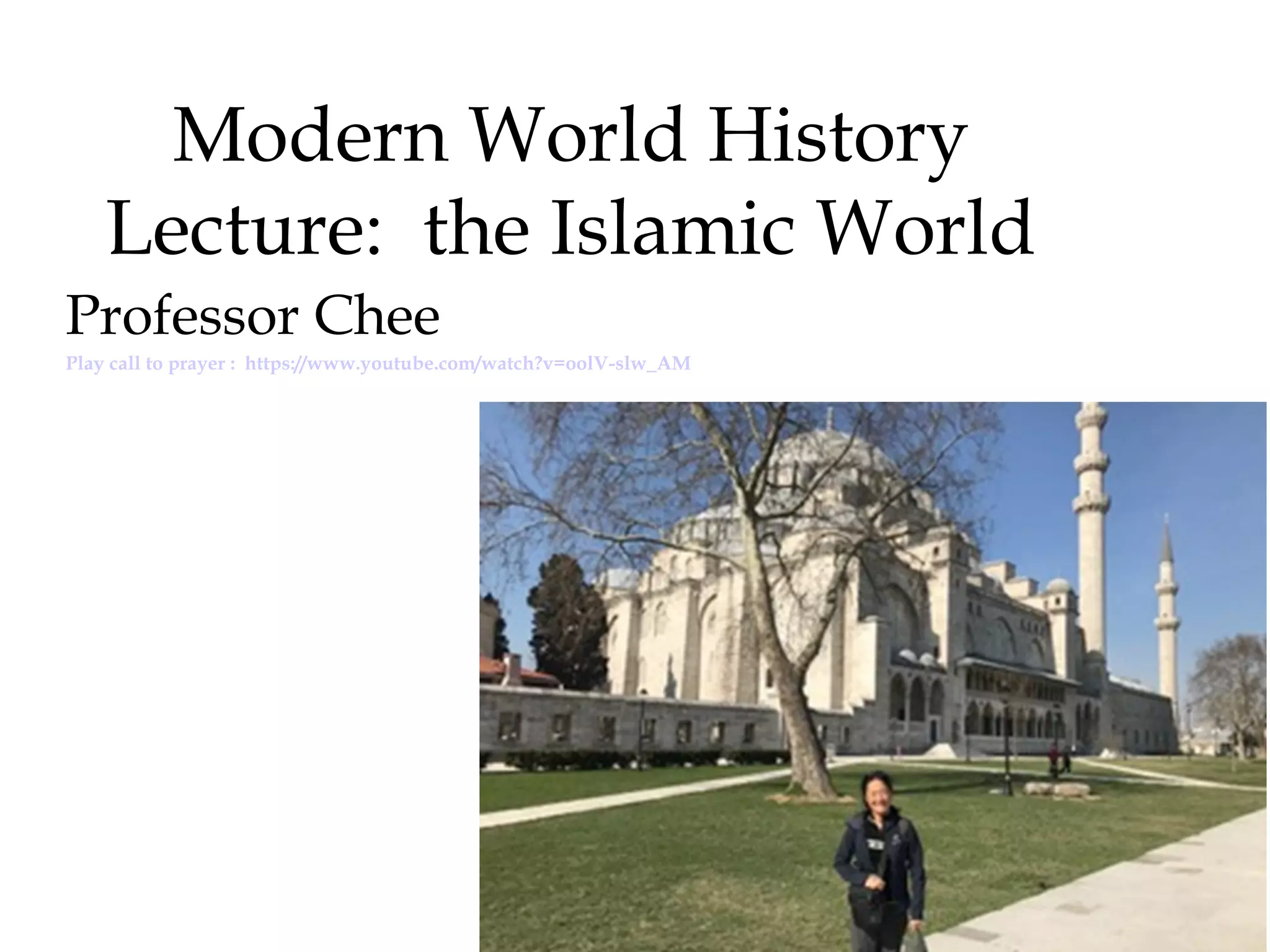
Modern World History
Lecture: the Islamic World
Professor Chee
Play call to prayer : https://www.youtube.com/watch?v=oolV-slw_AM
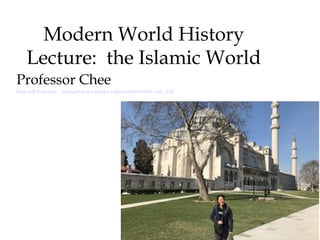
Modern World History
Lecture: the Islamic World
Professor Chee
Questions to consider:
Did Islamic empires decline? If
so, why? Think about both
internal and external factors that
bring about this change.
Play call to prayer : https://www.youtube.com/watch?v=oolV-slw_AM
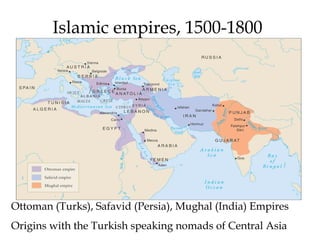
Islamic empires, 1500-1800
Ottoman (Turks), Safavid (Persia), Mughal (India) Empires
Origins with the Turkish speaking nomads of Central Asia
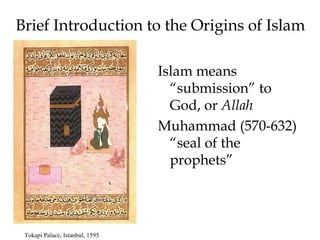
Brief Introduction to the Origins of Islam
Islam means
“submission” to
God, or Allah
Muhammad (570-632)
“seal of the
prophets”
Tokapi Palace, Istanbul, 1595
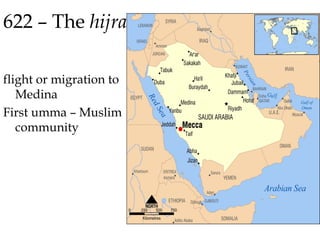
622 – The hijra
flight or migration to
Medina
First umma – Muslim
community
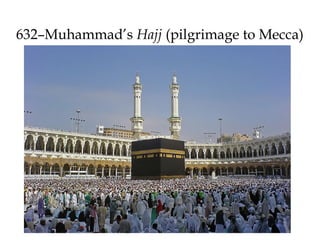
632–Muhammad’s Hajj (pilgrimage to Mecca)
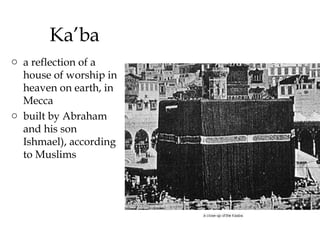
Ka’ba
o a reflection of a
house of worship in
heaven on earth, in
Mecca
o built by Abraham
and his son
Ishmael), according
to Muslims
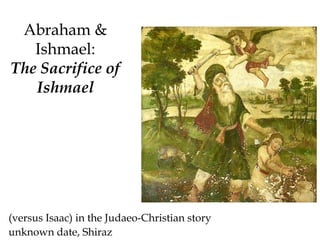
Abraham &
Ishmael:
The Sacrifice of
Ishmael
(versus Isaac) in the Judaeo-Christian story
unknown date, Shiraz
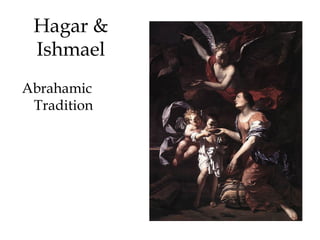
Hagar &
Ishmael
Abrahamic
Tradition
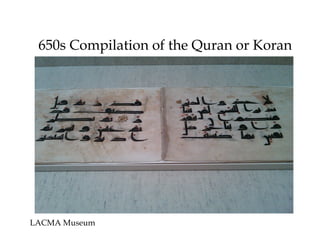
650s Compilation of the Quran or Koran
LACMA Museum
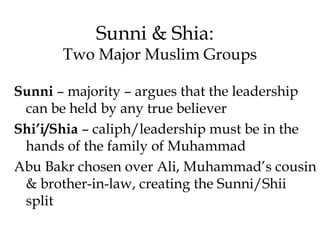
Sunni & Shia:
Two Major Muslim Groups
Sunni – majority – argues that the leadership
can be held by any true believer
Shi’i/Shia – caliph/leadership must be in the
hands of the family of Muhammad
Abu Bakr chosen over Ali, Muhammad’s cousin
& brother-in-law, creating the Sunni/Shii
split
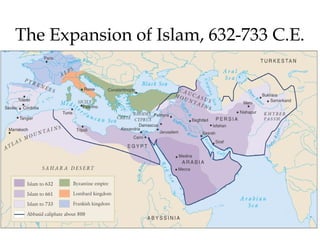
The Expansion of Islam, 632-733 C.E.
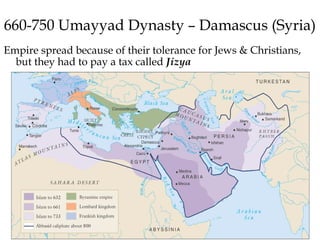
660-750 Umayyad Dynasty – Damascus (Syria)
Empire spread because of their tolerance for Jews & Christians,
but they had to pay a tax called Jizya
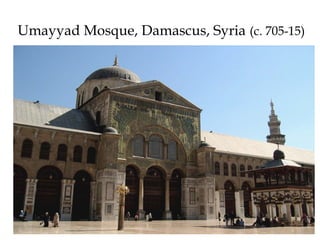
Umayyad Mosque, Damascus, Syria (c. 705-15)
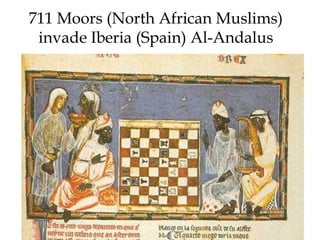
711 Moors (North African Muslims)
invade Iberia (Spain) Al-Andalus
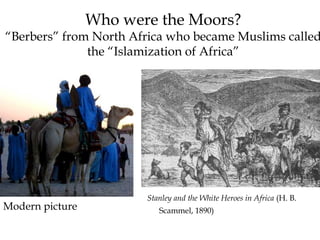
Who were the Moors?
“Berbers” from North Africa who became Muslims called
the “Islamization of Africa”
Stanley and the White Heroes in Africa (H. B.
Scammel, 1890)Modern picture
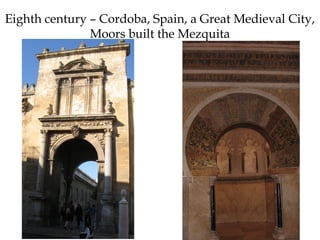
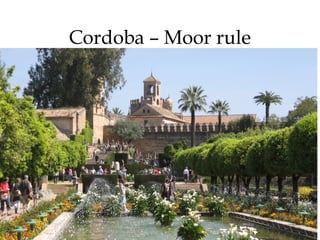
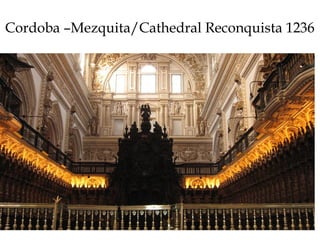
Eighth century – Cordoba, Spain, a Great Medieval City,
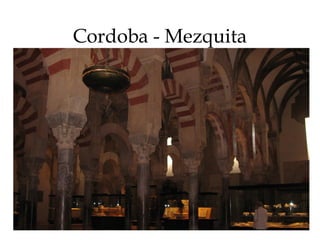
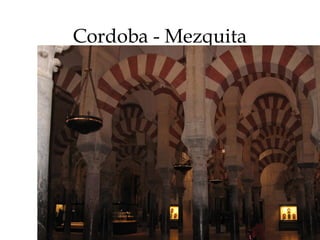
Moors built the Mezquita
Cordoba - Mezquita
Cordoba - Mezquita
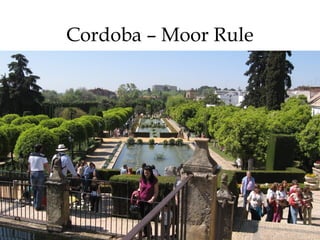
Cordoba – Moor Rule
Cordoba – Moor rule
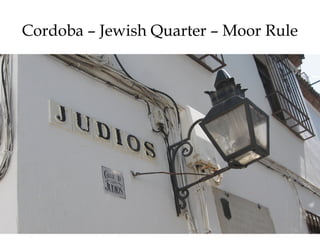
Cordoba – Jewish Quarter – Moor Rule
Cordoba –Mezquita/Cathedral Reconquista 1236
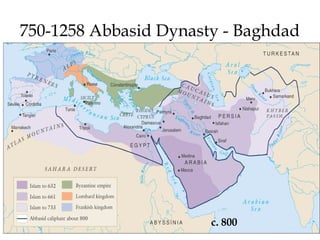
750-1258 Abbasid Dynasty - Baghdad
c. 800
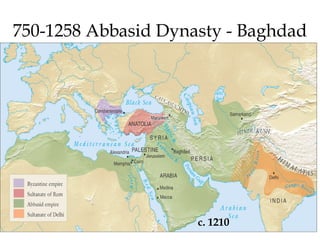
750-1258 Abbasid Dynasty - Baghdad
c. 1210
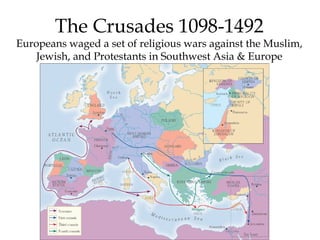
The Crusades 1098-1492
Europeans waged a set of religious wars against the Muslim,
Jewish, and Protestants in Southwest Asia & Europe
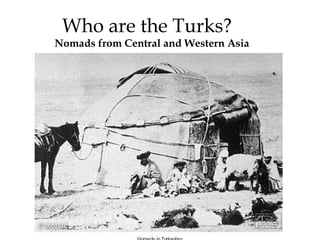
Who are the Turks?
Nomads from Central and Western Asia
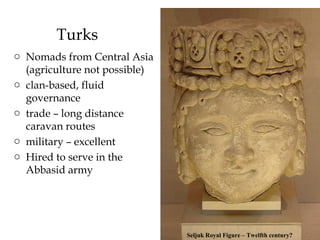
Turks
o Nomads from Central Asia
(agriculture not possible)
o clan-based, fluid
governance
o trade – long distance
caravan routes
o military – excellent
o Hired to serve in the
Abbasid army
Seljuk Royal Figure – Twelfth century?
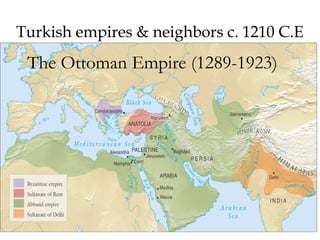
Turkish empires & neighbors c. 1210 C.E
The Ottoman Empire (1289-1923)
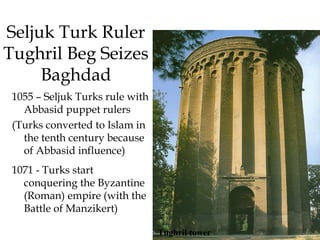
Seljuk Turk Ruler
Tughril Beg Seizes
Baghdad
1055 – Seljuk Turks rule with
Abbasid puppet rulers
(Turks converted to Islam in
the tenth century because
of Abbasid influence)
1071 - Turks start
conquering the Byzantine
(Roman) empire (with the
Battle of Manzikert)
Tughril tower
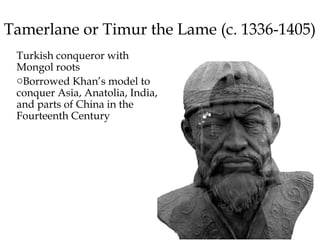
Tamerlane or Timur the Lame (c. 1336-1405)
Turkish conqueror with
Mongol roots
oBorrowed Khan’s model to
conquer Asia, Anatolia, India,
and parts of China in the
Fourteenth Century
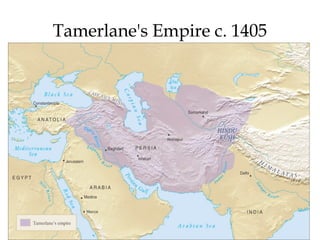
Tamerlane's Empire c. 1405
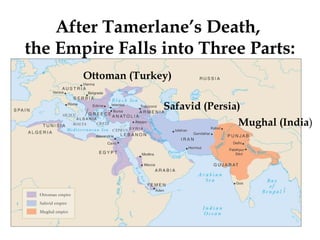
After Tamerlane’s Death,
the Empire Falls into Three Parts:
Ottoman (Turkey)
Mughal (India)
Safavid (Persia)
Ottoman Empire
1289-1923 Ottoman Empire (Turkey)
1280-1326 Osman Bey – founder of the Osmanli or Ottoman dynasty
1451-1481 r. Mehmed II the Conqueror
1453 Ottoman conquest of Constantinople
Mehmed converts Hagia Sophia to a mosque
1516 Turks conquer Cairo & Egypt
1520-1566 r. Suleyman (Solomon) the Magnificent (& Harem)
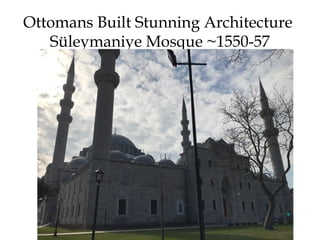
1550-57 builds the Suleymaniye or the Grand Mosque of Istanbul
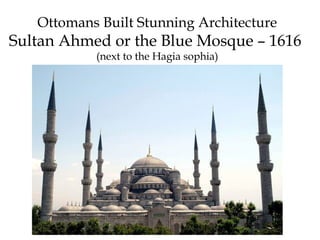
1610s Sultan Ahmed builds the Blue Mosque or the Sultan Ahmed
Mosque – Turkey’s national mosque
1680s Ottomans pushed back from Vienna, stops Ottoman expansion
1800s Ottoms lose Greece, Serbia & Egypt
1908“Proclamation of the Young Turks”
Powerful empire, with great contributions to art & architecture
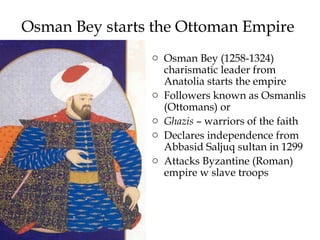
Osman Bey starts the Ottoman Empire
o Osman Bey (1258-1324)
charismatic leader from
Anatolia starts the empire
o Followers known as Osmanlis
(Ottomans) or
o Ghazis – warriors of the faith
o Declares independence from
Abbasid Saljuq sultan in 1299
o Attacks Byzantine (Roman)
empire w slave troops
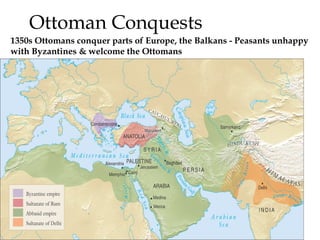
Ottoman Conquests
1350s Ottomans conquer parts of Europe, the Balkans - Peasants unhappy
with Byzantines & welcome the Ottomans
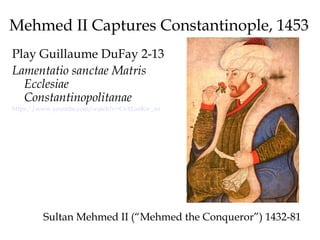
Mehmed II Captures Constantinople, 1453
Play Guillaume DuFay 2-13
Lamentatio sanctae Matris
Ecclesiae
Constantinopolitanae
https://www.youtube.com/watch?v=CvYGeiKw_zo
Sultan Mehmed II (“Mehmed the Conqueror”) 1432-81
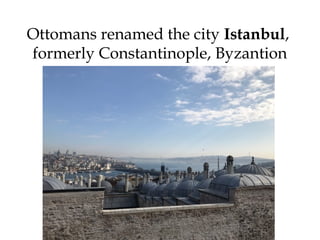
Ottomans renamed the city Istanbul,
formerly Constantinople, Byzantion
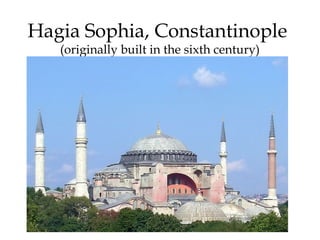
Hagia Sophia, Constantinople
(originally built in the sixth century)
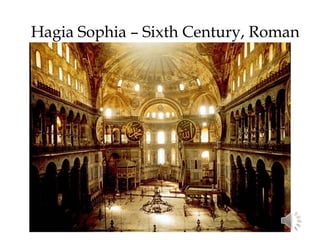
Hagia Sophia – Sixth Century, Roman
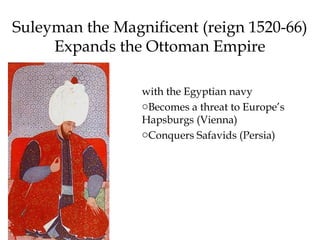
Suleyman the Magnificent (reign 1520-66)
Expands the Ottoman Empire
with the Egyptian navy
oBecomes a threat to Europe’s
Hapsburgs (Vienna)
oConquers Safavids (Persia)
Ottomans Built Stunning Architecture
SĂĽleymaniye Mosque ~1550-57
Ottomans Built Stunning Architecture
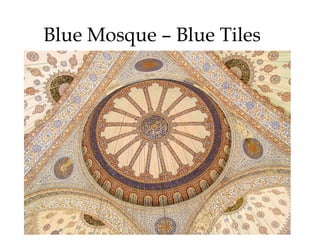
Sultan Ahmed or the Blue Mosque – 1616
(next to the Hagia sophia)
Blue Mosque – Blue Tiles
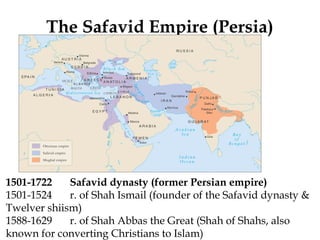
The Safavid Empire (Persia)
1501-1722 Safavid dynasty (former Persian empire)
1501-1524 r. of Shah Ismail (founder of the Safavid dynasty &
Twelver shiism)
1588-1629 r. of Shah Abbas the Great (Shah of Shahs, also
known for converting Christians to Islam)
The Safavid Empire (Persia)
1501-1722 Safavid dynasty (former Persian empire)
1501-1524 r. of Shah Ismail (founder of the Safavid
dynasty & Twelver shiism)
1514 Battle of Chaldiran
1588-1629 r. of Shah Abbas the Great (Shah of Shahs,
also known for converting Christians to Islam)
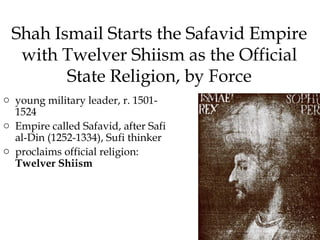
Shah Ismail Starts the Safavid Empire
with Twelver Shiism as the Official
State Religion, by Force
o young military leader, r. 1501-
1524
o Empire called Safavid, after Safi
al-Din (1252-1334), Sufi thinker
o proclaims official religion:
Twelver Shiism
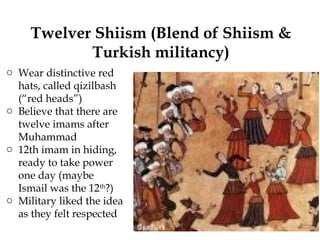
Twelver Shiism (Blend of Shiism &
Turkish militancy)
o Wear distinctive red
hats, called qizilbash
(“red heads”)
o Believe that there are
twelve imams after
Muhammad
o 12th imam in hiding,
ready to take power
one day (maybe
Ismail was the 12th
?)
o Military liked the idea
as they felt respected
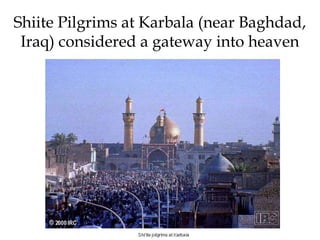
Shiite Pilgrims at Karbala (near Baghdad,
Iraq) considered a gateway into heaven
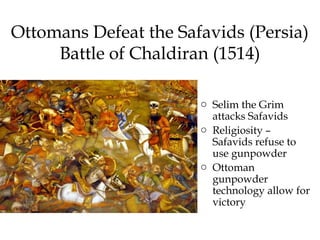
Ottomans Defeat the Safavids (Persia)
Battle of Chaldiran (1514)
o Selim the Grim
attacks Safavids
o Religiosity –
Safavids refuse to
use gunpowder
o Ottoman
gunpowder
technology allow for
victory
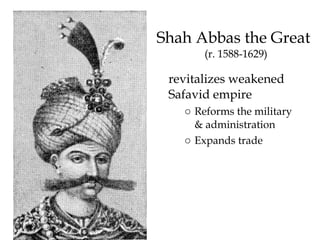
Shah Abbas the Great
(r. 1588-1629)
revitalizes weakened
Safavid empire
o Reforms the military
& administration
o Expands trade
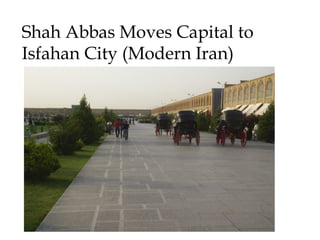
Shah Abbas Moves Capital to
Isfahan City (Modern Iran)
Isfahan
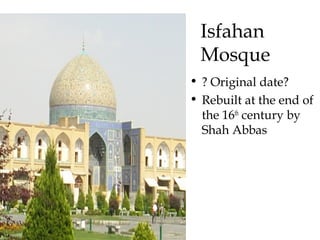
Mosque
• ? Original date?
• Rebuilt at the end of
the 16th
century by
Shah Abbas
Isfahan
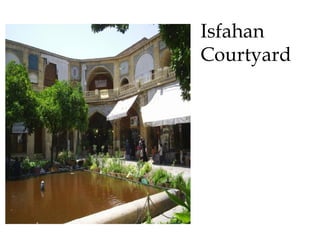
Courtyard
Isfahan
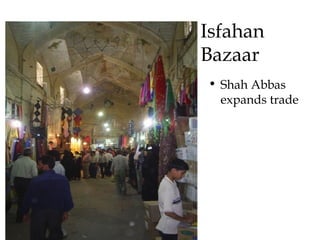
Bazaar
• Shah Abbas
expands trade
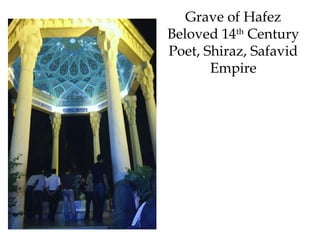
Grave of Hafez
Beloved 14th
Century
Poet, Shiraz, Safavid
Empire
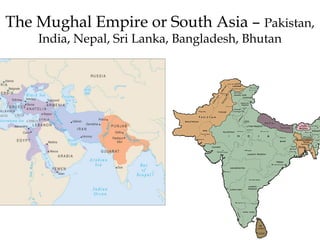
The Mughal Empire or South Asia – Pakistan,
India, Nepal, Sri Lanka, Bangladesh, Bhutan
The Mughal Empire or South Asia – Pakistan,
India, Nepal, Sri Lanka, Bangladesh, Bhutan
1526-1858 Mughal dynasty - [moo-guh l] Mo•ghul (mŏŏ-gŭl', mō-) (India)
1498 Portuguese Vasco da Gama arrives at Calicut, Southwest India
1526 Babur (descendant of Tamerland & Genghis Khan) seizes Delhi and
starts the Mughal dynasty
1556-1605 Reign of Akbar
1608 English arrive – Surat, SW India
1628-1657 r. of Emperor Shah Jahan
1639 English build fort at Madras – Southeast India
1648 Shah Jahan builds the Taj Mahal (for his wife)
(English imitation in 1815 – Royal Pavilion @Brighton, after the
British victory over Napoleon at Waterloo)
1659-1707 r. of Aurangzeb
1739 Persians sack Delhi
1757 Battle of Plassey – British East India Company conquer Bengal area
1770s famines lead to 1/3 population loss, under BEIC tax administration
1858 British crown colonizes India
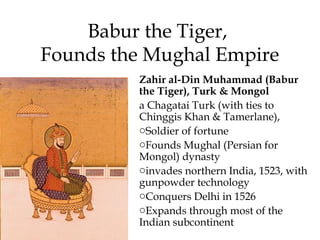
Babur the Tiger,
Founds the Mughal Empire
Zahir al-Din Muhammad (Babur
the Tiger), Turk & Mongol
a Chagatai Turk (with ties to
Chinggis Khan & Tamerlane),
oSoldier of fortune
oFounds Mughal (Persian for
Mongol) dynasty
oinvades northern India, 1523, with
gunpowder technology
oConquers Delhi in 1526
oExpands through most of the
Indian subcontinent
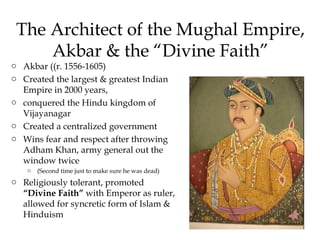
The Architect of the Mughal Empire,
Akbar & the “Divine Faith”
o Akbar ((r. 1556-1605)
o Created the largest & greatest Indian
Empire in 2000 years,
o conquered the Hindu kingdom of
Vijayanagar
o Created a centralized government
o Wins fear and respect after throwing
Adham Khan, army general out the
window twice
o (Second time just to make sure he was dead)
o Religiously tolerant, promoted
“Divine Faith” with Emperor as ruler,
allowed for syncretic form of Islam &
Hinduism
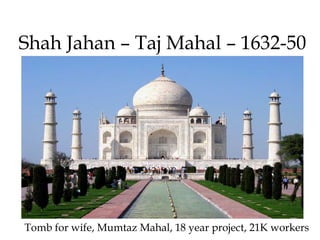
Shah Jahan – Taj Mahal – 1632-50
Tomb for wife, Mumtaz Mahal, 18 year project, 21K workers
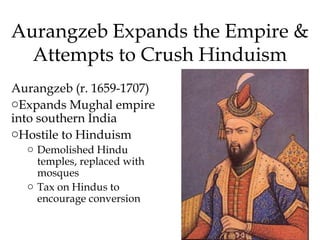
Aurangzeb Expands the Empire &
Attempts to Crush Hinduism
Aurangzeb (r. 1659-1707)
oExpands Mughal empire
into southern India
oHostile to Hinduism
o Demolished Hindu
temples, replaced with
mosques
o Tax on Hindus to
encourage conversion
Common Elements of Ottoman,
Safavid and Mughal Empires
• Empires based on military conquest
(“gunpowder empires”)
• Prestige of dynasty dependent on piety and
military prowess of the ruler
– Close relations with Sufism, ghazi tradition
• Steppe Turkish traditions
– Issuance of unilateral decrees
– Intra-family conflicts over power
• 1595 Sultan massacres 19 brothers (some infants), 15
expectant women (strangulation with silk)
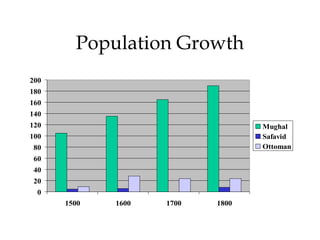
Population Growth
0
20
40
60
80
100
120
140
160
180
200
1500 1600 1700 1800
Mughal
Safavid
Ottoman
Religious Diversity
• Ottoman Empire: Christians, Jews
• Safavid Empire: Zoroastrians, Jews,
Christians
• Mughal Empire: Hindus, Jains, Zoroastrians,
Christians, Sikhs
• Mughal Akbar most tolerant
– Received Jesuits politely, but resented Christian
exclusivity
– Enthusiastic about syncretic Sikhism, self-serving
“Divine Faith”
Women and Politics
• Women officially banned from political
activity
• But tradition of revering mothers, 1st
wives
from Chinggis Khan
• Süleyman the Magnificent defers to
concubine HĂĽrrem Sultana
– Originally Roxelana, Ukrainian woman
– Convinces husband to murder eldest son in favor
of her own child
Agriculture and Trade
• American crops effect less dramatic change in
Muslim empires
– Coffee, tobacco important
– Initial opposition from conservative circles,
fearing lax morality of coffee houses
• Population growth also reflects territorial
additions and losses
• Trade with English East India Company,
French East India Company, and Dutch VOC
Status of Religious Minorities
• Non-Muslim protected people: dhimmi
– Payment of special tax: jizya
– Freedom of worship, property, legal affairs
• Ottoman communities: millet system of self-
administration
• Mughal rule: Muslims supreme, but work in
tandem with Hindus
– Under Akbar, jizya abolished
– Reaction under Aurangzeb
Capital Cities
• Istanbul cultural capital of Ottoman empire,
massive monumental architecture
• Rededication of Hagia Sofia church as Aya
Sofiya mosque
• Ishafan major Persian city
• Akbar builds magnificent Fatehpur Sikri
– Chooses site without sufficient water supply,
abandoned
– Taj Mahal example of Mughal architecture
Deterioration of Imperial
Leadership
• Ottoman princes become lazy through luxury
– Selim the Sot (r. 1566-1574)
– Ibrahim the Crazy (r.1640-1648)
• Attempts to isolate them compounds the problem
• Religious tensions between conservatives and liberals
intensify
– Role of women
• Wahhabi movement in Arabia denounces Ottomans
as unfit to rule
– Force destruction of observatory, printing press
• Safavid Shiites persecute Sunnis, non-Muslims and
even Sufis
Economic and Military Decline
• Foreign trade controlled by Europeans
• Military, administrative network
expensive to maintain
– Janissaries mutiny when paid with
debased coinage, 1589, other revolts follow
• Unproductive wars
• European military technology advances
faster than Ottomans can purchase it
Cultural Conservatism
• Europeans actively studying Islamic cultures
for purposes of trade, missionary activities
• Islamic empires less interested in outside
world
• Swiftly fell behind in technological
development
– E.g. Jews from Spain establish 1st
printing press in
Anatolia in late 15th
century
– But printing of books in Turkish and Arabic
forbidden until 1729
• Handwritten books preferred, but weak levels of
dissemination
Study Guide
Print/Take notes on Study Guide and
think about terms/questions
Questions to consider:
Did Islamic empires decline? If so, why?
Think about both internal and external
factors that bring about this change.

Lecture 4 islamic empires - modern shorter

  • 1.
    Modern World History Lecture:the Islamic World Professor Chee Play call to prayer : https://www.youtube.com/watch?v=oolV-slw_AM
  • 2.
    Modern World History Lecture:the Islamic World Professor Chee Questions to consider: Did Islamic empires decline? If so, why? Think about both internal and external factors that bring about this change. Play call to prayer : https://www.youtube.com/watch?v=oolV-slw_AM
  • 3.
    Islamic empires, 1500-1800 Ottoman(Turks), Safavid (Persia), Mughal (India) Empires Origins with the Turkish speaking nomads of Central Asia
  • 4.
    Brief Introduction tothe Origins of Islam Islam means “submission” to God, or Allah Muhammad (570-632) “seal of the prophets” Tokapi Palace, Istanbul, 1595
  • 5.
    622 – Thehijra flight or migration to Medina First umma – Muslim community
  • 6.
  • 7.
    Ka’ba o a reflectionof a house of worship in heaven on earth, in Mecca o built by Abraham and his son Ishmael), according to Muslims
  • 8.
    Abraham & Ishmael: The Sacrificeof Ishmael (versus Isaac) in the Judaeo-Christian story unknown date, Shiraz
  • 9.
  • 10.
    650s Compilation ofthe Quran or Koran LACMA Museum
  • 11.
    Sunni & Shia: TwoMajor Muslim Groups Sunni – majority – argues that the leadership can be held by any true believer Shi’i/Shia – caliph/leadership must be in the hands of the family of Muhammad Abu Bakr chosen over Ali, Muhammad’s cousin & brother-in-law, creating the Sunni/Shii split
  • 12.
    The Expansion ofIslam, 632-733 C.E.
  • 13.
    660-750 Umayyad Dynasty– Damascus (Syria) Empire spread because of their tolerance for Jews & Christians, but they had to pay a tax called Jizya
  • 14.
    Umayyad Mosque, Damascus,Syria (c. 705-15)
  • 15.
    711 Moors (NorthAfrican Muslims) invade Iberia (Spain) Al-Andalus
  • 16.
    Who were theMoors? “Berbers” from North Africa who became Muslims called the “Islamization of Africa” Stanley and the White Heroes in Africa (H. B. Scammel, 1890)Modern picture
  • 17.
    Eighth century –Cordoba, Spain, a Great Medieval City, Moors built the Mezquita
  • 18.
  • 19.
  • 20.
  • 21.
  • 22.
    Cordoba – JewishQuarter – Moor Rule
  • 23.
  • 24.
    750-1258 Abbasid Dynasty- Baghdad c. 800
  • 25.
    750-1258 Abbasid Dynasty- Baghdad c. 1210
  • 26.
    The Crusades 1098-1492 Europeanswaged a set of religious wars against the Muslim, Jewish, and Protestants in Southwest Asia & Europe
  • 27.
    Who are theTurks? Nomads from Central and Western Asia
  • 28.
    Turks o Nomads fromCentral Asia (agriculture not possible) o clan-based, fluid governance o trade – long distance caravan routes o military – excellent o Hired to serve in the Abbasid army Seljuk Royal Figure – Twelfth century?
  • 29.
    Turkish empires &neighbors c. 1210 C.E The Ottoman Empire (1289-1923)
  • 30.
    Seljuk Turk Ruler TughrilBeg Seizes Baghdad 1055 – Seljuk Turks rule with Abbasid puppet rulers (Turks converted to Islam in the tenth century because of Abbasid influence) 1071 - Turks start conquering the Byzantine (Roman) empire (with the Battle of Manzikert) Tughril tower
  • 31.
    Tamerlane or Timurthe Lame (c. 1336-1405) Turkish conqueror with Mongol roots oBorrowed Khan’s model to conquer Asia, Anatolia, India, and parts of China in the Fourteenth Century
  • 32.
  • 33.
    After Tamerlane’s Death, theEmpire Falls into Three Parts: Ottoman (Turkey) Mughal (India) Safavid (Persia)
  • 34.
    Ottoman Empire 1289-1923 OttomanEmpire (Turkey) 1280-1326 Osman Bey – founder of the Osmanli or Ottoman dynasty 1451-1481 r. Mehmed II the Conqueror 1453 Ottoman conquest of Constantinople Mehmed converts Hagia Sophia to a mosque 1516 Turks conquer Cairo & Egypt 1520-1566 r. Suleyman (Solomon) the Magnificent (& Harem) 1550-57 builds the Suleymaniye or the Grand Mosque of Istanbul 1610s Sultan Ahmed builds the Blue Mosque or the Sultan Ahmed Mosque – Turkey’s national mosque 1680s Ottomans pushed back from Vienna, stops Ottoman expansion 1800s Ottoms lose Greece, Serbia & Egypt 1908“Proclamation of the Young Turks” Powerful empire, with great contributions to art & architecture
  • 35.
    Osman Bey startsthe Ottoman Empire o Osman Bey (1258-1324) charismatic leader from Anatolia starts the empire o Followers known as Osmanlis (Ottomans) or o Ghazis – warriors of the faith o Declares independence from Abbasid Saljuq sultan in 1299 o Attacks Byzantine (Roman) empire w slave troops
  • 36.
    Ottoman Conquests 1350s Ottomansconquer parts of Europe, the Balkans - Peasants unhappy with Byzantines & welcome the Ottomans
  • 37.
    Mehmed II CapturesConstantinople, 1453 Play Guillaume DuFay 2-13 Lamentatio sanctae Matris Ecclesiae Constantinopolitanae https://www.youtube.com/watch?v=CvYGeiKw_zo Sultan Mehmed II (“Mehmed the Conqueror”) 1432-81
  • 38.
    Ottomans renamed thecity Istanbul, formerly Constantinople, Byzantion
  • 39.
    Hagia Sophia, Constantinople (originallybuilt in the sixth century)
  • 40.
    Hagia Sophia –Sixth Century, Roman
  • 41.
    Suleyman the Magnificent(reign 1520-66) Expands the Ottoman Empire with the Egyptian navy oBecomes a threat to Europe’s Hapsburgs (Vienna) oConquers Safavids (Persia)
  • 42.
    Ottomans Built StunningArchitecture SĂĽleymaniye Mosque ~1550-57
  • 43.
  • 44.
    Ottomans Built StunningArchitecture Sultan Ahmed or the Blue Mosque – 1616 (next to the Hagia sophia)
  • 45.
  • 46.
    The Safavid Empire(Persia) 1501-1722 Safavid dynasty (former Persian empire) 1501-1524 r. of Shah Ismail (founder of the Safavid dynasty & Twelver shiism) 1588-1629 r. of Shah Abbas the Great (Shah of Shahs, also known for converting Christians to Islam)
  • 47.
    The Safavid Empire(Persia) 1501-1722 Safavid dynasty (former Persian empire) 1501-1524 r. of Shah Ismail (founder of the Safavid dynasty & Twelver shiism) 1514 Battle of Chaldiran 1588-1629 r. of Shah Abbas the Great (Shah of Shahs, also known for converting Christians to Islam)
  • 48.
    Shah Ismail Startsthe Safavid Empire with Twelver Shiism as the Official State Religion, by Force o young military leader, r. 1501- 1524 o Empire called Safavid, after Safi al-Din (1252-1334), Sufi thinker o proclaims official religion: Twelver Shiism
  • 49.
    Twelver Shiism (Blendof Shiism & Turkish militancy) o Wear distinctive red hats, called qizilbash (“red heads”) o Believe that there are twelve imams after Muhammad o 12th imam in hiding, ready to take power one day (maybe Ismail was the 12th ?) o Military liked the idea as they felt respected
  • 50.
    Shiite Pilgrims atKarbala (near Baghdad, Iraq) considered a gateway into heaven
  • 51.
    Ottomans Defeat theSafavids (Persia) Battle of Chaldiran (1514) o Selim the Grim attacks Safavids o Religiosity – Safavids refuse to use gunpowder o Ottoman gunpowder technology allow for victory
  • 52.
    Shah Abbas theGreat (r. 1588-1629) revitalizes weakened Safavid empire o Reforms the military & administration o Expands trade
  • 53.
    Shah Abbas MovesCapital to Isfahan City (Modern Iran)
  • 54.
    Isfahan Mosque • ? Originaldate? • Rebuilt at the end of the 16th century by Shah Abbas
  • 55.
  • 56.
  • 57.
    Grave of Hafez Beloved14th Century Poet, Shiraz, Safavid Empire
  • 58.
    The Mughal Empireor South Asia – Pakistan, India, Nepal, Sri Lanka, Bangladesh, Bhutan
  • 59.
    The Mughal Empireor South Asia – Pakistan, India, Nepal, Sri Lanka, Bangladesh, Bhutan 1526-1858 Mughal dynasty - [moo-guh l] Mo•ghul (mŏŏ-gŭl', mō-) (India) 1498 Portuguese Vasco da Gama arrives at Calicut, Southwest India 1526 Babur (descendant of Tamerland & Genghis Khan) seizes Delhi and starts the Mughal dynasty 1556-1605 Reign of Akbar 1608 English arrive – Surat, SW India 1628-1657 r. of Emperor Shah Jahan 1639 English build fort at Madras – Southeast India 1648 Shah Jahan builds the Taj Mahal (for his wife) (English imitation in 1815 – Royal Pavilion @Brighton, after the British victory over Napoleon at Waterloo) 1659-1707 r. of Aurangzeb 1739 Persians sack Delhi 1757 Battle of Plassey – British East India Company conquer Bengal area 1770s famines lead to 1/3 population loss, under BEIC tax administration 1858 British crown colonizes India
  • 60.
    Babur the Tiger, Foundsthe Mughal Empire Zahir al-Din Muhammad (Babur the Tiger), Turk & Mongol a Chagatai Turk (with ties to Chinggis Khan & Tamerlane), oSoldier of fortune oFounds Mughal (Persian for Mongol) dynasty oinvades northern India, 1523, with gunpowder technology oConquers Delhi in 1526 oExpands through most of the Indian subcontinent
  • 61.
    The Architect ofthe Mughal Empire, Akbar & the “Divine Faith” o Akbar ((r. 1556-1605) o Created the largest & greatest Indian Empire in 2000 years, o conquered the Hindu kingdom of Vijayanagar o Created a centralized government o Wins fear and respect after throwing Adham Khan, army general out the window twice o (Second time just to make sure he was dead) o Religiously tolerant, promoted “Divine Faith” with Emperor as ruler, allowed for syncretic form of Islam & Hinduism
  • 62.
    Shah Jahan –Taj Mahal – 1632-50 Tomb for wife, Mumtaz Mahal, 18 year project, 21K workers
  • 63.
    Aurangzeb Expands theEmpire & Attempts to Crush Hinduism Aurangzeb (r. 1659-1707) oExpands Mughal empire into southern India oHostile to Hinduism o Demolished Hindu temples, replaced with mosques o Tax on Hindus to encourage conversion
  • 64.
    Common Elements ofOttoman, Safavid and Mughal Empires • Empires based on military conquest (“gunpowder empires”) • Prestige of dynasty dependent on piety and military prowess of the ruler – Close relations with Sufism, ghazi tradition • Steppe Turkish traditions – Issuance of unilateral decrees – Intra-family conflicts over power • 1595 Sultan massacres 19 brothers (some infants), 15 expectant women (strangulation with silk)
  • 65.
  • 66.
    Religious Diversity • OttomanEmpire: Christians, Jews • Safavid Empire: Zoroastrians, Jews, Christians • Mughal Empire: Hindus, Jains, Zoroastrians, Christians, Sikhs • Mughal Akbar most tolerant – Received Jesuits politely, but resented Christian exclusivity – Enthusiastic about syncretic Sikhism, self-serving “Divine Faith”
  • 67.
    Women and Politics •Women officially banned from political activity • But tradition of revering mothers, 1st wives from Chinggis Khan • Süleyman the Magnificent defers to concubine Hürrem Sultana – Originally Roxelana, Ukrainian woman – Convinces husband to murder eldest son in favor of her own child
  • 68.
    Agriculture and Trade •American crops effect less dramatic change in Muslim empires – Coffee, tobacco important – Initial opposition from conservative circles, fearing lax morality of coffee houses • Population growth also reflects territorial additions and losses • Trade with English East India Company, French East India Company, and Dutch VOC
  • 69.
    Status of ReligiousMinorities • Non-Muslim protected people: dhimmi – Payment of special tax: jizya – Freedom of worship, property, legal affairs • Ottoman communities: millet system of self- administration • Mughal rule: Muslims supreme, but work in tandem with Hindus – Under Akbar, jizya abolished – Reaction under Aurangzeb
  • 70.
    Capital Cities • Istanbulcultural capital of Ottoman empire, massive monumental architecture • Rededication of Hagia Sofia church as Aya Sofiya mosque • Ishafan major Persian city • Akbar builds magnificent Fatehpur Sikri – Chooses site without sufficient water supply, abandoned – Taj Mahal example of Mughal architecture
  • 71.
    Deterioration of Imperial Leadership •Ottoman princes become lazy through luxury – Selim the Sot (r. 1566-1574) – Ibrahim the Crazy (r.1640-1648) • Attempts to isolate them compounds the problem • Religious tensions between conservatives and liberals intensify – Role of women • Wahhabi movement in Arabia denounces Ottomans as unfit to rule – Force destruction of observatory, printing press • Safavid Shiites persecute Sunnis, non-Muslims and even Sufis
  • 72.
    Economic and MilitaryDecline • Foreign trade controlled by Europeans • Military, administrative network expensive to maintain – Janissaries mutiny when paid with debased coinage, 1589, other revolts follow • Unproductive wars • European military technology advances faster than Ottomans can purchase it
  • 73.
    Cultural Conservatism • Europeansactively studying Islamic cultures for purposes of trade, missionary activities • Islamic empires less interested in outside world • Swiftly fell behind in technological development – E.g. Jews from Spain establish 1st printing press in Anatolia in late 15th century – But printing of books in Turkish and Arabic forbidden until 1729 • Handwritten books preferred, but weak levels of dissemination
  • 74.
    Study Guide Print/Take noteson Study Guide and think about terms/questions Questions to consider: Did Islamic empires decline? If so, why? Think about both internal and external factors that bring about this change.