GUIDED MEDIA
 A communication channel that is used to carry the data from the transmitter
to the receiver through the electromagnetic signals. The main function of this is
to carry the data in the bits form through the Local Area Network (LAN).
 In data communication, it works like a physical path between the sender &
the receiver. For instance, in a copper cable network the bits in the form of
electrical signals whereas in a fiber network, the bits are available in the form
of light pulses.
 The quality, as well as characteristics of data transmission, can be
determined from the characteristics of medium & signal. The properties of
different transmission media are delay, bandwidth, maintenance, cost, and easy
installation.
INTRODUCTION TO
TRANSMISSION MEDIA
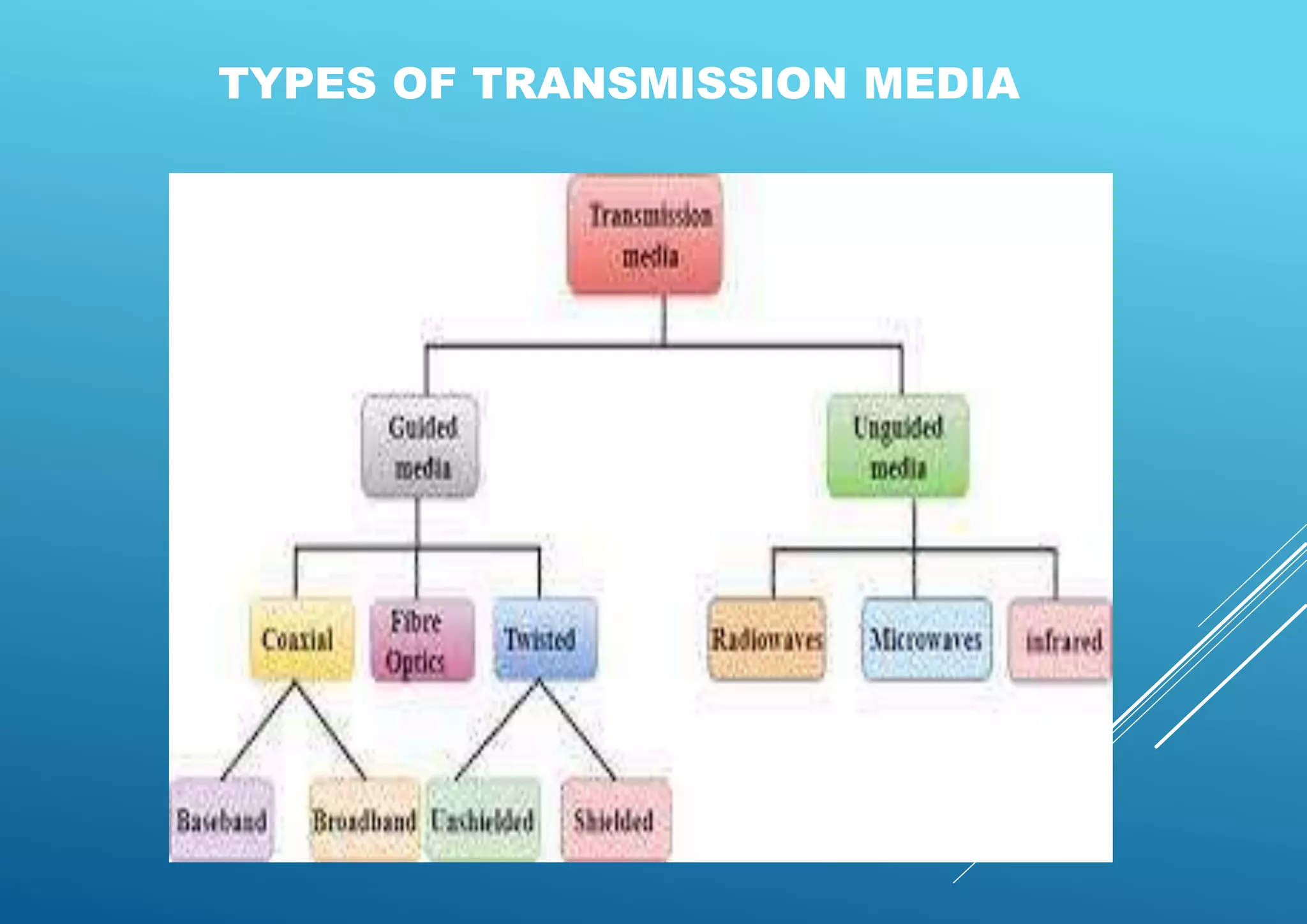
TYPES OF TRANSMISSION MEDIA
GUIDED MEDIA
 It is defined as the physical medium through which the
signals are transmitted. It is also known as Bounded
media.
 In guided media, transmitted data travels through
cabling system that has a fixed path. For example, copper
wires, fibre optic wires, etc.
TWISTED PAIR
 Twisted pair is a physical media made up of a pair of
cables twisted with each other. A twisted pair cable is
cheap as compared to other transmission media.
Installation of the twisted pair cable is easy, and it is a
lightweight cable. The frequency range for twisted pair
cable is from 0 to 3.5KHz.
 A twisted pair consists of two insulated copper wires
arranged in a regular spiral pattern. The degree of
reduction in noise interference is determined by the
number of turns per foot. Increasing the number of turns
per foot decreases noise interference.
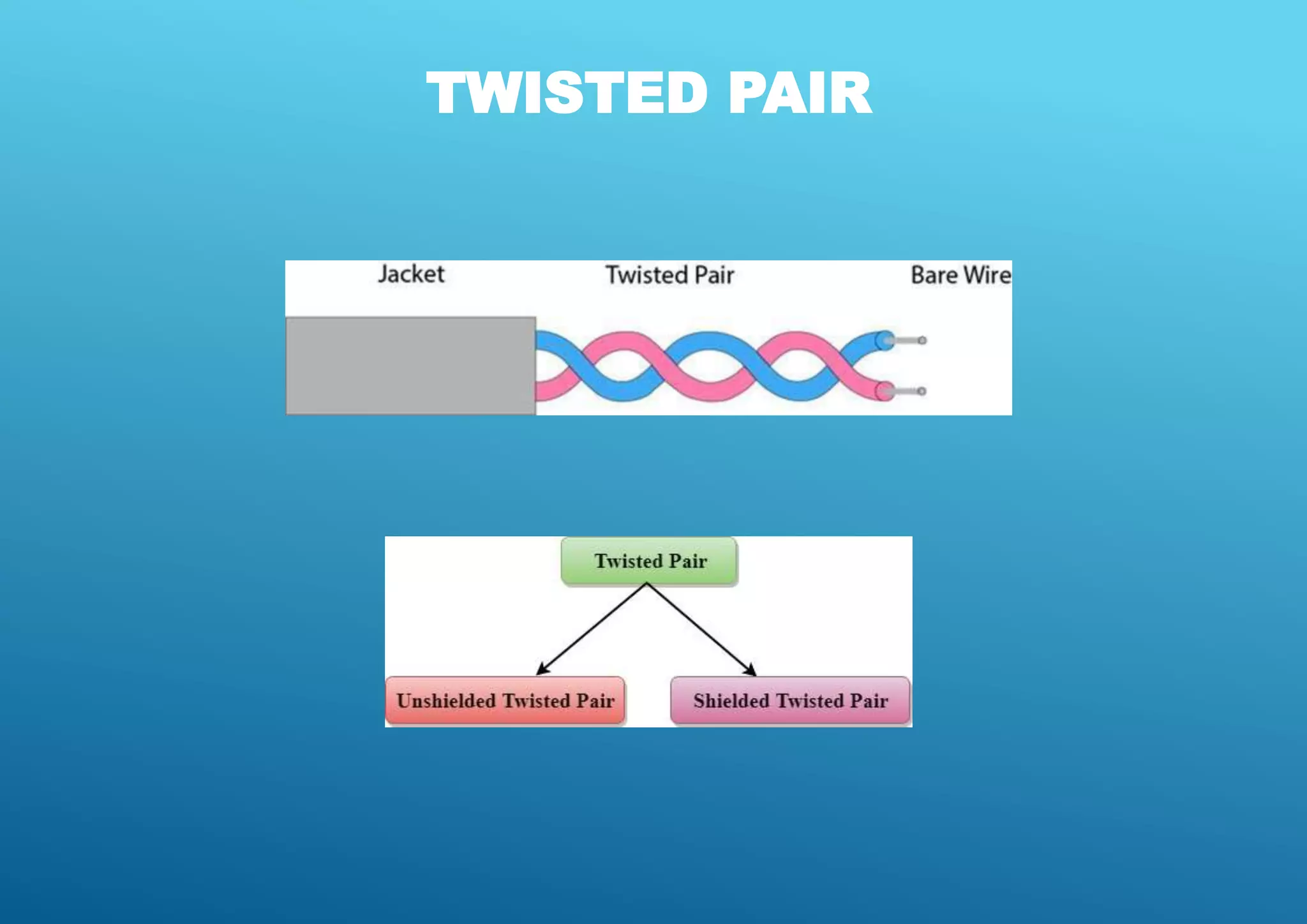
TWISTED PAIR
An unshielded twisted pair is widely used in telecommunication.
Following are the categories of the unshielded twisted pair cable:
o Category 1: Category 1 is used for telephone lines that have low-
speed data.
o Category 2: It can support upto 4Mbps.
o Category 3: It can support upto 16Mbps.
o Category 4: It can support upto 20Mbps. Therefore, it can be used
for long-distance communication.
o Category 5: It can support upto 200Mbps.
UNSHIELDED TWISTED PAIR
ADVANTAGES OF UNSHIELDED TWISTED PAIR:
o It is cheap.
o Installation of the unshielded twisted pair is easy.
o It can be used for high-speed LAN.
DISADVANTAGE OF UNSHIELDED TWISTED PAIR :
o This cable can only be used for shorter distances because
of attenuation.
A shielded twisted pair is a cable that contains the mesh
surrounding the wire that allows the higher transmission rate.
CHARACTERISTICS OF SHIELDED TWISTED PAIR:
o The cost of the shielded twisted pair cable is not very high and not
very low.
o An installation of STP is easy.
o It has higher capacity as compared to unshielded twisted pair cable.
o It has a higher attenuation.
o It is shielded that provides the higher data transmission rate.
Disadvantages
o It is more expensive as compared to UTP and coaxial cable.
o It has a higher attenuation rate.
SHIELDED TWISTED PAIR
oCoaxial cable is very commonly used transmission media, for example,
TV wire is usually a coaxial cable.
oThe name of the cable is coaxial as it contains two conductors parallel
to each other.
oIt has a higher frequency as compared to Twisted pair cable.
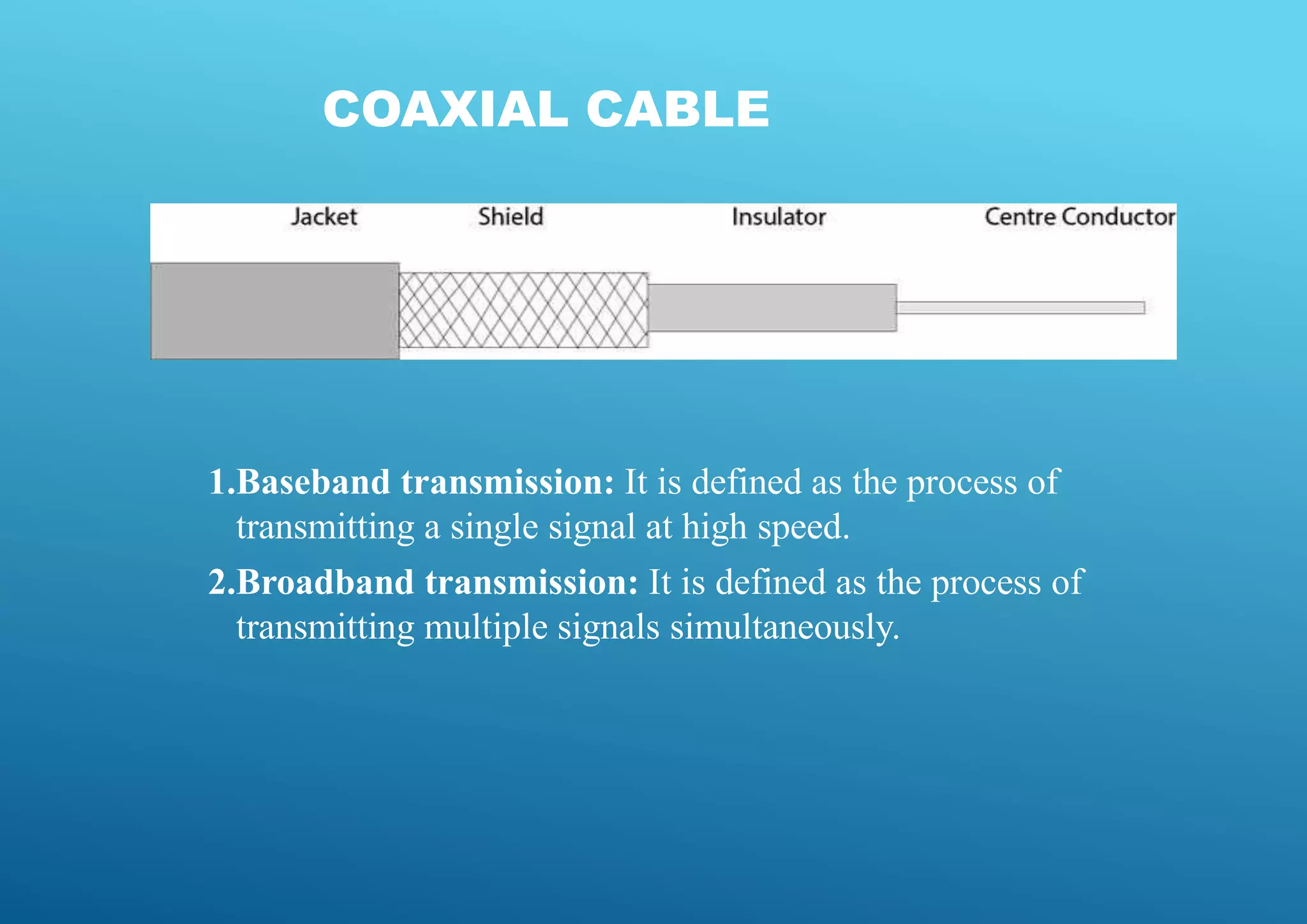
oThe inner conductor of the coaxial cable is made up of copper, and the
outer conductor is made up of copper mesh. The middle core is made up
of non-conductive cover that separates the inner conductor from the
outer conductor.
oThe middle core is responsible for the data transferring whereas
the copper mesh prevents from the EMI(Electromagnetic
interference).
COAXIAL CABLE
1.Baseband transmission: It is defined as the process of
transmitting a single signal at high speed.
2.Broadband transmission: It is defined as the process of
transmitting multiple signals simultaneously.
COAXIAL CABLE
ADVANTAGES OF COAXIAL CABLE
o The data can be transmitted at high speed.
o It has better shielding as compared to twisted pair
cable.
o It provides higher bandwidth.
DISADVANTAGES OF COAXIAL CABLE:
o It is more expensive as compared to twisted pair
cable.
o If any fault occurs in the cable causes the failure in
the entire network.
o Fibre optic cable is a cable that uses electrical signals for
communication.
o Fibre optic is a cable that holds the optical fibres coated in plastic that
are used to send the data by pulses of light.
o The plastic coating protects the optical fibres from heat, cold,
electromagnetic interference from other types of wiring.
o Fibre optics provide faster data transmission than copper wires.
FIBRE OPTIC CABLE
Diagrammatic representation of fibre optic cable
Core: The optical fibre consists of a narrow strand of glass or plastic known as a
core. A core is a light transmission area of the fibre. The more the area of the core, the
more light will be transmitted into the fibre.
Cladding: The concentric layer of glass is known as cladding. The main
functionality of the cladding is to provide the lower refractive index at the core
interface as to cause the reflection within the core so that the light waves are
transmitted through the fibre.
oJacket: The protective coating consisting of plastic is known as a jacket. The main
purpose of a jacket is to preserve the fibre strength, absorb shock and extra fibre
protection.
BASIC ELEMENTS OF FIBRE OPTIC CABLE
Greater Bandwidth: The fibre optic cable provides more bandwidth as
compared copper. Therefore, the fibre optic carries more data as compared to
copper cable.
Faster speed: Fibre optic cable carries the data in the form of light. This
allows the fibre optic cable to carry the signals at a higher speed.
Longer distances: The fibre optic cable carries the data at a longer distance
as compared to copper cable.
Better reliability: The fibre optic cable is more reliable than the copper
cable as it is immune to any temperature changes while it can cause obstruct in
the connectivity of copper cable.
Thinner and Sturdier: Fibre optic cable is thinner and lighter in weight so
it can withstand more pull pressure than copper cable.
FOLLOWING ARE THE ADVANTAGES OF FIBRE OPTIC
CABLE OVER COPPER:
THANK YOU

Guided media Transmission Media

  • 1.
  • 2.
     A communicationchannel that is used to carry the data from the transmitter to the receiver through the electromagnetic signals. The main function of this is to carry the data in the bits form through the Local Area Network (LAN).  In data communication, it works like a physical path between the sender & the receiver. For instance, in a copper cable network the bits in the form of electrical signals whereas in a fiber network, the bits are available in the form of light pulses.  The quality, as well as characteristics of data transmission, can be determined from the characteristics of medium & signal. The properties of different transmission media are delay, bandwidth, maintenance, cost, and easy installation. INTRODUCTION TO TRANSMISSION MEDIA
  • 3.
  • 4.
    GUIDED MEDIA  Itis defined as the physical medium through which the signals are transmitted. It is also known as Bounded media.  In guided media, transmitted data travels through cabling system that has a fixed path. For example, copper wires, fibre optic wires, etc.
  • 5.
    TWISTED PAIR  Twistedpair is a physical media made up of a pair of cables twisted with each other. A twisted pair cable is cheap as compared to other transmission media. Installation of the twisted pair cable is easy, and it is a lightweight cable. The frequency range for twisted pair cable is from 0 to 3.5KHz.  A twisted pair consists of two insulated copper wires arranged in a regular spiral pattern. The degree of reduction in noise interference is determined by the number of turns per foot. Increasing the number of turns per foot decreases noise interference.
  • 6.
  • 7.
    An unshielded twistedpair is widely used in telecommunication. Following are the categories of the unshielded twisted pair cable: o Category 1: Category 1 is used for telephone lines that have low- speed data. o Category 2: It can support upto 4Mbps. o Category 3: It can support upto 16Mbps. o Category 4: It can support upto 20Mbps. Therefore, it can be used for long-distance communication. o Category 5: It can support upto 200Mbps. UNSHIELDED TWISTED PAIR
  • 8.
    ADVANTAGES OF UNSHIELDEDTWISTED PAIR: o It is cheap. o Installation of the unshielded twisted pair is easy. o It can be used for high-speed LAN. DISADVANTAGE OF UNSHIELDED TWISTED PAIR : o This cable can only be used for shorter distances because of attenuation.
  • 9.
    A shielded twistedpair is a cable that contains the mesh surrounding the wire that allows the higher transmission rate. CHARACTERISTICS OF SHIELDED TWISTED PAIR: o The cost of the shielded twisted pair cable is not very high and not very low. o An installation of STP is easy. o It has higher capacity as compared to unshielded twisted pair cable. o It has a higher attenuation. o It is shielded that provides the higher data transmission rate. Disadvantages o It is more expensive as compared to UTP and coaxial cable. o It has a higher attenuation rate. SHIELDED TWISTED PAIR
  • 10.
    oCoaxial cable isvery commonly used transmission media, for example, TV wire is usually a coaxial cable. oThe name of the cable is coaxial as it contains two conductors parallel to each other. oIt has a higher frequency as compared to Twisted pair cable. oThe inner conductor of the coaxial cable is made up of copper, and the outer conductor is made up of copper mesh. The middle core is made up of non-conductive cover that separates the inner conductor from the outer conductor. oThe middle core is responsible for the data transferring whereas the copper mesh prevents from the EMI(Electromagnetic interference). COAXIAL CABLE
  • 11.
    1.Baseband transmission: Itis defined as the process of transmitting a single signal at high speed. 2.Broadband transmission: It is defined as the process of transmitting multiple signals simultaneously. COAXIAL CABLE
  • 12.
    ADVANTAGES OF COAXIALCABLE o The data can be transmitted at high speed. o It has better shielding as compared to twisted pair cable. o It provides higher bandwidth. DISADVANTAGES OF COAXIAL CABLE: o It is more expensive as compared to twisted pair cable. o If any fault occurs in the cable causes the failure in the entire network.
  • 13.
    o Fibre opticcable is a cable that uses electrical signals for communication. o Fibre optic is a cable that holds the optical fibres coated in plastic that are used to send the data by pulses of light. o The plastic coating protects the optical fibres from heat, cold, electromagnetic interference from other types of wiring. o Fibre optics provide faster data transmission than copper wires. FIBRE OPTIC CABLE Diagrammatic representation of fibre optic cable
  • 14.
    Core: The opticalfibre consists of a narrow strand of glass or plastic known as a core. A core is a light transmission area of the fibre. The more the area of the core, the more light will be transmitted into the fibre. Cladding: The concentric layer of glass is known as cladding. The main functionality of the cladding is to provide the lower refractive index at the core interface as to cause the reflection within the core so that the light waves are transmitted through the fibre. oJacket: The protective coating consisting of plastic is known as a jacket. The main purpose of a jacket is to preserve the fibre strength, absorb shock and extra fibre protection. BASIC ELEMENTS OF FIBRE OPTIC CABLE
  • 15.
    Greater Bandwidth: Thefibre optic cable provides more bandwidth as compared copper. Therefore, the fibre optic carries more data as compared to copper cable. Faster speed: Fibre optic cable carries the data in the form of light. This allows the fibre optic cable to carry the signals at a higher speed. Longer distances: The fibre optic cable carries the data at a longer distance as compared to copper cable. Better reliability: The fibre optic cable is more reliable than the copper cable as it is immune to any temperature changes while it can cause obstruct in the connectivity of copper cable. Thinner and Sturdier: Fibre optic cable is thinner and lighter in weight so it can withstand more pull pressure than copper cable. FOLLOWING ARE THE ADVANTAGES OF FIBRE OPTIC CABLE OVER COPPER:
  • 16.