Transmission Media
• Transmission media is a communication channel that carries the information
from the sender to the receiver. Data is transmitted through the electromagnetic
signals.
• The main functionality of the transmission media is to carry the information
in the form of bits through LAN(Local Area Network).
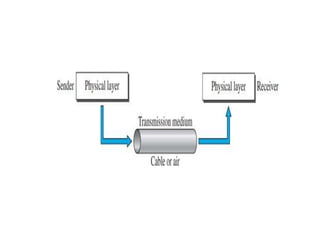
• It is a physical path between transmitter and receiver in data communication.
• In OSI(Open System Interconnection) phase, transmission media supports the
Layer 1. Therefore, it is considered to be as a Layer 1 component.
• The electrical signals can be sent through the copper wire, fibre optics,
atmosphere, water etc.
• The characteristics and quality of data transmission are determined by the
characteristics of medium and signal.
•Different transmission media have different properties such as bandwidth,
delay, cost and ease of installation and maintenance.
• The transmission media is available in the lowest layer of the OSI reference
model, i.e., Physical layer.
Some factors need to be considered for designing the
transmission media
• Bandwidth: All the factors are remaining constant, the
greater the bandwidth of a medium, the higher the data
transmission rate of a signal.
• Transmission impairment: When the received signal is not
identical to the transmitted one due to the transmission
impairment. The quality of the signals will get destroyed due
to transmission impairment.
• Interference: An interference is defined as the process of
troublemaking a signal when it travels over a communication
medium on the addition of some unwanted signal.
Classes of transmission media
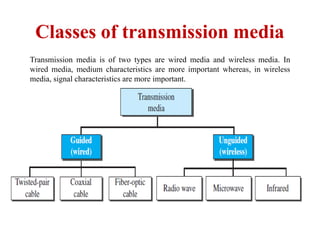
Transmission media is of two types are wired media and wireless media. In
wired media, medium characteristics are more important whereas, in wireless
media, signal characteristics are more important.
7.5
Guided media
Guided transmission media are also called bounded
media or wired media. They comprise cables or wires
through which data is transmitted. They are called
guided since they provide a physical conduit from the
sender device to the receiver device. The signal traveling
through these media are bounded by the physical limits
of the medium.
The most popular guided media are −
• Twisted pair cable
• Coaxial cable
• Power lines
• Fiber optics
Twisted-Pair Cable
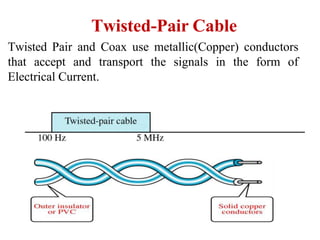
Twisted Pair and Coax use metallic(Copper) conductors
that accept and transport the signals in the form of
Electrical Current.
Twisted-pair cable is a type of cabling that is
used for telephone communications and
most modern Ethernet networks.
UTP and STP cables
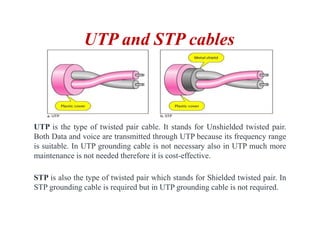
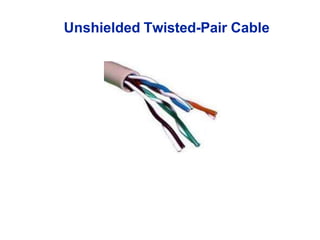
UTP is the type of twisted pair cable. It stands for Unshielded twisted pair.
Both Data and voice are transmitted through UTP because its frequency range
is suitable. In UTP grounding cable is not necessary also in UTP much more
maintenance is not needed therefore it is cost-effective.
STP is also the type of twisted pair which stands for Shielded twisted pair. In
STP grounding cable is required but in UTP grounding cable is not required.
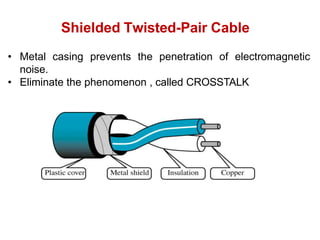
Shielded Twisted-Pair Cable
• Metal casing prevents the penetration of electromagnetic
noise.
• Eliminate the phenomenon , called CROSSTALK
Advantages :
1. Cheaper
2. Less susceptible to electrical interference caused by nearby
equipment or wires.
3. In turn are less likely to cause interference themselves.
4. Because it is electrically "cleaner", STP wire can carry data at
a faster speed.
Disadvantages :
1. STP wire is that it is physically larger and more expensive than
twisted pair wire.
7.11
Unshielded Twisted-Pair Cable
Twisted pair cable are the oldest and most popular
cables all over the world. This is due to the many
advantages that they offer −
Trained personnel easily available due to shallow
learning curve
Can be used for both analog and digital transmissions
Least expensive for short distances
Entire network does not go down if a part of network
is damaged
Advantages of twisted pair cable
With its many advantages, twisted pair cables
offer some disadvantages too −
Signal cannot travel long distances without
repeaters
High error rate for distances greater than 100m
Very thin and hence breaks easily
Not suitable for broadband connections
Disadvantages of twisted pair cable
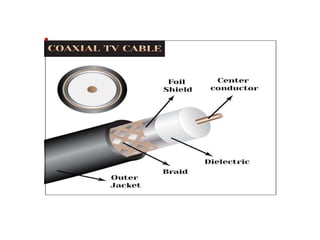
Coaxial Cable
This cable contains an external plastic
cover and it includes two parallel
conductors where each conductor
includes a separate protection cover.
This cable is used to transmit data in two
modes like baseband mode as well as
broadband mode. This cable is widely
used in cable TVs & analog TV
networks
.
Advantages of Coaxial Cables
Excellent noise immunity
• Signals can travel longer distances at higher speeds, e.g. 1 to 2
Gbps for 1 Km cable
• Can be used for both analog and digital signals
• Inexpensive as compared to fibre optic cables
• Easy to install and maintain
Disadvantages of Coaxial Cables
Expensive as compared to twisted pair cables
• Not compatible with twisted pair cables
7.16
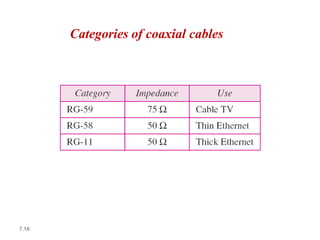
Categories of coaxial cables
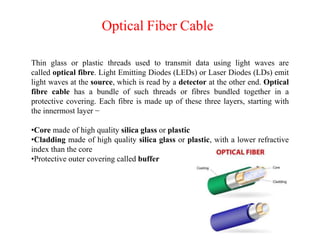
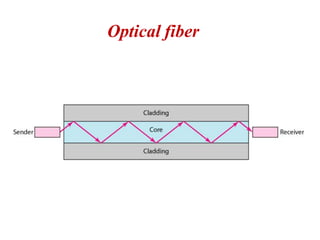
Thin glass or plastic threads used to transmit data using light waves are
called optical fibre. Light Emitting Diodes (LEDs) or Laser Diodes (LDs) emit
light waves at the source, which is read by a detector at the other end. Optical
fibre cable has a bundle of such threads or fibres bundled together in a
protective covering. Each fibre is made up of these three layers, starting with
the innermost layer −
•Core made of high quality silica glass or plastic
•Cladding made of high quality silica glass or plastic, with a lower refractive
index than the core
•Protective outer covering called buffer
Optical Fiber Cable
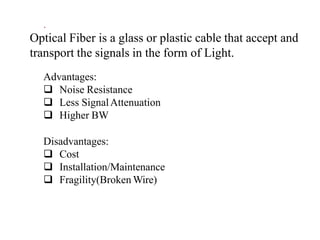
Optical Fiber is a glass or plastic cable that accept and
transport the signals in the form of Light.
Advantages:
 Noise Resistance
 Less SignalAttenuation
 Higher BW
Disadvantages:
 Cost
 Installation/Maintenance
 Fragility(Broken Wire)
.
Optical fiber
UNGUIDED MEDIA: WIRELESS
Unguided media transport electromagnetic
physical
is often
conductor. This
referred to as
waves
type of
wireless
without using a
communication
communication.
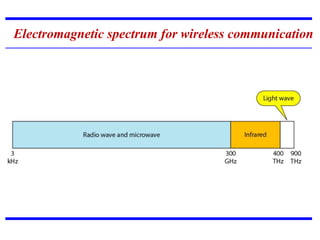
Electromagnetic spectrum for wireless communication
Propagation delay is the amount of time required for a signal to be
received after it has been sent; it is caused by the time it takes for
the signal to travel through a medium. Propagation delay is of
primary interest in electronic circuit design and computer
networking, although all signals will inherently experience some
form of propagation delay.
The fundamental limit on propagation delay is the speed of light (c).
Since nothing can travel faster than light and light has a finite speed,
there will always be some delay as a signal moves from source to
destination. This is true for all signals from small to great and
distances from short to vast.
Propagation delay
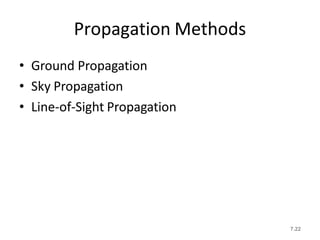
Propagation Methods
• Ground Propagation
• Sky Propagation
• Line-of-Sight Propagation
7.22
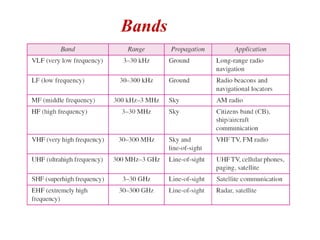
Bands
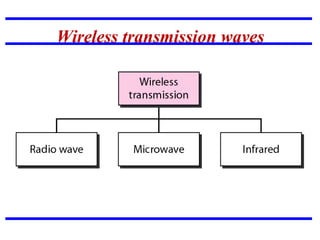
Wireless transmission waves
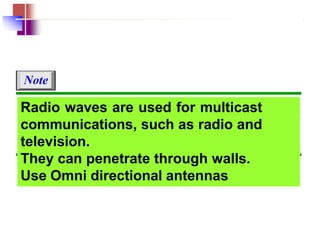
Radio waves are used for multicast
communications, such as radio and
television.
They can penetrate through walls.
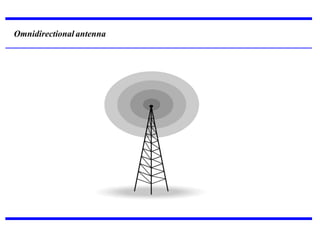
Use Omni directional antennas
Note
Omnidirectional antenna
Note
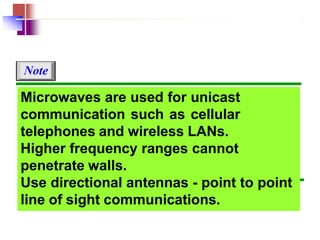
Microwaves are used for unicast
communication such as cellular
telephones and wireless LANs.
Higher frequency ranges cannot
penetrate walls.
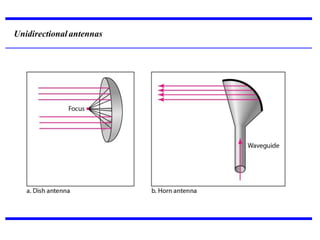
Use directional antennas - point to point
line of sight communications.
Unidirectional antennas
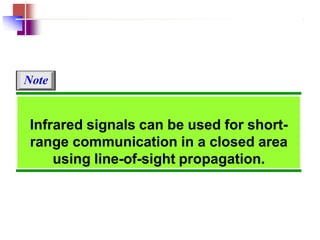
Infrared signals can be used for short-
range communication in a closed area
using line-of-sight propagation.
Note

Transmission_media.pptx

  • 1.
  • 2.
    • Transmission mediais a communication channel that carries the information from the sender to the receiver. Data is transmitted through the electromagnetic signals. • The main functionality of the transmission media is to carry the information in the form of bits through LAN(Local Area Network). • It is a physical path between transmitter and receiver in data communication. • In OSI(Open System Interconnection) phase, transmission media supports the Layer 1. Therefore, it is considered to be as a Layer 1 component. • The electrical signals can be sent through the copper wire, fibre optics, atmosphere, water etc. • The characteristics and quality of data transmission are determined by the characteristics of medium and signal. •Different transmission media have different properties such as bandwidth, delay, cost and ease of installation and maintenance. • The transmission media is available in the lowest layer of the OSI reference model, i.e., Physical layer.
  • 4.
    Some factors needto be considered for designing the transmission media • Bandwidth: All the factors are remaining constant, the greater the bandwidth of a medium, the higher the data transmission rate of a signal. • Transmission impairment: When the received signal is not identical to the transmitted one due to the transmission impairment. The quality of the signals will get destroyed due to transmission impairment. • Interference: An interference is defined as the process of troublemaking a signal when it travels over a communication medium on the addition of some unwanted signal.
  • 5.
    Classes of transmissionmedia Transmission media is of two types are wired media and wireless media. In wired media, medium characteristics are more important whereas, in wireless media, signal characteristics are more important.
  • 6.
    7.5 Guided media Guided transmissionmedia are also called bounded media or wired media. They comprise cables or wires through which data is transmitted. They are called guided since they provide a physical conduit from the sender device to the receiver device. The signal traveling through these media are bounded by the physical limits of the medium. The most popular guided media are − • Twisted pair cable • Coaxial cable • Power lines • Fiber optics
  • 7.
    Twisted-Pair Cable Twisted Pairand Coax use metallic(Copper) conductors that accept and transport the signals in the form of Electrical Current.
  • 8.
    Twisted-pair cable isa type of cabling that is used for telephone communications and most modern Ethernet networks.
  • 9.
    UTP and STPcables UTP is the type of twisted pair cable. It stands for Unshielded twisted pair. Both Data and voice are transmitted through UTP because its frequency range is suitable. In UTP grounding cable is not necessary also in UTP much more maintenance is not needed therefore it is cost-effective. STP is also the type of twisted pair which stands for Shielded twisted pair. In STP grounding cable is required but in UTP grounding cable is not required.
  • 10.
    Shielded Twisted-Pair Cable •Metal casing prevents the penetration of electromagnetic noise. • Eliminate the phenomenon , called CROSSTALK
  • 11.
    Advantages : 1. Cheaper 2.Less susceptible to electrical interference caused by nearby equipment or wires. 3. In turn are less likely to cause interference themselves. 4. Because it is electrically "cleaner", STP wire can carry data at a faster speed. Disadvantages : 1. STP wire is that it is physically larger and more expensive than twisted pair wire. 7.11
  • 12.
  • 13.
    Twisted pair cableare the oldest and most popular cables all over the world. This is due to the many advantages that they offer − Trained personnel easily available due to shallow learning curve Can be used for both analog and digital transmissions Least expensive for short distances Entire network does not go down if a part of network is damaged Advantages of twisted pair cable
  • 14.
    With its manyadvantages, twisted pair cables offer some disadvantages too − Signal cannot travel long distances without repeaters High error rate for distances greater than 100m Very thin and hence breaks easily Not suitable for broadband connections Disadvantages of twisted pair cable
  • 15.
    Coaxial Cable This cablecontains an external plastic cover and it includes two parallel conductors where each conductor includes a separate protection cover. This cable is used to transmit data in two modes like baseband mode as well as broadband mode. This cable is widely used in cable TVs & analog TV networks
  • 16.
  • 17.
    Advantages of CoaxialCables Excellent noise immunity • Signals can travel longer distances at higher speeds, e.g. 1 to 2 Gbps for 1 Km cable • Can be used for both analog and digital signals • Inexpensive as compared to fibre optic cables • Easy to install and maintain Disadvantages of Coaxial Cables Expensive as compared to twisted pair cables • Not compatible with twisted pair cables
  • 18.
  • 19.
    Thin glass orplastic threads used to transmit data using light waves are called optical fibre. Light Emitting Diodes (LEDs) or Laser Diodes (LDs) emit light waves at the source, which is read by a detector at the other end. Optical fibre cable has a bundle of such threads or fibres bundled together in a protective covering. Each fibre is made up of these three layers, starting with the innermost layer − •Core made of high quality silica glass or plastic •Cladding made of high quality silica glass or plastic, with a lower refractive index than the core •Protective outer covering called buffer Optical Fiber Cable
  • 20.
    Optical Fiber isa glass or plastic cable that accept and transport the signals in the form of Light. Advantages:  Noise Resistance  Less SignalAttenuation  Higher BW Disadvantages:  Cost  Installation/Maintenance  Fragility(Broken Wire) .
  • 22.
  • 23.
    UNGUIDED MEDIA: WIRELESS Unguidedmedia transport electromagnetic physical is often conductor. This referred to as waves type of wireless without using a communication communication.
  • 24.
    Electromagnetic spectrum forwireless communication
  • 25.
    Propagation delay isthe amount of time required for a signal to be received after it has been sent; it is caused by the time it takes for the signal to travel through a medium. Propagation delay is of primary interest in electronic circuit design and computer networking, although all signals will inherently experience some form of propagation delay. The fundamental limit on propagation delay is the speed of light (c). Since nothing can travel faster than light and light has a finite speed, there will always be some delay as a signal moves from source to destination. This is true for all signals from small to great and distances from short to vast. Propagation delay
  • 26.
    Propagation Methods • GroundPropagation • Sky Propagation • Line-of-Sight Propagation 7.22
  • 27.
  • 28.
  • 29.
    Radio waves areused for multicast communications, such as radio and television. They can penetrate through walls. Use Omni directional antennas Note
  • 30.
  • 31.
    Note Microwaves are usedfor unicast communication such as cellular telephones and wireless LANs. Higher frequency ranges cannot penetrate walls. Use directional antennas - point to point line of sight communications.
  • 32.
  • 33.
    Infrared signals canbe used for short- range communication in a closed area using line-of-sight propagation. Note