Assignment
On
CourseTitle: data
communication
Course code: CSE-313
Submitted to:
Pranab Bandhu Nath
Lecturer
Department of CSE
City University
Khagan, Savar, Dhaka
Submitted by:
Md .R0biul islam
ID: 1834902090
Batch:49th
Program:CSE(Day)
Department of CSE
City University
Khagan,savar,Dhaka
Submission date 18-08-2021
Assignment no :3
Assignment name : class
Lecture Notes 3
What is Transmission
media?
o Transmission media is a
communication channel
that carries the
information from the
sender to the receiver.
Data is transmitted
through the
electromagnetic signals.
o The main functionality of
the transmission media is
to carry the information
in the form of bits
through LAN(Local Area
Network).
o It is a physical path
between transmitter and
receiver in data
communication.
o In a copper-based
network, the bits in the
form of electrical signals.
o In a fibre based network,
the bits in the form of
light pulses.
o In OSI(Open System
Interconnection) phase,
transmission media
supports the Layer 1.
Therefore, it is considered
to be as a Layer 1
component.
o The electrical signals can
be sent through the
copper wire, fibre optics,
atmosphere, water, and
vacuum.
o The characteristics and
quality of data
transmission are
determined by the
characteristics of medium
and signal.
o Transmission media is of
two types are wired
media and wireless
media. In wired media,
medium characteristics
are more important
whereas, in wireless
media, signal
characteristics are more
important.
o Different transmission
media have different
properties such as
bandwidth, delay, cost
and ease of installation
and maintenance.
o The transmission media is
available in the lowest
layer of the OSI reference
model, i.e., Physical
layer.
Some factors need to be
considered for designing
the transmission media:
o Bandwidth: All the
factors are remaining
constant, the greater the
bandwidth of a medium,
the higher the data
transmission rate of a
signal.
o Transmission
impairment: When the
received signal is not
identical to the
transmitted one due to the
transmission impairment.
The quality of the signals
will get destroyed due to
transmission impairment.
o Interference: An
interference is defined as
the process of disrupting
a signal when it travels
over a communication
medium on the addition
of some unwanted signal.
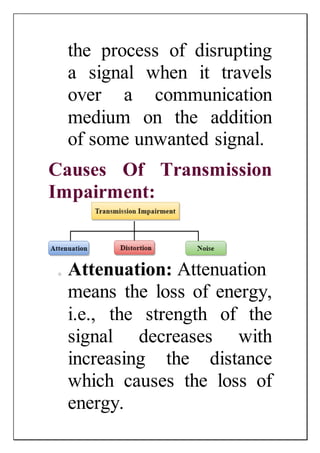
Causes Of Transmission
Impairment:
o Attenuation: Attenuation
means the loss of energy,
i.e., the strength of the
signal decreases with
increasing the distance
which causes the loss of
energy.
o Distortion: Distortion
occurs when there is a
change in the shape of the
signal. This type of
distortion is examined
from different signals
having different
frequencies. Each
frequency component has
its own propagation
speed, so they reach at a
different time which leads
to the delay distortion.
o Noise: When data is
travelled over a
transmission medium,
some unwanted signal is
added to it which creates
the noise.
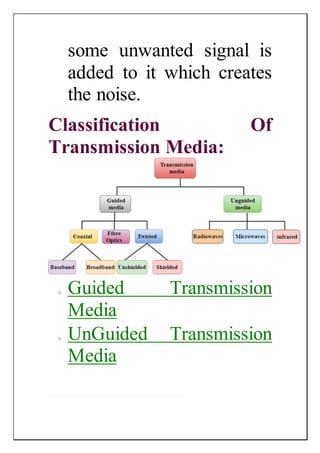
Classification Of
Transmission Media:
o Guided Transmission
Media
o UnGuided Transmission
Media
Guided Media
It is defined as the physical me
through which the signals
transmitted. It is also known as Bou
media.
Types Of Guided media:
Twisted pair:
Twisted pair is a physical media
up of a pair of cables twisted with
other. A twisted pair cable is che
compared to other transmission m
Installation of the twisted pair ca
easy, and it is a lightweight cable
frequency range for twisted pair ca
from 0 to 3.5KHz.
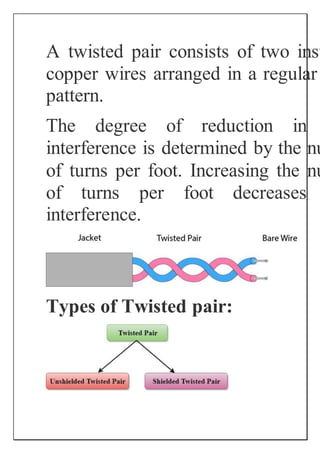
A twisted pair consists of two insu
copper wires arranged in a regular
pattern.
The degree of reduction in
interference is determined by the nu
of turns per foot. Increasing the nu
of turns per foot decreases
interference.
Types of Twisted pair:
Unshielded Twisted Pair:
An unshielded twisted pair is w
used in telecommunication. Follo
are the categories of the unshi
twisted pair cable:
o Category 1: Category 1 is use
telephone lines that have low-
data.
o Category 2: It can support
4Mbps.
o Category 3: It can support
16Mbps.
o Category 4: It can support
20Mbps. Therefore, it can be use
long-distance communication.
o Category 5: It can support
200Mbps.
Advantages Of Unshielded Tw
Pair:
o It is cheap.
o Installation of the unshielded tw
pair is easy.
o It can be used for high-speed LAN
Disadvantage:
o This cable can only be used
shorter distances because
attenuation.
Shielded Twisted Pair
A shielded twisted pair is a cable
contains the mesh surrounding the
that allows the higher transmission
Characteristics Of Shielded Tw
Pair:
o The cost of the shielded twisted
cable is not very high and not
low.
o An installation of STP is easy.
o It has higher capacity as compar
unshielded twisted pair cable.
o It has a higher attenuation.
o It is shielded that provides the h
data transmission rate.
Disadvantages
o It is more expensive as compar
UTP and coaxial cable.
o It has a higher attenuation rate.
Coaxial Cable
o Coaxial cable is very commonly
transmission media, for example
wire is usually a coaxial cable.
o The name of the cable is coaxial
contains two conductors parall
each other.
o It has a higher frequency as com
to Twisted pair cable.
o The inner conductor of the c
cable is made up of copper, an
outer conductor is made up of c
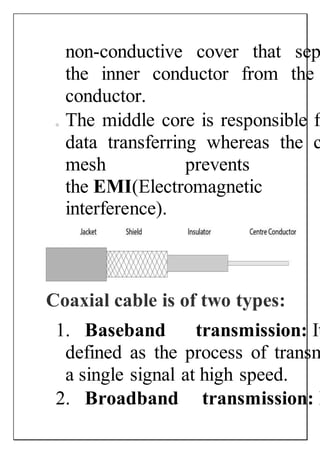
mesh. The middle core is made
non-conductive cover that sep
the inner conductor from the
conductor.
o The middle core is responsible fo
data transferring whereas the c
mesh prevents
the EMI(Electromagnetic
interference).
Coaxial cable is of two types:
1. Baseband transmission: It
defined as the process of transm
a single signal at high speed.
2. Broadband transmission: I
defined as the process of transm
multiple signals simultaneously.
Advantages Of Coaxial cable:
o The data can be transmitted at
speed.
o It has better shielding as compar
twisted pair cable.
o It provides higher bandwidth.
Disadvantages Of Coaxial cable:
o It is more expensive as compar
twisted pair cable.
o If any fault occurs in the cable c
the failure in the entire network.
Fibre Optic
o Fibre optic cable is a cable that
electrical signals for communicat
o Fibre optic is a cable that hold
optical fibres coated in plastic th
used to send the data by puls
light.
o The plastic coating protects the o
fibres from heat, cold, electromag
interference from other type
wiring.
o Fibre optics provide faster
transmission than copper wires.
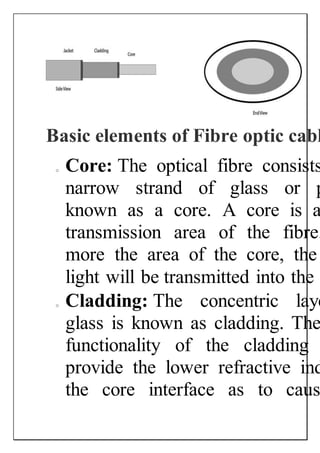
Diagrammatic representation of
optic cable:
Basic elements of Fibre optic cabl
o Core: The optical fibre consists
narrow strand of glass or p
known as a core. A core is a
transmission area of the fibre.
more the area of the core, the
light will be transmitted into the f
o Cladding: The concentric laye
glass is known as cladding. The
functionality of the cladding
provide the lower refractive ind
the core interface as to caus
reflection within the core so tha
light waves are transmitted th
the fibre.
o Jacket: The protective co
consisting of plastic is known
jacket. The main purpose of a jac
to preserve the fibre strength, a
shock and extra fibre protection.
Following are the advantages of
optic cable over copper:
o Greater Bandwidth: The fibre
cable provides more bandwid
compared copper. Therefore, the
optic carries more data as compa
copper cable.
o Faster speed: Fibre optic
carries the data in the form of
This allows the fibre optic cab
carry the signals at a higher speed
o Longer distances: The fibre
cable carries the data at a l
distance as compared to copper c
o Better reliability: The fibre
cable is more reliable than the c
cable as it is immune to
temperature changes while it
cause obstruct in the connectiv
copper cable.
o Thinner and Sturdier: Fibre
cable is thinner and lighter in w
so it can withstand more pull pre
than copper cab
UnGuided Transmission
o An unguided transmission tran
the electromagnetic waves w
using any physical medium. The
it is also known as wi
transmission.
o In unguided media, air is the m
through which the electromag
energy can flow easily.
Unguided transmission is br
classified into three categories:
Radio waves
o Radio waves are the electromag
waves that are transmitted in a
directions of free space.
o Radio waves are omnidirectional
the signals are propagated in a
directions.
o The range in frequencies of
waves is from 3Khz to 1 khz.
o In the case of radio waves, the se
and receiving antenna are not ali
i.e., the wave sent by the se
antenna can be received by
receiving antenna.
o An example of the radio wave i
radio.
Applications Of Radio waves:
o A Radio wave is useful
multicasting when there is one s
and many receivers.
o An FM radio, television, co
phones are examples of a radio w
Advantages Of Radio transmission:
o Radio transmission is mainly use
wide area networks and m
cellular phones.
o Radio waves cover a large area
they can penetrate the walls.
o Radio transmission provides a h
transmission rate.
References
https://www.javatpoint.com/ungu
transmission-media

Class notes 3

  • 1.
    Assignment On CourseTitle: data communication Course code:CSE-313 Submitted to: Pranab Bandhu Nath Lecturer Department of CSE
  • 2.
    City University Khagan, Savar,Dhaka Submitted by: Md .R0biul islam ID: 1834902090 Batch:49th Program:CSE(Day) Department of CSE City University Khagan,savar,Dhaka
  • 3.
    Submission date 18-08-2021 Assignmentno :3 Assignment name : class Lecture Notes 3 What is Transmission media? o Transmission media is a communication channel that carries the information from the sender to the receiver. Data is transmitted
  • 4.
    through the electromagnetic signals. oThe main functionality of the transmission media is to carry the information in the form of bits through LAN(Local Area Network). o It is a physical path between transmitter and receiver in data communication. o In a copper-based network, the bits in the form of electrical signals.
  • 5.
    o In afibre based network, the bits in the form of light pulses. o In OSI(Open System Interconnection) phase, transmission media supports the Layer 1. Therefore, it is considered to be as a Layer 1 component. o The electrical signals can be sent through the copper wire, fibre optics, atmosphere, water, and vacuum.
  • 6.
    o The characteristicsand quality of data transmission are determined by the characteristics of medium and signal. o Transmission media is of two types are wired media and wireless media. In wired media, medium characteristics are more important whereas, in wireless media, signal characteristics are more important.
  • 7.
    o Different transmission mediahave different properties such as bandwidth, delay, cost and ease of installation and maintenance. o The transmission media is available in the lowest layer of the OSI reference model, i.e., Physical layer. Some factors need to be considered for designing the transmission media: o Bandwidth: All the factors are remaining
  • 8.
    constant, the greaterthe bandwidth of a medium, the higher the data transmission rate of a signal. o Transmission impairment: When the received signal is not identical to the transmitted one due to the transmission impairment. The quality of the signals will get destroyed due to transmission impairment. o Interference: An interference is defined as
  • 9.
    the process ofdisrupting a signal when it travels over a communication medium on the addition of some unwanted signal. Causes Of Transmission Impairment: o Attenuation: Attenuation means the loss of energy, i.e., the strength of the signal decreases with increasing the distance which causes the loss of energy.
  • 10.
    o Distortion: Distortion occurswhen there is a change in the shape of the signal. This type of distortion is examined from different signals having different frequencies. Each frequency component has its own propagation speed, so they reach at a different time which leads to the delay distortion. o Noise: When data is travelled over a transmission medium,
  • 11.
    some unwanted signalis added to it which creates the noise. Classification Of Transmission Media: o Guided Transmission Media o UnGuided Transmission Media
  • 12.
    Guided Media It isdefined as the physical me through which the signals transmitted. It is also known as Bou media. Types Of Guided media: Twisted pair: Twisted pair is a physical media up of a pair of cables twisted with other. A twisted pair cable is che compared to other transmission m Installation of the twisted pair ca easy, and it is a lightweight cable frequency range for twisted pair ca from 0 to 3.5KHz.
  • 13.
    A twisted pairconsists of two insu copper wires arranged in a regular pattern. The degree of reduction in interference is determined by the nu of turns per foot. Increasing the nu of turns per foot decreases interference. Types of Twisted pair:
  • 14.
    Unshielded Twisted Pair: Anunshielded twisted pair is w used in telecommunication. Follo are the categories of the unshi twisted pair cable: o Category 1: Category 1 is use telephone lines that have low- data. o Category 2: It can support 4Mbps. o Category 3: It can support 16Mbps. o Category 4: It can support 20Mbps. Therefore, it can be use long-distance communication.
  • 15.
    o Category 5:It can support 200Mbps. Advantages Of Unshielded Tw Pair: o It is cheap. o Installation of the unshielded tw pair is easy. o It can be used for high-speed LAN Disadvantage: o This cable can only be used shorter distances because attenuation. Shielded Twisted Pair A shielded twisted pair is a cable
  • 16.
    contains the meshsurrounding the that allows the higher transmission Characteristics Of Shielded Tw Pair: o The cost of the shielded twisted cable is not very high and not low. o An installation of STP is easy. o It has higher capacity as compar unshielded twisted pair cable. o It has a higher attenuation. o It is shielded that provides the h data transmission rate. Disadvantages o It is more expensive as compar
  • 17.
    UTP and coaxialcable. o It has a higher attenuation rate. Coaxial Cable o Coaxial cable is very commonly transmission media, for example wire is usually a coaxial cable. o The name of the cable is coaxial contains two conductors parall each other. o It has a higher frequency as com to Twisted pair cable. o The inner conductor of the c cable is made up of copper, an outer conductor is made up of c mesh. The middle core is made
  • 18.
    non-conductive cover thatsep the inner conductor from the conductor. o The middle core is responsible fo data transferring whereas the c mesh prevents the EMI(Electromagnetic interference). Coaxial cable is of two types: 1. Baseband transmission: It defined as the process of transm a single signal at high speed. 2. Broadband transmission: I
  • 19.
    defined as theprocess of transm multiple signals simultaneously. Advantages Of Coaxial cable: o The data can be transmitted at speed. o It has better shielding as compar twisted pair cable. o It provides higher bandwidth. Disadvantages Of Coaxial cable: o It is more expensive as compar twisted pair cable. o If any fault occurs in the cable c the failure in the entire network. Fibre Optic
  • 20.
    o Fibre opticcable is a cable that electrical signals for communicat o Fibre optic is a cable that hold optical fibres coated in plastic th used to send the data by puls light. o The plastic coating protects the o fibres from heat, cold, electromag interference from other type wiring. o Fibre optics provide faster transmission than copper wires. Diagrammatic representation of optic cable:
  • 21.
    Basic elements ofFibre optic cabl o Core: The optical fibre consists narrow strand of glass or p known as a core. A core is a transmission area of the fibre. more the area of the core, the light will be transmitted into the f o Cladding: The concentric laye glass is known as cladding. The functionality of the cladding provide the lower refractive ind the core interface as to caus
  • 22.
    reflection within thecore so tha light waves are transmitted th the fibre. o Jacket: The protective co consisting of plastic is known jacket. The main purpose of a jac to preserve the fibre strength, a shock and extra fibre protection. Following are the advantages of optic cable over copper: o Greater Bandwidth: The fibre cable provides more bandwid compared copper. Therefore, the optic carries more data as compa copper cable.
  • 23.
    o Faster speed:Fibre optic carries the data in the form of This allows the fibre optic cab carry the signals at a higher speed o Longer distances: The fibre cable carries the data at a l distance as compared to copper c o Better reliability: The fibre cable is more reliable than the c cable as it is immune to temperature changes while it cause obstruct in the connectiv copper cable. o Thinner and Sturdier: Fibre cable is thinner and lighter in w so it can withstand more pull pre
  • 24.
    than copper cab UnGuidedTransmission o An unguided transmission tran the electromagnetic waves w using any physical medium. The it is also known as wi transmission. o In unguided media, air is the m through which the electromag energy can flow easily. Unguided transmission is br classified into three categories:
  • 25.
    Radio waves o Radiowaves are the electromag waves that are transmitted in a directions of free space. o Radio waves are omnidirectional the signals are propagated in a directions. o The range in frequencies of waves is from 3Khz to 1 khz. o In the case of radio waves, the se and receiving antenna are not ali i.e., the wave sent by the se antenna can be received by receiving antenna. o An example of the radio wave i radio.
  • 26.
    Applications Of Radiowaves: o A Radio wave is useful multicasting when there is one s and many receivers. o An FM radio, television, co phones are examples of a radio w Advantages Of Radio transmission: o Radio transmission is mainly use wide area networks and m cellular phones. o Radio waves cover a large area they can penetrate the walls. o Radio transmission provides a h transmission rate.
  • 27.