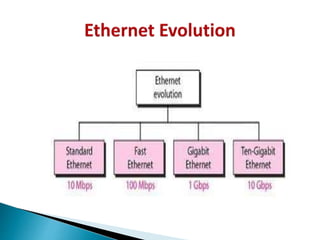
 Ethernet is a family of computer
networking technologies for local area
networks (LANs).
 Introduced in 1980 and standardized in 1985 as IEEE
Standard Project 802.3.
 Ethernet provides services up to and including
the data link layer which is divided into 2 sublayers:
LLC & MAC.
 Logic Link Control: Provides interconnectivity
between different LANs.
 Media Access Control: Frames data received from
the upper layer & passes to the physical layer.
 Physical Layer: It defines transmission of raw bits
rather than data packets.
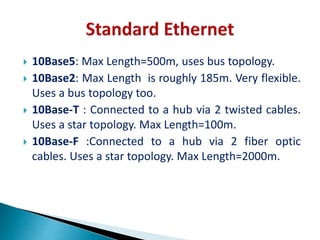
 10Base5: Max Length=500m, uses bus topology.
 10Base2: Max Length is roughly 185m. Very flexible.
Uses a bus topology too.
 10Base-T : Connected to a hub via 2 twisted cables.
Uses a star topology. Max Length=100m.
 10Base-F :Connected to a hub via 2 fiber optic
cables. Uses a star topology. Max Length=2000m.
Fast Ethernet
100 BASE-TX 100 BASE-FX 100 BASE-T4
The goals of the above are:
 Upgrade the data rate to 100Mbps.
 Make it compatible with Standard Ethernet.
 Keep the same 48-bit address.
 Keep the same frame format.
 Keep the same minimum & maximum frame lengths.
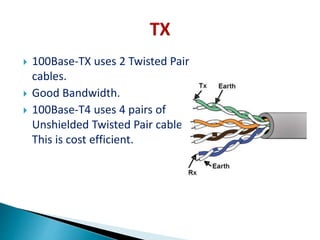
 100Base-TX uses 2 Twisted Pair
cables.
 Good Bandwidth.
 100Base-T4 uses 4 pairs of
Unshielded Twisted Pair cables.
This is cost efficient.
 100Base-FX uses 2 pairs of Fiber optic cables. Higher
Bandwidth.
 Uses 1300 nm near infrared wavelength
 Max length
◦ 412 m for half duplex.
◦ 2 kms for full duplex.
Gigabit Ethernet
Implementations
1000 BASE-
SX
1000 base-
LX
1000BASE-
CX
1000 BASE-T
The goals of the above are:
 Upgrade the data rate to 1Gbps.
 Make it compatible with Standard or Fast Ethernet.
 Use the same 48-bit address.
 Use the same frame format.
 Keep the minimum & maximum frame lengths.
 Upgrade the data rate to 10Gbps.
 Make it compatible with Standard, Fast & Gigabit
Ethernet.
 Use the same 48-bit address.
 Use the same frame format.
 Keep the same minimum & maximum frame lengths.
 Allow the interconnection of existing LANs into a
Metropolitan Area Network (MAN) or a Wide Area
Network (WAN).
 Make Ethernet compatible with technologies like
Frame Relay & ATM.
 Classification:
◦ 1. Single mode fiber (SMF)
◦ 2. Multi mode Fiber (MMF)
 Single mode: Light follows a single path
 Multi mode: Light follows multiple path leading to
differential mode delay.
Ethernet
Ethernet

Ethernet

  • 2.
     Ethernet isa family of computer networking technologies for local area networks (LANs).  Introduced in 1980 and standardized in 1985 as IEEE Standard Project 802.3.
  • 3.
     Ethernet providesservices up to and including the data link layer which is divided into 2 sublayers: LLC & MAC.  Logic Link Control: Provides interconnectivity between different LANs.  Media Access Control: Frames data received from the upper layer & passes to the physical layer.  Physical Layer: It defines transmission of raw bits rather than data packets.
  • 7.
     10Base5: MaxLength=500m, uses bus topology.  10Base2: Max Length is roughly 185m. Very flexible. Uses a bus topology too.  10Base-T : Connected to a hub via 2 twisted cables. Uses a star topology. Max Length=100m.  10Base-F :Connected to a hub via 2 fiber optic cables. Uses a star topology. Max Length=2000m.
  • 8.
    Fast Ethernet 100 BASE-TX100 BASE-FX 100 BASE-T4
  • 10.
    The goals ofthe above are:  Upgrade the data rate to 100Mbps.  Make it compatible with Standard Ethernet.  Keep the same 48-bit address.  Keep the same frame format.  Keep the same minimum & maximum frame lengths.
  • 11.
     100Base-TX uses2 Twisted Pair cables.  Good Bandwidth.  100Base-T4 uses 4 pairs of Unshielded Twisted Pair cables. This is cost efficient.
  • 12.
     100Base-FX uses2 pairs of Fiber optic cables. Higher Bandwidth.  Uses 1300 nm near infrared wavelength  Max length ◦ 412 m for half duplex. ◦ 2 kms for full duplex.
  • 13.
    Gigabit Ethernet Implementations 1000 BASE- SX 1000base- LX 1000BASE- CX 1000 BASE-T
  • 14.
    The goals ofthe above are:  Upgrade the data rate to 1Gbps.  Make it compatible with Standard or Fast Ethernet.  Use the same 48-bit address.  Use the same frame format.  Keep the minimum & maximum frame lengths.
  • 17.
     Upgrade thedata rate to 10Gbps.  Make it compatible with Standard, Fast & Gigabit Ethernet.  Use the same 48-bit address.  Use the same frame format.  Keep the same minimum & maximum frame lengths.
  • 18.
     Allow theinterconnection of existing LANs into a Metropolitan Area Network (MAN) or a Wide Area Network (WAN).  Make Ethernet compatible with technologies like Frame Relay & ATM.
  • 20.
     Classification: ◦ 1.Single mode fiber (SMF) ◦ 2. Multi mode Fiber (MMF)  Single mode: Light follows a single path  Multi mode: Light follows multiple path leading to differential mode delay.