Transmission Media
Presented by,
V.Santhi,
Assistant Professor,
Department of Computer Applications,
Bon Secours College for Women, Thanjavur
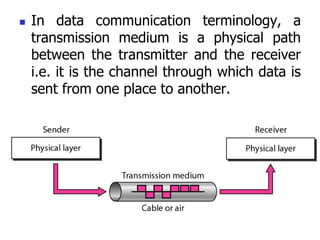
 In data communication terminology, a
transmission medium is a physical path
between the transmitter and the receiver
i.e. it is the channel through which data is
sent from one place to another.
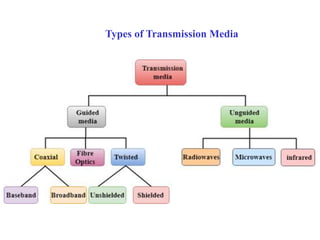
Types of Transmission Media
GUIDED MEDIA
It is also referred to as Wired or Bounded transmission
media. Signals being transmitted are directed and
confined in a narrow pathway by using physical links.
Features:
 High Speed
 Secure
 Used for comparatively shorter distances
Twisted-Pair Cable
Coaxial Cable
Fiber-Optic Cable
Types of Guided Media:
Twisted pair
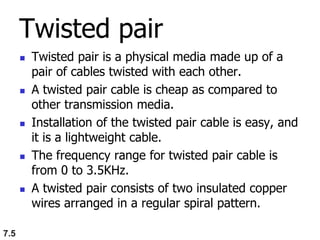
 Twisted pair is a physical media made up of a
pair of cables twisted with each other.
 A twisted pair cable is cheap as compared to
other transmission media.
 Installation of the twisted pair cable is easy, and
it is a lightweight cable.
 The frequency range for twisted pair cable is
from 0 to 3.5KHz.
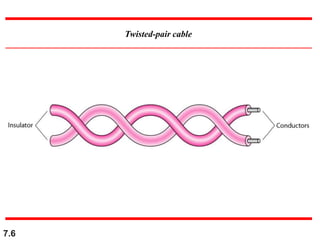
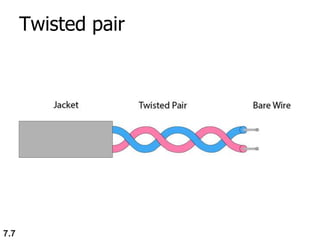
 A twisted pair consists of two insulated copper
wires arranged in a regular spiral pattern.
7.5
7.6
Twisted-pair cable
Twisted pair
7.7
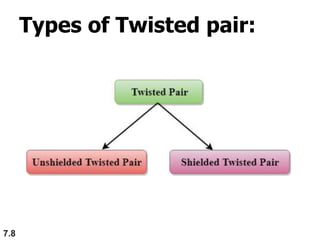
Types of Twisted pair:
7.8
Unshielded Twisted Pair
7.9
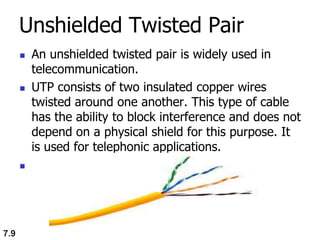
 An unshielded twisted pair is widely used in
telecommunication.
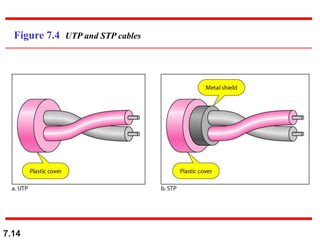
 UTP consists of two insulated copper wires
twisted around one another. This type of cable
has the ability to block interference and does not
depend on a physical shield for this purpose. It
is used for telephonic applications.

Unshielded Twisted Pair
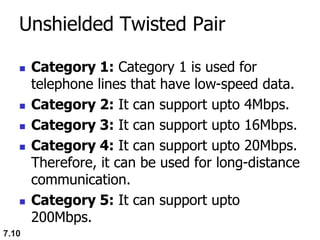
 Category 1: Category 1 is used for
telephone lines that have low-speed data.
 Category 2: It can support upto 4Mbps.
 Category 3: It can support upto 16Mbps.
 Category 4: It can support upto 20Mbps.
Therefore, it can be used for long-distance
communication.
 Category 5: It can support upto
200Mbps.
7.10
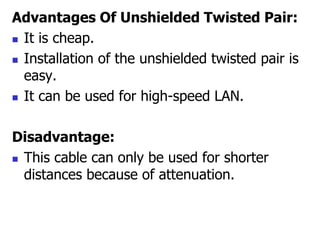
Advantages Of Unshielded Twisted Pair:
 It is cheap.
 Installation of the unshielded twisted pair is
easy.
 It can be used for high-speed LAN.
Disadvantage:
 This cable can only be used for shorter
distances because of attenuation.
Shielded Twisted Pair
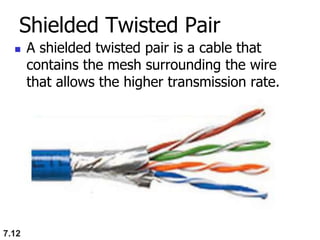
 A shielded twisted pair is a cable that
contains the mesh surrounding the wire
that allows the higher transmission rate.
7.12
Characteristics Of Shielded Twisted Pair:
 The cost of the shielded twisted pair cable is not
very high and not very low.
 An installation of STP is easy.
 It has higher capacity as compared to unshielded
twisted pair cable.
 It is shielded that provides the higher data
transmission rate.
Disadvantages
 It is more expensive as compared to UTP and
coaxial cable.
 Comparatively difficult to install and manufacture
 More expensive
 Bulky
7.14
Figure 7.4 UTP and STP cables
Coaxial cable
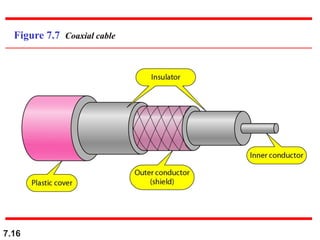
 A coaxial cable is an electrical cable with a
copper conductor and an insulator shielding
around it and a braided metal mesh that
prevents signal interference and cross talk.
Coaxial cable is also known as coax.
7.15
7.16
Figure 7.7 Coaxial cable
Applications of Coaxial cable
The coaxial cables are used in Ethernet LANs and also used
in MANs
 Television: Coaxial cable used for television would be
75 Ohm and RG-6 coaxial cable.
 Internet: Coaxial cables are also used for carrying
internet signals, RG-6 cables are used for this.
 CCTV: The coaxial cables are also used in CCTV systems
and both RG-59 AND RG-6 cables can be used.
 Video: The coaxial cables are also used in video
Transmission the RG-6 is used for better digital signals
and RG-59 for lossless transmission of video signals.
 HDTV: The HDTV uses RG-11 as it provides more space
for signals to transfer.
7.17
Advantages
 Coaxial cables support high bandwidth.
 It is easy to install coaxial cables.
 coaxial cables have better cut-through
resistance so they are more reliable and
durable.
 Less affected by noise or cross-talk or
electromagnetic inference.
 Coaxial cables support multiple channels
7.18
Disadvantages
 Coaxial cables are expensive.
 The coaxial cable must be grounded in
order to prevent any crosstalk.
 As a Coaxial cable has multiple layers it is
very bulky.
 There is a chance of breaking the coaxial
cable and attaching a “t-joint” by hackers,
this compromises the security of the data.
7.19
Fiber Optics
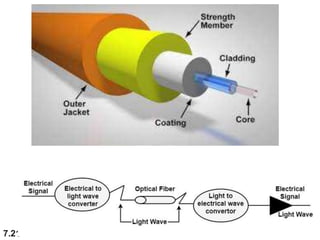
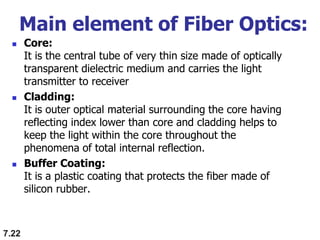
 A fibre optic cable is made of glass or
plastic and transmits signals in the
structure of light signals.
 It involves an inner glass core surrounded
by a glass cladding that reflects the light
into the core. Each fibre is encircled by a
plastic jacket.
7.20
7.21
Main element of Fiber Optics:
 Core:
It is the central tube of very thin size made of optically
transparent dielectric medium and carries the light
transmitter to receiver
 Cladding:
It is outer optical material surrounding the core having
reflecting index lower than core and cladding helps to
keep the light within the core throughout the
phenomena of total internal reflection.
 Buffer Coating:
It is a plastic coating that protects the fiber made of
silicon rubber.
7.22
Fiber Optics
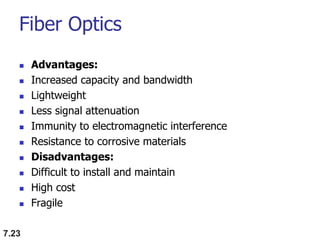
 Advantages:
 Increased capacity and bandwidth
 Lightweight
 Less signal attenuation
 Immunity to electromagnetic interference
 Resistance to corrosive materials
 Disadvantages:
 Difficult to install and maintain
 High cost
 Fragile
7.23
7.24
7-2 UNGUIDED MEDIA: WIRELESS
It is also referred to as Wireless or Unbounded
transmission media. No physical medium is
required for the transmission of electromagnetic
signals.
Features:
The signal is broadcasted through air
Less Secure
Used for larger distances
7.25
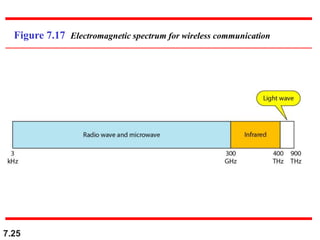
Figure 7.17 Electromagnetic spectrum for wireless communication
7.26
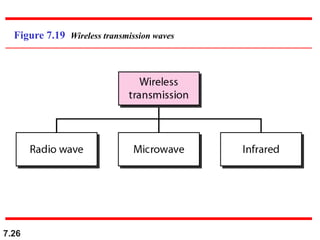
Figure 7.19 Wireless transmission waves
Radio waves
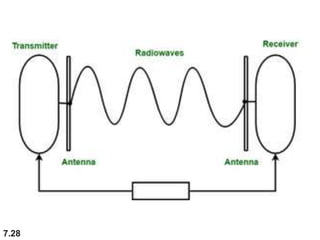
 These are easy to generate and can
penetrate through buildings. The sending
and receiving antennas need not be
aligned. Frequency Range:3KHz – 1GHz.
AM and FM radios and cordless phones
use Radio waves for transmission.

7.27
7.28
7.29
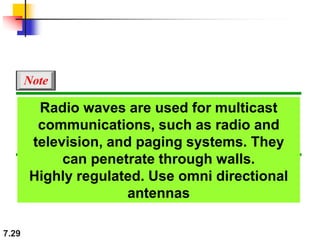
Radio waves are used for multicast
communications, such as radio and
television, and paging systems. They
can penetrate through walls.
Highly regulated. Use omni directional
antennas
Note
Microwaves
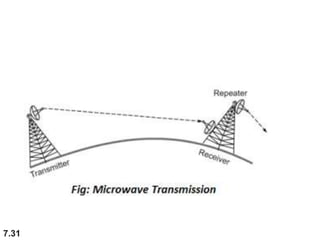
 It is a line of sight transmission i.e. the
sending and receiving antennas need to
be properly aligned with each other. The
distance covered by the signal is directly
proportional to the height of the antenna.
Frequency Range:1GHz – 300GHz. These
are majorly used for mobile phone
communication and television distribution.
7.30
7.31
Infrared

Infrared waves are used for very short
distance communication. They cannot
penetrate through obstacles. This
prevents interference between systems.
Frequency Range:300GHz – 400THz. It is
used in TV remotes, wireless mouse,
keyboard, printer, etc.
7.32
7.33
Microwaves are used for unicast
communication such as cellular
telephones, satellite networks,
and wireless LANs.
Higher frequency ranges cannot
penetrate walls.
Use directional antennas - point to point
line of sight communications.
Note
7.34
Infrared signals can be used for short-
range communication in a closed area
using line-of-sight propagation.
Note

transmission media.ppt

  • 1.
    Transmission Media Presented by, V.Santhi, AssistantProfessor, Department of Computer Applications, Bon Secours College for Women, Thanjavur
  • 2.
     In datacommunication terminology, a transmission medium is a physical path between the transmitter and the receiver i.e. it is the channel through which data is sent from one place to another.
  • 3.
  • 4.
    GUIDED MEDIA It isalso referred to as Wired or Bounded transmission media. Signals being transmitted are directed and confined in a narrow pathway by using physical links. Features:  High Speed  Secure  Used for comparatively shorter distances Twisted-Pair Cable Coaxial Cable Fiber-Optic Cable Types of Guided Media:
  • 5.
    Twisted pair  Twistedpair is a physical media made up of a pair of cables twisted with each other.  A twisted pair cable is cheap as compared to other transmission media.  Installation of the twisted pair cable is easy, and it is a lightweight cable.  The frequency range for twisted pair cable is from 0 to 3.5KHz.  A twisted pair consists of two insulated copper wires arranged in a regular spiral pattern. 7.5
  • 6.
  • 7.
  • 8.
  • 9.
    Unshielded Twisted Pair 7.9 An unshielded twisted pair is widely used in telecommunication.  UTP consists of two insulated copper wires twisted around one another. This type of cable has the ability to block interference and does not depend on a physical shield for this purpose. It is used for telephonic applications. 
  • 10.
    Unshielded Twisted Pair Category 1: Category 1 is used for telephone lines that have low-speed data.  Category 2: It can support upto 4Mbps.  Category 3: It can support upto 16Mbps.  Category 4: It can support upto 20Mbps. Therefore, it can be used for long-distance communication.  Category 5: It can support upto 200Mbps. 7.10
  • 11.
    Advantages Of UnshieldedTwisted Pair:  It is cheap.  Installation of the unshielded twisted pair is easy.  It can be used for high-speed LAN. Disadvantage:  This cable can only be used for shorter distances because of attenuation.
  • 12.
    Shielded Twisted Pair A shielded twisted pair is a cable that contains the mesh surrounding the wire that allows the higher transmission rate. 7.12
  • 13.
    Characteristics Of ShieldedTwisted Pair:  The cost of the shielded twisted pair cable is not very high and not very low.  An installation of STP is easy.  It has higher capacity as compared to unshielded twisted pair cable.  It is shielded that provides the higher data transmission rate. Disadvantages  It is more expensive as compared to UTP and coaxial cable.  Comparatively difficult to install and manufacture  More expensive  Bulky
  • 14.
    7.14 Figure 7.4 UTPand STP cables
  • 15.
    Coaxial cable  Acoaxial cable is an electrical cable with a copper conductor and an insulator shielding around it and a braided metal mesh that prevents signal interference and cross talk. Coaxial cable is also known as coax. 7.15
  • 16.
  • 17.
    Applications of Coaxialcable The coaxial cables are used in Ethernet LANs and also used in MANs  Television: Coaxial cable used for television would be 75 Ohm and RG-6 coaxial cable.  Internet: Coaxial cables are also used for carrying internet signals, RG-6 cables are used for this.  CCTV: The coaxial cables are also used in CCTV systems and both RG-59 AND RG-6 cables can be used.  Video: The coaxial cables are also used in video Transmission the RG-6 is used for better digital signals and RG-59 for lossless transmission of video signals.  HDTV: The HDTV uses RG-11 as it provides more space for signals to transfer. 7.17
  • 18.
    Advantages  Coaxial cablessupport high bandwidth.  It is easy to install coaxial cables.  coaxial cables have better cut-through resistance so they are more reliable and durable.  Less affected by noise or cross-talk or electromagnetic inference.  Coaxial cables support multiple channels 7.18
  • 19.
    Disadvantages  Coaxial cablesare expensive.  The coaxial cable must be grounded in order to prevent any crosstalk.  As a Coaxial cable has multiple layers it is very bulky.  There is a chance of breaking the coaxial cable and attaching a “t-joint” by hackers, this compromises the security of the data. 7.19
  • 20.
    Fiber Optics  Afibre optic cable is made of glass or plastic and transmits signals in the structure of light signals.  It involves an inner glass core surrounded by a glass cladding that reflects the light into the core. Each fibre is encircled by a plastic jacket. 7.20
  • 21.
  • 22.
    Main element ofFiber Optics:  Core: It is the central tube of very thin size made of optically transparent dielectric medium and carries the light transmitter to receiver  Cladding: It is outer optical material surrounding the core having reflecting index lower than core and cladding helps to keep the light within the core throughout the phenomena of total internal reflection.  Buffer Coating: It is a plastic coating that protects the fiber made of silicon rubber. 7.22
  • 23.
    Fiber Optics  Advantages: Increased capacity and bandwidth  Lightweight  Less signal attenuation  Immunity to electromagnetic interference  Resistance to corrosive materials  Disadvantages:  Difficult to install and maintain  High cost  Fragile 7.23
  • 24.
    7.24 7-2 UNGUIDED MEDIA:WIRELESS It is also referred to as Wireless or Unbounded transmission media. No physical medium is required for the transmission of electromagnetic signals. Features: The signal is broadcasted through air Less Secure Used for larger distances
  • 25.
    7.25 Figure 7.17 Electromagneticspectrum for wireless communication
  • 26.
    7.26 Figure 7.19 Wirelesstransmission waves
  • 27.
    Radio waves  Theseare easy to generate and can penetrate through buildings. The sending and receiving antennas need not be aligned. Frequency Range:3KHz – 1GHz. AM and FM radios and cordless phones use Radio waves for transmission.  7.27
  • 28.
  • 29.
    7.29 Radio waves areused for multicast communications, such as radio and television, and paging systems. They can penetrate through walls. Highly regulated. Use omni directional antennas Note
  • 30.
    Microwaves  It isa line of sight transmission i.e. the sending and receiving antennas need to be properly aligned with each other. The distance covered by the signal is directly proportional to the height of the antenna. Frequency Range:1GHz – 300GHz. These are majorly used for mobile phone communication and television distribution. 7.30
  • 31.
  • 32.
    Infrared  Infrared waves areused for very short distance communication. They cannot penetrate through obstacles. This prevents interference between systems. Frequency Range:300GHz – 400THz. It is used in TV remotes, wireless mouse, keyboard, printer, etc. 7.32
  • 33.
    7.33 Microwaves are usedfor unicast communication such as cellular telephones, satellite networks, and wireless LANs. Higher frequency ranges cannot penetrate walls. Use directional antennas - point to point line of sight communications. Note
  • 34.
    7.34 Infrared signals canbe used for short- range communication in a closed area using line-of-sight propagation. Note