The Graph Abstract
DataType - DATA
STRUCTURE
Mrs ARCHANA R,
ASSISTANT PROFESSOR DEPARTMENT OF COMPUTER SCIENCE,
SRI ADI CHUNCHANAGIRI WOMENS COLLEGE, CUMBUM
2.
Basics of Graphs
Graphsare a fundamental concept in computer science, offering a
powerful way to model relationships between entities. They are
the backbone of many complex systems, from the social networks
we use daily to the sophisticated algorithms that power GPS
navigation and recommendation engines.
This presentation will delve into the Graph Abstract Data Type
(ADT), exploring its core concepts, representations, operations, and
real-world applications.
3.
What is anAbstract Data Type (ADT)?
An Abstract Data Type (ADT) provides a logical description of data, its associated operations, and its behavior. It defines what a data structure
does, independent of how it is implemented. Think of it as a blueprint or an interface. Key characteristics of ADTs include:
Focus on behavior: Defines operations like push, pop, enqueue, dequeue, insert, delete, search.
Abstraction: Hides implementation details, allowing users to interact with data without knowing the underlying structure.
Modularity: Promotes reusable code and easier maintenance by separating interface from implementation.
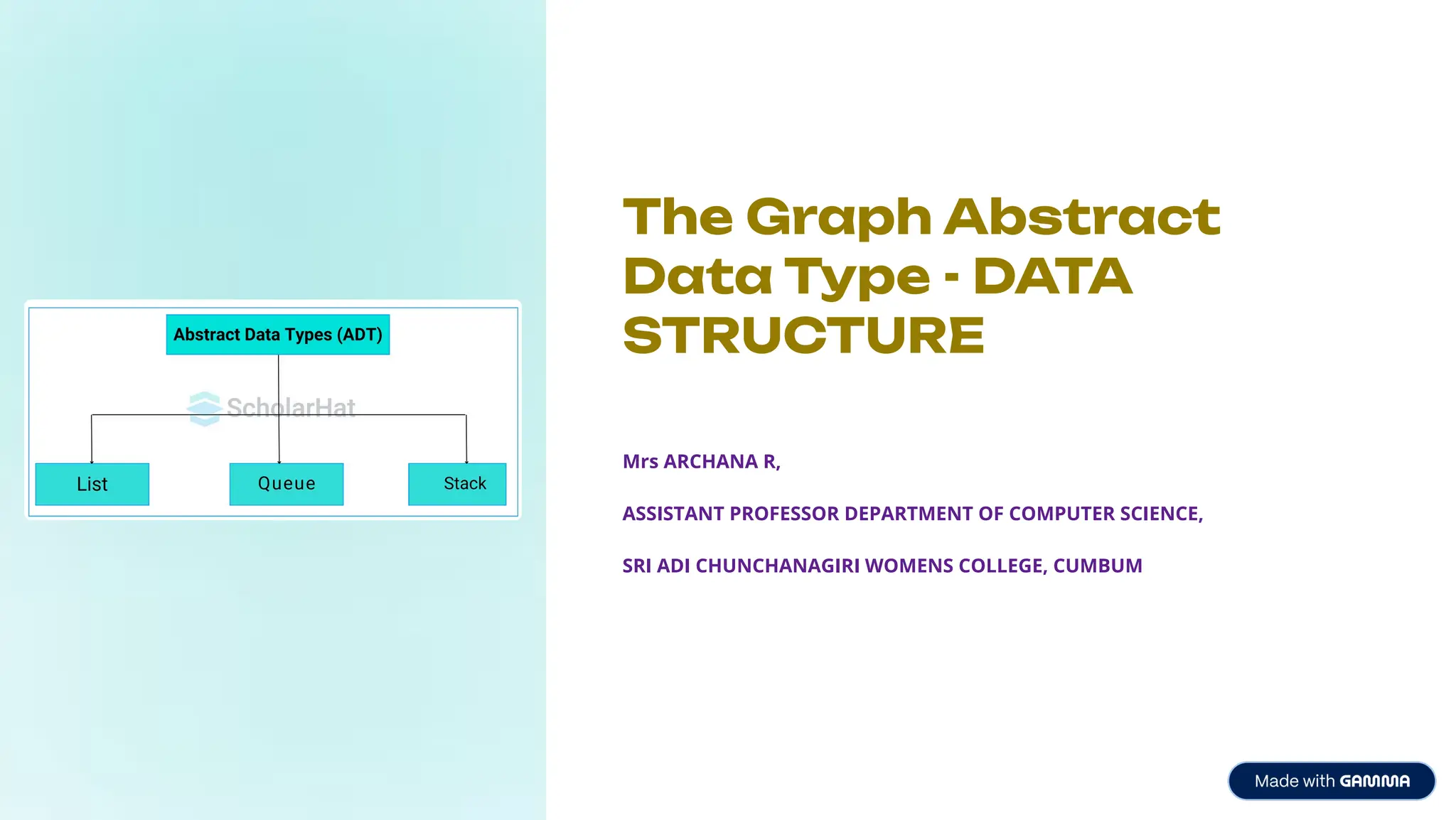
Examples: Common ADTs include Stacks (Last-In, First-Out), Queues (First-In, First-Out), and Lists (allowing indexed access or sequential
traversal).
Understanding ADTs is crucial for designing efficient and maintainable software systems, as they allow for clear separation of concerns and
promote the use of well-defined data manipulation methods.
4.
Introduction to Graphs
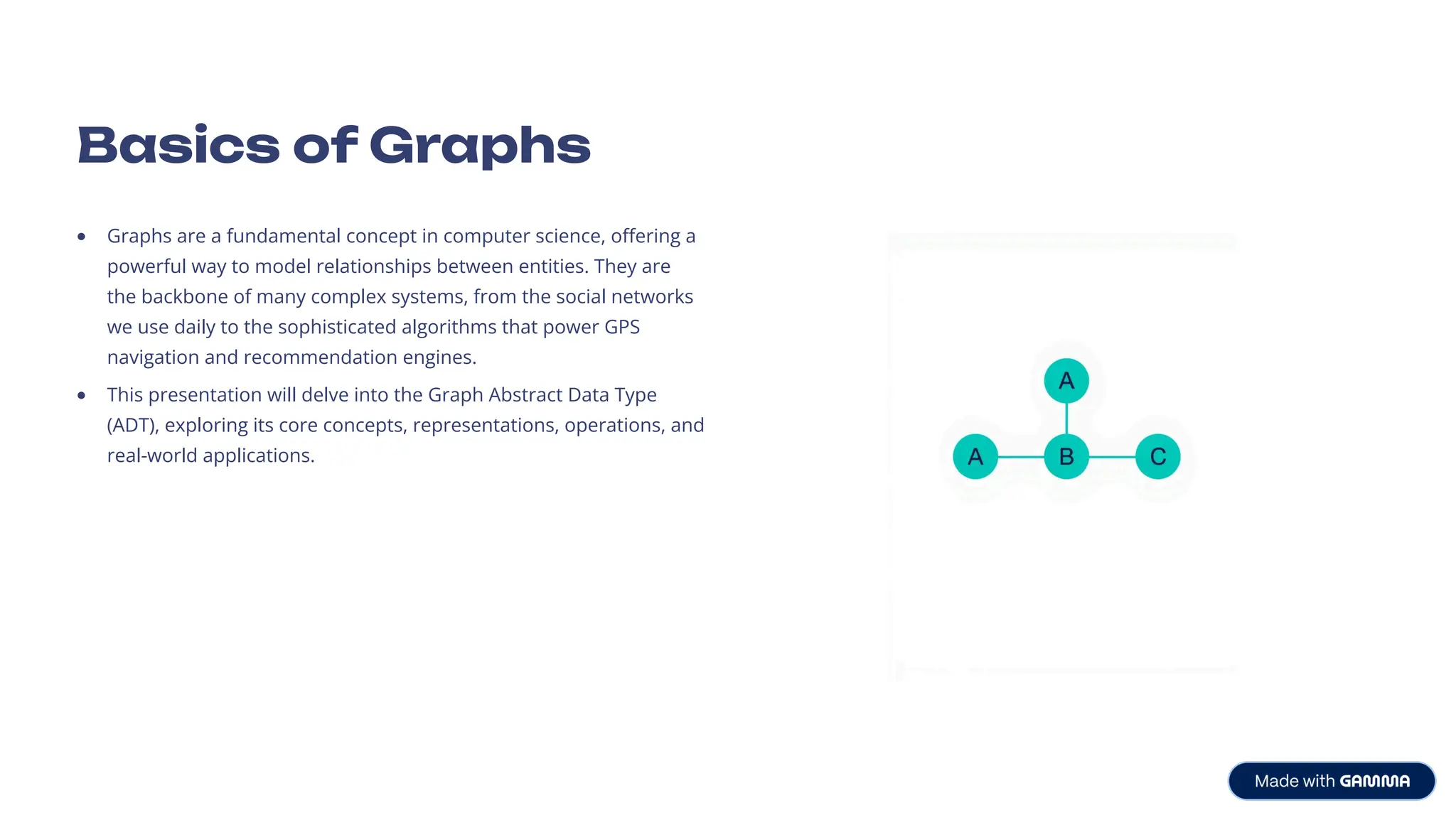
Agraph is a mathematical structure used to model pairwise relations between
objects. Formally, a graph G is defined as a pair G = (V, E), where:
V is a set of vertices (also called nodes or points). These represent the entities in
our system.
E is a set of edges (also called links or connections). These represent the
relationships or connections between vertices.
Each edge is typically an unordered or ordered pair of vertices, indicating a
connection between them. Graphs can be visually represented using circles or dots
for vertices and lines connecting these dots for edges. This visual representation
makes it easier to understand the structure and relationships within the data.
5.
Types of Graphs
Graphscan be categorized based on the nature of their edges and the relationships they represent:
Undirected Graph
Edges have no direction. If there's a connection between vertex A and vertex B, it means A is connected to B and B is connected to A. This is often
used to model symmetric relationships like friendships in a social network or two-way roads.
Example: A--B, B--C, A--C
Directed Graph (Digraph)
Edges have a specific direction, from a source vertex to a target vertex. This is used for asymmetric relationships, such as one-way streets, website
links, or task dependencies.
Example: A->B, B->C, C->A
Weighted Graph
Each edge has an associated numerical value or "weight." This weight can represent cost, distance, time, capacity, or any other metric relevant to
the connection between vertices.
Example: A--5--B, B--10--C
6.
Graph Representation: AdjacencyMatrix
The adjacency matrix is a square matrix used to represent a finite graph. The elements of the matrix indicate whether pairs of vertices are
adjacent or not in the graph.
Method: A V x V two-dimensional array is used, where V is the number of vertices. The cell at index [i][j] contains a value (typically 1 for
unweighted graphs, or the edge weight for weighted graphs) if there is an edge from vertex i to vertex j. If no edge exists, the cell contains 0.
Space Complexity: O(V^2). This can be memory-intensive for large graphs, especially sparse ones.
Advantage: Checking for the existence of an edge between two vertices takes constant time, O(1).
Disadvantage: It is inefficient for sparse graphs (graphs with significantly fewer edges than the maximum possible), as it requires storing many
zero entries.
7.
Graph Representation: AdjacencyList
The adjacency list is a collection of lists (or dynamic arrays) to represent a graph. One list or array is used for each vertex in the graph.
Method: An array or hash map is used, where each index or key corresponds to a vertex. The value associated with each index/key is a list of all
vertices that are adjacent to that vertex (i.e., connected by an edge).
Space Complexity: O(V + E), where V is the number of vertices and E is the number of edges. This is more memory-efficient than an adjacency
matrix for sparse graphs.
Advantage: It is very efficient for sparse graphs because it only stores the existing edges.
Disadvantage: Checking for the existence of an edge between two specific vertices can take time proportional to the degree of the vertex,
O(degree(V)), which can be up to O(V) in dense graphs.
8.
Common Graph Operations
Graphdata structures support a variety of operations to manipulate and query graph structures. These operations are fundamental to using
graphs effectively in algorithms:
addVertex(v)
Adds a new vertex `v` to the graph, typically as an isolated node with no edges.
addEdge(u, v, [weight])
Creates a connection (edge) between vertex `u` and vertex `v`. An optional `weight` can be provided for weighted graphs.
removeVertex(v)
Deletes vertex `v` from the graph, along with all edges connected to it.
removeEdge(u, v)
Removes the specific edge connecting vertex `u` and vertex `v`.
isAdjacent(u, v)
Returns `true` if an edge exists between vertex `u` and vertex `v`, and `false` otherwise.
getNeighbors(v)
Returns a collection of all vertices that are directly connected to vertex `v`.
9.
Graph Traversal Algorithms
Graphtraversal algorithms systematically visit (or "traverse") all the vertices and edges of a graph. Two fundamental algorithms are:
Breadth-First Search (BFS)
Explores the graph layer by layer. It starts at a source vertex and explores all its immediate neighbors first, then their unvisited neighbors, and so
on. BFS typically uses a queue data structure.
Use Cases: Finding the shortest path in an unweighted graph, finding all reachable nodes within a certain distance, web crawling.
Depth-First Search (DFS)
Explores as far as possible along each branch before backtracking. It starts at a source vertex and explores as far as possible along each branch
before backing up and exploring other paths. DFS typically uses a stack data structure or recursion.
Use Cases: Topological sorting, cycle detection, finding connected components, solving puzzles like mazes.
10.
Real-World Applications ofGraphs
Graphs are incredibly versatile and form the basis for solving a wide array of real-world problems:
Social Networks
Modeling friendships, connections, and interactions on platforms like Facebook or LinkedIn. Vertices are users, and edges represent relationships.
Navigation Systems
Representing road networks, public transport routes, or flight paths. Vertices are locations (intersections, airports), and edges are roads or routes,
often with weights representing distance or travel time.
Recommendation Engines
Suggesting products, movies, or content based on user preferences and item relationships. Nodes can be users or items, and edges can represent
ratings, purchases, or shared interests.
Logistics and Supply Chains
Optimizing delivery routes, managing inventory flow, and understanding dependencies in complex supply chains.
Computer Networks & Internet
Mapping network topology, routing data packets efficiently, and understanding the structure of the internet.
11.
Conclusion: The Enduring
Powerof Graphs
The Graph Abstract Data Type is a cornerstone of computer science, providing an
elegant and powerful paradigm for representing and analyzing interconnected data.
Its flexibility allows it to model a vast range of real-world phenomena, from the
intricate connections in social networks to the complex pathways in navigation
systems.
Mastering graph concepts and their associated algorithms is essential for anyone
looking to solve complex computational problems efficiently. As data continues to
grow in complexity and interconnectedness, the importance of graph theory and its
applications, including emerging fields like Graph Neural Networks, will only continue
to increase. Graphs are not just a data structure; they are a fundamental lens
through which we can understand and interact with the connected world.
Key Takeaways:
- Graphs model relationships between entities.
- ADTs define "what" without dictating "how."
- Adjacency Lists are generally preferred for sparse graphs.
- BFS and DFS are essential traversal algorithms.
- Graphs have widespread applications across industries.


![Graph Representation: Adjacency Matrix
The adjacency matrix is a square matrix used to represent a finite graph. The elements of the matrix indicate whether pairs of vertices are
adjacent or not in the graph.
Method: A V x V two-dimensional array is used, where V is the number of vertices. The cell at index [i][j] contains a value (typically 1 for
unweighted graphs, or the edge weight for weighted graphs) if there is an edge from vertex i to vertex j. If no edge exists, the cell contains 0.
Space Complexity: O(V^2). This can be memory-intensive for large graphs, especially sparse ones.
Advantage: Checking for the existence of an edge between two vertices takes constant time, O(1).
Disadvantage: It is inefficient for sparse graphs (graphs with significantly fewer edges than the maximum possible), as it requires storing many
zero entries.](https://image.slidesharecdn.com/thegraphabstractdatatype-datastructure-250704094200-4d9e400a/75/The-Graph-Abstract-Data-Type-DATA-STRUCTURE-pdf-6-2048.jpg)

![Common Graph Operations
Graph data structures support a variety of operations to manipulate and query graph structures. These operations are fundamental to using
graphs effectively in algorithms:
addVertex(v)
Adds a new vertex `v` to the graph, typically as an isolated node with no edges.
addEdge(u, v, [weight])
Creates a connection (edge) between vertex `u` and vertex `v`. An optional `weight` can be provided for weighted graphs.
removeVertex(v)
Deletes vertex `v` from the graph, along with all edges connected to it.
removeEdge(u, v)
Removes the specific edge connecting vertex `u` and vertex `v`.
isAdjacent(u, v)
Returns `true` if an edge exists between vertex `u` and vertex `v`, and `false` otherwise.
getNeighbors(v)
Returns a collection of all vertices that are directly connected to vertex `v`.](https://image.slidesharecdn.com/thegraphabstractdatatype-datastructure-250704094200-4d9e400a/75/The-Graph-Abstract-Data-Type-DATA-STRUCTURE-pdf-8-2048.jpg)


