ISDN
Submitted by:
Amit kr. Thakur
CONTENT
HISTORY
INTRODUCTON
THE BASIC PRINCIPLE
ISDN Services

USER INTERFACE
Functional grouping
ISDN Reference Points

ISDN TYPES

N ISDN
B ISDN
HISTORY
INTRODUCTON
Developed By ITU-T In 1976

Set Of Protocols That Combines Digital Telephony And
Data Transport Services. The Whole Idea Is To Digitize
The Telephone Network To Permit The Transmission Of
Audio, Video And Text Over Existing Telephone Lines.
The Goal Is To Form A WAN That Provides Universal
End-to-end Connectivity Over Digital Media.
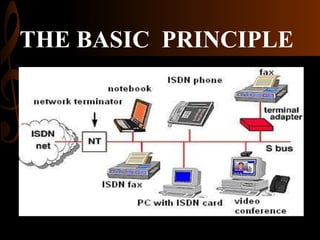
THE BASIC PRINCIPLE
The key feature of ISDN is that it integrates speech
and data on the same lines, adding features that were
not available in the classic telephone system
ISDN is a circuit-switched telephone network system
also provides access to packet switched networks
which resulted in potentially better voice quality than
an analog phone can provide
ISDN Services
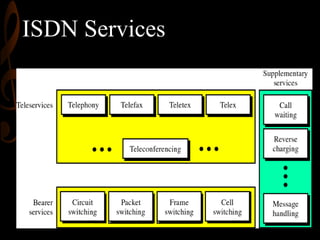
Bearer services – provide the means to transfer
information (voice, data, video) between users without
the network manipulating the content of that information.
Belongs to the first 3 layers of the OSI model.
Teleservices
 the network my change or process the contents of the data.
 correspond to layers 4-7 of the OSI model
 rely on the facilities of bearer services

Supplementary
services
–
provide
additional
functionality to the bearer services and teleservices.
ISDN Services
USER INTERFACE
ISDN Services – BRI
Basic Rate Interface (BRI)

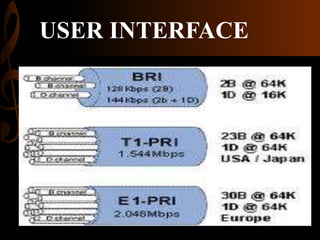
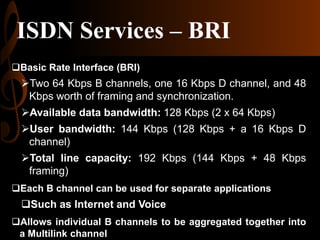
Two 64 Kbps B channels, one 16 Kbps D channel, and 48
Kbps worth of framing and synchronization.
Available data bandwidth: 128 Kbps (2 x 64 Kbps)
User bandwidth: 144 Kbps (128 Kbps + a 16 Kbps D
channel)
Total line capacity: 192 Kbps (144 Kbps + 48 Kbps
framing)
Each B channel can be used for separate applications

Such as Internet and Voice
Allows individual B channels to be aggregated together into
a Multilink channel
ISDN Services – PRI
Primary Rate Interface (PRI)
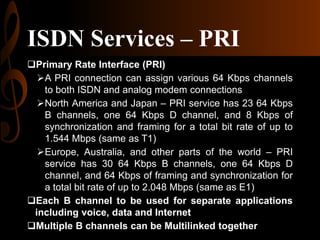
A PRI connection can assign various 64 Kbps channels
to both ISDN and analog modem connections
North America and Japan – PRI service has 23 64 Kbps
B channels, one 64 Kbps D channel, and 8 Kbps of
synchronization and framing for a total bit rate of up to
1.544 Mbps (same as T1)
Europe, Australia, and other parts of the world – PRI
service has 30 64 Kbps B channels, one 64 Kbps D
channel, and 64 Kbps of framing and synchronization for
a total bit rate of up to 2.048 Mbps (same as E1)
Each B channel to be used for separate applications
including voice, data and Internet
Multiple B channels can be Multilinked together
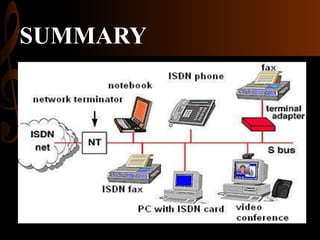
Functional grouping
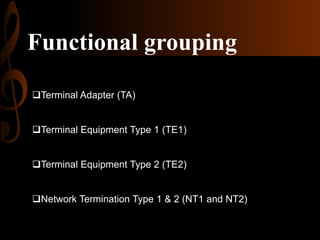
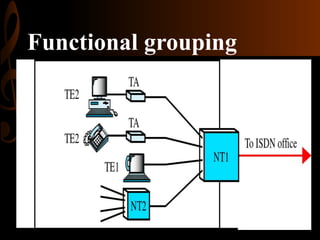
Terminal Adapter (TA)
Terminal Equipment Type 1 (TE1)
Terminal Equipment Type 2 (TE2)
Network Termination Type 1 & 2 (NT1 and NT2)
Functional grouping
ISDN Reference Points
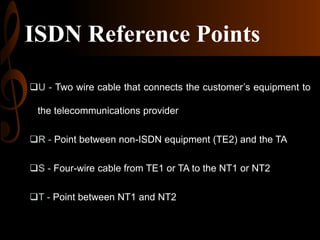
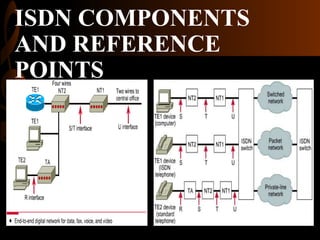
U - Two wire cable that connects the customer’s equipment to
the telecommunications provider
R - Point between non-ISDN equipment (TE2) and the TA
S - Four-wire cable from TE1 or TA to the NT1 or NT2
T - Point between NT1 and NT2
ISDN COMPONENTS
AND REFERENCE
POINTS
ISDN TYPES
N-ISDN
B-ISDN
N - ISDN
N-ISDN Was An Attempt To Replace The Analog
Telephone System With A Digital One
Telecommunication That Carries Voice Information In
A Narrow Band Of Frequencies
It Generally Uses 64 Kbps Channel As The Basic Unit
Of Switching
Its Major Contribution Was Frame Relay
N-ISDN Basic Rate Is Too Low So For Home As For Business
Today
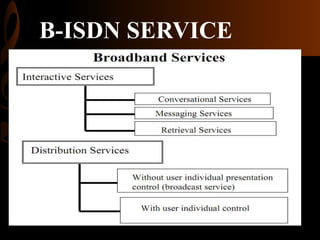
B-ISDN
A service requiring transmission channels
capable of supporting rates greater than the
primary rate.” ITU-T”.
Any service inquiry with a speed greater than
1.544 Mbps is defined as broadband, and any
communications based on this speed are called
broadband communications.
B ISDN
The Goal Of BISDN Is To Achieve Complete Integration Of
Services, Ranging From Low-bit- -Rate Bursty Signals To Highbit-rate Continuous Real-time Signals.
Worldwide Exchange Between Any Two Subscribers In Any
Medium.
Retrieval And Sharing Of
Sources, In Multiple Media.

Information

From

Multiple

Distribution Of A Wide Variety Of Materials To Home Or
Office, On Demand.
B-ISDN SERVICE
SUMMARY
THANK YOU

Isdn

  • 1.
  • 2.
    CONTENT HISTORY INTRODUCTON THE BASIC PRINCIPLE ISDNServices USER INTERFACE Functional grouping ISDN Reference Points ISDN TYPES N ISDN B ISDN
  • 3.
  • 5.
    INTRODUCTON Developed By ITU-TIn 1976 Set Of Protocols That Combines Digital Telephony And Data Transport Services. The Whole Idea Is To Digitize The Telephone Network To Permit The Transmission Of Audio, Video And Text Over Existing Telephone Lines. The Goal Is To Form A WAN That Provides Universal End-to-end Connectivity Over Digital Media.
  • 6.
  • 7.
    The key featureof ISDN is that it integrates speech and data on the same lines, adding features that were not available in the classic telephone system ISDN is a circuit-switched telephone network system also provides access to packet switched networks which resulted in potentially better voice quality than an analog phone can provide
  • 8.
    ISDN Services Bearer services– provide the means to transfer information (voice, data, video) between users without the network manipulating the content of that information. Belongs to the first 3 layers of the OSI model. Teleservices  the network my change or process the contents of the data.  correspond to layers 4-7 of the OSI model  rely on the facilities of bearer services Supplementary services – provide additional functionality to the bearer services and teleservices.
  • 9.
  • 10.
  • 11.
    ISDN Services –BRI Basic Rate Interface (BRI) Two 64 Kbps B channels, one 16 Kbps D channel, and 48 Kbps worth of framing and synchronization. Available data bandwidth: 128 Kbps (2 x 64 Kbps) User bandwidth: 144 Kbps (128 Kbps + a 16 Kbps D channel) Total line capacity: 192 Kbps (144 Kbps + 48 Kbps framing) Each B channel can be used for separate applications Such as Internet and Voice Allows individual B channels to be aggregated together into a Multilink channel
  • 12.
    ISDN Services –PRI Primary Rate Interface (PRI) A PRI connection can assign various 64 Kbps channels to both ISDN and analog modem connections North America and Japan – PRI service has 23 64 Kbps B channels, one 64 Kbps D channel, and 8 Kbps of synchronization and framing for a total bit rate of up to 1.544 Mbps (same as T1) Europe, Australia, and other parts of the world – PRI service has 30 64 Kbps B channels, one 64 Kbps D channel, and 64 Kbps of framing and synchronization for a total bit rate of up to 2.048 Mbps (same as E1) Each B channel to be used for separate applications including voice, data and Internet Multiple B channels can be Multilinked together
  • 13.
    Functional grouping Terminal Adapter(TA) Terminal Equipment Type 1 (TE1) Terminal Equipment Type 2 (TE2) Network Termination Type 1 & 2 (NT1 and NT2)
  • 14.
  • 15.
    ISDN Reference Points U- Two wire cable that connects the customer’s equipment to the telecommunications provider R - Point between non-ISDN equipment (TE2) and the TA S - Four-wire cable from TE1 or TA to the NT1 or NT2 T - Point between NT1 and NT2
  • 16.
  • 17.
  • 18.
    N - ISDN N-ISDNWas An Attempt To Replace The Analog Telephone System With A Digital One Telecommunication That Carries Voice Information In A Narrow Band Of Frequencies It Generally Uses 64 Kbps Channel As The Basic Unit Of Switching Its Major Contribution Was Frame Relay N-ISDN Basic Rate Is Too Low So For Home As For Business Today
  • 19.
    B-ISDN A service requiringtransmission channels capable of supporting rates greater than the primary rate.” ITU-T”. Any service inquiry with a speed greater than 1.544 Mbps is defined as broadband, and any communications based on this speed are called broadband communications.
  • 20.
    B ISDN The GoalOf BISDN Is To Achieve Complete Integration Of Services, Ranging From Low-bit- -Rate Bursty Signals To Highbit-rate Continuous Real-time Signals. Worldwide Exchange Between Any Two Subscribers In Any Medium. Retrieval And Sharing Of Sources, In Multiple Media. Information From Multiple Distribution Of A Wide Variety Of Materials To Home Or Office, On Demand.
  • 21.
  • 22.
  • 23.