
TOPIC – GSM ARCHITECTURE
Name- Marmik Kothari(140410111027)
Subject- Wireless Communication
Branch/Year : EC LY
What is GSM ?
Global System for Mobile (GSM) is a
second generation cellular standard
developed to cater voice services and data
delivery using digital modulation .
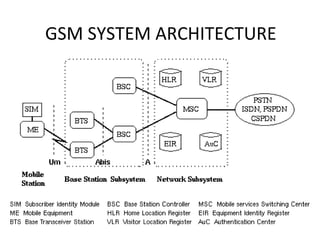
GSM SYSTEM ARCHITECTURE
GSM SYSTEM ARCHITECTURE-I
 Mobile Station (MS)
Mobile Equipment (ME) Subscriber Identity
Module (SIM)
 Base Station Subsystem (BSS)
Base Transceiver Station (BTS) Base
Station Controller (BSC)
 Network Switching
Subsystem(NSS) Mobile
Switching Center (MSC) Home
Location Register (HLR) Visitor
Location Register (VLR)
Authentication Center (AUC)
Equipment Identity Register (EIR)
SYSTEM ARCHITECTURE
MOBILE STATION (MS)
The Mobile Station is made up of two entities:
1.Mobile Equipment (ME)
2.Subscriber Identity Module (SIM)
MOBILE EQUIPMENT
 Portable, vehicle mounted, hand held device
 Uniquely identified by an IMEI
(International Mobile
Equipment Identity)
 Voice and data transmission
 Monitoring power and signal quality of surrounding cells
for optimum handover
 Power level : 0.8W – 20 W
 160 character long SMS.
SUBSCRIBER IDENTITY MODULE(SIM)
 Smart card contains the International Mobile
Subscriber
Identity (IMSI)
 Allows user to send and receive calls and receive other
subscribed services
 Protected by a password or PIN
 Can be moved from phone to phone – contains key
information to activate the phone
SYSTEM ARCHITECTURE
BASE STATION SUBSYSTEM (BSS)
Base Station Subsystem is composed of two parts that
communicate across the standardized Abis interface allowing
operation between components made by different suppliers
1.Base Transceiver Station (BTS)
2.Base Station Controller (BSC)
BASE TRANSCEIVER STATION (BTS):
 Encodes, encrypts, multiplexes, modulates and feeds
the RF signals to the antenna.
 Communicates with Mobile station and BSC
 Consists of Transceivers (TRX) units
BASE STATION CONTROLLER (BSC)
 Manages Radio resources for BTS
 Assigns Frequency and time slots for all MS’s in its
area
 Handles call set up
 Handover for each MS
 It communicates with MSC and BTS
SYSTEM ARCHITECTURE
NETWORK SWITCHING
SUBSYSTEM(NSS)
The system contains the
following functional units
Mobile Switching Center (MSC)
Home Location Register (HLR)
Visitor Location Register (VLR)
Authentication Center (AUC)
Equipment Identity Register (EIR)
MOBILE SWITCHING CENTER (MSC)
• Heart of the network
• Manages communication between GSM and other networks
• Billing information and collection
• Mobility management
- Registration
- Location Updating
- Inter BSS and inter MSC call handoff
HOME LOCATION REGISTERS (HLR)
Stores information about each subscriber that belongs to it MSC in
permanent and temporary fashion.
As soon as mobile subscriber leaves its current local area, the
information in the HLR is updated.
database contains IMSI, MSISDN, prepaid/ postpaid, roaming
restrictions, supplementary services.
VISITOR LOCATION REGISTERS (VLR)
Temporary database which updates whenever
new MS enters its area, by HLR database
Assigns a TMSI to each MS entering the VLR
area which keeps on
•changing.
Controls those mobiles roaming in its area
Database contains IMSI, MSISDN, Location
Area, authentication
•key
AUTHENTICATION CENTER (AUC)
 Contains the algorithms for authentication as well as the keys
for
encryption.
 Protects network operators from fraud.
 Situated in special protected part of the HLR.
EQUIPMENT IDENTITY REGISTER (EIR)
 Stores all devices identifications registered for this
network.
 Database that is used to track handsets using the IMEI
(International Mobile Equipment Identity)
 Prevents calls from stolen, unauthorised or defective
mobile devices
OPERATION AND MAINTENANCE CENTRE
(OMC)
 The centralized operation of the various units in the system
and functions needed to maintain the subsystems.
 Dynamic monitoring and controlling of the network.
 Functions :
- configuration management
- fault report and alarm handling
- performance supervision/management
- storage of system software and data
Thank You !

GSM architecture

  • 1.
    TOPIC – GSMARCHITECTURE Name- Marmik Kothari(140410111027) Subject- Wireless Communication Branch/Year : EC LY
  • 2.
    What is GSM? Global System for Mobile (GSM) is a second generation cellular standard developed to cater voice services and data delivery using digital modulation .
  • 3.
  • 4.
    GSM SYSTEM ARCHITECTURE-I Mobile Station (MS) Mobile Equipment (ME) Subscriber Identity Module (SIM)  Base Station Subsystem (BSS) Base Transceiver Station (BTS) Base Station Controller (BSC)  Network Switching Subsystem(NSS) Mobile Switching Center (MSC) Home Location Register (HLR) Visitor Location Register (VLR) Authentication Center (AUC) Equipment Identity Register (EIR)
  • 5.
    SYSTEM ARCHITECTURE MOBILE STATION(MS) The Mobile Station is made up of two entities: 1.Mobile Equipment (ME) 2.Subscriber Identity Module (SIM)
  • 6.
    MOBILE EQUIPMENT  Portable,vehicle mounted, hand held device  Uniquely identified by an IMEI (International Mobile Equipment Identity)  Voice and data transmission  Monitoring power and signal quality of surrounding cells for optimum handover  Power level : 0.8W – 20 W  160 character long SMS.
  • 7.
    SUBSCRIBER IDENTITY MODULE(SIM) Smart card contains the International Mobile Subscriber Identity (IMSI)  Allows user to send and receive calls and receive other subscribed services  Protected by a password or PIN  Can be moved from phone to phone – contains key information to activate the phone
  • 8.
    SYSTEM ARCHITECTURE BASE STATIONSUBSYSTEM (BSS) Base Station Subsystem is composed of two parts that communicate across the standardized Abis interface allowing operation between components made by different suppliers 1.Base Transceiver Station (BTS) 2.Base Station Controller (BSC)
  • 9.
    BASE TRANSCEIVER STATION(BTS):  Encodes, encrypts, multiplexes, modulates and feeds the RF signals to the antenna.  Communicates with Mobile station and BSC  Consists of Transceivers (TRX) units
  • 10.
    BASE STATION CONTROLLER(BSC)  Manages Radio resources for BTS  Assigns Frequency and time slots for all MS’s in its area  Handles call set up  Handover for each MS  It communicates with MSC and BTS
  • 11.
    SYSTEM ARCHITECTURE NETWORK SWITCHING SUBSYSTEM(NSS) Thesystem contains the following functional units Mobile Switching Center (MSC) Home Location Register (HLR) Visitor Location Register (VLR) Authentication Center (AUC) Equipment Identity Register (EIR)
  • 12.
    MOBILE SWITCHING CENTER(MSC) • Heart of the network • Manages communication between GSM and other networks • Billing information and collection • Mobility management - Registration - Location Updating - Inter BSS and inter MSC call handoff
  • 13.
    HOME LOCATION REGISTERS(HLR) Stores information about each subscriber that belongs to it MSC in permanent and temporary fashion. As soon as mobile subscriber leaves its current local area, the information in the HLR is updated. database contains IMSI, MSISDN, prepaid/ postpaid, roaming restrictions, supplementary services.
  • 14.
    VISITOR LOCATION REGISTERS(VLR) Temporary database which updates whenever new MS enters its area, by HLR database Assigns a TMSI to each MS entering the VLR area which keeps on •changing. Controls those mobiles roaming in its area Database contains IMSI, MSISDN, Location Area, authentication •key
  • 15.
    AUTHENTICATION CENTER (AUC) Contains the algorithms for authentication as well as the keys for encryption.  Protects network operators from fraud.  Situated in special protected part of the HLR.
  • 16.
    EQUIPMENT IDENTITY REGISTER(EIR)  Stores all devices identifications registered for this network.  Database that is used to track handsets using the IMEI (International Mobile Equipment Identity)  Prevents calls from stolen, unauthorised or defective mobile devices
  • 17.
    OPERATION AND MAINTENANCECENTRE (OMC)  The centralized operation of the various units in the system and functions needed to maintain the subsystems.  Dynamic monitoring and controlling of the network.  Functions : - configuration management - fault report and alarm handling - performance supervision/management - storage of system software and data
  • 18.