Frequency Reuse
2
Why are Cells Required?
• Original mobile voice networks used transmitter with large power
to cover very large area
• Capacity severely limited by available bandwidth
• Spectrum limited, so could not increase capacity by adding new
channels
• Cellular concept was born
– Ushered in modern communication systems
3
Frequency Reuse…
• Due to Co-channel Interference (CCI), cannot use same frequency
in adjacent cell
• Cells that use same frequencies must be separated by distances large
enough to keep interference levels low
• Frequencies assigned to different cells using frequency reuse plan
• Adjacent cells assigned different frequencies to avoid interference
or crosstalk
4
Frequency Reuse…
• Objective is to reuse frequency in nearby cells
• 10 to 50 frequencies assigned to each cell
• Transmission power controlled to limit power at that frequency
escaping to adjacent cells
• The issue is to determine how many cells must intervene between
two cells using the same frequency
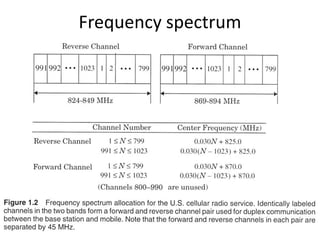
Frequency spectrum
6
Frequency Reuse
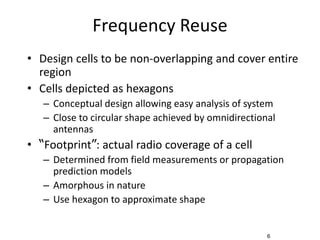
• Design cells to be non-overlapping and cover entire
region
• Cells depicted as hexagons
– Conceptual design allowing easy analysis of system
– Close to circular shape achieved by omnidirectional
antennas
• “Footprint”: actual radio coverage of a cell
– Determined from field measurements or propagation
prediction models
– Amorphous in nature
– Use hexagon to approximate shape
7
Frequency Reuse…
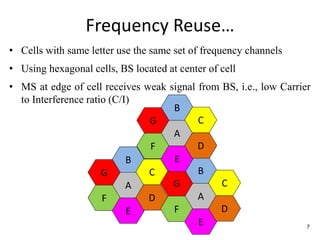
• Cells with same letter use the same set of frequency channels
• Using hexagonal cells, BS located at center of cell
• MS at edge of cell receives weak signal from BS, i.e., low Carrier
to Interference ratio (C/I)
A
F
E
D
B
G C
A
F
E
D
B
G C
A
F
E
D
B
G C
8
Frequency Reuse…
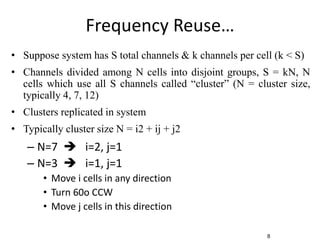
• Suppose system has S total channels & k channels per cell (k < S)
• Channels divided among N cells into disjoint groups, S = kN, N
cells which use all S channels called “cluster” (N = cluster size,
typically 4, 7, 12)
• Clusters replicated in system
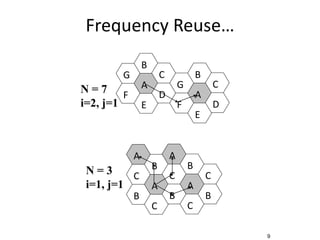
• Typically cluster size N = i2 + ij + j2
– N=7  i=2, j=1
– N=3  i=1, j=1
• Move i cells in any direction
• Turn 60o CCW
• Move j cells in this direction
9
Frequency Reuse…
A
F
E
D
B
G C
A
F
E
D
B
G CN = 7
i=2, j=1
A
B
C
B
B
C C
C
B
B
A
C
A
AA
N = 3
i=1, j=1
10
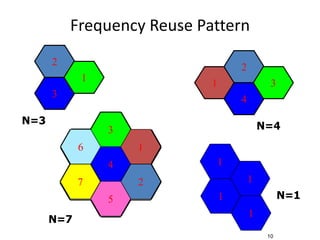
Frequency Reuse Pattern
2
3
1
N=3
1
2
4
3
4
1
3
6
5
27
N=4
N=7
1
1
1
1
N=1
11
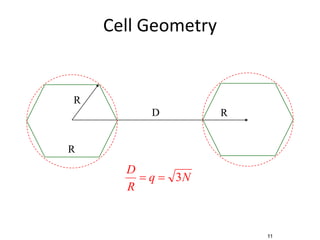
Cell Geometry
D
R
R
R
Nq
R
D
3

Frequency reuse

  • 1.
  • 2.
    2 Why are CellsRequired? • Original mobile voice networks used transmitter with large power to cover very large area • Capacity severely limited by available bandwidth • Spectrum limited, so could not increase capacity by adding new channels • Cellular concept was born – Ushered in modern communication systems
  • 3.
    3 Frequency Reuse… • Dueto Co-channel Interference (CCI), cannot use same frequency in adjacent cell • Cells that use same frequencies must be separated by distances large enough to keep interference levels low • Frequencies assigned to different cells using frequency reuse plan • Adjacent cells assigned different frequencies to avoid interference or crosstalk
  • 4.
    4 Frequency Reuse… • Objectiveis to reuse frequency in nearby cells • 10 to 50 frequencies assigned to each cell • Transmission power controlled to limit power at that frequency escaping to adjacent cells • The issue is to determine how many cells must intervene between two cells using the same frequency
  • 5.
  • 6.
    6 Frequency Reuse • Designcells to be non-overlapping and cover entire region • Cells depicted as hexagons – Conceptual design allowing easy analysis of system – Close to circular shape achieved by omnidirectional antennas • “Footprint”: actual radio coverage of a cell – Determined from field measurements or propagation prediction models – Amorphous in nature – Use hexagon to approximate shape
  • 7.
    7 Frequency Reuse… • Cellswith same letter use the same set of frequency channels • Using hexagonal cells, BS located at center of cell • MS at edge of cell receives weak signal from BS, i.e., low Carrier to Interference ratio (C/I) A F E D B G C A F E D B G C A F E D B G C
  • 8.
    8 Frequency Reuse… • Supposesystem has S total channels & k channels per cell (k < S) • Channels divided among N cells into disjoint groups, S = kN, N cells which use all S channels called “cluster” (N = cluster size, typically 4, 7, 12) • Clusters replicated in system • Typically cluster size N = i2 + ij + j2 – N=7  i=2, j=1 – N=3  i=1, j=1 • Move i cells in any direction • Turn 60o CCW • Move j cells in this direction
  • 9.
    9 Frequency Reuse… A F E D B G C A F E D B GCN = 7 i=2, j=1 A B C B B C C C B B A C A AA N = 3 i=1, j=1
  • 10.
  • 11.