
TOPIC - WLL,WLAN &
BLUETOOTH
Name- Marmik Kothari(140410111027)
Subject- Wireless Communication
Branch/Year : EC LY
Wireless Local Loop
 Sometimes called radio in the loop (RITL) or
fixed-radio access (FRA), WLL is a system that
connects subscribers to the public switched
telephone network (PSTN) using radio signals
as a substitute for copper for all or part of the
connection between the subscriber and the
switch. This includes cordless access systems,
proprietary fixed radio access, and fixed cellular
systems. . Using a wireless link shortens the
construction period and also reduces installation
and operating costs.
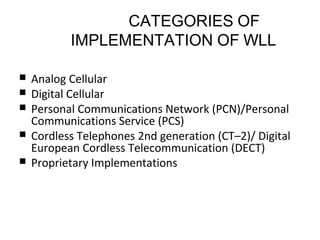
CATEGORIES OF
IMPLEMENTATION OF WLL
 Analog Cellular
 Digital Cellular
 Personal Communications Network (PCN)/Personal
Communications Service (PCS)
 Cordless Telephones 2nd generation (CT–2)/ Digital
European Cordless Telecommunication (DECT)
 Proprietary Implementations
ADVANTAGES OF WLL
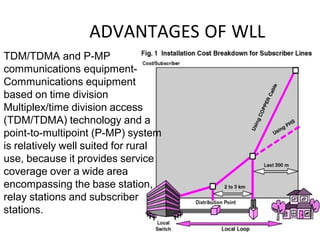
TDM/TDMA and P-MP
communications equipment-
Communications equipment
based on time division
Multiplex/time division access
(TDM/TDMA) technology and a
point-to-multipoint (P-MP) system
is relatively well suited for rural
use, because it provides service
coverage over a wide area
encompassing the base station,
relay stations and subscriber
stations.
WLAN
WLAN stands for Wireless Local Area Network.
 Sometimes it is also called Local Area Wireless Network
(LAWN).
 Norman Abramson, a professor at the University of Hawaii,
developed the world’s first wireless computer
communication network, ALOHA net (operational in 1971).
 WLAN is a wireless computer network that links two or
more devices (using-spectrum or OFDM radio) within a
limited area such as a home, school, computer laboratory,
or office building.
 WLAN is a marketed under the Wi-Fi brand name.
ADVANTAGES OF WLAN
 Installation flexibility.
 Reduced cost-of-
ownership.
 Mobility
Installation speed and simplicity
• No cable to pull.
• Few transmitters/receivers for multiple for
users.
Reduced cost-of-ownership than computer• Mobile devices are less expensive
workstations.
• No need to build wiring closets.
Mobility
• Access to real-time information.
• Provides service opportunities.
• Promotes flexibility.
• Supports productivity.
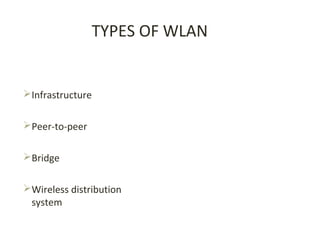
TYPES OF WLAN
Infrastructure
Peer-to-peer
Bridge
Wireless distribution
system
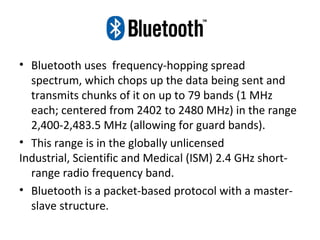
• Bluetooth uses frequency-hopping spread
spectrum, which chops up the data being sent and
transmits chunks of it on up to 79 bands (1 MHz
each; centered from 2402 to 2480 MHz) in the range
2,400-2,483.5 MHz (allowing for guard bands).
• This range is in the globally unlicensed
Industrial, Scientific and Medical (ISM) 2.4 GHz short-
range radio frequency band.
• Bluetooth is a packet-based protocol with a master-
slave structure.
Thank You !

WLL,WLAN & BLUETOOTH

  • 1.
    TOPIC - WLL,WLAN& BLUETOOTH Name- Marmik Kothari(140410111027) Subject- Wireless Communication Branch/Year : EC LY
  • 2.
    Wireless Local Loop Sometimes called radio in the loop (RITL) or fixed-radio access (FRA), WLL is a system that connects subscribers to the public switched telephone network (PSTN) using radio signals as a substitute for copper for all or part of the connection between the subscriber and the switch. This includes cordless access systems, proprietary fixed radio access, and fixed cellular systems. . Using a wireless link shortens the construction period and also reduces installation and operating costs.
  • 3.
    CATEGORIES OF IMPLEMENTATION OFWLL  Analog Cellular  Digital Cellular  Personal Communications Network (PCN)/Personal Communications Service (PCS)  Cordless Telephones 2nd generation (CT–2)/ Digital European Cordless Telecommunication (DECT)  Proprietary Implementations
  • 4.
    ADVANTAGES OF WLL TDM/TDMAand P-MP communications equipment- Communications equipment based on time division Multiplex/time division access (TDM/TDMA) technology and a point-to-multipoint (P-MP) system is relatively well suited for rural use, because it provides service coverage over a wide area encompassing the base station, relay stations and subscriber stations.
  • 5.
    WLAN WLAN stands forWireless Local Area Network.  Sometimes it is also called Local Area Wireless Network (LAWN).  Norman Abramson, a professor at the University of Hawaii, developed the world’s first wireless computer communication network, ALOHA net (operational in 1971).  WLAN is a wireless computer network that links two or more devices (using-spectrum or OFDM radio) within a limited area such as a home, school, computer laboratory, or office building.  WLAN is a marketed under the Wi-Fi brand name.
  • 6.
    ADVANTAGES OF WLAN Installation flexibility.  Reduced cost-of- ownership.  Mobility
  • 7.
    Installation speed andsimplicity • No cable to pull. • Few transmitters/receivers for multiple for users. Reduced cost-of-ownership than computer• Mobile devices are less expensive workstations. • No need to build wiring closets. Mobility • Access to real-time information. • Provides service opportunities. • Promotes flexibility. • Supports productivity.
  • 8.
  • 9.
    • Bluetooth usesfrequency-hopping spread spectrum, which chops up the data being sent and transmits chunks of it on up to 79 bands (1 MHz each; centered from 2402 to 2480 MHz) in the range 2,400-2,483.5 MHz (allowing for guard bands). • This range is in the globally unlicensed Industrial, Scientific and Medical (ISM) 2.4 GHz short- range radio frequency band. • Bluetooth is a packet-based protocol with a master- slave structure.
  • 12.