GSM handoffs
   Intra-BSS: if old and new BTSs are
    attached to same base station
       MSC is not involved


   Intra-MSC: if old and new BTSs are
    attached to different base stations but
    within same MSC
   Inter-MSC: if MSCs are changed
GSM Intra-MSC handoff
1.   Mobile station monitors signal quality and
     determines handoff is required, sends signal
     measurements to serving BSS
2.   Serving BSS sends handoff request to MSC with
     ranked list of qualified target BSSs
3.   MSC determines that best candidate BSS is under
     its control
4.   MSC reserves a trunk to target BSS
5.   Target BSS selects and reserves radio channels for
     new connection, sends Ack to MSC
6.   MSC notifies serving BSS to begin handoff,
     including new radio channel assignment
GSM Intra-MSC handoff
7.    Serving BSS forwards new radio channel assignment
      to mobile station
8.    Mobile station retunes to new radio channel, notifies
      target BSS on new channel
9.    Target BSS notifies MSC that handoff is detected
10.   Target BSS and mobile station exchange messages to
      synchronize transmission in proper timeslot
11.   MSC switches voice connection to target BSS, which
      responds when handoff is complete
12.   MSC notifies serving BSS to release old radio traffic
      channel
GSM Inter-MSC handoff
1.    MS sends signal measurements to serving BSS
2.   Serving BSS sends handoff request to MSC
3.   Serving MSC determines that best candidate BSS
     is under control of a target MSC and calls target
     MSC
4.   Target MSC notifies its VLR to assign a TMSI
5.   Target VLR returns TMSI
6.   Target MSC reserves a trunk to target BSS
7.   Target BSS selects and reserves radio channels
     for new connection, sends Ack to target MSC
8.   Target MSC notifies serving MSC that it is ready
     for handoff
GSM Inter-MSC handoff
9.    Serving MSC notifies serving BSS to begin handoff,
      including new radio channel assignment
10.   Serving BSS forwards new radio channel assignment
      to mobile station
11.   Mobile station retunes to new radio channel, notifies
      target BSS on new channel
12.   Target BSS notifies target MSC that handoff is
      detected
13.   Target BSS and mobile station synchronize timeslot
14.   Voice connection is switched to target BSS, which
      responds when handoff is complete
15.   Target MSC notifies serving MSC
16.   Old network resources are released
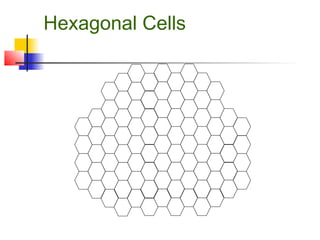
Geometric Representation
   Cells are commonly represented by
    hexagons.

   Why hexagon?
   How about circle?
   How about square, or triangle?
Hexagonal Cells
Channel Reuse
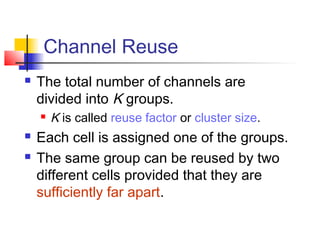
   The total number of channels are
    divided into K groups.
       K is called reuse factor or cluster size.
   Each cell is assigned one of the groups.
   The same group can be reused by two
    different cells provided that they are
    sufficiently far apart.
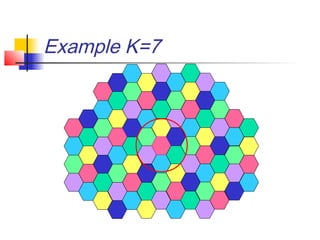
Example K=7
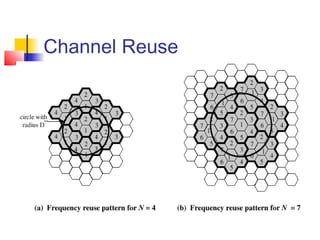
Channel Reuse
Coordinate System
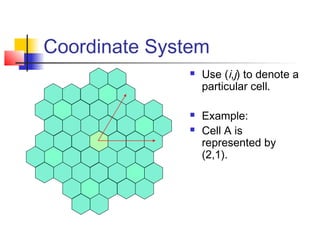
                 Use (i,j) to denote a
                  particular cell.

                 Example:
                 Cell A is
                  represented by
                  (2,1).
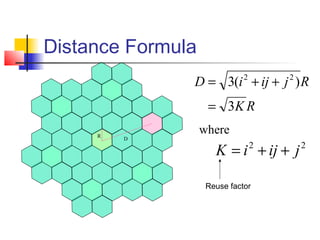
Distance Formula
               D = 3(i + ij + j ) R
                              2       2


                    = 3K R
     R
                   where
         D

                      K = i + ij + j
                                  2       2


                    Reuse factor
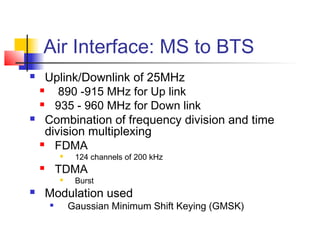
Air Interface: MS to BTS
     Uplink/Downlink of 25MHz
        890 -915 MHz for Up link
       935 - 960 MHz for Down link
     Combination of frequency division and time
      division multiplexing
       FDMA
                124 channels of 200 kHz
           TDMA
                Burst
       Modulation used
               Gaussian Minimum Shift Keying (GMSK)
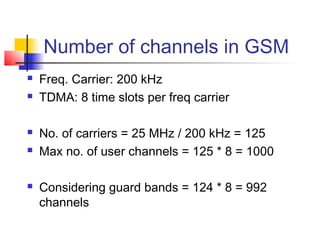
Number of channels in GSM
   Freq. Carrier: 200 kHz
   TDMA: 8 time slots per freq carrier

   No. of carriers = 25 MHz / 200 kHz = 125
   Max no. of user channels = 125 * 8 = 1000

   Considering guard bands = 124 * 8 = 992
    channels
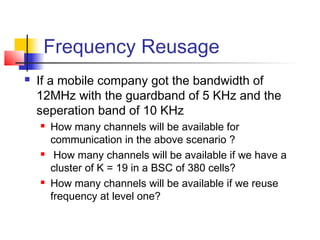
Frequency Reusage
   If a mobile company got the bandwidth of
    12MHz with the guardband of 5 KHz and the
    seperation band of 10 KHz
       How many channels will be available for
        communication in the above scenario ?
        How many channels will be available if we have a
        cluster of K = 19 in a BSC of 380 cells?
       How many channels will be available if we reuse
        frequency at level one?
Outgoing call setup
       User keys in the number and presses send
       Mobile transmits request on uplink signaling channel
       If network can process the call, BS sends a channel
        allocation message
       Network proceeds to setup the connection
   Network activity:
       MSC determines current location of target mobile
        using HLR, VLR and by communicating with other
        MSCs
       Source MSC initiates a call setup message to MSC
        covering target area
Incoming call setup
       Target MSC initiates a paging message
       BSs forward the paging message on
        downlink channel in coverage area
       If mobile is on (monitoring the signaling
        channel), it responds to BS
       BS sends a channel allocation message and
        informs MSC
   Network activity:
       Network completes the two halves of the
        connection
LAI
   Location Area Identifier of an LA of a PLMN                              (A
    Public Land Mobile Network is a generic name for all mobile wireless networks
    that use land based radio transmitters or base stations.)

   Based on international ISDN numbering plan
         Country Code (CC): 2,3+ decimal digits
         Mobile Network Code (MNC): 2,3 decimal digits
     
          Location Area Code (LAC) : maximum 5 decimal digits,
          or maximum twice 8 bits, coded in hexadecimal
   Is broadcast regularly by the BTS on broadcast
    channel
Cell Identifier (CI)
   Within LA, individual cells are uniquely
    identified with Cell Identifier (CI).
   It is maximum 2*8 bits
   LAI + CI = Global Cell Identity
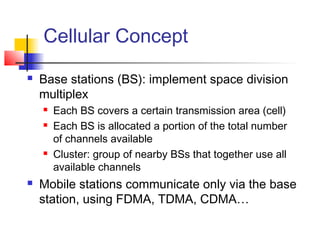
Cellular Concept
   Base stations (BS): implement space division
    multiplex
       Each BS covers a certain transmission area (cell)
       Each BS is allocated a portion of the total number
        of channels available
       Cluster: group of nearby BSs that together use all
        available channels
   Mobile stations communicate only via the base
    station, using FDMA, TDMA, CDMA…
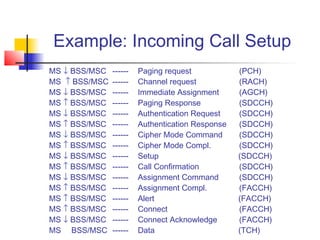
Example: Incoming Call Setup
MS ↓ BSS/MSC   ------   Paging request            (PCH)
MS ↑ BSS/MSC   ------   Channel request           (RACH)
MS ↓ BSS/MSC   ------   Immediate Assignment      (AGCH)
MS ↑ BSS/MSC   ------   Paging Response           (SDCCH)
MS ↓ BSS/MSC   ------   Authentication Request    (SDCCH)
MS ↑ BSS/MSC   ------   Authentication Response   (SDCCH)
MS ↓ BSS/MSC   ------   Cipher Mode Command       (SDCCH)
MS ↑ BSS/MSC   ------   Cipher Mode Compl.        (SDCCH)
MS ↓ BSS/MSC   ------   Setup                     (SDCCH)
MS ↑ BSS/MSC   ------   Call Confirmation         (SDCCH)
MS ↓ BSS/MSC   ------   Assignment Command        (SDCCH)
MS ↑ BSS/MSC   ------   Assignment Compl.         (FACCH)
MS ↑ BSS/MSC   ------   Alert                     (FACCH)
MS ↑ BSS/MSC   ------   Connect                   (FACCH)
MS ↓ BSS/MSC   ------   Connect Acknowledge       (FACCH)
MS BSS/MSC     ------   Data                      (TCH)

Gsm (Part 3)

  • 1.
    GSM handoffs  Intra-BSS: if old and new BTSs are attached to same base station  MSC is not involved  Intra-MSC: if old and new BTSs are attached to different base stations but within same MSC  Inter-MSC: if MSCs are changed
  • 2.
    GSM Intra-MSC handoff 1. Mobile station monitors signal quality and determines handoff is required, sends signal measurements to serving BSS 2. Serving BSS sends handoff request to MSC with ranked list of qualified target BSSs 3. MSC determines that best candidate BSS is under its control 4. MSC reserves a trunk to target BSS 5. Target BSS selects and reserves radio channels for new connection, sends Ack to MSC 6. MSC notifies serving BSS to begin handoff, including new radio channel assignment
  • 3.
    GSM Intra-MSC handoff 7. Serving BSS forwards new radio channel assignment to mobile station 8. Mobile station retunes to new radio channel, notifies target BSS on new channel 9. Target BSS notifies MSC that handoff is detected 10. Target BSS and mobile station exchange messages to synchronize transmission in proper timeslot 11. MSC switches voice connection to target BSS, which responds when handoff is complete 12. MSC notifies serving BSS to release old radio traffic channel
  • 4.
    GSM Inter-MSC handoff 1. MS sends signal measurements to serving BSS 2. Serving BSS sends handoff request to MSC 3. Serving MSC determines that best candidate BSS is under control of a target MSC and calls target MSC 4. Target MSC notifies its VLR to assign a TMSI 5. Target VLR returns TMSI 6. Target MSC reserves a trunk to target BSS 7. Target BSS selects and reserves radio channels for new connection, sends Ack to target MSC 8. Target MSC notifies serving MSC that it is ready for handoff
  • 5.
    GSM Inter-MSC handoff 9. Serving MSC notifies serving BSS to begin handoff, including new radio channel assignment 10. Serving BSS forwards new radio channel assignment to mobile station 11. Mobile station retunes to new radio channel, notifies target BSS on new channel 12. Target BSS notifies target MSC that handoff is detected 13. Target BSS and mobile station synchronize timeslot 14. Voice connection is switched to target BSS, which responds when handoff is complete 15. Target MSC notifies serving MSC 16. Old network resources are released
  • 6.
    Geometric Representation  Cells are commonly represented by hexagons.  Why hexagon?  How about circle?  How about square, or triangle?
  • 7.
  • 8.
    Channel Reuse  The total number of channels are divided into K groups.  K is called reuse factor or cluster size.  Each cell is assigned one of the groups.  The same group can be reused by two different cells provided that they are sufficiently far apart.
  • 9.
  • 10.
  • 11.
    Coordinate System  Use (i,j) to denote a particular cell.  Example:  Cell A is represented by (2,1).
  • 12.
    Distance Formula D = 3(i + ij + j ) R 2 2 = 3K R R where D K = i + ij + j 2 2 Reuse factor
  • 13.
    Air Interface: MSto BTS  Uplink/Downlink of 25MHz  890 -915 MHz for Up link  935 - 960 MHz for Down link  Combination of frequency division and time division multiplexing  FDMA  124 channels of 200 kHz  TDMA  Burst  Modulation used  Gaussian Minimum Shift Keying (GMSK)
  • 14.
    Number of channelsin GSM  Freq. Carrier: 200 kHz  TDMA: 8 time slots per freq carrier  No. of carriers = 25 MHz / 200 kHz = 125  Max no. of user channels = 125 * 8 = 1000  Considering guard bands = 124 * 8 = 992 channels
  • 15.
    Frequency Reusage  If a mobile company got the bandwidth of 12MHz with the guardband of 5 KHz and the seperation band of 10 KHz  How many channels will be available for communication in the above scenario ?  How many channels will be available if we have a cluster of K = 19 in a BSC of 380 cells?  How many channels will be available if we reuse frequency at level one?
  • 16.
    Outgoing call setup  User keys in the number and presses send  Mobile transmits request on uplink signaling channel  If network can process the call, BS sends a channel allocation message  Network proceeds to setup the connection  Network activity:  MSC determines current location of target mobile using HLR, VLR and by communicating with other MSCs  Source MSC initiates a call setup message to MSC covering target area
  • 17.
    Incoming call setup  Target MSC initiates a paging message  BSs forward the paging message on downlink channel in coverage area  If mobile is on (monitoring the signaling channel), it responds to BS  BS sends a channel allocation message and informs MSC  Network activity:  Network completes the two halves of the connection
  • 18.
    LAI  Location Area Identifier of an LA of a PLMN (A Public Land Mobile Network is a generic name for all mobile wireless networks that use land based radio transmitters or base stations.)  Based on international ISDN numbering plan  Country Code (CC): 2,3+ decimal digits  Mobile Network Code (MNC): 2,3 decimal digits  Location Area Code (LAC) : maximum 5 decimal digits, or maximum twice 8 bits, coded in hexadecimal  Is broadcast regularly by the BTS on broadcast channel
  • 19.
    Cell Identifier (CI)  Within LA, individual cells are uniquely identified with Cell Identifier (CI).  It is maximum 2*8 bits  LAI + CI = Global Cell Identity
  • 20.
    Cellular Concept  Base stations (BS): implement space division multiplex  Each BS covers a certain transmission area (cell)  Each BS is allocated a portion of the total number of channels available  Cluster: group of nearby BSs that together use all available channels  Mobile stations communicate only via the base station, using FDMA, TDMA, CDMA…
  • 21.
    Example: Incoming CallSetup MS ↓ BSS/MSC ------ Paging request (PCH) MS ↑ BSS/MSC ------ Channel request (RACH) MS ↓ BSS/MSC ------ Immediate Assignment (AGCH) MS ↑ BSS/MSC ------ Paging Response (SDCCH) MS ↓ BSS/MSC ------ Authentication Request (SDCCH) MS ↑ BSS/MSC ------ Authentication Response (SDCCH) MS ↓ BSS/MSC ------ Cipher Mode Command (SDCCH) MS ↑ BSS/MSC ------ Cipher Mode Compl. (SDCCH) MS ↓ BSS/MSC ------ Setup (SDCCH) MS ↑ BSS/MSC ------ Call Confirmation (SDCCH) MS ↓ BSS/MSC ------ Assignment Command (SDCCH) MS ↑ BSS/MSC ------ Assignment Compl. (FACCH) MS ↑ BSS/MSC ------ Alert (FACCH) MS ↑ BSS/MSC ------ Connect (FACCH) MS ↓ BSS/MSC ------ Connect Acknowledge (FACCH) MS BSS/MSC ------ Data (TCH)

Editor's Notes

  • #22 The figure shows an example of incoming call connection setup at the air interface how the various logical channels are used in principle. The MS is called via the PCH and requests a signaling channel on the RACH. It gets SDCCH through an IMMEDIATE ASSIGNMENT message on the AGCH. Then follow authentication, start of ciphering, and start of setup over the SDCCH. An ASSIGNMENT COMMAND message gives the traffic channel to the MS, which acknowledges its receipt on the FACCH of the traffic channel. The FACCH is also used to continue the connection setup.