Chapter 3
Air Interface
Eng. Ahmed Khaled
GSM Bands:
0.8 0.9 1.0 1.1 1.6 1.7 1.8 1.9 2.0 GHz
GSM 1800 GSM 1900
200 KHz
Carrier n
Carrier (n+1)
frequency
…
Mobile Channels (links):
Two carriers make up the radio channel required for communication between
the Mobile Station (MS) and Base Transceiver Station (BTS).
There are two links in mobile communication:
Up-Link (from mobile to BTS).
Down-Link (from BTS to mobile).
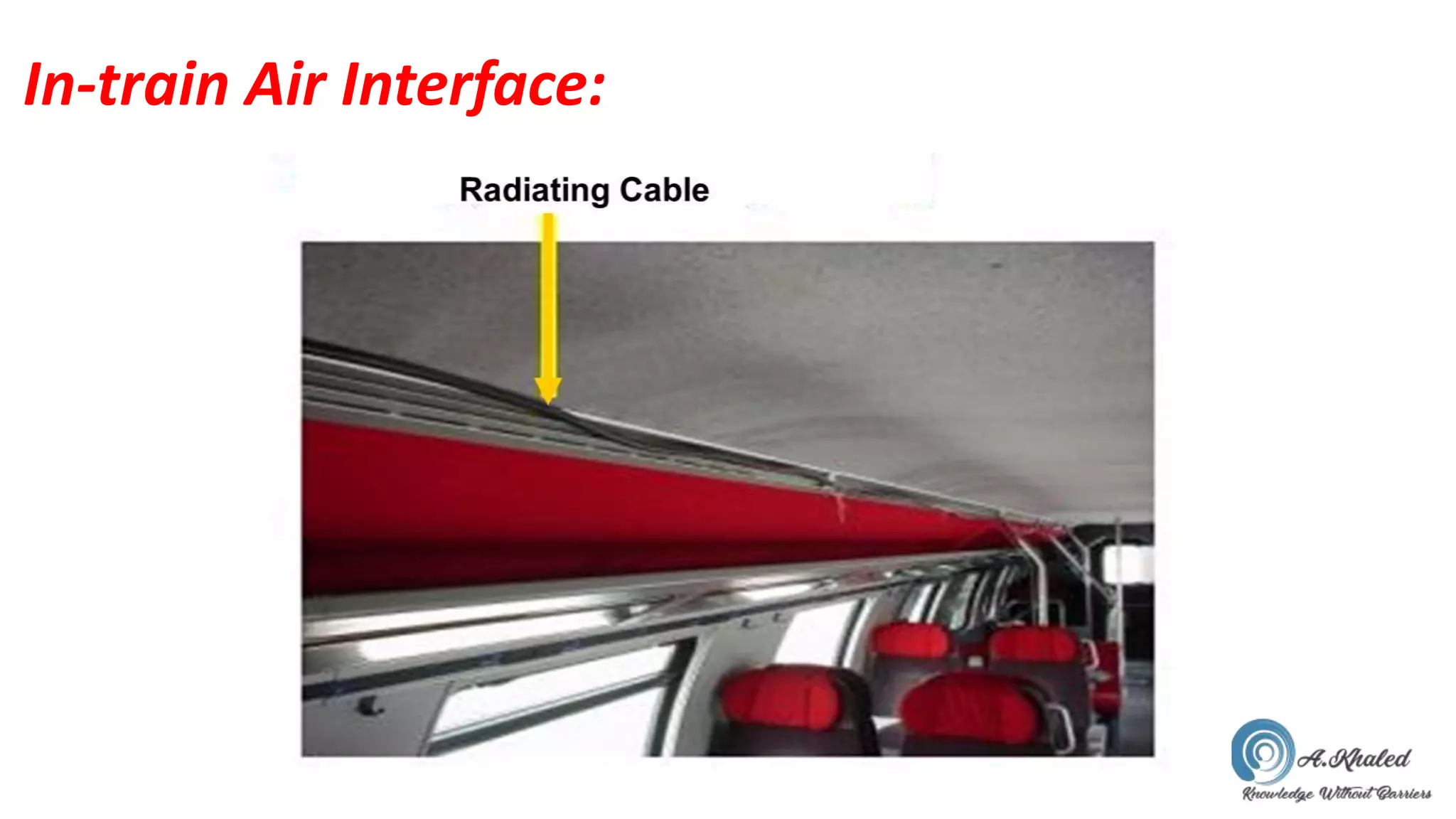
Train Coverage (In-train):
GSM-R Station:
In-train Air Interface:
GSM Frequency Bands:
System P-GSM 900 E-GSM 900
GSM(DCS)
1800
GSM(PCS) 1900
Uplink (𝑴𝑺 → 𝑩𝑺)
Downlink(𝑩𝑺 → 𝑴𝑺)
890 – 915MHz
935 – 960MHz
880 – 915MHz
925 - 960MHz
1710 – 1785MHz
1805 - 1880 MHz
1850 – 1910MHz
1930 - 1990MHz
Wavelength ≅ 𝟑𝟑 𝒄𝒎 ≅ 𝟑𝟑 𝒄𝒎 ≅ 𝟏𝟕 𝒄𝒎 ≅ 𝟏𝟔 𝒄𝒎
Bandwidth 25 MHz 35 MHz 75 MHz 60 MHz
Duplex distance 45 MHz 45 MHz 95 MHz 80 MHz
Carrier separation 200 kHz 200 kHz 200 kHz 200 kHz
No. of carriers 124 174 374 299
Channel rate 270.8 kbps 270.8 kbps 270.8 kbps 270.8 kbps
Channel Characteristics:
Channel
Characteristics
Multi-paths
Shadowing
Doppler
Shift
Delay
Spread
Distance
Path Loss
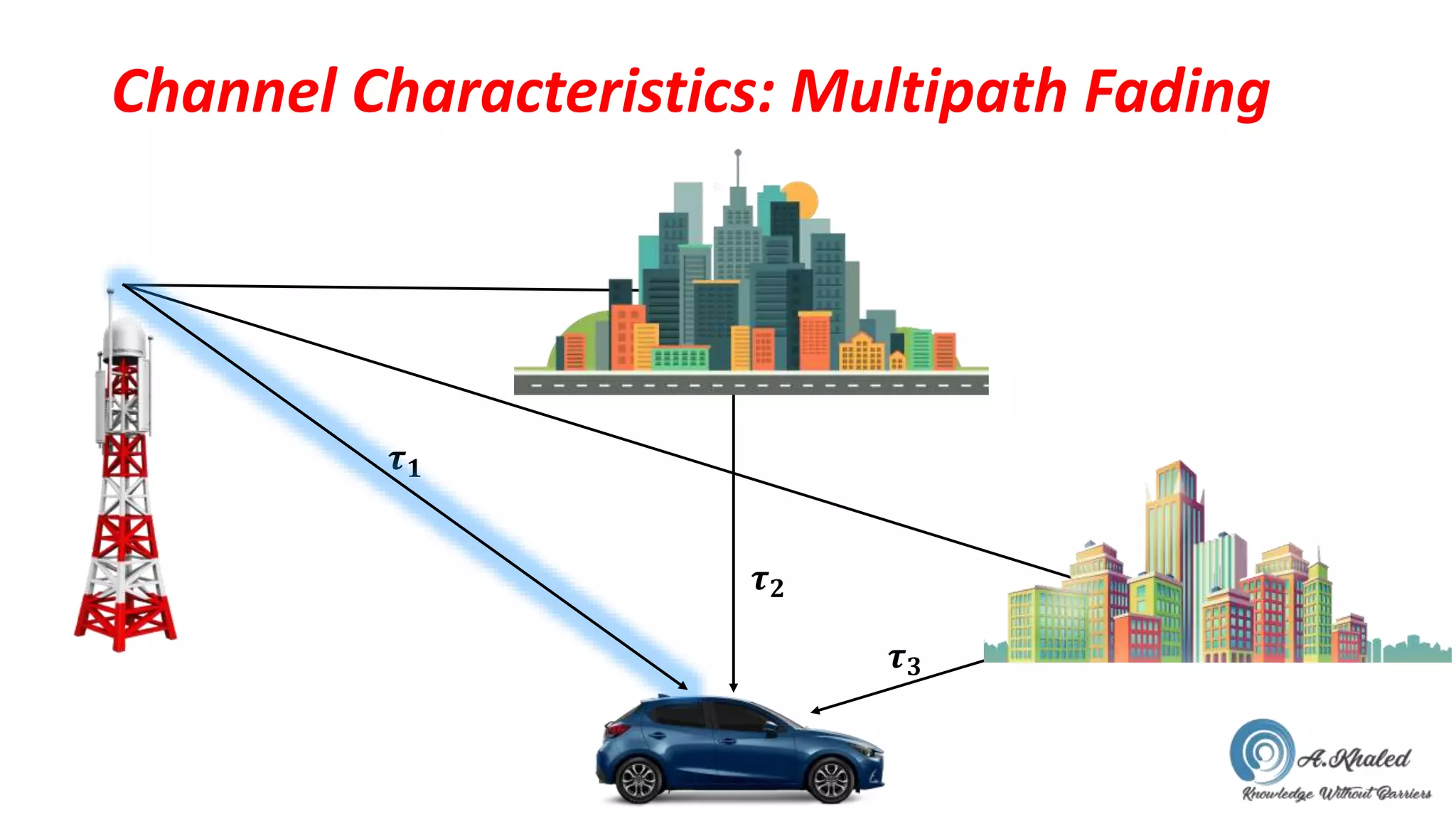
Channel Characteristics: Multipath Fading
𝝉 𝟏
𝝉 𝟐
𝝉 𝟑
Channel Characteristics: Multipath Fading
It gives a Rayleigh fading distribution.
Rayleigh fading is frequency selective.
Channel Characteristics: Multipath Fading
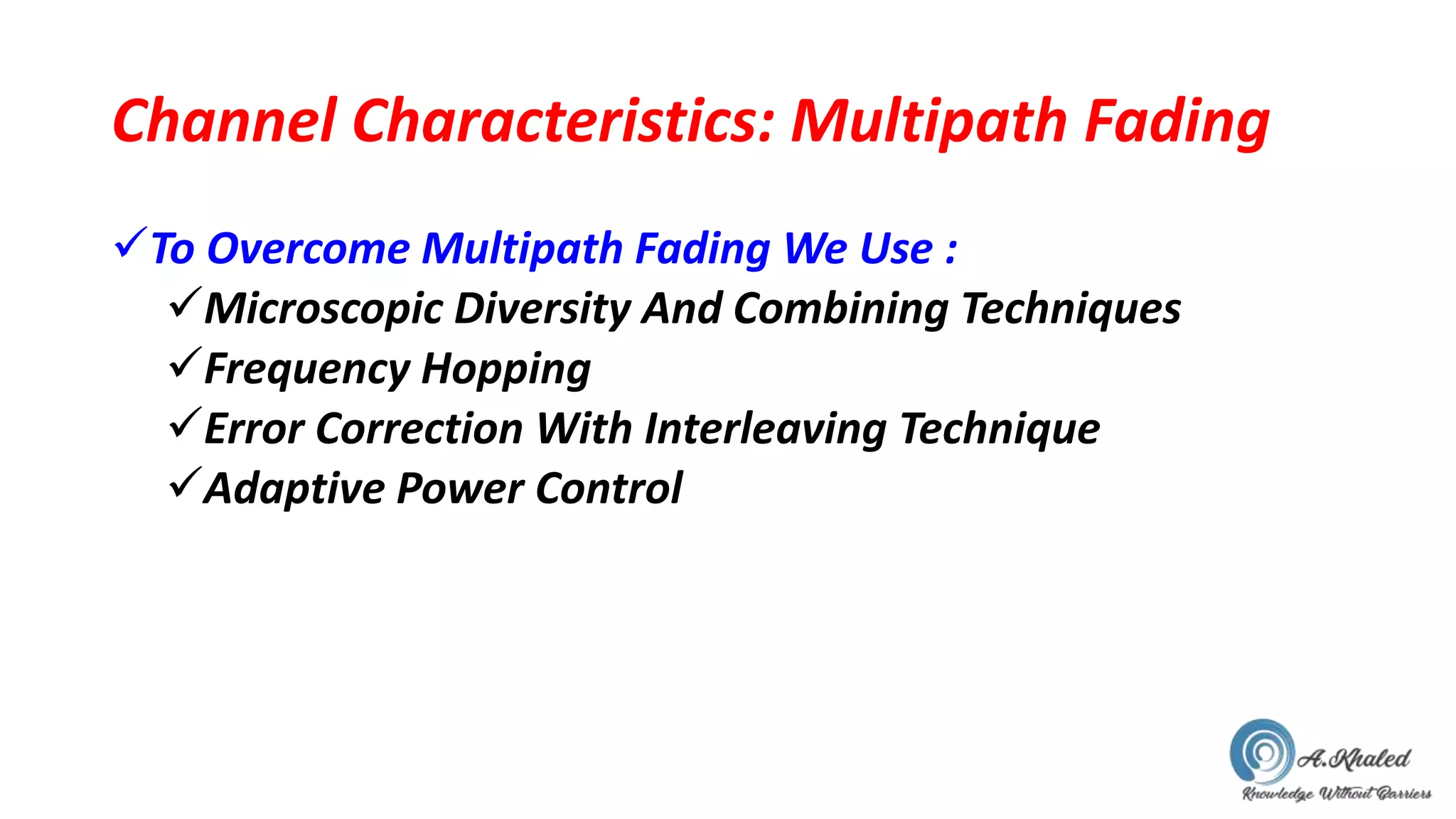
To Overcome Multipath Fading We Use :
Microscopic Diversity And Combining Techniques
Frequency Hopping
Error Correction With Interleaving Technique
Adaptive Power Control
Channel Characteristics: Multipath Fading
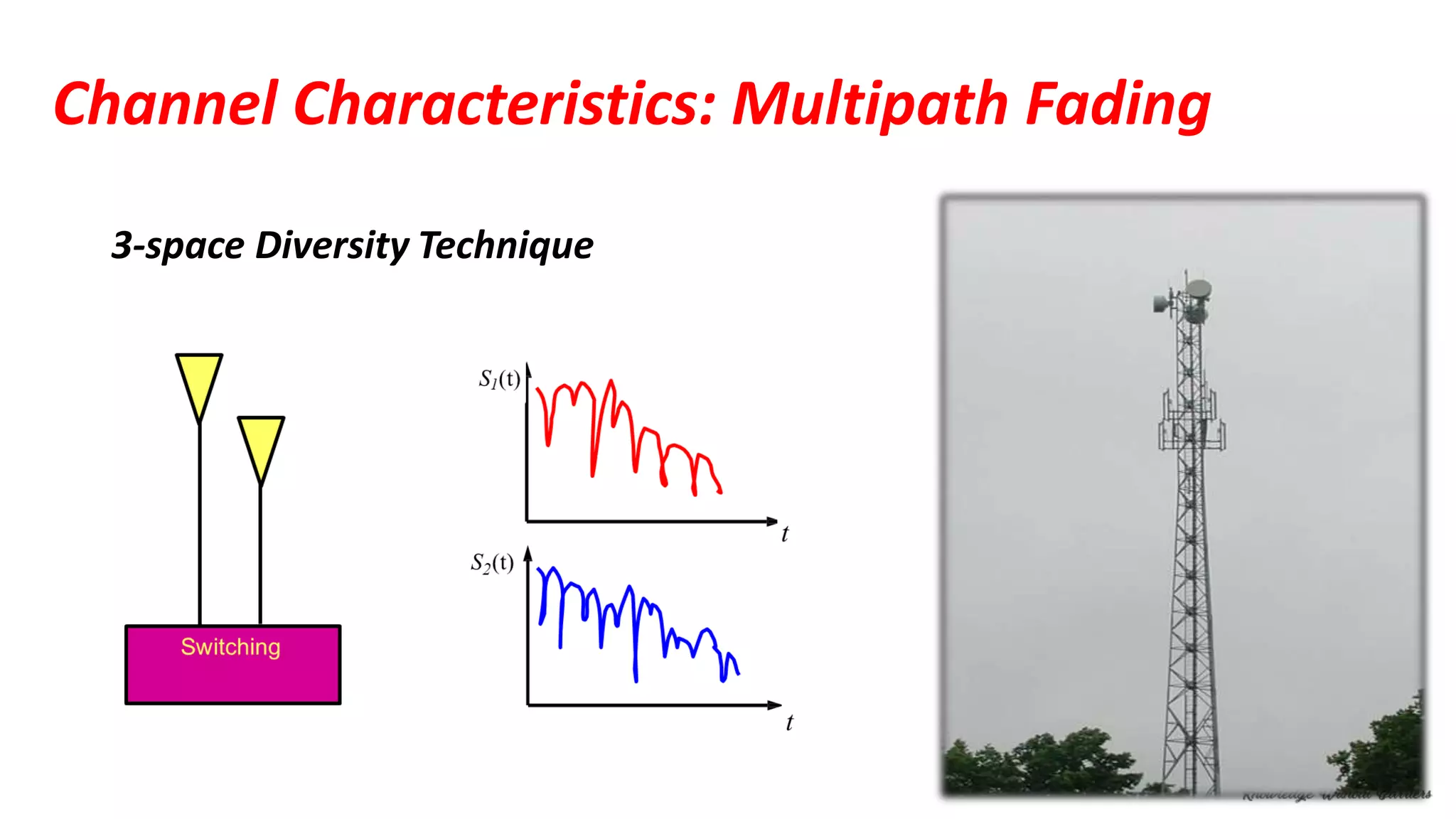
Microscopic diversity techniques :
1-Time diversity technique
2-Frequency diversity technique
Channel Characteristics: Multipath Fading
3-space Diversity Technique
Channel Characteristics: Multipath Fading
Frequency Hopping
Channel Characteristics: Shadow Fading
The signal is blocked by large structures.
The obstacles create shadowing (screening)
effect which decreases received signal strength.
This shadow is not due to multipath.
Slow fading.
Channel Characteristics: Doppler Shift
+Ve If The Mobile Moves Toward The BS
-Ve If The Mobile Moves Away From The BS
The Doppler Frequency Shift Should Be Compensated So That a
Correct Frequency Synchronization Is Achieved .
d y
v
𝜽
x
∆𝒍
Channel Characteristics: Doppler Shift
Channel Characteristics: Delay Spread (Time
dispersion)
Due To Multipath Fading
To Overcome This We Use Delay Equalizer
1 2 3 4 5 6
1 2 3 4 5 6
Path 2
Path 1
Channel Characteristics: Distance between
MS and BS
This makes Time alignment Problem
To overcome this system should respond to this delay
T1 T2 T3
A
B
A B
Channel Characteristics: Path loss
 Path loss
𝑷 𝒓𝒆𝒄𝒆𝒊𝒗𝒆𝒅 ∝
𝑷 𝒕𝒓𝒂𝒏𝒔𝒎𝒊𝒕𝒕𝒆𝒅
𝑹 𝜷
𝜷 = 𝟑 ∼ 𝟒
Signallevel(dB)
Distance
Channel Characteristics: Combined Signal
Losses
Rayleigh
fading
Path loss
Shadowing
Signal
level (dB)
Log d
TDMA in GSM:
Frequencies are divided into frames.
Each frame is divided into eight time slots.
Each mobile call is assigned a time slot.
Information transmitted in one time slot is a burst.
TDMA frame:
TDMA frame structure:
TDMA Frame Structure:
Frame Frame Frame
TS0 TS1 TS2 TS3 TS4 TS5 TS6 TS7
⋯⋯
TS0
Control Channels:
TS1 TS2 TS3 TS4 TS5 TS6 TS7
Broadcast
Carrier
Up-Link: RACH
Down-Link: BCCH, CBCH. FCCH, SCH
Up-Link & Down-Link: SDCCH. TCH or FACCH/SACCH.
TS0
Normal Burst:
TS1 TS2 TS3 TS4 TS5 TS6 TS7
3 57 data bits 1 1
26 bit training
sequence
57 data bits 8.253
Tail bits
InformationStealing
flags
Guard
Period
148 bits
156.25 bit
period
0: User information.
1: non-user information
(Control).
Bit−Period =
𝟏
𝟐𝟕𝟎 × 𝟏𝟎 𝟑
= 3.69 𝝁 𝒔𝒆𝒄
Channel Estimation
GSM Rate=𝟐𝟕𝟎 𝑲𝒃𝒑𝒔
TDMA frame structure:
-Bit rate of the radio carrier is 270.833 Kbps
-Bit duration =1/270833=3.69 µsec
-One time slot =148 +8.25 “guard”=156.25 bit duration
-Time slot duration =156.25x3.69 µsec= 0.577 msec
-Frame duration=0.577x8= 4.615 msec
TDMA frame structure:
Guard Period is used for :
burst alignment errors
time dispersion on the propagation path
Time required for smooth switch on-off in transmitter
The numbering scheme of the time slots is staggered by 3
time slots to remove necessity for MS to send and receive
in the same time
Types of channels:
Physical channels
Logic channels
Types of logic channels:
Traffic channels
Control channels
Types of Traffic channels:
1. Full rate
 13 Kbps data rate
2. Enhanced full rate
 12.2 Kbps data rate
3. Half rate
 Increase network capacity
13 kbps 9.8 kbps
12.2 kbps 10.6 kbps
5.8 kbps5.6 kbps
22.8 kbps
11.4 kbps
Data
Redundancy
Broadcast Control Channel.
Common Control Channel.
Dedicated Control Channel.
Types of control channels:
Control Channels
BCH
(Broadcast Channel)
(Down-Link)
BCCH
(Broadcast
Control
Channel)
1-Network
Name.
2-MCC (Mobile
country code)
3. MNC (Mobile
Network Code)
4-LAC (Location
Area Code)
5-CI (Cell
Identity)
6- Cell Max
Power.
7- Frequency
List of operator.
8- Periodic
Registration
Timer.
9-Niebour List.
FCCH
(Frequency
Correction
Channel)
1- Frequency
Synchronization
.
SCH
(Synchronizatio
n Channel)
1- Time
Synchroniz
ation
(Stream of
Zeros)
(It used to
inform the
MS the
Starting of
frame it
sends at
time slot 0
every 10
frames.)
2-frame
number
(FN)
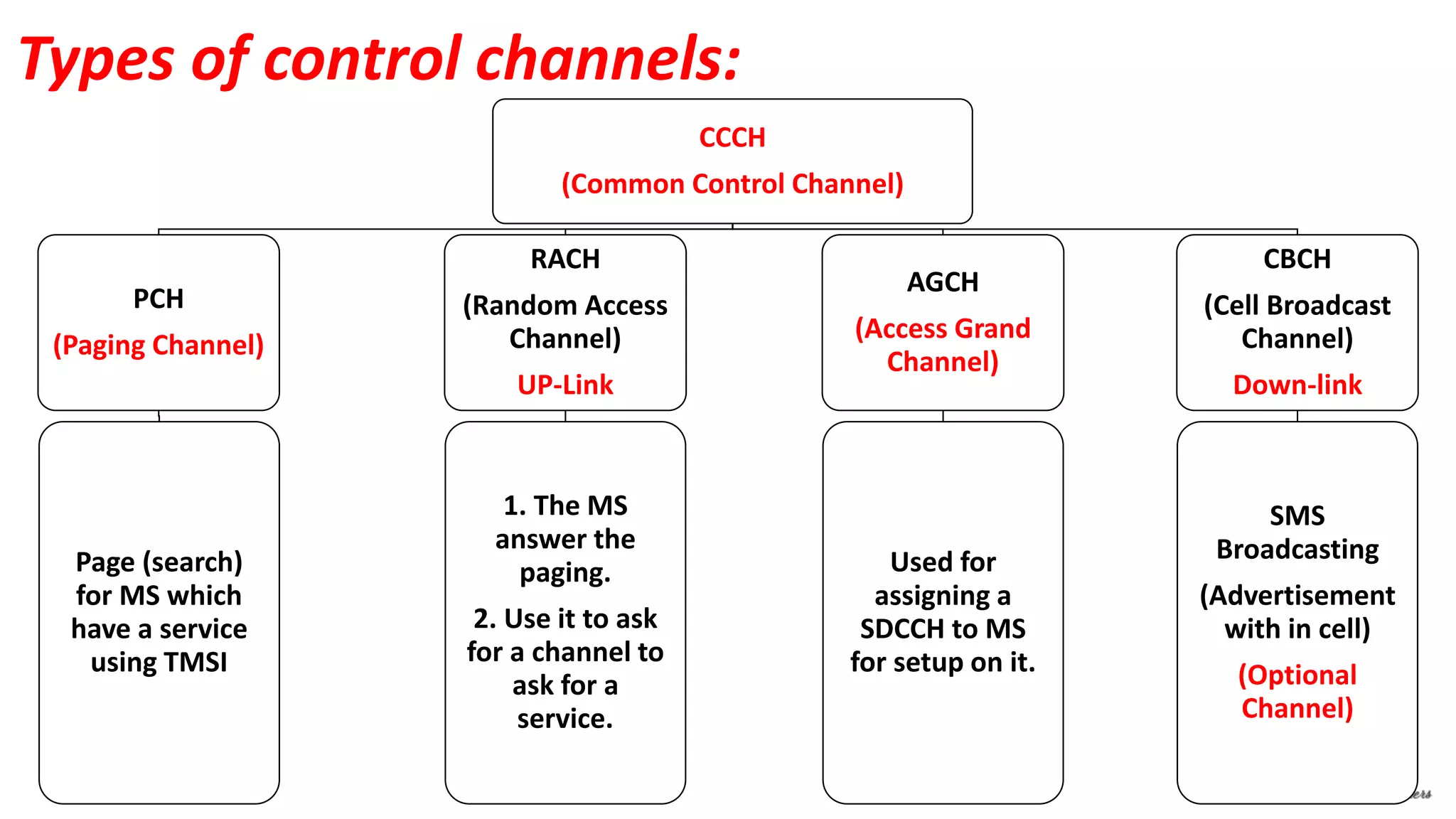
CCCH
(Common Control Channel)
PCH
(Paging Channel)
Page
(search)
for MS
which
have a
service
using
TMSI
RACH
(Random Access
Channel)
UP-Link
1. The MS
answer the
paging.
2. Use it to ask
for a channel to
ask for a service.
AGCH
(Access Grand
Channel)
Used for
assigning a
SDCCH to MS
for setup on it.
CBCH
(Cell Broadcast
Channel)
Down-link
SMS Broadcasting
(Advertisement
with in cell)
(Optional Channel)
DCCH
(Dedicated Control Channel)
UP-Link& Down-Link
SDCCH
(Standing a
lone Dedicated
Control
Channel)
1- Security Function
2- SMS (in ideal
mode)
SACCH
(Slow
Associated
Control
Channel)
1-Power
Control.
2- Timing
Advance
(Dedicated
mode)
FACCH
(Fast Associated
Control
Channel)
1-Hand Over
Types of control channels:
Control Channels
BCH
(Broadcast Channel)
(Down-Link)
CCCH
(Common Control Channel)
DCCH
(Dedicated Control Channel)
UP-Link& Down-Link
Types of control channels:
Control Channels
BCH
(Broadcast Channel)
(Down-Link)
BCCH
(Broadcast
Control
Channel)
1-Network
Name.
2-MCC (Mobile
country code)
3. MNC (Mobile
Network Code)
4-LAC (Location
Area Code)
5-CI (Cell
Identity)
6- Cell Max
Power.
7- Frequency
List of operator.
8- Periodic
Registration
Timer.
9-Niebour List.
FCCH
(Frequency
Correction
Channel)
1- Frequency
Synchronization
.
SCH
(Synchronizatio
n Channel)
1- Time
Synchroniz
ation
(Stream of
Zeros)
(It used to
inform the
MS the
Starting of
frame it
sends at
time slot 0
every 10
frames.)
2-frame
number
(FN)
CCCH
(Common Control Channel)
PCH
(Paging Channel)
Page
(search)
for MS
which
have a
service
using
TMSI
RACH
(Random Access
Channel)
UP-Link
1. The MS
answer the
paging.
2. Use it to ask
for a channel to
ask for a service.
AGCH
(Access Grand
Channel)
Used for
assigning a
SDCCH to MS
for setup on it.
CBCH
(Cell Broadcast
Channel)
Down-link
SMS Broadcasting
(Advertisement
with in cell)
(Optional Channel)
DCCH
(Dedicated Control Channel)
UP-Link& Down-Link
SDCCH
(Standing a
lone Dedicated
Control
Channel)
1- Security Function
2- SMS (in ideal
mode)
SACCH
(Slow
Associated
Control
Channel)
1-Power
Control.
2- Timing
Advance
(Dedicated
mode)
FACCH
(Fast Associated
Control
Channel)
1-Hand Over
Types of control channels:
BCH
(Broadcast Channel)
(Down-Link)
BCCH
(Broadcast Control
Channel)
1-Network Name.
2-MCC (Mobile country
code)
3. MNC (Mobile Network
Code)
4-LAC (Location Area
Code)
5-CI (Cell Identity)
6- Cell Max Power.
7- Frequency List of
operator.
8- Periodic Registration
Timer.
9-Niebour List.
FCCH
(Frequency
Correction Channel)
1- Frequency
Synchronization.
SCH
(Synchronization
Channel)
1- Time
Synchronization
(Stream of Zeros)
(It used to inform
the MS the
Starting of frame
it sends at time
slot 0 every 10
frames.)
2-frame number
(FN)
Types of control channels:
Control Channels
BCH
(Broadcast Channel)
(Down-Link)
BCCH
(Broadcast
Control
Channel)
1-Network
Name.
2-MCC (Mobile
country code)
3. MNC (Mobile
Network Code)
4-LAC (Location
Area Code)
5-CI (Cell
Identity)
6- Cell Max
Power.
7- Frequency
List of operator.
8- Periodic
Registration
Timer.
9-Niebour List.
FCCH
(Frequency
Correction
Channel)
1- Frequency
Synchronization
.
SCH
(Synchronizatio
n Channel)
1- Time
Synchroniz
ation
(Stream of
Zeros)
(It used to
inform the
MS the
Starting of
frame it
sends at
time slot 0
every 10
frames.)
2-frame
number
(FN)
CCCH
(Common Control Channel)
PCH
(Paging Channel)
Page
(search)
for MS
which
have a
service
using
TMSI
RACH
(Random Access
Channel)
UP-Link
1. The MS
answer the
paging.
2. Use it to ask
for a channel to
ask for a service.
AGCH
(Access Grand
Channel)
Used for
assigning a
SDCCH to MS
for setup on it.
CBCH
(Cell Broadcast
Channel)
Down-link
SMS Broadcasting
(Advertisement
with in cell)
(Optional Channel)
DCCH
(Dedicated Control Channel)
UP-Link& Down-Link
SDCCH
(Standing a
lone Dedicated
Control
Channel)
1- Security Function
2- SMS (in ideal
mode)
SACCH
(Slow
Associated
Control
Channel)
1-Power
Control.
2- Timing
Advance
(Dedicated
mode)
FACCH
(Fast Associated
Control
Channel)
1-Hand Over
Types of control channels:
CCCH
(Common Control Channel)
PCH
(Paging Channel)
Page (search)
for MS which
have a service
using TMSI
RACH
(Random Access
Channel)
UP-Link
1. The MS
answer the
paging.
2. Use it to ask
for a channel to
ask for a
service.
AGCH
(Access Grand
Channel)
Used for
assigning a
SDCCH to MS
for setup on it.
CBCH
(Cell Broadcast
Channel)
Down-link
SMS
Broadcasting
(Advertisement
with in cell)
(Optional
Channel)
Types of control channels:
Control Channels
BCH
(Broadcast Channel)
(Down-Link)
BCCH
(Broadcast
Control
Channel)
1-Network
Name.
2-MCC (Mobile
country code)
3. MNC (Mobile
Network Code)
4-LAC (Location
Area Code)
5-CI (Cell
Identity)
6- Cell Max
Power.
7- Frequency
List of operator.
8- Periodic
Registration
Timer.
9-Niebour List.
FCCH
(Frequency
Correction
Channel)
1- Frequency
Synchronization
.
SCH
(Synchronizatio
n Channel)
1- Time
Synchroniz
ation
(Stream of
Zeros)
(It used to
inform the
MS the
Starting of
frame it
sends at
time slot 0
every 10
frames.)
2-frame
number
(FN)
CCCH
(Common Control Channel)
PCH
(Paging Channel)
Page
(search)
for MS
which
have a
service
using
TMSI
RACH
(Random Access
Channel)
UP-Link
1. The MS
answer the
paging.
2. Use it to ask
for a channel to
ask for a service.
AGCH
(Access Grand
Channel)
Used for
assigning a
SDCCH to MS
for setup on it.
CBCH
(Cell Broadcast
Channel)
Down-link
SMS Broadcasting
(Advertisement
with in cell)
(Optional Channel)
DCCH
(Dedicated Control Channel)
UP-Link& Down-Link
SDCCH
(Standing a
lone Dedicated
Control
Channel)
1- Security Function
2- SMS (in ideal
mode)
SACCH
(Slow
Associated
Control
Channel)
1-Power
Control.
2- Timing
Advance
(Dedicated
mode)
FACCH
(Fast Associated
Control
Channel)
1-Hand Over
Types of control channels:
DCCH
(Dedicated Control Channel)
UP-Link& Down-Link
SDCCH
(Standing a lone Dedicated
Control Channel)
1- Security Function
2- SMS (in idle mode)
SACCH
(Slow Associated Control
Channel)
1-Power Control.
2- Timing Advance
(Dedicated mode)
FACCH
(Fast Associated Control
Channel)
1-Hand Over
Types of control channels:
Control Channels
BCH
(Broadcast Channel)
(Down-Link)
BCCH
(Broadcast
Control
Channel)
1-Network
Name.
2-MCC (Mobile
country code)
3. MNC (Mobile
Network Code)
4-LAC (Location
Area Code)
5-CI (Cell
Identity)
6- Cell Max
Power.
7- Frequency
List of operator.
8- Periodic
Registration
Timer.
9-Niebour List.
FCCH
(Frequency
Correction
Channel)
1- Frequency
Synchronization
.
SCH
(Synchronizatio
n Channel)
1- Time
Synchroniz
ation
(Stream of
Zeros)
(It used to
inform the
MS the
Starting of
frame it
sends at
time slot 0
every 10
frames.)
2-frame
number
(FN)
CCCH
(Common Control Channel)
PCH
(Paging Channel)
Page
(search)
for MS
which
have a
service
using
TMSI
RACH
(Random Access
Channel)
UP-Link
1. The MS
answer the
paging.
2. Use it to ask
for a channel to
ask for a service.
AGCH
(Access Grand
Channel)
Used for
assigning a
SDCCH to MS
for setup on it.
CBCH
(Cell Broadcast
Channel)
Down-link
SMS Broadcasting
(Advertisement
with in cell)
(Optional Channel)
DCCH
(Dedicated Control Channel)
UP-Link& Down-Link
SDCCH
(Standing a
lone Dedicated
Control
Channel)
1- Security Function
2- SMS (in ideal
mode)
SACCH
(Slow
Associated
Control
Channel)
1-Power
Control.
2- Timing
Advance
(Dedicated
mode)
FACCH
(Fast Associated
Control
Channel)
1-Hand Over
Types of control channels:
Common Control Channels (CCCHs):
Transfer control information between all MSs and BTS.
Necessary for call origination and paging.
Logical ch. Function BTS MS
Paging Channel
(PCH)
Downlink
 Alert the MS of an
incoming call
 Transmits paging
message to indicate an
incoming call
 The paging message
contains MS identity.
Listens to PCH regularly.
When identifies its
identity, it responds.
Random Access
CHannel (RACH)
Uplink
 Used by MS to request
access to the network.
 Receives request from MS
for a signaling channel.
 Answers paging
message on RACH by
requesting signaling
channel.
Access Grant
CHannel (AGCH)
Downlink
 Used by BS to inform
MS about the channel
to use.
 Assigns a SDCCH
signaling channel to
MS.
 Receives a signaling
channel assignment
SDCCH.
Dedicated Control Channels (DCCHs):
Carry messages between MS and network.
SDCCH is used for call setup, update, authentication
Logical ch. Function BTS MS
Stand-alone Dedicated
Control Channel
(SDCCH)
UL+DL
 Exchange signaling
information in uplink and
downlink.
 Switches to SDCCH.
 Call set-up is performed in
idle mode.
 BSC assigns a TCH.
 Switches to SDCCH.
 Call set up is performed.
 MS receives TCH assignment
[carrier + time slot]
Slow Associated
Control Channel
(SACCH)
UL+DL
 Conveys power control
and timing information in
downlink.
 Conveys link quality
reports in uplink.
 Instructs MS about:
 Transmit power
 Time advance.
 Sends measurements of its
BTS and neighboring BTSs
during a call.
Fast Associated
Control Channel
(FACCH)
UL+DL
 Steals TCH to carry
handover and channel
reassignment.
 Transmits handover
information.
 Transmits handover
request.
The Broadcast Channels (BCHs):
Is transmitted by BS all the time.
Monitored by MSs periodically (every 30 sec).
All BCHs are downlink.
Logical channel Function BTS MS
Frequency
Correction
Channel (FCCH)
 Supply MS with
reference freq.
 Transmits a carrier
frequency.
 Identifies BCCH carrier
 Synchronizes with the
frequency.
Synch.
Channel (SCH)
 For TDMA frame
synchronization .
 Transmits frame number
and BSIC.
 Synchronizes with frame
structure.
Broadcast
Control
Channel
(BCCH)
 Carries parameters
needed to identify and
access network.
 It is transmitted at
constant power at all
times and checked by
all MSs.
 Broadcasts cell
information such as:
LAI
 maximum output power
needed
 Receives LAI
 May update
 MS sets its output power
level.
Tail
Payload/Signaling Training sequence Payload/Signaling
Tail
Guard
PeriodTail
SCH-Data Extended Training sequence
Tail
SCH-Data
Tail
Guard
Period
Synchronization
Sequence
Data (RACH)
Tail
Guard Period
Tail
All Bits are coded with 0
Tail
Guard
Period
64 Bit 39 Bit39 Bit 8.25 Bit33
8 Bit 41 Bit 36 Bit 3 68.25 Bit
142 Bit3 3 8.25
3 57 Bit 57 Bit26 Bit1 1
Stealing Flags
3 8.25
Normal Burst:
Synchronization Burst:
Access Burst:
Frequency Correction Burst:
TCH Multi-frame:
The TCH multi-frame consists of 26 time-slots.
This multi-frame maps the following logical channels:
TCH.
SACCH.
FACCH.
TCH multi-frame structure:
T T T T T T T T T T T T S T T T T T T T T T T T T I
0 1 2 3 4 5 6 7 8 9 10 11 12 13 14 15 16 17 18 19 20 21 22 23 24 25
T: TCH S: SACCH I: Idle
FACCH: is not allocated slots in the multi-frame. It steals TCH slots when required.
Multi-frame:
The control channel multi-frame is formed of 51 timeslots.
CCH multi-frame maps the following logical channels:
Downlink:
 FCCH
 SCH
 BCCH
 CCCH (Combination of PCH and AGCH)
Uplink:
 RACH
F S BCCH CCCH F S CCCH CCCH F S CCCH CCCH F S CCCH CCCH F S CCCH CCCH I
RACH
Downlink
Uplink
0 1 2-5 6-9 10 11 12-15 16-19 20 21 22-25 26-29 5030 31 32-35 36-39 40 41 42-45 46-49
F: FCCH S: SCH I: Idle
0 1 2 3 4 5 6 7
Multi-frame:
Super-frame:
Hyper-frame:
1 Time-slot = 0.577 ms
1 frame = 8 Time-slots = 4.615 ms
1 Multi-frame =
26 TCH frames (120 ms)
Or
51 BCCH frames (235 ms)
1 Super-frame =
26 BCCH Multi-frames (6.12 s)
Or
51 TCH Multi-frames (6.12 s)
1 Hyper-frame =
2048 Super-frames
(3 hr 28 min 53.76 s)

GSM Air Interface

  • 1.
  • 2.
    GSM Bands: 0.8 0.91.0 1.1 1.6 1.7 1.8 1.9 2.0 GHz GSM 1800 GSM 1900 200 KHz Carrier n Carrier (n+1) frequency …
  • 3.
    Mobile Channels (links): Twocarriers make up the radio channel required for communication between the Mobile Station (MS) and Base Transceiver Station (BTS). There are two links in mobile communication: Up-Link (from mobile to BTS). Down-Link (from BTS to mobile).
  • 4.
  • 5.
  • 6.
  • 7.
    GSM Frequency Bands: SystemP-GSM 900 E-GSM 900 GSM(DCS) 1800 GSM(PCS) 1900 Uplink (𝑴𝑺 → 𝑩𝑺) Downlink(𝑩𝑺 → 𝑴𝑺) 890 – 915MHz 935 – 960MHz 880 – 915MHz 925 - 960MHz 1710 – 1785MHz 1805 - 1880 MHz 1850 – 1910MHz 1930 - 1990MHz Wavelength ≅ 𝟑𝟑 𝒄𝒎 ≅ 𝟑𝟑 𝒄𝒎 ≅ 𝟏𝟕 𝒄𝒎 ≅ 𝟏𝟔 𝒄𝒎 Bandwidth 25 MHz 35 MHz 75 MHz 60 MHz Duplex distance 45 MHz 45 MHz 95 MHz 80 MHz Carrier separation 200 kHz 200 kHz 200 kHz 200 kHz No. of carriers 124 174 374 299 Channel rate 270.8 kbps 270.8 kbps 270.8 kbps 270.8 kbps
  • 8.
  • 9.
    Channel Characteristics: MultipathFading 𝝉 𝟏 𝝉 𝟐 𝝉 𝟑
  • 10.
    Channel Characteristics: MultipathFading It gives a Rayleigh fading distribution. Rayleigh fading is frequency selective.
  • 11.
    Channel Characteristics: MultipathFading To Overcome Multipath Fading We Use : Microscopic Diversity And Combining Techniques Frequency Hopping Error Correction With Interleaving Technique Adaptive Power Control
  • 12.
    Channel Characteristics: MultipathFading Microscopic diversity techniques : 1-Time diversity technique 2-Frequency diversity technique
  • 13.
    Channel Characteristics: MultipathFading 3-space Diversity Technique
  • 14.
    Channel Characteristics: MultipathFading Frequency Hopping
  • 15.
    Channel Characteristics: ShadowFading The signal is blocked by large structures. The obstacles create shadowing (screening) effect which decreases received signal strength. This shadow is not due to multipath. Slow fading.
  • 16.
    Channel Characteristics: DopplerShift +Ve If The Mobile Moves Toward The BS -Ve If The Mobile Moves Away From The BS The Doppler Frequency Shift Should Be Compensated So That a Correct Frequency Synchronization Is Achieved . d y v 𝜽 x ∆𝒍
  • 17.
  • 18.
    Channel Characteristics: DelaySpread (Time dispersion) Due To Multipath Fading To Overcome This We Use Delay Equalizer 1 2 3 4 5 6 1 2 3 4 5 6 Path 2 Path 1
  • 19.
    Channel Characteristics: Distancebetween MS and BS This makes Time alignment Problem To overcome this system should respond to this delay T1 T2 T3 A B A B
  • 20.
    Channel Characteristics: Pathloss  Path loss 𝑷 𝒓𝒆𝒄𝒆𝒊𝒗𝒆𝒅 ∝ 𝑷 𝒕𝒓𝒂𝒏𝒔𝒎𝒊𝒕𝒕𝒆𝒅 𝑹 𝜷 𝜷 = 𝟑 ∼ 𝟒 Signallevel(dB) Distance
  • 21.
    Channel Characteristics: CombinedSignal Losses Rayleigh fading Path loss Shadowing Signal level (dB) Log d
  • 22.
    TDMA in GSM: Frequenciesare divided into frames. Each frame is divided into eight time slots. Each mobile call is assigned a time slot. Information transmitted in one time slot is a burst.
  • 23.
  • 24.
  • 25.
    TDMA Frame Structure: FrameFrame Frame TS0 TS1 TS2 TS3 TS4 TS5 TS6 TS7 ⋯⋯
  • 26.
    TS0 Control Channels: TS1 TS2TS3 TS4 TS5 TS6 TS7 Broadcast Carrier Up-Link: RACH Down-Link: BCCH, CBCH. FCCH, SCH Up-Link & Down-Link: SDCCH. TCH or FACCH/SACCH.
  • 27.
    TS0 Normal Burst: TS1 TS2TS3 TS4 TS5 TS6 TS7 3 57 data bits 1 1 26 bit training sequence 57 data bits 8.253 Tail bits InformationStealing flags Guard Period 148 bits 156.25 bit period 0: User information. 1: non-user information (Control). Bit−Period = 𝟏 𝟐𝟕𝟎 × 𝟏𝟎 𝟑 = 3.69 𝝁 𝒔𝒆𝒄 Channel Estimation GSM Rate=𝟐𝟕𝟎 𝑲𝒃𝒑𝒔
  • 28.
    TDMA frame structure: -Bitrate of the radio carrier is 270.833 Kbps -Bit duration =1/270833=3.69 µsec -One time slot =148 +8.25 “guard”=156.25 bit duration -Time slot duration =156.25x3.69 µsec= 0.577 msec -Frame duration=0.577x8= 4.615 msec
  • 29.
    TDMA frame structure: GuardPeriod is used for : burst alignment errors time dispersion on the propagation path Time required for smooth switch on-off in transmitter The numbering scheme of the time slots is staggered by 3 time slots to remove necessity for MS to send and receive in the same time
  • 30.
    Types of channels: Physicalchannels Logic channels
  • 31.
    Types of logicchannels: Traffic channels Control channels
  • 32.
    Types of Trafficchannels: 1. Full rate  13 Kbps data rate 2. Enhanced full rate  12.2 Kbps data rate 3. Half rate  Increase network capacity 13 kbps 9.8 kbps 12.2 kbps 10.6 kbps 5.8 kbps5.6 kbps 22.8 kbps 11.4 kbps Data Redundancy
  • 33.
    Broadcast Control Channel. CommonControl Channel. Dedicated Control Channel. Types of control channels:
  • 34.
    Control Channels BCH (Broadcast Channel) (Down-Link) BCCH (Broadcast Control Channel) 1-Network Name. 2-MCC(Mobile country code) 3. MNC (Mobile Network Code) 4-LAC (Location Area Code) 5-CI (Cell Identity) 6- Cell Max Power. 7- Frequency List of operator. 8- Periodic Registration Timer. 9-Niebour List. FCCH (Frequency Correction Channel) 1- Frequency Synchronization . SCH (Synchronizatio n Channel) 1- Time Synchroniz ation (Stream of Zeros) (It used to inform the MS the Starting of frame it sends at time slot 0 every 10 frames.) 2-frame number (FN) CCCH (Common Control Channel) PCH (Paging Channel) Page (search) for MS which have a service using TMSI RACH (Random Access Channel) UP-Link 1. The MS answer the paging. 2. Use it to ask for a channel to ask for a service. AGCH (Access Grand Channel) Used for assigning a SDCCH to MS for setup on it. CBCH (Cell Broadcast Channel) Down-link SMS Broadcasting (Advertisement with in cell) (Optional Channel) DCCH (Dedicated Control Channel) UP-Link& Down-Link SDCCH (Standing a lone Dedicated Control Channel) 1- Security Function 2- SMS (in ideal mode) SACCH (Slow Associated Control Channel) 1-Power Control. 2- Timing Advance (Dedicated mode) FACCH (Fast Associated Control Channel) 1-Hand Over Types of control channels:
  • 35.
    Control Channels BCH (Broadcast Channel) (Down-Link) CCCH (CommonControl Channel) DCCH (Dedicated Control Channel) UP-Link& Down-Link Types of control channels:
  • 36.
    Control Channels BCH (Broadcast Channel) (Down-Link) BCCH (Broadcast Control Channel) 1-Network Name. 2-MCC(Mobile country code) 3. MNC (Mobile Network Code) 4-LAC (Location Area Code) 5-CI (Cell Identity) 6- Cell Max Power. 7- Frequency List of operator. 8- Periodic Registration Timer. 9-Niebour List. FCCH (Frequency Correction Channel) 1- Frequency Synchronization . SCH (Synchronizatio n Channel) 1- Time Synchroniz ation (Stream of Zeros) (It used to inform the MS the Starting of frame it sends at time slot 0 every 10 frames.) 2-frame number (FN) CCCH (Common Control Channel) PCH (Paging Channel) Page (search) for MS which have a service using TMSI RACH (Random Access Channel) UP-Link 1. The MS answer the paging. 2. Use it to ask for a channel to ask for a service. AGCH (Access Grand Channel) Used for assigning a SDCCH to MS for setup on it. CBCH (Cell Broadcast Channel) Down-link SMS Broadcasting (Advertisement with in cell) (Optional Channel) DCCH (Dedicated Control Channel) UP-Link& Down-Link SDCCH (Standing a lone Dedicated Control Channel) 1- Security Function 2- SMS (in ideal mode) SACCH (Slow Associated Control Channel) 1-Power Control. 2- Timing Advance (Dedicated mode) FACCH (Fast Associated Control Channel) 1-Hand Over Types of control channels:
  • 37.
    BCH (Broadcast Channel) (Down-Link) BCCH (Broadcast Control Channel) 1-NetworkName. 2-MCC (Mobile country code) 3. MNC (Mobile Network Code) 4-LAC (Location Area Code) 5-CI (Cell Identity) 6- Cell Max Power. 7- Frequency List of operator. 8- Periodic Registration Timer. 9-Niebour List. FCCH (Frequency Correction Channel) 1- Frequency Synchronization. SCH (Synchronization Channel) 1- Time Synchronization (Stream of Zeros) (It used to inform the MS the Starting of frame it sends at time slot 0 every 10 frames.) 2-frame number (FN) Types of control channels:
  • 38.
    Control Channels BCH (Broadcast Channel) (Down-Link) BCCH (Broadcast Control Channel) 1-Network Name. 2-MCC(Mobile country code) 3. MNC (Mobile Network Code) 4-LAC (Location Area Code) 5-CI (Cell Identity) 6- Cell Max Power. 7- Frequency List of operator. 8- Periodic Registration Timer. 9-Niebour List. FCCH (Frequency Correction Channel) 1- Frequency Synchronization . SCH (Synchronizatio n Channel) 1- Time Synchroniz ation (Stream of Zeros) (It used to inform the MS the Starting of frame it sends at time slot 0 every 10 frames.) 2-frame number (FN) CCCH (Common Control Channel) PCH (Paging Channel) Page (search) for MS which have a service using TMSI RACH (Random Access Channel) UP-Link 1. The MS answer the paging. 2. Use it to ask for a channel to ask for a service. AGCH (Access Grand Channel) Used for assigning a SDCCH to MS for setup on it. CBCH (Cell Broadcast Channel) Down-link SMS Broadcasting (Advertisement with in cell) (Optional Channel) DCCH (Dedicated Control Channel) UP-Link& Down-Link SDCCH (Standing a lone Dedicated Control Channel) 1- Security Function 2- SMS (in ideal mode) SACCH (Slow Associated Control Channel) 1-Power Control. 2- Timing Advance (Dedicated mode) FACCH (Fast Associated Control Channel) 1-Hand Over Types of control channels:
  • 39.
    CCCH (Common Control Channel) PCH (PagingChannel) Page (search) for MS which have a service using TMSI RACH (Random Access Channel) UP-Link 1. The MS answer the paging. 2. Use it to ask for a channel to ask for a service. AGCH (Access Grand Channel) Used for assigning a SDCCH to MS for setup on it. CBCH (Cell Broadcast Channel) Down-link SMS Broadcasting (Advertisement with in cell) (Optional Channel) Types of control channels:
  • 40.
    Control Channels BCH (Broadcast Channel) (Down-Link) BCCH (Broadcast Control Channel) 1-Network Name. 2-MCC(Mobile country code) 3. MNC (Mobile Network Code) 4-LAC (Location Area Code) 5-CI (Cell Identity) 6- Cell Max Power. 7- Frequency List of operator. 8- Periodic Registration Timer. 9-Niebour List. FCCH (Frequency Correction Channel) 1- Frequency Synchronization . SCH (Synchronizatio n Channel) 1- Time Synchroniz ation (Stream of Zeros) (It used to inform the MS the Starting of frame it sends at time slot 0 every 10 frames.) 2-frame number (FN) CCCH (Common Control Channel) PCH (Paging Channel) Page (search) for MS which have a service using TMSI RACH (Random Access Channel) UP-Link 1. The MS answer the paging. 2. Use it to ask for a channel to ask for a service. AGCH (Access Grand Channel) Used for assigning a SDCCH to MS for setup on it. CBCH (Cell Broadcast Channel) Down-link SMS Broadcasting (Advertisement with in cell) (Optional Channel) DCCH (Dedicated Control Channel) UP-Link& Down-Link SDCCH (Standing a lone Dedicated Control Channel) 1- Security Function 2- SMS (in ideal mode) SACCH (Slow Associated Control Channel) 1-Power Control. 2- Timing Advance (Dedicated mode) FACCH (Fast Associated Control Channel) 1-Hand Over Types of control channels:
  • 41.
    DCCH (Dedicated Control Channel) UP-Link&Down-Link SDCCH (Standing a lone Dedicated Control Channel) 1- Security Function 2- SMS (in idle mode) SACCH (Slow Associated Control Channel) 1-Power Control. 2- Timing Advance (Dedicated mode) FACCH (Fast Associated Control Channel) 1-Hand Over Types of control channels:
  • 42.
    Control Channels BCH (Broadcast Channel) (Down-Link) BCCH (Broadcast Control Channel) 1-Network Name. 2-MCC(Mobile country code) 3. MNC (Mobile Network Code) 4-LAC (Location Area Code) 5-CI (Cell Identity) 6- Cell Max Power. 7- Frequency List of operator. 8- Periodic Registration Timer. 9-Niebour List. FCCH (Frequency Correction Channel) 1- Frequency Synchronization . SCH (Synchronizatio n Channel) 1- Time Synchroniz ation (Stream of Zeros) (It used to inform the MS the Starting of frame it sends at time slot 0 every 10 frames.) 2-frame number (FN) CCCH (Common Control Channel) PCH (Paging Channel) Page (search) for MS which have a service using TMSI RACH (Random Access Channel) UP-Link 1. The MS answer the paging. 2. Use it to ask for a channel to ask for a service. AGCH (Access Grand Channel) Used for assigning a SDCCH to MS for setup on it. CBCH (Cell Broadcast Channel) Down-link SMS Broadcasting (Advertisement with in cell) (Optional Channel) DCCH (Dedicated Control Channel) UP-Link& Down-Link SDCCH (Standing a lone Dedicated Control Channel) 1- Security Function 2- SMS (in ideal mode) SACCH (Slow Associated Control Channel) 1-Power Control. 2- Timing Advance (Dedicated mode) FACCH (Fast Associated Control Channel) 1-Hand Over Types of control channels:
  • 43.
    Common Control Channels(CCCHs): Transfer control information between all MSs and BTS. Necessary for call origination and paging. Logical ch. Function BTS MS Paging Channel (PCH) Downlink  Alert the MS of an incoming call  Transmits paging message to indicate an incoming call  The paging message contains MS identity. Listens to PCH regularly. When identifies its identity, it responds. Random Access CHannel (RACH) Uplink  Used by MS to request access to the network.  Receives request from MS for a signaling channel.  Answers paging message on RACH by requesting signaling channel. Access Grant CHannel (AGCH) Downlink  Used by BS to inform MS about the channel to use.  Assigns a SDCCH signaling channel to MS.  Receives a signaling channel assignment SDCCH.
  • 44.
    Dedicated Control Channels(DCCHs): Carry messages between MS and network. SDCCH is used for call setup, update, authentication Logical ch. Function BTS MS Stand-alone Dedicated Control Channel (SDCCH) UL+DL  Exchange signaling information in uplink and downlink.  Switches to SDCCH.  Call set-up is performed in idle mode.  BSC assigns a TCH.  Switches to SDCCH.  Call set up is performed.  MS receives TCH assignment [carrier + time slot] Slow Associated Control Channel (SACCH) UL+DL  Conveys power control and timing information in downlink.  Conveys link quality reports in uplink.  Instructs MS about:  Transmit power  Time advance.  Sends measurements of its BTS and neighboring BTSs during a call. Fast Associated Control Channel (FACCH) UL+DL  Steals TCH to carry handover and channel reassignment.  Transmits handover information.  Transmits handover request.
  • 45.
    The Broadcast Channels(BCHs): Is transmitted by BS all the time. Monitored by MSs periodically (every 30 sec). All BCHs are downlink. Logical channel Function BTS MS Frequency Correction Channel (FCCH)  Supply MS with reference freq.  Transmits a carrier frequency.  Identifies BCCH carrier  Synchronizes with the frequency. Synch. Channel (SCH)  For TDMA frame synchronization .  Transmits frame number and BSIC.  Synchronizes with frame structure. Broadcast Control Channel (BCCH)  Carries parameters needed to identify and access network.  It is transmitted at constant power at all times and checked by all MSs.  Broadcasts cell information such as: LAI  maximum output power needed  Receives LAI  May update  MS sets its output power level.
  • 46.
    Tail Payload/Signaling Training sequencePayload/Signaling Tail Guard PeriodTail SCH-Data Extended Training sequence Tail SCH-Data Tail Guard Period Synchronization Sequence Data (RACH) Tail Guard Period Tail All Bits are coded with 0 Tail Guard Period 64 Bit 39 Bit39 Bit 8.25 Bit33 8 Bit 41 Bit 36 Bit 3 68.25 Bit 142 Bit3 3 8.25 3 57 Bit 57 Bit26 Bit1 1 Stealing Flags 3 8.25 Normal Burst: Synchronization Burst: Access Burst: Frequency Correction Burst:
  • 47.
    TCH Multi-frame: The TCHmulti-frame consists of 26 time-slots. This multi-frame maps the following logical channels: TCH. SACCH. FACCH. TCH multi-frame structure: T T T T T T T T T T T T S T T T T T T T T T T T T I 0 1 2 3 4 5 6 7 8 9 10 11 12 13 14 15 16 17 18 19 20 21 22 23 24 25 T: TCH S: SACCH I: Idle FACCH: is not allocated slots in the multi-frame. It steals TCH slots when required.
  • 48.
    Multi-frame: The control channelmulti-frame is formed of 51 timeslots. CCH multi-frame maps the following logical channels: Downlink:  FCCH  SCH  BCCH  CCCH (Combination of PCH and AGCH) Uplink:  RACH F S BCCH CCCH F S CCCH CCCH F S CCCH CCCH F S CCCH CCCH F S CCCH CCCH I RACH Downlink Uplink 0 1 2-5 6-9 10 11 12-15 16-19 20 21 22-25 26-29 5030 31 32-35 36-39 40 41 42-45 46-49 F: FCCH S: SCH I: Idle
  • 49.
    0 1 23 4 5 6 7 Multi-frame: Super-frame: Hyper-frame: 1 Time-slot = 0.577 ms 1 frame = 8 Time-slots = 4.615 ms 1 Multi-frame = 26 TCH frames (120 ms) Or 51 BCCH frames (235 ms) 1 Super-frame = 26 BCCH Multi-frames (6.12 s) Or 51 TCH Multi-frames (6.12 s) 1 Hyper-frame = 2048 Super-frames (3 hr 28 min 53.76 s)