AIR INTERFACE
By:
Eng WALEED EL SHAFAI
AIR INTERFACE
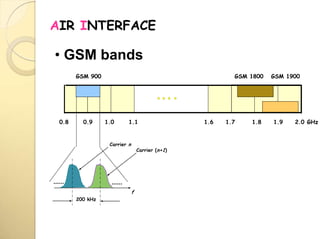
GSM 900
0.8 0.9 1.0 1.1 1.6 1.7 1.8 1.9 2.0 GHz
GSM 1800 GSM 1900
200 kHz
f
Carrier n
Carrier (n+1)
• GSM bands
AIR INTERFACE
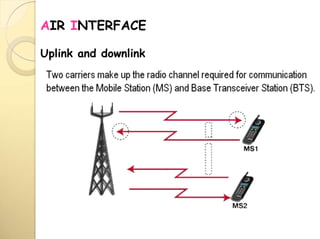
Uplink and downlink
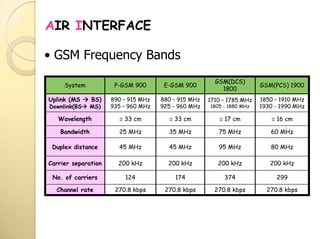
• GSM Frequency Bands
System P-GSM 900 E-GSM 900
GSM(DCS)
1800
GSM(PCS) 1900
Uplink (MS  BS)
Downlink(BS MS)
890 – 915 MHz
935 – 960 MHz
880 – 915 MHz
925 - 960 MHz
1710 – 1785 MHz
1805 - 1880 MHz
1850 – 1910 MHz
1930 - 1990 MHz
Wavelength  33 cm  33 cm  17 cm  16 cm
Bandwidth 25 MHz 35 MHz 75 MHz 60 MHz
Duplex distance 45 MHz 45 MHz 95 MHz 80 MHz
Carrier separation 200 kHz 200 kHz 200 kHz 200 kHz
No. of carriers 124 174 374 299
Channel rate 270.8 kbps 270.8 kbps 270.8 kbps 270.8 kbps
AIR INTERFACE
AIR INTERFACE
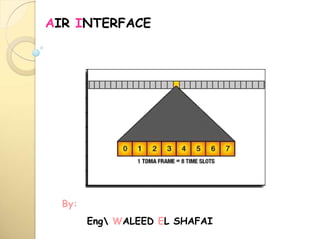
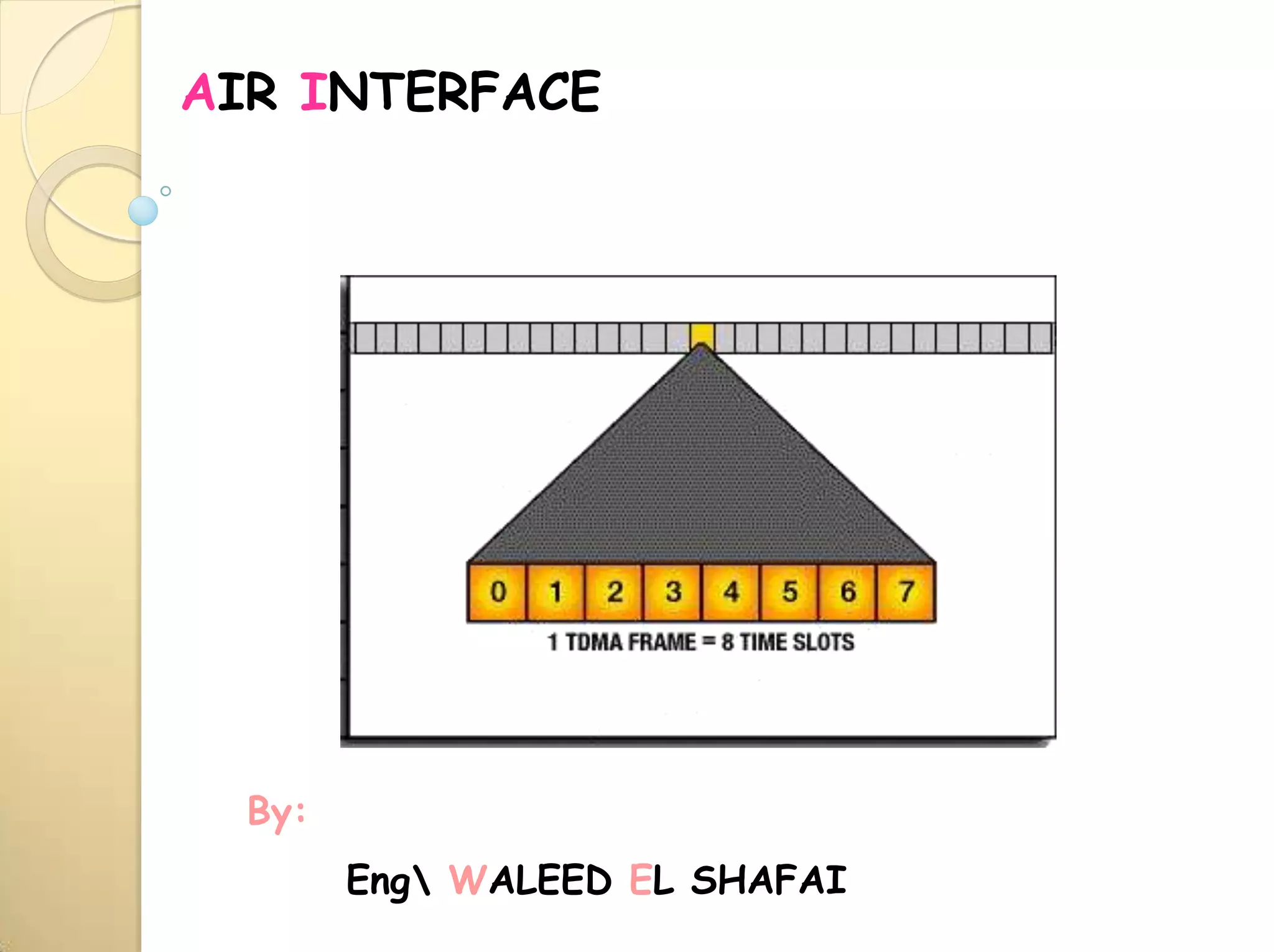
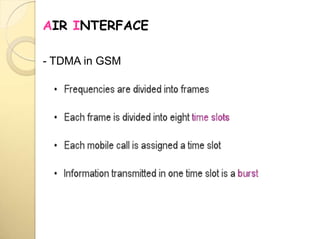
- TDMA in GSM
AIR INTERFACE
• TDMA frame
AIR INTERFACE
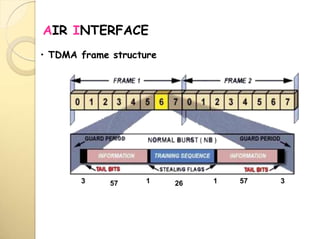
• TDMA frame structure
3113 57 5726
AIR INTERFACE
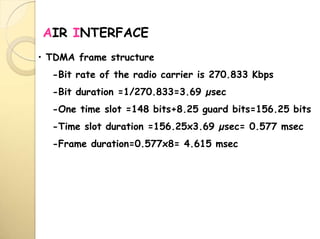
• TDMA frame structure
-Bit rate of the radio carrier is 270.833 Kbps
-Bit duration =1/270.833=3.69 µsec
-One time slot =148 bits+8.25 guard bits=156.25 bits
-Time slot duration =156.25x3.69 µsec= 0.577 msec
-Frame duration=0.577x8= 4.615 msec
AIR INTERFACE
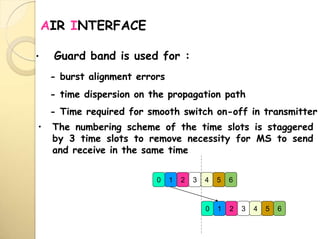
• Guard band is used for :
- burst alignment errors
- time dispersion on the propagation path
- Time required for smooth switch on-off in transmitter
1 2 3
• The numbering scheme of the time slots is staggered
by 3 time slots to remove necessity for MS to send
and receive in the same time
4 5 6
1 2 3 4 5 60
0
AIR INTERFACE
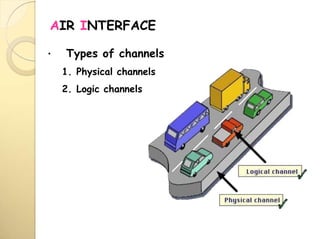
• Types of channels
1. Physical channels
2. Logic channels
AIR INTERFACE
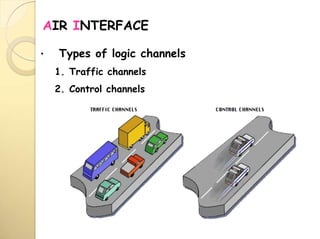
• Types of logic channels
1. Traffic channels
2. Control channels
AIR INTERFACE
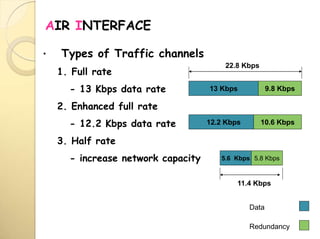
• Types of Traffic channels
1. Full rate
- 13 Kbps data rate
2. Enhanced full rate
- 12.2 Kbps data rate
3. Half rate
- increase network capacity
13 Kbps 9.8 Kbps
12.2 Kbps 10.6 Kbps
5.6 Kbps 5.8 Kbps
11.4 Kbps
22.8 Kbps
Data
Redundancy
AIR INTERFACE
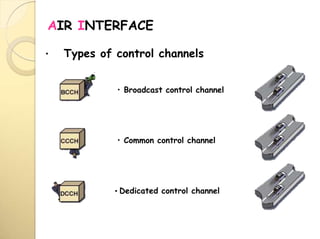
• Types of control channels
• Broadcast control channel
• Dedicated control channel
• Common control channel
AIR INTERFACE
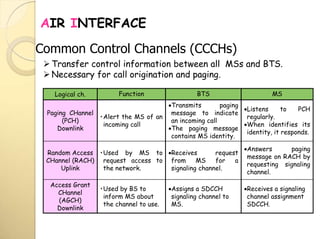
Common Control Channels (CCCHs)
 Transfer control information between all MSs and BTS.
 Necessary for call origination and paging.
Logical ch. Function BTS MS
Paging CHannel
(PCH)
Downlink
•Alert the MS of an
incoming call
Transmits paging
message to indicate
an incoming call
The paging message
contains MS identity.
Listens to PCH
regularly.
When identifies its
identity, it responds.
Random Access
CHannel (RACH)
Uplink
•Used by MS to
request access to
the network.
Receives request
from MS for a
signaling channel.
Answers paging
message on RACH by
requesting signaling
channel.
Access Grant
CHannel
(AGCH)
Downlink
•Used by BS to
inform MS about
the channel to use.
Assigns a SDCCH
signaling channel to
MS.
Receives a signaling
channel assignment
SDCCH.
AIR INTERFACE
Dedicated Control Channels (DCCHs)
Carry messages between MS and network.
SDCCH is used for call setup, update, authentication
Logical ch. Function BTS MS
Stand-alone
Dedicated Control
Channel (SDCCH)
UL+DL
•Exchange signaling
information in uplink
and downlink.
Switches to SDCCH.
Call set-up is
performed in idle
mode.
BSC assigns a TCH.
Switches to SDCCH.
Call set up is performed.
MS receives TCH
assignment [carrier +
time slot]
Slow Associated
Control Channel
(SACCH)
UL+DL
•Conveys power control
and timing information
in downlink.
•Conveys link quality
reports in uplink.
Instructs MS about:
Transmit power
Time advance.
Sends measurements of
its BTS and neighboring
BTSs during a call.
Fast Associated
Control Channel
(FACCH)
UL+DL
•Steals TCH to carry
handover and channel
reassignment.
Transmits handover
information.
Transmits handover
request..
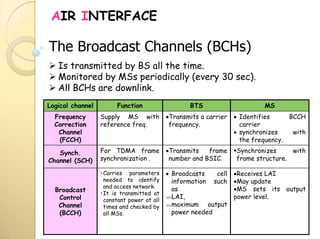
The Broadcast Channels (BCHs)
 Is transmitted by BS all the time.
 Monitored by MSs periodically (every 30 sec).
 All BCHs are downlink.
Logical channel Function BTS MS
Frequency
Correction
Channel
(FCCH)
Supply MS with
reference freq.
Transmits a carrier
frequency.
 Identifies BCCH
carrier
 synchronizes with
the frequency.
Synch.
Channel (SCH)
For TDMA frame
synchronization .
Transmits frame
number and BSIC.
Synchronizes with
frame structure.
Broadcast
Control
Channel
(BCCH)
•Carries parameters
needed to identify
and access network.
•It is transmitted at
constant power at all
times and checked by
all MSs.
 Broadcasts cell
information such
as
LAI,
maximum output
power needed
Receives LAI
May update
MS sets its output
power level.
AIR INTERFACE
AIR INTERFACE
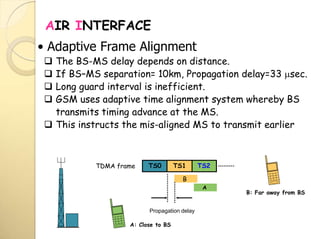
• Adaptive Frame Alignment
 The BS-MS delay depends on distance.
 If BS–MS separation= 10km, Propagation delay=33 sec.
 Long guard interval is inefficient.
 GSM uses adaptive time alignment system whereby BS
transmits timing advance at the MS.
 This instructs the mis-aligned MS to transmit earlier
TDMA frame
Propagation delay
TS0 TS2TS1
B: Far away from BS
B
A
A: Close to BS
AIR INTERFACE
 Rayleigh fading is frequency-selective.
 BS&MS hop from one frequency to other.
 Frequency hopping is optional.
 Rate of hopping =1/4.615msec=217 hop/sec.
Slow Frequency Hopping

Ch3 air interface

  • 1.
  • 2.
    AIR INTERFACE GSM 900 0.80.9 1.0 1.1 1.6 1.7 1.8 1.9 2.0 GHz GSM 1800 GSM 1900 200 kHz f Carrier n Carrier (n+1) • GSM bands
  • 3.
  • 4.
    • GSM FrequencyBands System P-GSM 900 E-GSM 900 GSM(DCS) 1800 GSM(PCS) 1900 Uplink (MS  BS) Downlink(BS MS) 890 – 915 MHz 935 – 960 MHz 880 – 915 MHz 925 - 960 MHz 1710 – 1785 MHz 1805 - 1880 MHz 1850 – 1910 MHz 1930 - 1990 MHz Wavelength  33 cm  33 cm  17 cm  16 cm Bandwidth 25 MHz 35 MHz 75 MHz 60 MHz Duplex distance 45 MHz 45 MHz 95 MHz 80 MHz Carrier separation 200 kHz 200 kHz 200 kHz 200 kHz No. of carriers 124 174 374 299 Channel rate 270.8 kbps 270.8 kbps 270.8 kbps 270.8 kbps AIR INTERFACE
  • 5.
  • 6.
  • 7.
    AIR INTERFACE • TDMAframe structure 3113 57 5726
  • 8.
    AIR INTERFACE • TDMAframe structure -Bit rate of the radio carrier is 270.833 Kbps -Bit duration =1/270.833=3.69 µsec -One time slot =148 bits+8.25 guard bits=156.25 bits -Time slot duration =156.25x3.69 µsec= 0.577 msec -Frame duration=0.577x8= 4.615 msec
  • 9.
    AIR INTERFACE • Guardband is used for : - burst alignment errors - time dispersion on the propagation path - Time required for smooth switch on-off in transmitter 1 2 3 • The numbering scheme of the time slots is staggered by 3 time slots to remove necessity for MS to send and receive in the same time 4 5 6 1 2 3 4 5 60 0
  • 10.
    AIR INTERFACE • Typesof channels 1. Physical channels 2. Logic channels
  • 11.
    AIR INTERFACE • Typesof logic channels 1. Traffic channels 2. Control channels
  • 12.
    AIR INTERFACE • Typesof Traffic channels 1. Full rate - 13 Kbps data rate 2. Enhanced full rate - 12.2 Kbps data rate 3. Half rate - increase network capacity 13 Kbps 9.8 Kbps 12.2 Kbps 10.6 Kbps 5.6 Kbps 5.8 Kbps 11.4 Kbps 22.8 Kbps Data Redundancy
  • 13.
    AIR INTERFACE • Typesof control channels • Broadcast control channel • Dedicated control channel • Common control channel
  • 14.
    AIR INTERFACE Common ControlChannels (CCCHs)  Transfer control information between all MSs and BTS.  Necessary for call origination and paging. Logical ch. Function BTS MS Paging CHannel (PCH) Downlink •Alert the MS of an incoming call Transmits paging message to indicate an incoming call The paging message contains MS identity. Listens to PCH regularly. When identifies its identity, it responds. Random Access CHannel (RACH) Uplink •Used by MS to request access to the network. Receives request from MS for a signaling channel. Answers paging message on RACH by requesting signaling channel. Access Grant CHannel (AGCH) Downlink •Used by BS to inform MS about the channel to use. Assigns a SDCCH signaling channel to MS. Receives a signaling channel assignment SDCCH.
  • 15.
    AIR INTERFACE Dedicated ControlChannels (DCCHs) Carry messages between MS and network. SDCCH is used for call setup, update, authentication Logical ch. Function BTS MS Stand-alone Dedicated Control Channel (SDCCH) UL+DL •Exchange signaling information in uplink and downlink. Switches to SDCCH. Call set-up is performed in idle mode. BSC assigns a TCH. Switches to SDCCH. Call set up is performed. MS receives TCH assignment [carrier + time slot] Slow Associated Control Channel (SACCH) UL+DL •Conveys power control and timing information in downlink. •Conveys link quality reports in uplink. Instructs MS about: Transmit power Time advance. Sends measurements of its BTS and neighboring BTSs during a call. Fast Associated Control Channel (FACCH) UL+DL •Steals TCH to carry handover and channel reassignment. Transmits handover information. Transmits handover request..
  • 16.
    The Broadcast Channels(BCHs)  Is transmitted by BS all the time.  Monitored by MSs periodically (every 30 sec).  All BCHs are downlink. Logical channel Function BTS MS Frequency Correction Channel (FCCH) Supply MS with reference freq. Transmits a carrier frequency.  Identifies BCCH carrier  synchronizes with the frequency. Synch. Channel (SCH) For TDMA frame synchronization . Transmits frame number and BSIC. Synchronizes with frame structure. Broadcast Control Channel (BCCH) •Carries parameters needed to identify and access network. •It is transmitted at constant power at all times and checked by all MSs.  Broadcasts cell information such as LAI, maximum output power needed Receives LAI May update MS sets its output power level. AIR INTERFACE
  • 17.
    AIR INTERFACE • AdaptiveFrame Alignment  The BS-MS delay depends on distance.  If BS–MS separation= 10km, Propagation delay=33 sec.  Long guard interval is inefficient.  GSM uses adaptive time alignment system whereby BS transmits timing advance at the MS.  This instructs the mis-aligned MS to transmit earlier TDMA frame Propagation delay TS0 TS2TS1 B: Far away from BS B A A: Close to BS
  • 18.
    AIR INTERFACE  Rayleighfading is frequency-selective.  BS&MS hop from one frequency to other.  Frequency hopping is optional.  Rate of hopping =1/4.615msec=217 hop/sec. Slow Frequency Hopping