McGraw-Hill ©The McGraw-Hill Companies, Inc., 2004
Chapter 21
Unicast and Multicast
Routing:
Routing Protocols
McGraw-Hill ©The McGraw-Hill Companies, Inc., 2004
21.1 Unicast Routing
Metric
Interior and Exterior Routing
McGraw-Hill ©The McGraw-Hill Companies, Inc., 2004
Figure 21.1 Unicasting
McGraw-Hill ©The McGraw-Hill Companies, Inc., 2004
In unicast routing, the router forwards
the received packet through only one
of its ports.
Note:
McGraw-Hill ©The McGraw-Hill Companies, Inc., 2004
21.2 Unicast Routing Protocols
RIP
OSPF
BGP
McGraw-Hill ©The McGraw-Hill Companies, Inc., 2004
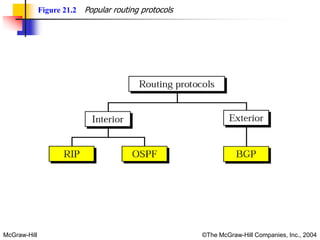
Figure 21.2 Popular routing protocols
McGraw-Hill ©The McGraw-Hill Companies, Inc., 2004
Figure 21.3 Autonomous systems
McGraw-Hill ©The McGraw-Hill Companies, Inc., 2004
Table 21.1 A distance vector routing table
Destination
Hop
Count
Next
Router
Other information
163.5.0.0 7 172.6.23.4
197.5.13.0 5 176.3.6.17
189.45.0.0 4 200.5.1.6
115.0.0.0 6 131.4.7.19
McGraw-Hill ©The McGraw-Hill Companies, Inc., 2004
Receive: a response RIP message
1. Add one hop to the hop count for each advertised destination.
2. Repeat the following steps for each advertised destination:
1. If (destination not in the routing table)
1. Add the advertised information to the table.
2. Else
1. If (next-hop field is the same)
1. Replace entry in the table with the advertised one.
2. Else
1. If (advertised hop count smaller than one in the table)
1. Replace entry in the routing table.
3. Return.
RIP Updating Algorithm
McGraw-Hill ©The McGraw-Hill Companies, Inc., 2004
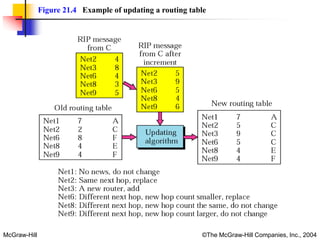
Figure 21.4 Example of updating a routing table
McGraw-Hill ©The McGraw-Hill Companies, Inc., 2004
Figure 21.5 Initial routing tables in a small autonomous system
McGraw-Hill ©The McGraw-Hill Companies, Inc., 2004
Figure 21.6 Final routing tables for Figure 21.5
McGraw-Hill ©The McGraw-Hill Companies, Inc., 2004
Figure 21.7 Areas in an autonomous system
McGraw-Hill ©The McGraw-Hill Companies, Inc., 2004
Figure 21.8 Types of links
McGraw-Hill ©The McGraw-Hill Companies, Inc., 2004
Figure 21.9 Point-to-point link
McGraw-Hill ©The McGraw-Hill Companies, Inc., 2004
Figure 21.10 Transient link
McGraw-Hill ©The McGraw-Hill Companies, Inc., 2004
Figure 21.11 Stub link
McGraw-Hill ©The McGraw-Hill Companies, Inc., 2004
Figure 21.12 Example of an internet
McGraw-Hill ©The McGraw-Hill Companies, Inc., 2004
Figure 21.13 Graphical representation of an internet
McGraw-Hill ©The McGraw-Hill Companies, Inc., 2004
Figure 21.14 Types of LSAs
McGraw-Hill ©The McGraw-Hill Companies, Inc., 2004
Figure 21.15 Router link
McGraw-Hill ©The McGraw-Hill Companies, Inc., 2004
Figure 21.16 Network link
McGraw-Hill ©The McGraw-Hill Companies, Inc., 2004
Figure 21.17 Summary link to network
McGraw-Hill ©The McGraw-Hill Companies, Inc., 2004
Figure 21.18 Summary link to AS boundary router
McGraw-Hill ©The McGraw-Hill Companies, Inc., 2004
Figure 21.19 External link
McGraw-Hill ©The McGraw-Hill Companies, Inc., 2004
In OSPF, all routers have the same
link state database.
Note:
McGraw-Hill ©The McGraw-Hill Companies, Inc., 2004
1. Start with the local node (router): the root of the tree.
2. Assign a cost of 0 to this node and make it the first permanent node.
3. Examine each neighbor node of the node that was the last permanent node.
4. Assign a cumulative cost to each node and make it tentative.
5. Among the list of tentative nodes
1. Find the node with the smallest cumulative cost and make it permanent.
2. If a node can be reached from more than one direction
1. Select the direction with the shortest cumulative cost.
6. Repeat steps 3 to 5 until every node becomes permanent.
Dijkstra Algorithm
McGraw-Hill ©The McGraw-Hill Companies, Inc., 2004
Figure 21.20 Shortest-path calculation
McGraw-Hill ©The McGraw-Hill Companies, Inc., 2004
Table 21.2 Link state routing table for router A
Network Cost Next Router Other Information
N1 5 C
N2 7 D
N3 10 B
N4 11 D
N5 15 C
McGraw-Hill ©The McGraw-Hill Companies, Inc., 2004
Table 21.3 Path vector routing table
Network Next Router Path
N01 R01 AS14, AS23, AS67
N02 R05 AS22, AS67, AS05, AS89
N03 R06 AS67, AS89, AS09, AS34
N04 R12 AS62, AS02, AS09
McGraw-Hill ©The McGraw-Hill Companies, Inc., 2004
Figure 21.21 Path vector messages
McGraw-Hill ©The McGraw-Hill Companies, Inc., 2004
Figure 21.22 Types of BGP messages
McGraw-Hill ©The McGraw-Hill Companies, Inc., 2004
21.3 Multicast Routing
IGMP
Multicast Trees
MBONE
McGraw-Hill ©The McGraw-Hill Companies, Inc., 2004
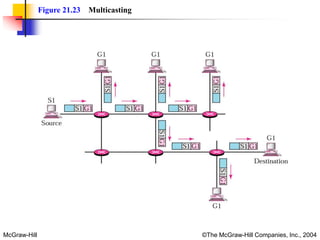
Figure 21.23 Multicasting
McGraw-Hill ©The McGraw-Hill Companies, Inc., 2004
In multicast routing, the router may
forward the received packet through
several of its ports.
Note:
McGraw-Hill ©The McGraw-Hill Companies, Inc., 2004
IGMP is a group management
protocol. It helps a multicast router
create and update a list of loyal
members related to each router
interface.
Note:
McGraw-Hill ©The McGraw-Hill Companies, Inc., 2004
Figure 21.24 IGMP message types
McGraw-Hill ©The McGraw-Hill Companies, Inc., 2004
Figure 21.25 IGMP message format
McGraw-Hill ©The McGraw-Hill Companies, Inc., 2004
Table 21.4 IGMP type field
Type Value
General or special query 0x11 or 00010001
Membership report 0x16 or 00010110
Leave report 0x17 or 00010111
McGraw-Hill ©The McGraw-Hill Companies, Inc., 2004
Figure 21.26 IGMP operation
McGraw-Hill ©The McGraw-Hill Companies, Inc., 2004
Figure 21.27 Membership report
McGraw-Hill ©The McGraw-Hill Companies, Inc., 2004
In IGMP, a membership report is sent
twice, one after the other.
Note:
McGraw-Hill ©The McGraw-Hill Companies, Inc., 2004
Figure 21.28 Leave report
No Response
McGraw-Hill ©The McGraw-Hill Companies, Inc., 2004
The general query message does not
define a particular group.
Note:
McGraw-Hill ©The McGraw-Hill Companies, Inc., 2004
Figure 21.29 General query message
No Response
McGraw-Hill ©The McGraw-Hill Companies, Inc., 2004
Example 1
Imagine there are three hosts in a network, as shown in Figure
21.30 (below). A query message was received at time 0; the random
delay time (in tenths of seconds) for each group is shown next to
the group address. Show the sequence of report messages.
McGraw-Hill ©The McGraw-Hill Companies, Inc., 2004
Solution
The events occur in this sequence:
1. Time 12. The timer for 228.42.0.0 in host A expires and a membership
report is sent, which is received by the router and every host including host
B which cancels its timer for 228.42.0.0.
2. Time 30. The timer for 225.14.0.0 in host A expires and a membership
report is sent, which is received by the router and every host including host
C which cancels its timer for 225.14.0.0.
3. Time 50. The timer for 251.71.0.0 in host B expires and a membership
report is sent, which is received by the router and every host.
4. Time 70. The timer for 230.43.0.0 in host C expires and a membership
report is sent, which is received by the router and every host including host
A which cancels its timer for 230.43.0.0.
McGraw-Hill ©The McGraw-Hill Companies, Inc., 2004
In a source-based tree approach, the
combination of source and group
determines the tree.
Note:
McGraw-Hill ©The McGraw-Hill Companies, Inc., 2004
In the group-shared tree approach, the
group determines the tree.
Note:
McGraw-Hill ©The McGraw-Hill Companies, Inc., 2004
Figure 21.31 Logical tunneling
McGraw-Hill ©The McGraw-Hill Companies, Inc., 2004
Figure 21.32 MBONE
McGraw-Hill ©The McGraw-Hill Companies, Inc., 2004
21.4 Multicast Routing Protocols
DVMRP
MOSPF
CBT
PIM
McGraw-Hill ©The McGraw-Hill Companies, Inc., 2004
Figure 21.33 Multicast routing protocols
McGraw-Hill ©The McGraw-Hill Companies, Inc., 2004
Figure 21.34 Reverse path forwarding
McGraw-Hill ©The McGraw-Hill Companies, Inc., 2004
In reverse path forwarding, the router
forwards only the packets that have
traveled the shortest path from the
source to the router; all other copies
are discarded. RPF prevents the
formation of loops.
Note:
McGraw-Hill ©The McGraw-Hill Companies, Inc., 2004
Figure 21.35 RPF versus RPB
McGraw-Hill ©The McGraw-Hill Companies, Inc., 2004
RPB creates a shortest-path broadcast
tree from the source to each
destination.
It guarantees that each destination
receives one and only one copy of the
packet.
Note:
McGraw-Hill ©The McGraw-Hill Companies, Inc., 2004
Figure 21.36 RPF, RPB, and RPM
McGraw-Hill ©The McGraw-Hill Companies, Inc., 2004
RPM adds pruning and grafting to
RPB to create a multicast shortest-
path tree that supports dynamic
membership changes.
Note:
McGraw-Hill ©The McGraw-Hill Companies, Inc., 2004
Figure 21.35 RPF versus RPB
McGraw-Hill ©The McGraw-Hill Companies, Inc., 2004
Figure 21.37 Unicast tree and multicast tree
McGraw-Hill ©The McGraw-Hill Companies, Inc., 2004
Figure 21.38 Shared-group tree with rendezvous router
McGraw-Hill ©The McGraw-Hill Companies, Inc., 2004
Figure 21.39 Sending a multicast packet to the rendezvous router
McGraw-Hill ©The McGraw-Hill Companies, Inc., 2004
In CBT, the source sends the multicast
packet to the core router. The core
router decapsulates the packet and
forwards it to all interested hosts.
Note:
McGraw-Hill ©The McGraw-Hill Companies, Inc., 2004
PIM-DM uses RPF and pruning and
grafting strategies to handle
multicasting. However, it is
independent of the underlying unicast
protocol.
Note:
McGraw-Hill ©The McGraw-Hill Companies, Inc., 2004
PIM-SM is similar to CBT but uses a
simpler procedure.
Note:

Ch 21

  • 1.
    McGraw-Hill ©The McGraw-HillCompanies, Inc., 2004 Chapter 21 Unicast and Multicast Routing: Routing Protocols
  • 2.
    McGraw-Hill ©The McGraw-HillCompanies, Inc., 2004 21.1 Unicast Routing Metric Interior and Exterior Routing
  • 3.
    McGraw-Hill ©The McGraw-HillCompanies, Inc., 2004 Figure 21.1 Unicasting
  • 4.
    McGraw-Hill ©The McGraw-HillCompanies, Inc., 2004 In unicast routing, the router forwards the received packet through only one of its ports. Note:
  • 5.
    McGraw-Hill ©The McGraw-HillCompanies, Inc., 2004 21.2 Unicast Routing Protocols RIP OSPF BGP
  • 6.
    McGraw-Hill ©The McGraw-HillCompanies, Inc., 2004 Figure 21.2 Popular routing protocols
  • 7.
    McGraw-Hill ©The McGraw-HillCompanies, Inc., 2004 Figure 21.3 Autonomous systems
  • 8.
    McGraw-Hill ©The McGraw-HillCompanies, Inc., 2004 Table 21.1 A distance vector routing table Destination Hop Count Next Router Other information 163.5.0.0 7 172.6.23.4 197.5.13.0 5 176.3.6.17 189.45.0.0 4 200.5.1.6 115.0.0.0 6 131.4.7.19
  • 9.
    McGraw-Hill ©The McGraw-HillCompanies, Inc., 2004 Receive: a response RIP message 1. Add one hop to the hop count for each advertised destination. 2. Repeat the following steps for each advertised destination: 1. If (destination not in the routing table) 1. Add the advertised information to the table. 2. Else 1. If (next-hop field is the same) 1. Replace entry in the table with the advertised one. 2. Else 1. If (advertised hop count smaller than one in the table) 1. Replace entry in the routing table. 3. Return. RIP Updating Algorithm
  • 10.
    McGraw-Hill ©The McGraw-HillCompanies, Inc., 2004 Figure 21.4 Example of updating a routing table
  • 11.
    McGraw-Hill ©The McGraw-HillCompanies, Inc., 2004 Figure 21.5 Initial routing tables in a small autonomous system
  • 12.
    McGraw-Hill ©The McGraw-HillCompanies, Inc., 2004 Figure 21.6 Final routing tables for Figure 21.5
  • 13.
    McGraw-Hill ©The McGraw-HillCompanies, Inc., 2004 Figure 21.7 Areas in an autonomous system
  • 14.
    McGraw-Hill ©The McGraw-HillCompanies, Inc., 2004 Figure 21.8 Types of links
  • 15.
    McGraw-Hill ©The McGraw-HillCompanies, Inc., 2004 Figure 21.9 Point-to-point link
  • 16.
    McGraw-Hill ©The McGraw-HillCompanies, Inc., 2004 Figure 21.10 Transient link
  • 17.
    McGraw-Hill ©The McGraw-HillCompanies, Inc., 2004 Figure 21.11 Stub link
  • 18.
    McGraw-Hill ©The McGraw-HillCompanies, Inc., 2004 Figure 21.12 Example of an internet
  • 19.
    McGraw-Hill ©The McGraw-HillCompanies, Inc., 2004 Figure 21.13 Graphical representation of an internet
  • 20.
    McGraw-Hill ©The McGraw-HillCompanies, Inc., 2004 Figure 21.14 Types of LSAs
  • 21.
    McGraw-Hill ©The McGraw-HillCompanies, Inc., 2004 Figure 21.15 Router link
  • 22.
    McGraw-Hill ©The McGraw-HillCompanies, Inc., 2004 Figure 21.16 Network link
  • 23.
    McGraw-Hill ©The McGraw-HillCompanies, Inc., 2004 Figure 21.17 Summary link to network
  • 24.
    McGraw-Hill ©The McGraw-HillCompanies, Inc., 2004 Figure 21.18 Summary link to AS boundary router
  • 25.
    McGraw-Hill ©The McGraw-HillCompanies, Inc., 2004 Figure 21.19 External link
  • 26.
    McGraw-Hill ©The McGraw-HillCompanies, Inc., 2004 In OSPF, all routers have the same link state database. Note:
  • 27.
    McGraw-Hill ©The McGraw-HillCompanies, Inc., 2004 1. Start with the local node (router): the root of the tree. 2. Assign a cost of 0 to this node and make it the first permanent node. 3. Examine each neighbor node of the node that was the last permanent node. 4. Assign a cumulative cost to each node and make it tentative. 5. Among the list of tentative nodes 1. Find the node with the smallest cumulative cost and make it permanent. 2. If a node can be reached from more than one direction 1. Select the direction with the shortest cumulative cost. 6. Repeat steps 3 to 5 until every node becomes permanent. Dijkstra Algorithm
  • 28.
    McGraw-Hill ©The McGraw-HillCompanies, Inc., 2004 Figure 21.20 Shortest-path calculation
  • 29.
    McGraw-Hill ©The McGraw-HillCompanies, Inc., 2004 Table 21.2 Link state routing table for router A Network Cost Next Router Other Information N1 5 C N2 7 D N3 10 B N4 11 D N5 15 C
  • 30.
    McGraw-Hill ©The McGraw-HillCompanies, Inc., 2004 Table 21.3 Path vector routing table Network Next Router Path N01 R01 AS14, AS23, AS67 N02 R05 AS22, AS67, AS05, AS89 N03 R06 AS67, AS89, AS09, AS34 N04 R12 AS62, AS02, AS09
  • 31.
    McGraw-Hill ©The McGraw-HillCompanies, Inc., 2004 Figure 21.21 Path vector messages
  • 32.
    McGraw-Hill ©The McGraw-HillCompanies, Inc., 2004 Figure 21.22 Types of BGP messages
  • 33.
    McGraw-Hill ©The McGraw-HillCompanies, Inc., 2004 21.3 Multicast Routing IGMP Multicast Trees MBONE
  • 34.
    McGraw-Hill ©The McGraw-HillCompanies, Inc., 2004 Figure 21.23 Multicasting
  • 35.
    McGraw-Hill ©The McGraw-HillCompanies, Inc., 2004 In multicast routing, the router may forward the received packet through several of its ports. Note:
  • 36.
    McGraw-Hill ©The McGraw-HillCompanies, Inc., 2004 IGMP is a group management protocol. It helps a multicast router create and update a list of loyal members related to each router interface. Note:
  • 37.
    McGraw-Hill ©The McGraw-HillCompanies, Inc., 2004 Figure 21.24 IGMP message types
  • 38.
    McGraw-Hill ©The McGraw-HillCompanies, Inc., 2004 Figure 21.25 IGMP message format
  • 39.
    McGraw-Hill ©The McGraw-HillCompanies, Inc., 2004 Table 21.4 IGMP type field Type Value General or special query 0x11 or 00010001 Membership report 0x16 or 00010110 Leave report 0x17 or 00010111
  • 40.
    McGraw-Hill ©The McGraw-HillCompanies, Inc., 2004 Figure 21.26 IGMP operation
  • 41.
    McGraw-Hill ©The McGraw-HillCompanies, Inc., 2004 Figure 21.27 Membership report
  • 42.
    McGraw-Hill ©The McGraw-HillCompanies, Inc., 2004 In IGMP, a membership report is sent twice, one after the other. Note:
  • 43.
    McGraw-Hill ©The McGraw-HillCompanies, Inc., 2004 Figure 21.28 Leave report No Response
  • 44.
    McGraw-Hill ©The McGraw-HillCompanies, Inc., 2004 The general query message does not define a particular group. Note:
  • 45.
    McGraw-Hill ©The McGraw-HillCompanies, Inc., 2004 Figure 21.29 General query message No Response
  • 46.
    McGraw-Hill ©The McGraw-HillCompanies, Inc., 2004 Example 1 Imagine there are three hosts in a network, as shown in Figure 21.30 (below). A query message was received at time 0; the random delay time (in tenths of seconds) for each group is shown next to the group address. Show the sequence of report messages.
  • 47.
    McGraw-Hill ©The McGraw-HillCompanies, Inc., 2004 Solution The events occur in this sequence: 1. Time 12. The timer for 228.42.0.0 in host A expires and a membership report is sent, which is received by the router and every host including host B which cancels its timer for 228.42.0.0. 2. Time 30. The timer for 225.14.0.0 in host A expires and a membership report is sent, which is received by the router and every host including host C which cancels its timer for 225.14.0.0. 3. Time 50. The timer for 251.71.0.0 in host B expires and a membership report is sent, which is received by the router and every host. 4. Time 70. The timer for 230.43.0.0 in host C expires and a membership report is sent, which is received by the router and every host including host A which cancels its timer for 230.43.0.0.
  • 48.
    McGraw-Hill ©The McGraw-HillCompanies, Inc., 2004 In a source-based tree approach, the combination of source and group determines the tree. Note:
  • 49.
    McGraw-Hill ©The McGraw-HillCompanies, Inc., 2004 In the group-shared tree approach, the group determines the tree. Note:
  • 50.
    McGraw-Hill ©The McGraw-HillCompanies, Inc., 2004 Figure 21.31 Logical tunneling
  • 51.
    McGraw-Hill ©The McGraw-HillCompanies, Inc., 2004 Figure 21.32 MBONE
  • 52.
    McGraw-Hill ©The McGraw-HillCompanies, Inc., 2004 21.4 Multicast Routing Protocols DVMRP MOSPF CBT PIM
  • 53.
    McGraw-Hill ©The McGraw-HillCompanies, Inc., 2004 Figure 21.33 Multicast routing protocols
  • 54.
    McGraw-Hill ©The McGraw-HillCompanies, Inc., 2004 Figure 21.34 Reverse path forwarding
  • 55.
    McGraw-Hill ©The McGraw-HillCompanies, Inc., 2004 In reverse path forwarding, the router forwards only the packets that have traveled the shortest path from the source to the router; all other copies are discarded. RPF prevents the formation of loops. Note:
  • 56.
    McGraw-Hill ©The McGraw-HillCompanies, Inc., 2004 Figure 21.35 RPF versus RPB
  • 57.
    McGraw-Hill ©The McGraw-HillCompanies, Inc., 2004 RPB creates a shortest-path broadcast tree from the source to each destination. It guarantees that each destination receives one and only one copy of the packet. Note:
  • 58.
    McGraw-Hill ©The McGraw-HillCompanies, Inc., 2004 Figure 21.36 RPF, RPB, and RPM
  • 59.
    McGraw-Hill ©The McGraw-HillCompanies, Inc., 2004 RPM adds pruning and grafting to RPB to create a multicast shortest- path tree that supports dynamic membership changes. Note:
  • 60.
    McGraw-Hill ©The McGraw-HillCompanies, Inc., 2004 Figure 21.35 RPF versus RPB
  • 61.
    McGraw-Hill ©The McGraw-HillCompanies, Inc., 2004 Figure 21.37 Unicast tree and multicast tree
  • 62.
    McGraw-Hill ©The McGraw-HillCompanies, Inc., 2004 Figure 21.38 Shared-group tree with rendezvous router
  • 63.
    McGraw-Hill ©The McGraw-HillCompanies, Inc., 2004 Figure 21.39 Sending a multicast packet to the rendezvous router
  • 64.
    McGraw-Hill ©The McGraw-HillCompanies, Inc., 2004 In CBT, the source sends the multicast packet to the core router. The core router decapsulates the packet and forwards it to all interested hosts. Note:
  • 65.
    McGraw-Hill ©The McGraw-HillCompanies, Inc., 2004 PIM-DM uses RPF and pruning and grafting strategies to handle multicasting. However, it is independent of the underlying unicast protocol. Note:
  • 66.
    McGraw-Hill ©The McGraw-HillCompanies, Inc., 2004 PIM-SM is similar to CBT but uses a simpler procedure. Note: