PRESENTATION CONTEMPORARY  STUDENTS NAME:  AZIZ ZOAIB ID:  FA06-BS-0013 COURSE:  SWITCHING THEORY TOPIC:   GSM ARCHITECTURE
What is Telecommunication Telecommunications means to change information into electric signals for remote transmission. Getting Wireless---What's the Advantage? Saving Transmission Cost. Fast Deployment. Easy and Fast Access Challenges  Interference Multipath Fading  LOS and NLOS (RAN and Backhaul) Changing Terrain and Air Interface  Characteristics(weather)
History of Cellular Mobile Radio and GSM(Global Systems for Mobile) Early 1980s there was analog technologies: Advanced Mobile Phone Services(AMPS)in North America. Total Access Communications System(TACS)in the UK. Nordic Mobile Telephone(NMT) in Nordic countries.
Contd Each country developed its own system, which caused problems: System worked only within the boundaries of each country. Mobile equipment manufacturers Markets were limited by the operating system. Solution was GSM, which is digital technology and was developed by CEPT(Conference of European Posts and Telecommunications)
The Goals of GSM Improved spectrum efficiency International roaming Low-cost mobile sets and base stations High-quality speech Compatibility with ISDN and other telephone company services. Support for new services QoS
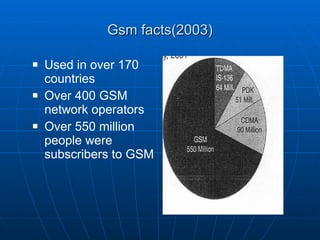
Gsm facts(2003) Used in over 170 countries Over 400 GSM network operators Over 550 million people were subscribers to GSM
 
FDMA, CDMA FDMA (FREQUENCY DIVISON MULTIPLEXING) 1) Each user on a different frequency. 2) A channel is a frequency. CDMA (CODE DIVISION MULTIPLEXING) 1) Each user uses the same frequency all the time, but  mixed with different distinguishing code patterns. 2) A channel is a unique set of code patterns.
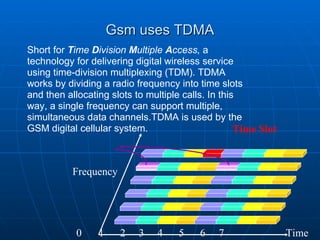
Gsm uses TDMA Short for  T ime  D ivision  M ultiple  A ccess,  a technology for delivering digital wireless service using time-division multiplexing (TDM). TDMA works by dividing a radio frequency into time slots and then allocating slots to multiple calls. In this way, a single frequency can support multiple, simultaneous data channels.TDMA is used by the GSM digital cellular system. Time Frequency 0 1 2 3 4 5 6 7 Time Slot
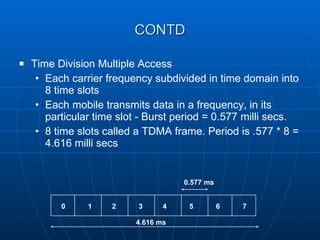
CONTD Time Division Multiple Access Each carrier frequency subdivided in time domain into 8 time slots  Each mobile transmits data in a frequency, in its particular time slot - Burst period = 0.577 milli secs. 8 time slots called a TDMA frame. Period is .577 * 8 = 4.616 milli secs 0 1 2 3 4 5 6 7 4.616 ms 0.577 ms
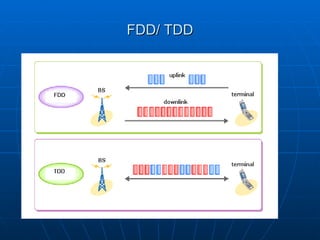
FDD/ TDD
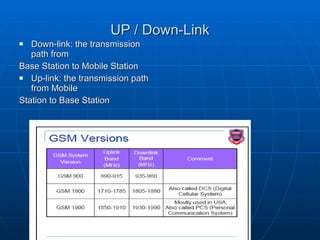
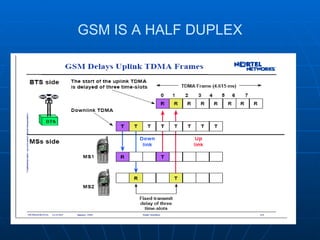
UP / Down-Link Down-link: the transmission path from Base Station to Mobile Station Up-link: the transmission path from Mobile Station to Base Station
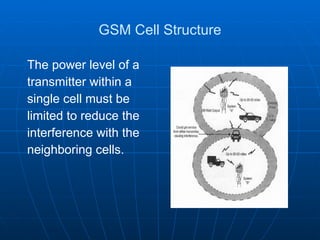
GSM Cell Structure The power level of a transmitter within a single cell must be limited to reduce the interference with the neighboring cells.
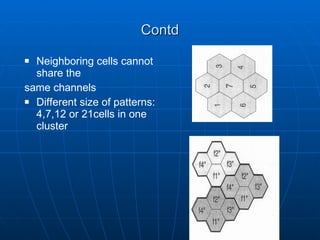
Contd Neighboring cells cannot share the same channels Different size of patterns: 4,7,12 or 21cells in one cluster
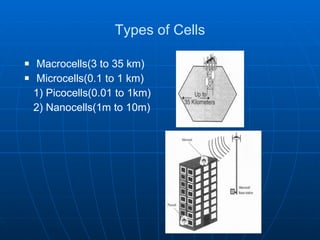
Types of Cells Macrocells(3 to 35 km) Microcells(0.1 to 1 km) 1) Picocells(0.01 to 1km) 2) Nanocells(1m to 10m)
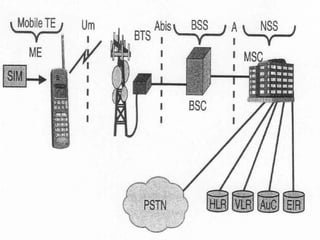
GSM Architecture   Mobile Station (MS) Used by the subscriber to access the GSM network via  the air interface Contains the hardware and software specific to the radio  interface Need a Subscriber Identity Module (SIM) which contains the subscriber-specific data to access GSM network,  except emergency call SIM cards are embedded with a microprocessor Stores  customer identity information and is made to fit inside the  cellular phone Memory capacity  1K, 3K, 8K, 16K
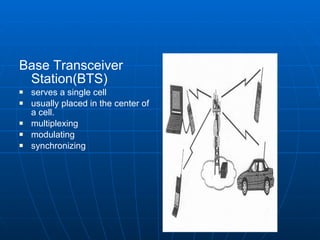
Base Transceiver Station(BTS) serves a single cell usually placed in the center of a cell. multiplexing modulating synchronizing
Base Station Controller(BSC) Frequency hopping Time and frequency synchronization Power management Time delay measurements
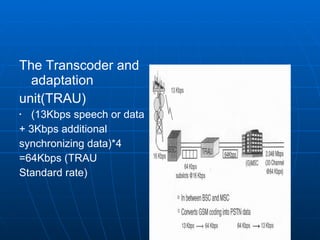
The Transcoder and adaptation unit(TRAU) (13Kbps speech or data + 3Kbps additional synchronizing data)*4 =64Kbps (TRAU Standard rate)
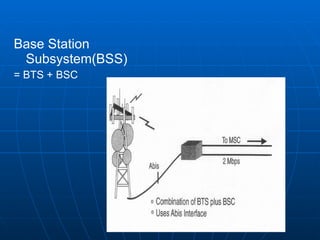
Base Station Subsystem(BSS) = BTS + BSC
Mobile Switching Center(MSC) The central component of the Network Subsystem (30 + 2)* 64Kbps = 2,048Mbps(E1) or better to the other network interfaces(PSDN,ISDN) Billing Location registration Gateway to SMS Synchronizing BSS Handover management
GSM Architectures 3 broad parts Subscribers carries MOBILE STATION BSS controls the radio link with the mobile station NETWORK SUBSYSTEM (NSS), which main part is MSC
 
 
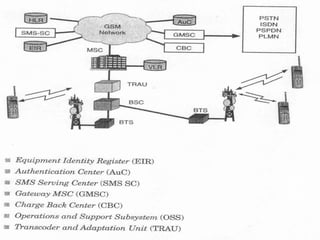
The Registers Completing the NSS Home Location Register (HLR) contains all  information of each subscriber registered in the  corresponding GSM network Visitor location Register (VLR) contains selected information from the HLR, which is necessary for call control and provision of the subscribed services, for each mobile currently located in the geographical area controlled by the VLR NSS = HLR + VLR + MSC
Equipment Identity Register (EIR)  contains a list of all valid mobile  equipment on the network Authentication Center (AUC) stores a  copy of the secret key stored in each  subscribers SIM card EIR and AUC are used for security  and authentication purposes EIR has three databases., White list - For all known, good IMEI’s Black list - For all bad or stolen handsets Grey list - For handsets/IMEI’s that are    on observation
GSM IS A HALF DUPLEX
Trunking theory and EARLANG Trunking theory:  Cellular radio systems rely on trunking theory to accommodate a large number of users in a limited radio spectrum. The fundamentals of trunking theory was developed by Earlang, a Danish mathematician in the late 1990s. EARLANG:  Earlang represents the amount of traffic intensity carried by a channel that is completely occupied.
CONTD EARLANG B: ( Also called Block calls Cleared) that is for every user who requests service it is assumed that user is given a immediate access to a channel if one is available. If no channel is available the user is blocked without access and is free to try again later.  EARLANG B:  (Also called Block calls Delayed) is one in which a que is provided to hold calls which are blocked. If a channel is not available immediately the call request may be delayed until a channel becomes available.
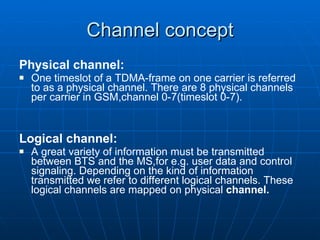
Channel concept Physical channel: One timeslot of a TDMA-frame on one carrier is referred to as a physical channel. There are 8 physical channels per carrier in GSM,channel 0-7(timeslot 0-7). Logical channel: A great variety of information must be transmitted between BTS and the MS,for e.g. user data and control signaling. Depending on the kind of information transmitted we refer to different logical channels. These logical channels are mapped on physical  channel.
GSM CHANNELS
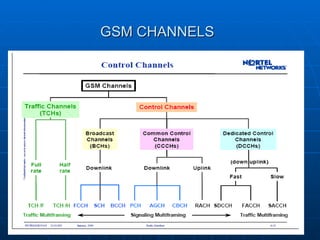
CONTD Control channels are intended to carry signaling or synchronization data. Three are defined: Broadcast Channels (BCHs), Common Control Channels (CCCHs), Dedicated Control Channels (DCCHs). Broadcast channels  are point to multipoint unidirectional (downlink) control channels from the the fixed subsystem to the mobile telephone. First, BCHs include a  Frequency Control Channel  ( FCCH ) that allows an MS to accurately tune to a Base Transceiver Station (BTS). Then BCHs contain the  Synchronization Channel  ( SCH ), which provide TDMA frame oriented synchronization data to a MS. Last, BCHs include the  Broadcast Control Channel  ( BCCH ) intended to broadcast a variety of information to MSs, including cues necessary for the MS to register in the network.

CONTD Common Control Channels   (CCCHs)  are point to multipoint channels that is primarily intended to carry signaling information for access handling functions. The CCCHs include: Paging Channel   ( PCH ), which is down channel used to page (call terminating) MSs. Access Grant Channel   ( AGCH ) that is a downlink channel used to assign a MS to a specific Dedicated Control Channel (DCCH). Cell Broadcast Channel   ( CBCH ), which is down channel used to broadcast miscellaneous short messages to the MSs. Random Access Control Channel   (RACH ) is an uplink channel which allows MS to initiate a call.

CONTD Stand Alone control channel   (SDCCH) it is used to send sms.   Slow Associated control channel   (SACCH) It is used to gather the information of surrounding area and updates the network. Fast Associated control channel   (FACCH) It has the authority to discard speech channel while executing the handoff.
Types of handoffs Intra cell handover: The MS in handed over to another channel on the same cell, under the same BTS. Intra BSC handover: The MS is handed over to the another channel on a d/f cell, under the control of the d/f BTS of the same BSC. Inter BSC Handover: the MS is handed over to the another channel on a d/f cell, under the control of a d/f BSC of the same MSC. Inter MSC Handover: The MS is handed over to another MSC.
 
THANKS  Q/A.?

Gsm By Aziz

  • 1.
  • 2.
    PRESENTATION CONTEMPORARY STUDENTS NAME: AZIZ ZOAIB ID: FA06-BS-0013 COURSE: SWITCHING THEORY TOPIC: GSM ARCHITECTURE
  • 3.
    What is TelecommunicationTelecommunications means to change information into electric signals for remote transmission. Getting Wireless---What's the Advantage? Saving Transmission Cost. Fast Deployment. Easy and Fast Access Challenges Interference Multipath Fading LOS and NLOS (RAN and Backhaul) Changing Terrain and Air Interface Characteristics(weather)
  • 4.
    History of CellularMobile Radio and GSM(Global Systems for Mobile) Early 1980s there was analog technologies: Advanced Mobile Phone Services(AMPS)in North America. Total Access Communications System(TACS)in the UK. Nordic Mobile Telephone(NMT) in Nordic countries.
  • 5.
    Contd Each countrydeveloped its own system, which caused problems: System worked only within the boundaries of each country. Mobile equipment manufacturers Markets were limited by the operating system. Solution was GSM, which is digital technology and was developed by CEPT(Conference of European Posts and Telecommunications)
  • 6.
    The Goals ofGSM Improved spectrum efficiency International roaming Low-cost mobile sets and base stations High-quality speech Compatibility with ISDN and other telephone company services. Support for new services QoS
  • 7.
    Gsm facts(2003) Usedin over 170 countries Over 400 GSM network operators Over 550 million people were subscribers to GSM
  • 8.
  • 9.
    FDMA, CDMA FDMA(FREQUENCY DIVISON MULTIPLEXING) 1) Each user on a different frequency. 2) A channel is a frequency. CDMA (CODE DIVISION MULTIPLEXING) 1) Each user uses the same frequency all the time, but mixed with different distinguishing code patterns. 2) A channel is a unique set of code patterns.
  • 10.
    Gsm uses TDMAShort for T ime D ivision M ultiple A ccess, a technology for delivering digital wireless service using time-division multiplexing (TDM). TDMA works by dividing a radio frequency into time slots and then allocating slots to multiple calls. In this way, a single frequency can support multiple, simultaneous data channels.TDMA is used by the GSM digital cellular system. Time Frequency 0 1 2 3 4 5 6 7 Time Slot
  • 11.
    CONTD Time DivisionMultiple Access Each carrier frequency subdivided in time domain into 8 time slots Each mobile transmits data in a frequency, in its particular time slot - Burst period = 0.577 milli secs. 8 time slots called a TDMA frame. Period is .577 * 8 = 4.616 milli secs 0 1 2 3 4 5 6 7 4.616 ms 0.577 ms
  • 12.
  • 13.
    UP / Down-LinkDown-link: the transmission path from Base Station to Mobile Station Up-link: the transmission path from Mobile Station to Base Station
  • 14.
    GSM Cell StructureThe power level of a transmitter within a single cell must be limited to reduce the interference with the neighboring cells.
  • 15.
    Contd Neighboring cellscannot share the same channels Different size of patterns: 4,7,12 or 21cells in one cluster
  • 16.
    Types of CellsMacrocells(3 to 35 km) Microcells(0.1 to 1 km) 1) Picocells(0.01 to 1km) 2) Nanocells(1m to 10m)
  • 17.
    GSM Architecture Mobile Station (MS) Used by the subscriber to access the GSM network via the air interface Contains the hardware and software specific to the radio interface Need a Subscriber Identity Module (SIM) which contains the subscriber-specific data to access GSM network, except emergency call SIM cards are embedded with a microprocessor Stores customer identity information and is made to fit inside the cellular phone Memory capacity 1K, 3K, 8K, 16K
  • 18.
    Base Transceiver Station(BTS)serves a single cell usually placed in the center of a cell. multiplexing modulating synchronizing
  • 19.
    Base Station Controller(BSC)Frequency hopping Time and frequency synchronization Power management Time delay measurements
  • 20.
    The Transcoder andadaptation unit(TRAU) (13Kbps speech or data + 3Kbps additional synchronizing data)*4 =64Kbps (TRAU Standard rate)
  • 21.
  • 22.
    Mobile Switching Center(MSC)The central component of the Network Subsystem (30 + 2)* 64Kbps = 2,048Mbps(E1) or better to the other network interfaces(PSDN,ISDN) Billing Location registration Gateway to SMS Synchronizing BSS Handover management
  • 23.
    GSM Architectures 3broad parts Subscribers carries MOBILE STATION BSS controls the radio link with the mobile station NETWORK SUBSYSTEM (NSS), which main part is MSC
  • 24.
  • 25.
  • 26.
    The Registers Completingthe NSS Home Location Register (HLR) contains all information of each subscriber registered in the corresponding GSM network Visitor location Register (VLR) contains selected information from the HLR, which is necessary for call control and provision of the subscribed services, for each mobile currently located in the geographical area controlled by the VLR NSS = HLR + VLR + MSC
  • 27.
    Equipment Identity Register(EIR) contains a list of all valid mobile equipment on the network Authentication Center (AUC) stores a copy of the secret key stored in each subscribers SIM card EIR and AUC are used for security and authentication purposes EIR has three databases., White list - For all known, good IMEI’s Black list - For all bad or stolen handsets Grey list - For handsets/IMEI’s that are on observation
  • 28.
    GSM IS AHALF DUPLEX
  • 29.
    Trunking theory andEARLANG Trunking theory: Cellular radio systems rely on trunking theory to accommodate a large number of users in a limited radio spectrum. The fundamentals of trunking theory was developed by Earlang, a Danish mathematician in the late 1990s. EARLANG: Earlang represents the amount of traffic intensity carried by a channel that is completely occupied.
  • 30.
    CONTD EARLANG B:( Also called Block calls Cleared) that is for every user who requests service it is assumed that user is given a immediate access to a channel if one is available. If no channel is available the user is blocked without access and is free to try again later. EARLANG B: (Also called Block calls Delayed) is one in which a que is provided to hold calls which are blocked. If a channel is not available immediately the call request may be delayed until a channel becomes available.
  • 31.
    Channel concept Physicalchannel: One timeslot of a TDMA-frame on one carrier is referred to as a physical channel. There are 8 physical channels per carrier in GSM,channel 0-7(timeslot 0-7). Logical channel: A great variety of information must be transmitted between BTS and the MS,for e.g. user data and control signaling. Depending on the kind of information transmitted we refer to different logical channels. These logical channels are mapped on physical channel.
  • 32.
  • 33.
    CONTD Control channelsare intended to carry signaling or synchronization data. Three are defined: Broadcast Channels (BCHs), Common Control Channels (CCCHs), Dedicated Control Channels (DCCHs). Broadcast channels are point to multipoint unidirectional (downlink) control channels from the the fixed subsystem to the mobile telephone. First, BCHs include a Frequency Control Channel ( FCCH ) that allows an MS to accurately tune to a Base Transceiver Station (BTS). Then BCHs contain the Synchronization Channel ( SCH ), which provide TDMA frame oriented synchronization data to a MS. Last, BCHs include the Broadcast Control Channel ( BCCH ) intended to broadcast a variety of information to MSs, including cues necessary for the MS to register in the network.
  • 34.
    CONTD Common ControlChannels (CCCHs) are point to multipoint channels that is primarily intended to carry signaling information for access handling functions. The CCCHs include: Paging Channel ( PCH ), which is down channel used to page (call terminating) MSs. Access Grant Channel ( AGCH ) that is a downlink channel used to assign a MS to a specific Dedicated Control Channel (DCCH). Cell Broadcast Channel ( CBCH ), which is down channel used to broadcast miscellaneous short messages to the MSs. Random Access Control Channel (RACH ) is an uplink channel which allows MS to initiate a call.
  • 35.
    CONTD Stand Alonecontrol channel (SDCCH) it is used to send sms. Slow Associated control channel (SACCH) It is used to gather the information of surrounding area and updates the network. Fast Associated control channel (FACCH) It has the authority to discard speech channel while executing the handoff.
  • 36.
    Types of handoffsIntra cell handover: The MS in handed over to another channel on the same cell, under the same BTS. Intra BSC handover: The MS is handed over to the another channel on a d/f cell, under the control of the d/f BTS of the same BSC. Inter BSC Handover: the MS is handed over to the another channel on a d/f cell, under the control of a d/f BSC of the same MSC. Inter MSC Handover: The MS is handed over to another MSC.
  • 37.
  • 38.