Distributed DBMS ©M. T. Özsu & P. Valduriez Ch.13/1
Outline
• Introduction
• Background
• Distributed Database Design
• Database Integration
• Semantic Data Control
• Distributed Query Processing
• Distributed Transaction Management
• Data Replication
➡ Consistency criteria
➡ Replication protocols
➡ Replication and failure management
• Parallel Database Systems
• Distributed Object DBMS
• Peer-to-Peer Data Management
• Web Data Management
• Current Issues
Distributed DBMS ©M. T. Özsu & P. Valduriez Ch.13/2
Replication
• Why replicate?
➡ System availability
✦ Avoid single points of failure
➡ Performance
✦ Localization
➡ Scalability
✦ Scalability in numbers and geographic area
➡ Application requirements
• Why not replicate?
➡ Replication transparency
➡ Consistency issues
✦ Updates are costly
✦ Availability may suffer if not careful
Distributed DBMS ©M. T. Özsu & P. Valduriez Ch.13/3
Execution Model
• There are physical copies of logical objects in the system.
• Operations are specified on logical objects, but translated to operate on
physical objects.
• One-copy equivalence
➡ The effect of transactions performed by clients on replicated objects should be
the same as if they had been performed on a single set of objects.
x
x1 x2 xn
…
Physical data item (replicas, copies)
Logical data item
Write(x)
Write(x1) Write(x2) Write(xn)
Distributed DBMS ©M. T. Özsu & P. Valduriez Ch.13/4
Replication Issues
• Consistency models - how do we reason about the consistency of the
“global execution state”?
➡ Mutual consistency
➡ Transactional consistency
• Where are updates allowed?
➡ Centralized
➡ Distributed
• Update propagation techniques – how do we propagate updates to one
copy to the other copies?
➡ Eager
➡ Lazy
Distributed DBMS ©M. T. Özsu & P. Valduriez Ch.13/5
Consistency
• Mutual Consistency
➡ How do we keep the values of physical copies of a logical data item
synchronized?
➡ Strong consistency
✦ All copies are updated within the context of the update transaction
✦ When the update transaction completes, all copies have the same value
✦ Typically achieved through 2PC
➡ Weak consistency
✦ Eventual consistency: the copies are not identical when update transaction
completes, but they eventually converge to the same value
✦ Many versions possible:
✓ Time-bounds
✓ Value-bounds
✓ Drifts
Distributed DBMS ©M. T. Özsu & P. Valduriez Ch.13/6
Transactional Consistency
• How can we guarantee that the global execution history over replicated
data is serializable?
• One-copy serializability (1SR)
➡ The effect of transactions performed by clients on replicated objects should be
the same as if they had been performed one at-a-time on a single set of objects.
• Weaker forms are possible
➡ Snapshot isolation
➡ RC-serializability
Distributed DBMS ©M. T. Özsu & P. Valduriez Ch.13/7
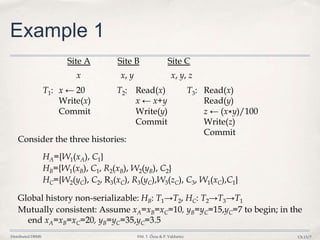
Example 1
Site A Site B Site C
x x, y x, y, z
T1: x ← 20 T2: Read(x) T3: Read(x)
Write(x) x ← x+y Read(y)
Commit Write(y) z ← (x∗y)/100
Commit Write(z)
Commit
Consider the three histories:
HA={W1(xA), C1}
HB={W1(xB), C1, R2(xB), W2(yB), C2}
HC={W2(yC), C2, R3(xC), R3(yC),W3(zC), C3, W1(xC),C1}
Global history non-serializable: HB: T1→T2, HC: T2→T3→T1
Mutually consistent: Assume xA=xB=xC=10, yB=yC=15,yC=7 to begin; in the
end xA=xB=xC=20, yB=yC=35,yC=3.5
Distributed DBMS ©M. T. Özsu & P. Valduriez Ch.13/8
Example 2
Site A Site B
x x
T1: Read(x) T2: Read(x)
x ← x+5 x ← x∗10
Write(x) Write(x)
Commit Commit
Consider the two histories:
HA={R1(xA),W1(xA), C1, W2(xA), C2}
HB={R1(xB), W2(xB), C2, W1(xB), C1}
Global history non-serializable: HA: T1→ T2, HB: T2→ T1
Mutually inconsistent: Assume xA=xB=1 to begin; in the end xA=10,
xB=6
Distributed DBMS ©M. T. Özsu & P. Valduriez Ch.13/9
Update Management Strategies
• Depending on when the updates are propagated
➡ Eager
➡ Lazy
• Depending on where the updates can take place
➡ Centralized
➡ Distributed
Eager
Lazy
Centralized Distributed
Distributed DBMS ©M. T. Özsu & P. Valduriez Ch.13/10
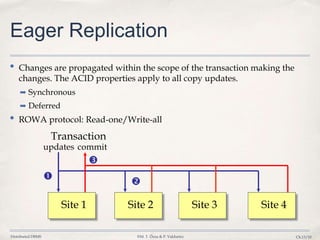
Eager Replication
• Changes are propagated within the scope of the transaction making the
changes. The ACID properties apply to all copy updates.
➡ Synchronous
➡ Deferred
• ROWA protocol: Read-one/Write-all
Site 1 Site 2 Site 3 Site 4
Transaction
updates commit



Distributed DBMS ©M. T. Özsu & P. Valduriez Ch.13/11
Lazy Replication
●Lazy replication first executes the updating transaction on one copy. After
the transaction commits, the changes are propagated to all other copies
(refresh transactions)
●While the propagation takes place, the copies are mutually inconsistent.
●The time the copies are mutually inconsistent is an adjustable parameter
which is application dependent.
Site 1 Site 2 Site 3 Site 4
Transaction
updates commit
 

Distributed DBMS ©M. T. Özsu & P. Valduriez Ch.13/12
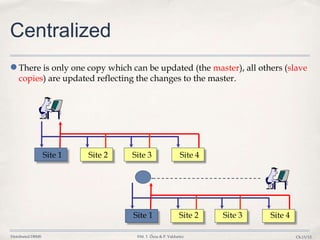
Centralized
●There is only one copy which can be updated (the master), all others (slave
copies) are updated reflecting the changes to the master.
Site 1 Site 2 Site 3 Site 4
Distributed DBMS ©M. T. Özsu & P. Valduriez Ch.13/13
Distributed
●Changes can be initiated at any of the copies. That is, any of the sites which
owns a copy can update the value of the data item.
Site 1 Site 2 Site 3 Site 4
Transaction
updates commit
Site 1 Site 2 Site 3 Site 4
Transaction
updates commit
Distributed DBMS ©M. T. Özsu & P. Valduriez Ch.13/14
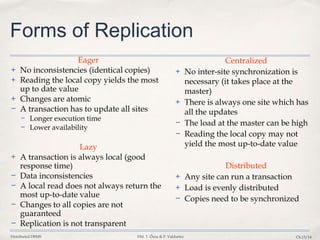
Forms of Replication
Eager
+ No inconsistencies (identical copies)
+ Reading the local copy yields the most
up to date value
+ Changes are atomic
− A transaction has to update all sites
− Longer execution time
− Lower availability
Lazy
+ A transaction is always local (good
response time)
− Data inconsistencies
− A local read does not always return the
most up-to-date value
− Changes to all copies are not
guaranteed
− Replication is not transparent
Centralized
+ No inter-site synchronization is
necessary (it takes place at the
master)
+ There is always one site which has
all the updates
− The load at the master can be high
− Reading the local copy may not
yield the most up-to-date value
Distributed
+ Any site can run a transaction
+ Load is evenly distributed
− Copies need to be synchronized
Distributed DBMS ©M. T. Özsu & P. Valduriez Ch.13/15
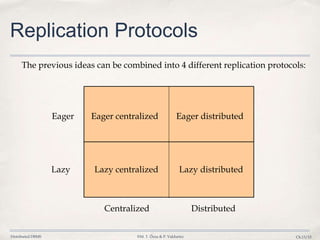
Replication Protocols
Eager
Lazy
Centralized Distributed
Eager centralized Eager distributed
Lazy distributedLazy centralized
The previous ideas can be combined into 4 different replication protocols:
Distributed DBMS ©M. T. Özsu & P. Valduriez Ch.13/16
Eager Centralized Protocols
• Design parameters:
➡ Distribution of master
✦ Single master: one master for all data items
✦ Primary copy: different masters for different (sets of) data items
➡ Level of transparency
✦ Limited: applications and users need to know who the master is
✓ Update transactions are submitted directly to the master
✓ Reads can occur on slaves
✦ Full: applications and users can submit anywhere and the operations will be
forwarded to the master
✓ Operation-based forwarding
• Four alternative implementation architectures, only three are meaningful:
➡ Single master, limited transparency
➡ Single master, full transparency
➡ Primary copy, full transparency
Distributed DBMS ©M. T. Özsu & P. Valduriez Ch.13/17
Eager Single Master/Limited
Transparency
• Applications submit update transactions directly to the master
• Master:
➡ Upon read: read locally and return to user
➡ Upon write: write locally, multicast write to other replicas (in FFO
timestamps order)
➡ Upon commit request: run 2PC coordinator to ensure that all have really
installed the changes
➡ Upon abort: abort and inform other sites about abort
• Slaves install writes that arrive from the master
Distributed DBMS ©M. T. Özsu & P. Valduriez Ch.13/18
Eager Single Master/Limited
Transparency (cont’d)
• Applications submit read transactions directly to an appropriate slave
• Slave
➡ Upon read: read locally
➡ Upon write from master copy: execute conflicting writes in the proper order
(FIFO or timestamp)
➡ Upon write from client: refuse (abort transaction; there is error)
➡ Upon commit request from read-only: commit locally
➡ Participant of 2PC for update transaction running on primary
Distributed DBMS ©M. T. Özsu & P. Valduriez Ch.13/19
Eager Single Master/
Full Transparency
Coordinating TM
1. Send op(x) to the master site
2. Send Read(x) to any site that has x
3. Send Write(x) to all the slaves
where a copy of x exists
4. When Commit arrives, act as
coordinator for 2PC
Master Site
1. If op(x) = Read(x): set read lock on
x and send “lock granted” msg to
the coordinating TM
2. If op(x) = Write(x)
1. Set write lock on x
2. Update local copy of x
3. Inform coordinating TM
3. Act as participant in 2PC
Applications submit all transactions to the Transaction Manager at their
own sites (Coordinating TM)
Distributed DBMS ©M. T. Özsu & P. Valduriez Ch.13/20
Eager Primary Copy/Full
Transparency
• Applications submit transactions directly to their local TMs
• Local TM:
➡ Forward each operation to the primary copy of the data item
➡ Upon granting of locks, submit Read to any slave, Write to all slaves
➡ Coordinate 2PC
Distributed DBMS ©M. T. Özsu & P. Valduriez Ch.13/21
Eager Primary Copy/Full
Transparency (cont’d)
• Primary copy site
➡ Read(x): lock xand reply to TM
➡ Write(x): lock x, perform update, inform TM
➡ Participate in 2PC
• Slaves: as before
Distributed DBMS ©M. T. Özsu & P. Valduriez Ch.13/22
Eager Distributed Protocol
• Updates originate at any copy
➡ Each sites uses 2 phase locking.
➡ Read operations are performed locally.
➡ Write operations are performed at all sites (using a distributed locking
protocol).
➡ Coordinate 2PC
• Slaves:
➡ As before
Distributed DBMS ©M. T. Özsu & P. Valduriez Ch.13/23
Eager Distributed Protocol
(cont’d)
• Critical issue:
➡ Concurrent Writes initiated at different master sites are executed in the same
order at each slave site
➡ Local histories are serializable (this is easy)
• Advantages
➡ Simple and easy to implement
• Disadvantage
➡ Very high communication overhead
✦ n replicas; m update operations in each transaction: n*m messages (assume no
multicasting)
✦ For throughput of k tps: k* n*m messages
• Alternative
➡ Use group communication + deferred update to slaves to reduce messages
Distributed DBMS ©M. T. Özsu & P. Valduriez Ch.13/24
Lazy Single Master/Limited
Transparency
• Update transactions submitted to master
• Master:
➡ Upon read: read locally and return to user
➡ Upon write: write locally and return to user
➡ Upon commit/abort: terminate locally
➡ Sometime after commit: multicast updates to slaves (in order)
• Slaves:
➡ Upon read: read locally
➡ Refresh transactions: install updates
Distributed DBMS ©M. T. Özsu & P. Valduriez Ch.13/25
Lazy Primary Copy/Limited
Transparency
• There are multiple masters; each master execution is similar to lazy single
master in the way it handles transactions
• Slave execution complicated: refresh transactions from multiple masters
and need to be ordered properly
Distributed DBMS ©M. T. Özsu & P. Valduriez Ch.13/26
Lazy Primary Copy/Limited
Transparency – Slaves
• Assign system-wide unique timestamps to refresh transactions and execute
them in timestamp order
➡ May cause too many aborts
• Replication graph
➡ Similar to serialization graph, but nodes are transactions (T) + sites (S); edge
〈Ti,Sj〉exists iff Ti performs a Write(x) and x is stored in Sj
➡ For each operation (opk), enter the appropriate nodes (Tk) and edges; if graph
has no cycles, no problem
➡ If cycle exists and the transactions in the cycle have been committed at their
masters, but their refresh transactions have not yet committed at slaves, abort
Tk; if they have not yet committed at their masters, Tkwaits.
• Use group communication
Distributed DBMS ©M. T. Özsu & P. Valduriez Ch.13/27
Lazy Single Master/Full
Transparency
• This is very tricky
➡ Forwarding operations to a master and then getting refresh transactions
cause difficulties
• Two problems:
➡ Violation of 1SR behavior
➡ A transaction may not see its own reads
• Problem arises in primary copy/full transparency as well
Distributed DBMS ©M. T. Özsu & P. Valduriez Ch.13/28
Example 3
Site M (Master) holds x, y; SiteB holds slave copies of x, y
T1: Read(x), Write(y), Commit
T2: Read(x), Write(y), Commit
Distributed DBMS ©M. T. Özsu & P. Valduriez Ch.13/29
Example 4
• Master site M holds x, site C holds slave copy of x
• T3: Write(x), Read(x), Commit
• Sequence of execution
1. W3(x) submitted at C, forwarded to M for execution
2. W3(x) is executed at M, confirmation sent back to C
3. R3(x) submitted at C and executed on the local copy
4. T3 submits Commit at C, forwarded to M for execution
5. M executes Commit, sends notification to C, which also commits T3
6. M sends refresh transaction for T3 to C (for W3(x) operation)
7. C executes the refresh transaction and commits it
• When C reads x at step 3, it does not see the effects of Write at step 2
Distributed DBMS ©M. T. Özsu & P. Valduriez Ch.13/30
Lazy Single Master/
Full Transparency - Solution
• Assume T = Write(x)
• At commit time of transaction T, the master generates a timestamp for it
[ts(T)]
• Master sets last_modified(xM) ← ts(T)
• When a refresh transaction arrives at a slave site i, it also sets
last_modified(xi) ← last_modified(xM)
• Timestamp generation rule at the master:
➡ ts(T) should be greater than all previously issued timestamps and should
be less than the last_modified timestamps of the data items it has accessed. If
such a timestamp cannot be generated, then T is aborted.
Distributed DBMS ©M. T. Özsu & P. Valduriez Ch.13/31
Lazy Distributed Replication
• Any site:
➡ Upon read: read locally and return to user
➡ Upon write: write locally and return to user
➡ Upon commit/abort: terminate locally
➡ Sometime after commit: send refresh transaction
➡ Upon message from other site
✦ Detect conflicts
✦ Install changes
✦ Reconciliation may be necessary
Distributed DBMS ©M. T. Özsu & P. Valduriez Ch.13/32
Reconciliation
• Such problems can be solved using pre-arranged patterns:
➡ Latest update win (newer updates preferred over old ones)
➡ Site priority (preference to updates from headquarters)
➡ Largest value (the larger transaction is preferred)
• Or using ad-hoc decision making procedures:
➡ Identify the changes and try to combine them
➡ Analyze the transactions and eliminate the non-important ones
➡ Implement your own priority schemas
Distributed DBMS ©M. T. Özsu & P. Valduriez Ch.13/33
Replication Strategies
Centralized Distributed
+Updates do not need to be
coordinated
+No inconsistencies
- Longest response time
- Only useful with few updates
- Local copies are can only be
read
+No inconsistencies
+Elegant (symmetrical solution)
- Long response times
- Updates need to be
coordinated
+No coordination necessary
+Short response times
- Local copies are not up to date
- Inconsistencies
+No centralized coordination
+Shortest response times
- Inconsistencies
- Updates can be lost
(reconciliation)
Distributed DBMS ©M. T. Özsu & P. Valduriez Ch.13/34
Group Communication
• A node can multicast a message to all nodes of a group with a delivery
guarantee
• Multicast primitives
➡ There are a number of them
➡ Total ordered multicast: all messages sent by different nodes are delivered in
the same total order at all the nodes
• Used with deferred writes, can reduce communication overhead
➡ Remember eager distributed requires k*m messages (with multicast) for
throughput of ktps when there are n replicas and m update operations in each
transaction
➡ With group communication and deferred writes: 2k messages
Distributed DBMS ©M. T. Özsu & P. Valduriez Ch.13/35
Failures
• So far we have considered replication protocols in the absence of failures
• How to keep replica consistency when failures occur
➡ Site failures
✦ Read One Write All Available (ROWAA)
➡ Communication failures
✦ Quorums
➡ Network partitioning
✦ Quorums
Distributed DBMS ©M. T. Özsu & P. Valduriez Ch.13/36
ROWAA with Primary Site
• READ = read any copy, if time-out, read another copy.
• WRITE = send W(x) to all copies. If one site rejects the operation, then
abort. Otherwise, all sites not responding are “missing writes”.
• VALIDATION = To commit a transaction
➡ Check that all sites in “missing writes” are still down. If not, then abort the
transaction.
✦ There might be a site recovering concurrent with transaction updates and these
may be lost
➡ Check that all sites that were available are still available. If some do not
respond, then abort.
Distributed DBMS ©M. T. Özsu & P. Valduriez Ch.13/37
Distributed ROWAA
• Each site has a copy of V
➡ V represents the set of sites a site believes is available
➡ V(A) is the “view” a site has of the system configuration.
• The view of a transaction T [V(T)] is the view of its coordinating site, when the
transaction starts.
➡ Read any copy within V; update all copies in V
➡ If at the end of the transaction the view has changed, the transaction is aborted
• All sites must have the same view!
• To modify V, run a special atomic transaction at all sites.
➡ Take care that there are no concurrent views!
➡ Similar to commit protocol.
➡ Idea: Vs have version numbers; only accept new view if its version number is higher
than your current one
• Recovery: get missed updates from any active node
➡ Problem: no unique sequence of transactions
Distributed DBMS ©M. T. Özsu & P. Valduriez Ch.13/38
Quorum-Based Protocol
• Assign a vote to each copy of a replicated object (say Vi) such that ∑iVi = V
• Each operation has to obtain a read quorum (Vr) to read and a write
quorum (Vw) to write an object
• Then the following rules have to be obeyed in determining the quorums:
➡ Vr+ Vw>V an object is not read and written by two transactions
concurrently
➡ Vw>V/2 two write operations from two transactions cannot occur
concurrently on the same object
Distributed DBMS ©M. T. Özsu & P. Valduriez Ch.13/39
Quorum Example
Three examples of the voting algorithm:
a) A correct choice of read and write set
b) A choice that may lead to write-write conflicts
c) ROWA
From Tanenbaum and van Steen, Distributed Systems: Principles and Paradigms
© Prentice-Hall, Inc. 2002

Database , 13 Replication

  • 1.
    Distributed DBMS ©M.T. Özsu & P. Valduriez Ch.13/1 Outline • Introduction • Background • Distributed Database Design • Database Integration • Semantic Data Control • Distributed Query Processing • Distributed Transaction Management • Data Replication ➡ Consistency criteria ➡ Replication protocols ➡ Replication and failure management • Parallel Database Systems • Distributed Object DBMS • Peer-to-Peer Data Management • Web Data Management • Current Issues
  • 2.
    Distributed DBMS ©M.T. Özsu & P. Valduriez Ch.13/2 Replication • Why replicate? ➡ System availability ✦ Avoid single points of failure ➡ Performance ✦ Localization ➡ Scalability ✦ Scalability in numbers and geographic area ➡ Application requirements • Why not replicate? ➡ Replication transparency ➡ Consistency issues ✦ Updates are costly ✦ Availability may suffer if not careful
  • 3.
    Distributed DBMS ©M.T. Özsu & P. Valduriez Ch.13/3 Execution Model • There are physical copies of logical objects in the system. • Operations are specified on logical objects, but translated to operate on physical objects. • One-copy equivalence ➡ The effect of transactions performed by clients on replicated objects should be the same as if they had been performed on a single set of objects. x x1 x2 xn … Physical data item (replicas, copies) Logical data item Write(x) Write(x1) Write(x2) Write(xn)
  • 4.
    Distributed DBMS ©M.T. Özsu & P. Valduriez Ch.13/4 Replication Issues • Consistency models - how do we reason about the consistency of the “global execution state”? ➡ Mutual consistency ➡ Transactional consistency • Where are updates allowed? ➡ Centralized ➡ Distributed • Update propagation techniques – how do we propagate updates to one copy to the other copies? ➡ Eager ➡ Lazy
  • 5.
    Distributed DBMS ©M.T. Özsu & P. Valduriez Ch.13/5 Consistency • Mutual Consistency ➡ How do we keep the values of physical copies of a logical data item synchronized? ➡ Strong consistency ✦ All copies are updated within the context of the update transaction ✦ When the update transaction completes, all copies have the same value ✦ Typically achieved through 2PC ➡ Weak consistency ✦ Eventual consistency: the copies are not identical when update transaction completes, but they eventually converge to the same value ✦ Many versions possible: ✓ Time-bounds ✓ Value-bounds ✓ Drifts
  • 6.
    Distributed DBMS ©M.T. Özsu & P. Valduriez Ch.13/6 Transactional Consistency • How can we guarantee that the global execution history over replicated data is serializable? • One-copy serializability (1SR) ➡ The effect of transactions performed by clients on replicated objects should be the same as if they had been performed one at-a-time on a single set of objects. • Weaker forms are possible ➡ Snapshot isolation ➡ RC-serializability
  • 7.
    Distributed DBMS ©M.T. Özsu & P. Valduriez Ch.13/7 Example 1 Site A Site B Site C x x, y x, y, z T1: x ← 20 T2: Read(x) T3: Read(x) Write(x) x ← x+y Read(y) Commit Write(y) z ← (x∗y)/100 Commit Write(z) Commit Consider the three histories: HA={W1(xA), C1} HB={W1(xB), C1, R2(xB), W2(yB), C2} HC={W2(yC), C2, R3(xC), R3(yC),W3(zC), C3, W1(xC),C1} Global history non-serializable: HB: T1→T2, HC: T2→T3→T1 Mutually consistent: Assume xA=xB=xC=10, yB=yC=15,yC=7 to begin; in the end xA=xB=xC=20, yB=yC=35,yC=3.5
  • 8.
    Distributed DBMS ©M.T. Özsu & P. Valduriez Ch.13/8 Example 2 Site A Site B x x T1: Read(x) T2: Read(x) x ← x+5 x ← x∗10 Write(x) Write(x) Commit Commit Consider the two histories: HA={R1(xA),W1(xA), C1, W2(xA), C2} HB={R1(xB), W2(xB), C2, W1(xB), C1} Global history non-serializable: HA: T1→ T2, HB: T2→ T1 Mutually inconsistent: Assume xA=xB=1 to begin; in the end xA=10, xB=6
  • 9.
    Distributed DBMS ©M.T. Özsu & P. Valduriez Ch.13/9 Update Management Strategies • Depending on when the updates are propagated ➡ Eager ➡ Lazy • Depending on where the updates can take place ➡ Centralized ➡ Distributed Eager Lazy Centralized Distributed
  • 10.
    Distributed DBMS ©M.T. Özsu & P. Valduriez Ch.13/10 Eager Replication • Changes are propagated within the scope of the transaction making the changes. The ACID properties apply to all copy updates. ➡ Synchronous ➡ Deferred • ROWA protocol: Read-one/Write-all Site 1 Site 2 Site 3 Site 4 Transaction updates commit   
  • 11.
    Distributed DBMS ©M.T. Özsu & P. Valduriez Ch.13/11 Lazy Replication ●Lazy replication first executes the updating transaction on one copy. After the transaction commits, the changes are propagated to all other copies (refresh transactions) ●While the propagation takes place, the copies are mutually inconsistent. ●The time the copies are mutually inconsistent is an adjustable parameter which is application dependent. Site 1 Site 2 Site 3 Site 4 Transaction updates commit   
  • 12.
    Distributed DBMS ©M.T. Özsu & P. Valduriez Ch.13/12 Centralized ●There is only one copy which can be updated (the master), all others (slave copies) are updated reflecting the changes to the master. Site 1 Site 2 Site 3 Site 4 Site 1 Site 2 Site 3 Site 4
  • 13.
    Distributed DBMS ©M.T. Özsu & P. Valduriez Ch.13/13 Distributed ●Changes can be initiated at any of the copies. That is, any of the sites which owns a copy can update the value of the data item. Site 1 Site 2 Site 3 Site 4 Transaction updates commit Site 1 Site 2 Site 3 Site 4 Transaction updates commit
  • 14.
    Distributed DBMS ©M.T. Özsu & P. Valduriez Ch.13/14 Forms of Replication Eager + No inconsistencies (identical copies) + Reading the local copy yields the most up to date value + Changes are atomic − A transaction has to update all sites − Longer execution time − Lower availability Lazy + A transaction is always local (good response time) − Data inconsistencies − A local read does not always return the most up-to-date value − Changes to all copies are not guaranteed − Replication is not transparent Centralized + No inter-site synchronization is necessary (it takes place at the master) + There is always one site which has all the updates − The load at the master can be high − Reading the local copy may not yield the most up-to-date value Distributed + Any site can run a transaction + Load is evenly distributed − Copies need to be synchronized
  • 15.
    Distributed DBMS ©M.T. Özsu & P. Valduriez Ch.13/15 Replication Protocols Eager Lazy Centralized Distributed Eager centralized Eager distributed Lazy distributedLazy centralized The previous ideas can be combined into 4 different replication protocols:
  • 16.
    Distributed DBMS ©M.T. Özsu & P. Valduriez Ch.13/16 Eager Centralized Protocols • Design parameters: ➡ Distribution of master ✦ Single master: one master for all data items ✦ Primary copy: different masters for different (sets of) data items ➡ Level of transparency ✦ Limited: applications and users need to know who the master is ✓ Update transactions are submitted directly to the master ✓ Reads can occur on slaves ✦ Full: applications and users can submit anywhere and the operations will be forwarded to the master ✓ Operation-based forwarding • Four alternative implementation architectures, only three are meaningful: ➡ Single master, limited transparency ➡ Single master, full transparency ➡ Primary copy, full transparency
  • 17.
    Distributed DBMS ©M.T. Özsu & P. Valduriez Ch.13/17 Eager Single Master/Limited Transparency • Applications submit update transactions directly to the master • Master: ➡ Upon read: read locally and return to user ➡ Upon write: write locally, multicast write to other replicas (in FFO timestamps order) ➡ Upon commit request: run 2PC coordinator to ensure that all have really installed the changes ➡ Upon abort: abort and inform other sites about abort • Slaves install writes that arrive from the master
  • 18.
    Distributed DBMS ©M.T. Özsu & P. Valduriez Ch.13/18 Eager Single Master/Limited Transparency (cont’d) • Applications submit read transactions directly to an appropriate slave • Slave ➡ Upon read: read locally ➡ Upon write from master copy: execute conflicting writes in the proper order (FIFO or timestamp) ➡ Upon write from client: refuse (abort transaction; there is error) ➡ Upon commit request from read-only: commit locally ➡ Participant of 2PC for update transaction running on primary
  • 19.
    Distributed DBMS ©M.T. Özsu & P. Valduriez Ch.13/19 Eager Single Master/ Full Transparency Coordinating TM 1. Send op(x) to the master site 2. Send Read(x) to any site that has x 3. Send Write(x) to all the slaves where a copy of x exists 4. When Commit arrives, act as coordinator for 2PC Master Site 1. If op(x) = Read(x): set read lock on x and send “lock granted” msg to the coordinating TM 2. If op(x) = Write(x) 1. Set write lock on x 2. Update local copy of x 3. Inform coordinating TM 3. Act as participant in 2PC Applications submit all transactions to the Transaction Manager at their own sites (Coordinating TM)
  • 20.
    Distributed DBMS ©M.T. Özsu & P. Valduriez Ch.13/20 Eager Primary Copy/Full Transparency • Applications submit transactions directly to their local TMs • Local TM: ➡ Forward each operation to the primary copy of the data item ➡ Upon granting of locks, submit Read to any slave, Write to all slaves ➡ Coordinate 2PC
  • 21.
    Distributed DBMS ©M.T. Özsu & P. Valduriez Ch.13/21 Eager Primary Copy/Full Transparency (cont’d) • Primary copy site ➡ Read(x): lock xand reply to TM ➡ Write(x): lock x, perform update, inform TM ➡ Participate in 2PC • Slaves: as before
  • 22.
    Distributed DBMS ©M.T. Özsu & P. Valduriez Ch.13/22 Eager Distributed Protocol • Updates originate at any copy ➡ Each sites uses 2 phase locking. ➡ Read operations are performed locally. ➡ Write operations are performed at all sites (using a distributed locking protocol). ➡ Coordinate 2PC • Slaves: ➡ As before
  • 23.
    Distributed DBMS ©M.T. Özsu & P. Valduriez Ch.13/23 Eager Distributed Protocol (cont’d) • Critical issue: ➡ Concurrent Writes initiated at different master sites are executed in the same order at each slave site ➡ Local histories are serializable (this is easy) • Advantages ➡ Simple and easy to implement • Disadvantage ➡ Very high communication overhead ✦ n replicas; m update operations in each transaction: n*m messages (assume no multicasting) ✦ For throughput of k tps: k* n*m messages • Alternative ➡ Use group communication + deferred update to slaves to reduce messages
  • 24.
    Distributed DBMS ©M.T. Özsu & P. Valduriez Ch.13/24 Lazy Single Master/Limited Transparency • Update transactions submitted to master • Master: ➡ Upon read: read locally and return to user ➡ Upon write: write locally and return to user ➡ Upon commit/abort: terminate locally ➡ Sometime after commit: multicast updates to slaves (in order) • Slaves: ➡ Upon read: read locally ➡ Refresh transactions: install updates
  • 25.
    Distributed DBMS ©M.T. Özsu & P. Valduriez Ch.13/25 Lazy Primary Copy/Limited Transparency • There are multiple masters; each master execution is similar to lazy single master in the way it handles transactions • Slave execution complicated: refresh transactions from multiple masters and need to be ordered properly
  • 26.
    Distributed DBMS ©M.T. Özsu & P. Valduriez Ch.13/26 Lazy Primary Copy/Limited Transparency – Slaves • Assign system-wide unique timestamps to refresh transactions and execute them in timestamp order ➡ May cause too many aborts • Replication graph ➡ Similar to serialization graph, but nodes are transactions (T) + sites (S); edge 〈Ti,Sj〉exists iff Ti performs a Write(x) and x is stored in Sj ➡ For each operation (opk), enter the appropriate nodes (Tk) and edges; if graph has no cycles, no problem ➡ If cycle exists and the transactions in the cycle have been committed at their masters, but their refresh transactions have not yet committed at slaves, abort Tk; if they have not yet committed at their masters, Tkwaits. • Use group communication
  • 27.
    Distributed DBMS ©M.T. Özsu & P. Valduriez Ch.13/27 Lazy Single Master/Full Transparency • This is very tricky ➡ Forwarding operations to a master and then getting refresh transactions cause difficulties • Two problems: ➡ Violation of 1SR behavior ➡ A transaction may not see its own reads • Problem arises in primary copy/full transparency as well
  • 28.
    Distributed DBMS ©M.T. Özsu & P. Valduriez Ch.13/28 Example 3 Site M (Master) holds x, y; SiteB holds slave copies of x, y T1: Read(x), Write(y), Commit T2: Read(x), Write(y), Commit
  • 29.
    Distributed DBMS ©M.T. Özsu & P. Valduriez Ch.13/29 Example 4 • Master site M holds x, site C holds slave copy of x • T3: Write(x), Read(x), Commit • Sequence of execution 1. W3(x) submitted at C, forwarded to M for execution 2. W3(x) is executed at M, confirmation sent back to C 3. R3(x) submitted at C and executed on the local copy 4. T3 submits Commit at C, forwarded to M for execution 5. M executes Commit, sends notification to C, which also commits T3 6. M sends refresh transaction for T3 to C (for W3(x) operation) 7. C executes the refresh transaction and commits it • When C reads x at step 3, it does not see the effects of Write at step 2
  • 30.
    Distributed DBMS ©M.T. Özsu & P. Valduriez Ch.13/30 Lazy Single Master/ Full Transparency - Solution • Assume T = Write(x) • At commit time of transaction T, the master generates a timestamp for it [ts(T)] • Master sets last_modified(xM) ← ts(T) • When a refresh transaction arrives at a slave site i, it also sets last_modified(xi) ← last_modified(xM) • Timestamp generation rule at the master: ➡ ts(T) should be greater than all previously issued timestamps and should be less than the last_modified timestamps of the data items it has accessed. If such a timestamp cannot be generated, then T is aborted.
  • 31.
    Distributed DBMS ©M.T. Özsu & P. Valduriez Ch.13/31 Lazy Distributed Replication • Any site: ➡ Upon read: read locally and return to user ➡ Upon write: write locally and return to user ➡ Upon commit/abort: terminate locally ➡ Sometime after commit: send refresh transaction ➡ Upon message from other site ✦ Detect conflicts ✦ Install changes ✦ Reconciliation may be necessary
  • 32.
    Distributed DBMS ©M.T. Özsu & P. Valduriez Ch.13/32 Reconciliation • Such problems can be solved using pre-arranged patterns: ➡ Latest update win (newer updates preferred over old ones) ➡ Site priority (preference to updates from headquarters) ➡ Largest value (the larger transaction is preferred) • Or using ad-hoc decision making procedures: ➡ Identify the changes and try to combine them ➡ Analyze the transactions and eliminate the non-important ones ➡ Implement your own priority schemas
  • 33.
    Distributed DBMS ©M.T. Özsu & P. Valduriez Ch.13/33 Replication Strategies Centralized Distributed +Updates do not need to be coordinated +No inconsistencies - Longest response time - Only useful with few updates - Local copies are can only be read +No inconsistencies +Elegant (symmetrical solution) - Long response times - Updates need to be coordinated +No coordination necessary +Short response times - Local copies are not up to date - Inconsistencies +No centralized coordination +Shortest response times - Inconsistencies - Updates can be lost (reconciliation)
  • 34.
    Distributed DBMS ©M.T. Özsu & P. Valduriez Ch.13/34 Group Communication • A node can multicast a message to all nodes of a group with a delivery guarantee • Multicast primitives ➡ There are a number of them ➡ Total ordered multicast: all messages sent by different nodes are delivered in the same total order at all the nodes • Used with deferred writes, can reduce communication overhead ➡ Remember eager distributed requires k*m messages (with multicast) for throughput of ktps when there are n replicas and m update operations in each transaction ➡ With group communication and deferred writes: 2k messages
  • 35.
    Distributed DBMS ©M.T. Özsu & P. Valduriez Ch.13/35 Failures • So far we have considered replication protocols in the absence of failures • How to keep replica consistency when failures occur ➡ Site failures ✦ Read One Write All Available (ROWAA) ➡ Communication failures ✦ Quorums ➡ Network partitioning ✦ Quorums
  • 36.
    Distributed DBMS ©M.T. Özsu & P. Valduriez Ch.13/36 ROWAA with Primary Site • READ = read any copy, if time-out, read another copy. • WRITE = send W(x) to all copies. If one site rejects the operation, then abort. Otherwise, all sites not responding are “missing writes”. • VALIDATION = To commit a transaction ➡ Check that all sites in “missing writes” are still down. If not, then abort the transaction. ✦ There might be a site recovering concurrent with transaction updates and these may be lost ➡ Check that all sites that were available are still available. If some do not respond, then abort.
  • 37.
    Distributed DBMS ©M.T. Özsu & P. Valduriez Ch.13/37 Distributed ROWAA • Each site has a copy of V ➡ V represents the set of sites a site believes is available ➡ V(A) is the “view” a site has of the system configuration. • The view of a transaction T [V(T)] is the view of its coordinating site, when the transaction starts. ➡ Read any copy within V; update all copies in V ➡ If at the end of the transaction the view has changed, the transaction is aborted • All sites must have the same view! • To modify V, run a special atomic transaction at all sites. ➡ Take care that there are no concurrent views! ➡ Similar to commit protocol. ➡ Idea: Vs have version numbers; only accept new view if its version number is higher than your current one • Recovery: get missed updates from any active node ➡ Problem: no unique sequence of transactions
  • 38.
    Distributed DBMS ©M.T. Özsu & P. Valduriez Ch.13/38 Quorum-Based Protocol • Assign a vote to each copy of a replicated object (say Vi) such that ∑iVi = V • Each operation has to obtain a read quorum (Vr) to read and a write quorum (Vw) to write an object • Then the following rules have to be obeyed in determining the quorums: ➡ Vr+ Vw>V an object is not read and written by two transactions concurrently ➡ Vw>V/2 two write operations from two transactions cannot occur concurrently on the same object
  • 39.
    Distributed DBMS ©M.T. Özsu & P. Valduriez Ch.13/39 Quorum Example Three examples of the voting algorithm: a) A correct choice of read and write set b) A choice that may lead to write-write conflicts c) ROWA From Tanenbaum and van Steen, Distributed Systems: Principles and Paradigms © Prentice-Hall, Inc. 2002