Chapter
Ch t 3

The Cellular Concept - System Design
p
y
g
Fundamentals
I. Introduction
 Goals of a Cellular System
 High capacity
 L
Large coverage area
 Efficient use of limited spectrum

 Large coverage area - Bell system in New York City
g
g
y
y
had early mobile radio
 Single Tx, high power, and tall tower
 Low cost
 Large coverage area - Bell system in New York City had 12
simultaneous channels for 1000 square miles
 S ll # users
Small
 Poor spectrum utilization

 What are possible ways we could increase the number
p
y
of channels available in a cellular system?
2
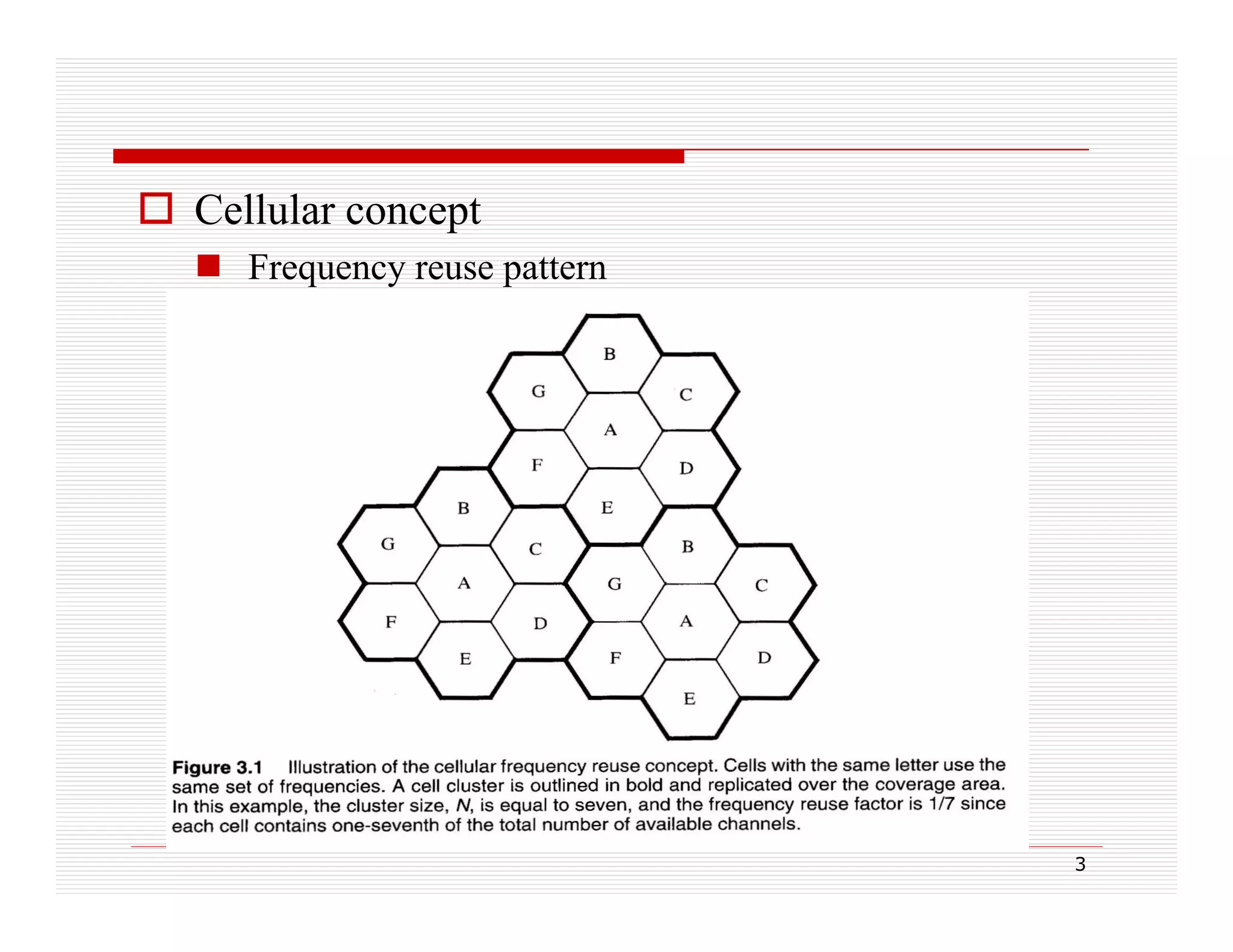
 Cellular concept
 Frequency reuse pattern

3
 Cells labeled with the same letter use the same
group of channels.
 C ll Cluster: group of N cells using complete set of
Cell Cl
f
ll
i
l
f
available channels
 Many base stations, lower power, and shorter
stations
power
towers
g
 Small coverage areas called “cells”
 Each cell allocated a % of the total number of
available channels
 Nearby (adjacent) cells assigned different channel
groups
 t prevent interference between neighboring base
to
ti t f
b t
i hb i b
stations and mobile users
4
 Same frequency channels may be reused by cells a
“reasonable” distance away
 reused many times as long as interference between same
channel (co-channel) cells is < acceptable level

 As frequency reuse↑ → # possible simultaneous
users↑→ # subscribers ↑→ but system cost ↑ (more
towers)
 To increase number of users without increasing radio
frequency allocation reduce cell sizes (more base
allocation,
stations) ↑→ # possible simultaneous users ↑
 The cellular concept allows all mobiles to be
manufactured to use the same set of freqencies
f
d
h
ff
i
 *** A fixed # of channels serves a large # of users
by reusing channels in a coverage area ***
5
II. Frequency Reuse/Planning

 Design process of selecting & allocating
channel groups of cellular base stations
 Two competing/conflicting objectives:
1) maximize frequency reuse in specified area
2) minimize interference between cells

6
 Cells
 base station antennas designed to cover specific cell
area
 hexagonal cell shape assumed for planning
 simple model for easy analysis → circles leave gaps
 actual cell “footprint” is amorphous (no specific shape)
 where Tx successfully serves mobile unit

 base station location
 cell center → omni-directional antenna (360 coverage)
omni directional
(360°
 not necessarily in the exact center (can be up to R/4
from the ideal location)

7
 cell corners → sectored or directional antennas
on 3 corners with 120° coverage.
 very commom
 Note that what is defined as a “corner” is
somewhat flexible → a sectored antenna covers
120° of a hexagonal cell.
g
 So one can define a cell as having three antennas
in the center or antennas at 3 corners.

8
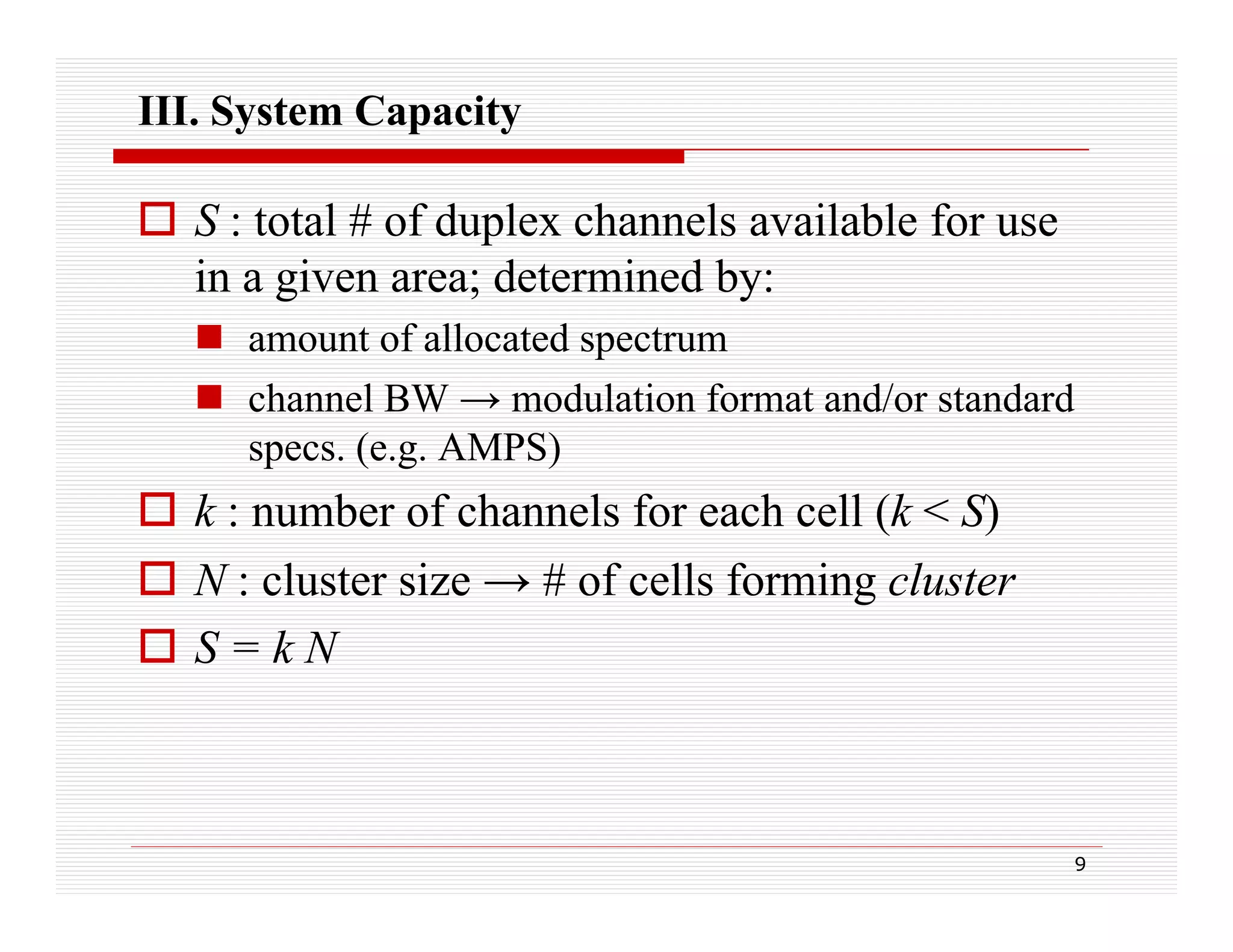
III. System Capacity

 S : total # of duplex channels available for use
in a given area; determined by:
g
;
y
 amount of allocated spectrum
 channel BW → modulation format and/or standard
specs. (e.g. AMPS)

 k : number of channels for each cell (k < S)
(
)
 N : cluster size → # of cells forming cluster
 S=kN

9
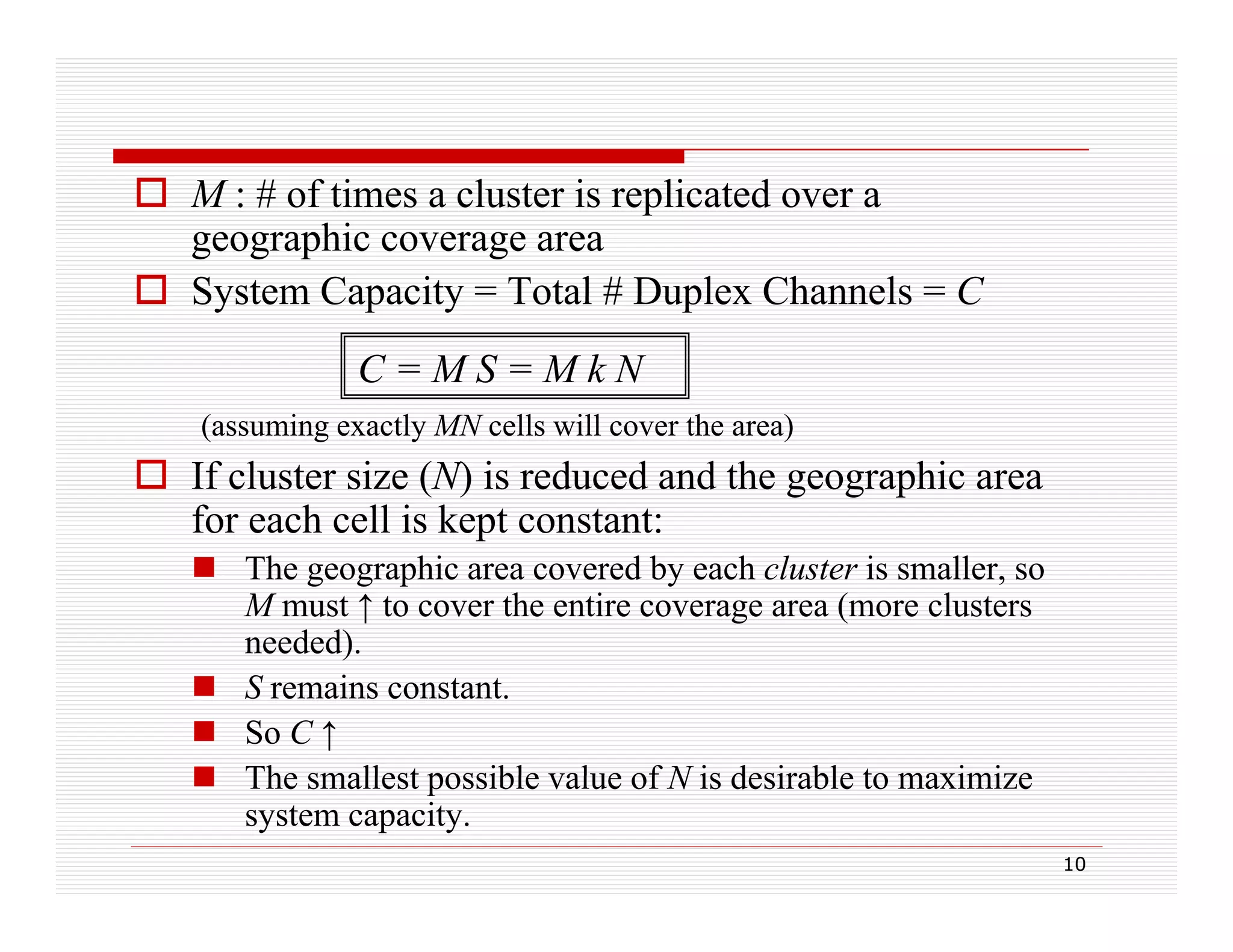
 M : # of times a cluster is replicated over a
geographic coverage area
 System Capacity = Total # Duplex Channels = C
C=MS=MkN
(assuming exactly MN cells will cover the area)
(
i
l
ll ill
h
)

 If cluster size (N) is reduced and the geographic area
for each cell is kept constant:
p
 The geographic area covered by each cluster is smaller, so
M must ↑ to cover the entire coverage area (more clusters
needed).
)
 S remains constant.
 So C ↑
 The smallest possible value of N is desirable to maximize
system capacity.
10
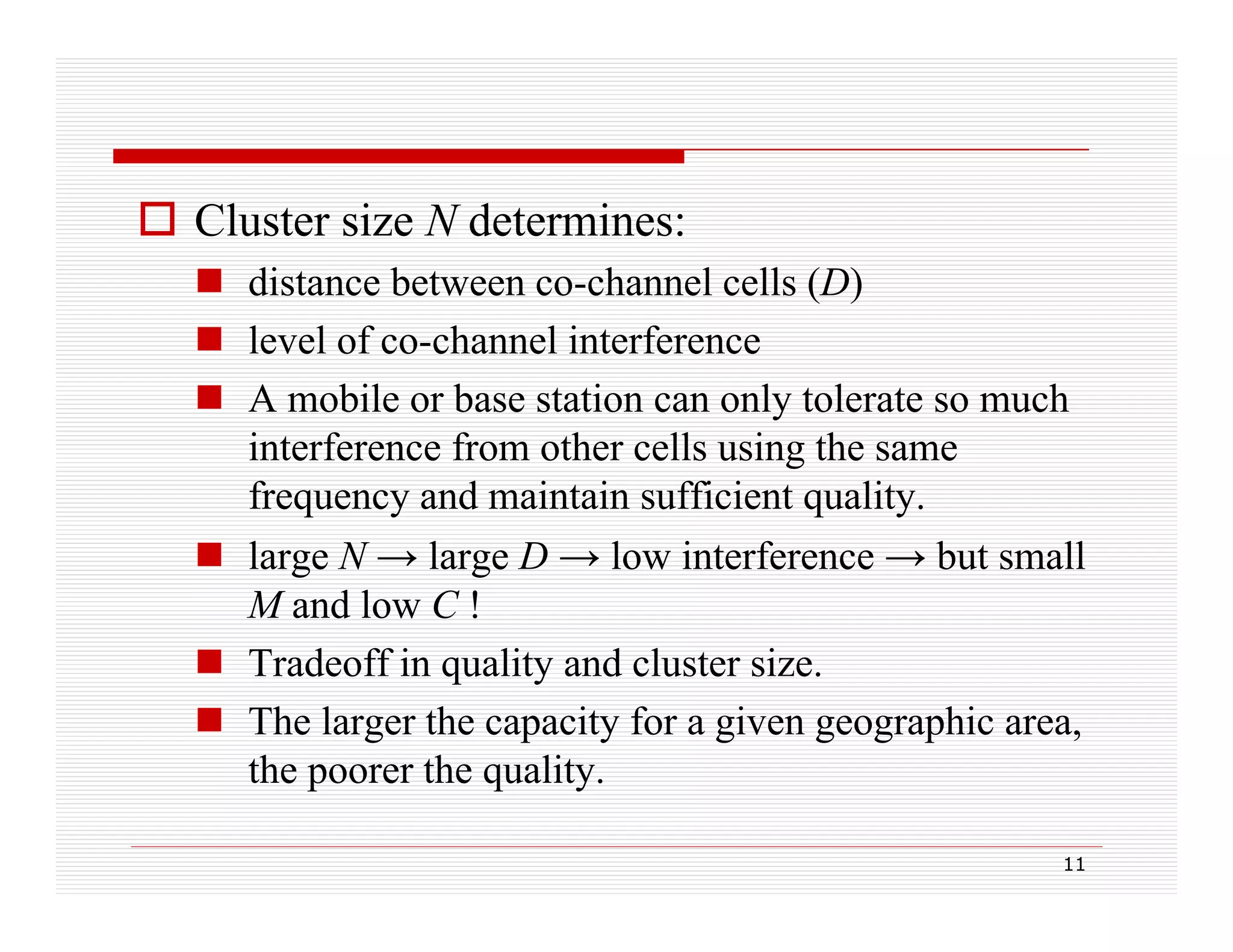
 Cluster size N determines:
 distance between co-channel cells (D)
( )
 level of co-channel interference
 A mobile or base station can only tolerate so much
y
interference from other cells using the same
frequency and maintain sufficient quality.
 large N → large D → low interference → but small
M and low C !
 T d ff i quality and cluster size.
Tradeoff in
lit
d l t i
 The larger the capacity for a given geographic area,
the poorer the quality
quality.
11
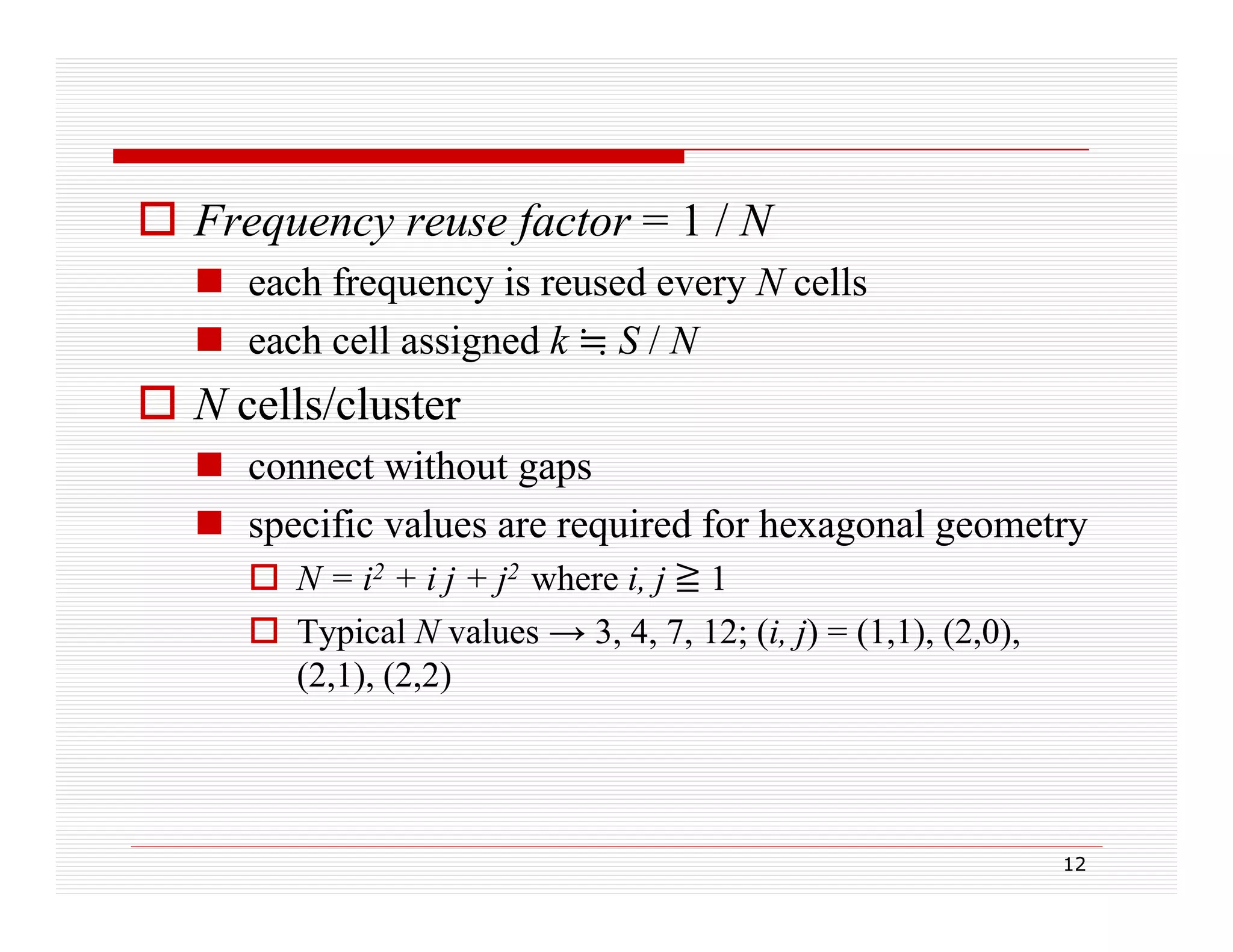
 Frequency reuse factor = 1 / N
 each frequency is reused every N cells
q
y
y
 each cell assigned k S / N

 N cells/cluster
 connect without gaps
 specific values are required for hexagonal geometry
 N = i2 + i j + j2 where i, j ≧ 1
 Typical N values → 3, 4, 7, 12; (i, j) = (1,1), (2,0),
(2,1), (2,2)

12
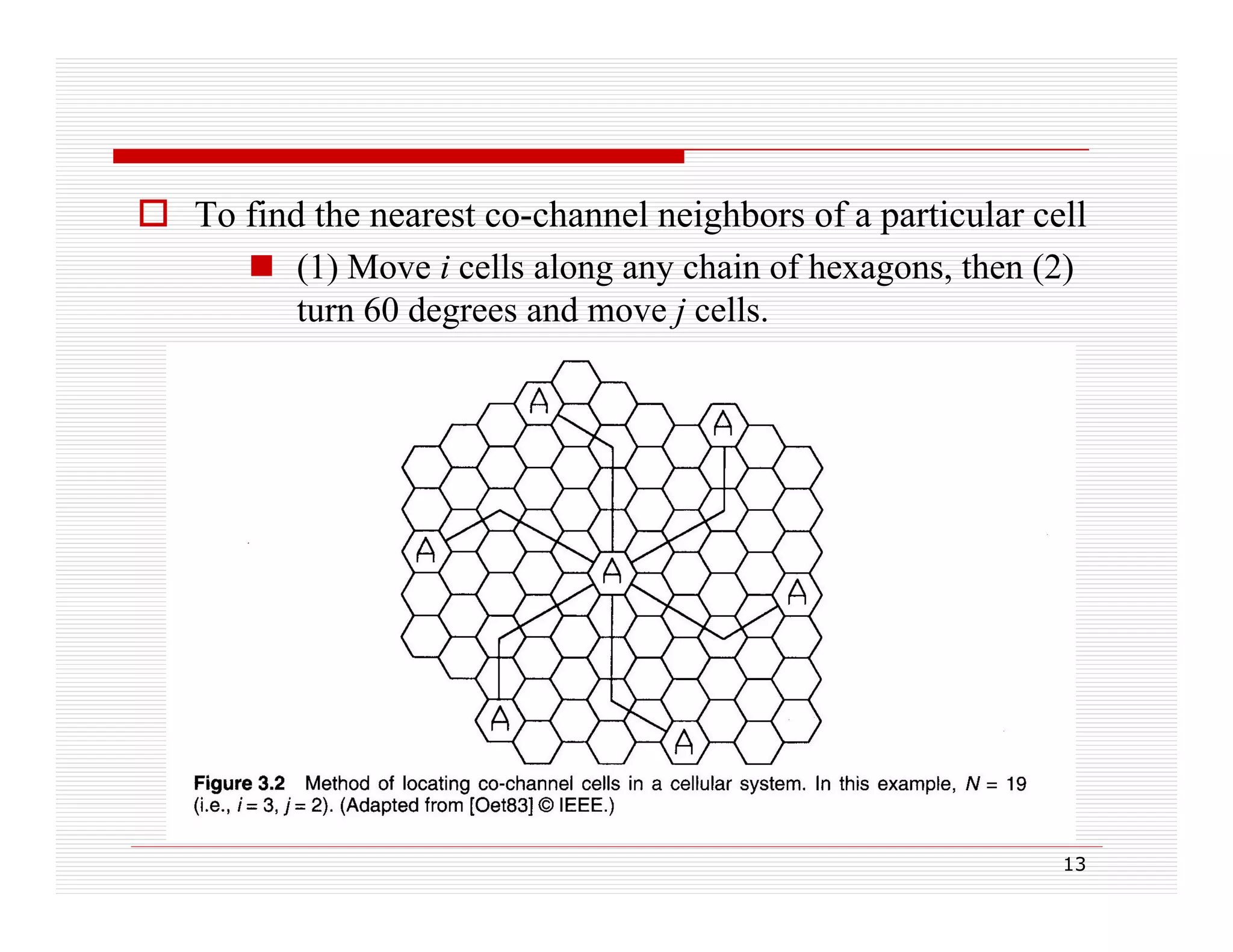
 To find the nearest co-channel neighbors of a particular cell
 (1) Move i cells along any chain of hexagons, then (2)
turn 60 degrees and move j cells.

13
14
15
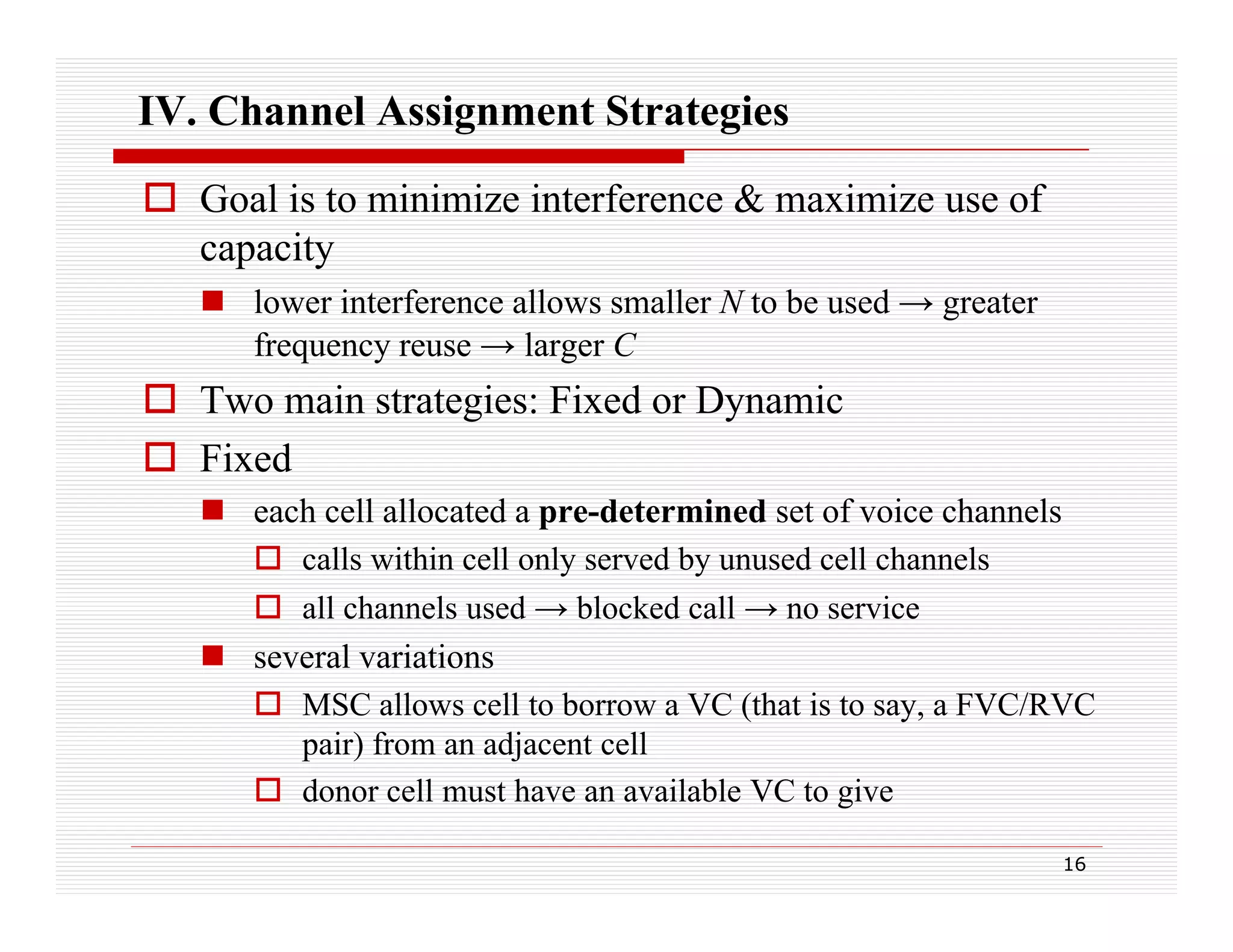
IV. Channel Assignment Strategies
 Goal is to minimize interference & maximize use of
capacity
 l
lower interference allows smaller N t be used → greater
i t f
ll
ll
to b
d
t
frequency reuse → larger C

 Two main strategies: Fixed or Dynamic
g
y
 Fixed
 each cell allocated a pre-determined set of voice channels
 calls within cell only served by unused cell channels
 all channels used → blocked call → no service
 several variations
 MSC allows cell to borrow a VC (that is to say, a FVC/RVC
pair) from an adjacent cell
 donor cell must have an available VC to give
16
 Dynamic
 channels NOT allocated permanently
 call request → goes to serving base station → goes
to MSC
 MSC allocates channel “on the fly”
 allocation strategy considers:
 lik lih d of future call blocking in the cell
likelihood f f t
ll bl ki i th
ll
 reuse distance (interference potential with other cells
that are using the same frequency)
 channel frequency

 All frequencies in a market are available to be used
17
 Advantage: reduces call blocking (that is to say,
it increases the trunking capacity), and
g p y),
increases voice quality
 Disadvantage: increases storage &
g
g
computational load @ MSC
 requires real-time data from entire network related
q
to:
 channel occupancy
 traffic distribution
 Radio Signal Strength Indications (RSSI's) from all
channels
18
V. Handoff Strategies

 Handoff: when a mobile unit moves from one
cell to another while a call is in progress, the
p g
,
MSC must transfer (handoff) the call to a new
channel belonging to a new base station
 new voice and control channel frequencies
 very important task → often given higher priority
than new call
 It is worse to drop an in-progress call than to deny a
new one

19
 Minimum useable signal level





lowest acceptable voice quality
c
call is dropped if be ow this level
s d opped below s eve
specified by system designers
typical values → -90 to -100 dBm
yp

20
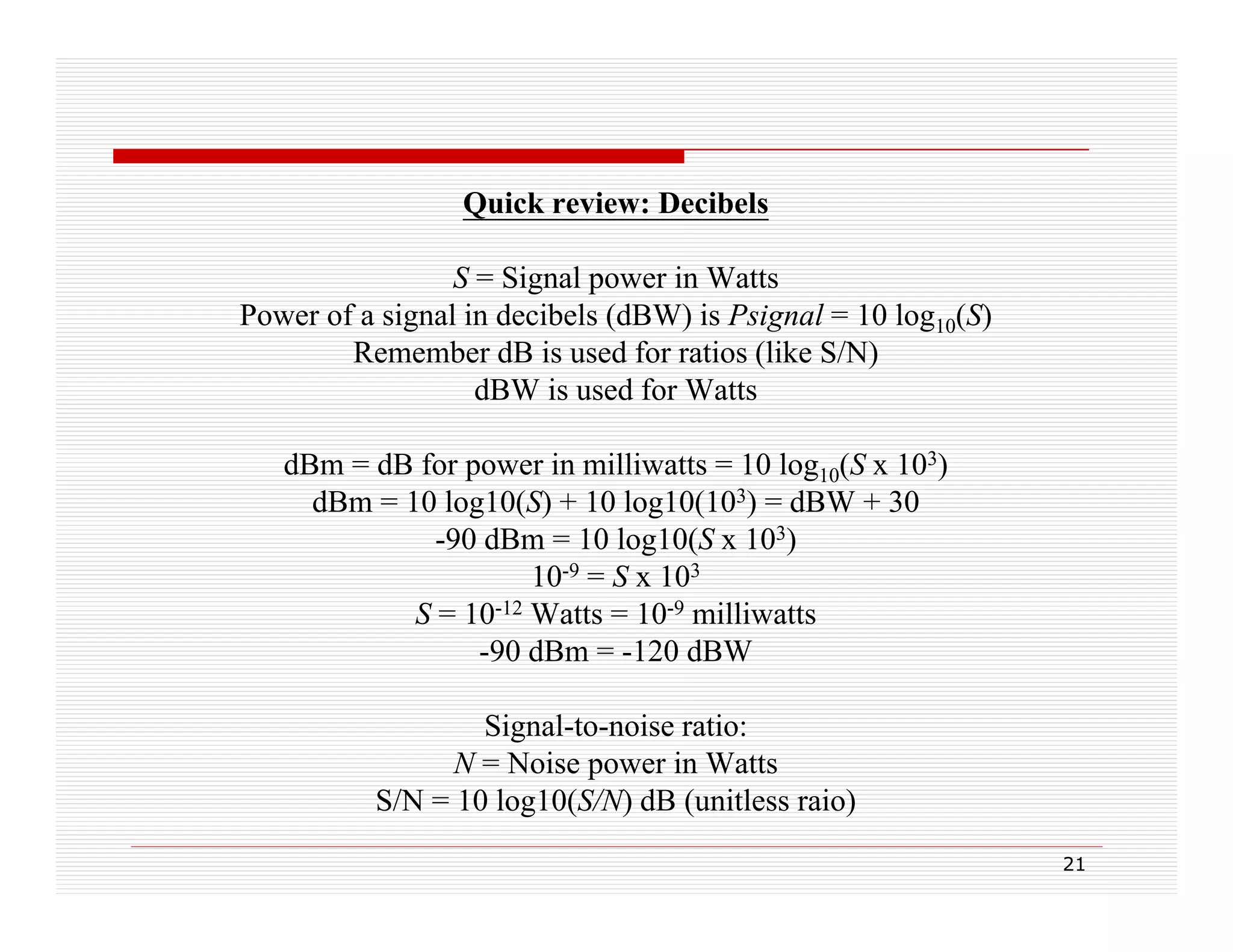
Quick review: Decibels
S = Signal power in Watts
Power of a signal in decibels (dBW) is Psignal = 10 log10(S)
Remember dB is used for ratios (like S/N)
dBW is used for Watts
dBm = dB for power in milliwatts = 10 log10(S x 103)
dBm = 10 log10(S) + 10 log10(103) = dBW + 30
-90 dBm = 10 log10(S x 103)
90
10-9 = S x 103
S = 10-12 Watts = 10-9 milliwatts
-90 dBm = -120 dBW
90
120
Signal-to-noise ratio:
p
N = Noise power in Watts
S/N = 10 log10(S/N) dB (unitless raio)
21
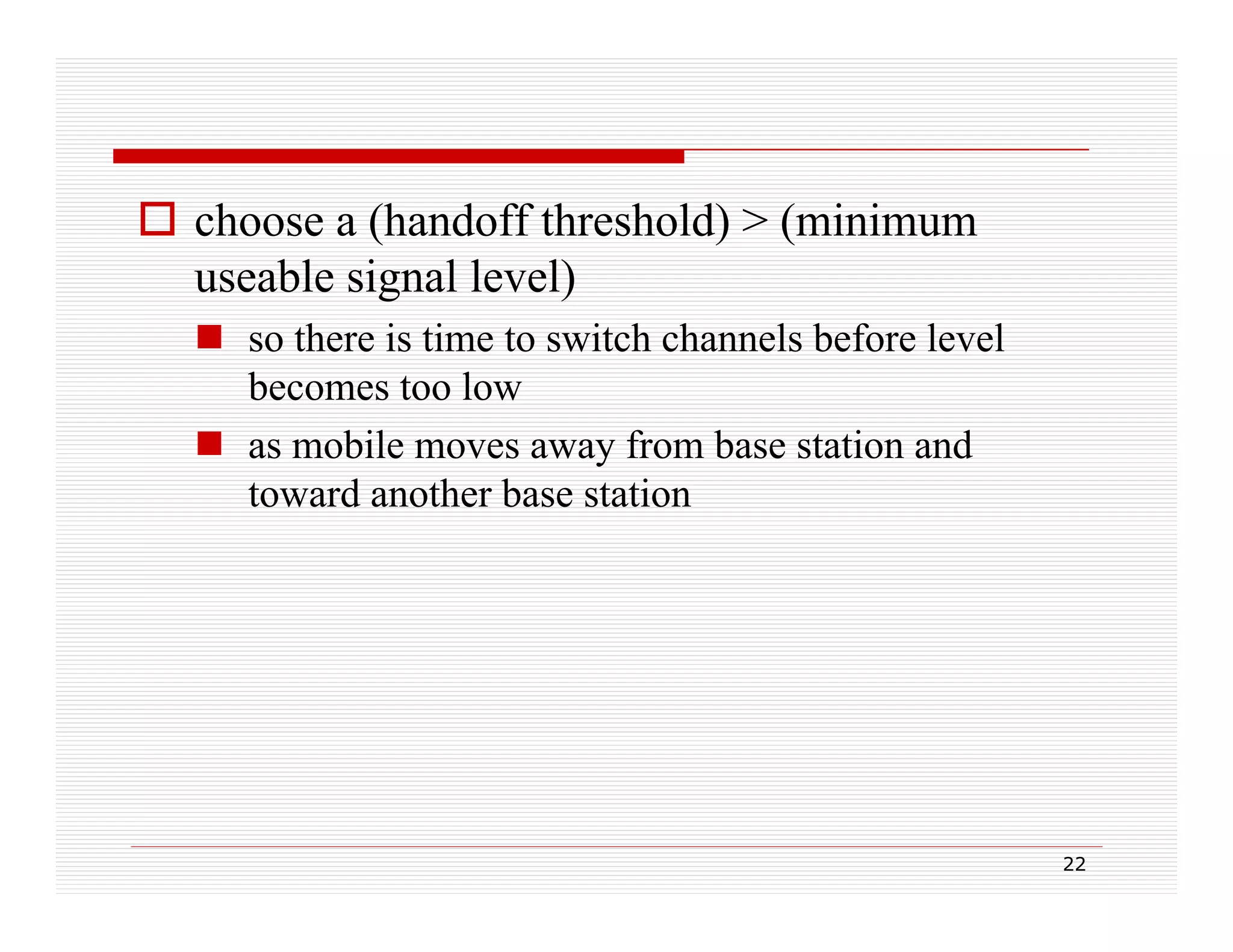
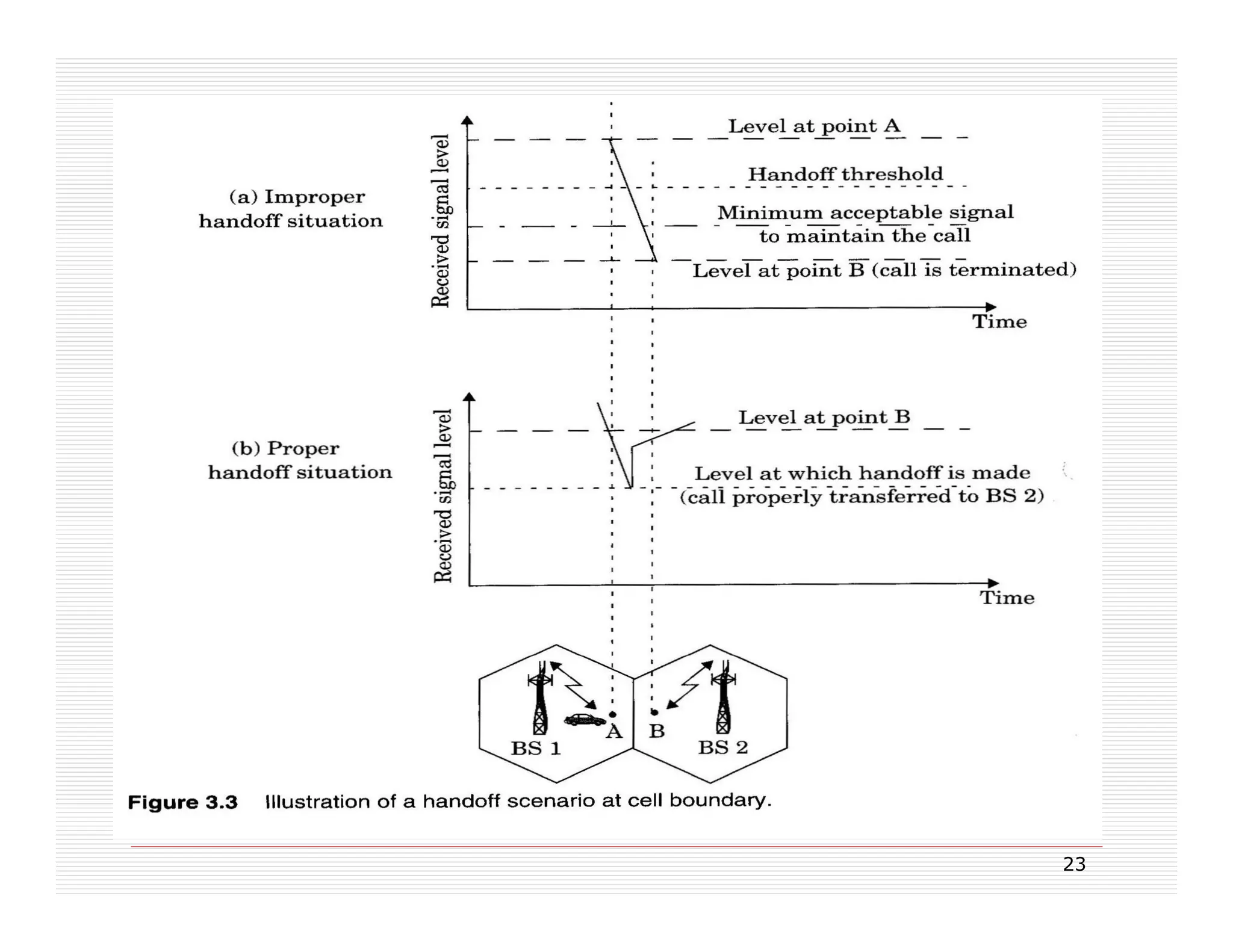
 choose a (handoff threshold) > (minimum
useable signal level)
g
)
 so there is time to switch channels before level
becomes too low
 as mobile moves away from base station and
toward another base station

22
23
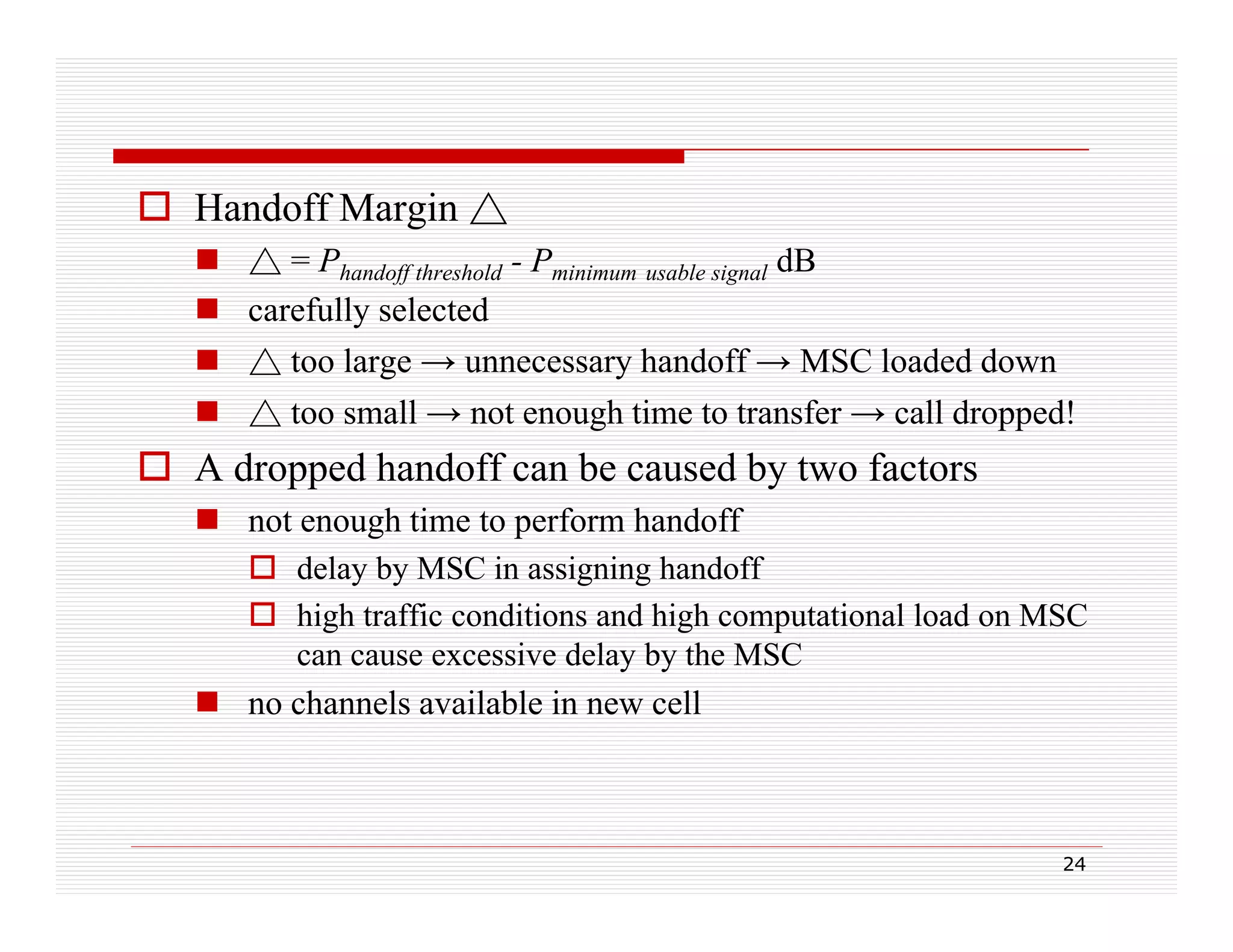
 Handoff Margin △
 △ = Phandoff threshold - Pminimum usable signal dB
 carefully selected
 △ too large → unnecessary handoff → MSC loaded down
 △ too small → not enough time to transfer → call dropped!

 A dropped handoff can be caused by two factors
 not enough time to p
g
perform handoff
 delay by MSC in assigning handoff
 high traffic conditions and high computational load on MSC
can cause excessive delay by the MSC
 no channels available in new cell

24
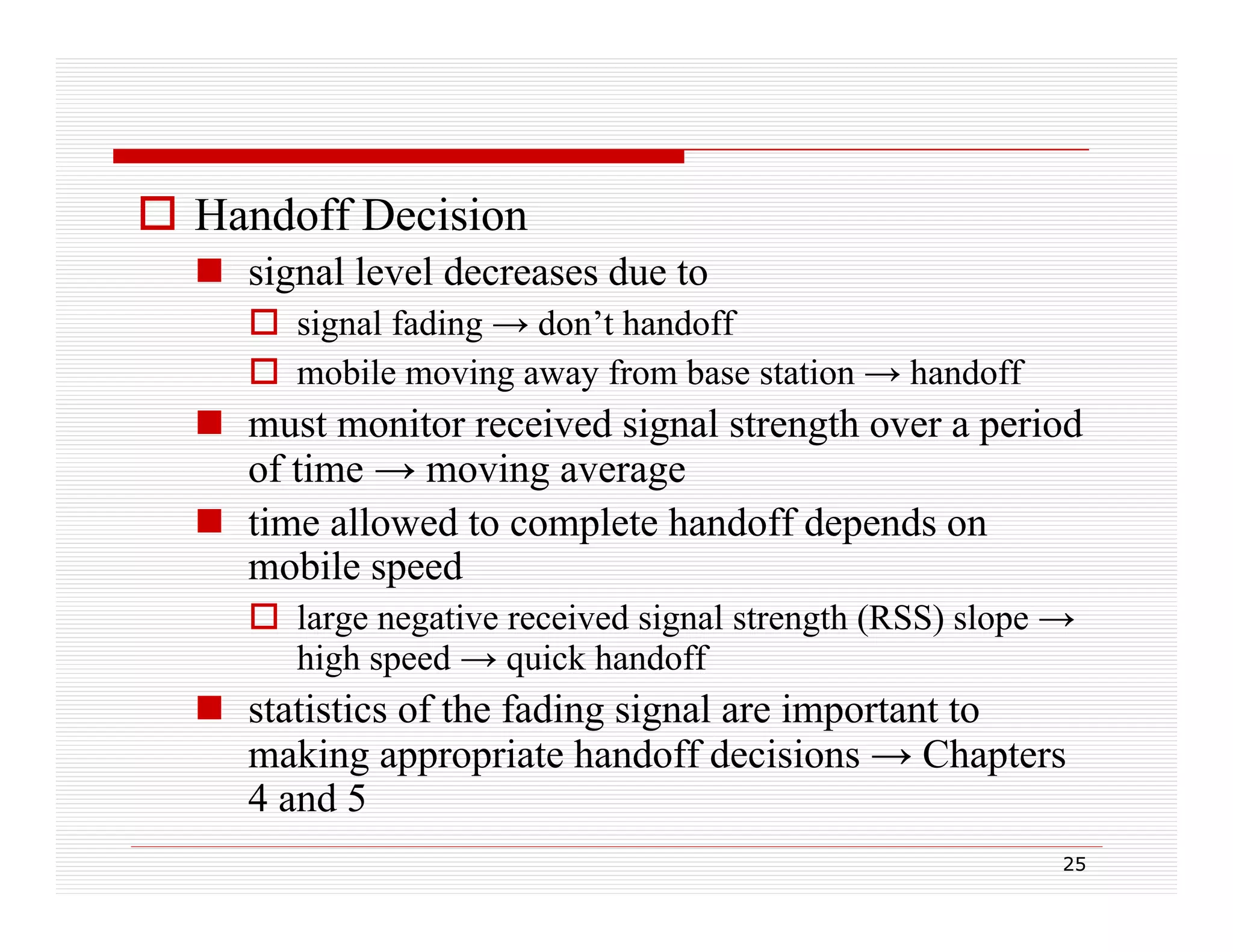
 Handoff Decision
 signal level decreases due to
 signal fading → don’t handoff
 mobile moving away from base station → handoff

 must monitor received signal strength over a period
t
it
i d i l t
th
i d
of time → moving average
 time allowed to complete handoff depends on
t e a owed co p ete a do depe ds o
mobile speed
 large negative received signal strength (RSS) slope →
high speed → quick handoff

 statistics of the fading signal are important to
g pp p
p
making appropriate handoff decisions → Chapters
4 and 5
25
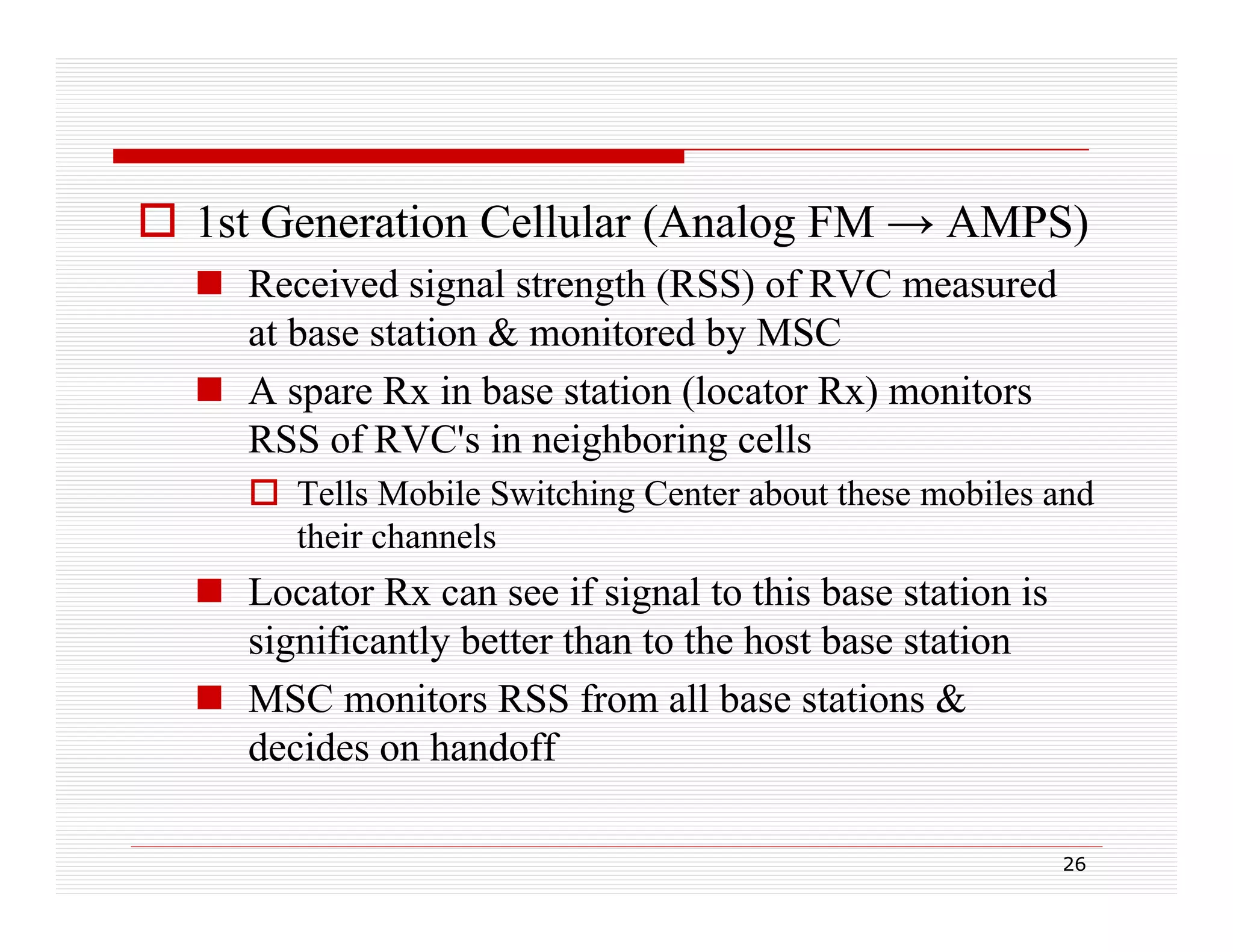
 1st Generation Cellular (Analog FM → AMPS)
 Received signal strength (RSS) of RVC measured
at base station & monitored by MSC
 A spare Rx in base station (locator Rx) monitors
RSS of RVC's in neighboring cells
 Tells Mobile Switching Center about these mobiles and
their channels

 Locator Rx can see if signal to this base station is
significantly better than to the host base station
g
y
 MSC monitors RSS from all base stations &
decides on handoff
26
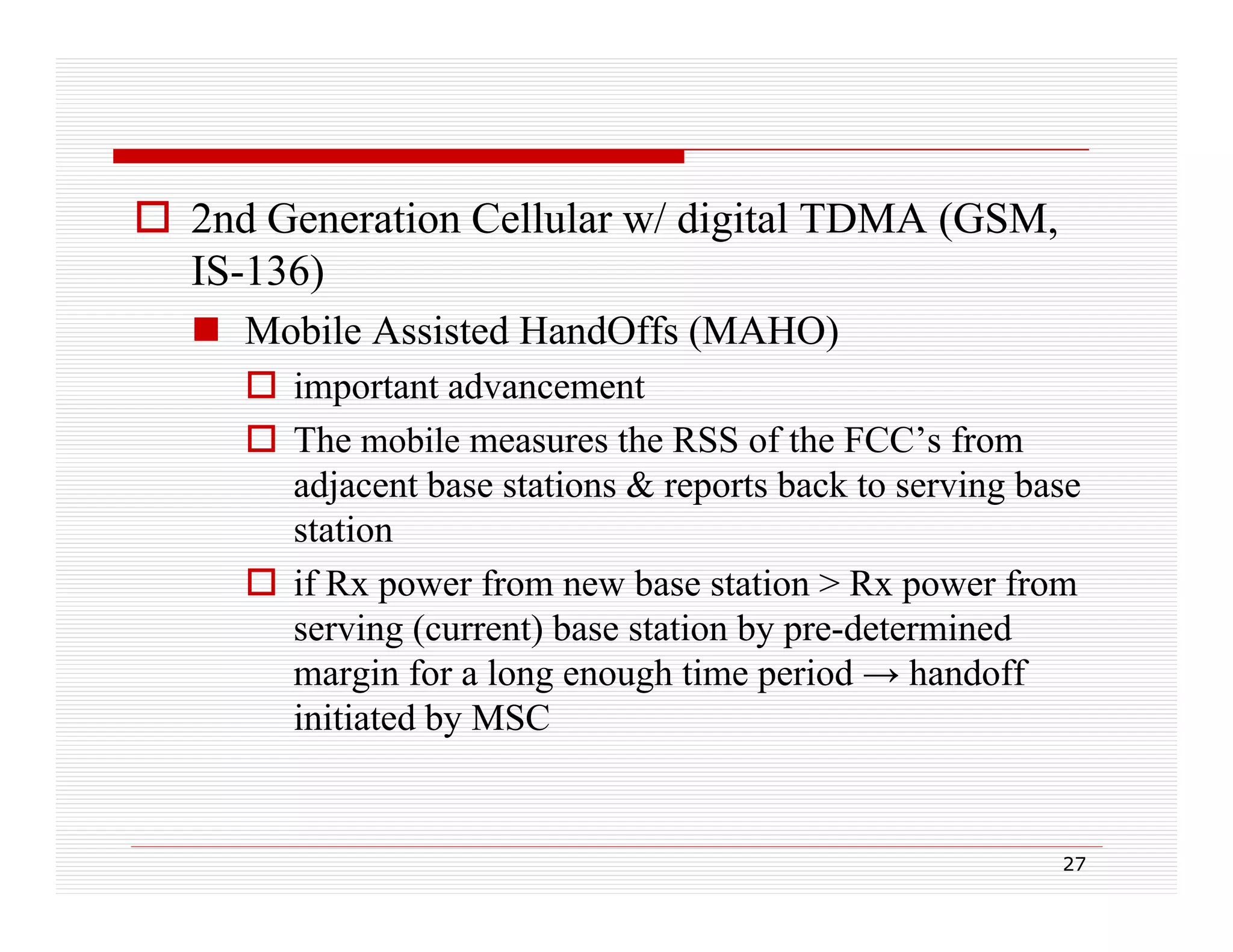
 2nd Generation Cellular w/ digital TDMA (GSM,
IS-136)
 Mobile Assisted HandOffs (MAHO)
 important advancement
 The mobile measures the RSS of the FCC’s from
adjacent base stations & reports back to serving base
station
 if Rx power from new base station > Rx power from
serving (current) base station by pre-determined
margin for a long enough time period → handoff
initiated by MSC

27
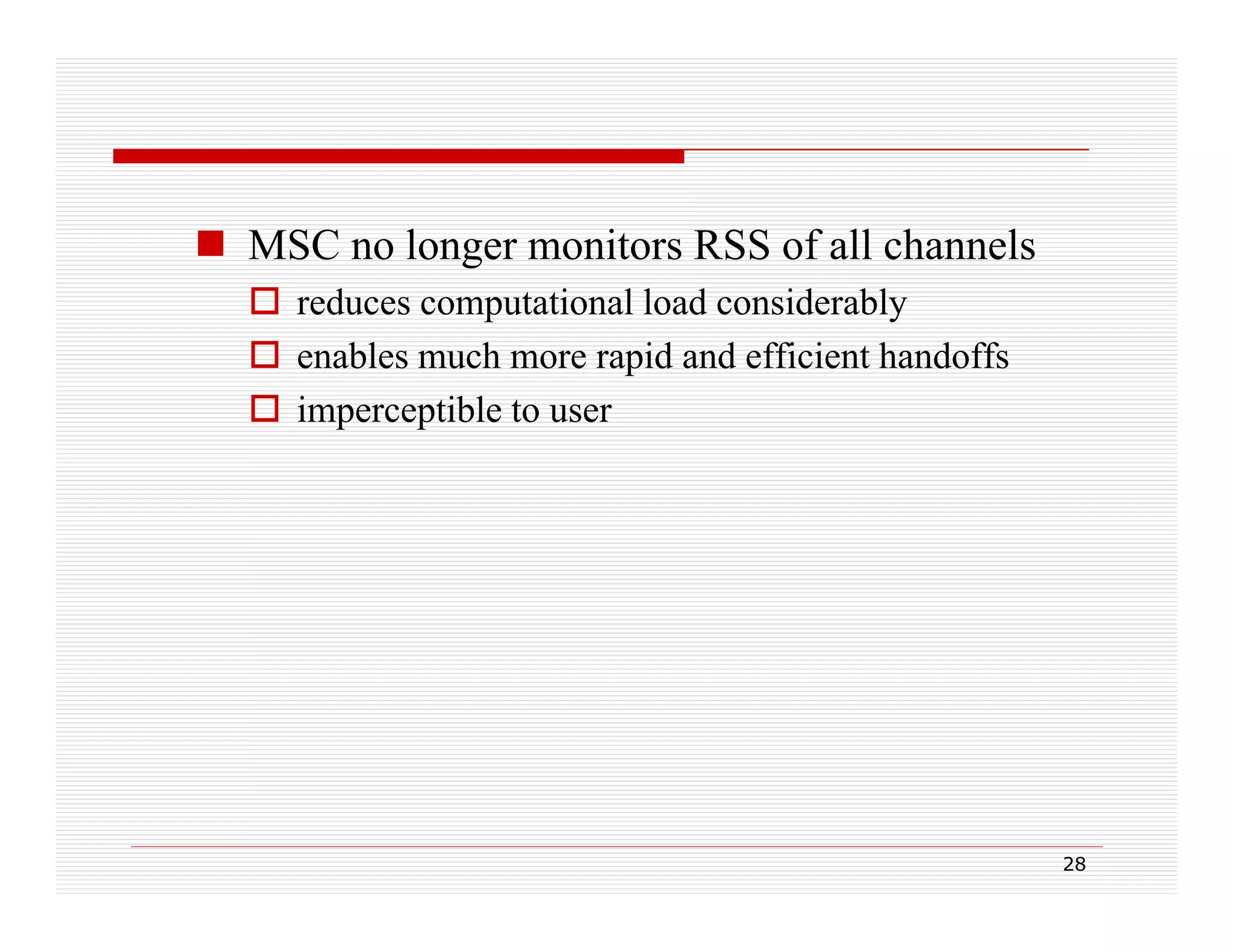
 MSC no longer monitors RSS of all channels
 reduces computational load considerably
d
t ti l l d
id bl
 enables much more rapid and efficient handoffs
 imperceptible to user

28
 A mobile may move into a different system
controlled by a different MSC
 Called an intersystem handoff
 What issues would be involved here?

 Prioritizing Handoffs
 I
Issue: Perceived Grade of S i (GOS) – service
P
i d G d f Service
i
quality as viewed by users
 “quality” in terms of dropped or blocked calls (not
q
y
pp
(
voice quality)
 assign higher priority to handoff vs. new call request
 a dropped call is more annoying than an occasional
blocked call
29
 Guard Channels
 % of total available cell channels exclusively set
aside for handoff requests
 makes fewer channels available for new call
requests
 a good strategy is dynamic channel allocation (not
fixed)
 adjust number of guard channels as needed by demand
 so channels are not wasted in cells with low traffic

30
 Queuing Handoff Requests
 use time delay between handoff threshold and
y
minimum useable signal level to place a blocked
handoff request in queue
 a handoff request can "keep trying" during that time
period, instead of having a single block/no block
decision
 prioritize requests (based on mobile speed) and
handoff as needed
 calls will still be dropped if time period expires

31
VI. Practical Handoff Considerations

 Problems occur because of a large range of
mobile velocities
 pedestrian vs. vehicle user

 Small cell sizes and/or micro-cells → larger #
handoffs
 MSC load is heavy when high speed users are
passed between very small cells

32
 Umbrella Cells
 Fig. 3.4, pg 67
g
, pg.
 use different antenna heights and Tx power levels to
provide large and small cell coverage
 multiple antennas & Tx can be co-located at single
location if necessary (saves on obtaining new tower
licenses)
li
)
 large cell → high speed traffic → fewer handoffs
 small cell → l speed traffic
ll ll
low
d t ffi
 example areas: interstate highway passing thru
urban center office park, or nearby shopping mall
center,
park
33
34
 Cell Dragging
 low speed user w/ line of sight to base station (very strong
signal)
 strong signal changing slowly
 user moves into the area of an adjacent cell without handoff
 causes interference with adjacent cells and other cells
 Remember: handoffs help all users, not just the one which is
handed ff
h d d off.
 If this mobile is closer to a reused channel → interference for the other user using the same frequency
 So this mobile needs to hand off anyway, so other users
benefit because that mobile stays far away from them.

35
 Typical handoff parameters
 Analog cellular (1st generation)
 threshold margin △ ≈ 6 to 12 dB
 total time to complete handoff ≈ 8 to 10 sec

 Digital cellular (2nd generation)
 total time to complete handoff ≈ 1 to 2 sec
 l
lower necessary threshold margin △ ≈ 0 t 6 dB
th h ld
i
to
 enabled by mobile assisted handoff

36
 benefits of small handoff time
 greater flexibility in handling high/low speed
g
y
g g
p
users
 queuing handoffs & prioritizing
 more time to “rescue” calls needing urgent
handoff
f
fewer d
dropped calls → GOS i
d ll
increased
d
 can make decisions based on a wide range of
metrics other than signal strength
 such as also measure interference levels
 can have a multidimensional algorithm for
making decisions
37
 Soft vs. Hard Handoffs
 Hard handoff: different radio channels assigned
when moving from cell to cell
 all analog (AMPS) & digital TDMA systems (IS-136,
GS , etc.)
GSM, e c.)

 Many spread spectrum users share the same
frequency in every cell
 CDMA → IS-95
 Since a mobile uses the same frequency in every cell, it
can also be assigned the same code for multiple cells
when it is near the boundary of multiple cells.
 The MSC simultaneously monitors reverse link signal
at several base stations
38
 MSC dynamically decides which signal is best
and then listens to that one
 Soft Handoff
 passes data from that base station on to the PSTN
p

 This choice of best signal can keep changing.
ob e user
ot g o a do s except
 Mobile use does nothing for handoffs e cept
just transmit, MSC does all the work
g
q
y
 Advantage unique to CDMA systems
 As long as there are enough codes available.

39
VII. Co-Channel Interference

 Interference is the limiting factor in
performance of all cellular radio systems
 What are the sources of interference for a
mobile receiver?
 Interference is in both
 voice channels
 control channels
l h
l

 Two major types of system-generated
interference:
1) Co-Channel Interference (CCI)
2) Adjacent Channel Interference (ACI)
40
 First we look at CCI
 Frequency Reuse
 Many cells in a given coverage area use the same
set of channel frequencies to increase system
q
y
capacity (C)
 Co-channel cells → cells that share the same set of
frequencies
 VC & CC traffic in co-channel cells is an
interfering source to mobiles in Several different
cells

41
 Possible Solutions?
1) Increase base station Tx p
)
power to improve radio
p
signal reception? __
 this will also increase interference from co-channel
cells by the same amount
ll b h
 no net improvement

2) Separate co-channel cells by some minimum
co channel
distance to provide sufficient isolation from
propagation of radio signals?
 if all cell sizes, transmit powers, and coverage patterns
≈ same → co-channel interference is independent of
Tx power
42
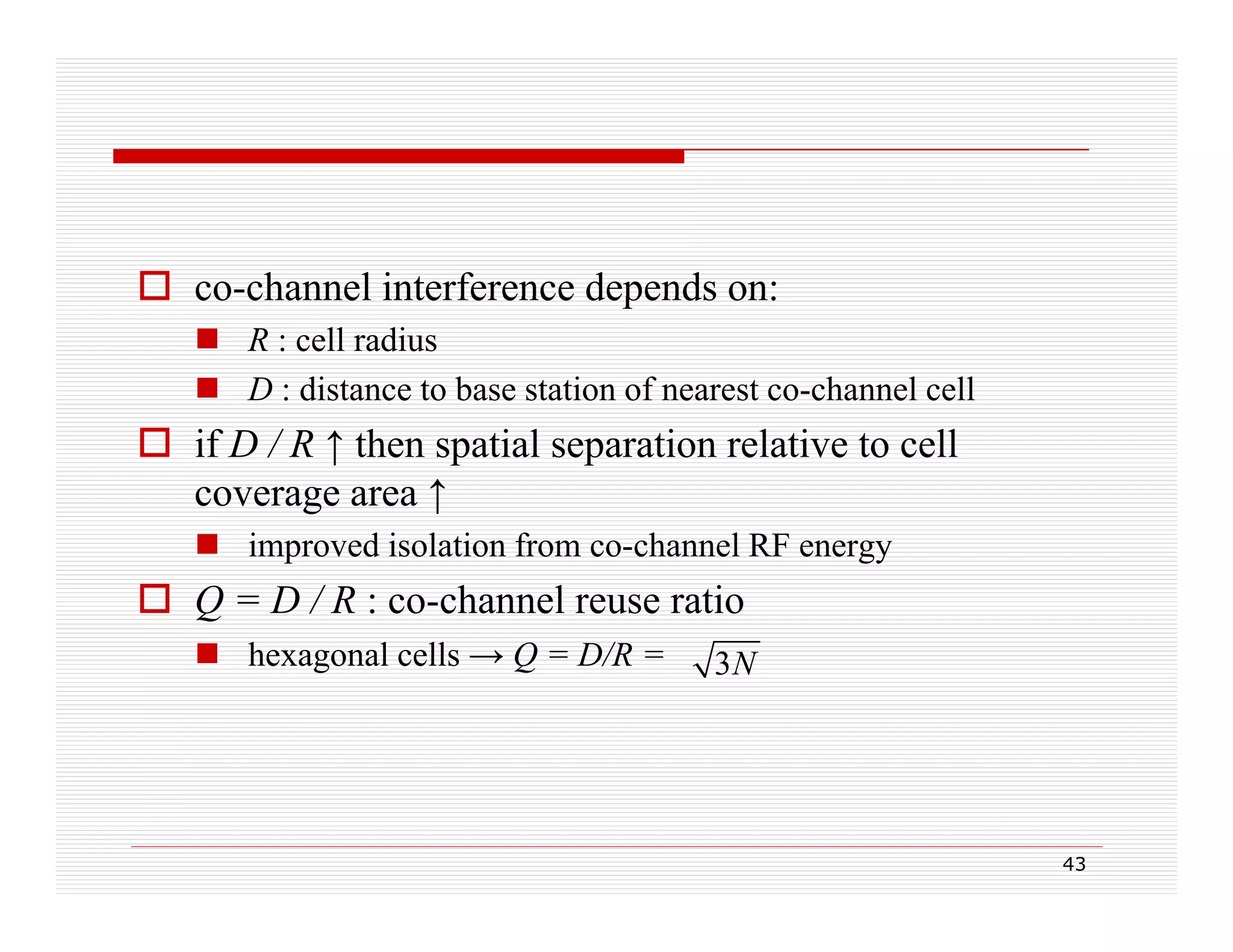
 co-channel interference depends on:
co channel
 R : cell radius
 D : distance to base station of nearest co-channel cell

 if D / R ↑ then spatial separation relative to cell
coverage area ↑
 i
improved isolation from co-channel RF energy
di l i f
h
l

 Q = D / R : co-channel reuse ratio
 hexagonal cells → Q = D/R =

3N

43
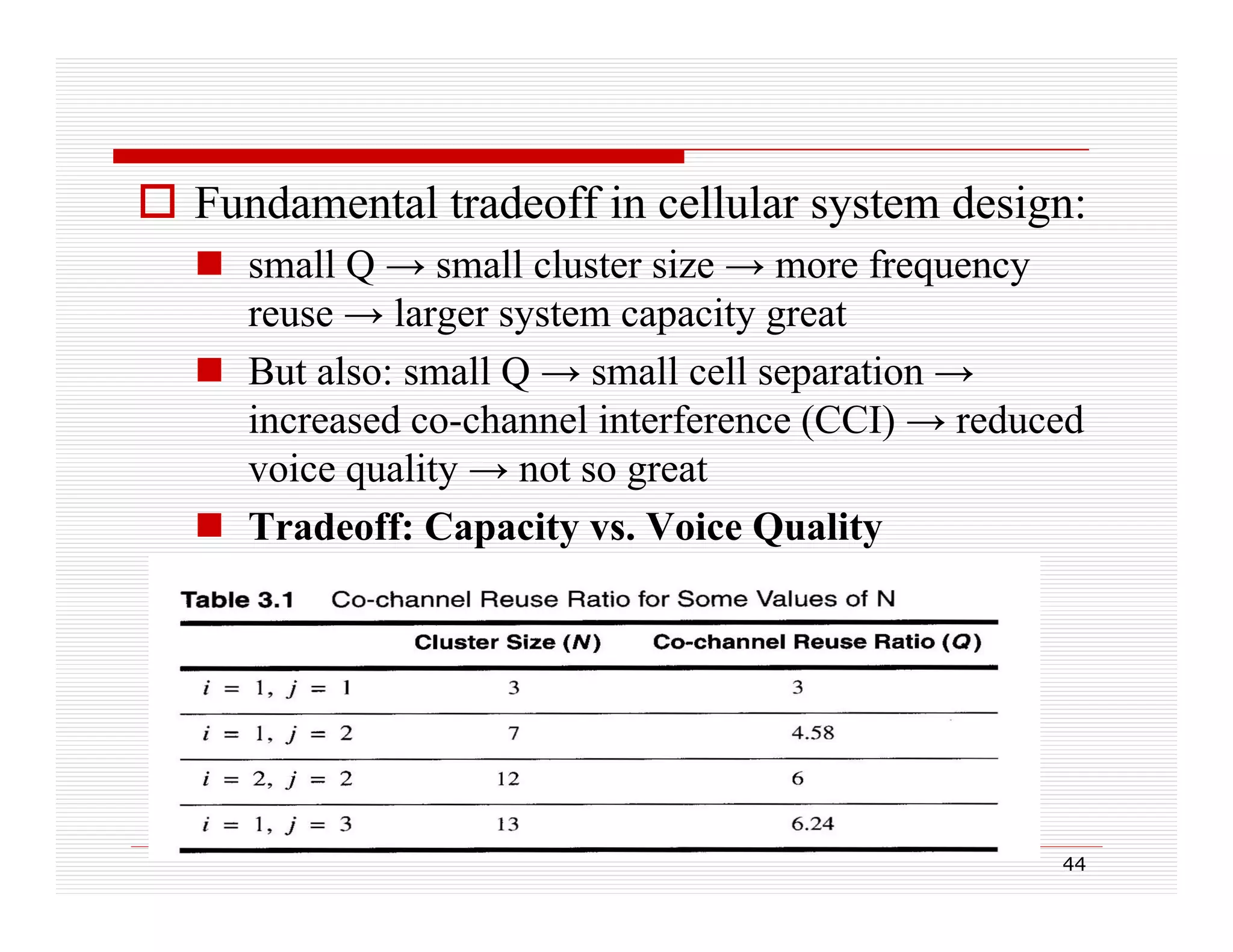
 Fundamental tradeoff in cellular system design:
 small Q → small cluster size → more frequency
reuse → larger system capacity great
 But also: small Q → small cell separation →
increased co-channel interference (CCI) → reduced
co channel
voice quality → not so great
 Tradeoff: Capacity vs. Voice Quality

44
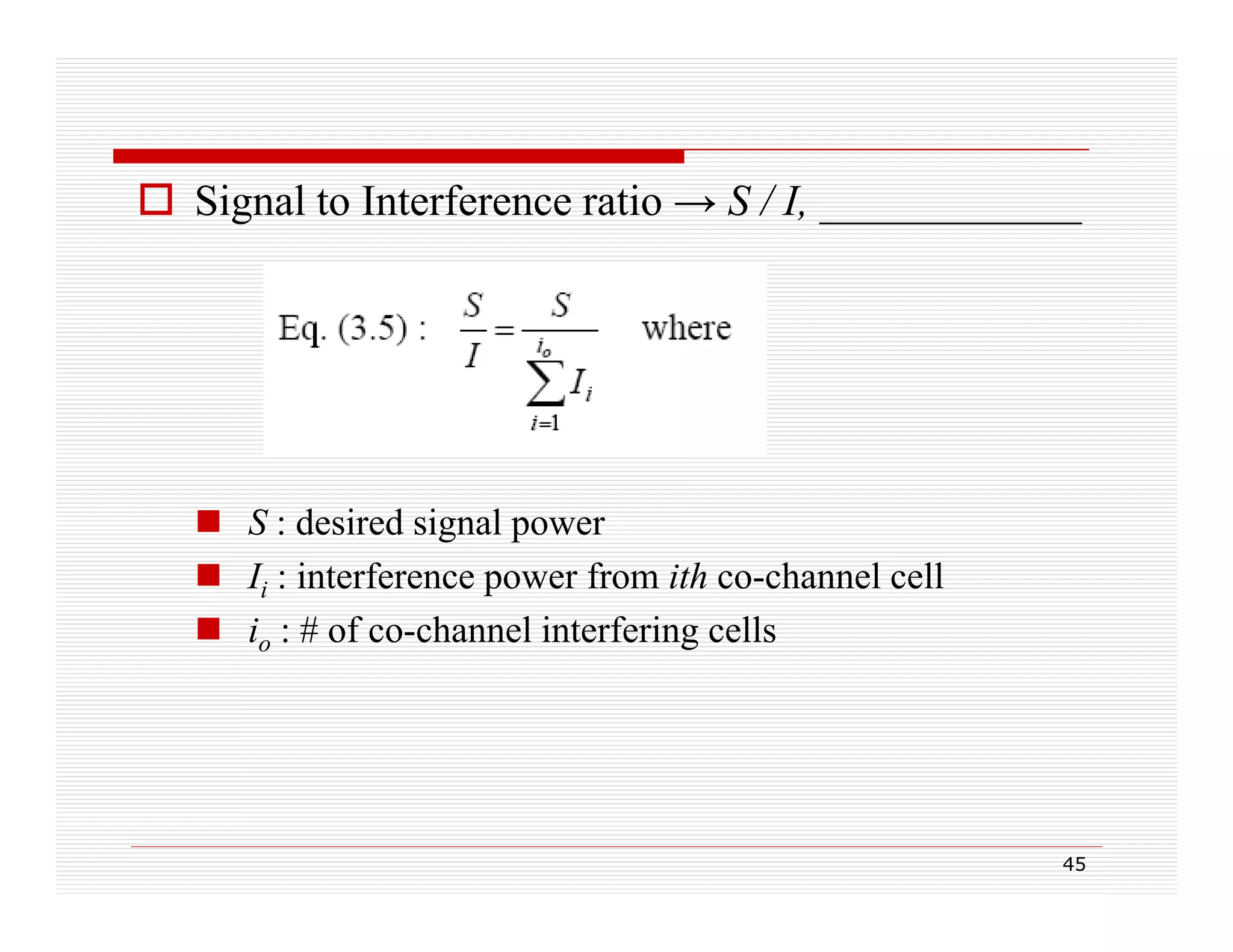
 Signal to Interference ratio → S / I, ____________

 S : desired signal p
g power
 Ii : interference power from ith co-channel cell
 io : # of co-channel interfering cells

45
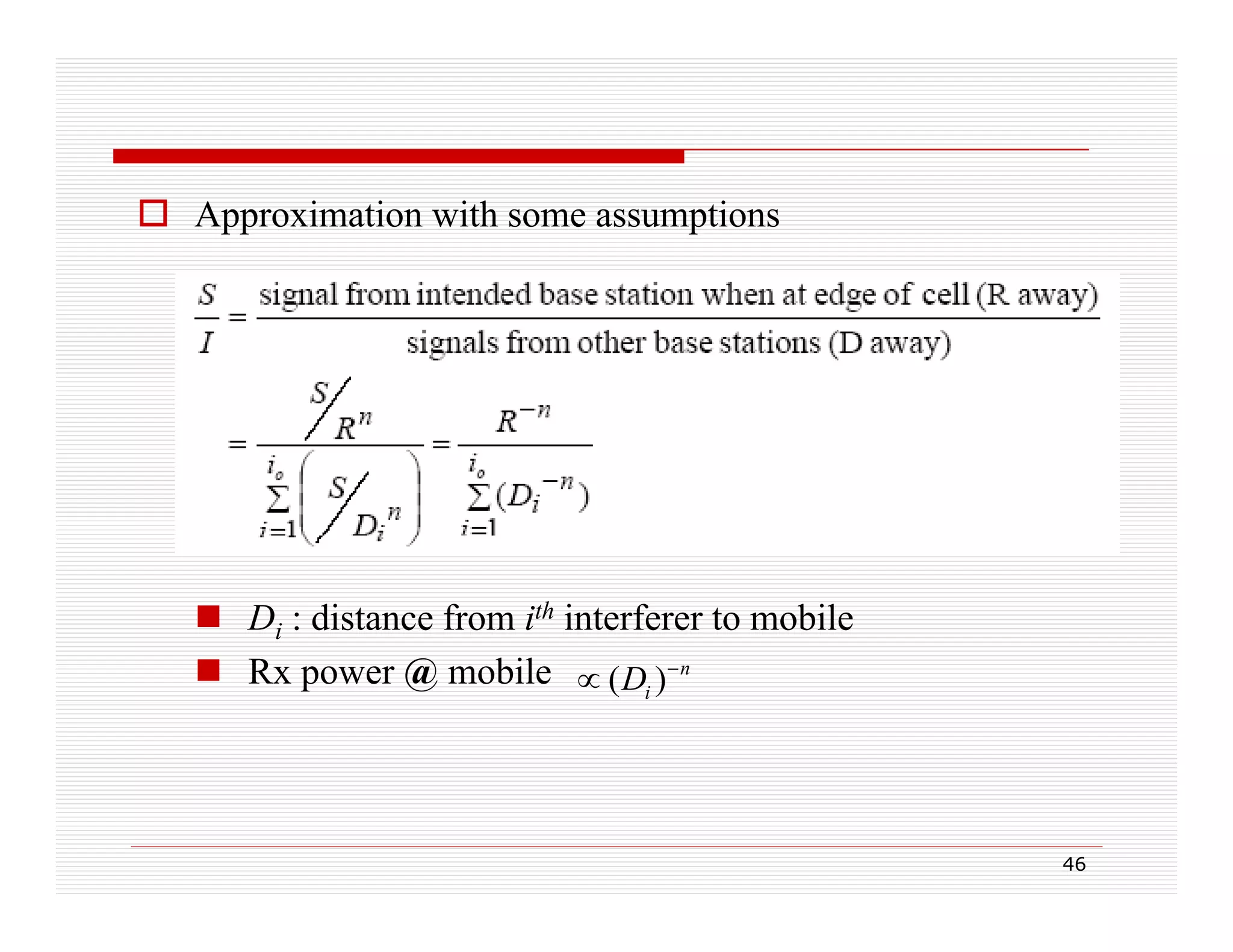
 Approximation with some assumptions

 Di : distance from ith interferer to mobile
 Rx power @ mobile  ( Di ) n

46
 n : path loss exponent
 free space or line of sight (LOS) (no obstruction) →
n=2
 urban cellular → n = 2 to 4, signal decays faster
with distance away from the base station
ith di t
f
th b
t ti
 having the same n throughout the coverage area
means radio propagation properties are roughly the
same everywhere
 if base stations have equal Tx power and n is the
q
p
same throughout coverage area (not always true)
then the above equation (Eq. 3.8) can be used.
47
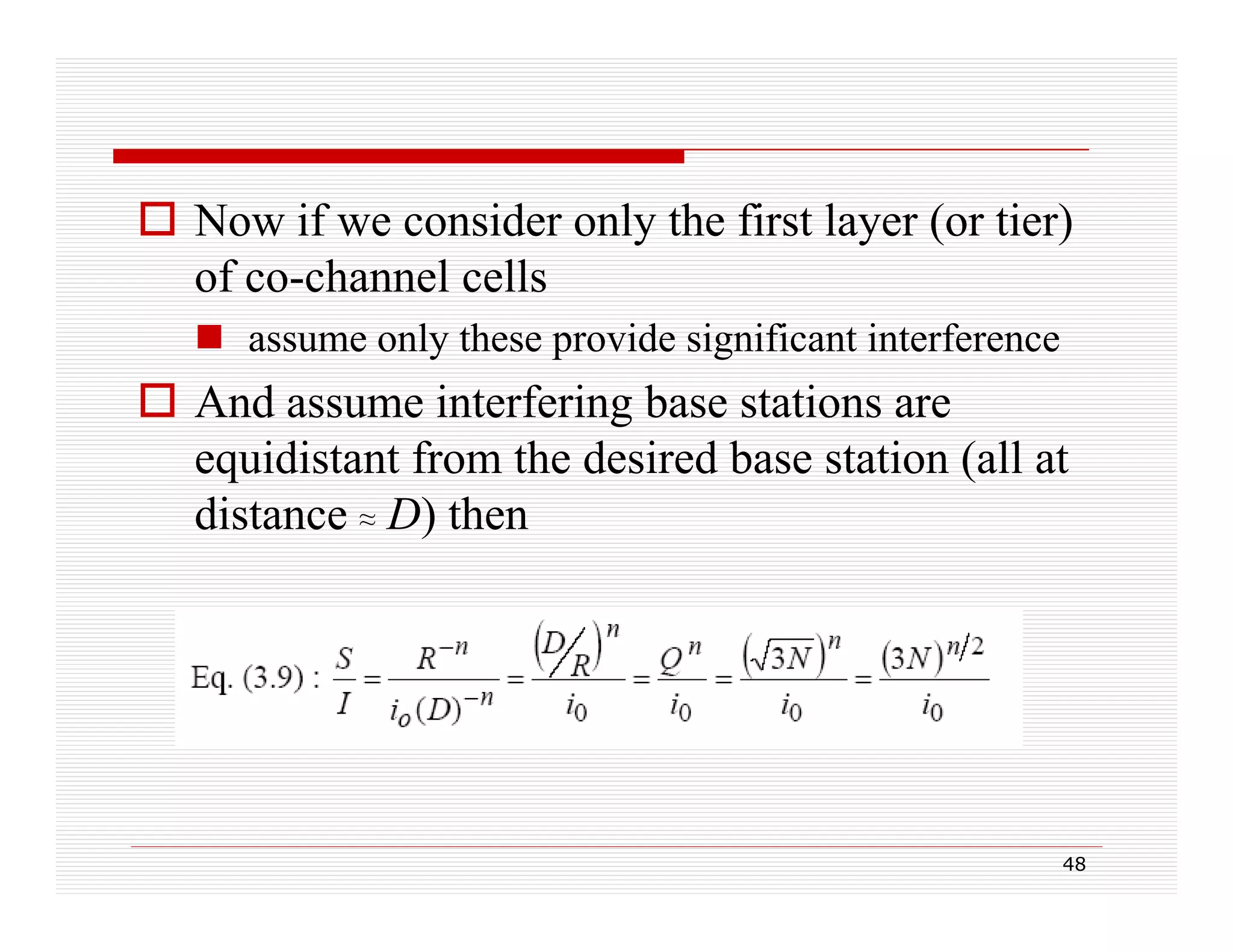
 Now if we consider only the first layer (or tier)
of co-channel cells
 assume only these provide significant interference

 And assume interfering base stations are
equidistant from the desired base station (all at
distance ≈ D) then
)

48
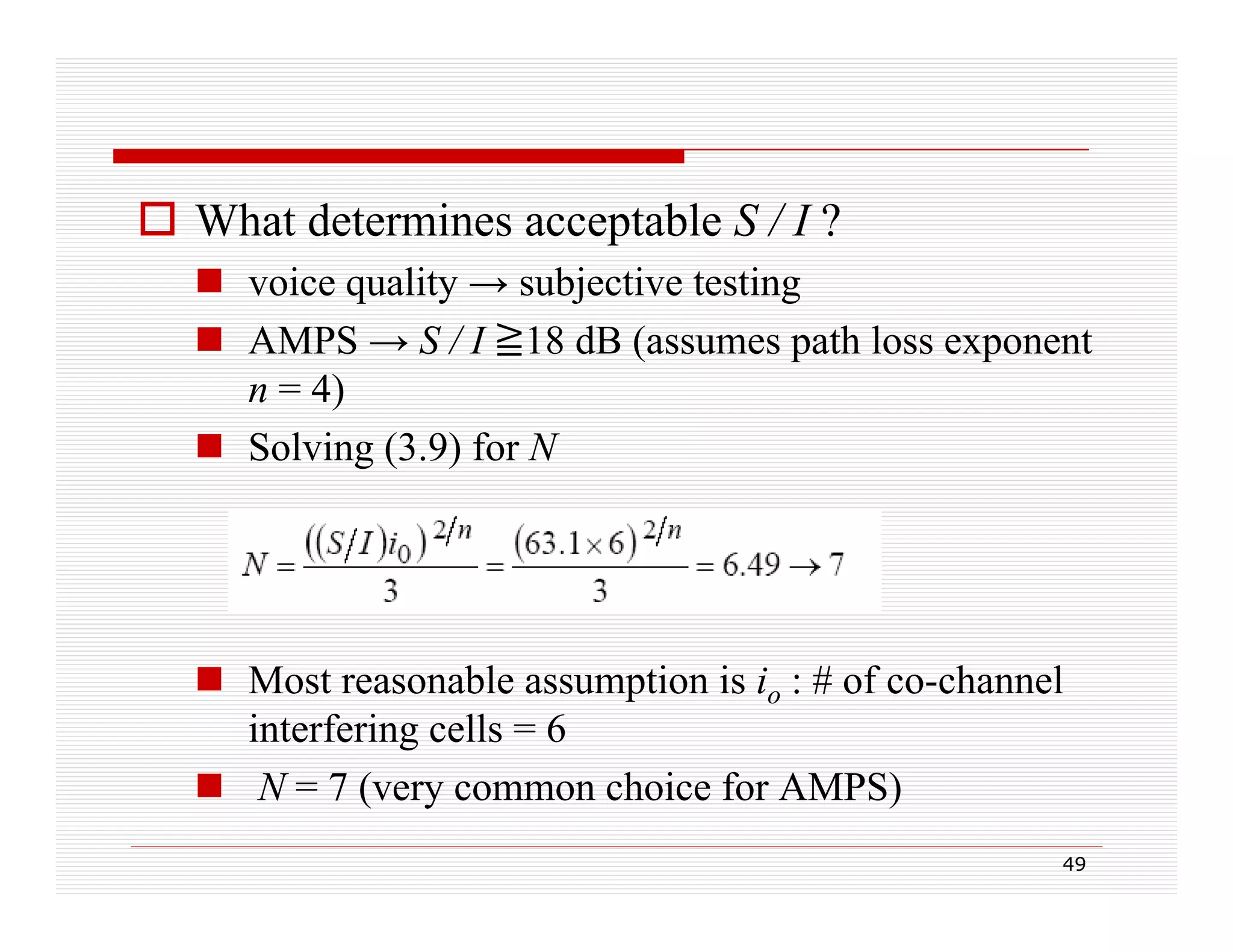
 What determines acceptable S / I ?
 voice quality → subjective testing
q
y
j
g
 AMPS → S / I 18 dB (assumes path loss exponent
n = 4)
 Solving (3.9) for N

 Most reasonable assumption is io : # of co-channel
interfering cells = 6
 N = 7 (very common choice for AMPS)
(
h i f
49
 Many assumptions involved in (3.9) :





same Tx power
p
hexagonal geometry
n same throughout area
g
Di ≈ D (all interfering cells are equidistant from the
base station receiver)
 optimistic result in many cases
 propagation tools are used to calculate S / I when
assumptions aren’t valid
i
lid

50
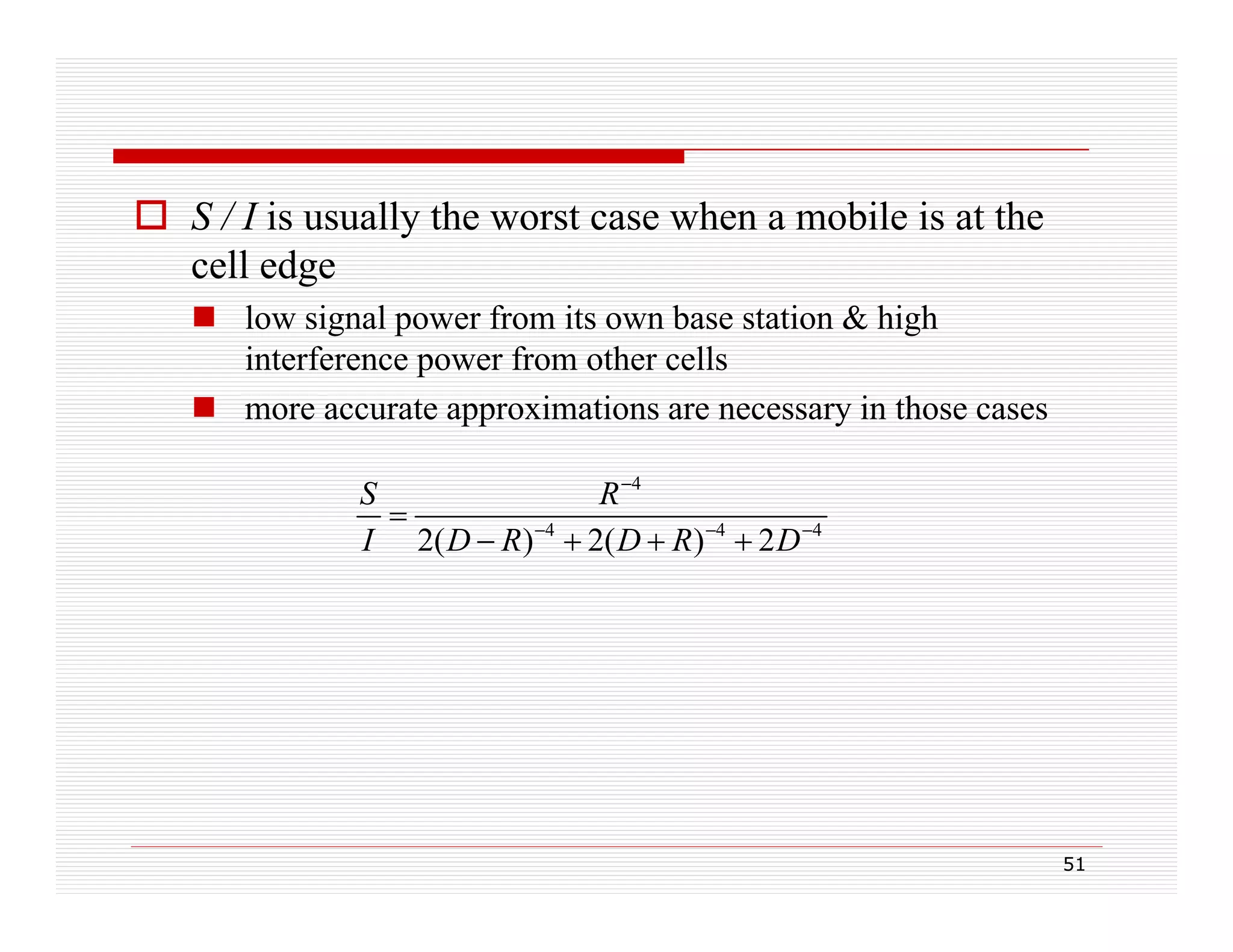
 S / I is usually the worst case when a mobile is at the
cell edge
 low signal power from its own base station & high
interference power from other cells
 more accurate approximations are necessary in those cases
S
R 4

I 2( D  R) 4  2( D  R) 4  2 D 4

51
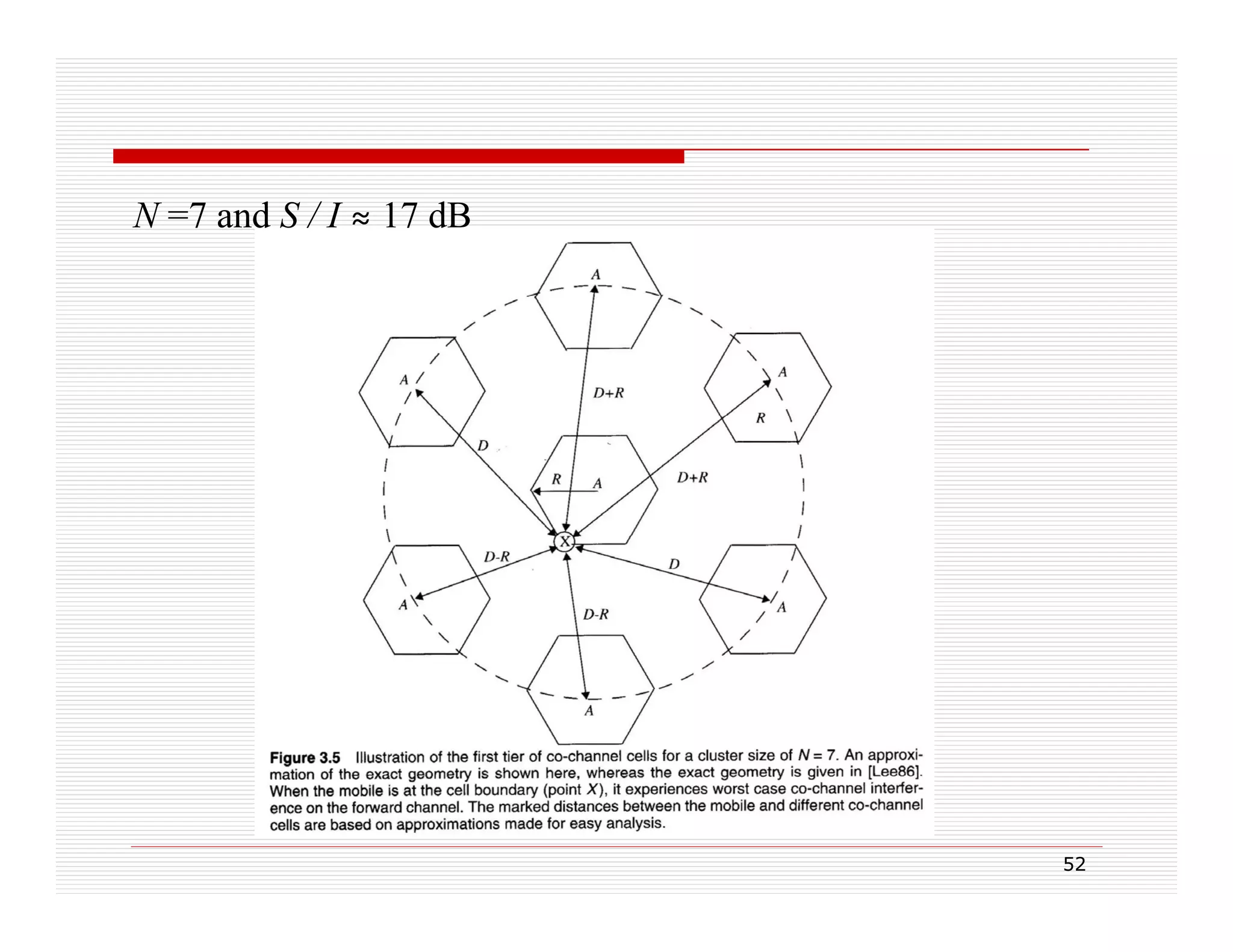
N =7 and S / I ≈ 17 dB

52
 Eq. (3.5), (3.8), and (3.9) are (S / I) for forward link
only, i.e. the cochannel base Tx interfering with
desired base station transmission to mobile unit
 so this considers interference @ the mobile unit

 What abo t reverse link co-channel interference?
about
co channel
 less important because signals from mobile antennas (near
the ground) don’t propagate as well as those from tall base
station antennas
 obstructions near ground level significantly attenuate mobile
energy in direction of base station Rx
 also weaker because mobile Tx power is variable → base
stations regulate transmit power of mobiles to be no larger
than necessary
53
I. Adjacent Channel Interference
 Two major types of system-generated
interference:
1) Co-Channel Interference (CCI) – discussed in last
lecture
2) Adjacent Channel Interference (ACI)

 Adjacent Channel Interference (ACI)
 Imperfect Rx filters allow energy from adjacent
channels to leak into the passband of other
channels
h
l

54
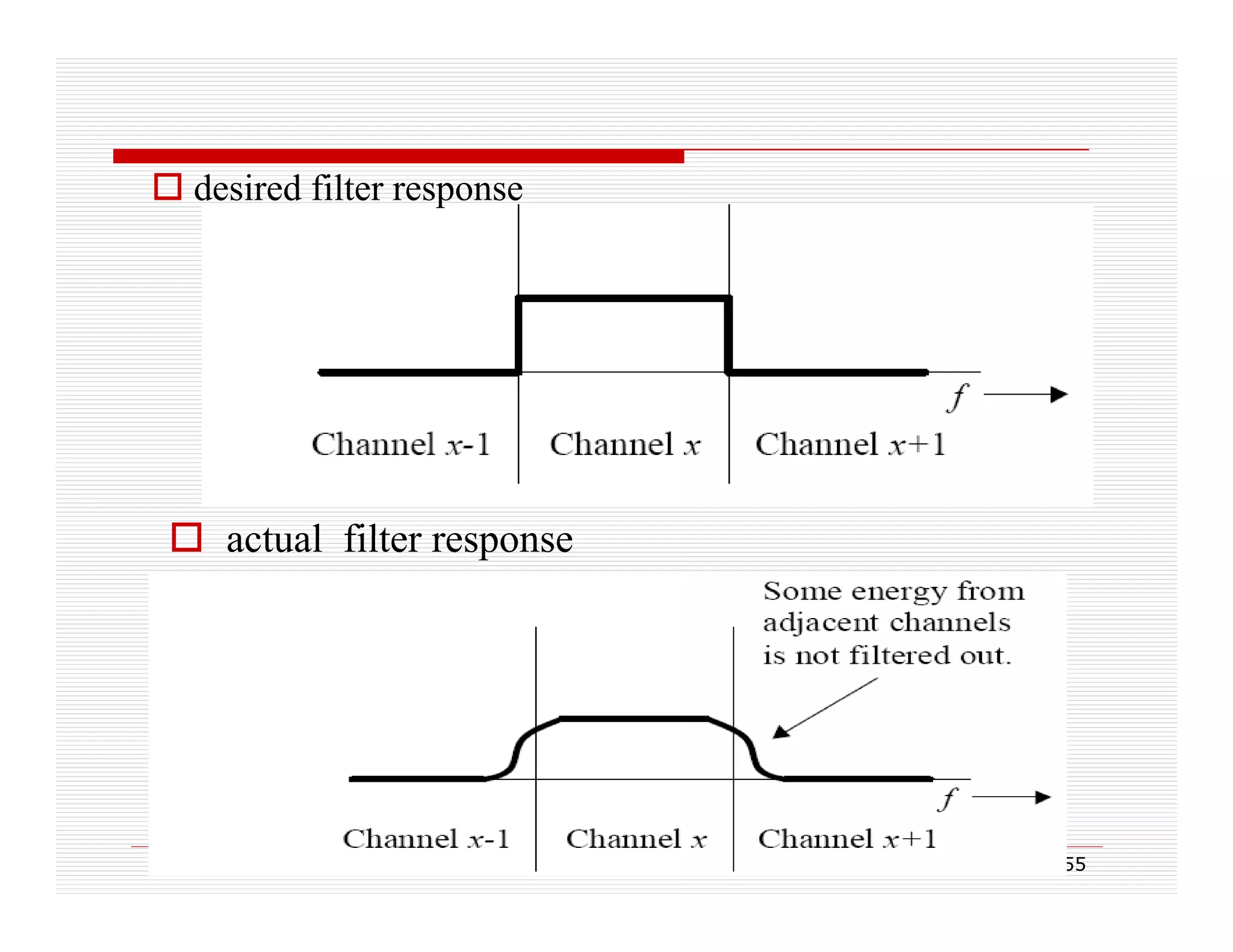
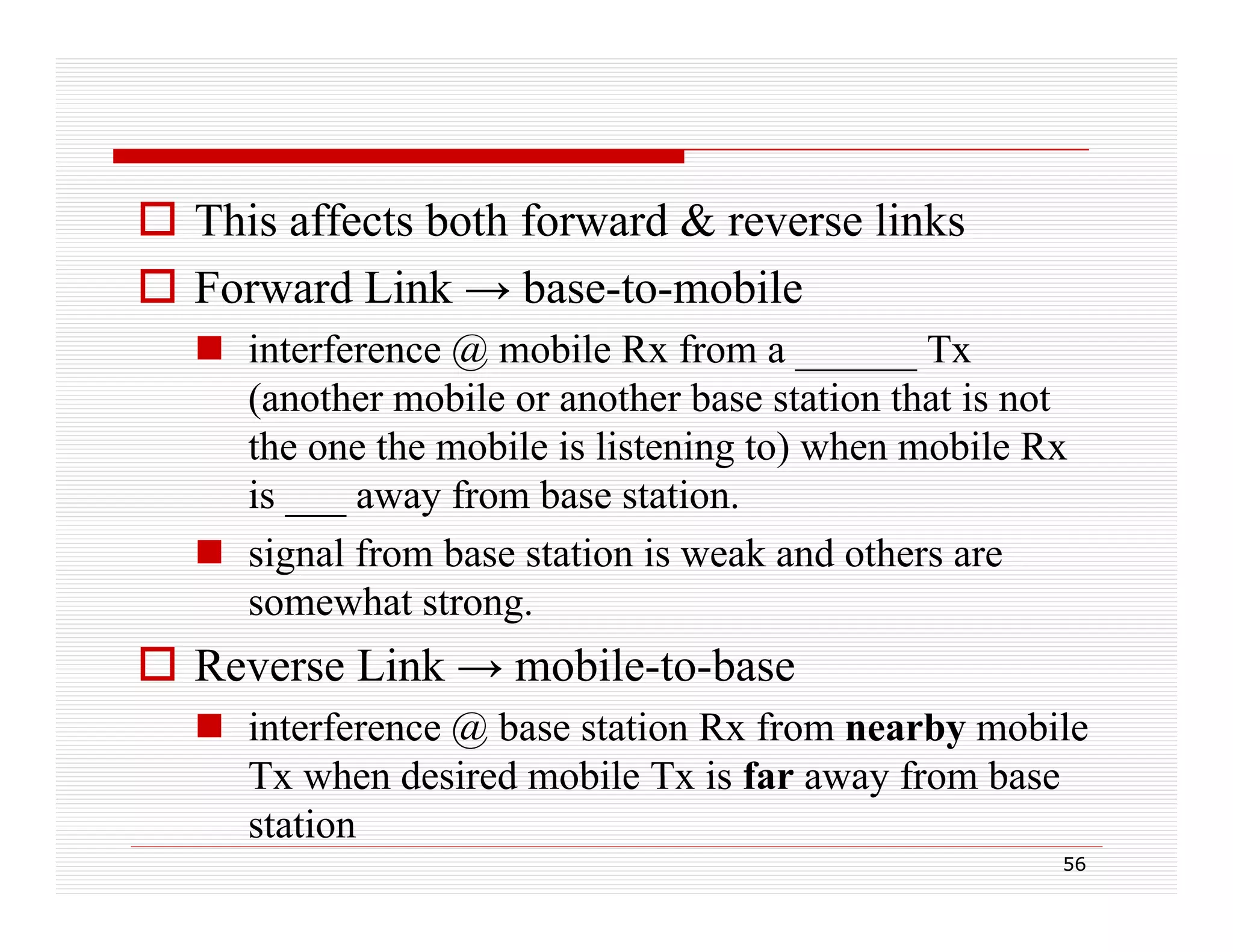
 d i d filter response
desired fil

 actual filter response

55
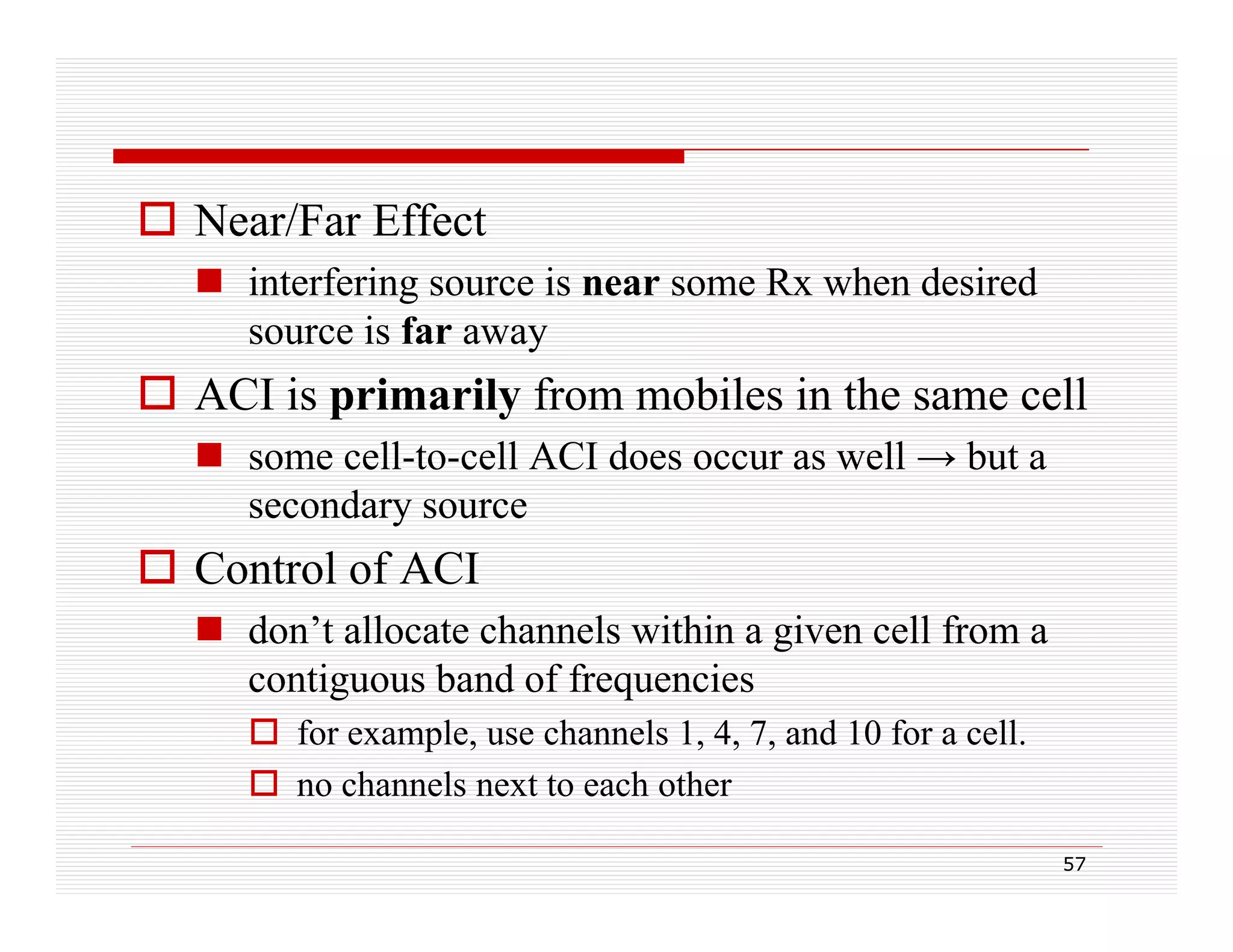
 This affects both forward & reverse links
 Forward Link → base-to-mobile
base to mobile
 interference @ mobile Rx from a ______ Tx
(
(another mobile or another base station that is not
the one the mobile is listening to) when mobile Rx
is ___ away from base station.
 signal from base station is weak and others are
somewhat strong.

R
Reverse Li k → mobile-to-base
Link
bil t b
 interference @ base station Rx from nearby mobile
Tx when desired mobile Tx is far away from base
station
56
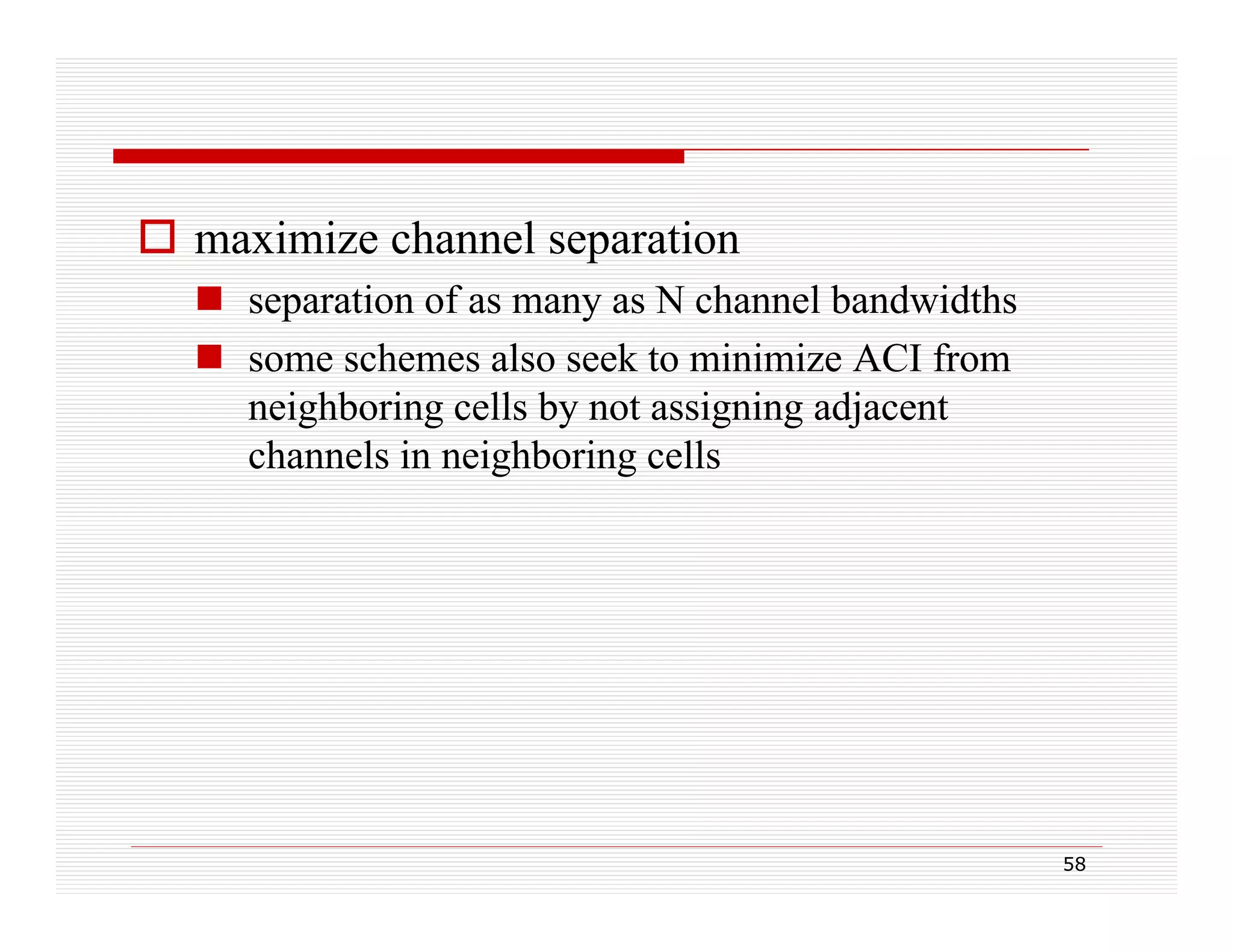
 Near/Far Effect
 interfering source is near some Rx when desired
g
source is far away

 ACI is primarily from mobiles in the same cell
p
y
 some cell-to-cell ACI does occur as well → but a
secondary source

 Control of ACI
 don’t allocate channels within a given cell from a
contiguous band of frequencies
 for example, use channels 1, 4, 7, and 10 for a cell.
 no channels next to each other
h
l
tt
h th
57
 maximize channel separation
 separation of as many as N channel bandwidths
 some schemes also seek to minimize ACI from
neighboring cells by not assigning adjacent
channels in neighboring cells

58
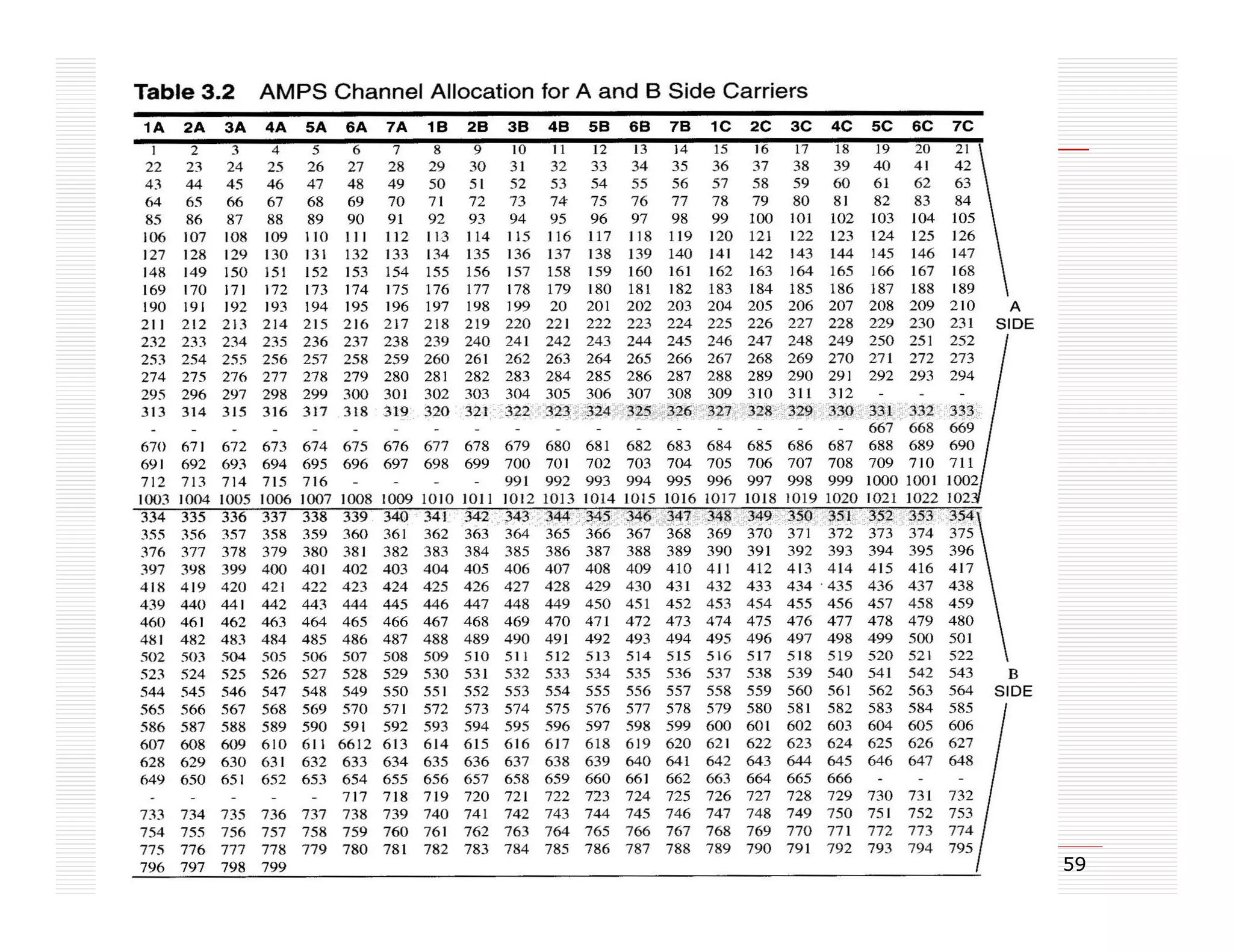
59
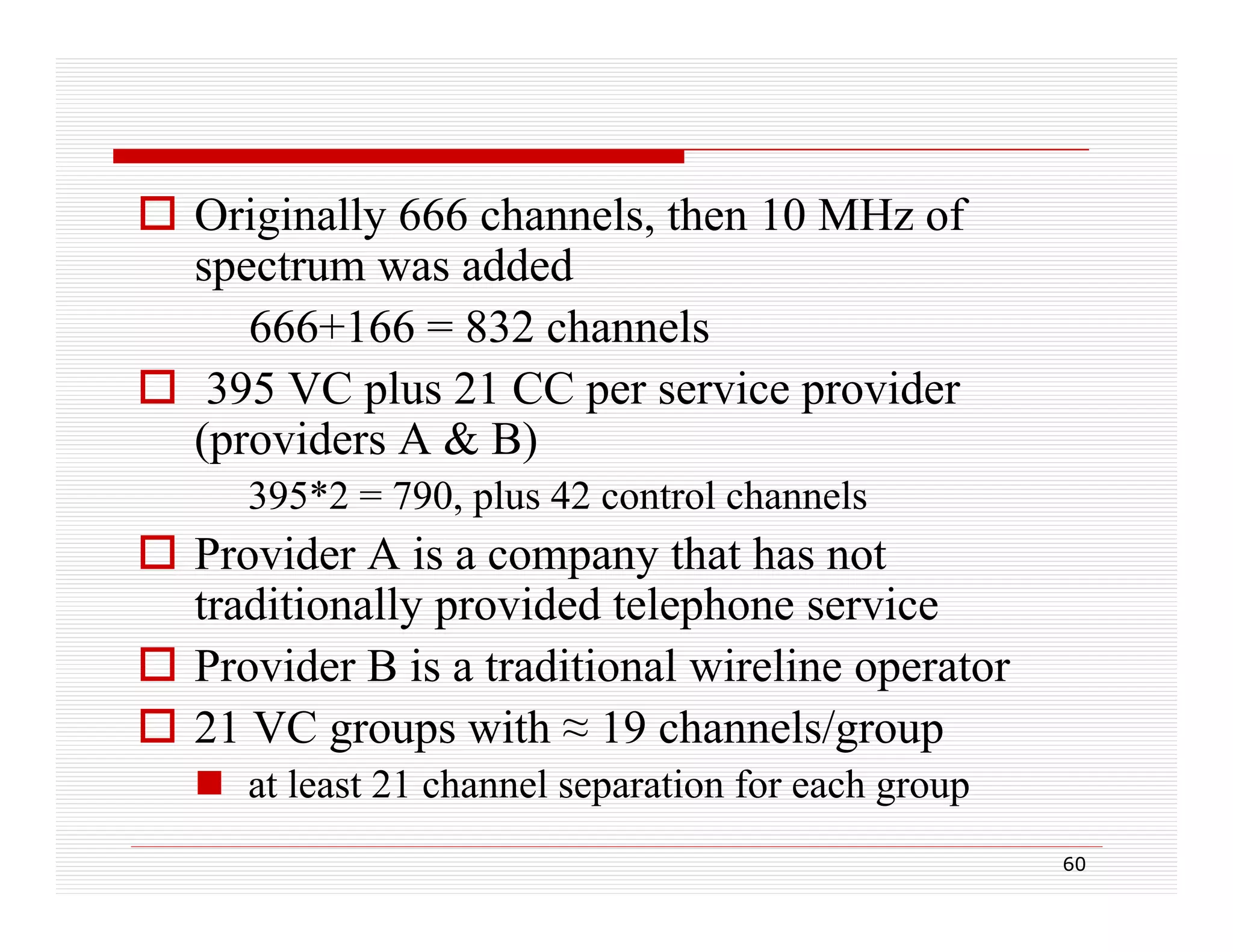
 Originally 666 channels, then 10 MHz of
spectrum was added
666+166 = 832 channels
 395 VC plus 21 CC per service provider
(providers A & B)
395*2 = 790, plus 42 control channels

 Provider A is a company that has not
traditionally provided telephone service
 P id B i a traditional wireline operator
Provider is t diti l i li
t
 21 VC groups with ≈ 19 channels/group
 at least 21 channel separation for each group
tl t
h
l
ti f
h
60
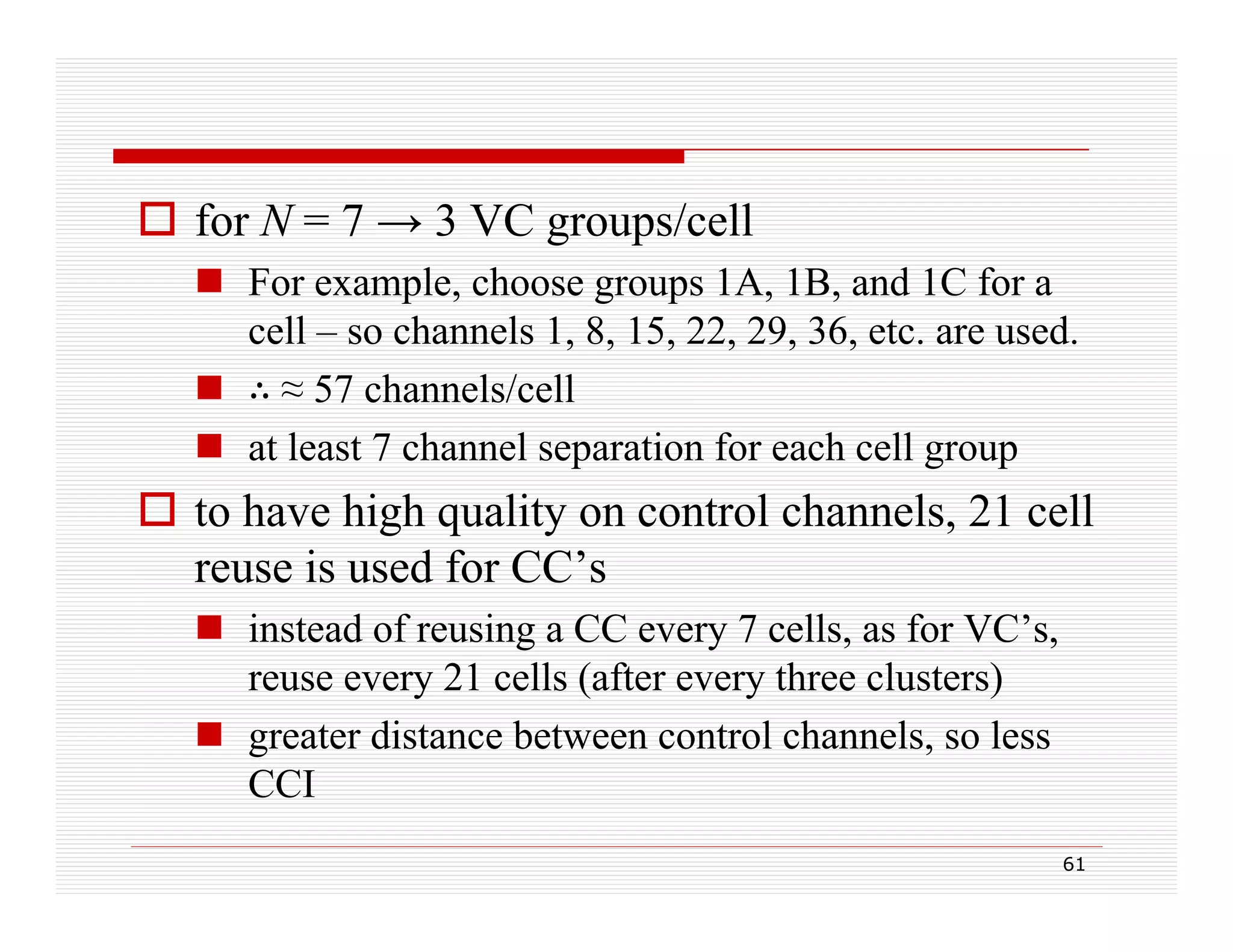
 for N = 7 → 3 VC groups/cell
 For example, choose groups 1A, 1B, and 1C for a
p ,
g p
, ,
cell – so channels 1, 8, 15, 22, 29, 36, etc. are used.
 ≈ 57 channels/cell
 at least 7 channel separation for each cell group

 to have high quality on control channels, 21 cell
g q
y
reuse is used for CC’s
 instead of reusing a CC every 7 cells, as for VC’s,
reuse every 21 cells (after every three clusters)
 greater distance between control channels, so less
CCI
61
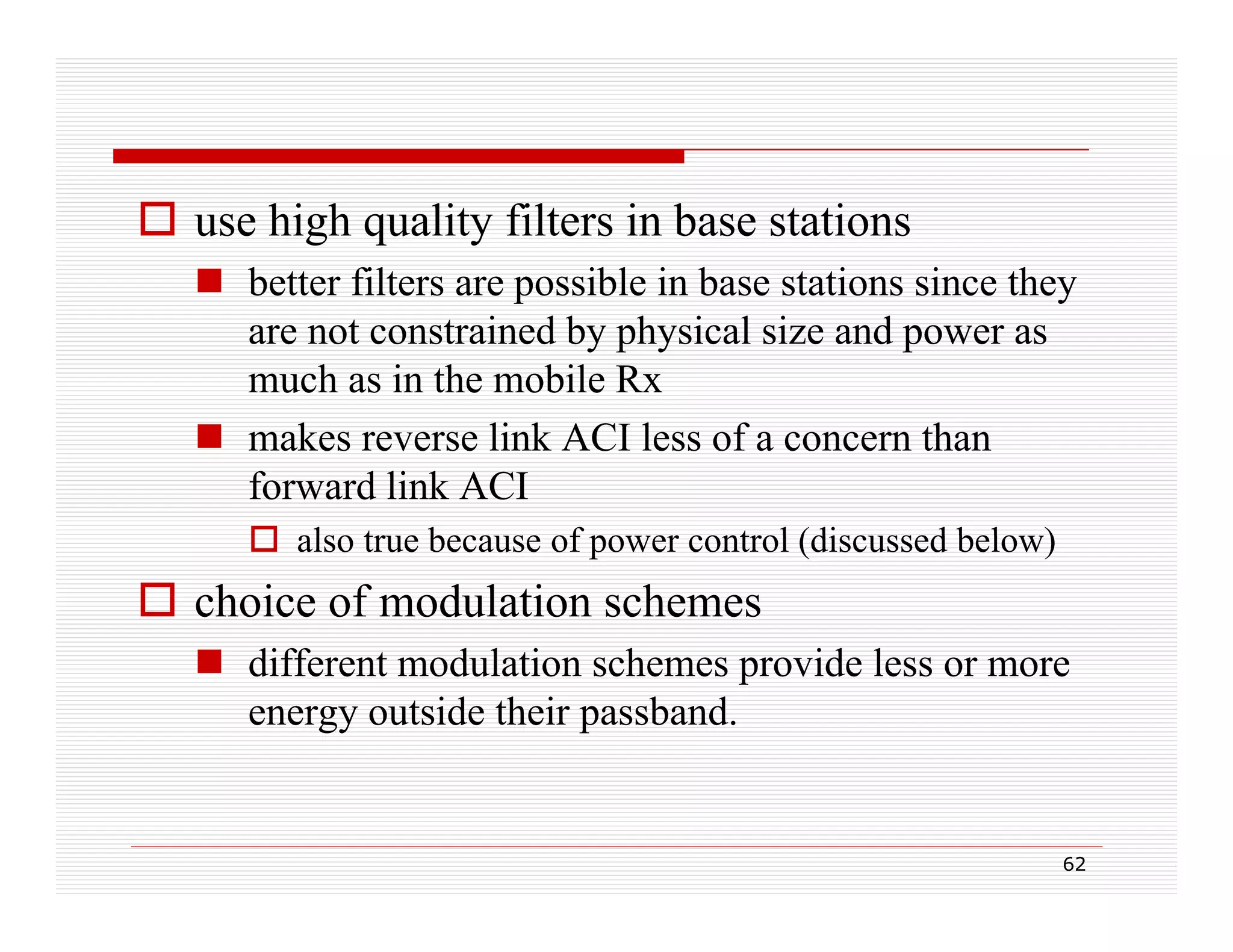
 use high quality filters in base stations
 better filters are possible in base stations since they
p
y
are not constrained by physical size and power as
much as in the mobile Rx
 makes reverse link ACI less of a concern than
forward link ACI
 also true because of power control (discussed below)

 choice of modulation schemes
 diff
different modulation schemes provide less or more
t
d l ti
h
id l
energy outside their passband.

62
 Power Control
 technique to minimize ACI
q
 base station & MSC constantly monitor mobile
received signal strength
 mobile Tx power varied (controlled) so that
smallest Tx power necessary for a quality reverse
link i l i
li k signal is used (lower power for the closer the
d (l
f th l
th
mobile is to the base station)
 also helps battery life on mobile

63
 dramatically improves adjacent channel S / I
ratio, since mobiles in other cells only transmit
at high enough power as transmitter controls
t hi h
h
t
itt
t l
(not at full power)
 most beneficial for ACI on reverse link
 will see later that this is especially important for
CDMA systems

64
III. Trunking & Grade of Service (GOS)
 Trunked radio system: radio system where a
large # of users share a pool of channels
 channel allocated on demand & returned to channel
pool upon call termination
 exploit statistical (random) behavior of users so that
fixed # of channels can accommodate large # of
users
 Trade-off between the number of available channels
that are provided and the likelihood of a particular user
finding no channels available during the busy hour of
the day.

65
 trunking theory is used by telephone companies to
allocate limited # of voice circuits for large # of
telephone lines
 efficient use of equipment resources → savings
q p
g
 disadvantage is that some probability exists that
mobile user will be denied access to a channel
 blocked call : access denied → “blocked call cleared”
 delayed call : access delayed by call being put into
holding queue for specified amount of time

66
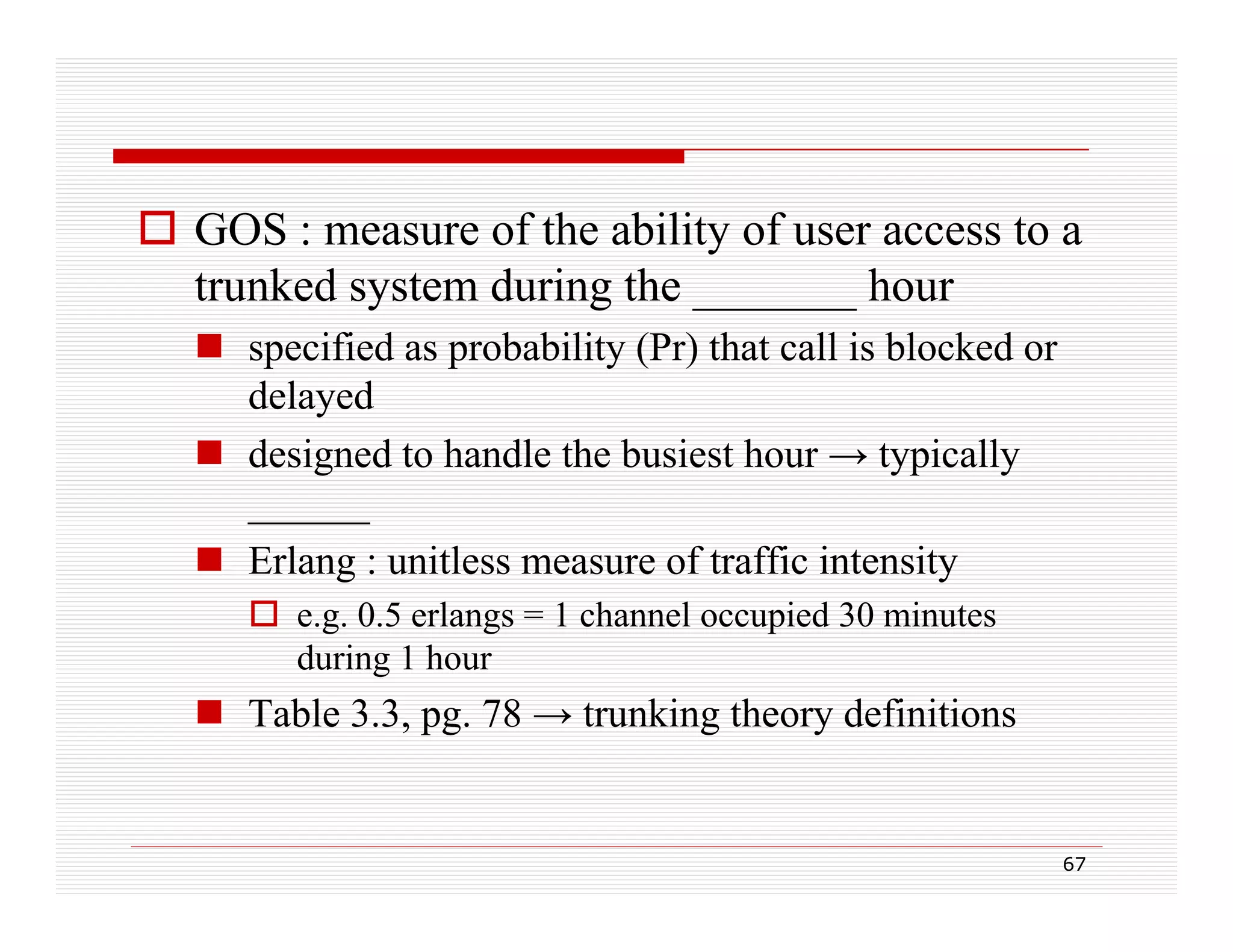
 GOS : measure of the ability of user access to a
trunked system during the _______ hour
 specified as probability (Pr) that call is blocked or
delayed
y
 designed to handle the busiest hour → typically
______
 Erlang : unitless measure of traffic intensity
 e.g. 0.5 erlangs = 1 channel occupied 30 minutes
during 1 hour

 Table 3.3, pg. 78 → trunking theory definitions

67
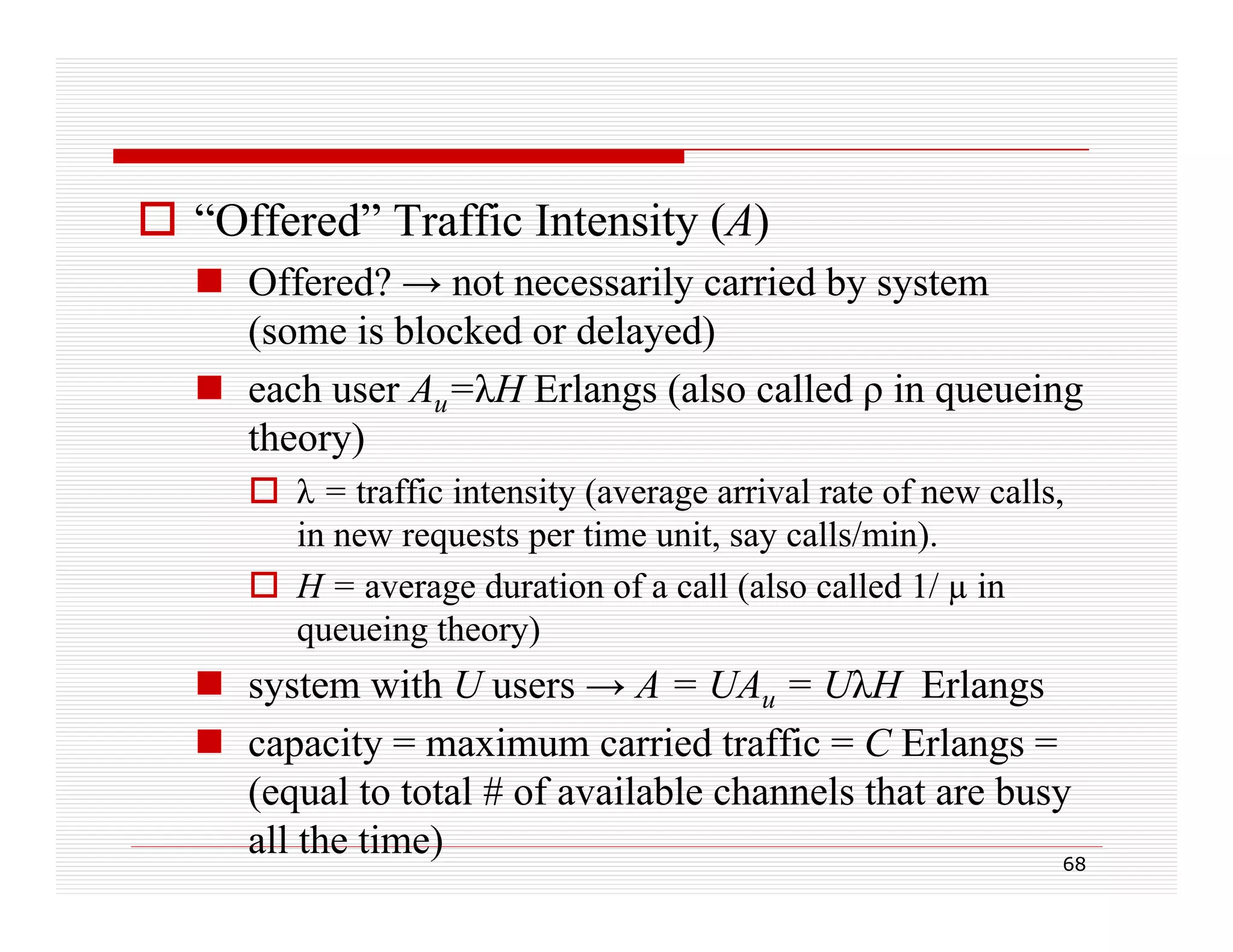
 “Offered” Traffic Intensity (A)
 Offered? → not necessarily carried by system
y
y y
(some is blocked or delayed)
 each user Au=λH Erlangs (also called ρ in queueing
theory)
 λ = traffic intensity (average arrival rate of new calls,
in new requests per time unit say calls/min)
unit,
calls/min).
 H = average duration of a call (also called 1/ µ in
queueing theory)

 system with U users → A = UAu = UλH Erlangs
 capacity = maximum carried traffic = C Erlangs =
(equal to total # of available channels that are busy
all the time)
68
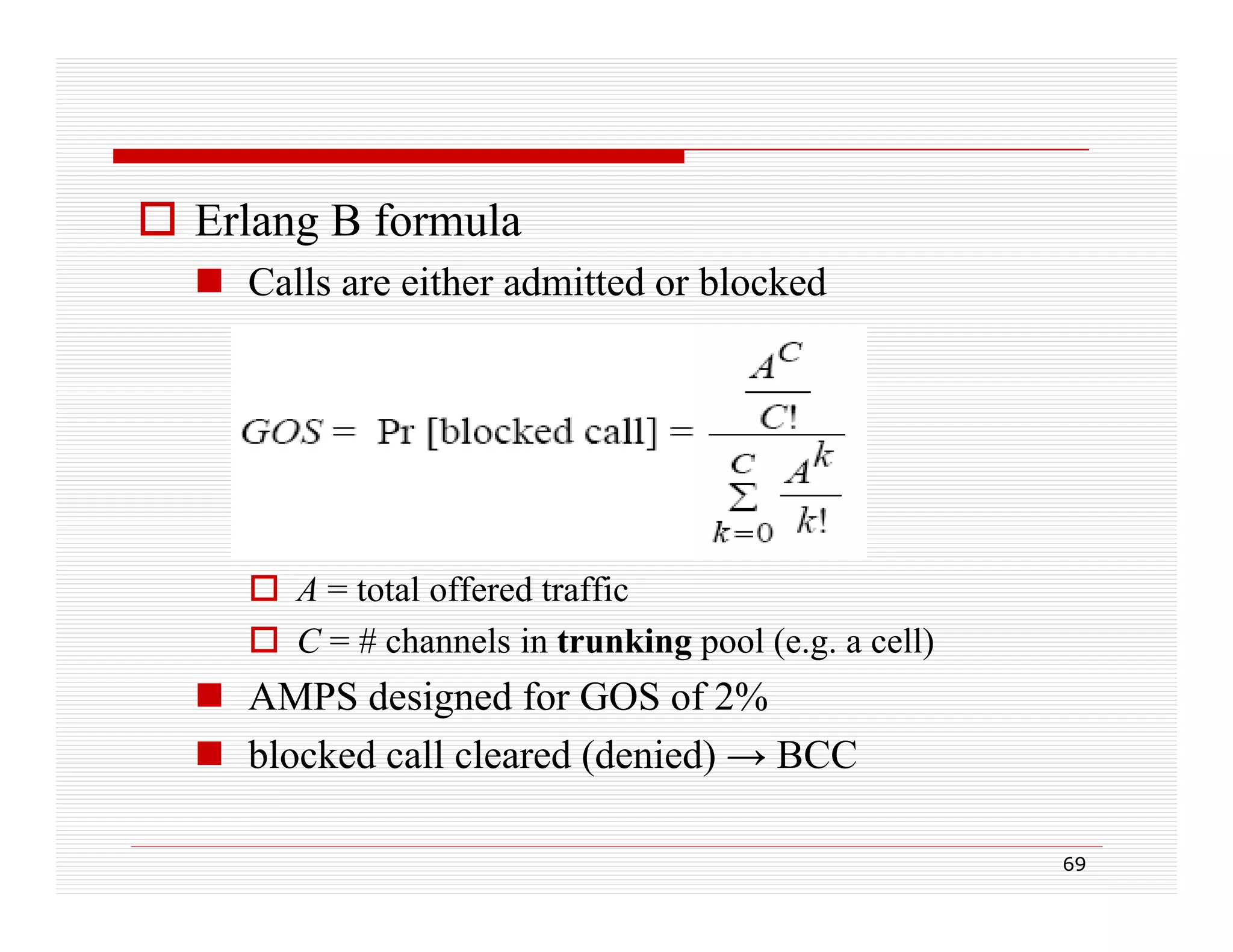
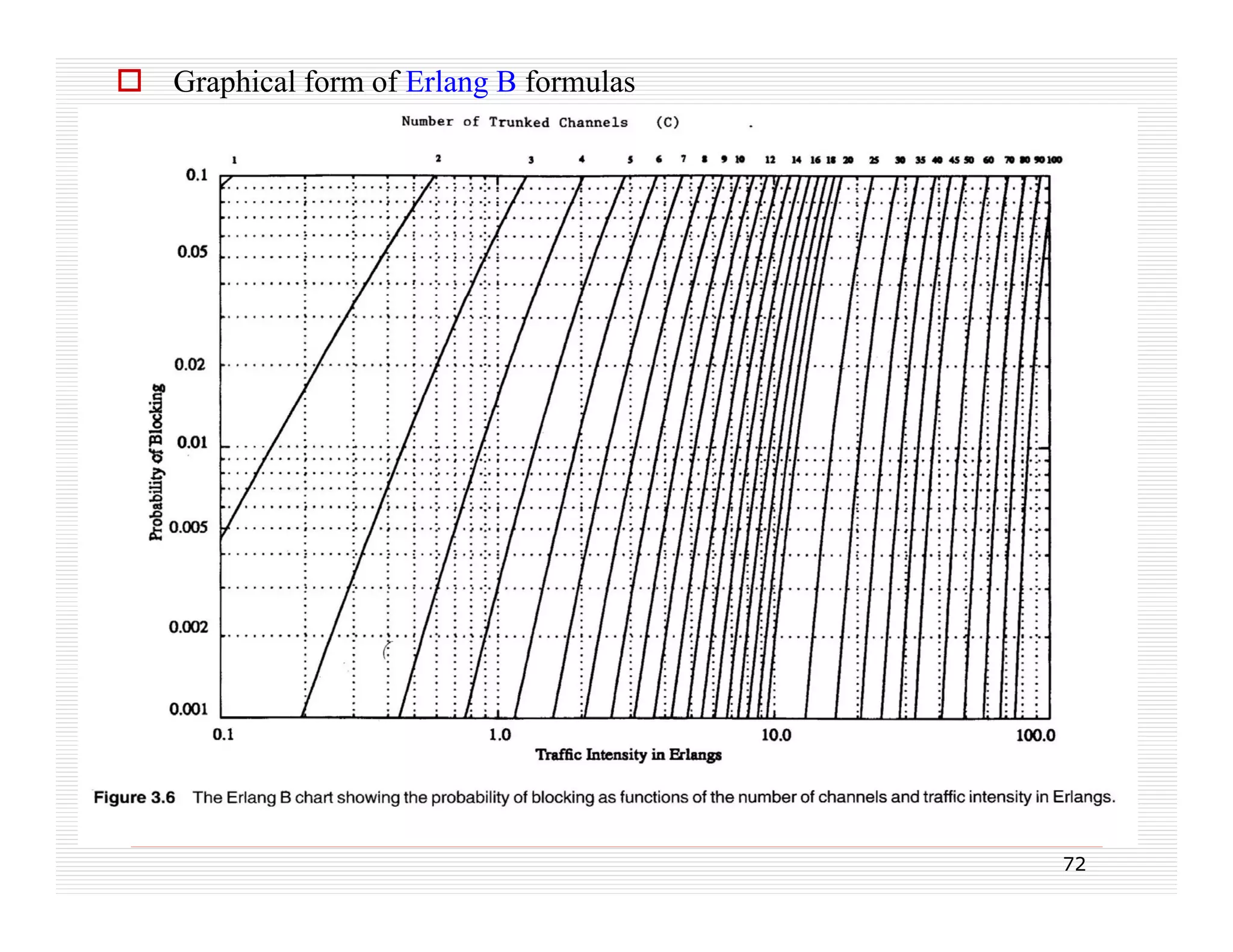
 Erlang B formula
 Calls are either admitted or blocked

 A = total offered traffic
gp
(e.g.
)
 C = # channels in trunking pool ( g a cell)

 AMPS designed for GOS of 2%
 blocked call cleared (denied) → BCC
(
)
69
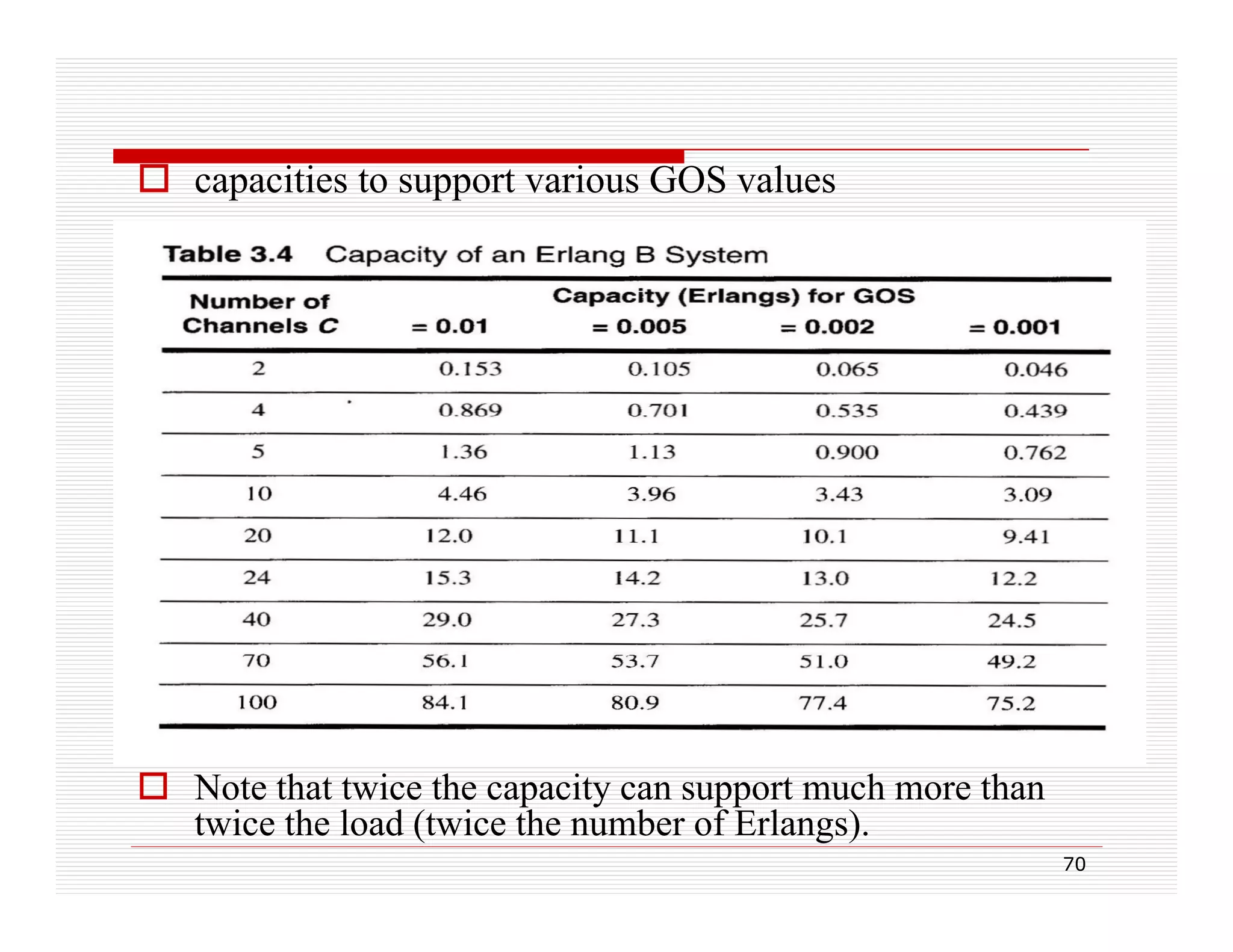
 capacities to support various GOS values

 N that twice the capacity can support much more than
Note h
i h
i
h
h
twice the load (twice the number of Erlangs).
70
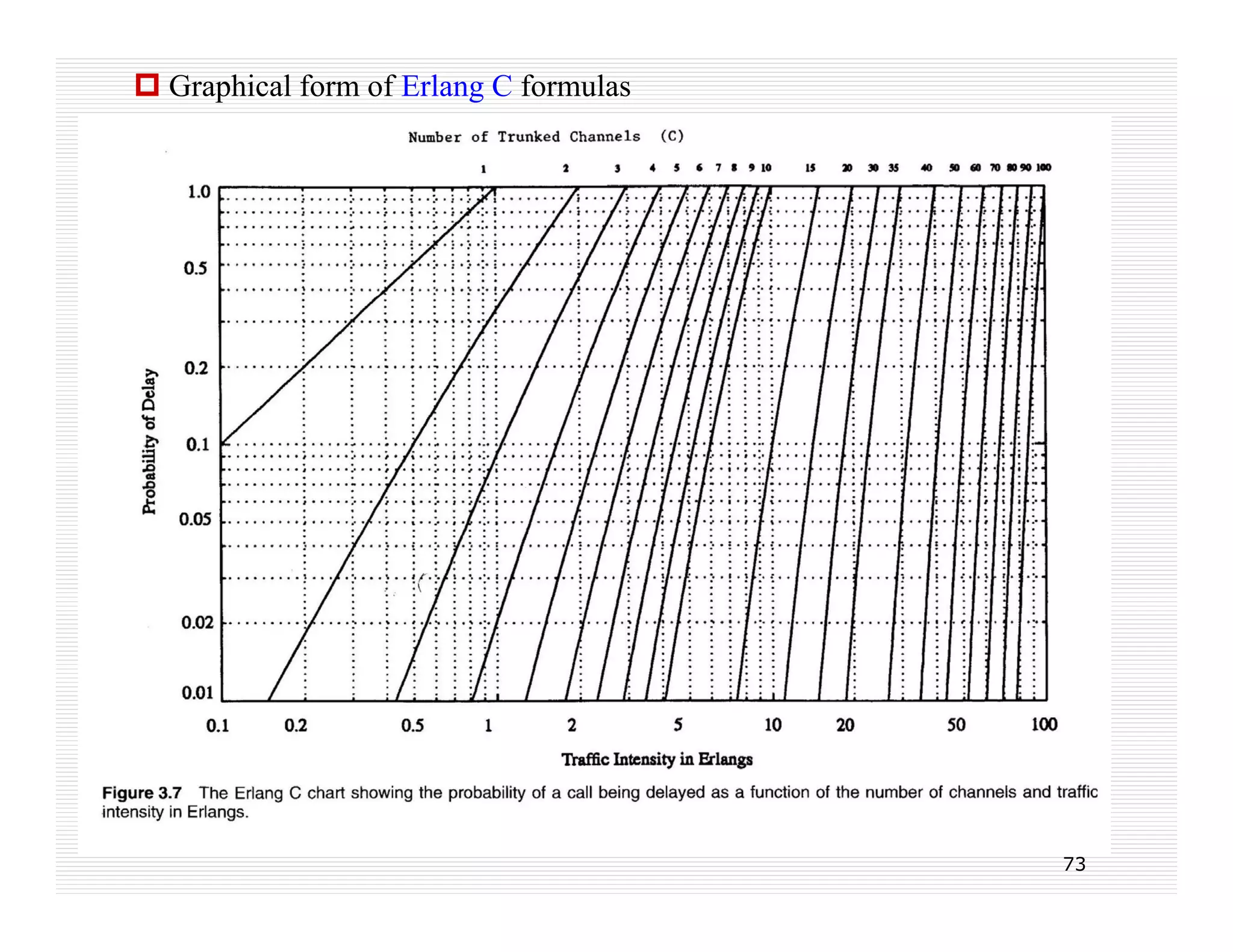
 Erlang C formulas
 blocked call delayed → BCD → put into holding
y
p
g
queue
 GOS is probability that a call will still be blocked
even if it spends time in a queue and waits for up to
t seconds
 equations (3.17) to (3.19) in book
ti
(3 17) t (3 19) i b k

71
 Graphical form of Erlang B formulas

72
 Graphical form of Erlang C formulas

73
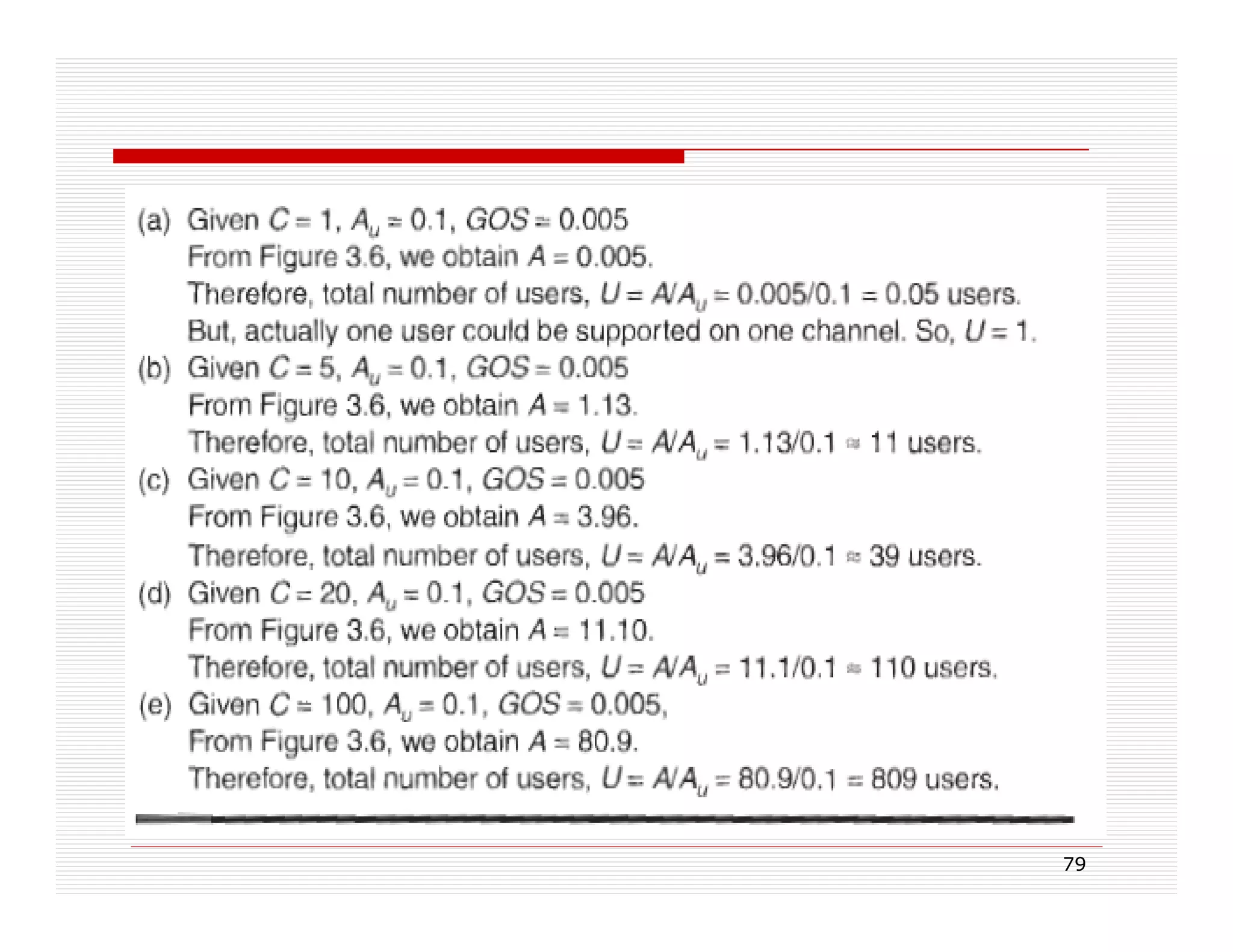
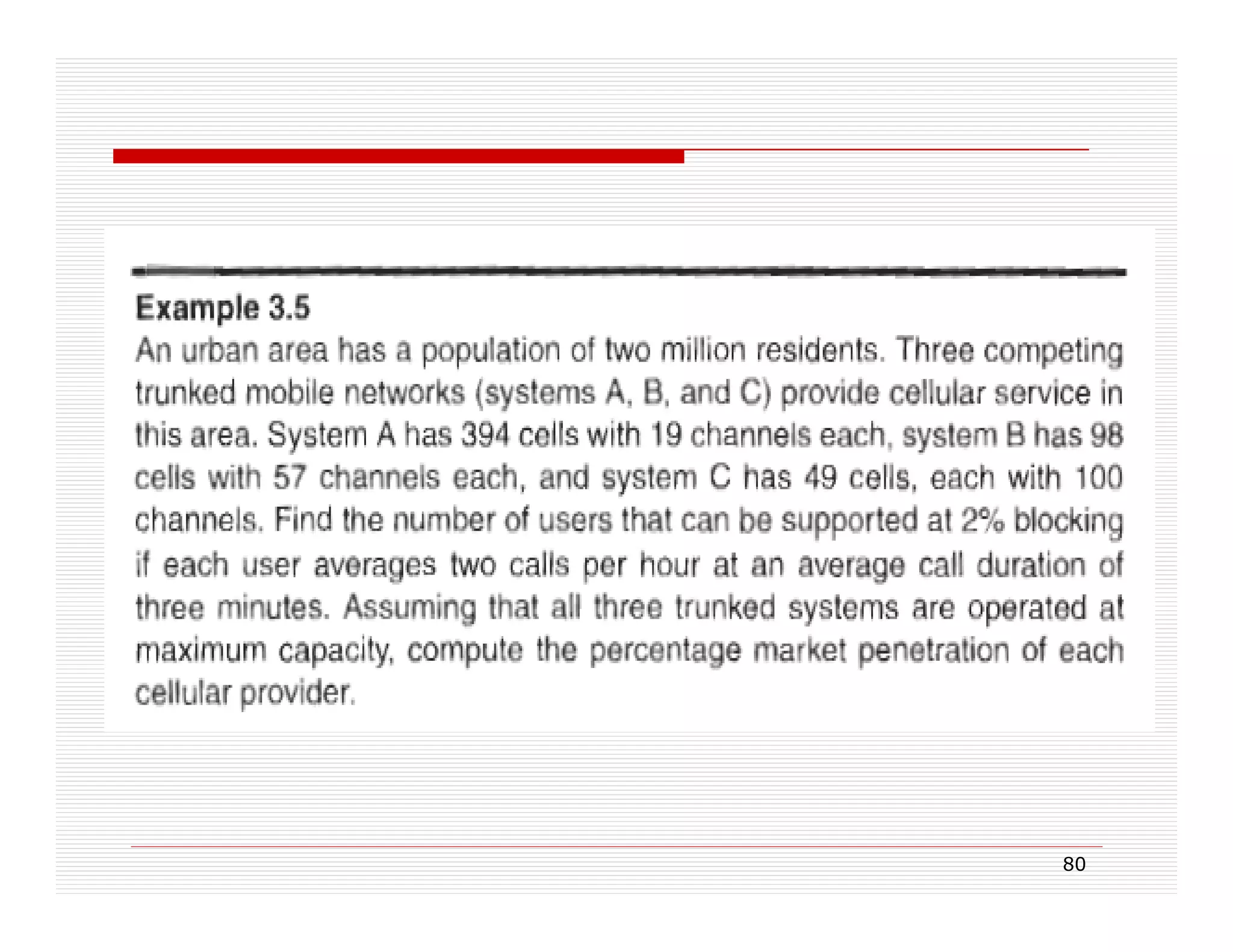
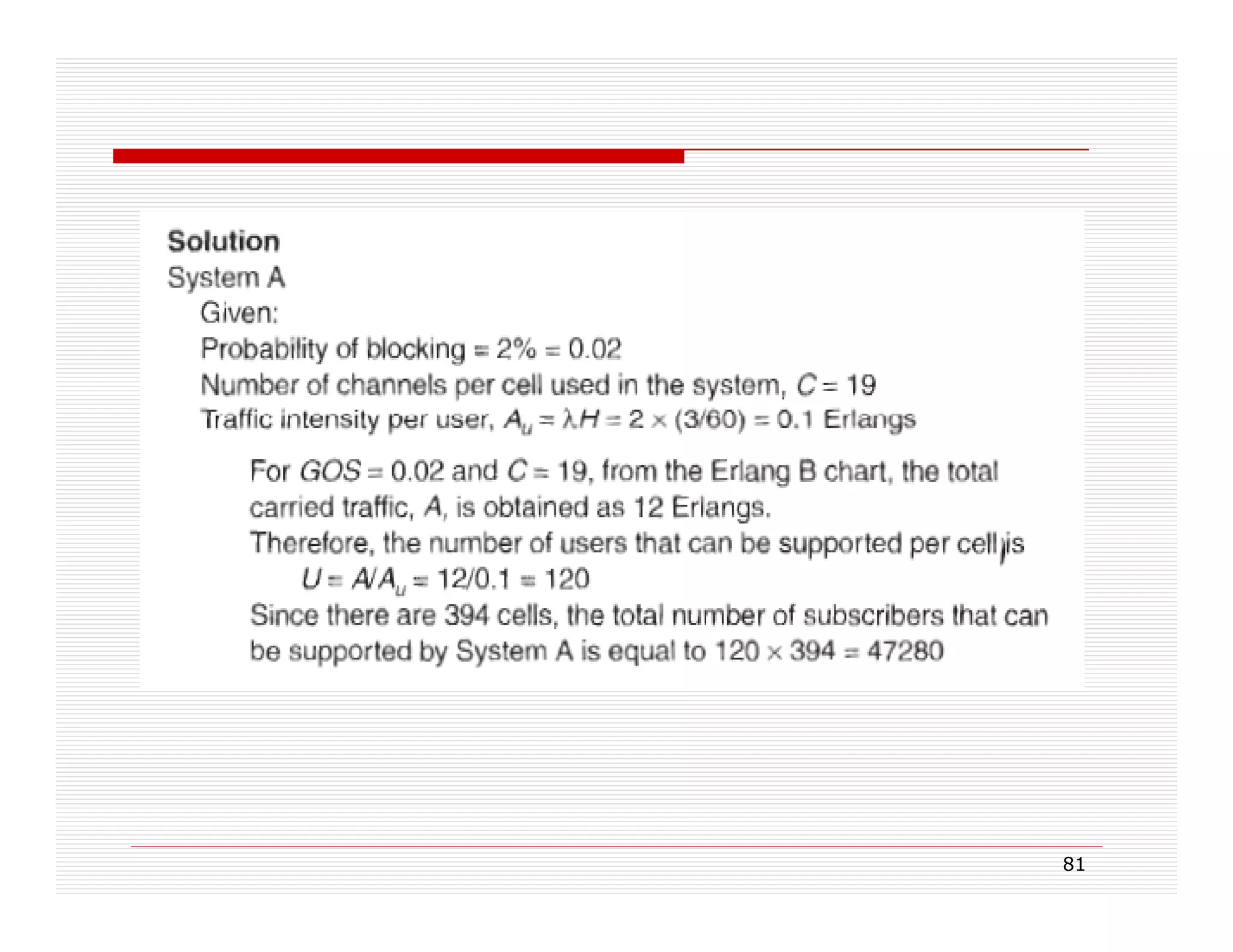
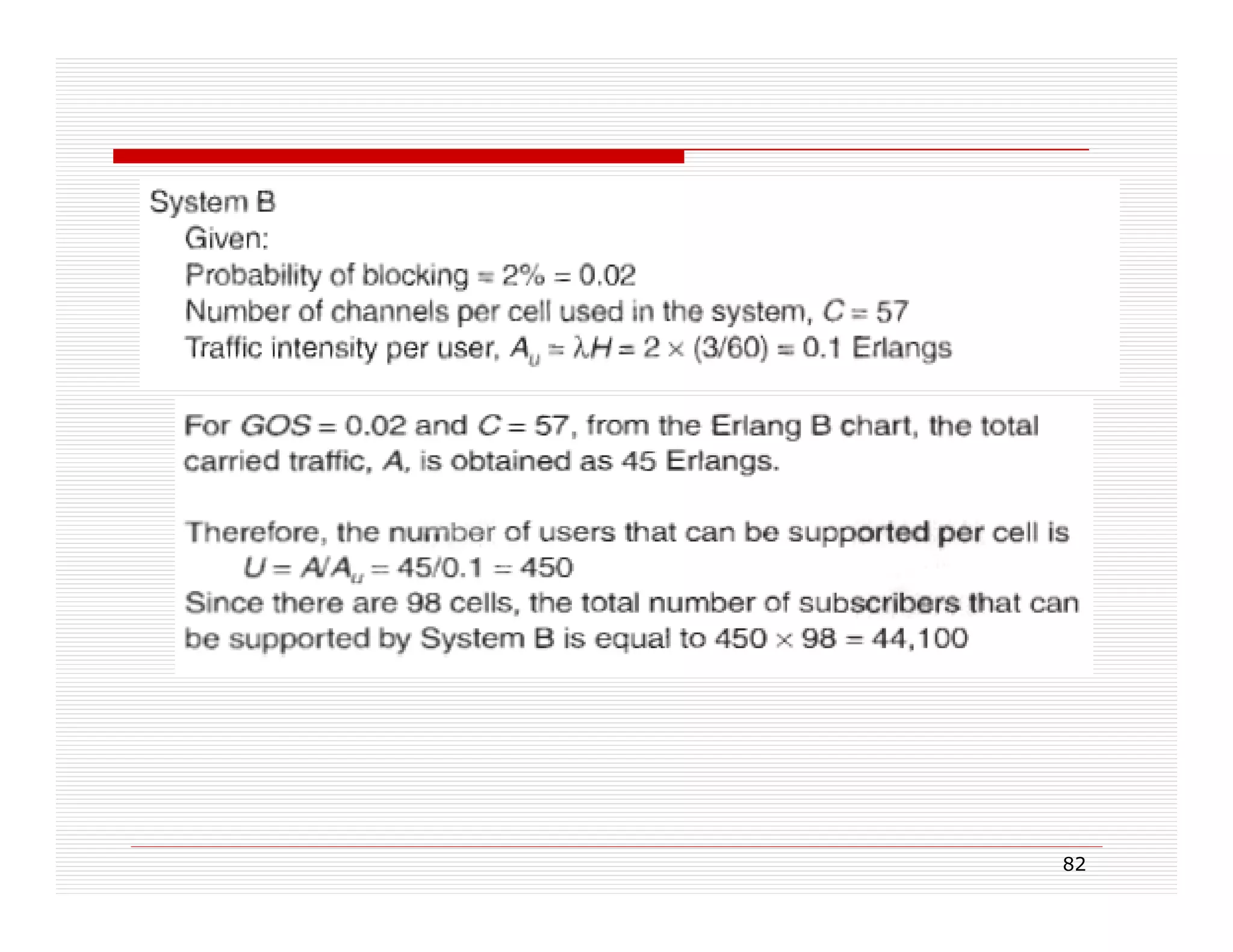
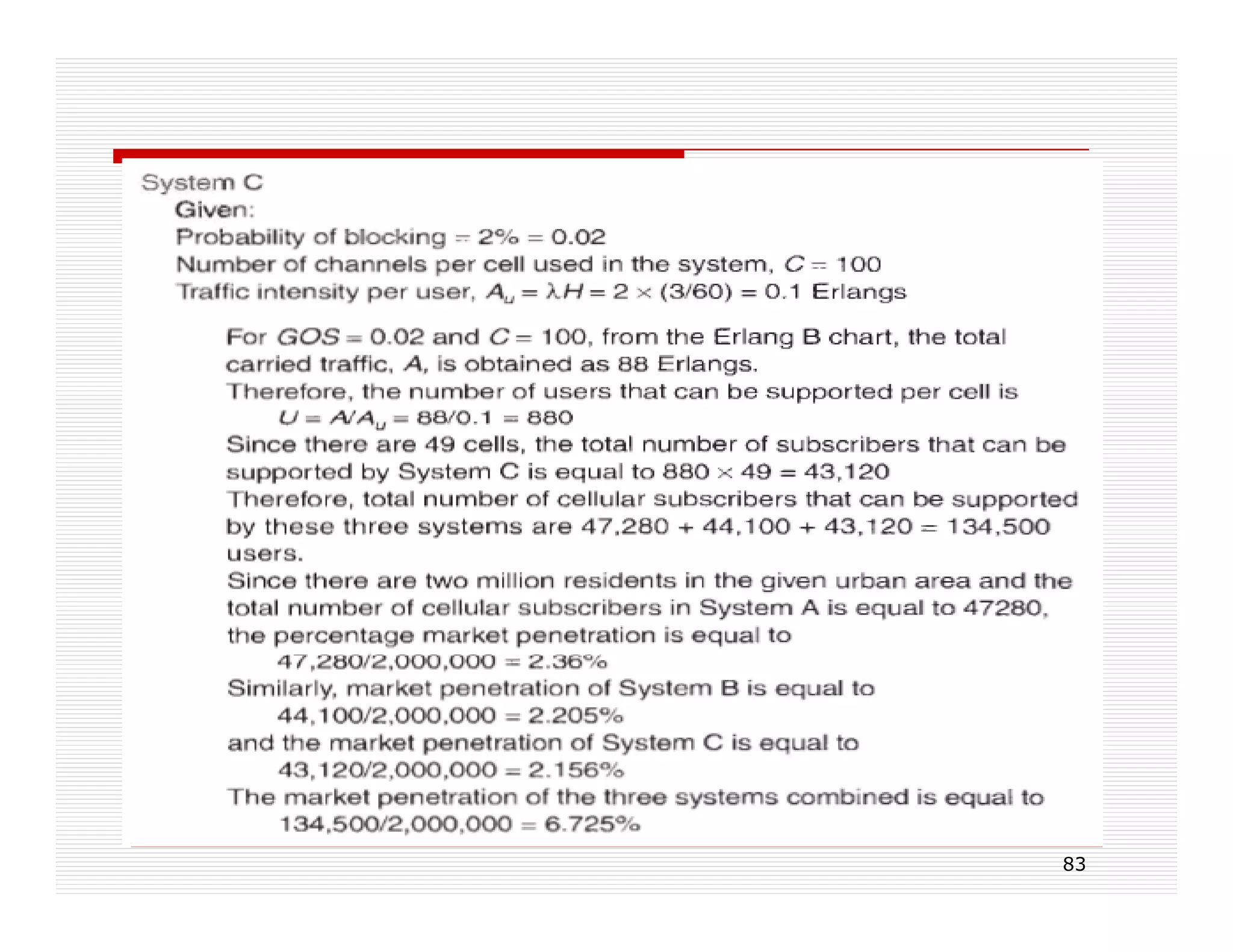
 Example: Find how many users can be
supported in a cell containing 50 channels for a
pp
g
2% GOS (Blocked Calls Cleared) if the average
user calls twice/hr with an average call duration
of 5 minutes.
 What is the corresponding C from the figure?
 What is A (Traffic Intensity) from the figure?
 So, how many users can be supported?
,
y
pp
74
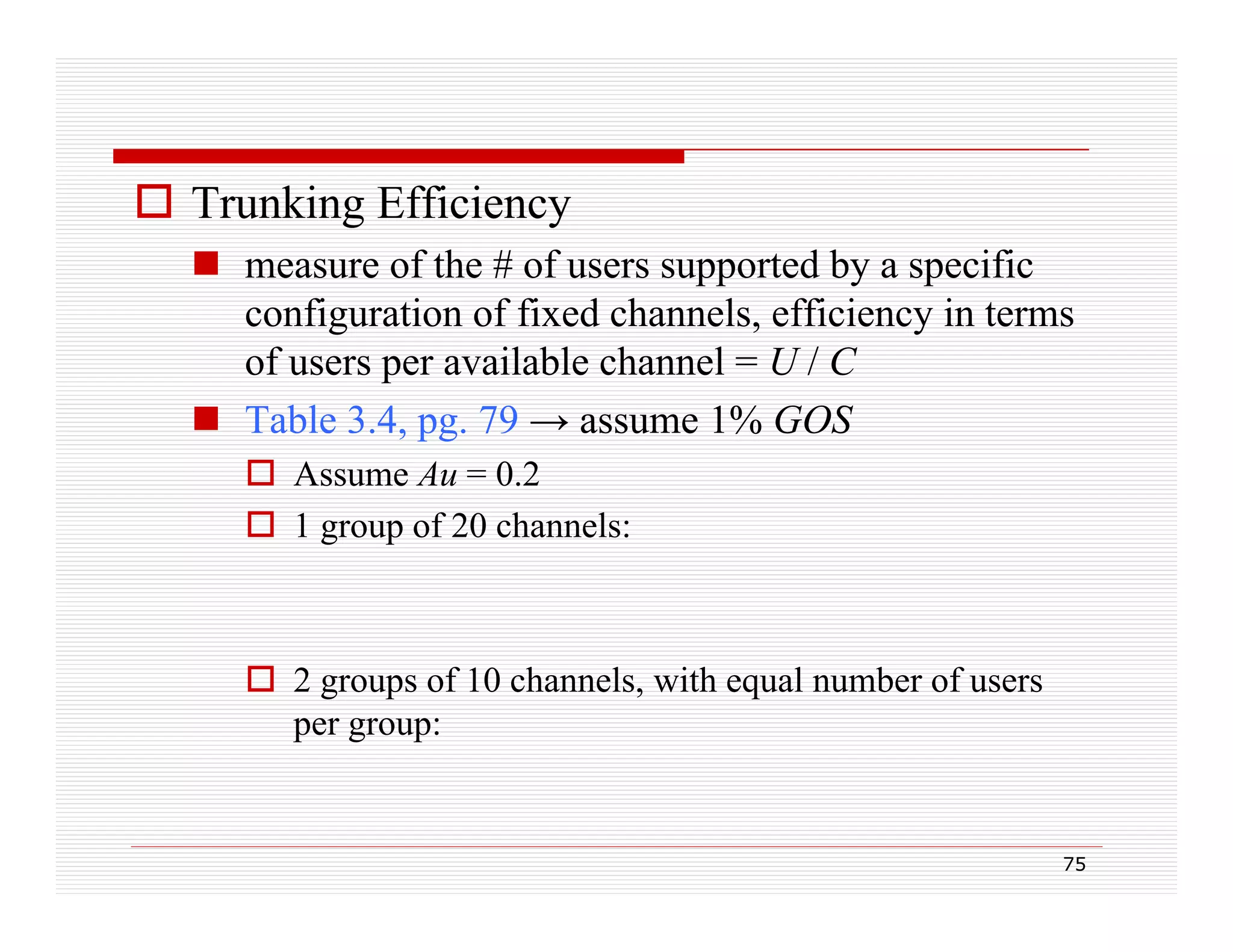
 Trunking Efficiency
 measure of the # of users supported by a specific
configuration of fixed channels, efficiency in terms
of users per available channel = U / C
 Table 3.4, pg. 79 → assume 1% GOS
3 4 pg
 Assume Au = 0.2
 1 group of 20 channels:

 2 groups of 10 channels, with equal number of users
per group:

75
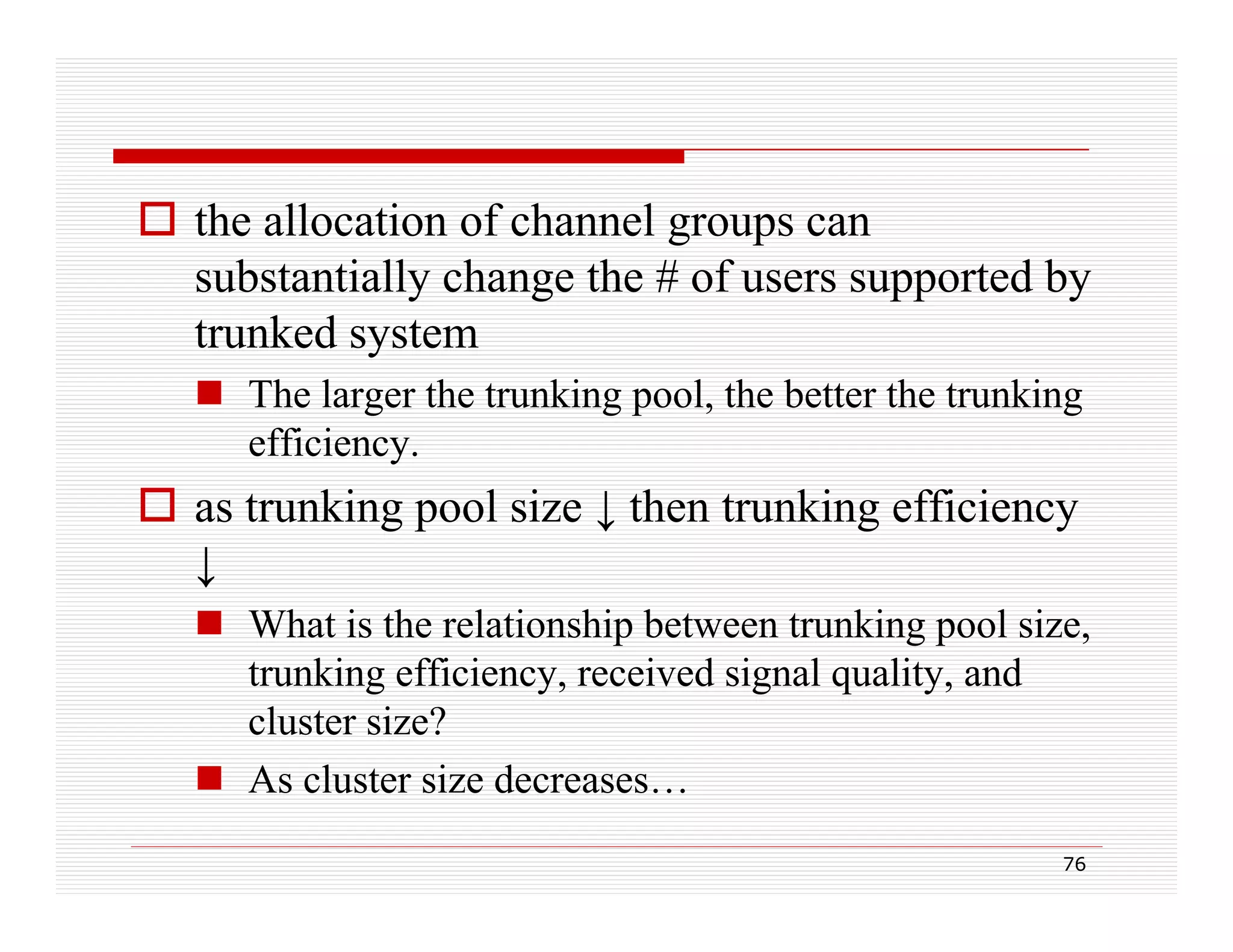
 the allocation of channel groups can
substantially change the # of users supported by
y
g
pp
y
trunked system
 The larger the trunking p
g
g pool, the better the trunking
g
efficiency.

 as trunking pool size ↓ then trunking efficiency
↓
 What is the relationship between trunking pool size,
trunking efficiency, received signal quality, and
cluster size?
 As cluster size decreases
decreases…
76
 Note: Trunking efficiency is an issue both in
FDMA/TDMA systems and i CDMA systems
t
d in
t
(where the capacity limit is the number of
possible codes and the interference levels).
levels)

77
78
79
80
81
82
83
84
85
86
87
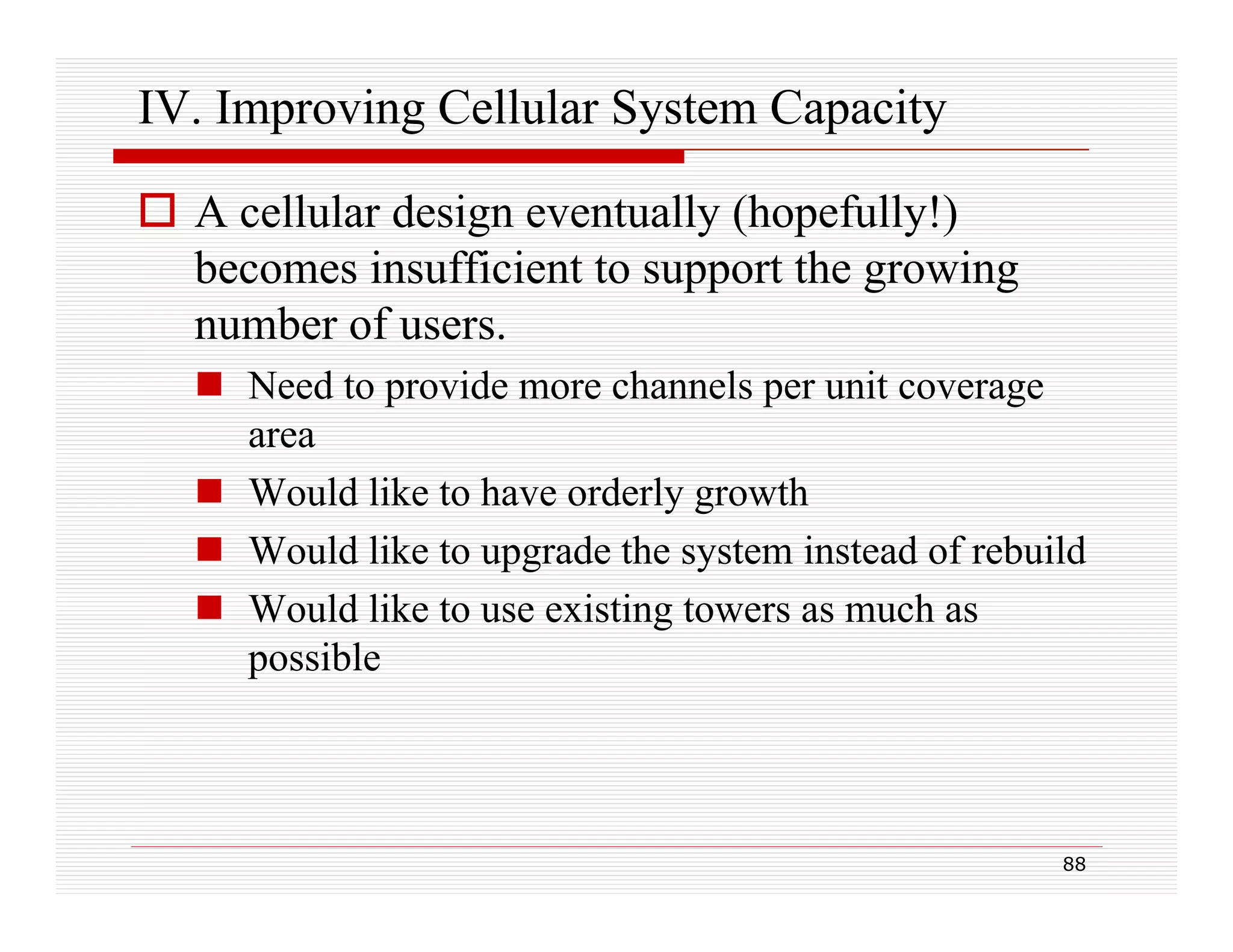
IV. Improving Cellular System Capacity
 A cellular design eventually (hopefully!)
becomes insufficient to support the growing
number of users.
 Need to provide more channels per unit coverage
area
 Would like to have orderly growth
 Would like to upgrade the system instead of rebuild
ld lik
d h
i
d f b ild
 Would like to use existing towers as much as
possible

88
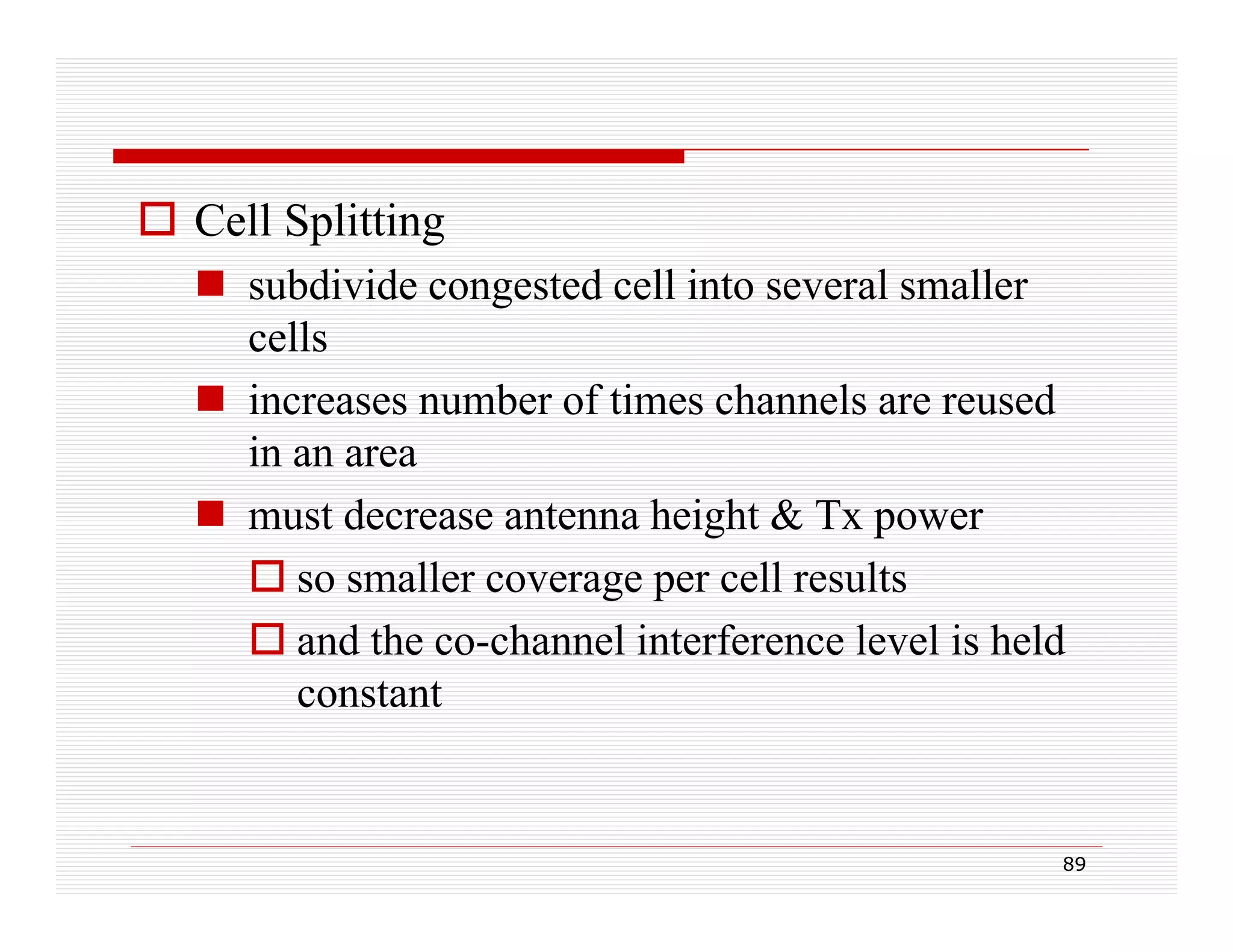
 Cell Splitting
 subdivide congested cell into several smaller
cells
 increases number of times channels are reused
in an area
g
power
 must decrease antenna height & Tx p
 so smaller coverage per cell results
 and the co-channel interference level is held
constant

89
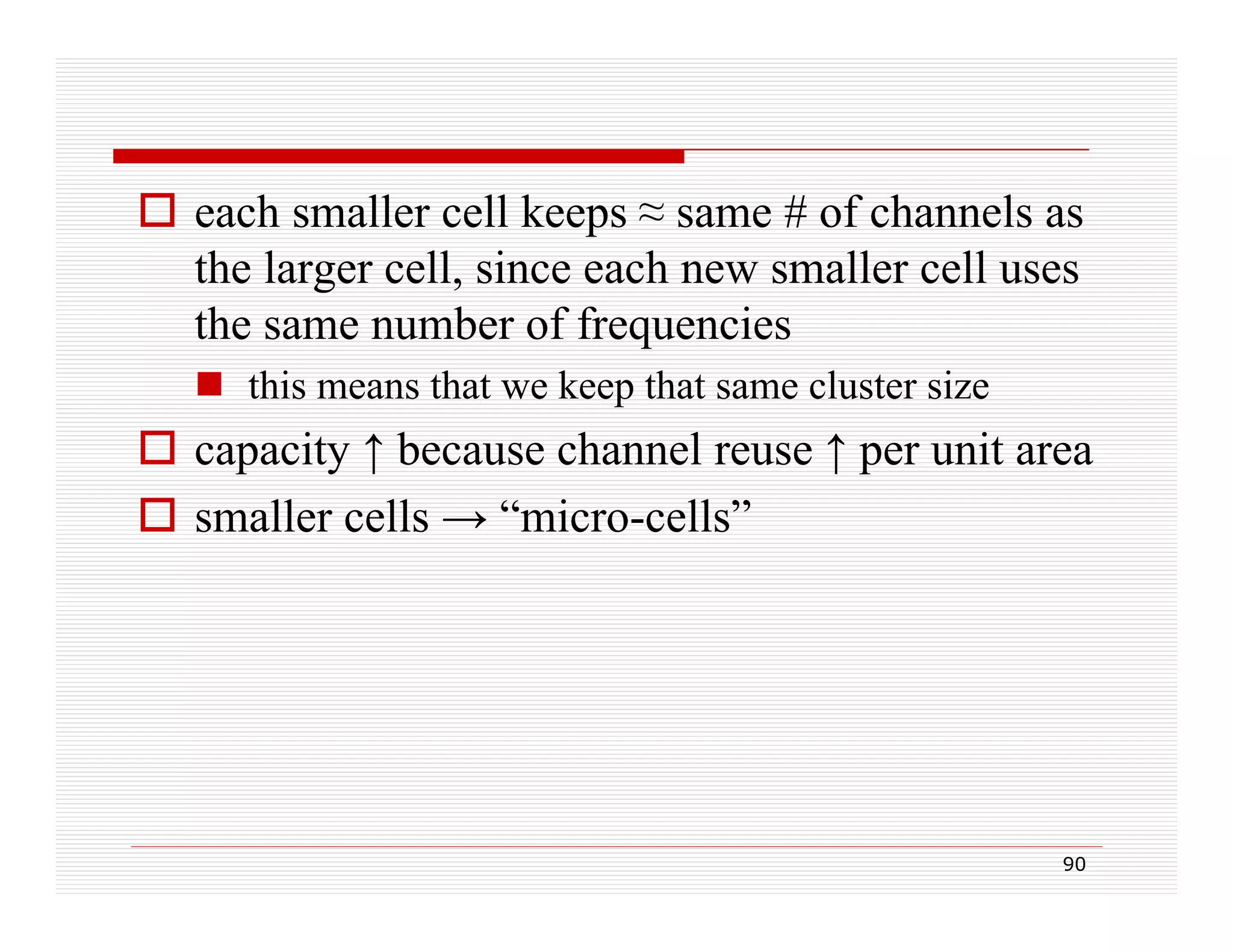
 each smaller cell keeps ≈ same # of channels as
the larger cell, since each new smaller cell uses
the same number of frequencies
 this means that we keep that same cluster size

 capacity ↑ because channel reuse ↑ per unit area
 smaller cells → “micro-cells”

90
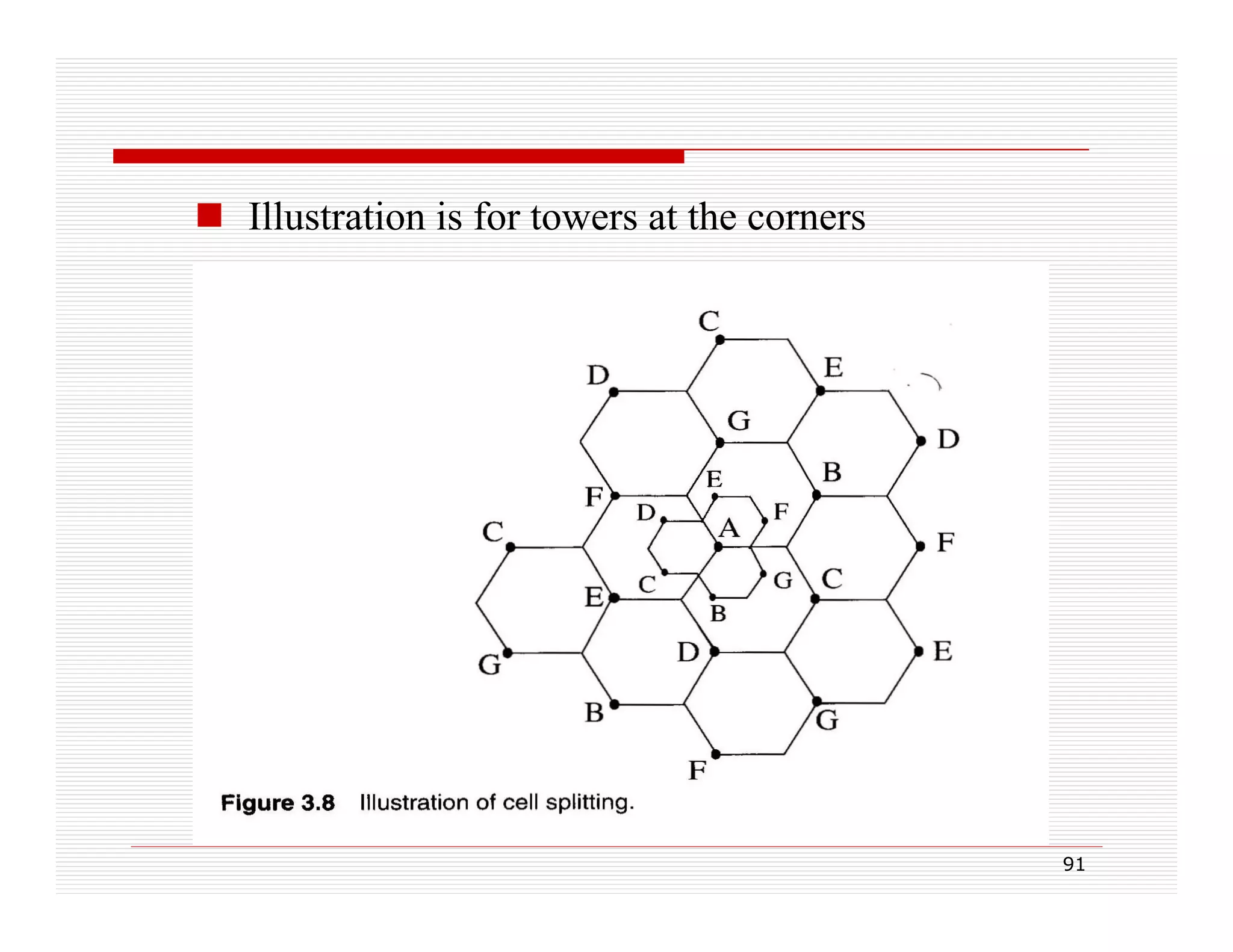
 Illustration is for towers at the corners

91
 advantages include:
 only needed for cells that reach max. capacity → not
all cells
 implement when Pr [blocked call] > acceptable GOS
 system capacity can gradually expand as demand ↑

 disadvantages include:
 # handoffs/unit area increases
 umbrella cell for high velocity traffic may be needed
 more base stations → $$ for real estate, towers, etc.

92
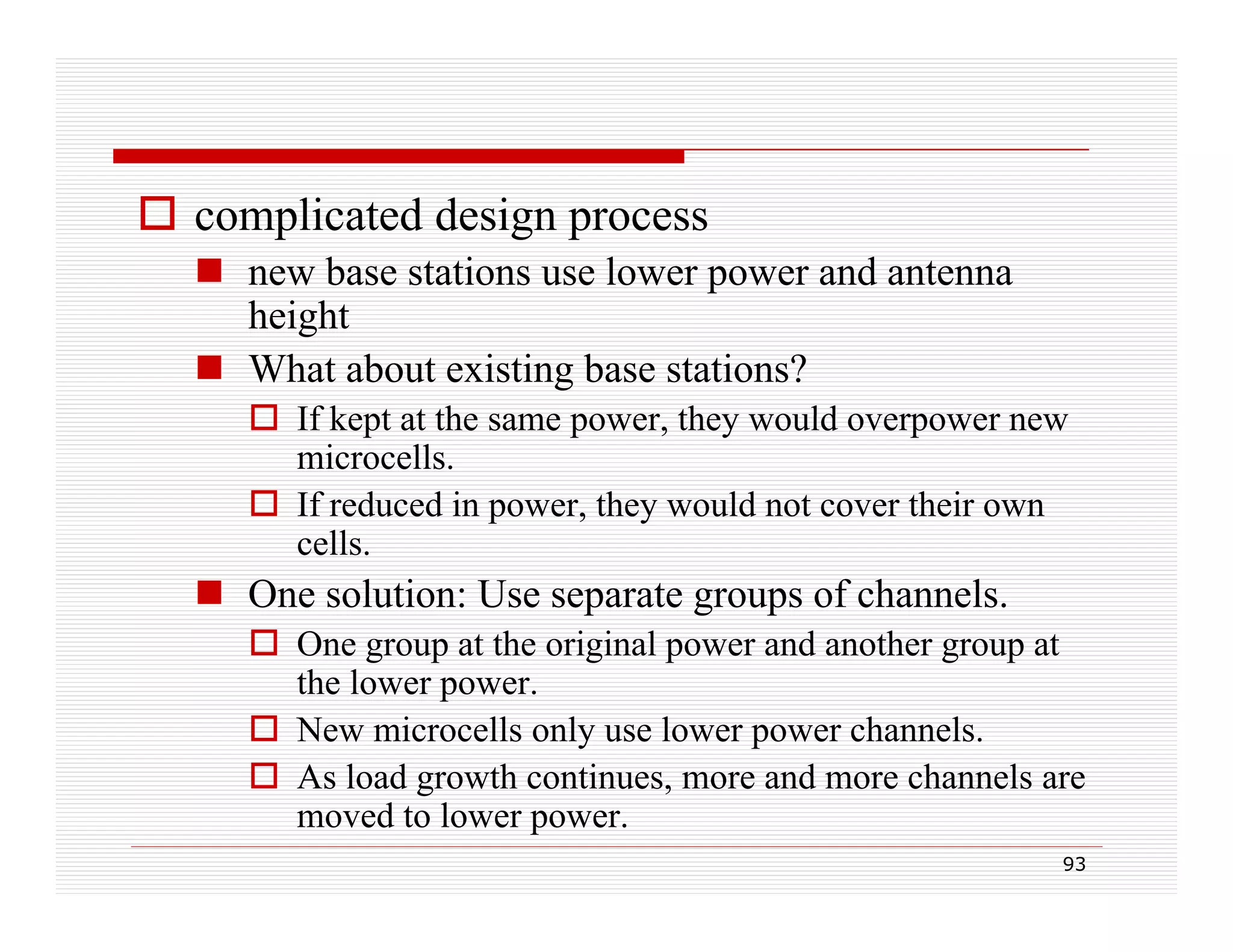
 complicated design process
 new base stations use lower power and antenna
height
 What about existing base stations?
 If kept at the same power, they would overpower new
power
microcells.
 If reduced in power, they would not cover their own
cells.
ll

 One solution: Use separate groups of channels.
 One group at the original power and another group at
O e g oup
eo g
powe
d o e g oup
the lower power.
 New microcells only use lower power channels.
 As load growth continues more and more channels are
continues,
moved to lower power.
93
94
95
 Sectoring
 cell splitting keeps D / R unchanged (same
cluster size and CCI) but increases frequency
reuse/area
 alternate way to ↑ capacity is to _____ CCI
(increase S / I ratio)

96
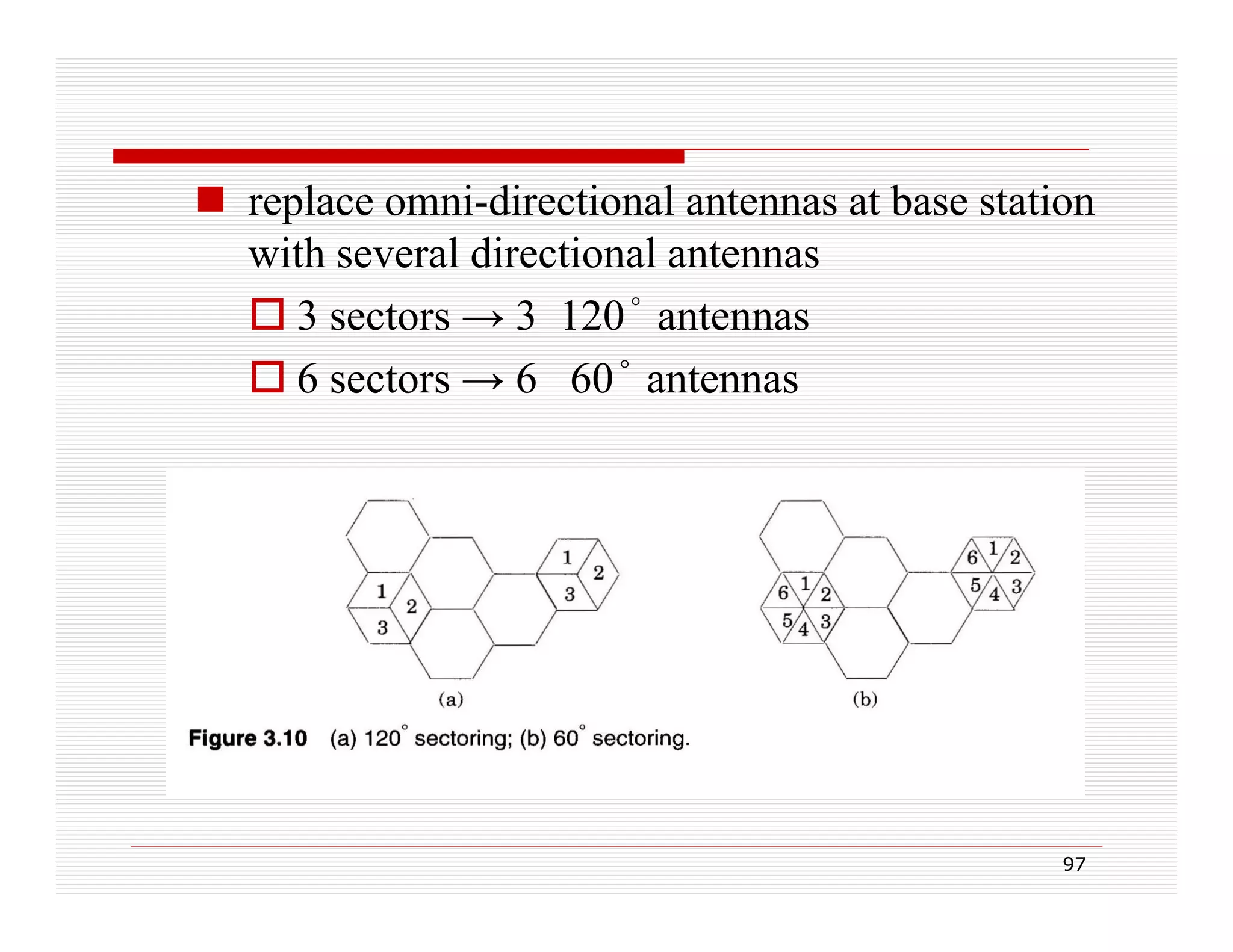
 replace omni-directional antennas at base station
with several directional antennas
 3 sectors → 3 120° antennas
 6 sectors → 6 60° antennas

97
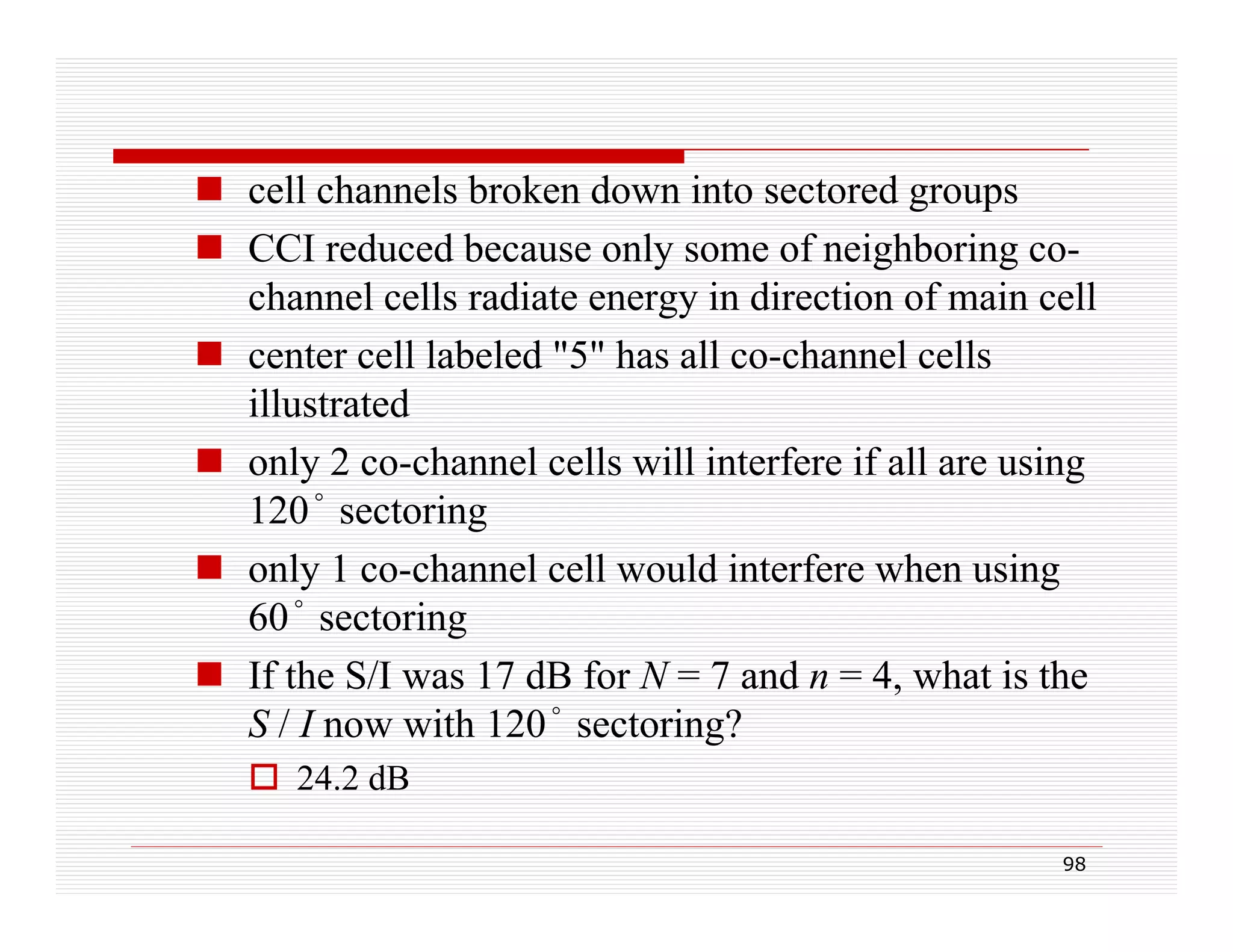
 cell channels broken down into sectored groups
ll h
l b k d
i
d
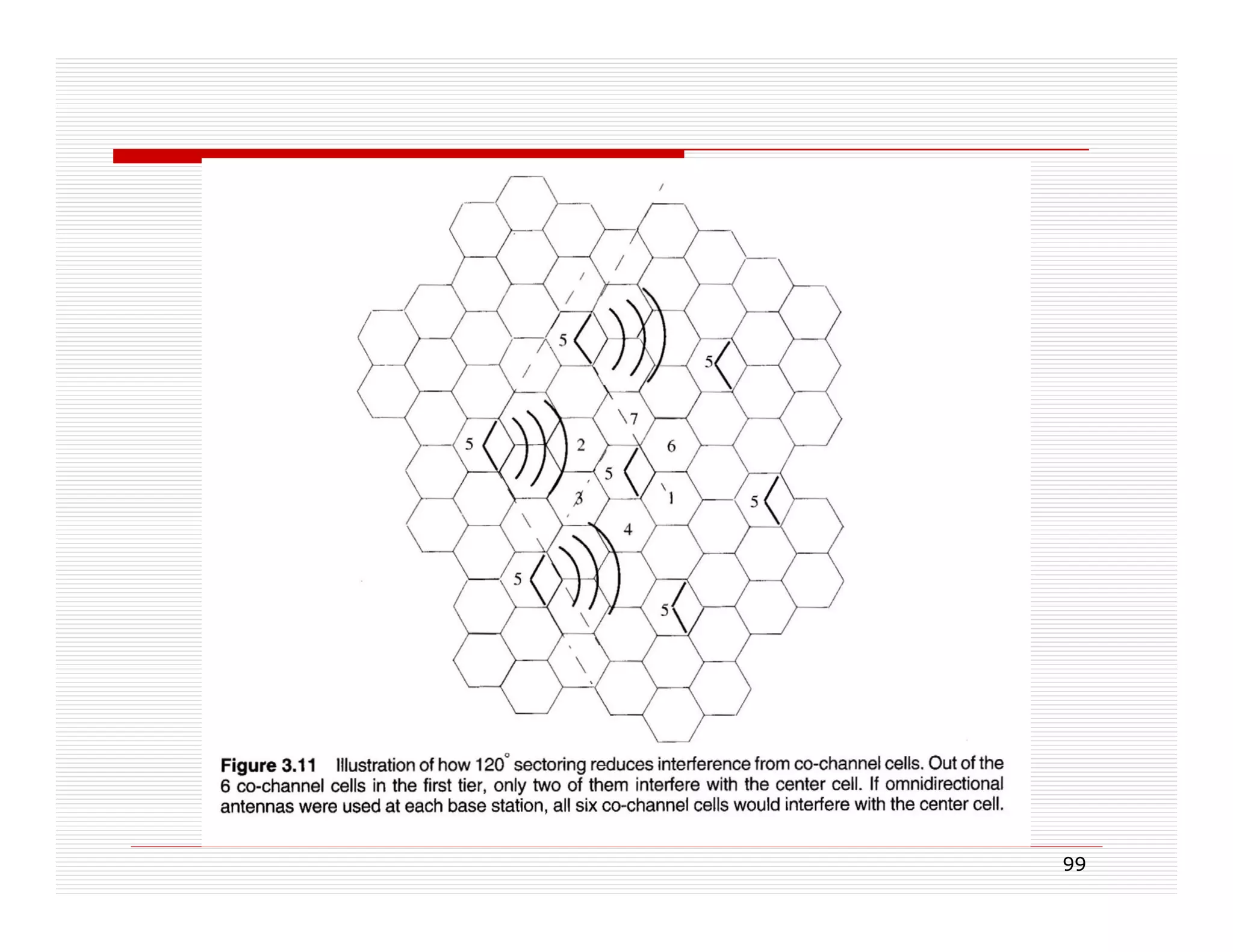
 CCI reduced because only some of neighboring cochannel cells radiate energy in direction of main cell
 center cell labeled "5" has all co-channel cells
illustrated
 only 2 co-channel cells will interfere if all are using
120° sectoring
 only 1 co-channel cell would interfere when using
60° sectoring
 If the S/I was 17 dB for N = 7 and n = 4, what is the
S / I now with 120° sectoring?
 24 2 dB
24.2
98
99
 How is capacity increased?
 sectoring only improves S/I which increases voice
quality, beyond what is really necessary
 by reducing CCI, the cell system designer can choose
smaller cluster size (N ↓) for acceptable voice quality
 smaller N → greater frequency reuse → larger system
capacity
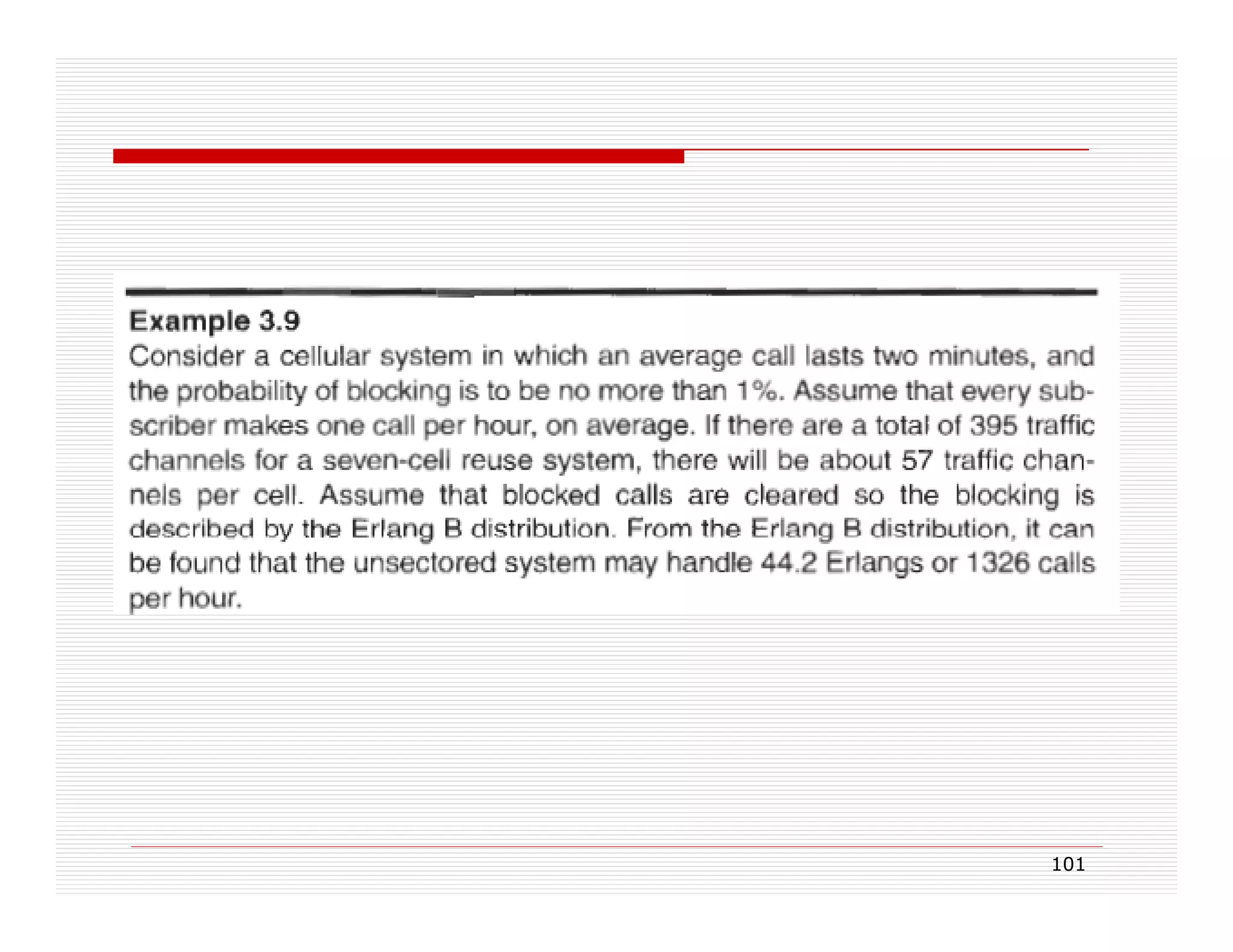
 What would the system capacity, Cnew, now be when
using 120° sectoring, as compared to the old capacity,
Cold ?

100
101
102
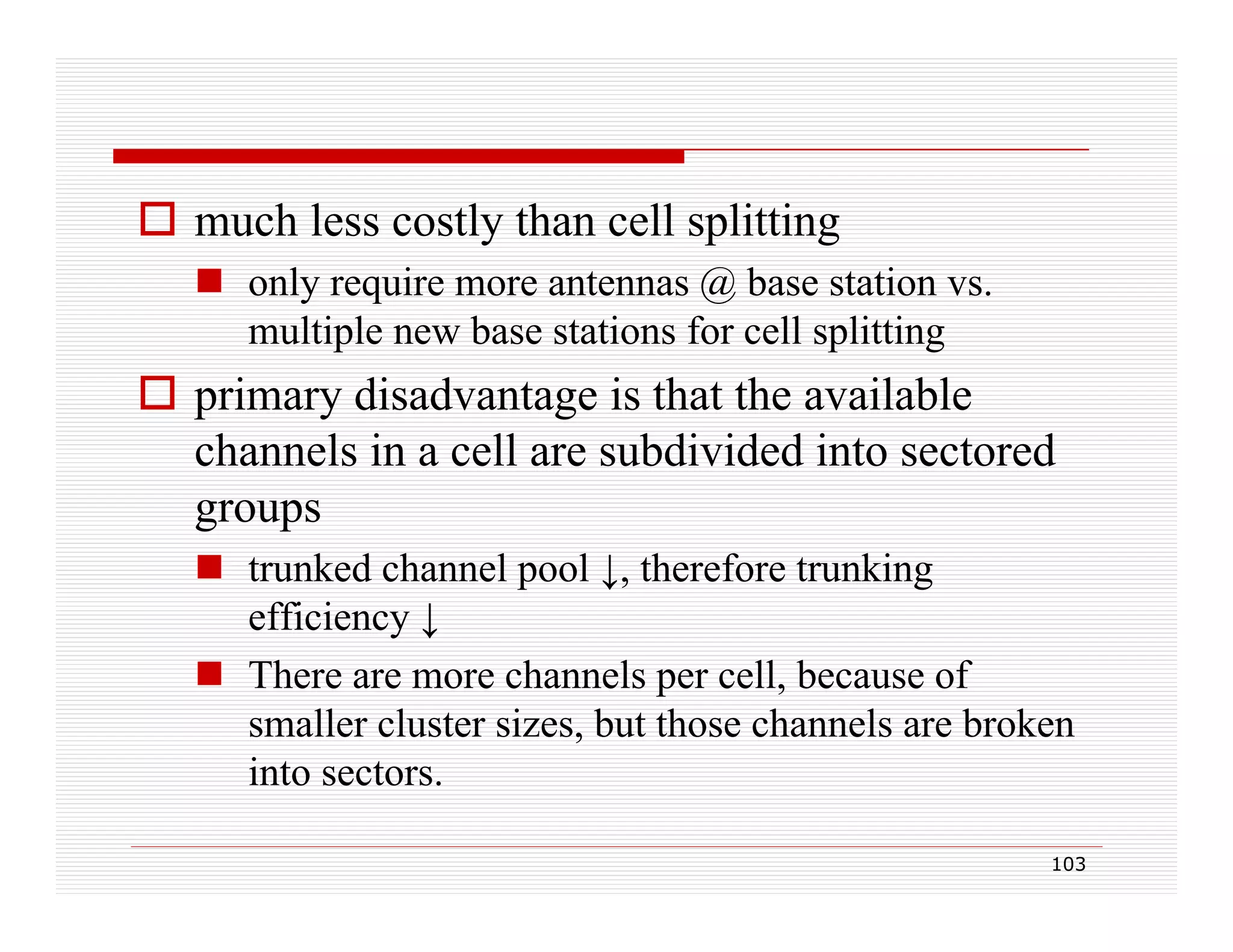
 much less costly than cell splitting
 only require more antennas @ base station vs.
y q
multiple new base stations for cell splitting

 primary disadvantage is that the available
p
y
g
channels in a cell are subdivided into sectored
groups
 trunked channel pool ↓, therefore trunking
efficiency ↓
 There are more channels per cell, because of
smaller cluster sizes, but those channels are broken
into sectors.
sectors
103
 other disadvantages:
 must design network coverage with sectoring
decided in advance
 can’t effectively use sectoring to increase capacity
after setting cluster size N
 can’t be used to gradually expand capacity as
traffic ↑ like cell splitting
 More Handoffs
d ff
 More antenna, more cost

104
 Next topic: Mobile Radio Propagation - Largescale path loss, small-scale fading, and
p
,
g,
multipath







Free space p p g
p
propagation loss
Reflections
2-ray model
Diffraction
Fading
Multipath

105

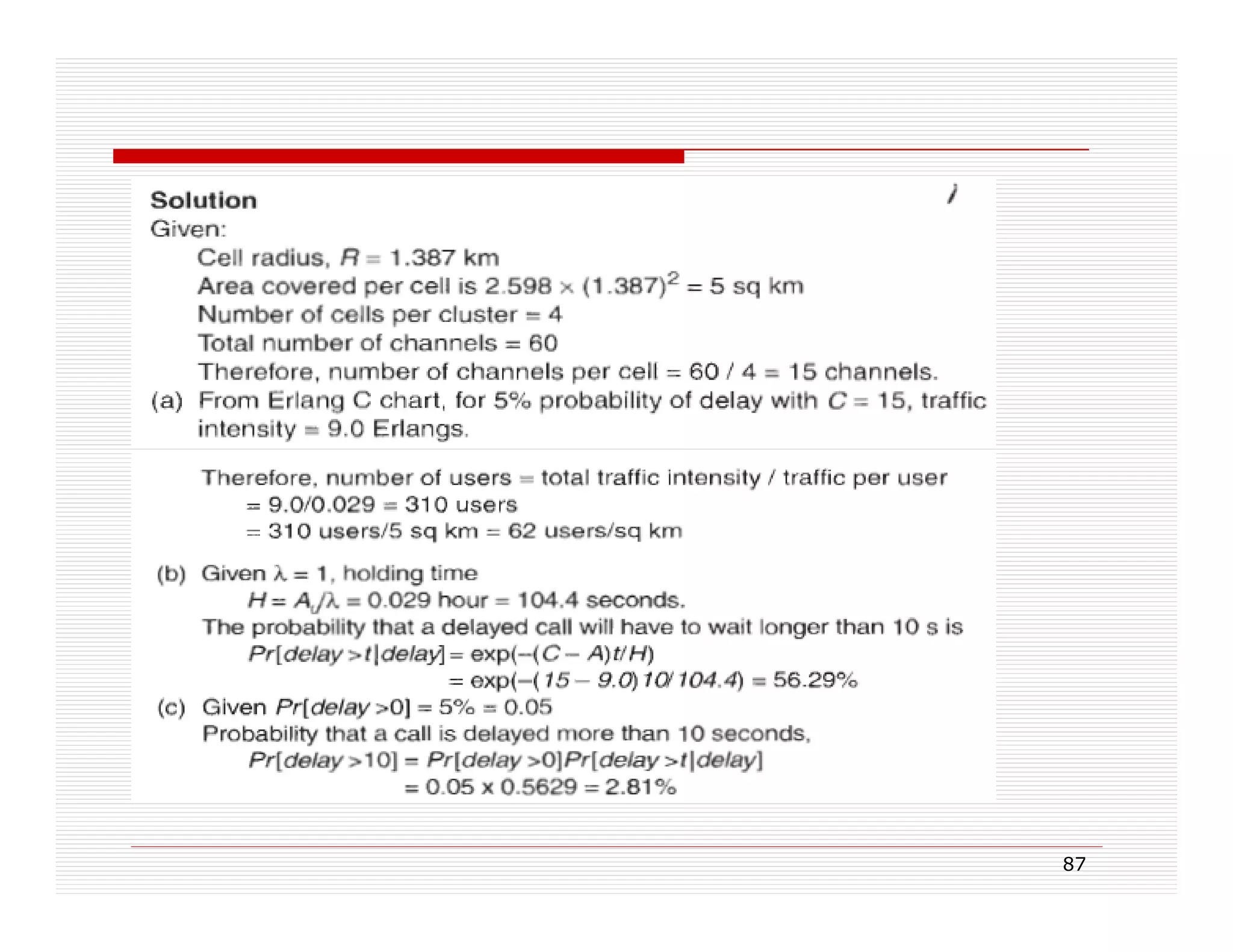
Cellular concepts

  • 1.
    Chapter Ch t 3 TheCellular Concept - System Design p y g Fundamentals
  • 2.
    I. Introduction  Goalsof a Cellular System  High capacity  L Large coverage area  Efficient use of limited spectrum  Large coverage area - Bell system in New York City g g y y had early mobile radio  Single Tx, high power, and tall tower  Low cost  Large coverage area - Bell system in New York City had 12 simultaneous channels for 1000 square miles  S ll # users Small  Poor spectrum utilization  What are possible ways we could increase the number p y of channels available in a cellular system? 2
  • 3.
     Cellular concept Frequency reuse pattern 3
  • 4.
     Cells labeledwith the same letter use the same group of channels.  C ll Cluster: group of N cells using complete set of Cell Cl f ll i l f available channels  Many base stations, lower power, and shorter stations power towers g  Small coverage areas called “cells”  Each cell allocated a % of the total number of available channels  Nearby (adjacent) cells assigned different channel groups  t prevent interference between neighboring base to ti t f b t i hb i b stations and mobile users 4
  • 5.
     Same frequencychannels may be reused by cells a “reasonable” distance away  reused many times as long as interference between same channel (co-channel) cells is < acceptable level  As frequency reuse↑ → # possible simultaneous users↑→ # subscribers ↑→ but system cost ↑ (more towers)  To increase number of users without increasing radio frequency allocation reduce cell sizes (more base allocation, stations) ↑→ # possible simultaneous users ↑  The cellular concept allows all mobiles to be manufactured to use the same set of freqencies f d h ff i  *** A fixed # of channels serves a large # of users by reusing channels in a coverage area *** 5
  • 6.
    II. Frequency Reuse/Planning Design process of selecting & allocating channel groups of cellular base stations  Two competing/conflicting objectives: 1) maximize frequency reuse in specified area 2) minimize interference between cells 6
  • 7.
     Cells  basestation antennas designed to cover specific cell area  hexagonal cell shape assumed for planning  simple model for easy analysis → circles leave gaps  actual cell “footprint” is amorphous (no specific shape)  where Tx successfully serves mobile unit  base station location  cell center → omni-directional antenna (360 coverage) omni directional (360°  not necessarily in the exact center (can be up to R/4 from the ideal location) 7
  • 8.
     cell corners→ sectored or directional antennas on 3 corners with 120° coverage.  very commom  Note that what is defined as a “corner” is somewhat flexible → a sectored antenna covers 120° of a hexagonal cell. g  So one can define a cell as having three antennas in the center or antennas at 3 corners. 8
  • 9.
    III. System Capacity S : total # of duplex channels available for use in a given area; determined by: g ; y  amount of allocated spectrum  channel BW → modulation format and/or standard specs. (e.g. AMPS)  k : number of channels for each cell (k < S) ( )  N : cluster size → # of cells forming cluster  S=kN 9
  • 10.
     M :# of times a cluster is replicated over a geographic coverage area  System Capacity = Total # Duplex Channels = C C=MS=MkN (assuming exactly MN cells will cover the area) ( i l ll ill h )  If cluster size (N) is reduced and the geographic area for each cell is kept constant: p  The geographic area covered by each cluster is smaller, so M must ↑ to cover the entire coverage area (more clusters needed). )  S remains constant.  So C ↑  The smallest possible value of N is desirable to maximize system capacity. 10
  • 11.
     Cluster sizeN determines:  distance between co-channel cells (D) ( )  level of co-channel interference  A mobile or base station can only tolerate so much y interference from other cells using the same frequency and maintain sufficient quality.  large N → large D → low interference → but small M and low C !  T d ff i quality and cluster size. Tradeoff in lit d l t i  The larger the capacity for a given geographic area, the poorer the quality quality. 11
  • 12.
     Frequency reusefactor = 1 / N  each frequency is reused every N cells q y y  each cell assigned k S / N  N cells/cluster  connect without gaps  specific values are required for hexagonal geometry  N = i2 + i j + j2 where i, j ≧ 1  Typical N values → 3, 4, 7, 12; (i, j) = (1,1), (2,0), (2,1), (2,2) 12
  • 13.
     To findthe nearest co-channel neighbors of a particular cell  (1) Move i cells along any chain of hexagons, then (2) turn 60 degrees and move j cells. 13
  • 14.
  • 15.
  • 16.
    IV. Channel AssignmentStrategies  Goal is to minimize interference & maximize use of capacity  l lower interference allows smaller N t be used → greater i t f ll ll to b d t frequency reuse → larger C  Two main strategies: Fixed or Dynamic g y  Fixed  each cell allocated a pre-determined set of voice channels  calls within cell only served by unused cell channels  all channels used → blocked call → no service  several variations  MSC allows cell to borrow a VC (that is to say, a FVC/RVC pair) from an adjacent cell  donor cell must have an available VC to give 16
  • 17.
     Dynamic  channelsNOT allocated permanently  call request → goes to serving base station → goes to MSC  MSC allocates channel “on the fly”  allocation strategy considers:  lik lih d of future call blocking in the cell likelihood f f t ll bl ki i th ll  reuse distance (interference potential with other cells that are using the same frequency)  channel frequency  All frequencies in a market are available to be used 17
  • 18.
     Advantage: reducescall blocking (that is to say, it increases the trunking capacity), and g p y), increases voice quality  Disadvantage: increases storage & g g computational load @ MSC  requires real-time data from entire network related q to:  channel occupancy  traffic distribution  Radio Signal Strength Indications (RSSI's) from all channels 18
  • 19.
    V. Handoff Strategies Handoff: when a mobile unit moves from one cell to another while a call is in progress, the p g , MSC must transfer (handoff) the call to a new channel belonging to a new base station  new voice and control channel frequencies  very important task → often given higher priority than new call  It is worse to drop an in-progress call than to deny a new one 19
  • 20.
     Minimum useablesignal level     lowest acceptable voice quality c call is dropped if be ow this level s d opped below s eve specified by system designers typical values → -90 to -100 dBm yp 20
  • 21.
    Quick review: Decibels S= Signal power in Watts Power of a signal in decibels (dBW) is Psignal = 10 log10(S) Remember dB is used for ratios (like S/N) dBW is used for Watts dBm = dB for power in milliwatts = 10 log10(S x 103) dBm = 10 log10(S) + 10 log10(103) = dBW + 30 -90 dBm = 10 log10(S x 103) 90 10-9 = S x 103 S = 10-12 Watts = 10-9 milliwatts -90 dBm = -120 dBW 90 120 Signal-to-noise ratio: p N = Noise power in Watts S/N = 10 log10(S/N) dB (unitless raio) 21
  • 22.
     choose a(handoff threshold) > (minimum useable signal level) g )  so there is time to switch channels before level becomes too low  as mobile moves away from base station and toward another base station 22
  • 23.
  • 24.
     Handoff Margin△  △ = Phandoff threshold - Pminimum usable signal dB  carefully selected  △ too large → unnecessary handoff → MSC loaded down  △ too small → not enough time to transfer → call dropped!  A dropped handoff can be caused by two factors  not enough time to p g perform handoff  delay by MSC in assigning handoff  high traffic conditions and high computational load on MSC can cause excessive delay by the MSC  no channels available in new cell 24
  • 25.
     Handoff Decision signal level decreases due to  signal fading → don’t handoff  mobile moving away from base station → handoff  must monitor received signal strength over a period t it i d i l t th i d of time → moving average  time allowed to complete handoff depends on t e a owed co p ete a do depe ds o mobile speed  large negative received signal strength (RSS) slope → high speed → quick handoff  statistics of the fading signal are important to g pp p p making appropriate handoff decisions → Chapters 4 and 5 25
  • 26.
     1st GenerationCellular (Analog FM → AMPS)  Received signal strength (RSS) of RVC measured at base station & monitored by MSC  A spare Rx in base station (locator Rx) monitors RSS of RVC's in neighboring cells  Tells Mobile Switching Center about these mobiles and their channels  Locator Rx can see if signal to this base station is significantly better than to the host base station g y  MSC monitors RSS from all base stations & decides on handoff 26
  • 27.
     2nd GenerationCellular w/ digital TDMA (GSM, IS-136)  Mobile Assisted HandOffs (MAHO)  important advancement  The mobile measures the RSS of the FCC’s from adjacent base stations & reports back to serving base station  if Rx power from new base station > Rx power from serving (current) base station by pre-determined margin for a long enough time period → handoff initiated by MSC 27
  • 28.
     MSC nolonger monitors RSS of all channels  reduces computational load considerably d t ti l l d id bl  enables much more rapid and efficient handoffs  imperceptible to user 28
  • 29.
     A mobilemay move into a different system controlled by a different MSC  Called an intersystem handoff  What issues would be involved here?  Prioritizing Handoffs  I Issue: Perceived Grade of S i (GOS) – service P i d G d f Service i quality as viewed by users  “quality” in terms of dropped or blocked calls (not q y pp ( voice quality)  assign higher priority to handoff vs. new call request  a dropped call is more annoying than an occasional blocked call 29
  • 30.
     Guard Channels % of total available cell channels exclusively set aside for handoff requests  makes fewer channels available for new call requests  a good strategy is dynamic channel allocation (not fixed)  adjust number of guard channels as needed by demand  so channels are not wasted in cells with low traffic 30
  • 31.
     Queuing HandoffRequests  use time delay between handoff threshold and y minimum useable signal level to place a blocked handoff request in queue  a handoff request can "keep trying" during that time period, instead of having a single block/no block decision  prioritize requests (based on mobile speed) and handoff as needed  calls will still be dropped if time period expires 31
  • 32.
    VI. Practical HandoffConsiderations  Problems occur because of a large range of mobile velocities  pedestrian vs. vehicle user  Small cell sizes and/or micro-cells → larger # handoffs  MSC load is heavy when high speed users are passed between very small cells 32
  • 33.
     Umbrella Cells Fig. 3.4, pg 67 g , pg.  use different antenna heights and Tx power levels to provide large and small cell coverage  multiple antennas & Tx can be co-located at single location if necessary (saves on obtaining new tower licenses) li )  large cell → high speed traffic → fewer handoffs  small cell → l speed traffic ll ll low d t ffi  example areas: interstate highway passing thru urban center office park, or nearby shopping mall center, park 33
  • 34.
  • 35.
     Cell Dragging low speed user w/ line of sight to base station (very strong signal)  strong signal changing slowly  user moves into the area of an adjacent cell without handoff  causes interference with adjacent cells and other cells  Remember: handoffs help all users, not just the one which is handed ff h d d off.  If this mobile is closer to a reused channel → interference for the other user using the same frequency  So this mobile needs to hand off anyway, so other users benefit because that mobile stays far away from them. 35
  • 36.
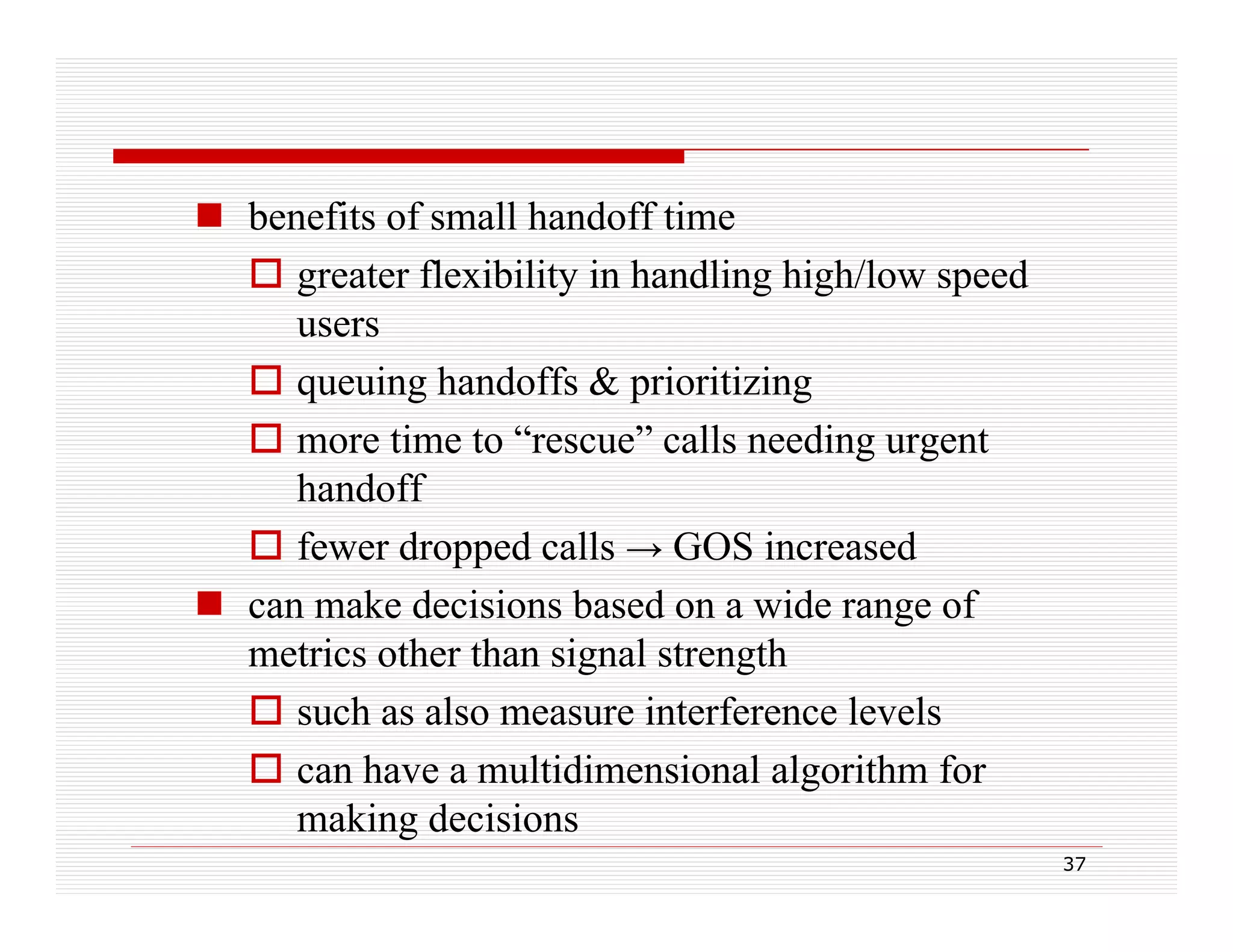
     Typical handoffparameters  Analog cellular (1st generation)  threshold margin △ ≈ 6 to 12 dB  total time to complete handoff ≈ 8 to 10 sec  Digital cellular (2nd generation)  total time to complete handoff ≈ 1 to 2 sec  l lower necessary threshold margin △ ≈ 0 t 6 dB th h ld i to  enabled by mobile assisted handoff 36
  • 37.
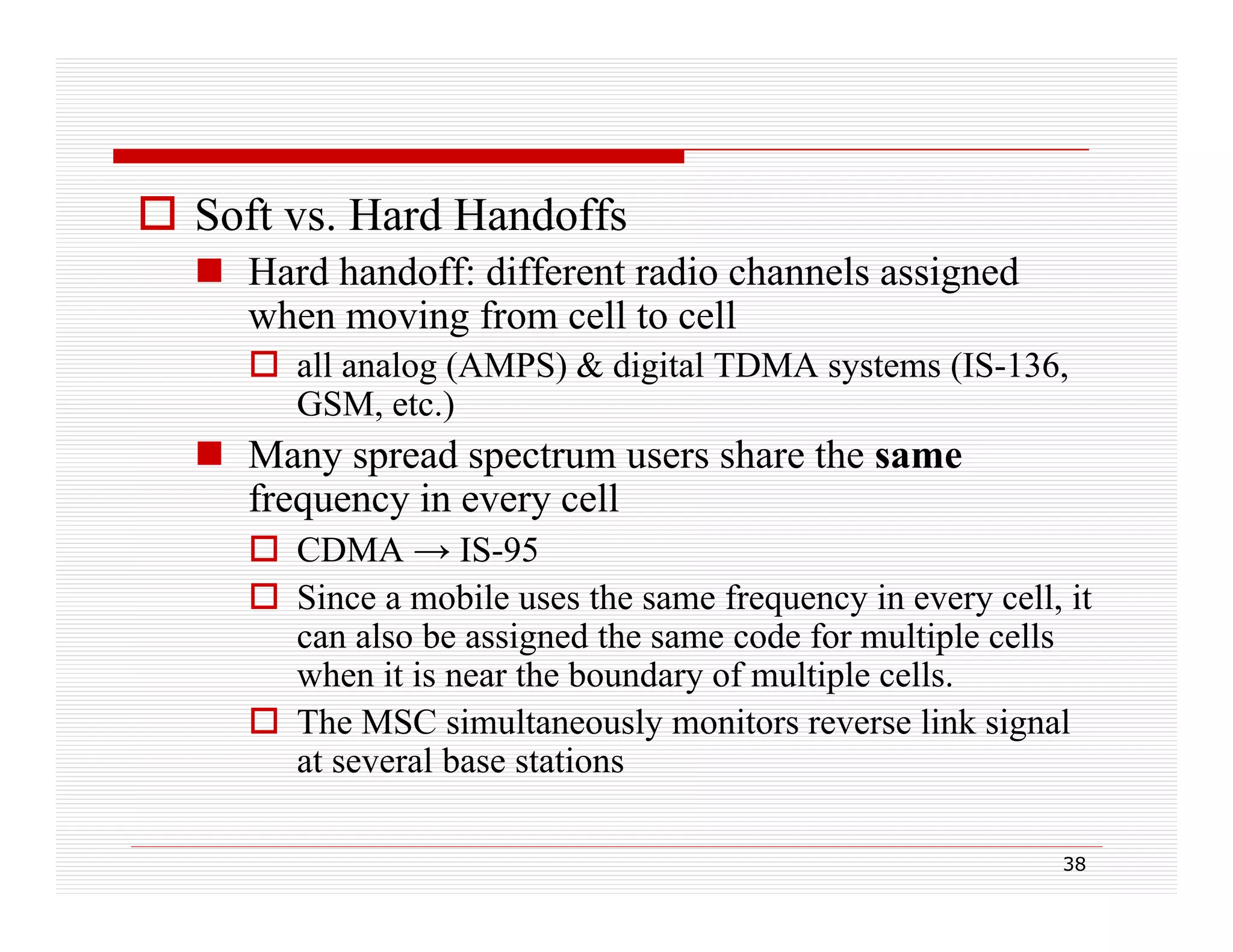
     benefits ofsmall handoff time  greater flexibility in handling high/low speed g y g g p users  queuing handoffs & prioritizing  more time to “rescue” calls needing urgent handoff f fewer d dropped calls → GOS i d ll increased d  can make decisions based on a wide range of metrics other than signal strength  such as also measure interference levels  can have a multidimensional algorithm for making decisions 37
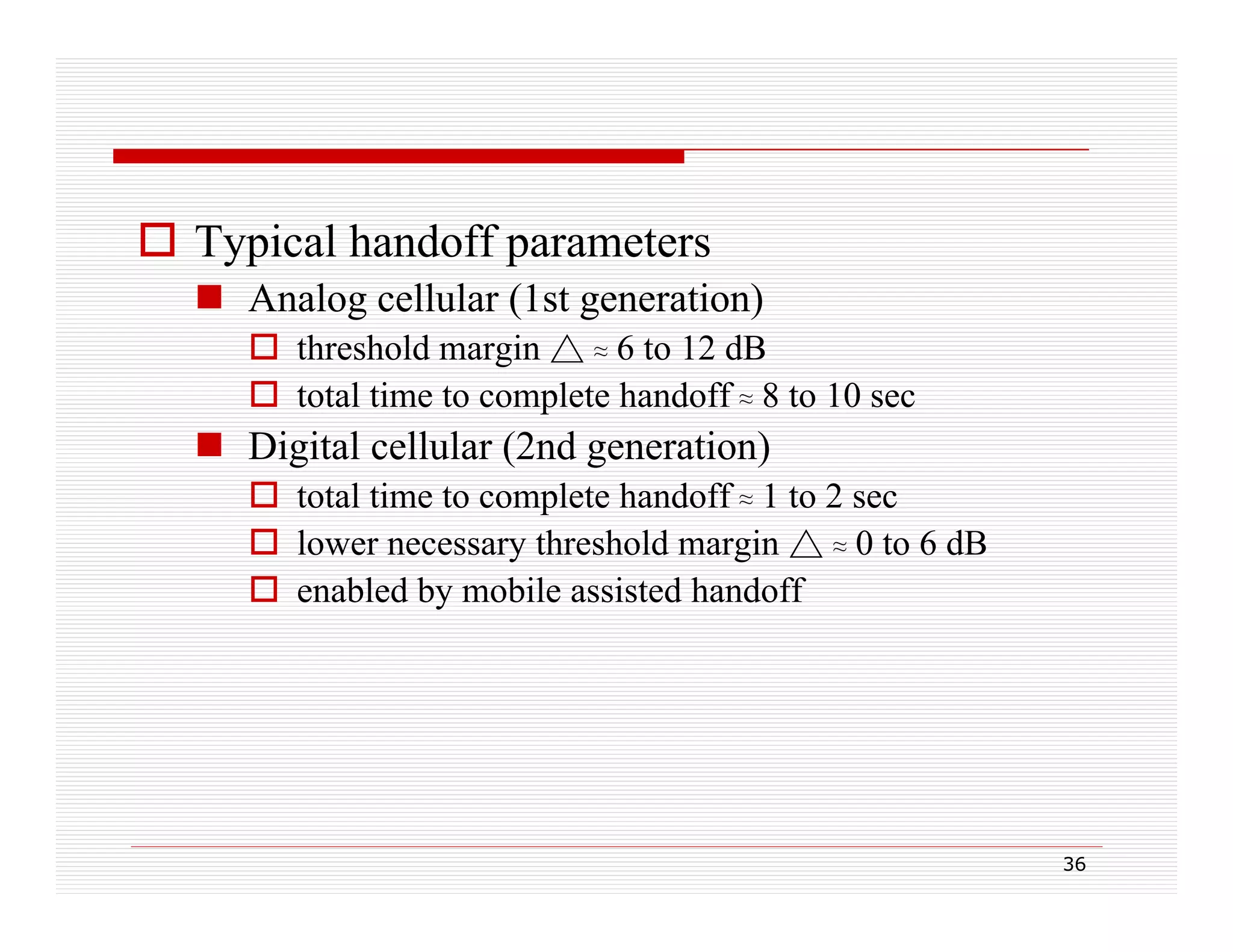
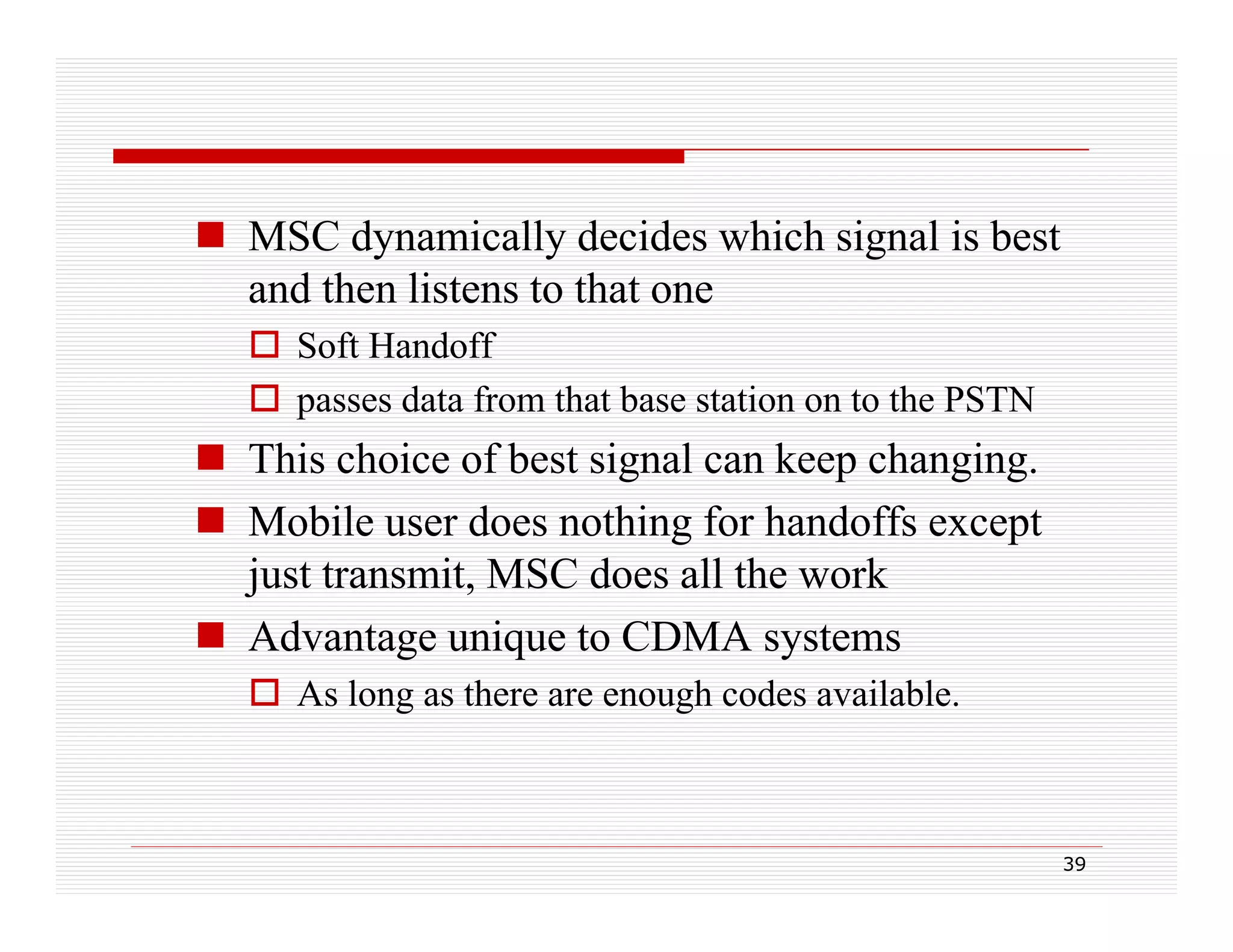
  • 38.
     Soft vs.Hard Handoffs  Hard handoff: different radio channels assigned when moving from cell to cell  all analog (AMPS) & digital TDMA systems (IS-136, GS , etc.) GSM, e c.)  Many spread spectrum users share the same frequency in every cell  CDMA → IS-95  Since a mobile uses the same frequency in every cell, it can also be assigned the same code for multiple cells when it is near the boundary of multiple cells.  The MSC simultaneously monitors reverse link signal at several base stations 38
  • 39.
     MSC dynamicallydecides which signal is best and then listens to that one  Soft Handoff  passes data from that base station on to the PSTN p  This choice of best signal can keep changing. ob e user ot g o a do s except  Mobile use does nothing for handoffs e cept just transmit, MSC does all the work g q y  Advantage unique to CDMA systems  As long as there are enough codes available. 39
  • 40.
    VII. Co-Channel Interference Interference is the limiting factor in performance of all cellular radio systems  What are the sources of interference for a mobile receiver?  Interference is in both  voice channels  control channels l h l  Two major types of system-generated interference: 1) Co-Channel Interference (CCI) 2) Adjacent Channel Interference (ACI) 40
  • 41.
     First welook at CCI  Frequency Reuse  Many cells in a given coverage area use the same set of channel frequencies to increase system q y capacity (C)  Co-channel cells → cells that share the same set of frequencies  VC & CC traffic in co-channel cells is an interfering source to mobiles in Several different cells 41
  • 42.
     Possible Solutions? 1)Increase base station Tx p ) power to improve radio p signal reception? __  this will also increase interference from co-channel cells by the same amount ll b h  no net improvement 2) Separate co-channel cells by some minimum co channel distance to provide sufficient isolation from propagation of radio signals?  if all cell sizes, transmit powers, and coverage patterns ≈ same → co-channel interference is independent of Tx power 42
  • 43.
     co-channel interferencedepends on: co channel  R : cell radius  D : distance to base station of nearest co-channel cell  if D / R ↑ then spatial separation relative to cell coverage area ↑  i improved isolation from co-channel RF energy di l i f h l  Q = D / R : co-channel reuse ratio  hexagonal cells → Q = D/R = 3N 43
  • 44.
     Fundamental tradeoffin cellular system design:  small Q → small cluster size → more frequency reuse → larger system capacity great  But also: small Q → small cell separation → increased co-channel interference (CCI) → reduced co channel voice quality → not so great  Tradeoff: Capacity vs. Voice Quality 44
  • 45.
     Signal toInterference ratio → S / I, ____________  S : desired signal p g power  Ii : interference power from ith co-channel cell  io : # of co-channel interfering cells 45
  • 46.
     Approximation withsome assumptions  Di : distance from ith interferer to mobile  Rx power @ mobile  ( Di ) n 46
  • 47.
     n :path loss exponent  free space or line of sight (LOS) (no obstruction) → n=2  urban cellular → n = 2 to 4, signal decays faster with distance away from the base station ith di t f th b t ti  having the same n throughout the coverage area means radio propagation properties are roughly the same everywhere  if base stations have equal Tx power and n is the q p same throughout coverage area (not always true) then the above equation (Eq. 3.8) can be used. 47
  • 48.
     Now ifwe consider only the first layer (or tier) of co-channel cells  assume only these provide significant interference  And assume interfering base stations are equidistant from the desired base station (all at distance ≈ D) then ) 48
  • 49.
     What determinesacceptable S / I ?  voice quality → subjective testing q y j g  AMPS → S / I 18 dB (assumes path loss exponent n = 4)  Solving (3.9) for N  Most reasonable assumption is io : # of co-channel interfering cells = 6  N = 7 (very common choice for AMPS) ( h i f 49
  • 50.
     Many assumptionsinvolved in (3.9) :     same Tx power p hexagonal geometry n same throughout area g Di ≈ D (all interfering cells are equidistant from the base station receiver)  optimistic result in many cases  propagation tools are used to calculate S / I when assumptions aren’t valid i lid 50
  • 51.
     S /I is usually the worst case when a mobile is at the cell edge  low signal power from its own base station & high interference power from other cells  more accurate approximations are necessary in those cases S R 4  I 2( D  R) 4  2( D  R) 4  2 D 4 51
  • 52.
    N =7 andS / I ≈ 17 dB 52
  • 53.
     Eq. (3.5),(3.8), and (3.9) are (S / I) for forward link only, i.e. the cochannel base Tx interfering with desired base station transmission to mobile unit  so this considers interference @ the mobile unit  What abo t reverse link co-channel interference? about co channel  less important because signals from mobile antennas (near the ground) don’t propagate as well as those from tall base station antennas  obstructions near ground level significantly attenuate mobile energy in direction of base station Rx  also weaker because mobile Tx power is variable → base stations regulate transmit power of mobiles to be no larger than necessary 53
  • 54.
    I. Adjacent ChannelInterference  Two major types of system-generated interference: 1) Co-Channel Interference (CCI) – discussed in last lecture 2) Adjacent Channel Interference (ACI)  Adjacent Channel Interference (ACI)  Imperfect Rx filters allow energy from adjacent channels to leak into the passband of other channels h l 54
  • 55.
     d id filter response desired fil  actual filter response 55
  • 56.
     This affectsboth forward & reverse links  Forward Link → base-to-mobile base to mobile  interference @ mobile Rx from a ______ Tx ( (another mobile or another base station that is not the one the mobile is listening to) when mobile Rx is ___ away from base station.  signal from base station is weak and others are somewhat strong. R Reverse Li k → mobile-to-base Link bil t b  interference @ base station Rx from nearby mobile Tx when desired mobile Tx is far away from base station 56
  • 57.
     Near/Far Effect interfering source is near some Rx when desired g source is far away  ACI is primarily from mobiles in the same cell p y  some cell-to-cell ACI does occur as well → but a secondary source  Control of ACI  don’t allocate channels within a given cell from a contiguous band of frequencies  for example, use channels 1, 4, 7, and 10 for a cell.  no channels next to each other h l tt h th 57
  • 58.
     maximize channelseparation  separation of as many as N channel bandwidths  some schemes also seek to minimize ACI from neighboring cells by not assigning adjacent channels in neighboring cells 58
  • 59.
  • 60.
     Originally 666channels, then 10 MHz of spectrum was added 666+166 = 832 channels  395 VC plus 21 CC per service provider (providers A & B) 395*2 = 790, plus 42 control channels  Provider A is a company that has not traditionally provided telephone service  P id B i a traditional wireline operator Provider is t diti l i li t  21 VC groups with ≈ 19 channels/group  at least 21 channel separation for each group tl t h l ti f h 60
  • 61.
     for N= 7 → 3 VC groups/cell  For example, choose groups 1A, 1B, and 1C for a p , g p , , cell – so channels 1, 8, 15, 22, 29, 36, etc. are used.  ≈ 57 channels/cell  at least 7 channel separation for each cell group  to have high quality on control channels, 21 cell g q y reuse is used for CC’s  instead of reusing a CC every 7 cells, as for VC’s, reuse every 21 cells (after every three clusters)  greater distance between control channels, so less CCI 61
  • 62.
     use highquality filters in base stations  better filters are possible in base stations since they p y are not constrained by physical size and power as much as in the mobile Rx  makes reverse link ACI less of a concern than forward link ACI  also true because of power control (discussed below)  choice of modulation schemes  diff different modulation schemes provide less or more t d l ti h id l energy outside their passband. 62
  • 63.
     Power Control technique to minimize ACI q  base station & MSC constantly monitor mobile received signal strength  mobile Tx power varied (controlled) so that smallest Tx power necessary for a quality reverse link i l i li k signal is used (lower power for the closer the d (l f th l th mobile is to the base station)  also helps battery life on mobile 63
  • 64.
     dramatically improvesadjacent channel S / I ratio, since mobiles in other cells only transmit at high enough power as transmitter controls t hi h h t itt t l (not at full power)  most beneficial for ACI on reverse link  will see later that this is especially important for CDMA systems 64
  • 65.
    III. Trunking &Grade of Service (GOS)  Trunked radio system: radio system where a large # of users share a pool of channels  channel allocated on demand & returned to channel pool upon call termination  exploit statistical (random) behavior of users so that fixed # of channels can accommodate large # of users  Trade-off between the number of available channels that are provided and the likelihood of a particular user finding no channels available during the busy hour of the day. 65
  • 66.
     trunking theoryis used by telephone companies to allocate limited # of voice circuits for large # of telephone lines  efficient use of equipment resources → savings q p g  disadvantage is that some probability exists that mobile user will be denied access to a channel  blocked call : access denied → “blocked call cleared”  delayed call : access delayed by call being put into holding queue for specified amount of time 66
  • 67.
     GOS :measure of the ability of user access to a trunked system during the _______ hour  specified as probability (Pr) that call is blocked or delayed y  designed to handle the busiest hour → typically ______  Erlang : unitless measure of traffic intensity  e.g. 0.5 erlangs = 1 channel occupied 30 minutes during 1 hour  Table 3.3, pg. 78 → trunking theory definitions 67
  • 68.
     “Offered” TrafficIntensity (A)  Offered? → not necessarily carried by system y y y (some is blocked or delayed)  each user Au=λH Erlangs (also called ρ in queueing theory)  λ = traffic intensity (average arrival rate of new calls, in new requests per time unit say calls/min) unit, calls/min).  H = average duration of a call (also called 1/ µ in queueing theory)  system with U users → A = UAu = UλH Erlangs  capacity = maximum carried traffic = C Erlangs = (equal to total # of available channels that are busy all the time) 68
  • 69.
     Erlang Bformula  Calls are either admitted or blocked  A = total offered traffic gp (e.g. )  C = # channels in trunking pool ( g a cell)  AMPS designed for GOS of 2%  blocked call cleared (denied) → BCC ( ) 69
  • 70.
     capacities tosupport various GOS values  N that twice the capacity can support much more than Note h i h i h h twice the load (twice the number of Erlangs). 70
  • 71.
     Erlang Cformulas  blocked call delayed → BCD → put into holding y p g queue  GOS is probability that a call will still be blocked even if it spends time in a queue and waits for up to t seconds  equations (3.17) to (3.19) in book ti (3 17) t (3 19) i b k 71
  • 72.
     Graphical formof Erlang B formulas 72
  • 73.
     Graphical formof Erlang C formulas 73
  • 74.
     Example: Findhow many users can be supported in a cell containing 50 channels for a pp g 2% GOS (Blocked Calls Cleared) if the average user calls twice/hr with an average call duration of 5 minutes.  What is the corresponding C from the figure?  What is A (Traffic Intensity) from the figure?  So, how many users can be supported? , y pp 74
  • 75.
     Trunking Efficiency measure of the # of users supported by a specific configuration of fixed channels, efficiency in terms of users per available channel = U / C  Table 3.4, pg. 79 → assume 1% GOS 3 4 pg  Assume Au = 0.2  1 group of 20 channels:  2 groups of 10 channels, with equal number of users per group: 75
  • 76.
     the allocationof channel groups can substantially change the # of users supported by y g pp y trunked system  The larger the trunking p g g pool, the better the trunking g efficiency.  as trunking pool size ↓ then trunking efficiency ↓  What is the relationship between trunking pool size, trunking efficiency, received signal quality, and cluster size?  As cluster size decreases decreases… 76
  • 77.
     Note: Trunkingefficiency is an issue both in FDMA/TDMA systems and i CDMA systems t d in t (where the capacity limit is the number of possible codes and the interference levels). levels) 77
  • 78.
  • 79.
  • 80.
  • 81.
  • 82.
  • 83.
  • 84.
  • 85.
  • 86.
  • 87.
  • 88.
    IV. Improving CellularSystem Capacity  A cellular design eventually (hopefully!) becomes insufficient to support the growing number of users.  Need to provide more channels per unit coverage area  Would like to have orderly growth  Would like to upgrade the system instead of rebuild ld lik d h i d f b ild  Would like to use existing towers as much as possible 88
  • 89.
     Cell Splitting subdivide congested cell into several smaller cells  increases number of times channels are reused in an area g power  must decrease antenna height & Tx p  so smaller coverage per cell results  and the co-channel interference level is held constant 89
  • 90.
     each smallercell keeps ≈ same # of channels as the larger cell, since each new smaller cell uses the same number of frequencies  this means that we keep that same cluster size  capacity ↑ because channel reuse ↑ per unit area  smaller cells → “micro-cells” 90
  • 91.
     Illustration isfor towers at the corners 91
  • 92.
     advantages include: only needed for cells that reach max. capacity → not all cells  implement when Pr [blocked call] > acceptable GOS  system capacity can gradually expand as demand ↑  disadvantages include:  # handoffs/unit area increases  umbrella cell for high velocity traffic may be needed  more base stations → $$ for real estate, towers, etc. 92
  • 93.
     complicated designprocess  new base stations use lower power and antenna height  What about existing base stations?  If kept at the same power, they would overpower new power microcells.  If reduced in power, they would not cover their own cells. ll  One solution: Use separate groups of channels.  One group at the original power and another group at O e g oup eo g powe d o e g oup the lower power.  New microcells only use lower power channels.  As load growth continues more and more channels are continues, moved to lower power. 93
  • 94.
  • 95.
  • 96.
     Sectoring  cellsplitting keeps D / R unchanged (same cluster size and CCI) but increases frequency reuse/area  alternate way to ↑ capacity is to _____ CCI (increase S / I ratio) 96
  • 97.
     replace omni-directionalantennas at base station with several directional antennas  3 sectors → 3 120° antennas  6 sectors → 6 60° antennas 97
  • 98.
     cell channelsbroken down into sectored groups ll h l b k d i d  CCI reduced because only some of neighboring cochannel cells radiate energy in direction of main cell  center cell labeled "5" has all co-channel cells illustrated  only 2 co-channel cells will interfere if all are using 120° sectoring  only 1 co-channel cell would interfere when using 60° sectoring  If the S/I was 17 dB for N = 7 and n = 4, what is the S / I now with 120° sectoring?  24 2 dB 24.2 98
  • 99.
  • 100.
     How iscapacity increased?  sectoring only improves S/I which increases voice quality, beyond what is really necessary  by reducing CCI, the cell system designer can choose smaller cluster size (N ↓) for acceptable voice quality  smaller N → greater frequency reuse → larger system capacity  What would the system capacity, Cnew, now be when using 120° sectoring, as compared to the old capacity, Cold ? 100
  • 101.
  • 102.
  • 103.
     much lesscostly than cell splitting  only require more antennas @ base station vs. y q multiple new base stations for cell splitting  primary disadvantage is that the available p y g channels in a cell are subdivided into sectored groups  trunked channel pool ↓, therefore trunking efficiency ↓  There are more channels per cell, because of smaller cluster sizes, but those channels are broken into sectors. sectors 103
  • 104.
     other disadvantages: must design network coverage with sectoring decided in advance  can’t effectively use sectoring to increase capacity after setting cluster size N  can’t be used to gradually expand capacity as traffic ↑ like cell splitting  More Handoffs d ff  More antenna, more cost 104
  • 105.
     Next topic:Mobile Radio Propagation - Largescale path loss, small-scale fading, and p , g, multipath       Free space p p g p propagation loss Reflections 2-ray model Diffraction Fading Multipath 105