Growth of Bone Lloyd Dean Skeletal System
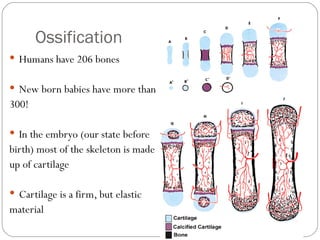
Ossification Humans have 206 bones New born babies have more than  300! In the embryo (our state before  birth) most of the skeleton is made  up of cartilage Cartilage is a firm, but elastic  material
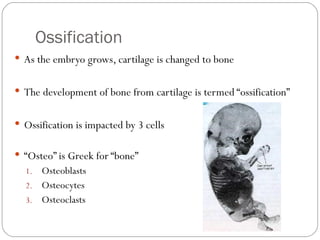
Ossification As the embryo grows, cartilage is changed to bone The development of bone from cartilage is termed “ossification” Ossification is impacted by 3 cells “ Osteo” is Greek for “bone” Osteoblasts Osteocytes Osteoclasts
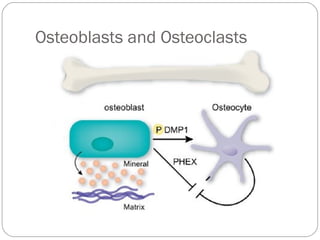
Ossification Completed during three stages: Production of an extracellular matrix Osteoblasts produce collagen (Tough elastic) Calcium is utilised Mineralisation of matrix to form bone Osteoblasts fill spaces in bone with matrix, and then become trapped There are then known as Osteocytes and have a star shape appearance Bone remodelling Osteoclasts break down bone and Osteoblasts rebuild them Enables skeleton to repaid, adapt and build strong bones
Osteoblasts and Osteoclasts
Bone Remodelling
Osteoblasts, Osteoclasts and Osteoporosis
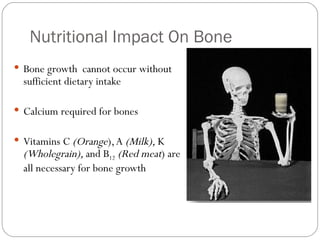
Bone growth  cannot occur without sufficient dietary intake Calcium required for bones  Vitamins C  (Orange ), A  (Milk),  K  (Wholegrain),  and B 12   (Red meat ) are all necessary for bone growth Nutritional Impact On Bone
Growth hormone stimulates bone growth Thyroxine  (Thyroid gland) increases the rate of osteoblast activity At puberty, sex hormones (estrogens in females and androgens in males) cause osteoblasts to produce bone faster than the epiphyseal cartilage can divide.  Commonly know as  “growth spurt”  as well as the closure of the epiphyseal plate. Estrogens cause faster closure of the epiphyseal growth plate than androgens -  Girls grow faster than boys! Hormones Impacting Bone Growth

Growth of bone

  • 1.
    Growth of BoneLloyd Dean Skeletal System
  • 2.
    Ossification Humans have206 bones New born babies have more than 300! In the embryo (our state before birth) most of the skeleton is made up of cartilage Cartilage is a firm, but elastic material
  • 3.
    Ossification As theembryo grows, cartilage is changed to bone The development of bone from cartilage is termed “ossification” Ossification is impacted by 3 cells “ Osteo” is Greek for “bone” Osteoblasts Osteocytes Osteoclasts
  • 4.
    Ossification Completed duringthree stages: Production of an extracellular matrix Osteoblasts produce collagen (Tough elastic) Calcium is utilised Mineralisation of matrix to form bone Osteoblasts fill spaces in bone with matrix, and then become trapped There are then known as Osteocytes and have a star shape appearance Bone remodelling Osteoclasts break down bone and Osteoblasts rebuild them Enables skeleton to repaid, adapt and build strong bones
  • 5.
  • 6.
  • 7.
  • 8.
    Bone growth cannot occur without sufficient dietary intake Calcium required for bones Vitamins C (Orange ), A (Milk), K (Wholegrain), and B 12 (Red meat ) are all necessary for bone growth Nutritional Impact On Bone
  • 9.
    Growth hormone stimulatesbone growth Thyroxine (Thyroid gland) increases the rate of osteoblast activity At puberty, sex hormones (estrogens in females and androgens in males) cause osteoblasts to produce bone faster than the epiphyseal cartilage can divide. Commonly know as “growth spurt” as well as the closure of the epiphyseal plate. Estrogens cause faster closure of the epiphyseal growth plate than androgens - Girls grow faster than boys! Hormones Impacting Bone Growth