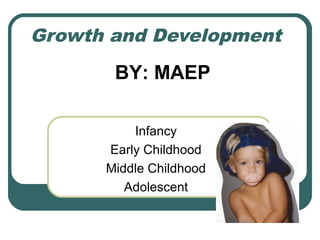
Growth and Development

BY: MAEP
Infancy
Early Childhood
Middle Childhood
Adolescent
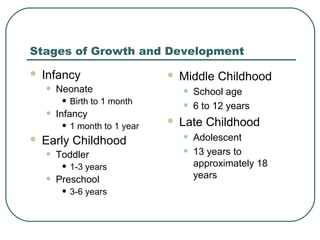
Stages of Growth and Development


Infancy

•



Neonate

•

Infancy



•
•

• Birth to 1 month
•

1 month to 1 year

Early Childhood

•

Toddler

•

Preschool

• 1-3 years
• 3-6 years

Middle Childhood



School age
6 to 12 years

Late Childhood

•
•

Adolescent
13 years to
approximately 18
years
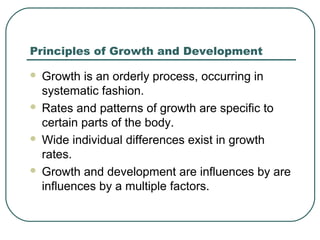
Principles of Growth and Development








Growth is an orderly process, occurring in
systematic fashion.
Rates and patterns of growth are specific to
certain parts of the body.
Wide individual differences exist in growth
rates.
Growth and development are influences by are
influences by a multiple factors.
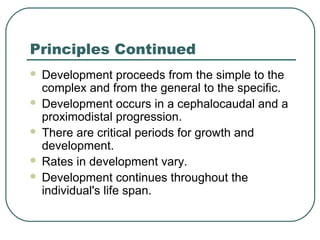
Principles Continued






Development proceeds from the simple to the
complex and from the general to the specific.
Development occurs in a cephalocaudal and a
proximodistal progression.
There are critical periods for growth and
development.
Rates in development vary.
Development continues throughout the
individual's life span.
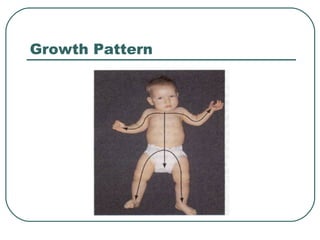
Growth Pattern
Growth Patterns
 The

child’s pattern of growth is in a
head-to-toe direction, or
cephalocaudal, and in an inward to
outward pattern called proximodistal.
Why developmental
assessment?
 Early

detection of deviation in child’s
pattern of development
 Simple and time efficient mechanism to
ensure adequate surveillance of
developmental progress
 Domains assessed: cognitive, motor,
language, social / behavioral and
adaptive
Gross Motor Skills
 The

acquisition of gross motor skill
precedes the development of fine motor
skills.
 Both processes occur in a cephalocaudal
fashion

• Head control preceding arm and hand control
• Followed by leg and foot control.
Gross Motor Development
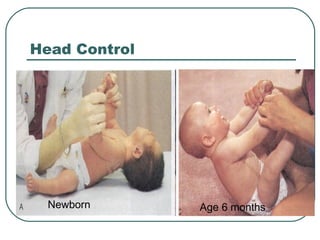
 Newborn:

barely able to lift head
 6 months: easily lifts head, chest and
upper abdomen and can bear weight on
arms
Head Control

Newborn

Age 6 months
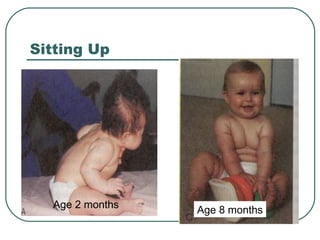
Sitting up
 2months

old: needs assistance
 6 months old: can sit alone in the tripod
position
 8 months old: can sit without support and
engage in play
Sitting Up

Age 2 months

Age 8 months
Ambulation
9

month old: crawl
 1 year: stand independently from a crawl
position
 13 month old: walk and toddle quickly
 15 month old: can run
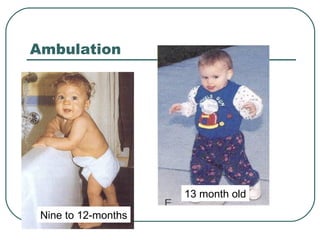
Ambulation

13 month old
Nine to 12-months
Fine Motor - Infant
 Newborn

has very little control. Objects
will be involuntarily grasped and dropped
without notice.
 6 month old: palmar grasp – uses entire
hand to pick up an object
 9 month old: pincer grasp – can grasp
small objects using thumb and forefinger
Speech Milestones








1-2 months: coos
2-6 months: laughs and squeals
8-9 months babbles: mama/dada as sounds
10-12 months: “mama/dada specific
18-20 months: 20 to 30 words – 50%
understood by strangers
22-24 months: two word sentences, >50
words, 75% understood by strangers
30-36 months: almost all speech understood
by strangers
Hearing







BAER hearing test done at birth
Ability to hear correlates with ability enunciate
words properly
Always ask about history of otitis media – ear
infection, placement of PET – tubes in ear
Early referral to MD to assess for possible fluid
in ears (effusion)
Repeat hearing screening test
Speech therapist as needed
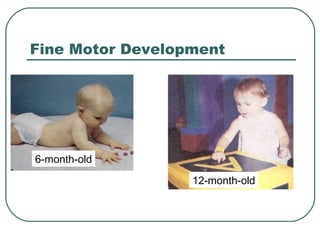
Fine Motor Development

6-month-old
12-month-old
Red Flags in infant development
 Unable

to sit alone by age 9 months
 Unable to transfer objects from hand to
hand by age 1 year
 Abnormal pincer grip or grasp by age 15
months
 Unable to walk alone by 18 months
 Failure to speak recognizable words by 2
years.
Fine Motor - toddler
1

year old: transfer objects from hand to
hand
 2 year old: can hold a crayon and color
vertical strokes

• Turn the page of a book
• Build a tower of six blocks
Fine Motor – Older Toddler
3

year old: copy a circle and a cross –
build using small blocks
 4 year old: use scissors, color within the
borders
 5 year old: write some letters and draw a
person with body parts
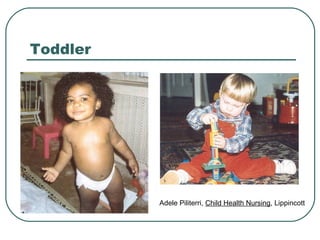
Toddler

Adele Piliterri, Child Health Nursing, Lippincott
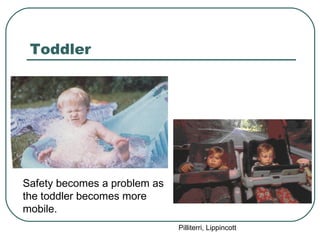
Toddler

Safety becomes a problem as
the toddler becomes more
mobile.
Pilliterri, Lippincott
Toddlers
Issues in parenting - toddlers








Stranger anxiety – should dissipate by age 2 ½
to 3 years
Temper tantrums: occur weekly in 50 to 80%
of children – peak incidence 18 months – most
disappear by age 3
Sibling rivalry: aggressive behavior towards
new infant: peak between 1 to 2 years but may
be prolonged indefinitely
Thumb sucking
Toilet Training
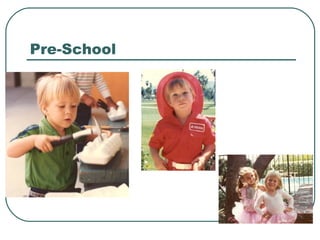
Pre-School
Fine motor and cognitive abilities







Buttoning clothing
Holding a crayon / pencil
Building with small blocks
Using scissors
Playing a board game
Have child draw picture of himself

•

Pre-school tasks
Red flags: preschool
 Inability

to perform self-care tasks, hand
washing simple dressing, daytime
toileting
 Lack of socialization
 Unable to play with other children
 Able to follow directions during exam
 Performance evaluation of pre-school
teacher for kindergarten readiness
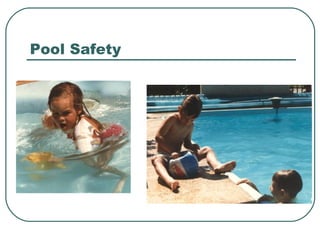
Pool Safety
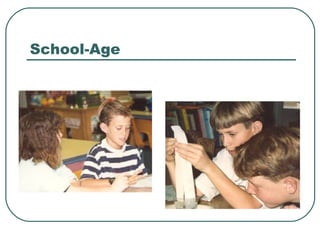
School-Age
School Years: fine motor




Writing skills improve
Fine motor is refined
Fine motor with more focus

•
•
•
•
•
•

Building: models – legos
Sewing
Musical instrument
Painting
Typing skills
Technology: computers
School performance
•
•
•
•

•

Ask about favorite subject
How they are doing in school
Do they like school
By parent report: any learning difficulties,
attention problems, homework
Parental expectations
Red flags: school age
 School

failure
 Lack of friends
 Social isolation
 Aggressive behavior: fights, fire setting,
animal abuse
School Age: gross motor
8

to 10 years: team sports
 Age ten: match sport to the physical and
emotional development
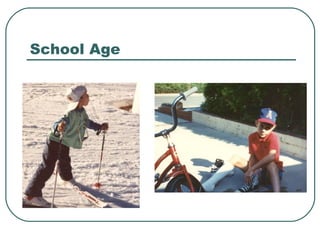
School Age
School Age: cognitive
 Greater

ability to concentrate and
participate in self-initiating quiet activities
that challenge cognitive skills, such as
reading, playing computer and board
games.
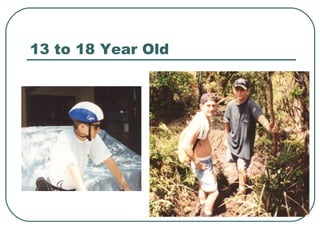
13 to 18 Year Old
Adolescent
 As

teenagers gain independence they
begin to challenge values
 Critical of adult authority
 Relies on peer relationship
 Mood swings especially in early
adolescents
Adolescent behavioral problems
 Anorexia
 Attention

deficit
 Anger issues
 Suicide
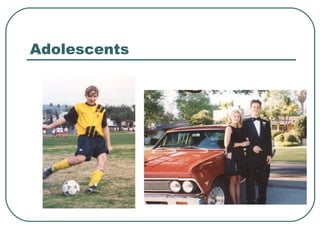
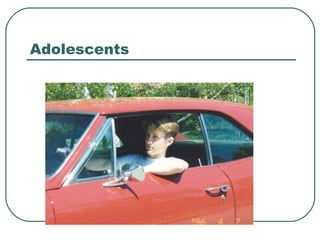
Adolescents
Adolescent Teaching
 Relationships
 Sexuality

– STD’s / AIDS
 Substance use and abuse
 Gang activity
 Driving
 Access to weapons
Adolescents

Growth & development

  • 1.
    Growth and Development BY:MAEP Infancy Early Childhood Middle Childhood Adolescent
  • 2.
    Stages of Growthand Development  Infancy •  Neonate • Infancy  • • • Birth to 1 month • 1 month to 1 year Early Childhood • Toddler • Preschool • 1-3 years • 3-6 years Middle Childhood  School age 6 to 12 years Late Childhood • • Adolescent 13 years to approximately 18 years
  • 3.
    Principles of Growthand Development     Growth is an orderly process, occurring in systematic fashion. Rates and patterns of growth are specific to certain parts of the body. Wide individual differences exist in growth rates. Growth and development are influences by are influences by a multiple factors.
  • 4.
    Principles Continued      Development proceedsfrom the simple to the complex and from the general to the specific. Development occurs in a cephalocaudal and a proximodistal progression. There are critical periods for growth and development. Rates in development vary. Development continues throughout the individual's life span.
  • 5.
  • 6.
    Growth Patterns  The child’spattern of growth is in a head-to-toe direction, or cephalocaudal, and in an inward to outward pattern called proximodistal.
  • 7.
    Why developmental assessment?  Early detectionof deviation in child’s pattern of development  Simple and time efficient mechanism to ensure adequate surveillance of developmental progress  Domains assessed: cognitive, motor, language, social / behavioral and adaptive
  • 8.
    Gross Motor Skills The acquisition of gross motor skill precedes the development of fine motor skills.  Both processes occur in a cephalocaudal fashion • Head control preceding arm and hand control • Followed by leg and foot control.
  • 9.
    Gross Motor Development Newborn: barely able to lift head  6 months: easily lifts head, chest and upper abdomen and can bear weight on arms
  • 10.
  • 11.
    Sitting up  2months old:needs assistance  6 months old: can sit alone in the tripod position  8 months old: can sit without support and engage in play
  • 12.
    Sitting Up Age 2months Age 8 months
  • 13.
    Ambulation 9 month old: crawl 1 year: stand independently from a crawl position  13 month old: walk and toddle quickly  15 month old: can run
  • 14.
  • 15.
    Fine Motor -Infant  Newborn has very little control. Objects will be involuntarily grasped and dropped without notice.  6 month old: palmar grasp – uses entire hand to pick up an object  9 month old: pincer grasp – can grasp small objects using thumb and forefinger
  • 16.
    Speech Milestones        1-2 months:coos 2-6 months: laughs and squeals 8-9 months babbles: mama/dada as sounds 10-12 months: “mama/dada specific 18-20 months: 20 to 30 words – 50% understood by strangers 22-24 months: two word sentences, >50 words, 75% understood by strangers 30-36 months: almost all speech understood by strangers
  • 17.
    Hearing       BAER hearing testdone at birth Ability to hear correlates with ability enunciate words properly Always ask about history of otitis media – ear infection, placement of PET – tubes in ear Early referral to MD to assess for possible fluid in ears (effusion) Repeat hearing screening test Speech therapist as needed
  • 18.
  • 19.
    Red Flags ininfant development  Unable to sit alone by age 9 months  Unable to transfer objects from hand to hand by age 1 year  Abnormal pincer grip or grasp by age 15 months  Unable to walk alone by 18 months  Failure to speak recognizable words by 2 years.
  • 20.
    Fine Motor -toddler 1 year old: transfer objects from hand to hand  2 year old: can hold a crayon and color vertical strokes • Turn the page of a book • Build a tower of six blocks
  • 21.
    Fine Motor –Older Toddler 3 year old: copy a circle and a cross – build using small blocks  4 year old: use scissors, color within the borders  5 year old: write some letters and draw a person with body parts
  • 22.
    Toddler Adele Piliterri, ChildHealth Nursing, Lippincott
  • 23.
    Toddler Safety becomes aproblem as the toddler becomes more mobile. Pilliterri, Lippincott
  • 24.
  • 25.
    Issues in parenting- toddlers      Stranger anxiety – should dissipate by age 2 ½ to 3 years Temper tantrums: occur weekly in 50 to 80% of children – peak incidence 18 months – most disappear by age 3 Sibling rivalry: aggressive behavior towards new infant: peak between 1 to 2 years but may be prolonged indefinitely Thumb sucking Toilet Training
  • 26.
  • 27.
    Fine motor andcognitive abilities       Buttoning clothing Holding a crayon / pencil Building with small blocks Using scissors Playing a board game Have child draw picture of himself • Pre-school tasks
  • 28.
    Red flags: preschool Inability to perform self-care tasks, hand washing simple dressing, daytime toileting  Lack of socialization  Unable to play with other children  Able to follow directions during exam  Performance evaluation of pre-school teacher for kindergarten readiness
  • 29.
  • 30.
  • 31.
    School Years: finemotor    Writing skills improve Fine motor is refined Fine motor with more focus • • • • • • Building: models – legos Sewing Musical instrument Painting Typing skills Technology: computers
  • 32.
    School performance • • • • • Ask aboutfavorite subject How they are doing in school Do they like school By parent report: any learning difficulties, attention problems, homework Parental expectations
  • 33.
    Red flags: schoolage  School failure  Lack of friends  Social isolation  Aggressive behavior: fights, fire setting, animal abuse
  • 34.
    School Age: grossmotor 8 to 10 years: team sports  Age ten: match sport to the physical and emotional development
  • 35.
  • 36.
    School Age: cognitive Greater ability to concentrate and participate in self-initiating quiet activities that challenge cognitive skills, such as reading, playing computer and board games.
  • 37.
    13 to 18Year Old
  • 38.
    Adolescent  As teenagers gainindependence they begin to challenge values  Critical of adult authority  Relies on peer relationship  Mood swings especially in early adolescents
  • 39.
    Adolescent behavioral problems Anorexia  Attention deficit  Anger issues  Suicide
  • 40.
  • 41.
    Adolescent Teaching  Relationships Sexuality – STD’s / AIDS  Substance use and abuse  Gang activity  Driving  Access to weapons
  • 42.

Editor's Notes