INFANCY By: Shawnte Cruz Michelle Indemne Darlene Sanchez Coleman Meyar
PHYSICAL, SENSORY AND PERCEPTUAL DEVELOPMENT IN INFANCY Physical Changes The Brain & Nervous System Reflexes & Behavioral System Growth Motor Skills & Developing Body Systems Health & Wellness Infant Mortality Sensory Skills Vision Hearing, Smelling, Tasting, & Touch/Motion Perceptual Skills Studying Perceptual Development Looking Listening
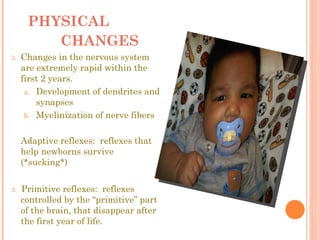
PHYSICAL  CHANGES Changes in the nervous system are extremely rapid within the first 2 years.  Development of dendrites and synapses Myelinization of nerve fibers Adaptive reflexes:  reflexes that help newborns survive (*sucking*) 3.   Primitive reflexes:  reflexes controlled by the “primitive” part of the brain, that disappear after the first year of life.
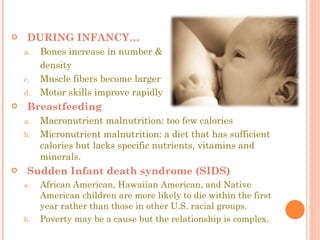
DURING INFANCY… Bones increase in number & density Muscle fibers become larger Motor skills improve rapidly Breastfeeding Macronutrient malnutrition: too few calories Micronutrient malnutrition: a diet that has sufficient calories but lacks specific nutrients, vitamins and minerals.  Sudden Infant death syndrome (SIDS)  African American, Hawaiian American, and Native American children are more likely to die within the first year rather than those in other U.S. racial groups. Poverty may be a cause but the relationship is complex.
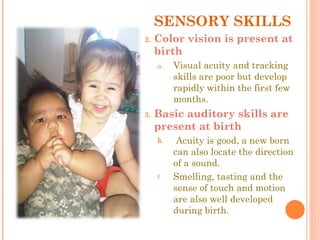
SENSORY SKILLS Color vision is present at birth Visual acuity and tracking skills are poor but develop rapidly within the first few months. Basic auditory skills are present at birth Acuity is good, a new born can also locate the direction of a sound. Smelling, tasting and the sense of touch and motion are also well developed during birth.
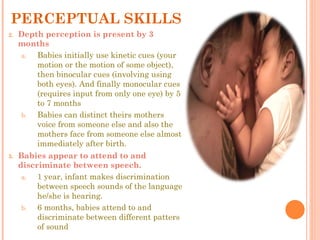
PERCEPTUAL SKILLS Depth perception is present by 3 months Babies initially use kinetic cues (your motion or the motion of some object), then binocular cues (involving using both eyes). And finally monocular cues (requires input from only one eye) by 5 to 7 months Babies can distinct theirs mothers voice from someone else and also the mothers face from someone else almost immediately after birth. Babies appear to attend to and discriminate between speech. 1 year, infant makes discrimination between speech sounds of the language he/she is hearing. 6 months, babies attend to and discriminate between different patters of sound
COGNITIVE DEVELOPMENT IN INFANCY Piaget’s Sensorimotor Substages 1.  (0-1)  Reflexes 2.  (1-4)  Primary circular  reactions 3.  (4-8)  Secondary circular  reactions 4.  (8-12)  Coordination of  secondary schemes 5.  (12-18)  Tertiary circular  reactions 6.  (18-24)  Beginning of mental  representation
LEARNING, CATEGORIZING, & REMEMBERING Babies learn through… classical conditioning operant conditioning observing models - Infants use categories to organize information. ↑  after the first 2 yrs. - 3-4 month old infants show signs of remembering over periods of a few days to a week.
THE BEGINNING OF LANGUAGE Theories of language development… behaviorists:  learn through parental reinforcement nativists:   innate language processor helps them learn language rules constructavists:   language development is a process of cognitive development *both cognitive and internal variables affect language development
BABIES… Start of by crying 2 months  - cooing 6 months  - babbling 9 months  - use meaningful gestures and understanding of small vocabulary  The rate of language development varies from one child to another.
MEASURING INTELLIGENCE IN INFANCY It is difficult to measure intelligence in infants. - Bayley Scales of  Infant Development   - necessary to help  health care  professionals  identify infants who  require special  interventions .
Psychoanalytic and Ethological Perspectives Freud suggested that individual differences in personality originated in the nursing and weaning practices of infants’ mothers. Erikson emphasized the roles of both mother and father as well as other people in the infants environment, a sense of trust. The ethological approach to social and personality development proposes that infants form emotional bonds with their caregiver.
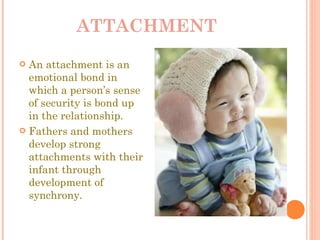
ATTACHMENT An attachment is an emotional bond in which a person’s sense of security is bond up in the relationship.  Fathers and mothers develop strong attachments with their infant through development of synchrony.
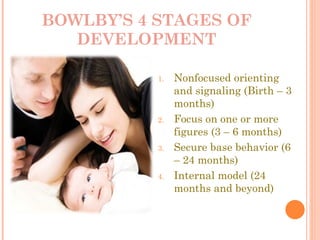
BOWLBY’S 4 STAGES OF DEVELOPMENT Nonfocused orienting and signaling (Birth – 3 months)  Focus on one or more figures (3 – 6 months)  Secure base behavior (6 – 24 months)  Internal model (24 months and beyond)
Secure and Insecure Attachment in Ainsworth’s Strange Situation Secure attachment  Insecure/avoidant attachment  Insecure/ambivalent attachment Insecure/ disorganized attachment
PERSONALITY, TEMPERAMENT, & SELF-CONCEPT Dimension  of Temperament - activity level  - negative emotionality - approach/positive emotionality  - effortful control/ task persistence  - inhibition  Origins and Stability of Temperament Heredity Long-Term Stability Neurological  processes Environment Self-Concept Subjective Self Objective Self Emotional Self
EFFECTS OF NON-PARENTAL CARE Difficulties in Studying Non-parental Care Effects on Cognitive Development Effects on Social Development Interpreting Research on Non-parental Care

Infancy

  • 1.
    INFANCY By: ShawnteCruz Michelle Indemne Darlene Sanchez Coleman Meyar
  • 2.
    PHYSICAL, SENSORY ANDPERCEPTUAL DEVELOPMENT IN INFANCY Physical Changes The Brain & Nervous System Reflexes & Behavioral System Growth Motor Skills & Developing Body Systems Health & Wellness Infant Mortality Sensory Skills Vision Hearing, Smelling, Tasting, & Touch/Motion Perceptual Skills Studying Perceptual Development Looking Listening
  • 3.
    PHYSICAL CHANGESChanges in the nervous system are extremely rapid within the first 2 years. Development of dendrites and synapses Myelinization of nerve fibers Adaptive reflexes: reflexes that help newborns survive (*sucking*) 3. Primitive reflexes: reflexes controlled by the “primitive” part of the brain, that disappear after the first year of life.
  • 4.
    DURING INFANCY… Bonesincrease in number & density Muscle fibers become larger Motor skills improve rapidly Breastfeeding Macronutrient malnutrition: too few calories Micronutrient malnutrition: a diet that has sufficient calories but lacks specific nutrients, vitamins and minerals. Sudden Infant death syndrome (SIDS) African American, Hawaiian American, and Native American children are more likely to die within the first year rather than those in other U.S. racial groups. Poverty may be a cause but the relationship is complex.
  • 5.
    SENSORY SKILLS Colorvision is present at birth Visual acuity and tracking skills are poor but develop rapidly within the first few months. Basic auditory skills are present at birth Acuity is good, a new born can also locate the direction of a sound. Smelling, tasting and the sense of touch and motion are also well developed during birth.
  • 6.
    PERCEPTUAL SKILLS Depthperception is present by 3 months Babies initially use kinetic cues (your motion or the motion of some object), then binocular cues (involving using both eyes). And finally monocular cues (requires input from only one eye) by 5 to 7 months Babies can distinct theirs mothers voice from someone else and also the mothers face from someone else almost immediately after birth. Babies appear to attend to and discriminate between speech. 1 year, infant makes discrimination between speech sounds of the language he/she is hearing. 6 months, babies attend to and discriminate between different patters of sound
  • 7.
    COGNITIVE DEVELOPMENT ININFANCY Piaget’s Sensorimotor Substages 1. (0-1) Reflexes 2. (1-4) Primary circular reactions 3. (4-8) Secondary circular reactions 4. (8-12) Coordination of secondary schemes 5. (12-18) Tertiary circular reactions 6. (18-24) Beginning of mental representation
  • 8.
    LEARNING, CATEGORIZING, &REMEMBERING Babies learn through… classical conditioning operant conditioning observing models - Infants use categories to organize information. ↑ after the first 2 yrs. - 3-4 month old infants show signs of remembering over periods of a few days to a week.
  • 9.
    THE BEGINNING OFLANGUAGE Theories of language development… behaviorists: learn through parental reinforcement nativists: innate language processor helps them learn language rules constructavists: language development is a process of cognitive development *both cognitive and internal variables affect language development
  • 10.
    BABIES… Start ofby crying 2 months - cooing 6 months - babbling 9 months - use meaningful gestures and understanding of small vocabulary The rate of language development varies from one child to another.
  • 11.
    MEASURING INTELLIGENCE ININFANCY It is difficult to measure intelligence in infants. - Bayley Scales of Infant Development - necessary to help health care professionals identify infants who require special interventions .
  • 12.
    Psychoanalytic and EthologicalPerspectives Freud suggested that individual differences in personality originated in the nursing and weaning practices of infants’ mothers. Erikson emphasized the roles of both mother and father as well as other people in the infants environment, a sense of trust. The ethological approach to social and personality development proposes that infants form emotional bonds with their caregiver.
  • 13.
    ATTACHMENT An attachmentis an emotional bond in which a person’s sense of security is bond up in the relationship. Fathers and mothers develop strong attachments with their infant through development of synchrony.
  • 14.
    BOWLBY’S 4 STAGESOF DEVELOPMENT Nonfocused orienting and signaling (Birth – 3 months) Focus on one or more figures (3 – 6 months) Secure base behavior (6 – 24 months) Internal model (24 months and beyond)
  • 15.
    Secure and InsecureAttachment in Ainsworth’s Strange Situation Secure attachment Insecure/avoidant attachment Insecure/ambivalent attachment Insecure/ disorganized attachment
  • 16.
    PERSONALITY, TEMPERAMENT, &SELF-CONCEPT Dimension of Temperament - activity level - negative emotionality - approach/positive emotionality - effortful control/ task persistence - inhibition Origins and Stability of Temperament Heredity Long-Term Stability Neurological processes Environment Self-Concept Subjective Self Objective Self Emotional Self
  • 17.
    EFFECTS OF NON-PARENTALCARE Difficulties in Studying Non-parental Care Effects on Cognitive Development Effects on Social Development Interpreting Research on Non-parental Care