Managing Stress
MAEP
WHAT IS STRESS?
Are normal physical
responses to events that
make you feel threatened
or upset your balance in
some way.
WHAT IS STRESS?

It affects the mind, body, and
behavior in many ways, and
everyone experiences stress
differently.
WHAT IS STRESS?
When you sense danger –
whether it’s real or imagined –
the body's defenses kick into
high gear in a rapid, automatic
process known as the “fightor-flight” reaction, or the
stress response.
WHAT IS A STRESS RESPONSE?

Is the body’s way of
protecting you.
WHAT IS A STRESS RESPONSE?

When working properly - it
helps you stay focused,
energetic, and alert.
WHAT IS A STRESS RESPONSE?

In emergency situations,
stress can save your life –
giving you extra strength to
defend yourself.
WHAT IS A STRESS RESPONSE?

Also helps you rise to meet
challenges.
WHAT IS A STRESS RESPONSE?

Drives you to study for an
exam when you'd rather be
watching TV.
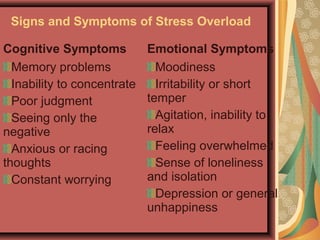
Signs and Symptoms of Stress Overload
Cognitive Symptoms
Memory problems
Inability to concentrate
Poor judgment
Seeing only the
negative
Anxious or racing
thoughts
Constant worrying

Emotional Symptoms
Moodiness
Irritability or short
temper
Agitation, inability to
relax
Feeling overwhelmed
Sense of loneliness
and isolation
Depression or general
unhappiness
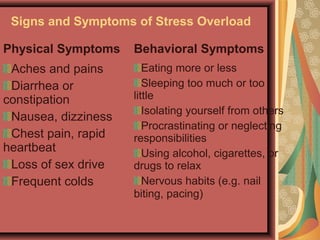
Signs and Symptoms of Stress Overload
Physical Symptoms

Behavioral Symptoms

Aches and pains
Diarrhea or
constipation
Nausea, dizziness
Chest pain, rapid
heartbeat
Loss of sex drive
Frequent colds

Eating more or less
Sleeping too much or too
little
Isolating yourself from others
Procrastinating or neglecting
responsibilities
Using alcohol, cigarettes, or
drugs to relax
Nervous habits (e.g. nail
biting, pacing)
HOW MUCH STRESS IS TOO MUCH?

know your own limit - the
widespread damage stress
can cause you
HOW MUCH STRESS IS TOO MUCH?

“Too much” stress- differs from
person to person
HOW MUCH STRESS IS TOO MUCH?

Some people roll with the
punches, while others
crumble at the slightest
obstacle or frustration.
HOW MUCH STRESS IS TOO MUCH?

Some seem to thrive on the
excitement and challenge of a
high-stress lifestyle.
HOW MUCH STRESS IS TOO MUCH?

The ability to tolerate stress
depends on many factors - the
quality of your relationships,
your general outlook on life,
your emotional intelligence, and
genetics.
Things That Influence Your Stress
Tolerance Level

Your support network
A strong network of
supportive friends and family
members – buffer against life
stressor
Lonely and isolated – the
greater your vulnerability to
stress.
Things That Influence Your Stress
Tolerance Level

Your sense of control
Confidence in yourself, ability to
influence events, perseverance
through challenges –easier to
take stress in stride.
Things That Influence Your Stress
Tolerance Level

Your attitude and outlook
Optimistic attitude, embrace
challenges
Strong sense of humor,
Accept that change is a part of
life, and
Believe in a higher power or
purpose.
Things That Influence Your Stress
Tolerance Level

Your ability to deal with your
emotions
Calm and soothe yourself when
you’re feeling sad, angry, or
afraid – otherwise you’re
extremely vulnerable to stress
The ability to bring your
emotions into balance helps
you bounce back from
adversity.
Things That Influence Your Stress
Tolerance Level

Your knowledge and
preparation
The more you know about a
stressful situation, including
how long it will last and what to
expect, the easier it is to cope.
Causes of Stress
Situations and pressures that
cause stress a.k.a stressors
Causes of Stress
Perceived negative Stressors exhausting work / school
schedule, a rocky relationship,
high demands, or anything that
forces you to adjust.
Causes of Stress
Positive events - getting married,
buying a house, going to college,
or receiving a promotion.
Causes of Stress

Your perception on stressors –
something may be stressful to
you but may not to others; they
may even enjoy it.
Common external causes of stress

Major life
changes
Work
Relationship
difficulties

Financial
problems
Being too busy
Children and
family
Common internal causes of stress

Inability to
accept
uncertainty
Pessimism
Negative SelfTalk

Unrealistic
Expectations
Perfectionism
Lack of
Assertiveness
Effects of chronic stress
The body doesn’t distinguish
between physical and
psychological threats.
Effects of chronic stress

When you’re stressed over a
busy schedule, an argument with
a friend, a traffic jam, your body
reacts just as strongly as if you
were facing a life-or-death
situation.
Effects of chronic stress

If you have a lot of
responsibilities and worries, your
emergency stress response may
be “on” most of the time.
Effects of chronic stress
The more your body’s stress
system is activated, the easier it
is to trip and the harder it is to
shut off.
Effects of chronic stress
Long-term exposure to stress can
lead to serious health problems.
Effects of chronic stress

Chronic stress disrupts nearly
every system in your body.
Effects of chronic stress
It can raise blood pressure,
suppress the immune system,
increase the risk of heart attack
and stroke, contribute to infertility,
and speed up the aging process.
Effects of chronic stress
Long-term stress can even rewire
the brain, leaving you more
vulnerable to anxiety and
depression.
Many health problems are caused or
exacerbated by stress, including:

Pain of any
Depression
kind
Obesity
Heart disease Autoimmune
Digestive
diseases
problems
Skin
Sleep
conditions such
problems
eczema
HOW TO DEAL STRESS & ITS SYMPTOMS?

While unchecked stress is
undeniably damaging, there
are many things you can do to
reduce its impact and cope
with symptoms.
HOW TO DEAL STRESS & ITS SYMPTOMS?

1. Learn how to manage
stress
You may feel like the stress
in your life is out of your
control, but you can always
control the way you
respond.
HOW TO DEAL STRESS & ITS SYMPTOMS?

1. Learn how to manage stress
Managing stress is all about
taking charge:
your thoughts, your
emotions, your schedule
your environment, & the way
you deal with problems
HOW TO DEAL STRESS & ITS SYMPTOMS?

1. Learn how to manage stress
Stress management involves;
changing the stressful situation
when you can,
changing your reaction when you
can’t,
taking care of yourself, and
making time for rest and
relaxation.
HOW TO DEAL STRESS & ITS
SYMPTOMS?

2. Learn how to relax
You can’t completely eliminate
stress from your life, but you can
control how much it affects you.
HOW TO DEAL STRESS & ITS
SYMPTOMS?
2. Learn how to relax
Relaxation techniques such as:
Yoga, meditation, and deep breathing
activate the body’s relaxation response,
a state of restfulness
When practiced regularly, these
activities lead to a reduction in your
everyday stress levels and a boost in
your feelings of joy and serenity.
They also increase your ability to stay
calm and collected under pressure.
HOW TO DEAL STRESS & ITS
SYMPTOMS?

3. Learn quick stress relief
Reduce the impact of stress as
it’s happening in that moment.
HOW TO DEAL STRESS & ITS
SYMPTOMS?

3. Learn quick stress relief
Learn to spot stressors and stay
in control when the pressure
builds.
HOW TO DEAL STRESS & ITS
SYMPTOMS?

3. Learn quick stress relief
Sensory stress-busting
techniques give you a powerful
tool for staying clear-headed and
in control in the middle of
stressful situations.
HOW TO DEAL STRESS & ITS
SYMPTOMS?

3. Learn quick stress relief
They give you the confidence to
face challenges, knowing that you
have the ability to rapidly bring
yourself back into balance.
Reference
http://www.helpguide.org/mental/str
ess_signs.htm

Managing stress

  • 1.
  • 2.
    WHAT IS STRESS? Arenormal physical responses to events that make you feel threatened or upset your balance in some way.
  • 3.
    WHAT IS STRESS? Itaffects the mind, body, and behavior in many ways, and everyone experiences stress differently.
  • 4.
    WHAT IS STRESS? Whenyou sense danger – whether it’s real or imagined – the body's defenses kick into high gear in a rapid, automatic process known as the “fightor-flight” reaction, or the stress response.
  • 5.
    WHAT IS ASTRESS RESPONSE? Is the body’s way of protecting you.
  • 6.
    WHAT IS ASTRESS RESPONSE? When working properly - it helps you stay focused, energetic, and alert.
  • 7.
    WHAT IS ASTRESS RESPONSE? In emergency situations, stress can save your life – giving you extra strength to defend yourself.
  • 8.
    WHAT IS ASTRESS RESPONSE? Also helps you rise to meet challenges.
  • 9.
    WHAT IS ASTRESS RESPONSE? Drives you to study for an exam when you'd rather be watching TV.
  • 10.
    Signs and Symptomsof Stress Overload Cognitive Symptoms Memory problems Inability to concentrate Poor judgment Seeing only the negative Anxious or racing thoughts Constant worrying Emotional Symptoms Moodiness Irritability or short temper Agitation, inability to relax Feeling overwhelmed Sense of loneliness and isolation Depression or general unhappiness
  • 11.
    Signs and Symptomsof Stress Overload Physical Symptoms Behavioral Symptoms Aches and pains Diarrhea or constipation Nausea, dizziness Chest pain, rapid heartbeat Loss of sex drive Frequent colds Eating more or less Sleeping too much or too little Isolating yourself from others Procrastinating or neglecting responsibilities Using alcohol, cigarettes, or drugs to relax Nervous habits (e.g. nail biting, pacing)
  • 12.
    HOW MUCH STRESSIS TOO MUCH? know your own limit - the widespread damage stress can cause you
  • 13.
    HOW MUCH STRESSIS TOO MUCH? “Too much” stress- differs from person to person
  • 14.
    HOW MUCH STRESSIS TOO MUCH? Some people roll with the punches, while others crumble at the slightest obstacle or frustration.
  • 15.
    HOW MUCH STRESSIS TOO MUCH? Some seem to thrive on the excitement and challenge of a high-stress lifestyle.
  • 16.
    HOW MUCH STRESSIS TOO MUCH? The ability to tolerate stress depends on many factors - the quality of your relationships, your general outlook on life, your emotional intelligence, and genetics.
  • 17.
    Things That InfluenceYour Stress Tolerance Level Your support network A strong network of supportive friends and family members – buffer against life stressor Lonely and isolated – the greater your vulnerability to stress.
  • 18.
    Things That InfluenceYour Stress Tolerance Level Your sense of control Confidence in yourself, ability to influence events, perseverance through challenges –easier to take stress in stride.
  • 19.
    Things That InfluenceYour Stress Tolerance Level Your attitude and outlook Optimistic attitude, embrace challenges Strong sense of humor, Accept that change is a part of life, and Believe in a higher power or purpose.
  • 20.
    Things That InfluenceYour Stress Tolerance Level Your ability to deal with your emotions Calm and soothe yourself when you’re feeling sad, angry, or afraid – otherwise you’re extremely vulnerable to stress The ability to bring your emotions into balance helps you bounce back from adversity.
  • 21.
    Things That InfluenceYour Stress Tolerance Level Your knowledge and preparation The more you know about a stressful situation, including how long it will last and what to expect, the easier it is to cope.
  • 22.
    Causes of Stress Situationsand pressures that cause stress a.k.a stressors
  • 23.
    Causes of Stress Perceivednegative Stressors exhausting work / school schedule, a rocky relationship, high demands, or anything that forces you to adjust.
  • 24.
    Causes of Stress Positiveevents - getting married, buying a house, going to college, or receiving a promotion.
  • 25.
    Causes of Stress Yourperception on stressors – something may be stressful to you but may not to others; they may even enjoy it.
  • 26.
    Common external causesof stress Major life changes Work Relationship difficulties Financial problems Being too busy Children and family
  • 27.
    Common internal causesof stress Inability to accept uncertainty Pessimism Negative SelfTalk Unrealistic Expectations Perfectionism Lack of Assertiveness
  • 28.
    Effects of chronicstress The body doesn’t distinguish between physical and psychological threats.
  • 29.
    Effects of chronicstress When you’re stressed over a busy schedule, an argument with a friend, a traffic jam, your body reacts just as strongly as if you were facing a life-or-death situation.
  • 30.
    Effects of chronicstress If you have a lot of responsibilities and worries, your emergency stress response may be “on” most of the time.
  • 31.
    Effects of chronicstress The more your body’s stress system is activated, the easier it is to trip and the harder it is to shut off.
  • 32.
    Effects of chronicstress Long-term exposure to stress can lead to serious health problems.
  • 33.
    Effects of chronicstress Chronic stress disrupts nearly every system in your body.
  • 34.
    Effects of chronicstress It can raise blood pressure, suppress the immune system, increase the risk of heart attack and stroke, contribute to infertility, and speed up the aging process.
  • 35.
    Effects of chronicstress Long-term stress can even rewire the brain, leaving you more vulnerable to anxiety and depression.
  • 36.
    Many health problemsare caused or exacerbated by stress, including: Pain of any Depression kind Obesity Heart disease Autoimmune Digestive diseases problems Skin Sleep conditions such problems eczema
  • 37.
    HOW TO DEALSTRESS & ITS SYMPTOMS? While unchecked stress is undeniably damaging, there are many things you can do to reduce its impact and cope with symptoms.
  • 38.
    HOW TO DEALSTRESS & ITS SYMPTOMS? 1. Learn how to manage stress You may feel like the stress in your life is out of your control, but you can always control the way you respond.
  • 39.
    HOW TO DEALSTRESS & ITS SYMPTOMS? 1. Learn how to manage stress Managing stress is all about taking charge: your thoughts, your emotions, your schedule your environment, & the way you deal with problems
  • 40.
    HOW TO DEALSTRESS & ITS SYMPTOMS? 1. Learn how to manage stress Stress management involves; changing the stressful situation when you can, changing your reaction when you can’t, taking care of yourself, and making time for rest and relaxation.
  • 41.
    HOW TO DEALSTRESS & ITS SYMPTOMS? 2. Learn how to relax You can’t completely eliminate stress from your life, but you can control how much it affects you.
  • 42.
    HOW TO DEALSTRESS & ITS SYMPTOMS? 2. Learn how to relax Relaxation techniques such as: Yoga, meditation, and deep breathing activate the body’s relaxation response, a state of restfulness When practiced regularly, these activities lead to a reduction in your everyday stress levels and a boost in your feelings of joy and serenity. They also increase your ability to stay calm and collected under pressure.
  • 43.
    HOW TO DEALSTRESS & ITS SYMPTOMS? 3. Learn quick stress relief Reduce the impact of stress as it’s happening in that moment.
  • 44.
    HOW TO DEALSTRESS & ITS SYMPTOMS? 3. Learn quick stress relief Learn to spot stressors and stay in control when the pressure builds.
  • 45.
    HOW TO DEALSTRESS & ITS SYMPTOMS? 3. Learn quick stress relief Sensory stress-busting techniques give you a powerful tool for staying clear-headed and in control in the middle of stressful situations.
  • 46.
    HOW TO DEALSTRESS & ITS SYMPTOMS? 3. Learn quick stress relief They give you the confidence to face challenges, knowing that you have the ability to rapidly bring yourself back into balance.
  • 47.