THE INFANT
AND FAMILY
BSN 2C
Group 9
NORMAL INFANT
It is the period which starts at the end of the
first month up to the end of the first year of
age. Infant's growth and development during
this period are rapid.
GROWTH
It is the process of physical maturation
resulting an increase in size of the body and
various organs.It occurs by multiplication of
cells and an increase in intracellular
substance. It is quantitative changes of the
body.
DEVELOPMENT
It is the process of fuctional and physiological
maturation of the individual. It is progressive
increase in skill and capacity to function. It is
related to maturation and myelination of the
nervous system. It includes psychological,emotional
and social changes. It is qualitative aspects.
GROWTH AND DEVELOPMENT OF
INFANT (0-1 YEAR)
PHYSICAL GROWTH:
Weight:
Average weight of newborn is 2.5kgs which decreases by 10% in first 10 days of life and then
increases at the rate of 500 to 600 gms per month for first 6 months.
Length:
At birth the length of newborn is 45-50 cm. It increases approximately 2-2.5 cm per month
during first 6 months.
Head circumference:
At birth it is approximately 33-35cm and increases at the rate of 1.5 cm per month during the
first 6 months.
Chest circumference:
About 31-33 cm.
Pulse rate:
130 ± 20/min
PHYSICAL GROWTH AND
DEVELOPMENT
2 MONTHS
Posterior fontanel closes at 3-6 weeks age.
Tears starts appearing.
Drooling begins.
3 MONTHS
Flexion posture is reduced.
Grasping, crossed extensor and moro's reflex
disappears.
Landavu reflex appears.
PHYSICAL GROWTH AND
DEVELOPMENT
4 MONTHS
Drooling indicates appearance of saliva.
Tonic neck reflex and rooting reflex disappears.
5 MONTHS
Weight is almost double of birth weight.
6 MONTHS
Weight gain 300-400 gms/month during next 6
months.
PHYSICAL GROWTH AND
DEVELOPMENT
7 MONTHS
8 MONTHS
Eruption of upper central incisors.
Mashes food with jaws.
9 MONTHS
Eruption of upper lateral incisors.
10 MONTHS
Drooling stops.
PHYSICAL GROWTH AND
DEVELOPMENT
11 MONTHS
Sleeps 14-16hrs/day and still snaps.
12 MONTHS
Weight becomes tripe of birth weight.
The progression of mascular coordination required
for physical activities.
Cephalocaudal Trend
Head- to - toe direction of motor development
Proximodistal Trend
Center to outward direction of motor development
MOTOR DEVELOPMENT
DEVELOPMENTAL MILESTONES OF INFANT
FINE MOTOR DEVELOPMENT GROSS MOTOR DEVELOPMENT
the coordination of small
muscles in the hands, fingers,
and wrists to perform precise
movements. It involves the
brain, nervous system, and
small muscles working
together to control
movements in the hands,
fingers, lips, tongue, and eyes
the process by which children
use their large muscles to
develop skills like walking,
running, and throwing. These
skills are important for
everyday activities and help
children develop balance,
strength, and body awareness.
GROSS MOTOR DEVELOPMENT
1 MONTH 2 MONTHS 3 MONTHS
4 MONTHS 5 MONTHS 6 MONTHS
Assumes flexed
posture
Can turn head from
side to side and lift
head from bed.
Holds head in midline
lift chest off table
Head control
Support on forearms
in prone
holds head up to
steady
Rolls front to back
Support on wrists
Shift weight
Head control
Rolling over the back
from abdomen
Rolling over from
back to abdomen
GROSS MOTOR DEVELOPMENT
7 MONTHS 8 MONTHS 9 MONTHS
12 MONTHS
11 MONTHS
10 MONTHS
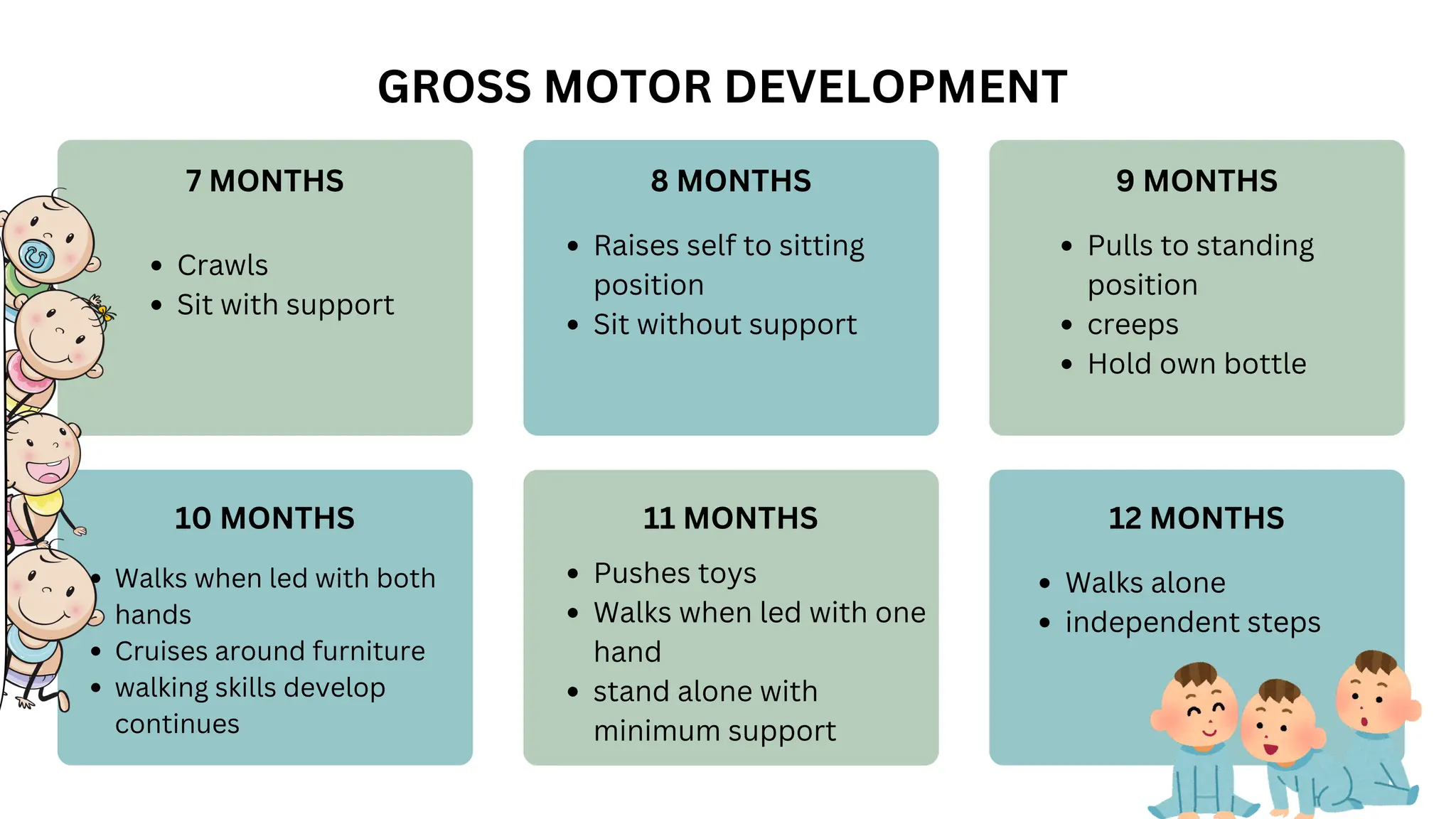
Crawls
Sit with support
Raises self to sitting
position
Sit without support
Pulls to standing
position
creeps
Hold own bottle
Walks when led with both
hands
Cruises around furniture
walking skills develop
continues
Pushes toys
Walks when led with one
hand
stand alone with
minimum support
Walks alone
independent steps
FINE MOTOR DEVELOPMENT
1 MONTH 2 MONTHS 3 MONTHS
4 MONTHS 5 MONTHS 6 MONTHS
hands are in fists
most of the time.
Hands may ba open
hols rattle when
placed in hand
Can grasp toy but
lack of firm hold
carries of object and
hand to mouth at
well
Brings hadn together
in midline
olays with finger
Reaches fo objective
Attempt to catch tangling
objet with 2 hands
Tried to obtain object
beyong reach.
Bangs object that held
drops one object when
offered another
can grasp at well
FINE MOTOR DEVELOPMENT
7 MONTHS 8 MONTHS 9 MONTHS
12 MONTHS
11 MONTHS
10 MONTHS
Holds two toys
together.
transfer toy from 1
hand to another
hold two object while
looking at the three.
Crude pincer grasp
feed self with finger
and food
Release object from
hand voluntarily
fine grasp of tiny object
Bring hands together
and plays
ring bells
hild bottle and place
nipple in the mouth
Heat pincer grasp
explore object carefully
beginning to hold pens
and marks on paper.
Can remove covers
from boxes
Good spincer grasp
attempt
to build tower of two but
fails
enjoy eating with fingers
can drink himself with cup
LANGUAGE,
LANGUAGE,
PSYCHOSOCIAL
PSYCHOSOCIAL
DEVELOPMENT
DEVELOPMENT
LANGUAGE DEVELOPMENT IN INFANCY
•Babies vocalise from birth - during the first year, babies
sounds go through a particular sequence:
• Crying: babies cry from birth. Crying is initially is used by
babies only to signal distress (hungry, wind, dirty nappy, tired),
later though crying is used for a variety of reasons e.g. pick me
up I am bored sitting here
Cooing: babies first begin cooing between 1 and 2 months.
Cooing is a gurgling sound made at the back of the throat and
usually signals pleasure
Babbling: from about 6 months babies begin stringing together
speech like sounds made up of a consonant and vowel - ba ba
ba, da da da
According to Erikson it Refers to the
emotional and psychological changes
across the life cycle that occurs in the
context of the individual's social
environment.
Erikson described the time that an
individual experiences a psychological
challenge as a crisis
PSYCHOSOCIAL DEVELOPMENT
• Children are completely dependent on
others
Trust: Established when babies given
adequate warmth, touching, love, and
physical care -
Mistrust: Caused by inadequate or
unpredictable care and by cold,
indifferent, and rejecting parents
STAGE 1: TRUST VERSUS & MISTRUST
STAGE TWO: AUTONOMY
STAGE TWO: AUTONOMY
VERSUS SHAME AND DOUBT
• Autonomy: Doing things for
themselves
• Overprotective or ridiculing parents
may cause children to doubt abilities
and feel shameful about their actions
Infancy ( 1 to 3 years)
COGNITIVE DEVELOPMENT
OF INFANTS
OF INFANTS
Cognitive Development- its talks about
how infant psychological processes
involved in thinking & knowing develop
into young children. In infancy refers to
development in the way a baby thinks.
This includes his/her language,
communication and exploration skills.
COGNITIVE CHANGES
COGNITIVE CHANGES
Object permanence: the realization that
objects still exist when hidden from sight
At two months of age, infants show surprise
when an object disappears.
At six to eight months of age, infants will look
for the missing object.
At eight to twelve months of age, infants will
reach or search for a cempletely hidden toy.
PIAGET: OBJECT PERMANENCE
PIAGET'S COGNITIVE DEVELOPMENT
SENSORIMOTOR STAGE- infants construct an understanding of the
world by coordinating sensory experiences with physical, motoric
actions
STAGE 1-Simple reflexes -Which lasts from birth until around 1
month of age, includes inborn motor and sensory reflexes, such as
sucking and palmar reflexes
STAGE 2- First habits and primary circular reactions phase -
Observes the primary circular reaction in which an infants happens
to experience an event and then attempts to repeat the action
STAGE 3-Secondary circular reactions phase -Which takes place
between 4-8 months, is a secondary circular reaction when an infants
repeats an action with a specific, desired consequence or to
achieved an unrelated consequence
PIAGET'S COGNITIVE DEVELOPMENT
STAGE 4- Coordination of reactions stage secondary circular -This
occurs between 8-12 months and comprises the use of familiar means
to obtain ends. It entails deliberate planning of steps to meet a goal or
objective
STAGE 5-Tertiary circular reactions, novelty, and curiosity -Which
takes place between 12-18 months of age, is a tertiary circular reaction
in which an infants experiments with their environments using the
properties of one object to manipulate another object
STAGE 6-Internalization of schemes (invention of new means through
mental combination) -Which occurs approximately between 18-24
months is characterized by insight, wherein the child observes other
people to manipulate the environment to reach the desired goal, then
the child applies that knowledge to obtain a particular goal
MAJOR STEPS IN INTELLECTUAL DEVELOPMENT
1-2 months:
Follows objects with eyes
Prefers faces to objects, recognizes certain voices
Cries to get needs met
.3-4 months:
Recognizes caregiver’s face, and responds to talking
Grasps and swipes at objects, practices sounds
Interested in their hands and feet
5-6 months:
Alert for long periods of time
Reaches for things and holds onto them
Studies objects and looks for things that are dropped.
Loves Peek-a-boo
Recognizes their own voice and recognizes angry voices
Process of learning to interact with
others and to express oneself to
others.
Infants are born with social instincts.
They like to be held, talked to, and
looked at.
Newborns prefer to look at and
interact with the human face.
SOCIAL DEVELOPMENT
SOCIAL DEVELOPMENT
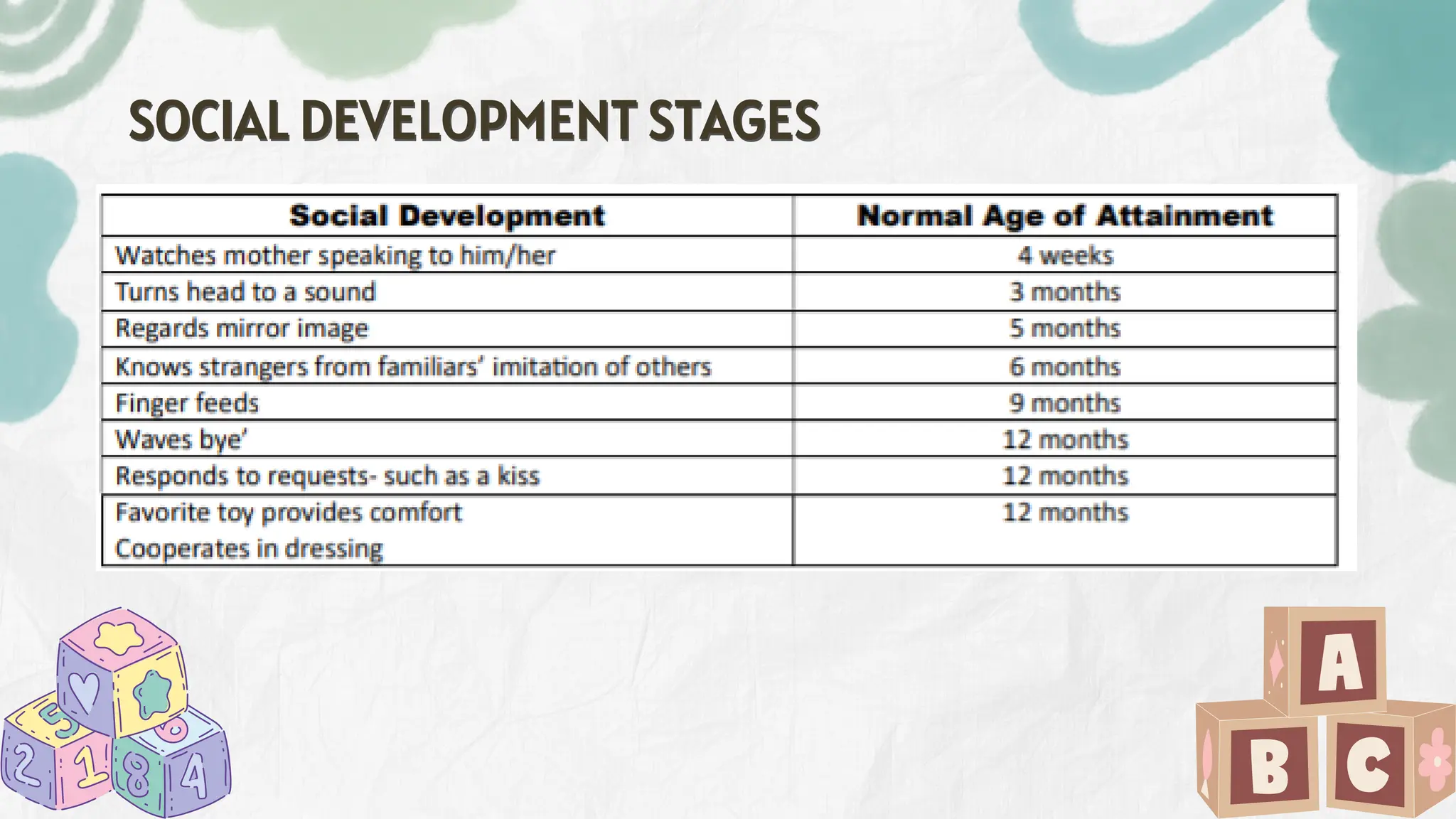
SOCIAL DEVELOPMENT STAGES
INJURY PREVENTION
INJURY PREVENTION
Natural curiosity
Investigative, Impulsive, Impatient
Less careful, hyperactive
Drive to test new master skills
Attempted activities before
developmental readiness
Self-assertion and challenges to
rules
Desire for peer aproval
CHILDREN ARE VULNERABLE TO INJURY
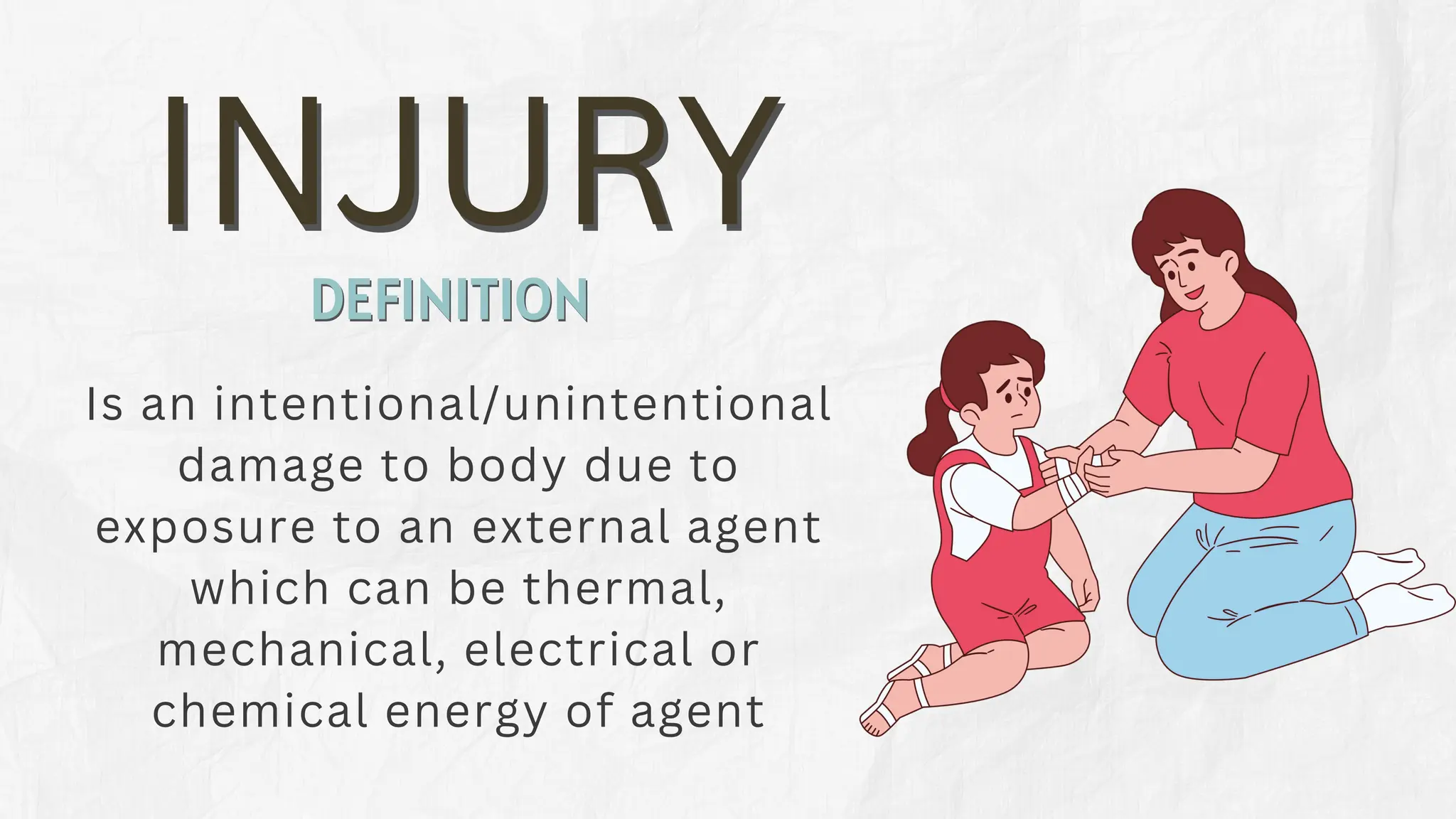
Is an intentional/unintentional
damage to body due to
exposure to an external agent
which can be thermal,
mechanical, electrical or
chemical energy of agent
INJURY
INJURY
DEFINITION
DEFINITION
COMMON ACCIDENTAL INJURY
Number 1 cause of unintentional
injury
Using age and size appropriate
child safety seats reduces serious
and fatal injuries by more than half
It is crucial that child safety seats
are used and installed properly
MOTOR VEHICLE INJURY
Leading cause of injury death in
children ages 1-4 years
2nd highest unintentional
drowning rate in the nation for
ages 1-5 years
About 75% of child drowning occur
due to lapse of adult supervision
for less than 5 minutes
COMMON ACCIDENTAL INJURY
DROWNINGS
DROWNINGS
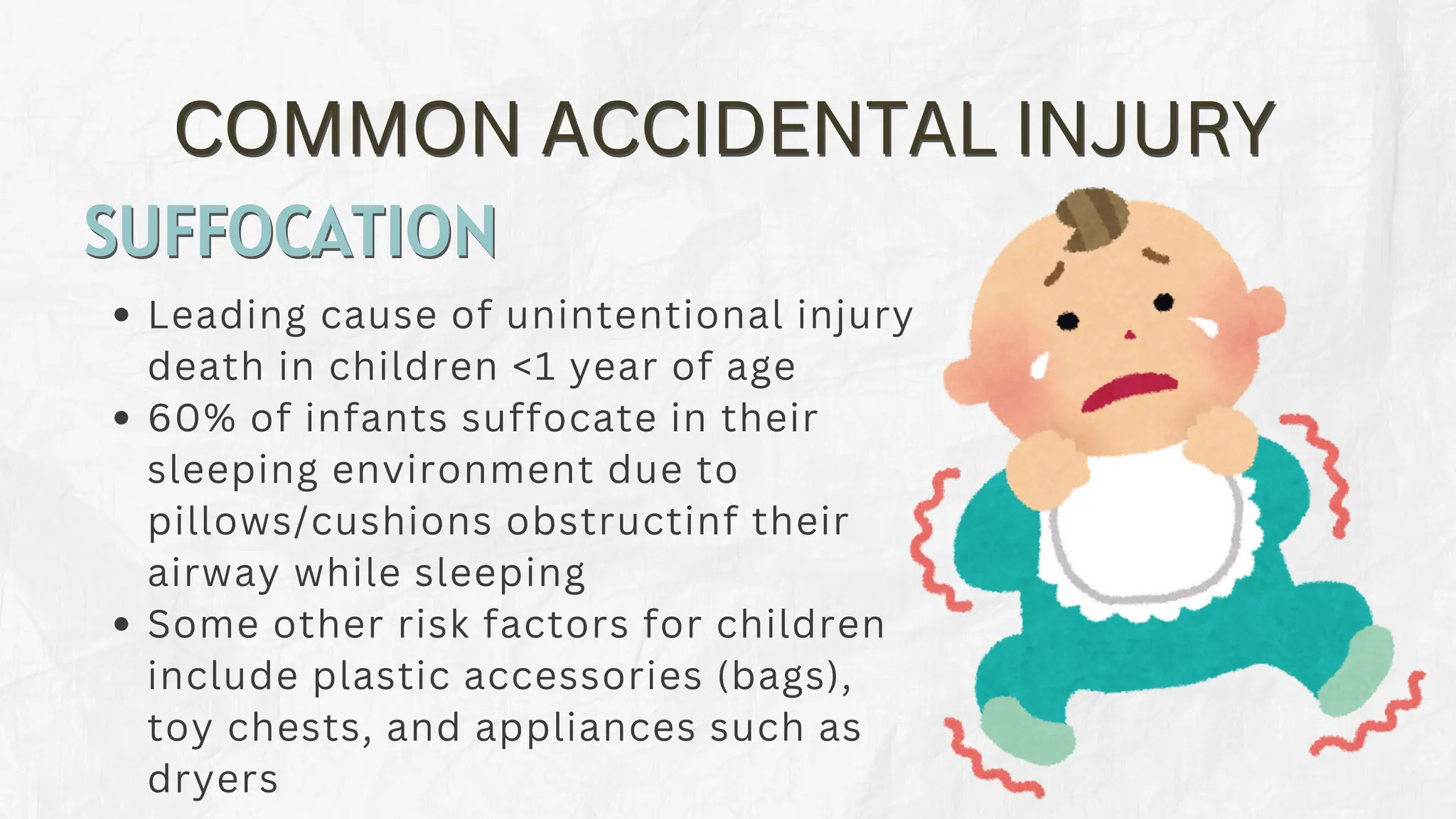
COMMON ACCIDENTAL INJURY
Leading cause of unintentional injury
death in children <1 year of age
60% of infants suffocate in their
sleeping environment due to
pillows/cushions obstructinf their
airway while sleeping
Some other risk factors for children
include plastic accessories (bags),
toy chests, and appliances such as
dryers
SUFFOCATION
SUFFOCATION
3rd leading cause of unintentional injury
deaths in 2003
Greatest occurence in children <5 yrs of
age
most of the exposures occur in the child's
own home
Leading cause: pain killers,
cream/ointment, drying agent(selica gel
pockets), personal care products,
household cleaning and automotive
product
COMMON ACCIDENTAL INJURY
POISONING
POISONING
Leading cause of non-fatal injury
More than 80% of fall-related
injuries of children <4 yrs of age
occur in the home
windows and playgrounds
equipment ate major hazards for
toddlers and older children
Stairs, furniture, and walkers are risk
factor in children <4 years of age
COMMON ACCIDENTAL INJURY
FALLS
FALLS
Approximately 528 children <14 yrs of age die
annually due to unintentional and burn related
injury
Scald burns are more common in younger
children while burns from direct contact with
fire is more prevalent among older children
Hot tap water for 1 in 4 scald burns and is
associated with more deaths and
hospitalizations than any other hot liquid burn
Fireworks are a major risk factors in older
children
COMMON ACCIDENTAL INJURY
FIRE/BURNS
FIRE/BURNS
THANK YOU!
THANK YOU!
MEMBERS:
Abragan, Andrie B.
Aliling, Jhambie A.
Ariño, Leakim S.
Asug, Dianna P.
Baldesco, Jazmin Michaela A.
Bandojo, Athena Rose P.

FINALS REPORT in MATERNAL _20241206_225313_0000.pdf

  • 1.
  • 2.
    NORMAL INFANT It isthe period which starts at the end of the first month up to the end of the first year of age. Infant's growth and development during this period are rapid.
  • 3.
    GROWTH It is theprocess of physical maturation resulting an increase in size of the body and various organs.It occurs by multiplication of cells and an increase in intracellular substance. It is quantitative changes of the body.
  • 4.
    DEVELOPMENT It is theprocess of fuctional and physiological maturation of the individual. It is progressive increase in skill and capacity to function. It is related to maturation and myelination of the nervous system. It includes psychological,emotional and social changes. It is qualitative aspects.
  • 5.
    GROWTH AND DEVELOPMENTOF INFANT (0-1 YEAR) PHYSICAL GROWTH: Weight: Average weight of newborn is 2.5kgs which decreases by 10% in first 10 days of life and then increases at the rate of 500 to 600 gms per month for first 6 months. Length: At birth the length of newborn is 45-50 cm. It increases approximately 2-2.5 cm per month during first 6 months. Head circumference: At birth it is approximately 33-35cm and increases at the rate of 1.5 cm per month during the first 6 months. Chest circumference: About 31-33 cm. Pulse rate: 130 ± 20/min
  • 6.
    PHYSICAL GROWTH AND DEVELOPMENT 2MONTHS Posterior fontanel closes at 3-6 weeks age. Tears starts appearing. Drooling begins. 3 MONTHS Flexion posture is reduced. Grasping, crossed extensor and moro's reflex disappears. Landavu reflex appears.
  • 7.
    PHYSICAL GROWTH AND DEVELOPMENT 4MONTHS Drooling indicates appearance of saliva. Tonic neck reflex and rooting reflex disappears. 5 MONTHS Weight is almost double of birth weight. 6 MONTHS Weight gain 300-400 gms/month during next 6 months.
  • 8.
    PHYSICAL GROWTH AND DEVELOPMENT 7MONTHS 8 MONTHS Eruption of upper central incisors. Mashes food with jaws. 9 MONTHS Eruption of upper lateral incisors. 10 MONTHS Drooling stops.
  • 9.
    PHYSICAL GROWTH AND DEVELOPMENT 11MONTHS Sleeps 14-16hrs/day and still snaps. 12 MONTHS Weight becomes tripe of birth weight.
  • 10.
    The progression ofmascular coordination required for physical activities. Cephalocaudal Trend Head- to - toe direction of motor development Proximodistal Trend Center to outward direction of motor development MOTOR DEVELOPMENT
  • 11.
    DEVELOPMENTAL MILESTONES OFINFANT FINE MOTOR DEVELOPMENT GROSS MOTOR DEVELOPMENT the coordination of small muscles in the hands, fingers, and wrists to perform precise movements. It involves the brain, nervous system, and small muscles working together to control movements in the hands, fingers, lips, tongue, and eyes the process by which children use their large muscles to develop skills like walking, running, and throwing. These skills are important for everyday activities and help children develop balance, strength, and body awareness.
  • 12.
    GROSS MOTOR DEVELOPMENT 1MONTH 2 MONTHS 3 MONTHS 4 MONTHS 5 MONTHS 6 MONTHS Assumes flexed posture Can turn head from side to side and lift head from bed. Holds head in midline lift chest off table Head control Support on forearms in prone holds head up to steady Rolls front to back Support on wrists Shift weight Head control Rolling over the back from abdomen Rolling over from back to abdomen
  • 13.
    GROSS MOTOR DEVELOPMENT 7MONTHS 8 MONTHS 9 MONTHS 12 MONTHS 11 MONTHS 10 MONTHS Crawls Sit with support Raises self to sitting position Sit without support Pulls to standing position creeps Hold own bottle Walks when led with both hands Cruises around furniture walking skills develop continues Pushes toys Walks when led with one hand stand alone with minimum support Walks alone independent steps
  • 14.
    FINE MOTOR DEVELOPMENT 1MONTH 2 MONTHS 3 MONTHS 4 MONTHS 5 MONTHS 6 MONTHS hands are in fists most of the time. Hands may ba open hols rattle when placed in hand Can grasp toy but lack of firm hold carries of object and hand to mouth at well Brings hadn together in midline olays with finger Reaches fo objective Attempt to catch tangling objet with 2 hands Tried to obtain object beyong reach. Bangs object that held drops one object when offered another can grasp at well
  • 15.
    FINE MOTOR DEVELOPMENT 7MONTHS 8 MONTHS 9 MONTHS 12 MONTHS 11 MONTHS 10 MONTHS Holds two toys together. transfer toy from 1 hand to another hold two object while looking at the three. Crude pincer grasp feed self with finger and food Release object from hand voluntarily fine grasp of tiny object Bring hands together and plays ring bells hild bottle and place nipple in the mouth Heat pincer grasp explore object carefully beginning to hold pens and marks on paper. Can remove covers from boxes Good spincer grasp attempt to build tower of two but fails enjoy eating with fingers can drink himself with cup
  • 16.
  • 17.
    LANGUAGE DEVELOPMENT ININFANCY LANGUAGE DEVELOPMENT IN INFANCY •Babies vocalise from birth - during the first year, babies sounds go through a particular sequence: • Crying: babies cry from birth. Crying is initially is used by babies only to signal distress (hungry, wind, dirty nappy, tired), later though crying is used for a variety of reasons e.g. pick me up I am bored sitting here Cooing: babies first begin cooing between 1 and 2 months. Cooing is a gurgling sound made at the back of the throat and usually signals pleasure Babbling: from about 6 months babies begin stringing together speech like sounds made up of a consonant and vowel - ba ba ba, da da da
  • 18.
    According to Eriksonit Refers to the emotional and psychological changes across the life cycle that occurs in the context of the individual's social environment. Erikson described the time that an individual experiences a psychological challenge as a crisis PSYCHOSOCIAL DEVELOPMENT PSYCHOSOCIAL DEVELOPMENT
  • 19.
    • Children arecompletely dependent on others Trust: Established when babies given adequate warmth, touching, love, and physical care - Mistrust: Caused by inadequate or unpredictable care and by cold, indifferent, and rejecting parents STAGE 1: TRUST VERSUS & MISTRUST STAGE 1: TRUST VERSUS & MISTRUST
  • 20.
    STAGE TWO: AUTONOMY STAGETWO: AUTONOMY VERSUS SHAME AND DOUBT VERSUS SHAME AND DOUBT • Autonomy: Doing things for themselves • Overprotective or ridiculing parents may cause children to doubt abilities and feel shameful about their actions Infancy ( 1 to 3 years)
  • 21.
    COGNITIVE DEVELOPMENT COGNITIVE DEVELOPMENT OFINFANTS OF INFANTS Cognitive Development- its talks about how infant psychological processes involved in thinking & knowing develop into young children. In infancy refers to development in the way a baby thinks. This includes his/her language, communication and exploration skills.
  • 22.
    COGNITIVE CHANGES COGNITIVE CHANGES Objectpermanence: the realization that objects still exist when hidden from sight At two months of age, infants show surprise when an object disappears. At six to eight months of age, infants will look for the missing object. At eight to twelve months of age, infants will reach or search for a cempletely hidden toy. PIAGET: OBJECT PERMANENCE PIAGET: OBJECT PERMANENCE
  • 23.
    PIAGET'S COGNITIVE DEVELOPMENT PIAGET'SCOGNITIVE DEVELOPMENT SENSORIMOTOR STAGE- infants construct an understanding of the world by coordinating sensory experiences with physical, motoric actions STAGE 1-Simple reflexes -Which lasts from birth until around 1 month of age, includes inborn motor and sensory reflexes, such as sucking and palmar reflexes STAGE 2- First habits and primary circular reactions phase - Observes the primary circular reaction in which an infants happens to experience an event and then attempts to repeat the action STAGE 3-Secondary circular reactions phase -Which takes place between 4-8 months, is a secondary circular reaction when an infants repeats an action with a specific, desired consequence or to achieved an unrelated consequence
  • 24.
    PIAGET'S COGNITIVE DEVELOPMENT PIAGET'SCOGNITIVE DEVELOPMENT STAGE 4- Coordination of reactions stage secondary circular -This occurs between 8-12 months and comprises the use of familiar means to obtain ends. It entails deliberate planning of steps to meet a goal or objective STAGE 5-Tertiary circular reactions, novelty, and curiosity -Which takes place between 12-18 months of age, is a tertiary circular reaction in which an infants experiments with their environments using the properties of one object to manipulate another object STAGE 6-Internalization of schemes (invention of new means through mental combination) -Which occurs approximately between 18-24 months is characterized by insight, wherein the child observes other people to manipulate the environment to reach the desired goal, then the child applies that knowledge to obtain a particular goal
  • 25.
    MAJOR STEPS ININTELLECTUAL DEVELOPMENT MAJOR STEPS IN INTELLECTUAL DEVELOPMENT 1-2 months: Follows objects with eyes Prefers faces to objects, recognizes certain voices Cries to get needs met .3-4 months: Recognizes caregiver’s face, and responds to talking Grasps and swipes at objects, practices sounds Interested in their hands and feet 5-6 months: Alert for long periods of time Reaches for things and holds onto them Studies objects and looks for things that are dropped. Loves Peek-a-boo Recognizes their own voice and recognizes angry voices
  • 26.
    Process of learningto interact with others and to express oneself to others. Infants are born with social instincts. They like to be held, talked to, and looked at. Newborns prefer to look at and interact with the human face. SOCIAL DEVELOPMENT SOCIAL DEVELOPMENT
  • 27.
  • 28.
    INJURY PREVENTION INJURY PREVENTION Naturalcuriosity Investigative, Impulsive, Impatient Less careful, hyperactive Drive to test new master skills Attempted activities before developmental readiness Self-assertion and challenges to rules Desire for peer aproval CHILDREN ARE VULNERABLE TO INJURY CHILDREN ARE VULNERABLE TO INJURY
  • 29.
    Is an intentional/unintentional damageto body due to exposure to an external agent which can be thermal, mechanical, electrical or chemical energy of agent INJURY INJURY DEFINITION DEFINITION
  • 30.
    COMMON ACCIDENTAL INJURY COMMONACCIDENTAL INJURY Number 1 cause of unintentional injury Using age and size appropriate child safety seats reduces serious and fatal injuries by more than half It is crucial that child safety seats are used and installed properly MOTOR VEHICLE INJURY MOTOR VEHICLE INJURY
  • 31.
    Leading cause ofinjury death in children ages 1-4 years 2nd highest unintentional drowning rate in the nation for ages 1-5 years About 75% of child drowning occur due to lapse of adult supervision for less than 5 minutes COMMON ACCIDENTAL INJURY COMMON ACCIDENTAL INJURY DROWNINGS DROWNINGS
  • 32.
    COMMON ACCIDENTAL INJURY COMMONACCIDENTAL INJURY Leading cause of unintentional injury death in children <1 year of age 60% of infants suffocate in their sleeping environment due to pillows/cushions obstructinf their airway while sleeping Some other risk factors for children include plastic accessories (bags), toy chests, and appliances such as dryers SUFFOCATION SUFFOCATION
  • 33.
    3rd leading causeof unintentional injury deaths in 2003 Greatest occurence in children <5 yrs of age most of the exposures occur in the child's own home Leading cause: pain killers, cream/ointment, drying agent(selica gel pockets), personal care products, household cleaning and automotive product COMMON ACCIDENTAL INJURY COMMON ACCIDENTAL INJURY POISONING POISONING
  • 34.
    Leading cause ofnon-fatal injury More than 80% of fall-related injuries of children <4 yrs of age occur in the home windows and playgrounds equipment ate major hazards for toddlers and older children Stairs, furniture, and walkers are risk factor in children <4 years of age COMMON ACCIDENTAL INJURY COMMON ACCIDENTAL INJURY FALLS FALLS
  • 35.
    Approximately 528 children<14 yrs of age die annually due to unintentional and burn related injury Scald burns are more common in younger children while burns from direct contact with fire is more prevalent among older children Hot tap water for 1 in 4 scald burns and is associated with more deaths and hospitalizations than any other hot liquid burn Fireworks are a major risk factors in older children COMMON ACCIDENTAL INJURY COMMON ACCIDENTAL INJURY FIRE/BURNS FIRE/BURNS
  • 36.
    THANK YOU! THANK YOU! MEMBERS: Abragan,Andrie B. Aliling, Jhambie A. Ariño, Leakim S. Asug, Dianna P. Baldesco, Jazmin Michaela A. Bandojo, Athena Rose P.